Edgar Allan PoeBiblio.com
3 934 résultats
184415<p>8o. Some minor occasional foxing. Engraved frontispiece additional title and 7 plates. Original publisher's plum cloth sides decorated in gilt and blind spine gilt-decorated edges gilt spine lightly sunned minor wear to extremities first gathering sprung. Provenance: THOMAS HOLLEY CHIVERS 1809-1858 poet and friend of Poe presentation inscription in pencil from Poe on title-page; J.H. Whitty Poe bibliographer and scholar ink provenance note laid in.</p><p><strong>F</strong><strong>IRST EDITION PRESENTATION COPY INSCRIBED BY POE TO HIS FRIEND AND FELLOW-POET </strong><strong>T</strong><strong>HOMAS</strong><strong> H</strong><strong>OLLEY</strong><strong> C</strong><strong>HIVERS</strong> on the title-page: "E.A.P. to T.H.C." Contains the first printing of Poe's sketch "Morning on the Wissahiccon" pp. 249-256 which was later renamed "The Elk" when republished after Poe's death.</p><p>Thomas Holley Chivers was an American doctor-turned-poet from Georgia. Poe showed an interest in the young poet and encouraged his work. The first interaction between the two was in 1840 though they did not meet until 1845 in New York. "Chivers's own poetry at this time dwelt on shrouds coffins angels and celestial reunion with lost loved ones his The Lost Pleiad 1845 featuring sonnets with such titles as 'Death' 'The Grave' and 'On Hearing of the Death of my Mother.'</p><p>Not surprisingly Poe praised the volume as 'the honest and fervent utterance of an exquisitely sensitive heart' and particularly admired a poem of Chivers whose refrain was 'She came from heaven to tell me she was blest.' He often recited it with tears in his eyes according to Muddy." Silverman Edgar A. Poe: Mournful and Never-Ending Remembrance 1991 p. 259.</p><p>The two became friends and Chivers was willing to give Poe lifetime financial support if he moved to the South. Poe hoped Chivers would lend his wealth as a financial backer for The Stylus and possibly even serve as a co-editor in its early planning stages. Chivers considered Poe's proposal but was not able to accept because of the death of his three-year-old daughter just over a week later. Chivers spent the last few years of his life defending the reputation of Poe who had died in 1849 though he also thought Poe had been heavily influenced by his own poetry.</p><p><strong>A VERY FINE ASSOCIATION COPY.</strong></p> John C. Riker hardcover
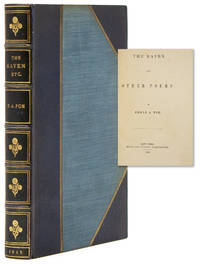
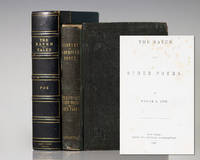
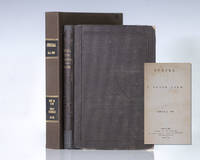
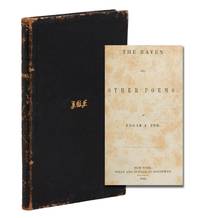
1845320399New York: Wiley and Putnam 1845. First editions of both titles. Raven with half title "Wiley and Putnam's Library of American Books" name of stereotyper T. B. Smith on the title verso; Tales third printing with three-line copyright. Raven: i-viii 1-91 92 blank 93-96 ads. Tales: i-v 1-228 229-232 ads. 1 vols. 8vo. Three quarter blue morocco gilt t.e.g. by Riviere & Son. Binder's endsheets with foxing text with slight toning and a few stray traces of foxing. First editions of both titles. Raven with half title "Wiley and Putnam's Library of American Books" name of stereotyper T. B. Smith on the title verso; Tales third printing with three-line copyright. Raven: i-viii 1-91 92 blank 93-96 ads. Tales: i-v 1-228 229-232 ads. 1 vols. 8vo. Students all over the world know of the title poem and many know others as well: "The Conqueror Worm" "Eulalie" "Leonore" "To Helen" etc. "The most important volume of poetry that had been issued up to that time in America." - Grolier American 56<br /> <br /> A choice set of the major books published during Poe's lifetime BAL's "reissue B" issued by Wiley and Putnam in April 1846 comprising the first edition sheets of The Raven and The Tales in either second or third printing here in BAL's third printing distinguishable by the three-line copyright notice. <br /> <br /> BAL notes that "impressions from the plates of several pages vary in an anomalous way. For instance the first three letters of the last three lines of p. 160 appear both battered and intact within the three printings." This copy has slight battering to "I" and "o" on p. 160 while the "v" is intact. The E in the running head on p. 187 is broken here as in most copies of all printings. BAL cautions "It is possible that the printings designated below as second and third are in fact two states of the same printing." This copy is textually complete in both books including the integral ads; the volume has been rebound without the separate gatherings of advertisements that followed the text. BAL 16146 16147; Heartman & Canny 92-94 97-108; Grolier American 56 Wiley and Putnam unknown
1845368340New York: Wiley and Putnam 1845. First editions of both titles. Raven with name of stereotyper T. B. Smith on the title verso; both half titles present: "Wiley and Putnam's Library of American Books. Tales: viii 1-228; Raven: i-viii 1-91 92 blank 93-96 ads. 1 vols. 8vo. Original blue green cloth spine titled in gilt boards stamped in blind endpapers stamped in stars and dots pattern. Recased with expert conservation repair to spine ends and corners paper repair to binder's blank. Manuscript identification of poem To - on p. 87 of the Raven. In custom clamshell box. First editions of both titles. Raven with name of stereotyper T. B. Smith on the title verso; both half titles present: "Wiley and Putnam's Library of American Books" Tales: viii 1-228; Raven: i-viii 1-91 92 blank 93-96 ads. 1 vols. 8vo. Students all over the world know of the title poem and many know others as well: "The Conqueror Worm" "Eulalie" "Leonore" "To Helen" etc. "The most important volume of poetry that had been issued up to that time in America." - Grolier American 56<br /> <br /> A choice set of the major books published during Poe's lifetime BAL's "reissue B" issued by Wiley and Putnam in April 1846 comprising the first edition sheets of The Raven and The Tales in either second or third printing here in BAL's third printing distinguishable by the three-line copyright notice. <br /> <br /> BAL notes that "impressions from the plates of several pages vary in an anomalous way. For instance the first three letters of the last three lines of p. 160 appear both battered and intact within the three printings." All three are intact here; the battered running heads on p. 187 and 224 conform with BAL.<br /> <br /> A MAJOR WORK BY POE IN ORIGINAL CLOTH. BAL 16146 16147; Heartman & Canny 92-94 97-108; Grolier American 56 Wiley and Putnam unknown
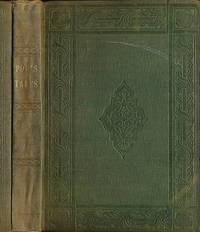
1845139816New York: Wiley and Putnam 1845. Rare first editions of Poe's two great collections of stories and poems bound together in the original publisher's cloth. Octavo original publisher's dark green cloth elaborately stamped in blind with gilt titles to the spine publisher's advertisements at rear of each volume which are most often lacking with both volumes bound together. Wiley and Putnam issued both titles separately in paper wrappers but bound the two together for additional appeal to readers. The Raven is bound first in this copy the order varies; that work is arguably the widest read and best-known in the American canon. Tales includes "The "The Black Cat" "The Fall of the House of Usher" "The Descent Into the Maelstrom" and other tales of horror and adventure as well as the three Dupin stories contained here for the first time in book form and considered "the first important book of detective stories the first and greatest the cornerstone of cornerstones.the highest of all high spots" Queen's Quorum 1. In very good condition. Tales bears the third issue of the copyright notice. Housed in a custom half morocco and folding chemise slipcase. Rare and desirable in the original publisher's cloth. The Raven and Other Poems “was published at one of the low ebbs of Poe’s fortunes when his Broadway Journal was about to expire and is thus characterized by his biographer Hervey Allen: The most important volume of poetry that had been issued up to that time in America… In this little volume the weary wayworn wanderer had successfully reached his own native shore in the realm of imagination†Grolier 100 American 56. Poe considered “The Raven†to be his finest poem—indeed he was quoted as saying it was the finest poem ever written. Dedicated to Elizabeth Barrett Barrett and first published by Wiley & Putnam in November 1845 in an edition of roughly 750 copies The Raven and Other Poems "made Poe's name known both in America and England and brought him an immortality that by no other means could he have attained" Robertson 224. Wiley and Putnam hardcover
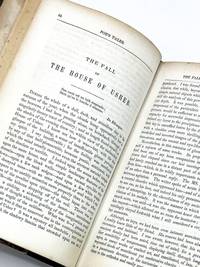
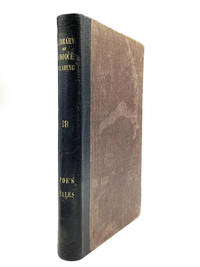
184547445New York: Wiley and Putnam 1845. First edition. Very good plus. Rare first printing of this selection of Poe's tales including "The Fall of the House of Usher" and "The Murders in the Rue Morgue." Included in these twelve tales are the pieces that are often anointed as the first modern detective stories: "The Murders in the Rue Morgue" "The Mystery of Marie Roget" and "The Purloined Letter" all featuring his famed character C. Auguste Dupin. It is item number 1 in QUEEN'S QUORUM which spares no fanfare: "the first important book of detective fiction the first and the greatest the cornerstone of cornerstones in any readers' or collectors' guide the highest of all highspots." <br /> <br /> The works were selected out of Poe's various magazine publications for printing as the second number in Wiley & Putnam's Library of American Books. Despite the author's private complaints and general grumbles Poe lamented the number of "analytic" stories in the collection as unrepresentative of his full capacities Wiley reader Evert Duyckink's astute choices contributed to the volume's relative success. These include "The Fall of the House of Usher" "The Black Cat" and "The Gold-Bug" along with a few philosophical dialogues and the lesser-known "Lionizing" - "perhaps as a concession to Poe's unfounded sense of himself as a humorist" Silverman. Immensely influential: one of the most important short story collections published in the United States. 7'' x 4.75''. Modern half brown goatskin with contemporary marbled boards sympathetically rebacked to style spine ruled and lettered in bright gilt. With half-title "Wiley and Putnam's Library of American Books / Poe's Tales"; bound without advertisements. Imprint of T.B. Smith and H. Ludwig on copyright page. 6 228 pages. Housed in custom quarter green goatskin slipcase and green cloth chemise. Ownership signatures of Charles L. Swasey to front free endpaper dated 1849 with shelfmark in same hand; and to title page. Some edgewear and rubbing to boards. Mild foxing to endpapers and some margins. Wiley and Putnam unknown
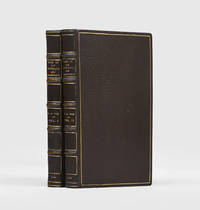
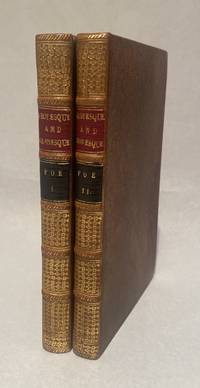
1839180683Philadelphia: Lea and Blanchard 1840 1839. The first collection of his famous tales First edition. Poe's influential first collection of tales gathers all 25 stories he had produced to date. They include two of his best-known stories "Fall of the House of Usher" and "MS. Found in a Bottle" along with the first known appearance in print of "Why the Little Frenchman Wears His Hand in a Sling". The popularity of the magazine appearance of "Fall of the House of Usher" convinced the publisher Lea and Blanchard to publish a collection on condition that Poe would retain the copyright and receive 20 copies in lieu of royalties. Poe revised the stories for book publication in a "bid for fame and while the volumes were favourably reviewed they did not sell rapidly. Yet they contained some of the greatest short stories in the literature of the world" Quinn p. 290. Though his originality divided contemporary opinion some reviewers recognised his "power for vivid description an opulence of imagination a fecundity of invention and a command over the elegances of diction which have seldom been displayed" Tasistro. Nevertheless the book proved a commercial failure which did not sell out during his lifetime and some copies sold in later years were reissued with a cancel title page. Poe's offer to the publisher in 1841 to produce an expanded second edition again forfeiting royalties was quickly declined. The publishers wrote to Poe on 28 September 1839 stating they would "print a Small Ed. say 1750 copies". However in 1880 the publisher's son Henry Charles Lea discovered that "a reference to memoranda of that time shows that the Edition consisted of but 750 copies" Quinn p. 287. BAL notes that Volume II Signature 20 occurs in several states due to the progressive loosening of type during the course of a single printing. In this copy page 213 is correctly numbered and page 219 still has the proper alignment of the "i" in "ing" line 13 up and the hyphen at the end of line 6 up. There is no priority of issue. 2 vols duodecimo in half-sheets. Publisher's 4-page adverts bound at front of vol. II. Early 20th-century brown pigskin spines lettered and framed in gilt covers ruled in gilt floral gilt roll on turn-ins patterned endpapers edges gilt. Scattered light foxing vol. I pp. 33-44 toned a couple of tears to end blanks of vol. I. A very good copy. BAL 16133; Barron 2-77; Bleiler 1313; Heartman & Canny pp. 49-54. Arthur Hobson Quinn Edgar Allan Poe: A Critical Biography 1998; Louis F. Tasistro New York Mirror 28 Dec. 1839. unknown
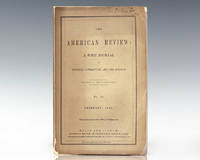
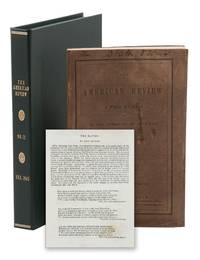
1845136274New York: Wiley and Putnam 1845. First appearance in print of The Raven one of the most famous and recognizable poems ever written which Poe considered his finest poem calling it “the greatest poem that was ever written.†Octavo original wrappers. In keeping with the policy of The American Review which required that poems be published anonymously or with a pseudonym the poem which appears on page 143 is credited to 'Quarles.' In very good condition. Rare in the original wrappers. The Raven and Other Poems “was published at one of the low ebbs of Poe’s fortunes when his Broadway Journal was about to expire and is thus characterized by his biographer Hervey Allen: The most important volume of poetry that had been issued up to that time in America… In this little volume the weary wayworn wanderer had successfully reached his own native shore in the realm of imagination†Grolier 100 American 56. Poe considered “The Raven†to be his finest poem—indeed he was quoted as saying it was the finest poem ever written. Dedicated to Elizabeth Barrett Barrett and first published in book form by Wiley & Putnam in November 1845 in an edition of roughly 750 copies The Raven and Other Poems "made Poe's name known both in America and England and brought him an immortality that by no other means could he have attained" Robertson 224. Wiley and Putnam unknown
184032820658First edition of Poe's first published collection of tales one of only 750 sets printed. Tales of the Grotesque and Arabesque contains many of Poe's finest tales including "The Fall of the House of Usher" and "MS. Found in a Bottle."<br /><br />The publication of these twenty-five tales marked the culmination of Poe's long struggle to get his prose tales into book form. In 1833-34 Poe had failed to see into print his planned Tales of the Folio Club. Most of these tales with additions were published as Tales of the Grotesque and Arabesque. The title is derived from Sir Walter Scott's 1827 essay "On the Supernatural in Fictitious Composition: "the tales of the arabesque are the product of an intense imaginative effort and the tales of the grotesque tend toward satire or burlesque." In the preface to the collection Poe defends himself from those critics who have charged him with 'Germanism' and gloom writing "If in many of my productions terror has been the thesis I maintain that terror is not of Germany but of the soul--that I have deduced this terror only from its legitimate sources and urged it only to its legitimate results."<br /><br />Poe's only remuneration for the publication of these 25 tales was twenty copies of the book. Lea & Blanchard the publisher retained the profits if any were ever realized. Although the title page is dated 1840 the book was actually published at the end of 1839.Two volumes. Beautifully bound in full mottled calf spines gilt black and red morocco labels marbled endpapers. Page 213 of vol. 2 can occur with the numbers 213 as in the present copy or 231. Current scholarship most notably BAL v. 7 1983 does not assign priority to either state. Foxing as usual. A handsome copy.<br /> Lea and Blanchard hardcover
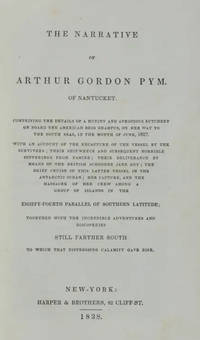
183816<p>Octavo. Original pebble grain blue muslin printed paper label affixed to spine panel.</p><p>First edition.</p><p><strong>First edition of the only completed novel by Edgar Allan Poe published in August 1838 without author's name.</strong></p><p>Poe had published under his name extracts from <em>The Adventures of Arthur Gordon Pym</em> corresponding to chapters I to IV of the novel in the American magazine <em>Southern Literary Messenger</em> in January and February 1837 but during the volume edition produced a year later the text was presented in agreement with Edgar Allan Poe as the story of an authentic voyage of exploration to the confines of the Antarctic Ocean therefore without the author's name. The Preface dated June 1838 speaks of it as the testimony of an adventurer entrusted to a gentleman from Richmond Edgar A. Poe.</p><p>The work which appeared almost simultaneously in England was panned by Anglo-American critics and later almost disowned by its author. Baudelaire himself who delivered the first French translation in 1858 initially expressed reservations about this exuberant adventure novel where implausibilities and construction defects could put off certain readers. But today <em>The Adventures of Arthur G. Pym</em> the subject of numerous and scholarly studies is recognized as a true masterpiece.</p><p><strong>Very precious copy in its original condition.</strong></p> Harper & Brothers hardcover
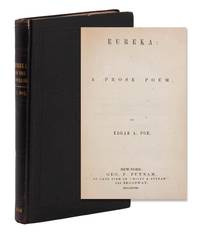
1848140948979New York: George P. Putnam 1848. First Edition. Very Good. First edition first issue of the famous American author's take on physics and cosmology that preceded the Big Bang Theory by nearly a century. 143 15 1 pp. Bound in publisher's straight-grained black cloth stamped in blind and spine lettered in gilt with Eureka having no reviews at p. 2 of advertisements. Very Good with slight lean to binding minor loss of cloth at crown and corners with crimping at foot. Light soiling and staining to cloth with faint scuffing and wear; small nick to top edge of front board. Modest foxing to peach endpapers tiny nick to rear endpaper with associated staining to rear blank. <p>A rather odd deviation from his poetical oeuvre that followed a serious illness related in part to alcoholism the death of his wife and thoughts of his own mortality Poe turned to the heavens for consolation. Adapted from a lecture and written from intuition the book presents his theory of the universe's creation and destiny proposing that all matter originated from a single point and will eventually return to it driven by forces of attraction and repulsion. An eerily prescient book that predicted several modern theories of physics. While riddled with scientific errors it includes one of the first credible solutions to Olbers' paradox anticipating Kelvin. Rare to market as it is one of only 500 copies published by Putnam due in part to its peculiar subject matter just a year before the author's puzzling death. BAL 16153. George P. Putnam unknown
184837022New York: George P. Putnam 1848. First edition first issue of Poe's classic work. Duodecimo original publishers blind stamped black cloth with gilt lettering to the spine. First issue without the review for Eureka on page 2 of the 16 page catalogue at the end of the book but reads simply: “Poe. — Eureka A Prose Poem: Or the Physical and Metaphysical Universe. By Edgar A. Poe Esq.†In very good condition with some light rubbing to the extremities contemporary inscription to the front free endpaper. Housed in a custom clamshell box. An exceptional example of this rare and important text. Poe considered Eureka his magnum opus but Putnam only agreed to publish 500 copies due to the unique nature of the material. Eureka has often been misunderstood and ridiculed but it is in fact a remarkable precursor of several modern theories of physics and a powerful essay on the material and spiritual universe. Poe hypothesized that the universe began at a set point in the past and was finite rather than infinite. In arguing that the Universe of Stars must be finite he appeals to the evidence of observed experience. Poe wrote “Were the succession of stars endless then the background of the sky would present us an uniform luminosity like that displayed by the Galaxy–since there could be absolutely no point in all that background at which would not exist a star. The only mode therefore in which under such a state of affairs we could comprehend the voids which our telescopes find in innumerable directions would be by supposing the distance of the invisible background so immense that no ray from it has yet been able to reach us at all. That this may be so who shall venture to deny I maintain simply that we have not even the shadow of a reason for believing that it is so.†BAL 16153. George P. Putnam hardcover
1845140947477New York: Wiley and Putnam 1845. First Edition. Very Good. First edition first printing of "The Raven" by Edgar Allan Poe printed in the February 1845 issue of The American Review under the pseudonym "Quarles." BAL 16147. iv 113 - 220 pp. "The Raven" pp. 143 - 145. Bound in scarce original printed wraps rebacked with repaired edges. Very Good with heavy toning to covers several closed tears to front cover of which two are repaired with rice paper to verso. Previous owner inscription in an old hand to upper margin of front cover. Light scattered foxing throughout light waterstaining to upper right margin pages 137 - 144 roughly opened resulting in minor chipping. Minimal toning to pages; paper is near-white. Housed in a custom clamshell case dark green cloth with gilt stamping to spine. <p>The very first printing of the poem that made Poe famous though he signed it with a pseudonym in accordance with The American Review's policy. The editors of the Whig-aligned magazine which was published monthly from 1844 to 1852 state in the introduction to "The Raven" that the lines "appear to us one of the most felicitous specimens of unique rhyming which has for some time met our eye. Wiley and Putnam unknown
184578404New York: Wiley and Putnam 1845. First Edition. Hardcover. First edition third issue with the three-line copyright notice naming Wiley and Putnam and the Library of American Books half-title. Octavo: vi 228 4 ads pp. In the publisher's black gilt-stamped black morocco over plum cloth binding which has been expertly rebacked. The contents are clean and bright. Some general toning and minor staining to the cloth; otherwise very good. BAL 16146.<br /> <br /> ".the first important book of detective stories the first and greatest the cornerstone of cornerstones.the highest of all high spots.contains for the first time in book form all three Dupin stories" Queen's Quorum 1. While the tales herein were not selected by Poe and he expressed reservations about the editor "whose taste does not coincide with my own" they are in the end perhaps the single best representation of his broad range and lasting influence. The 1845 Tales contains not only the invention of modern detective fiction but also his supreme handling of psychological horror and contributions to both science fiction and the adventure story. Wiley and Putnam hardcover
1848140614New York: George P. Putnam 1848. First edition first issue of Poe's classic work. Duodecimo original publishers blind stamped black cloth with gilt lettering to the spine. First issue without the review for Eureka on page 2 of the 16 page catalogue at the end of the book but reads simply: “Poe. — Eureka A Prose Poem: Or the Physical and Metaphysical Universe. By Edgar A. Poe Esq.†In very good condition with some light rubbing to the extremities rebacked. Housed in a custom clamshell box. Rare. Poe considered Eureka his magnum opus but Putnam only agreed to publish 500 copies due to the unique nature of the material. Eureka has often been misunderstood and ridiculed but it is in fact a remarkable precursor of several modern theories of physics and a powerful essay on the material and spiritual universe. Poe hypothesized that the universe began at a set point in the past and was finite rather than infinite. In arguing that the Universe of Stars must be finite he appeals to the evidence of observed experience. Poe wrote “Were the succession of stars endless then the background of the sky would present us an uniform luminosity like that displayed by the Galaxy–since there could be absolutely no point in all that background at which would not exist a star. The only mode therefore in which under such a state of affairs we could comprehend the voids which our telescopes find in innumerable directions would be by supposing the distance of the invisible background so immense that no ray from it has yet been able to reach us at all. That this may be so who shall venture to deny I maintain simply that we have not even the shadow of a reason for believing that it is so.†BAL 16153. George P. Putnam hardcover
1845140947352New York: Wiley and Putnam 1845. First Edition. Very Good. First edition. vi 91 1 pp. Bound in a mourning binding contemporary black pebble calf double ruled in blind with gilt stamped monogram "J.B.F." Jessie Benton Fremont on upper board; spine lettered in gilt with blind ruled bands. All edges gilt with green nonpareil marbled endpapers. Very Good with moderate rubbing to extremities gnawing to bottom edge of textblock gift inscription from Jessie Fremont to her husband John C. at first blank "To Mr. Fremont / from his wife Jessie - / in memory of August 1847. / August 1848." Numerous literary notations in Fremont's hand throughout the endsheets contents moderately foxed and toned with spots of age staining. Page 5 is torn with loss at bottom edge and abbreviated quote from The Raven written at bottom margin "And my heart from out that shadow shall be lifted - nevermore." Chip with loss to top edge affecting 89-91 pp. Three leaves of mourning paper with various literary quotations one a full transcript of Dinah Maria Mulock Craik's "Philip My King" in Benton Fremont's hand. Lacking half-title. <p>The much sought-after first book appearance of the iconic titular poem as well as others such as "Lenore" "Eulalie" and "To Helen." Called "the most important volume of poetry that had been issued up until that time in America" by Hervey Allen in his Poe biography Israfel vol. 2 p. <p>Specially bound in a black mourning binding with provenance of Fremont 1824-1902. She was a woman of letters and writer whose work primarily focused on the American West. She was heavily active in politics and was an outspoken opponent of slavery. She was the wife of John C. Fremont 1813-1890 a United States Army Officer who commanded the West during the Civil War under President Abraham Lincoln. Jessie gifted this to her husband directly after the birth of their first son Benton Fremont b. July 24 1848 who sadly died a year later. She likely had this bound later in memoriam of her son as most of the notations written in her hand on the endsheets are almost all quotations relating to and about death and tragedy. BAL 16147. Wiley and Putnam unknown
197940489SUCHIER RALPH 1979. 1. hardcover. Phantastische und unheimliche Geschichten SUCHIER, RALPH hardcover
1846poe46London: Wiley & Putnam. G : in good condition. Cover rubbed and marked. Spine faded. Some foxing. 1846. First UK Edition. Green hardback cloth cover. 190mm x 130mm 7" x 5". 228pp. Includes 'The Fall of the House of Usher' and The Murders in the Rue Morgue' &c. . Wiley & Putnam hardcover
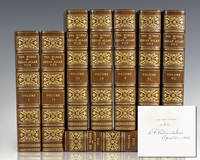
1884118042New York: G. P. Putnam's Sons 1884. The Amontillado edition of the works of Edgar Allan Poe. Octavo 8 volumes bound in full morocco by P.B. Sanford with gilt titles and tooling to the spine in 6 compartments within raised gilt bands double gilt ruling to the panels gilt turn-ins and inner dentelles marbled endpapers all edges gilt tissue-guarded engraved frontispiece to each volume by R. Swain Gifford Frederick Church and others etched engraved vignettes to the title pages. One of 315 numbered copies signed and dated by the publisher on the limitation leaf of each volume this is number 290. In fine condition. Rare and desirable. Best known for his tales of mystery and the macabre American Romantic writer and poet Edgar Allan Poe is credited with inventing the genre of detective fiction and contributing to the genre of science fiction only just emerging at the turn of the 20th century. Poe was the first well-known American writer to earn a living through writing alone resulting in a financially difficult life and career and his works influenced literature around the world as well as specialized fields such as cosmology and cryptography. Poe's most memorable tales include: The Black Cat The Cask of Amontillado The Gold-Bug The Pit and the Pendulum The Premature Burial and The Tell-Tale Heart. G. P. Putnam's Sons unknown
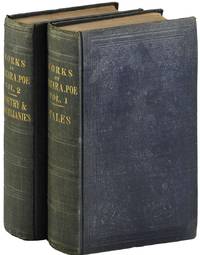
18508535New York: J.S. Redfield 1850. First Editions. First Printings with final page of ads in Vol.1 printing "Was published on the First of April" beneath American Drawing-Book and in Vol.2 there is no "r" in "choir" on p.46 third stanza line 1. Two 12mo. volumes 19.75cm; Blanck's A binding in publisher's blue cloth spines blind-stamped with simple rules with gilt-stamped rules between volume number and title on spines and covers with embossed corner and centerpieces within a triple blind-ruled frame; peach endpapers; xxii1-483484 4pp ads with inserted tissue-guarded portrait frontispiece; vi7-495496-498pp. In Vol.1 the first leaf a blank is not excised as is found in some copies. Both volumes bear the early ink signature of Samuel E. Perkins of Bangor Maine a druggist with his circular business label on preliminary blank Vol.1 and front pastedown Vol.2. Some very mild softening to spine ends spines gently sunned with sprinkled foxing to text; Vol.1 slightly over-opened at gutter following front endpaper with some light rubbing to covers on Vol.2; a uniformly Near Fine set without repair with the gilt bright and unrubbed.<br /> <br /> The first collected edition of Poe's works part of what would become a four-volume set with the third published later in 1850 and the fourth volume appearing in 1856. These volumes were published roughly six months after Poe's death; Volume I contains biographical matter and a notice of Poe's death followed by his Tales. Considerable material appears here for the first time in book form including "The Balloon-Hoax" "Mellonta Tauta" "A Tale of the Ragged Mountains" and "The Unparalleled Adventure of One Hans Pfaall sic. Uncommon in the first printings particularly in matched condition. A Haycraft-Queen Cornerstone. BAL 16158; Sabin 63570. 8535. J.S. Redfield unknown
18411610315George R. Graham 1841. 1st Edition. Hardcover. Very Good. These stories are the first appearances of Poe's works: The Murders in the Rue Morgue A Descent into the Malstrom The islands of the Fay The Coloquy of Monos and Una Never Bet the Devil Your Head Israfel. In Graham's Lady's and Gentleman's Magazine. Large thick quarto full maroon calf. Publisher's deluxe binding. Covers with decorative borders stamped in gilt and blind. Gilt-decorated turn-ins and marbled endpapers. Spine with raised bands and gilt in compartments. All edges gilt. Plate tissues moderately foxed else contents especially clean and fresh. A beautiful very good plus copy. Previous owner's small bookplate attached to front paste-down rear cover slightly separating at bottom. Housed in a custom-made slipcase. George R. Graham hardcover
184578226New York: Wiley and Putnam 1845. First Edition. Hardcover. Very good. The first printing of "The Raven" by Edgar Allan Poe 1809-49. Among the most famous works in American literature the poem tells of a raven's mysterious visit to a distraught lover tracing the man's slow descent into madness. It appears anonymously on p.143-145 as "by ——— Quarles." The first appearance of "The Raven" is something of a bibliographical dispute. Heartman and Canny consider this form to be the first printing maintaining that the January 29 1845 appearance in The Evening Mirror is not the first. The American Review had announced that "No. II will bear date Feb. 1845 but will be issued early in January" thus unless the publishers were unable to issue the work by the date promised the present version clearly predates the late January appearance in The Evening Mirror. Octavo: ii iv 656 pp. with a frontispiece portrait of Henry Clay. This volume contains other work by Poe including the first printing of "Some Words with a Mummy" p.363 as well as "Valley of Unrest" p.392 and "The City in the Sea" p.393. Original calf binding with black morocco spine labels gilt-stamped titles and decorations four raised bands blind-stamped borders and marbled endpapers. Scattered light foxing to the contents with a previous owner's pencil inscription to a prefatory blank leaf. The bookplate of American botanist and horticulturalist Ulysses Prentiss Hedrick appears on the front pastedown. Some general edgewear more so to the corners and tips with a bit of rubbing along the joints; otherwise very good. Heartman and Canny p.100; Tane 177. Wiley and Putnam hardcover
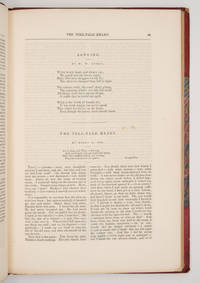
1843101067Boston: Leland and Whiting 1843. 4to. 3 engraved plates in no. 2 plates to nos. 1 & 3 in facsimile. 1-48; 49-96; 97-144 pp. Later 19th-century half red morocco and marbled boards no. 1 rear wrapper and no. 2 wrappers bound-in upper portion of no. 2 front wrapper filled in no. 1 front wrapper in facsimile; covers lightly rubbed and faded a few small tape repairs light staining to margins of no. 2 foxing and toning to no. 3. The complete run of this short-lived periodical edited by James Russell Lowell with contributions by Poe in each volume including the first printings of "The Tell-Tale Heart" no. 1 pp. 29-31 and "Notes Upon English Verse" no. 3 p. 102-112. Other contributions include short stories by Nathaniel Hawthorne "The Hall of Fantasy" and "The Birthmark" and poems by Jones Very John Greenleaf Whittier Elizabeth Barrett Browning and James Russell Lowell. "The Tell-Tale Heart" was first rejected by the Boston Miscellany with the editor's request that "if Mr. Poe would condescend to furnish more quiet articles he would be a most desirable correspondent." Lowell accepted the story for the first number of The Pioneer. "Before its demise Poe had contributed at Lowell's invitation to each number. For these contributions he was never paid" Heartman & Canny. PROVENANCE: Richardson book-plate ms notes on comparable copies 1900-05 on front pastedownREFERENCE: Heartman & Canny p. 240 Leland and Whiting hardcover
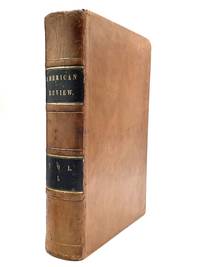
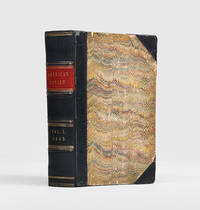
1845191176New York: Wiley and Putnam February but January 1845. And my soul from out that shadow that lies floating on the floor / Shall be lifted - nevermore! First appearance of "The Raven" pp. 143-5 appearing in the second number under the pseudonym "by --- Quarles". This bound volume of the American Review's initial six numbers is a presentation copy inscribed by the editor on the first blank "Col. Webb Ed. Courier & Enquirer from the Editor G. H. Colton". George Hooker Colton 1818-1847 paid Poe "not over $20" for "The Raven" which is introduced by Colton's brief essay on poetic metre. Colton recited the poem to staff "in his ramshackle Nassau Street office before yet it had gone into type; and as he closed with oratorical effect the last refrain he declared with an emphasis that shook the whole mass of his flaxen locks - 'that is amazing - amazing!'" Thomas p. 484. Colton presented this volume to General James Watson Webb 1802-1884 whose own paper Courier & Enquirer once had the largest circulation in the nation. "The Raven" was immediately successful appealing to both the popular and critical taste of its day and it was reprinted at least ten times within a month. The Evening Mirror issue of 29 January announced that they were reprinting the poem in advance of the February issue of the American Review; however the American Review itself announced that the February number would in fact be issued in early January. Richard Gimbel notes that the Evening Mirror text was slightly corrected from the first setting of type seen in the American Review and introduces an obvious typographical error. The April issue further includes the first appearance in print of Poe's "Some Words with a Mummy" pp. 363-70 and his revised versions of "The City in the Sea" and "The Valley of Unrest" pp. 392-3. Nos I-VI bound in single octavo volume 219 x 131 mm. Contemporary black half morocco rebacked to style red spine label and gilt and blind rules to compartments blind roll to sides and corners marbled sides and endpapers. Ownership signature on title page. Covers a little rubbed light wear and refurbishment to edges inner hinges reinforced occasional foxing and sticky notes to contents. A very good copy. Heartman & Canny pp. 100-1. Richard Gimbel "Quoth the Raven" a catalogue of the exhibition The Yale University Library Gazette April 1959 Vol. 33 No. 4 pp. 139-89. unknown
190730029HBDJ 1907 1ST LIMITED EDITION of 1000 copies Stated on Last PG NF/NEAR FINE First Quarto Photogravure Edition .Limited Edition of 1000 copies printed on Arches handmade paper. Book Condition: Very Good PAGES EDGES ARE UNTRIMMED .IN PLAIN BROWN DUSTJACKET WITH TITLE & AUTHOR IS BLACK WITH RED DECORATION publishers SLIPCASE OPEN AT BOTH ENDS Dust Jacket Condition: Very Good Gilt top. In original dust jacket and OPEN END slipcase. Lightest wear only to volume and dust jacket. Slipcase in good- condition. Very Scarce. 8 1/4 X 10 1/4 IN. narrative poem by American writer Edgar Allan Poe & Philosophy of Composition an essay written by Poe that elucidates a theory about how good writers write when they write well. RAVEN often noted for its musicality stylized language and supernatural atmosphere. Philosophy of Composition" an essay written by Poe that elucidates a theory about how good writers write when they write well.<br /> PAUL ELDER SAN FRANCISCO NEW YORK PRINTED On Arches Handmade Paper hardcover
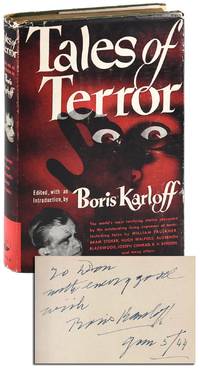
19438614Cleveland and New York: The World Publishing Company / Tower Books 1943. First Edition. First Printing. Octavo 21cm; dark sage green paper-covered boards with titling and publisher's logo stamped in black on spine; dustjacket; 89-3173pp. Inscribed by Karloff on the front endpaper: "To Don / with every good wish / Boris Karloff / Jan 5/44." Some external wear shallow chipping to crown hint of sunning to spine with some mild bubbling to paper and lower front cover offsetting and some mild discoloration to endpapers and the usual tanning to the text edges; Very Good. Dustjacket is edgeworn with corresponding tears and creasing to upper spine panel a few tiny nick and tears and a small splash mark to upper front flap; Very Good or better. <br /> <br /> Offered together with a three-page ALS from Karloff to Dr. E.M. Sheare the publisher of this volume composed in black pen on three sheets of Arsenic and Old Lace letterhead measuring ca.8.5" x 11" and dated about five months prior to publication May 20 1943; 49 lines 280 words signed "as ever Boris." Two old folds from mailing smoothed out some very subtle toning to extremities else Fine together with the original mailing envelope. All housed in a custom quarter-morocco drop-backed clamshell case. <br /> <br /> Scarce first printing of this cheaply-manufactured wartime anthology of "terror stories" all selected by Karloff who has written a generous six-page introduction. The contents include contributions by Bram Stoker "The Judge's House" Ambrose Bierce "The Damned Thing" William Faulkner "The Hound" Edgar Allan Poe "The Tell-Tale Heart" Algernon Blackwood "The Willows" and Oliver Onions "The Beckoning Fair One" among others. The letter to his editor is particularly insightful showing Karloff's strong opinions regarding what merited inclusion: "I am quite firm against Dunsany's "Where the Tides Ebb and Flow." It is beautiful and imaginative and all that but it no in sic sense fits our patterns.For reasons of space I think we could omit I Dunsany II Woman at Seven Brothers III Shipment or Mute Fate or IV Breakdown / which is interesting but not terror. Hugh Binson's tale I consider a must also The Waxwork - I've had three invitations to dinner without points on the telling of that one! I am enclosing the amended list for your consideration. By all means "The Beckoning Fair One" should be in last place in the book on the score of length and excellence." Uncommon inscribed with a lengthy contemporary ALS. 8614. The World Publishing Company / Tower Books unknown