LeibnizBiblio.com

1 704 résultats
1017538379.Ghardcover. Good. Access codes and supplements are not guaranteed with used items. May be an ex-library book. hardcover
2385993910.Gpaperback. Good. Access codes and supplements are not guaranteed with used items. May be an ex-library book. paperback
9728288034.Gpaperback. Good. Access codes and supplements are not guaranteed with used items. May be an ex-library book. paperback
19752090502124900444Iwanamishoten 1975. Soft Cover. Fine. The book is in fine condition. Iwanamishoten paperback
183813015Berlin, Veit, 1838. Verlagsbroschur, 8°, xx, 486, 46 S., unbeschnitten; -Einband und Block stärker angerändert, Papier etwas stockfleckig, Bindung gebrochen, ungebundener Block in der Verlagsbroschur.
176538096Amsterdam et Leipzig Chez Jean Schreuder 1765. 4to. Uncut in the original marbled boards. Professionally rebacked preserving almost all of the original back. The fragile orginal binding is here preserved in its entirety and it has quite a bit of overall wear. Apart from a small hole to two leaves in the index affecting ab. one work on each of the four pages it is internally nice and clean. Title-page printed in red and black. Beautiful eng. title-vignette and a few other woodcut vignettes and initials. 4 XVI 2 540 18 pp. <br/><br/><em>First edition thus being the first collected edition of Leibnitz' philosophical works in French and Latin and containing the FIRST PRINTING of one of Leibnitz' most important philosophical works his "Nouveaux essays sur l'entendement humain" New Essays on Human Understanding in which he attacks and refutes Locke and his "Essay on Human Understanding" and gives important testimony to his own philosophical ideas. With its 496 pages this extensive work takes up most of this collection of philosophical works and it also constitutes one of his largest and most important of his philosophical works. As explained by Raspe the editor in his preface to this publication "LES NOUVEAUX ESSAIS SUR L'ENTENDEMENT HUMAIN qui sont la partie principale de recueil sont connûs trés imparfaitement par l'histoire de la Philosophie de Leibnitz que Mr. Ludovici a publiée" p. X and the reason why the work was known even though it had not been published is because of a letter that Leibnitz had written in 1714 in which he explains why he did not wish to publish the work. Raspe quotes the letter p. X from which it becomes clear that Leibnitz had not wished to publish an attack on Locke and his work because Locke had died in 1704 the same year that Leibnitz had actually written the work and because Leibnitz was against publishing refutations of dead authors: "Mais je me suis degouté de publier des refutations des Auteurs morts quoiqu'elles dissent paroitre Durant leur vie & étre communiqués à eux memes". Raspe points to the nobleness of this decision but he also points to what could be other reasons for Leibnitz not wishing to publish his seminal work one of them being that towards the end of his life he died in 1716 he did not wish to enter into any more controversies with the British since he was already engaged in two very important ones that occuopied much of his time and energy: The first concerned the invention of the differential calculus the second was against Mr. Clarke on liberty and important metaphysical and theological questions. Another reason could also be that he did not want to begin controversies with the friends of Locke who at that time were many and important.Locke's "An Essay Concerning Human Understanding" which is the work here being refuted by Leibnitz became the crucial groundwork for the future empiricists with David Hume in the foreground and thus Leibnitz' work though published posthumously probably came to play a bigger role in the history of philosophy than it would have done had it been published just after he wrote it. Few philosophers of his time were susceptible to Leibnitz' ideas and his application of logic to the problems of metaphysics as most of them were far more receptive to Locke's empiricism. However when Leibnitz' "Nouveaux essays." was finally published here in his "Oeuvres philosophiques" in 1765 it became hugely influential and was also an important factor in the development of Kant's transcendental philosophy.The hugely famous work by Locke in which he stated his famous theory that the mind of the newborn is like a blank slate tabula rasa and concluded that all ideas come from experience and that there are no such things as innate principles was generally sharply criticized by the rationalists the most important of them being Leibnitz. Leibnitz' response his "Les nouveaux essays sur l'entendement humain" constitutes the most important of the rationalist responses and it is written in the form of a chapter-by-chapter refutation. He refutes the major premise of Locke's work that the senses are the source of all understanding primarily by adding to this "except the understanding itself" thus going on to distinguish between his three levels of understanding which are part of the centre of his philosophy.For Leibnitz as well as for Locke the great inspiration was Descartes but they chose two fundamentally different directions Locke the materialistic one and Leibnitz the idealistic one. The present work represents the greatest clash between the two giants of late 17th century philosophy. The effect of Leibnitz' work was enormous and among the Germans he invoked a great passion for philosophical studies. Leibnitz represents a striking contrast to both Locke with his empiricism and Spinoza. One earlier collection of some of Leibnitz' works had been printed before this one but it did not contain his "New Essays on Human Understanding" and only consisted of his "Smaller Philosophical Works". This is the German 1740-edition "Kleinere philosohische Schriften". The other writings contained in this publication are "Examen du sentiment du P. Malebranche que nous voyons tout en Dieu" ""Dialogus de connexione inter res & verba" "Difficultates quaedam Logicae" "Discours touchant la methode de la certitude & de l'art d'inventer" "Historia et commendatio charactericae universalis quae simul sit ars inveniendi".Graesse IV:152. </em> hardcover
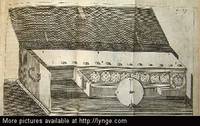
173528333Hannover Zu finden bey Nicolai Försters und Sohns sel. Erben 1735. 8vo. Contemporary full vellum w. author and title in old hand on back. Bdg. a bit soiled. Internally a bit of brownspotting. title-page w. professionally repaired tear. Inner front-hinge starting to crack but bdg. and bookblock tight. Overall a good and fairly well preserved copy. With engr. portrait woodcut vignettes and one folded engr. plate depicting an early calculating machine. 28 64 1030 pp. <br/><br/><em>Rare third German edition. Last Richter-edition. First published in French in 1710. It is the only larger philosophical work Leibnitz himself published and it is a work of immense importance to philosophy theology and mathematics. In this work Leibniz represents his excellent calculating machine which has served as the basis for what we now call a computer as he presents the binary arithmetic "Rechnen mit Null und Eins" "calculating with zero and one" in the Beylage p. 926 which forms the basis for the much later developed computer science see PMM 177. This work contains "Anmerkungen" by Richter and "Lebens=Beschreibung" by Fontenelle followed by "Beylage". In these "Beylage" we find the method of converting numbers into the binary system which here is said to be "etwas recht neues welches der Herr Leibnitz zu Hanover erfunden" "something brand new which Mr. Leibnitz von Hanover has discovered" as well as "Eine Schrift. In welcher klar gezeiget wird/ dass nicht Herr Neutonsondern der Herr von Leibnitz Erfinder des CALCULI DIFFERENTIALIS sey." A Treatise. In which it is clearly shown/ that Mr. Leibniz and not Mr. Newton is the inventor of the CALCULI DIFFERENTIALIS".All early editions of the Theodicee are rare. See D.S.B.: VIII pp. 161-166. </em> hardcover
Paris, Delagrave 1938, vi + 232pp., 11e mille, dos reparé, intérieur en bon état, F21263
2 parties en 1 vol.: 340 + 380pp.avec front., reliure cart.avec plats marbrés, dos en cuir avec titre et décoration marbrées, feuilles de garde marbrées, 18cm., nouvelle éd. (corrigée et augmentée), bon état
Bruxelles, Société Nationale 1838, 340pp., couv.salie, cachets, dos reparé, F884
172046329Amsterdam D. Mortier 1720. Bound in one contemporary full calf. Spine richly blindtooled. XLI3520 pp. 1 fold. table. A fine clean copy. <br/><br/><em>The scarce third edition of Leibnitz' importent treatise on the goodnes of God the free will of man and the causes of evil in the world The principal subject of the work being the problem of liberty and free will. It is the only larger philosophical work published by Leibnitz himself.Ravier No 67 the first ed. from 1710 - PMM: 177 1710-edition. </em> unknown
175942999Berlin Haude et Spener 1759. 4to. No wrappers as issued in "Memoires de l'Academie Royale des Sciences et Belles Lettres". tome XIII 1757. Titlepage Classe de Philosophie Spéculative and pp. 451-522. <br/><br/><em>First appearance of this remarkable mathematical correspondance comprising 29 letters mostly of mathematical content and after the death of Herman leading to some controveries in relation to priorities.Ravier "Bibliographie des Oeuvres de Leibniz" No. 465. </em> unknown
169542860Leipzig Grosse & Gleditsch 1695. 4to. Contemp. full vellum. Faint handwritten title on spine. A small stamp on titlepage and pasted library label to pasted down front free end-paper. In: "Acta Eruditorum Anno MDCXCV". 2 560 52 pp. 10 plates. As usual with various browning to leaves and plates. The entire volume offered. Leibniz's papers: pp. 145-57; 184-185; 310-316; 369-372; 493-495. Jacob Bernoulli's paper: pp. 537-553 one folding table; 65-66. Johann Bernoulli's: pp. 59-65; 374-376. <br/><br/><em>First printing of a series of influential papers by Leibniz Jacob Bernoulli and Johann Bernoulli.First publication of Jakob Bernoulli's famous and influential "Bernoulli Equation". In "Notatiuncula Constructiones Lineae" Bernoulli proposed a solution to non linear equations which today is one of the most common used solutions of the general fluid. Bernoulli equations are significant because they are nonlinear differential equations with known exact solutions. In the "Specimen dynamicum" Leibniz presents a conception of body and force which distinct between primitive and derivative forces and between active and passive forces. This article is regarded as being the clearest exposition of Leibniz' dynamics. DSB VII 151b."The first attempt at a detailed account of the dynamics was a long dialogue the "Phoranomus seu de potentia et legibus naturae" written in July 1689 while Leibniz was in Rome. This was quickly followed be the composition of the massive Dynamica de potential et legibus naturae corporeae 1689-90 . Though it was written with the intention of publication and though Leibniz work at publishing it he never considered it entirely finished and it remained unpublished during his lifetime.The later . he finally revealed some of the metaphysical foundations of the project in an essay the present paper." Garber Daniel. Leibniz: body substance monad. 2009. 132 p."Its title suggests a summary of or a selection from the earlier work . However it actually contains something in a way rather more interesting: a careful exposition of the metaphysical foundations of the new science something that is hard to find in the old Dynamica or any of the more Technical pieces." Garber Daniel. Leibniz: Body Substance Monad. 2009. 133 p. </em> hardcover
2008ROD0122127FLAMMARION. 2008. In-12. Relié. Bon état, Couv. convenable, Dos satisfaisant, Intérieur frais. XX+839 pages. Emboitage cartonné souple en noir et blanc satisfaisante. Un signet.. . Sous Emboitage. . Classification Dewey : 100-PHILOSOPHIE ET DISCIPLINES CONNEXES
1967R300273473Librairie philosophique J.Vrin. 1967. In-12. Broché. Etat d'usage, Couv. légèrement passée, Dos satisfaisant, Intérieur acceptable. 94 pages.. . . . Classification Dewey : 190-Philosophie occidentale moderne
1962R320052970MONTAIGNE. 1962. In-8. Broché. Etat d'usage, Couv. convenable, Dos satisfaisant, Intérieur frais. 522 pages.. . . . Classification Dewey : 100-PHILOSOPHIE ET DISCIPLINES CONNEXES
1962R300330359Aubier/Montaigne. 1962. In-12. Broché. Etat d'usage, Couv. légèrement passée, Dos plié, Papier jauni. 522 pages. Légère trace de mouillure sur le 1er plat et le dos.. . . . Classification Dewey : 100-PHILOSOPHIE ET DISCIPLINES CONNEXES
1962R320058604LIBRAIRIE PHILOSOPHIQUE J. VRIN. 1962. In-8. Broché. Etat d'usage, Couv. convenable, Dos satisfaisant, Intérieur frais. 154 pages - 1 petite etiquette collée en coiffe en tete -. . . . Classification Dewey : 100-PHILOSOPHIE ET DISCIPLINES CONNEXES
15933Paris, Librairie Philosophique J. Vrin, 1965. Coll. "Bibliothèque des Textes Philosophiques". In-8 broché, 155 p. Traduit du latin par Paul Schrecker. Bon état.
R200079290HENRI GAUTIER. NON DATE. In-8. En feuillets. Bon état, Couv. convenable, Dos satisfaisant, Quelques rousseurs. 32 pages.. . . . Classification Dewey : 830-Littératures des langues germaniques
63165Librairie philosophique J. Vrin 1970, broché, 144pp; texte en latin avec traduction en regard de Yvon Belaval - très bon état
1970191995Vrin Éditions Vrin, 1970. In-8 broché (21,5 x 13,5 cm) de 142 pages. Collection "Bibliothèque des Textes Philosophiques". Texte établi, traduit et annoté par Yvon Belaval. Écrit vers 1673, ce dialogue est l'un des joyaux de la jeunesse de Leibniz. Il y affronte déjà les questions qui hanteront toute son uvre : le problème du mal, la liberté humaine et la justice divine. C'est l'embryon de ce qui deviendra plus tard la Théodicée. Traces de scotch ancien et petites rousseurs aux premiers feuillets blancs.
60289Paris, J. Vrin 1970, 215x130mm, 142pages, broché. Bel exemplaire.
58517Vrin, Bibliothèque des textes philosophiques, bilingue latin/ français, traduit par Yvon Belaval, 1970, 144 pp., broché, bon état.