LEIBNIZ, Gottfried Wilhelm vonBiblio.com
1 658 résultats
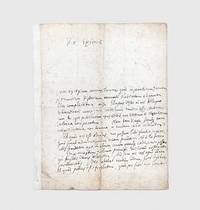
1702168455Hanover: 25 April 1702. A meeting of minds in the Age of Enlightenment The opening letter of Leibniz's correspondence with William Wotton marking the beginning of the long-standing relationship between the two great polymaths. The letter draws attention towards a relatively understudied side of Leibniz his engagement with historiography and presents his reflections on the role of history as a "mirror for princes". Wotton 1666-1727 was an English theologian who wrote chiefly on history and theology. Among his major works are Reflections upon Ancient and Modern Learning 1694 and The History of Rome from the Death of Antoninus Pius to the Death of Severus Alexander 1701 - the latter later used by Gibbon. These caught Leibniz's attention prompting him to open correspondence. Leibniz thanks Wotton for gifting him a copy of his Roman history praising the work as "accurately elaborate" and presented in "an elegant book". He then compliments the breadth of Wotton's knowledge admitting that: "I almost couldn't believe that the author of the History was the same as he who produced that famous work comparing the learning of the ancients and moderns Reflections. For such different forms of erudition are unlikely to coexist in the same person. I can't thank you without also expressing my admiration". Leibniz had read the Reflections a contribution to the ongoing controversy concerning the merits of ancient and modern learning and sided with the moderns as did Wotton. Leibniz first heard of Wotton's works a few years before from his friend Thomas Burnett who acted as a source of English intellectual news for him and had previously introduced him to Locke. In the first part of the letter Leibniz also mentions Wotton's "extraordinary envoy" who delivered the book; this was James Cresset English ambassador for several north-German states and a friend of Leibniz. Leibniz reveals that soon after receiving the book he immediately brought it to court and showed it to Georg Ludwig Elector of Hanover and the future King George I of England. The prince who Leibniz notes was "fond of English literature" was already reading a copy with pleasure; Leibniz regrets that the recently deceased William III could not do the same. This occasion prompts the philosopher to reflect on the educational role of history as a mirror for princes: "It is an old saying that History is the school of princes but hardly another history could be a better teacher than yours in which the Caesars. are depicted almost as if to be admired on a canvas". The letter also exemplifies Leibniz's fluid and creative Latin style: "with this taste you have wonderfully stimulated my appetite which you can satisfy if anyone can". Wotton replied in July and their correspondence continued until Leibniz's death the two typically exchanging cultural news. Leibniz's fascination with history began very early and was concentrated on Germany. Work on the critical edition of his historical contributions started in 2019 and is ongoing. Around the time of this letter he was publishing collections of Medieval documents: Mantissa Codicis Juris Gentium Diplomatici 1700 and Accessiones historicae 1700. These were part of a wider project to collect materials for the publication of a history of Germany which was never realized. The letter is a witness to Leibniz's curiosity towards the works of English historians at a time when he was actively reflecting on these topics; it also testifies to the popularity of Wotton whose achievements are often overlooked by modern scholarship. A transcription of the letter is published in Gottfried Wilhelm Leibniz Sämtliche Schrifte und BriefenReihe I Band 21 2012 no. 137. Single sheet of laid paper 199 x 158 mm legibly written on both sides in brown ink attached to a later blank of wove paper. Lightly toned and foxed creased from folding Leibniz's hand clear and the ink unfaded. Overall in very good condition. unknown
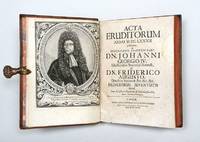
1682155395Leipzig: J. Grossium & J. F. Gleditschium typis Christophori Guntheri 1682-89. Leibniz's independent discovery of calculus Third edition of the first published work on the subject of calculus in the 1684 volume of the German scientific journal Acta eruditorum here included as part of a run of the first eight years of the journal in a uniform contemporary binding and unusual in commerce in such state. The journal was issued in monthly parts. Recent scholarship by Samuel V. Lemley has determined there were three editions of the October monthly part including Leibniz's paper. The first edition was printed in 1684 the second in 1686. This is the third edition incorporating Leibniz's revisions printed in 1692 or 1693. The plate accompanying the paper is in the first state. It is apparent that individual parts were reprinted to allow subscribers to fill out incomplete sets and that these reprintings were authorized rather than piracies. The paper just seven pages long "was the first attempt to set out the rules governing infinitesimal procedures. The rules are introduced geometrically translated into algebraic terms and then redescribed in terms of differentials. This enables Leibniz to provide basic rules of addition subtraction multiplication and division. Specifying rules for the manipulation of signs depending on whether the ordinates increase or decrease he moves to the behaviour of curves leading him to introduce second-order differentials and by these means he offers procedures for finding powers and taking roots. Nevertheless it should be said that the programme advocated in Nova methodus was obscurely formulated and the paper was so cautious in its presentation that it hardly mentioned infinitesimals at all. The programme was quickly developed by the Bernoullis and others however and the first textbook Guillaume de l'Hôpital's Analyse des infiniment petits 1696 written under the guidance of Johann Bernoulli is far more explicit" Clarke & Wilson p. 349. Through its adoption and elaboration by these and other contemporaries calculus was soon firmly established in western mathematics. Leibniz's paper famously preceded Newton's publication of his own discovery of calculus and the question of whether Leibniz plagiarized Newton's unpublished work caused a lengthy furore in the scientific world; it is now recognized that both men discovered calculus independently. "The infinitesimal calculus originated in the seventeenth century with the researches of Kepler Cavalieri Torricelli Fermat and Barrow but the two independent inventors of the subject as we understand it today were Newton and Leibniz. The subsequent controversy in the early part of the eighteenth century as to the priority of their discoveries - one of the most notorious disputes in the history of science - led to an unfortunate divorce of English from Continental mathematics that lasted until the end of the first quarter of the nineteenth century. Although both Newton and Leibniz developed similar ideas Leibniz devised a superior symbolism and his notation is now an essential feature in all presentations of the subject" PMM. The Acta Eruditorum was established in 1682 in imitation of the Journal des Savans and ran till 1731. Published under the auspices of the Collegium Gellianum with support from the Duke of Saxony it covered a wide range of topics including medicine mathematics physics law history geography and theology. The journal soon became the most well-known German publication of its kind. Contributors included Boyle Leeuwenhoek Bernoulli Pascal Huygens Halley and Descartes alongside Leibniz. 8 vols quarto 207 x 152 mm. With 117 plates many folding. Bound without plate 14 in 1684 vol. and a few minor defects in other vols. Contemporary calf twin red and brown calf labels gilt in spine compartments effaced early shelf labels at foot of spines triple gilt rule to covers marbled endpapers red edges. Slight peripheral wear a few joints a little split at ends but all firm bindings in generally fresh condition browning to contents as usual a few folding plates cropped into neatline slight staining at edges of 1682 1683 and 1685 vols. A very good set. Dibner 109; Grolier/Horblit 66a; Norman 1326; Printing and the Mind of Man 160. Samuel V. Lemley "Printing Leibniz's Calculus: Dating and Numbering the Editions of the Nova Methodus pro Maximis et Minimis" in The Library pp. 177-196 vol. 22 no. 2 2021; Desmond M. Clarke & Catherine Wilson The Oxford Handbook of Philosophy in Early Modern Europe 2013. unknown
114780Frankfurt Christopher Cröker 1690. . Second edition; 4to 18.5 x 14.5 cm; engraved frontispiece tables in the text decorative initials typographic headpiece contents faintly toned but overall clean; early 19th century half vellum with marbled boards manuscript title to spine small bookplate of the same period in the upper left corner of the front pastedown the name scratched out and the number '192' in manuscript calf a little toned boards rubbed with wear at the edges very good unsophisticated condition; 78pp.<br /> Second edition of Leibniz's groundbreaking early work on combinatorics a highly original proposal in logic and mathematical philosophy expanded from his thesis Disputatio arithmetica de complexionibus and first published with the title Dissertatio de arte combinatoria in 1666. Both editions of the text are rare in commerce with only one copy of each noted in auction records over the last two decades.<br /><br />Leibniz's Arte Combinatoria is concerned with two issues the development of a system of symbols denoting human concepts so that they could be symbolically manipulated 'to discover new truths and find proofs for the old ones' and a 'meta-science' for 'investigating the various methods and procedures deductive and inductive empirical and logical internal to each scientific field' Mugnai Leibniz: Dissertation on Combinatorial Art Oxford University Press 2020. These would remain major pre-occupations for Leibniz throughout his life.<br /><br />Though the book made Leibniz famous among European intellectuals it was written before he had thoroughly studied mathematics. He responded to this unauthorised edition with a note in the scientific journal Acta Erudatorium writing that though the text was 'not sufficiently polished' it contained '"many new meditations" he did not regret concerning "the art of discovery" and the "excellent" idea of an alphabet of human thoughts' Mugnai.<br /> Frankfurt, Christopher Cröker, 1690. hardcover
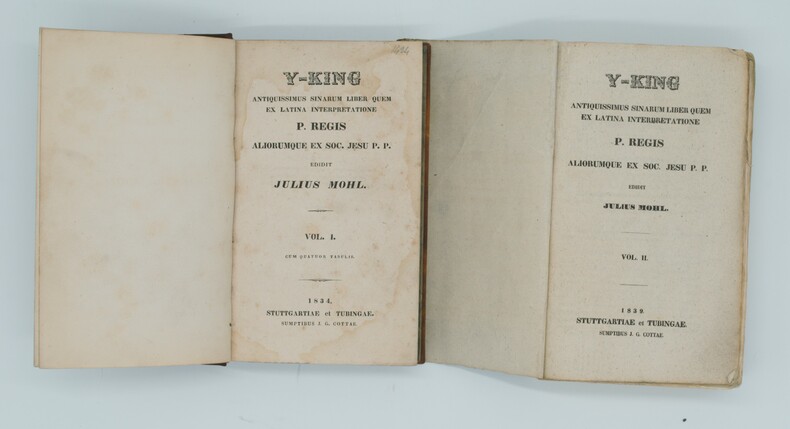
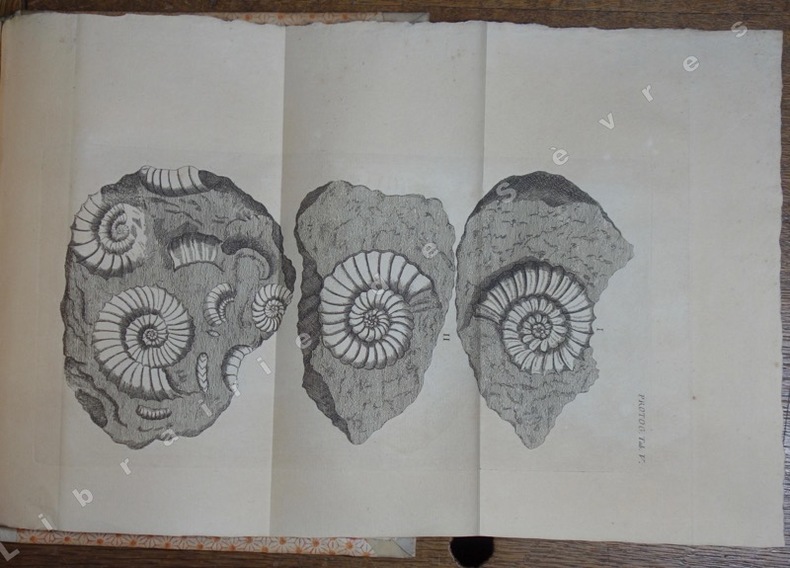
1834PHO-1520Stuttgart & Tubingue, Cotta, 1834-1839. 2 volumes in-8 de [1] f., xvi-474-[1] pp., 4 planches dépliantes ; [1] f., 588 pp. Premier tome relié en demi-basane brune, dos lisse, titre doré, date en queue (reliure moderne) et second tome broché, couverture d’attente, inscriptions manuscrites sur la couverture ("à Monsieur M. Barucchi - Directeur du Musée égyptien, professeur d'histoire à l'Université de Turin), dos usé avec qqs fentes. Les deux volumes réunis dans un emboîtage toilé bleu moderne. Très légères mouillures claires par endroits.
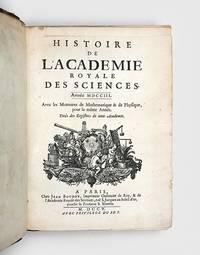
1705153285Paris: Jean Boudot 1705. The foundation of binary arithmetic First edition of this momentous volume of the journal of l'Académie Royale des Sciences containing Leibniz's invention of binary arithmetic the foundation of the electronic computer industry. Binary notation reduces all numbers to expressions involving only 0 and 1. It was a topic that had interested Leibniz for over two decades. "This explanation of binary arithmetic was the first publication on this topic to result in a significant impact on the scientific community" Glaser History of Binary and other Nondecimal Numeration p. 39. Although other mathematicians had experimented with binary previous to Leibniz including Pascal Leibniz's paper was the first to have a notable influence on scientific thought. After its publication the binary system became a popular subject of study. As modern computing is based on the binary system the paper can be seen as the basis of computational science both theoretical and in practice. Leibniz had conceived of a calculating machine based on the binary system as early as 1679 but this was never constructed. Binary arithmetic had broader implications for Leibniz beyond just its mathematical function. "In the domain of mathematics Leibniz regarded binary notation as intrinsically superior to decimal notation. Over and above this advantage however he believed that it contained the key to resolving both the problem of conceptual primitives and the problem of adequate characters. If it could be established as Leibniz speculated from about 1679 onwards that the only truly primitive concepts were those of God and Nothingness or Being and Privation then the symbols 1 and 0 would form the basis for an adequate characteristic whose simplest signs would stand in an immediate relation to the two conceptual primitives" The Cambridge Companion to Leibniz pp. 236-7. This was the second of Leibniz's great trilogy of works on mathematics and computation following Nova methodus pro maximis et minimis 1684 his independent invention of calculus and preceding Brevis descriptio machinae arithmeticae 1710 his decimal mechanical calculating machine. Also included in the volume is Bernard Le Boyer de Fontenelle's Nouvelle Arithmétique binaire pp. 58-63 written as secretary of the academy which offers an editorial comment on Leibniz's paper. 2 parts in 1 vol. quarto 245 x 173 mm. Engraved frontispiece 11 plates of 12 of which 9 folding. Recased in contemporary black morocco rebacked and recornered fragments of original spine laid down with new red morocco labels gilt border to covers enclosing gilt arms of Louis XIV marbled endpapers reinforced in hinges gilt edges. Contemporary armorial bookplate on title verso. Binding firm contents a little toned title page excised at head plate 12 the heart of the American tortoise lacking sporadic light foxing; a very good copy. Ravier 166. unknown
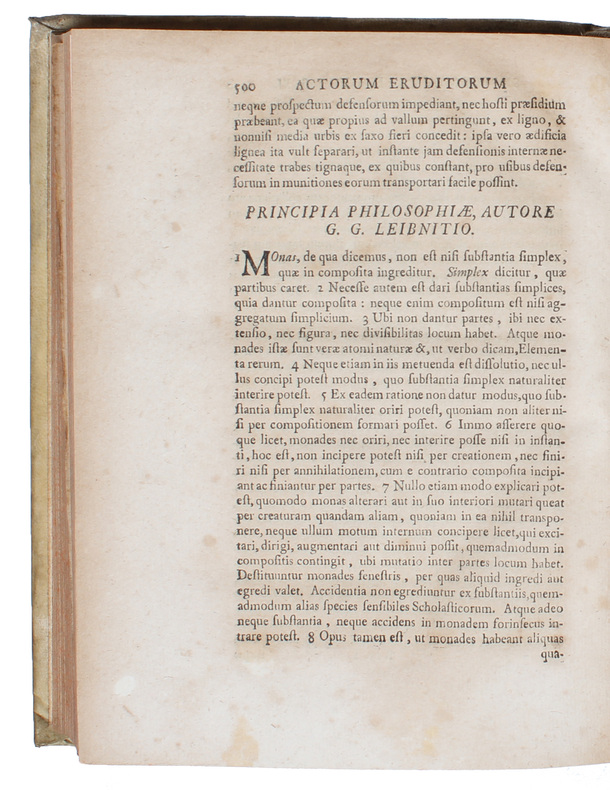
172149396Leipzig, 1721. 4to. Both entire volumes (Acta Eruditorum 1721 + Supplementa VII, 1721) present, in uniform contemporary full vellum bindings with handwriting to spines. A small later label to top of spines. Old handwritten ex libris-inscription to top of both title-pages as well as a small stamp. The supplement-volume with an additional stamp to title-page, and both volumes with library label (Archiv des k.k. militär.-geograf Institutes) to pasted down front free end-paper. As usual some brownspotting. A nice set. pp. 500-514 (Supplement-vol.) + pp. 94-95. [Entire volumes: (2), 537, (39) pp. + three plates (Suppl.-vol.) + (4), 547, (42) pp. + five plates].
172149396Leipzig 1721. 4to. Both entire volumes Acta Eruditorum 1721 Supplementa VII 1721 present in uniform contemporary full vellum bindings with handwriting to spines. A small later label to top of spines. Old handwritten ex libris-inscription to top of both title-pages as well as a small stamp. The supplement-volume with an additional stamp to title-page and both volumes with library label Archiv des k.k. militär.-geograf Institutes to pasted down front free end-paper. As usual some brownspotting. A nice set. pp. 500-514 Supplement-vol. pp. 94-95. Entire volumes: 2 537 39 pp. three plates Suppl.-vol. 4 547 42 pp. five plates. <br/><br/><em>The highly important first Latin translation of Leibnitz' seminal "The Monadology" - his main philosophical work and the work that stands as the epitomization of anti-materialism - which was not published in the original French until 1814 and which only appeared in a German translation exceedingly scarce in 1720 and in a Latin translation by Christian Wolff in 1721 as it is here. Up until then Leibnitz' key philosophical text had only circulated in manuscript form written in 1714. - Here sold together with Wolff's anonymously written review of the German version of the "Monadology" which had great impact upon the reception of the seminal philosophical text that is the "Monadology"."Until the XXth century criticism about Leibniz's "Principles of Nature and Grace" and "Monadology" has been characterised by a number of mistakes and misunderstandings which have roots in the circumstances surrounding the genesis of these manuscripts. As a consequence erroneous information about these texts was included in an anonymous review published in 1721 in the "Acta eruditorum" of Leipzig. Research on primary sources proves that the author of this review who was in fact the author of the latin translation of the Monadology published immediately afterwards was Christian Wolff who was in possession of a copy of Leibniz's manuscript as early as 1717. Wolff's initiative of translating the Monadology can be seen as part of a cultural strategy aiming to prevent any idealistic interpretation of Leibniz's monadological thought. From this point of view to consider the theory of pre-established harmony as based on a system of strictly dualistic metaphysics was an essential element of Wolff's philosophical strategy."Antonio Lamarra: Contexte génétique et première reception de la "Monadologie". Leibniz Wolff et la doctrine de l'harmonie préétablie". During his last stay in Vienna from 1712 to September 1714 Leibniz wrote two short texts which were meant as concise expositions of his philosophy namely the "Principes de la Nature et de la Grace fondés en raison" written as a letter to Prince Eugene of Savoy and the work we now know as the "Monadology" which he had been asked to write by Nicolas Redmond Duke of Orleons - the latter being the work that established Leibnitz' fame as a philosopher and which has gone down in history as not only as one of the most important philosophical texts of the 18th century but also arguably the most important work of immaterialism. After his death "Principes de la Nature et de la Grace fondés en raison" appeared in French in the Netherlands. Without having seen this publication Christian Wolff and collaborators had assumed that it contained the French original of the "Monadology" as well although this in fact remained unpublished until 1840. Thus it happened that Leibnitz' key philosophical text which came to be known as "The Monadology" was printed in German and Latin ab. 120 years before it appeared in the original French. The German translation appeared in 1720 as "Lehrsätze über die Monadologie" and the following year the Latin translation appeared in Acta Eruditorum as "Principia philosophiae". Three manuscript versions of the text exist: the first written by Leibniz and overcharged with corrections and two further emended copies with some corrections appearing in one but not the other. "Leibniz was one of the last "universal men" of the type which the Italian Renaissance had ideally postulated: philosopher historian mathematician scientist lawyer librarian and diplomat. In all these fields either all his actual achievements or his seminal suggestions have become part and parcel of European thought. Although trained for the law mathematics was his favourite subject. Independently of Newton he worked out the infinitesimal calculus introduced a number of mathematical symbols now in general use and constructed an early calculating machine the ancestor of our computers. Mathematical conceptions also determine his philosophy. In it Leibniz tried to combine physics and metaphysics and to reconcile philosophy and theology. The "essay on a Theodicy" is the only larger philosophical work published by himself; but his fame as a philosopher rests on his "Theory of Monads". The original French text of this was published for the first time in 1840; but it had circulated in manuscript in its initial form of a letter addressed to Prince Eugene of Savoy 1714 and it was printed in German 1720 and Latin 1721 translations. Leibniz proclaimed a "pre-established harmony" of the universe which he explained as composed of hierarchically ordered "monads" i.e. the ultimate substances of mind as well as matter. This concept clearly reflects the ideal of the properly organized absolutist state of the baroque period and derives partly from the "idées simples" of Descartes whom Leibniz greatly admired. A generation later Voltaire ridiculed the "pre-established harmony" in "Candide"; but modern nuclear science has vindicated Leibniz's basic ideas albeit from different presuppositions." Printing and the Mind of Man pp. 105-6. The "Monadology" is an extremely condense work that consists of 90 in this Latin version 93 numbered sections/paragraphs which outline a metaphysics of a single substance. The Monadology ends the dualistic mind-body-problem of Descartes and offers a new solution to the question of the interaction between mind and matter by explaining the pre-established harmony and the synchronous not causal relationship between the realm of final causes and that of efficient causes. Leibniz' groundbreaking work came to profoundly influence not only 18th century thought but also much later philosophy and logic. For this we have to thank Christian Wolff the translator of the "Monadology" into Latin and the first reviewer of the work. It is through Wolff and his elaboration of the development of Leibniz' speculative and metaphysical views that Leibniz becomes a recognized figure of importance particularly in Germany from the 1720'ies onwards where Wolff's writings were standardly studied. "Notably Wolff's Leibnizianism made a deep impact on Kant in whose "Critique of Pure Reason" 1781 Leibniz himself came to figure as one of the main targets of Kant's anti-metaphysical programme. In particular Kant saw Leibniz as pretending to "a priori" knowledge of the world as it is in itself and presented his own claim that the only knowledge we can have is of the world as it appears in our experience as sharply opposed to the Leibnizian vision. . today shows that his thought has survived even the extreme empiricism of the Vienna Circle in the 1930s which would have viewed its principal doctrines as unverifiable and hence utterly meaningless. Although not in evidence in the "Monadology" itself one of Leibniz' preoccupations was with the philosophy of logic and language and the twentieth-century's concern for those topics has discovered in what he had to say about them a treasure house of good sense and wisdom which can be detached from the less appealing of his metaphysical speculations. Then more recent writers who have been interested in the metaphysics of possibility and necessity have found inspiration in the Leibnizian image of possible worlds and that too has helped keep his name alive for us." Savile "Leibniz and the Monadology" pp. 6-7. "The long span of Leibniz' intellectual life and his early involvement with philosophy made for engagement with a wide variety of philosophical traditions and issues. Early studies at home exposed him to the thought of the Scholastics; during his university years he was something of a materialist influenced by the atomism of Bacon and Gassendi. In his mid-20s and early 30s becoming disenchanted with the intellectual prospects for materialist thought he turned towards the sort of immaterialism that came to shape his mature thinking after the decade between 1675 and 1685 when he was more narrowly concerned with mathematics than philosophy. It is this anti-materialism that is epitomized in the "Monadology" itself.Although Leibniz produced a prodigious quantity of philosophical writing very little of it was published in his lifetime; indeed very little was intended for publication. For the most part. his philosophical thoughts were prepared for individual scholars he had met or with whom he corresponded and were never presented as a worked-out system. it was not until the last period of his life that he found the time and the impetus to set down the whole which he did in two condensed papers written in French during a visit to Vienna.The more popular and less taxing of these was the "Principles of Nature and Grace Founded on Reason" which he prepared for Prince Eugène of Savoy and the second which he had been asked to write by the councellor of the Duke of Orleans Nicolas Remond but never sent off was the "Principles of Philosophy" or as he called it "Elucidation Concerning Monads" . The title by which that work is known today "Monadology" was not one that Leibniz ever gave it but was invented by the work's first editor Henrich Kohler who published it in a German translation under that title in 1720." Savile "Leibniz and the Monadology" pp. 3-4. "Gottfried Wilhelm Leibniz 1646-1716 was one of the great thinkers of the seventeenth and eighteenth centuries and is known as the last "universal genius". He made deep and important contributions to the fields of metaphysics epistemology logic philosophy of religion as well as mathematics physics geology jurisprudence and history. Even the eighteenth-century French atheist and materialist Denis Diderot whose views were very often at odds with those of Leibniz could not help being awed by his achievement writing in his entry on Leibniz in the Encyclopedia "Perhaps never has a man read as much studied as much meditated more and written more than Leibniz. What he has composed on the world God nature and the soul is of the most sublime eloquence. If his ideas had been expressed with the flair of Plato the philosopher of Leipzig would cede nothing to the philosopher of Athens." "Oeuvres complètes" vol. 7 p. 709 Indeed Diderot was almost moved to despair in this piece: "When one compares the talents one has with those of a Leibniz one is tempted to throw away one's books and go die quietly in the dark of some forgotten corner." "Oeuvres complètes" vol. 7 p. 678 More than a century later Gottlob Frege who fortunately did not cast his books away in despair expressed similar admiration declaring that "in his writings Leibniz threw out such a profusion of seeds of ideas that in this respect he is virtually in a class of his own." "Boole's logical Calculus and the Concept-script" in "Posthumous Writings" p. 9." SEP.Ravier: 357PMM 177b - being the Latin translation </em> hardcover
H872Leipzig Grosse & Gleditsch 1697. Acta Eruditorum Anno MDCXCVII. 4to. 594 . mit 4 von 8 Tafeln vorhanden Tafeln 1468. Text komplett S.135/136 in der Paginierung ¸bersprungen - so komplett!. Die wichtigestn Schriften und Beitr‰ge von Leibniz Bernoulli und Newton sind vorhanden: Leibniz G.W.: Communicatio suae pariter duarumque alienarum ad edendum sibi a Dn. Jo. Bernoulli . Solutio problematum a Jo. Bernoullio geometris publice propositorum. S. 201-205 mit 1 gefalt. Tafel;. Leibniz G.W.: Epistola ad Actorum horum Collectores. S.254-256. Bernoulli Johann: Problemapure gemometricum Eruditis propositum. S.95-96. Bernoulli Johann: De Conoidibus et Sphaeroidibus Quedam et c. S.113-118. Bernoulli Johann: Principia Calculi exponentialium seu percurrentium. S. 125-132. Bernoulli Johann: Curvatura radii in Diaphanis non uniformibus solutioque Problematis a se in Actis 1696 . S. 206-211. Bernoulli Jacob: Solutio Problematum fraternorum pecultiari Programmate Cal.Jan. 1697 . S. 211-214. Bernoulli Jacob: Solutio Difficultatis cujusdam circa naturam Flexus contrarii . S.410-412. Bernoulli Jacob: Addenda ad constructionem Problematis Beauniani. S.412-413. Newton Isaack: Excerpta eTransactionibus Philos.Anglig. Jan.1697: Epistola missa ad praenobilem virum d. Carolum Montague Armigerum . Solutio duorum problematum Mathematicorum a Jo. Bernoullio prpositorum. S. 223-224. Weitere Beitr‰ge von Marchio Hospitalius. S.217-218. Erstes Erscheinen der ber¸hmten Ausgabe von Acta Eruditorum in der die vier Lˆsungen der vier damals bedeutendsten Mathematiker zusammen gedruckt wurden. Es gab insgesamt f¸nf Lˆsungen f¸r das gestellte Problem und Newtons Lˆsung wurde erstmals in den Philosophical Transactions Januar 1697 abgedruckt und hier nachgedruckt. Die von L'Hopital vorgeschlagene hier nicht abgedruckte Lˆsung wurde erst 1988 verˆffentlicht. Das Brachistochrone-Problem wurde von Johann Bernoulli in Acta Eruditorum im Juni 1696 gestellt. Er f¸hrte das Problem wie folgt ein: "Ich Johann Bernoulli spreche den brillantesten an." Nichts ist f¸r intelligente Menschen attraktiver als ein ehrliches herausforderndes Problem dessen mˆgliche Lˆsung Ruhm verleihen und als bleibendes Denkmal bleiben wird. Ich hoffe die Dankbarkeit zu gewinnen der gesamten wissenschaftlichen Gemeinschaft indem ich den besten Mathematikern unserer Zeit ein Problem vorlege das ihre Methoden und die St‰rke ihres Intellekts auf die Probe stellt. Wenn mir jemand die Lˆsung des vorgeschlagenen Problems mitteilt werde ich ihn ˆffentlich f¸r lobenswert erkl‰ren. Johann Bernoulli und Leibniz haben Newton mit diesem Problem bewusst in Versuchung gef¸hrt. Angesichts des Streits um die Infinitesimalrechnung ist es nicht verwunderlich dass Johann Bernoulli diese Worte in seine Herausforderung aufgenommen hat: "Es gibt weniger die unsere hervorragenden Probleme lˆsen kˆnnen ja weniger selbst unter den Mathematikern die sich r¸hmen dass Sie haben ihre Grenzen wunderbar erweitert und zwar mithilfe der goldenen Theoreme die ihrer Meinung nach niemandem bekannt waren die aber tats‰chlich schon lange zuvor von anderen verˆffentlicht worden waren. "Laut Newtons Biograph Conduitt lˆste er das Problem auf einem Abend nach der Heimkehr von der Royal Mint. Newton: . "Inmitten der Hektik der groflen Neupr‰gung kam er erst um vier Uhr nachmittags sehr m¸de vom Turm nach Hause schlief aber nicht bis er das Problem gelˆswas um vier Uhr morgens geschah." Newton. Seine Lˆsung schickte er an seinen Freund Charles Montague und Montague verˆffentlichte ihn anonym in den Transaktionen. Auch Newtons Lˆsung die hier in der Acta vorgestellt wird ist anonym. Die Episode gefiel Newton nicht wie er sp‰ter schrieb: "Ich mag es nicht von Ausl‰ndern ¸ber mathematische Dinge bel‰stigt und geh‰nselt zu werden." Nach dem Wettbewerb sagte Johann Bernoulli: "Mein ‰lterer Bruder stellte den vierten von ihnen zusammen nach Leibniz ihm selbst und Newton dass die drei groflen Nationen Deutschland England und Frankreich jede f¸r sich sich mit mir in einer solchen vereinigen." schˆne Suche alle finden die gleiche Wahrheit."Struik Hrsg. "A Source Book in Mathematics 1200-1800 S. 391 ff. unknown
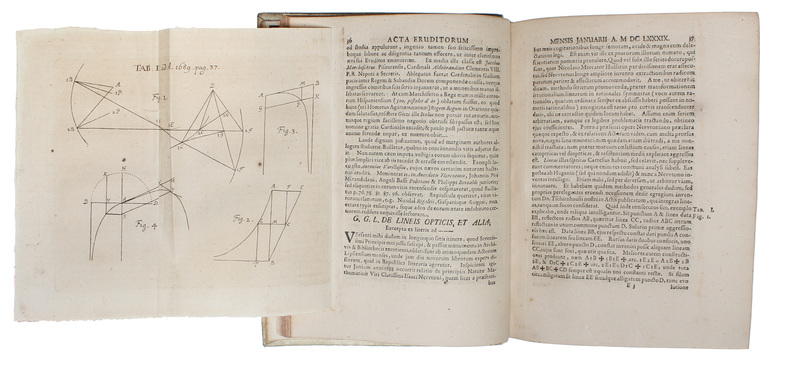
168941661Leipzig Grosse & Gleditsch 1689. 4to. Contemporary full vellum. Faint hand-written title to spine. A small stamp on title-page. In: "Acta Eruditorum Anno MDCLXXXIX". 8 653 7 pp. and 15 engraved plates. As usual with various browning to leaves and plates. The entire volume offered. Leibniz's papers: pp. 36-38 a. 1 engraved plate; pp. 38-46; pp. 82-89 a. 1 engraved plate; pp. 195-198. <br/><br/><em>First printing of these extremely important papers in which Leibniz claimed that he independently of Newton had discovered the principal propositions of his "Principia" and which present us with Leibniz's fundamental physico-mathematical theory his dynamics his concepts of force space and time. The "Tentamen." constitutes Leibniz's response to Newton's theories about the motion of the celestial bodies. Leibniz can be said to have anticipated the modern mathematical principle of relativity as it is his idea of individual co-ordinate systems and his practical rejection of the Galilean co-ordinate system that Newton adopted. Leibniz opposes Newton's ideas of attractions gravitational forces and calls them "occult qualities". The task of the "Tentamen." was to attain a theory mathematically equivalent to Newton's in accounting for planetary motion and especially for the inverse-square law of Kepler's laws but physically sound and capable of explaining the causes of phenomena.Newton attacked Leibniz's claim of priority in his anonymously published paper "Commercium epistolicum" Phil. Transactions 1714 and states that "in those tracts the principal propositions of that book are composed in a new manner and claimed by Mr. Leibniz as if he had found them himself before the publishing of the said book. But Mr. Leibniz cannot be a witness in his own cause. It lies upon him either to prove that he had found them before mr. Newton or to quit his claim." The features of Leibniz's mathematical representation of motion as put forward in "Tentamen." are see D.B. Meli: Equivalence and Priority. Newton versus Leibniz. pp. 90-91:- Empty space does not exist. The world is filled with a variety of fluids which are responsible for physical actions including gravity.- Living force and its conservation are the fundamental notion and principle respectively in the investigation of nature however they do not figure prominently in the study of planetary motion.- Finite and infinitesimal variables are regularly employed in the study of motion and of other physical phenomena. Living force and velocity are finite; solicitation and conatus are infinitesimal.- Accelerated motion whether rectilinear or curvilinear is represented as a series of infinitesimal uniform rectilinear motions interrupted by impulses. I call this 'polygonal representation'. Usually the polygon is chosen in such a way that each side is traversed in an equal element of time dt. In polygonal representations accelerations are reduced to a macroscopic phenomenon.- Propositions are often used to safeguard dimensional homogeneity. Constant factors - such as numerical factors mass and the element of time - are usually ignored in the calculations.Denys Papin's papers:1. Descriptio Torcularis cujus in Actis Anni 1688 pag. 646 mentio facta a suit. and 1 plate. Pp. 96-101.2. De Gravitatis Causa et proprietatibus Observationes. Pp. 183-188.3. Examen Machinæ Dn. Perrault. Pp. 189-195 a. 1 plate.4. Rotatilis Suctor et Pressor Hasciacus in Serenissima Aula Cassellana demonstratus & detectus. Pp. 317-322 a. 1 plate.5. In J.B. Appendicem Illam Ad Perpetuum Mobile Actis Novemb.A. 1688 p. 592.Pp. 322-324 a. 1 plate.6. Excerpta et Litteris Dn. Dion Papini ad --- de Instrumentis ad flammam sub aqua conservandam. Pp. 485-489 a. 1 plate.With the paper describing and depicting Papin's famous invention of the CENTRIFUGAL PUMP. Rotatilis Suctor et Pressor Hasciacus in Serenissima Aula Cassellana demonstratus & detectus. - The paper offered no.4.Jakob Bernoulli's papers:1. De Invenienda Cujusque Plani Declinatione ex unica observatione projectæ a flylo umbræ. Pp. 311-316 a. 1 plate.2. Vera Constructio geometrica Problematum Solidorum & Hypersolidorum per rectas lineas & circulos. Pp. 586-588 a. 1 plate.3. Novum Theorema Pro Doctrina Sectionum Conicarum. Pp. 586-588 a. 1 engraved plate. </em> hardcover
168941661Leipzig, Grosse & Gleditsch, 1689. 4to. Contemporary full vellum. Faint hand-written title to spine. A small stamp on title-page. In: ""Acta Eruditorum Anno MDCLXXXIX"". (8), 653, (7) pp. and 15 engraved plates. As usual with various browning to leaves and plates. The entire volume offered. Leibniz's papers: pp. 36-38 a. 1 engraved plate" pp. 38-46 pp. 82-89 a. 1 engraved plate" pp. 195-198.
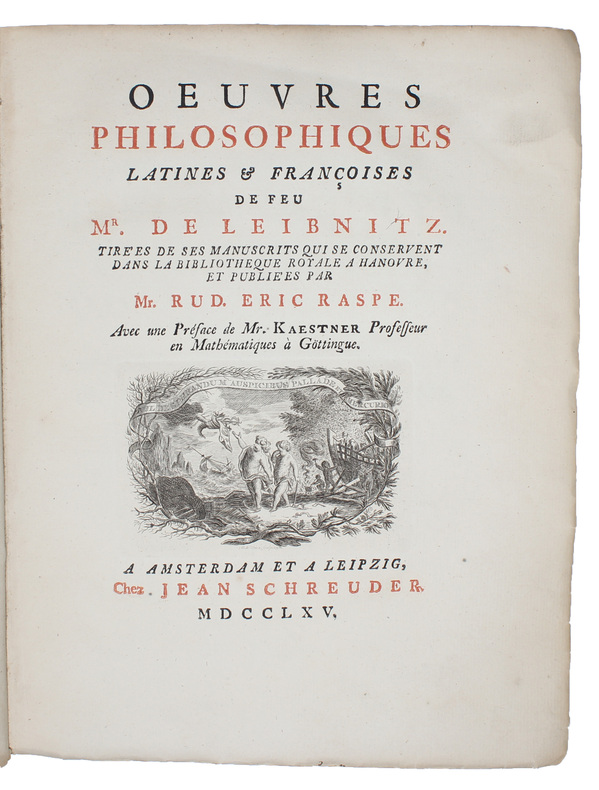
176538096Amsterdam et Leipzig, Chez Jean Schreuder, 1765. 4to. Uncut in the original marbled boards. Professionally rebacked preserving almost all of the original back. The fragile orginal binding is here preserved in its entirety, and it has quite a bit of overall wear. Apart from a small hole to two leaves in the index, affecting ab. one work on each of the four pages, it is internally nice and clean. Title-page printed in red and black. Beautiful eng. title-vignette and a few other woodcut vignettes and initials. (4), XVI, (2), 540, (18) pp.
176538096Amsterdam et Leipzig Chez Jean Schreuder 1765. 4to. Uncut in the original marbled boards. Professionally rebacked preserving almost all of the original back. The fragile orginal binding is here preserved in its entirety and it has quite a bit of overall wear. Apart from a small hole to two leaves in the index affecting ab. one work on each of the four pages it is internally nice and clean. Title-page printed in red and black. Beautiful eng. title-vignette and a few other woodcut vignettes and initials. 4 XVI 2 540 18 pp. <br/><br/><em>First edition thus being the first collected edition of Leibnitz' philosophical works in French and Latin and containing the FIRST PRINTING of one of Leibnitz' most important philosophical works his "Nouveaux essays sur l'entendement humain" New Essays on Human Understanding in which he attacks and refutes Locke and his "Essay on Human Understanding" and gives important testimony to his own philosophical ideas. With its 496 pages this extensive work takes up most of this collection of philosophical works and it also constitutes one of his largest and most important of his philosophical works. As explained by Raspe the editor in his preface to this publication "LES NOUVEAUX ESSAIS SUR L'ENTENDEMENT HUMAIN qui sont la partie principale de recueil sont connûs trés imparfaitement par l'histoire de la Philosophie de Leibnitz que Mr. Ludovici a publiée" p. X and the reason why the work was known even though it had not been published is because of a letter that Leibnitz had written in 1714 in which he explains why he did not wish to publish the work. Raspe quotes the letter p. X from which it becomes clear that Leibnitz had not wished to publish an attack on Locke and his work because Locke had died in 1704 the same year that Leibnitz had actually written the work and because Leibnitz was against publishing refutations of dead authors: "Mais je me suis degouté de publier des refutations des Auteurs morts quoiqu'elles dissent paroitre Durant leur vie & étre communiqués à eux memes". Raspe points to the nobleness of this decision but he also points to what could be other reasons for Leibnitz not wishing to publish his seminal work one of them being that towards the end of his life he died in 1716 he did not wish to enter into any more controversies with the British since he was already engaged in two very important ones that occuopied much of his time and energy: The first concerned the invention of the differential calculus the second was against Mr. Clarke on liberty and important metaphysical and theological questions. Another reason could also be that he did not want to begin controversies with the friends of Locke who at that time were many and important.Locke's "An Essay Concerning Human Understanding" which is the work here being refuted by Leibnitz became the crucial groundwork for the future empiricists with David Hume in the foreground and thus Leibnitz' work though published posthumously probably came to play a bigger role in the history of philosophy than it would have done had it been published just after he wrote it. Few philosophers of his time were susceptible to Leibnitz' ideas and his application of logic to the problems of metaphysics as most of them were far more receptive to Locke's empiricism. However when Leibnitz' "Nouveaux essays." was finally published here in his "Oeuvres philosophiques" in 1765 it became hugely influential and was also an important factor in the development of Kant's transcendental philosophy.The hugely famous work by Locke in which he stated his famous theory that the mind of the newborn is like a blank slate tabula rasa and concluded that all ideas come from experience and that there are no such things as innate principles was generally sharply criticized by the rationalists the most important of them being Leibnitz. Leibnitz' response his "Les nouveaux essays sur l'entendement humain" constitutes the most important of the rationalist responses and it is written in the form of a chapter-by-chapter refutation. He refutes the major premise of Locke's work that the senses are the source of all understanding primarily by adding to this "except the understanding itself" thus going on to distinguish between his three levels of understanding which are part of the centre of his philosophy.For Leibnitz as well as for Locke the great inspiration was Descartes but they chose two fundamentally different directions Locke the materialistic one and Leibnitz the idealistic one. The present work represents the greatest clash between the two giants of late 17th century philosophy. The effect of Leibnitz' work was enormous and among the Germans he invoked a great passion for philosophical studies. Leibnitz represents a striking contrast to both Locke with his empiricism and Spinoza. One earlier collection of some of Leibnitz' works had been printed before this one but it did not contain his "New Essays on Human Understanding" and only consisted of his "Smaller Philosophical Works". This is the German 1740-edition "Kleinere philosohische Schriften". The other writings contained in this publication are "Examen du sentiment du P. Malebranche que nous voyons tout en Dieu" ""Dialogus de connexione inter res & verba" "Difficultates quaedam Logicae" "Discours touchant la methode de la certitude & de l'art d'inventer" "Historia et commendatio charactericae universalis quae simul sit ars inveniendi".Graesse IV:152. </em> hardcover
1768115831768 Genève, Fratres de Tournes, 1768, 6 tomes en 12 vol. in 4 de 1f. blanc-IV-(2)-CCXLIV-296 pp. ; (2) blanc, (2)- p. 297 à p. 790 ; 1f. blanc-(2)-VIII-400 pp. ; 1 f. blanc-291 pp. ; 1 f. blanc-(2)-LV-272 pp. ; 1 f. blanc, (2)- p. 273 à p. 663 ; 1 f. blanc-VIII-285 pp. ; 1 f. blanc-VIII-352 pp. ; 1f. blanc-(2)-647 pp. ; 1 f. blanc-(2)-p. 353 à p. 632 ; 1f. blanc, VI-1 f. blanc-334 pp. ; 1 f. blanc-344 pp., rel. d'ép. demi-velin ivoire à coins, dos lisses ornés de fleurons et roulettes dorées, pièces de titres de maroquin vert et de tomaisons de maroquin rouge, plats recouverts de papier dominoté à motifs d'étoiles vieux rouge (orange), bel ex. non rogné.
176813828Genf, de Tournes, 1768. 6 in 7 Bdn. 1 gefalt. Kupferporträt, 41 gefalt. Kupfertafeln und 1 gefalt. Tabelle. Kl.-4°. Pgmt. der Zeit mit Rückenschild (etw. verzogen, fleckig, bestoßen und wurmstichig).
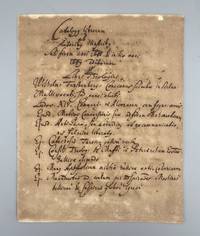
170002965Germany 1700. A single quire unbound evidence of earlier sewing. <p>      LEIBNIZ’S CATALOG OF FIFTY-TWO IMAGINARY BOOKS satirizes European political and military maneuvering in 1688-9 at the outset of the Nine Years’ War. The text was printed in Latin this version and in Latin and German. Together three editions survive in four examples all in German-speaking countries.<br />       Leibniz 1646-1716 grouped the works into theology eighteen law eight medicine ten and philosophy fourteen and closed with two “forthcoming publicationsâ€. The titles’ scholarly veneer hardly disguises his harsh view of contemporary politics. This manuscript copy was likely made between 1691 and 1716 while Leibniz was librarian at Wolfenbüttel then the largest library north of the Alps. Browned the inner bifolium less so.</p> unknown
169141859Leipzig, Grosse & Gleditsch, 1691. 4to. Contemp. full vellum. Faint handwritten title on spine. a small stamp on titlepage. In: ""Acta Eruditorum Anno MDCLXXXXI"". (8),590,(6) pp. and 13 (of 15) folded engraved plates. The 2 first plates lacks, but they do not belong to the papers listed.Leibniz' papers: pp.277-281 a. 1 plate, pp. 435-439. Johann Bernoulli: pp. 274-276 a. 1 plate. Huygens: pp. 281-282. - Jacob Bernoulli: pp. 282-290 a. 1 plate.
169141859Leipzig Grosse & Gleditsch 1691. 4to. Contemp. full vellum. Faint handwritten title on spine. a small stamp on titlepage. In: "Acta Eruditorum Anno MDCLXXXXI". 85906 pp. and 13 of 15 folded engraved plates. The 2 first plates lacks but they do not belong to the papers listed.Leibniz' papers: pp.277-281 a. 1 plate pp. 435-439. Johann Bernoulli: pp. 274-276 a. 1 plate. Huygens: pp. 281-282. - Jacob Bernoulli: pp. 282-290 a. 1 plate. <br/><br/><em>All papers first apperance. All 5 of extreme importence in the development of the Calculus. Leibniz' 2 papers on the catenary curve paper 1-2 offered here was written at the instigation of Jacques Bernoulli. Following the example of Blaise Pascal who had initiated in 1658 a contest for the construction of the cycloid Leibniz also provoked the geometers of his time by challenging them to submit at the fixed date of mid-1691 their geometric method for the construction of the catenary curve. Leibniz later provided the answer followed by Johann Bernoulli and Huygens.'These two papers are a historical account of the origin of the study of this transcendental curve and at the same time the first physical-geometric construction showing the species-relationship between the catenary and the logarithmic curves as two companion curves; one arithmetic the other geometric. All of the differentials of the catenary curve are arithmetic means of corresponding differentials of the logarithmic curve; and all of the differentials of the logarithmic curve are geometric means of the catenary.'"The Catenary is the form of a hanging fully flexible rope or chain the name comes from "catena" which means 'chain' suspended on two points. The interest in this curve originated with Galileo who thought that is was a parabola. Young Christiaan Huygens proved in 1646 that this cannot be the case. What the actual form was remained an open question till 1691 when Leibniz Johann Bernoulli and the then much older Huygens sent solutions to the problem to the "Acta" Jakob Bernoulli 1690 Johann Bernoulli 1691 Huygens 1691 and Leibniz 1691 - these 4 1691-papers offered here - in which the previous year Jakob Bernoulli had challenged mathematicians to solve it. As published the solutions did not reveal the methods but through later publications of manuscripts these methods have been known. Huygens applied with great paper 4 virtuosity the by then classical methods of 17th century infinitesimal mathematics and he needed all his ingenuity to reach a satisfactory solution. Leibniz the papers 1-2 and Bernoulli paper 3 applying the new Calculus found the solutions in a much direct way. In fact the catenary was a test-case between the old and the new style in the study of curves and only because the champion of the old style was a giant like Huygens the test-case can formally be considered as ending in a draw." Grattan-Guiness in "From the Calculus to Set Theory 1630-1910.".The paper by JACOB BERNOULLI no. 5 offered here is a milestone papers as it marks the invention of the "SYSTEM OF POLAR COORDINATES" with points located by reference to a fixed point and a line through that point. Although newton had earlier also devised such a coordinate system in 1671 his work was not known so that the credit for the discovery generally goes to Bernoulli. Parkinson Breakthroughs 1691.Further papers contained in this volume of Acta Eruditorum:DENYS PAPIN: Mecanicorum de Viribus Motricibus sententia asserta a D. Papino adversius C.G.G. L. Leibniz objectiones. pp. 6-13. The plate lacks. - and Dion. Papini Observationes quaedam circa materias ad Hydraulicam spectantes. Pp. 208-213 a. 1 plate. This importent paper is part of the LEIBNIZ-PAPIN-CONTROVERSY.JACOB BERNOULLI: Specimen Calculi Differentialis in dimensione Parabolæ helicoidis ubi de flexuris curvarum in genere carundem evolutionibus. Pp. 13-22. The plate lacks. - and J.B. Demonstratio Centri Oscillationis ex Natura Vectis reperta occassione eorum quæ super hac materia in Historia Literaria Roterodamensi recensentur articulo.Pp.317-321.LEIBNIZ: O.V.E. Additio ad Schediasma de Medii Resistentia publicatum in Actis mensis Febr. 1889. Pp. 177-178. and O.V.E. Quadratura Arithmetica Communis Sectionum Conicarum quæ centrum babent.Pp. 178-182 a. 1 plate.TSCHIRNHAUS: Singularia Effecta Vitri Caustici bipedalis quod omnia magno sumtu hactenus constructa specula ustoria virtute superat per D.T. Pp. 517-520 </em> hardcover
169632Hannov. et Gurlpherpit Hannover Wolfenbütte: Gothofredi Freytagii Gottfried Freytag 1696. First edition. Papered spine. Printer’s device on last page. In fine condition. First edition. Papered spine. Printer’s device on last page. 8º; a1–b8 c1–3 .; 37 1 p. <p><br /> Scarce pharmacological work on the ipecacuanha root that can be used as an emetic nauseant expectorant and diaphoretic. <br /> <p><p><br /> “Relatio ad inclytam Societatem Leopoldinam Naturae Curiosorum de novo antidysenterico Americano magnis successibus comprobato†Relation to the Illustrious Leopoldine Society of Naturalists Concerning the New American Anti-Dysentery Drug Attested with Great Success is Leibniz’s most comprehensive and influential contribution to the history of medicine and pharmacy. <br /> <p><p><br /> Leibniz wrote the treatise after he read the study on ipecacuanha root written by Willem Piso and Georg Marggraf published in Historia naturalis Brasilia 1648 and evidently after conducted experiences with the root himself. The root was made famous after it was used successfully to treat the King of France Louis XIV’s dysentery in 1672 by the Dutch physician John Frederick Helvetius 1625–1719. <br /> <p><p><br /> The work has been published in the same year as an appendix to Martin Lister’s “Sex exercitationes medicales de quibusdam morbis chronicis†Frankfurt and Leipzig 1696 and also to “Miscellanea curiosa sive Ephemeridum medico-physicarum Germanicarum†Nuremberg 1696. Lister’s work was printed by Freytag too the difference is merely the lack of the colophon on the “Lister-editionâ€.<br /> <p><p><br /> Ref.: Smith J. E. H.: Divine Machines. Leibniz and the Sciences of Life. Princeton University Press 2011.; Dutens II. 2. pp. 110–119.; Ravier 36.<br /> <p>. Gothofredi Freytagii (Gottfried Freytag) unknown
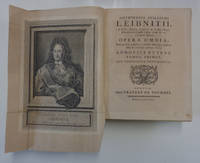
1768009245<p>Genevae: Apud Fratres De Tournes 1768. Alla pagina di occhiello: "Gothofredi Guillelmi Leibnitii Opera omnia. In sex tomos distributa". Sei tomi in sette volumi 25x20 cm legatura coeva in mezza pelle con dorso ornato e dorato piatti in cartone marmorizzato con usure; un paio di volumi risultano incurvati qualche spellatura alla cerniera e al dorso di due volumi. Gora vistosa al tomo 1 da pag. C a 70 che ha increspato le pagine che poi sfuma in angolo. Gora al margine delle prime pp del tomo 2 fino a p. 18 e poi all'angolo superiore di p. 219-307. Foretto di tarlo senza gravità all'angolo inferiore delle pp 9-30 del tomo 3. Fioriture e tracce di antica umidità alle risguardie dei primi due tomi. 40 tavole in b/n ripiegate fuori testo altre figure e tabelle anche a piena pagina nel testo. Il legatore settecentesco ha scelto di dividere il tomo IV in due volumi numerati 4 e 5 al dorso con la conseguenza di far "slittare" anche i numeri degli ultimi due tomi numero 6 per il tomo V e numero 7 per il tomo VI. L'opera è così articolata: Volume 1: Tomus primus quo theologica continentur. 2-IV-CCXLIV-790 pagine antiporta incisa ripiegata con ritratto di Leibnitz. Segnatura: a-gg4 hh2; A-Ggggg4 - Volume 2: Tomus secundus in duas partes distributus quarum 1. Continet Logicam & Metaphysicam; 2. Physicam generalem Chymiam Medicinam Botanicam Historiam Naturalem Artes &c. 2-VIII-400-291-1 pagine 12 tavole ripiegate in fine. Segnatura: 2ast.4 A-Ddd4 Tomo II parte I; A-Nn4 Oo2 Tomo II parte II - Volume 3: Tomus tertius continens opera mathematica. 2-VIII-LV-1-663-1 pagine XXV tavole ripiegate in fine. Segnatura: piè di mosca4 a-Oooo4 - Volumi 4 e 5: Tomus quartus in tres partes distributus quarum 1. continet Philosophiam in genere & opuscula Sinenses attingentia. 2. Historiam & Antiquitates. 3. Jurisprudentiam. Volume 4: VIII-216-285 pagine; segnatura: 2piè di mosca4 A-Dd4 Tomo IV parte I; A-Nn4 Tomo IV parte II. Volume 5: 2-647-1 pagine; segnatura: A-Mmmm4 Tomo IV parte III - Volume 6: Tomus quintus continens opera philologica. VIII-632 pagine; segnatura: croce latina4 A-Kkkk4. Tra le pagine 512 e 513 è stata inserita dal rilegatore una tavola pertinente al Tomo IV l'esatta posizione è stata tagliata dalla rifilatura - Volume 7: Tomus sextus in duas partes distributus quarum 1. continet philologicorum continuationem 2. collectanea etymologica. VI-2-334 2-344 pagine; segnatura: 2croce latina4 A-Tt4 parte I A-Vv4 Parte II. Tra le pagine 88 e 89 è stata inserita dal rilegatore una tavola pertinente al Tomo IV parte II pagina 88. In lingua latina prima edizione delle opere di Leibniz. Peso: 9500 gr.</p> Apud Fratres De Tournes
59436Amsterdam et Leipzig: Chez Jean Schreuder 1765. FIRST EDITION THUS. Large 4to.26 x 19.5 cm. pp.xvi2 Table & Errata54016Table des Principales Matières. Contemporary full mottled calf sides ruled in blind spine with raised bands and gilt-decorated with floral motifs red morocco label lettered in gilt marbled endpapers and edges. Title-page printed in red and black. Engraved vignette to title-page by O. de Vries decorative woodcut head-pieces culs-de-lampe and initials throughout. Lightly rubbed a few tiny wormholes to foot of spine occasional browning and light spotting generally an excellent copy in a handsome contemporary binding. First edition thus being the first collected edition of Leibnitz' philosophical works in French and Latin and containing the FIRST PRINTING of one of Leibnitz' most important philosophical works his "Nouveaux essays sur l'entendement humain" a riposte to John Locke's "Essay on Human Understanding" which Leibniz had read in Pierre Coste's celebrated French translation of 1704. "The New Essays.are a detailed commentary on Locke's Essay and thus represent an almost unique case in which one major philosopher produces a paragraph-by-paragraph critique of the principal work of another. Leibniz had practically completed the manuscript by 1704 but after learning that Locke had died he apparently lost interest in publishing it. He put it aside and it did not appear in print until 1765 nearly fifty years after his death" Benson Mates. Written directly in French this extensive treatise pp.1-496 comprises most of this collection and also constitutes one of the largest and most important of Leibniz's philosophical contributions being in addition to the Theodicy one of only two full-length works which Leibniz ever produced. Like many philosophical works of the time it is written in dialogue form. The two speakers in the book are Theophilus "lover of God" who represents the views of Leibniz and Philalethes "lover of truth" who represents those of Locke. The famous rebuttal to the empiricist thesis about the provenance of ideas appears at the beginning of Book II: "Nothing is in the mind without being first in the senses except for the mind itself". All of Locke's major arguments against innate ideas are criticized at length by Leibniz who defends an extreme view of innate cognition according to which all thoughts and actions of the soul are innate. In addition to his discussion of innate ideas Leibniz offers penetrating criticisms of Locke's views on personal identity free will mind-body dualism language necessary truth and Locke's attempted proof of the existence of God. The Encyclopedia of Philosophy IV p. 431. Amsterdam et Leipzig: Chez Jean Schreuder, 1765. hardcover
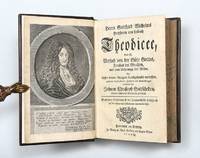
1744149335Hanover & Leipzig: In Verlag sel. Nicol. Försters und Sohns Erben 1744. The first appearance of the standard text First Gottsched edition of the Théodicée first 1710 the version which remains the standard German text expanded with important additions. The Sprachreformer Johann Christoph Gottsched aimed at freeing the text from the inaccessibly convoluted metaphysical language of Richter's translation 1720. Fontenelle's eulogy to Leibniz introduces the text while addressing the Newton-Leibniz controversy over priority in the discovery of differential calculus. The appendix adds several short works by Leibniz relevant to the issues dealt with in the Théodicée; of those four appear here in German for the first time. The choice of essays reflected Gottsched's plan to integrate Leibniz's mathematical-scientific and metaphysical work: included in the selection are works on the binary system the fundamental and typographically complex Rechnung mit Null und Eins and the description of Leibniz's invention the first calculating machine capable of performing all four arithmetical operations accompanied by an engraved plate. Octavo 181 x 112 mm. With engraved portrait frontispiece by C. F. Boctius and engraved folding plate of the calculating machine. Twentieth-century sheep to style marbled and speckled edges. Light peripheral rubbing small chip to label lettered over light toning and sporadic foxing but contents generally crisp; a very good copy. Ravier 421; Fromm VI 28315; see Printing and the Mind of Man 177 first edition. unknown
174731752AB1747. First English Edition. London Printed for R.Dodsley 1747. Octavo. 72 pages. Modern cloth. The bookblock with signs of stitching to the inner margin possibly used to be part of a Sammelband. Last three leaves with paper-restoration and manuscript inscription to last page looks like a 18th century gift-inscription. With numerous manuscript - annotations in the tracts of George Berkeley namely in "A Word to the Wise" "Farther Thoughts on Tar-Water" "The Querist". From the library of Daniel Conner Manch House County Cork. Bound with: "Berkeley George Bishop of Coyne - "A Miscellany Containing Several Tracts on Various Subjects. By the Bishop of Cloyne. London Printed for J. and R. Tonson and S.Draper 1752. VI 267 1 pages. Title-page witme minor paper-restoration. This wonderful collection by the eminent ANglo-Irish Philosopher includes the following Pamphlets / Tracts as called for: 1. Farther Thoughts on Tar-Water 2. An Essay towards preventing the Ruin of Great-Britain 3. A Discourse addressed to Magistrates and Men in Authority. Occasioned by the enormous Licence and Irreligion of the Times. 4. A Word to the Wise - Or an Exhortation to the Roman Catholic Clergy of Ireland This section "A Word to the Wise" includes several interesting annotations: a. an underlining of the sentence: "Seeing you are obnoxious of the Law" with a comment "Oh! infamous" b. annotation: "the catholic clergy cannot be accused even by there greatest enemies of having been influenced by interested motives therefore this hint of his lordship was not of much avail" 5. A Letter to the Roman Catholics of the Diocese of Cloyne 6. Maxims concerning Patriotism 7. The Querist - Containing several Queries proposed to the Consideration of the Public 8. Verses on the Prospect of Planting Arts and Learning in America 9. A Proposal for the better supplying of Churches in our Foreign Plantations and for converting the Savage Americans to Christianity by a College to be erected in the Summer Islands otherwise called The Isles of Bermuda 10. A Sermon preached before the Incorporated Society for the Propagation of the Gospel in Foreign Parts; at their Anniversary Meeting in the Parish-Church of St.Mary-le-Bow in 1731 11. De Motu ; sive de motus principio & natura & de causa communicationis motuum ______________________________________________________________________________ hardcover
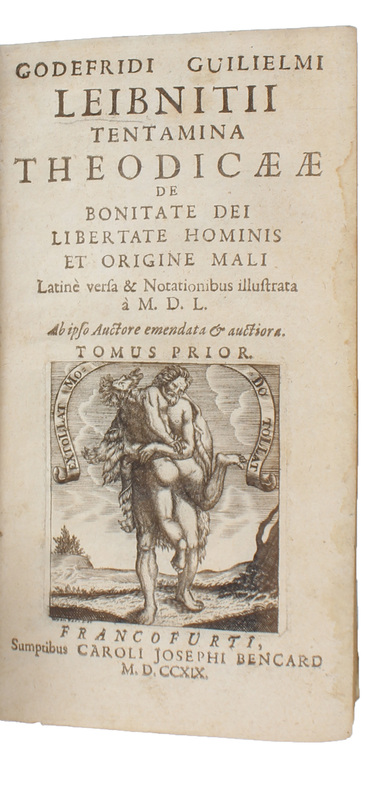
171949802Franckfurt, Bencard, 1719. 8vo. Contemp. full vellum. A few small brownspots to covers. Large engraved titlevignette. (48),(40),408,(12) pp. 1 folded table (between p.48/49). Clean and fine.
171949802Franckfurt Bencard 1719. 8vo. Contemp. full vellum. A few small brownspots to covers. Large engraved titlevignette. 484040812 pp. 1 folded table between p.48/49. Clean and fine. <br/><br/><em>Extremely scarce first Latin edition of Leibniz's hugely influential work "Essais de Theodicée sur la Bonté de Dieu la Liberté de L'Homme et L'Origine du Mal" 1710. It is his importent treatise on the goodnes of God the free will of man and the causes of evil in the world The principal subject of the work being the problem of liberty and free will. It is the only larger philosophical work published by Leibnitz himself.The "Théodicée" was a response to skeptical Pierre Bayle who wrote in his work Dictionnaire Historique et Critique that after rejecting three attempts to solve it he saw no rational solution to the problem of evil.The work was composed at the instigation of Sophia Charlotte with whom Leibniz had conversed concerning the views of Bayle. In response to a request from Prince Eugene for an abstract of the Théodicée Leibniz in 1714 wrote the "Principes de la nature et de la grâce fondées en raison and the Monadologie".It is often the case that this Latin edition is followed by the small work "Causa Dei Asserta per Justitiam Ejus." 32 pp. This work is not withbound here.Ravier "Bibliographie des Oeuvres de Leibniz" No 344. - PMM 1710-edition. </em> hardcover
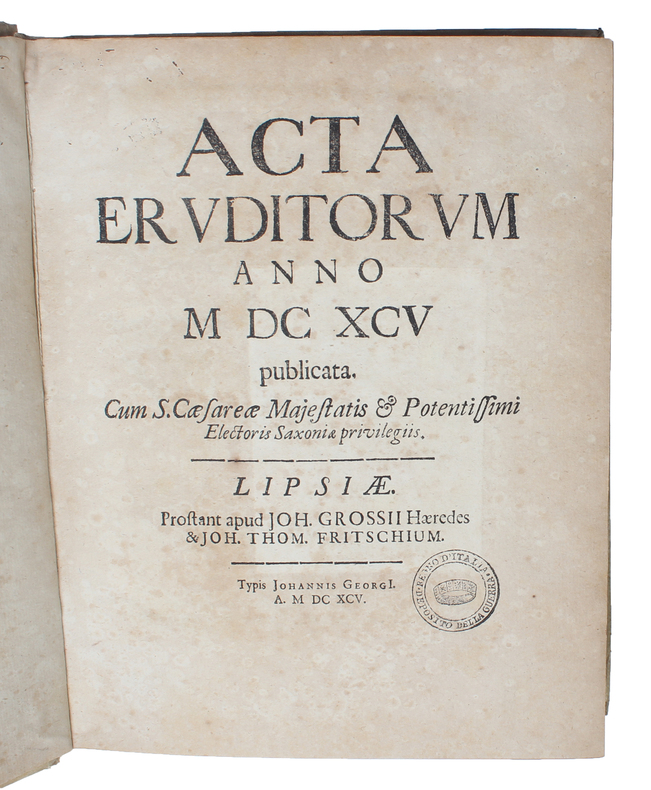
169542860Leipzig, Grosse & Gleditsch, 1695. 4to. Contemp. full vellum. Faint handwritten title on spine. A small stamp on titlepage and pasted library label to pasted down front free end-paper. In: ""Acta Eruditorum Anno MDCXCV"". (2), 560, (52) pp. + 10 plates. As usual with various browning to leaves and plates. The entire volume offered. Leibniz's papers: pp. 145-57" 184-185 310-316 369-372 493-495. Jacob Bernoulli's paper: pp. 537-553 + one folding table 65-66. Johann Bernoulli's: pp. 59-65" 374-376.