Leibniz, Gottfried WilhelmBiblio.com

1 705 résultats
1016326963.Ghardcover. Good. Access codes and supplements are not guaranteed with used items. May be an ex-library book. hardcover
1018257284.Ghardcover. Good. Access codes and supplements are not guaranteed with used items. May be an ex-library book. hardcover
1019187352.Ghardcover. Good. Access codes and supplements are not guaranteed with used items. May be an ex-library book. hardcover
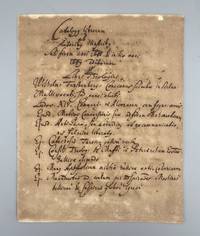
170002965Germany 1700. A single quire unbound evidence of earlier sewing. <p>      LEIBNIZ’S CATALOG OF FIFTY-TWO IMAGINARY BOOKS satirizes European political and military maneuvering in 1688-9 at the outset of the Nine Years’ War. The text was printed in Latin this version and in Latin and German. Together three editions survive in four examples all in German-speaking countries.<br />       Leibniz 1646-1716 grouped the works into theology eighteen law eight medicine ten and philosophy fourteen and closed with two “forthcoming publicationsâ€. The titles’ scholarly veneer hardly disguises his harsh view of contemporary politics. This manuscript copy was likely made between 1691 and 1716 while Leibniz was librarian at Wolfenbüttel then the largest library north of the Alps. Browned the inner bifolium less so.</p> unknown
101943256X.Ghardcover. Good. Access codes and supplements are not guaranteed with used items. May be an ex-library book. hardcover
1023919702.Ghardcover. Good. Access codes and supplements are not guaranteed with used items. May be an ex-library book. hardcover
__3112751361De Gruyter 1964. Hardcover. New. 352 pages. German language. 6.89x0.98x9.69 inches. De Gruyter hardcover
49990543-nnew. unknown
49990543like new. unknown
200626147BB2006 978-3-938793-22-0. Frankfurt/Main: Ontos 2006. 216 S. Pappband sehr gut erhalten unknown
H872Leipzig Grosse & Gleditsch 1697. Acta Eruditorum Anno MDCXCVII. 4to. 594 . mit 4 von 8 Tafeln vorhanden Tafeln 1468. Text komplett S.135/136 in der Paginierung ¸bersprungen - so komplett!. Die wichtigestn Schriften und Beitr‰ge von Leibniz Bernoulli und Newton sind vorhanden: Leibniz G.W.: Communicatio suae pariter duarumque alienarum ad edendum sibi a Dn. Jo. Bernoulli . Solutio problematum a Jo. Bernoullio geometris publice propositorum. S. 201-205 mit 1 gefalt. Tafel;. Leibniz G.W.: Epistola ad Actorum horum Collectores. S.254-256. Bernoulli Johann: Problemapure gemometricum Eruditis propositum. S.95-96. Bernoulli Johann: De Conoidibus et Sphaeroidibus Quedam et c. S.113-118. Bernoulli Johann: Principia Calculi exponentialium seu percurrentium. S. 125-132. Bernoulli Johann: Curvatura radii in Diaphanis non uniformibus solutioque Problematis a se in Actis 1696 . S. 206-211. Bernoulli Jacob: Solutio Problematum fraternorum pecultiari Programmate Cal.Jan. 1697 . S. 211-214. Bernoulli Jacob: Solutio Difficultatis cujusdam circa naturam Flexus contrarii . S.410-412. Bernoulli Jacob: Addenda ad constructionem Problematis Beauniani. S.412-413. Newton Isaack: Excerpta eTransactionibus Philos.Anglig. Jan.1697: Epistola missa ad praenobilem virum d. Carolum Montague Armigerum . Solutio duorum problematum Mathematicorum a Jo. Bernoullio prpositorum. S. 223-224. Weitere Beitr‰ge von Marchio Hospitalius. S.217-218. Erstes Erscheinen der ber¸hmten Ausgabe von Acta Eruditorum in der die vier Lˆsungen der vier damals bedeutendsten Mathematiker zusammen gedruckt wurden. Es gab insgesamt f¸nf Lˆsungen f¸r das gestellte Problem und Newtons Lˆsung wurde erstmals in den Philosophical Transactions Januar 1697 abgedruckt und hier nachgedruckt. Die von L'Hopital vorgeschlagene hier nicht abgedruckte Lˆsung wurde erst 1988 verˆffentlicht. Das Brachistochrone-Problem wurde von Johann Bernoulli in Acta Eruditorum im Juni 1696 gestellt. Er f¸hrte das Problem wie folgt ein: "Ich Johann Bernoulli spreche den brillantesten an." Nichts ist f¸r intelligente Menschen attraktiver als ein ehrliches herausforderndes Problem dessen mˆgliche Lˆsung Ruhm verleihen und als bleibendes Denkmal bleiben wird. Ich hoffe die Dankbarkeit zu gewinnen der gesamten wissenschaftlichen Gemeinschaft indem ich den besten Mathematikern unserer Zeit ein Problem vorlege das ihre Methoden und die St‰rke ihres Intellekts auf die Probe stellt. Wenn mir jemand die Lˆsung des vorgeschlagenen Problems mitteilt werde ich ihn ˆffentlich f¸r lobenswert erkl‰ren. Johann Bernoulli und Leibniz haben Newton mit diesem Problem bewusst in Versuchung gef¸hrt. Angesichts des Streits um die Infinitesimalrechnung ist es nicht verwunderlich dass Johann Bernoulli diese Worte in seine Herausforderung aufgenommen hat: "Es gibt weniger die unsere hervorragenden Probleme lˆsen kˆnnen ja weniger selbst unter den Mathematikern die sich r¸hmen dass Sie haben ihre Grenzen wunderbar erweitert und zwar mithilfe der goldenen Theoreme die ihrer Meinung nach niemandem bekannt waren die aber tats‰chlich schon lange zuvor von anderen verˆffentlicht worden waren. "Laut Newtons Biograph Conduitt lˆste er das Problem auf einem Abend nach der Heimkehr von der Royal Mint. Newton: . "Inmitten der Hektik der groflen Neupr‰gung kam er erst um vier Uhr nachmittags sehr m¸de vom Turm nach Hause schlief aber nicht bis er das Problem gelˆswas um vier Uhr morgens geschah." Newton. Seine Lˆsung schickte er an seinen Freund Charles Montague und Montague verˆffentlichte ihn anonym in den Transaktionen. Auch Newtons Lˆsung die hier in der Acta vorgestellt wird ist anonym. Die Episode gefiel Newton nicht wie er sp‰ter schrieb: "Ich mag es nicht von Ausl‰ndern ¸ber mathematische Dinge bel‰stigt und geh‰nselt zu werden." Nach dem Wettbewerb sagte Johann Bernoulli: "Mein ‰lterer Bruder stellte den vierten von ihnen zusammen nach Leibniz ihm selbst und Newton dass die drei groflen Nationen Deutschland England und Frankreich jede f¸r sich sich mit mir in einer solchen vereinigen." schˆne Suche alle finden die gleiche Wahrheit."Struik Hrsg. "A Source Book in Mathematics 1200-1800 S. 391 ff. unknown
200583578New Haven and London: Yale University Press 2005. Hardcover. Near Fine. 24 x 15.5 cm. Octavo. xli 178pp. Maroon cloth. Original test Latin French or German opposite English translations. End notes index. A few faint marks to front cover. Yale University Press hardcover
200535388Cumberland Rhode Island U.S.A.: Yale Univ Pr. New. 2005. Hardcover. 0300089589 . FREE UPGRADE to Courier/Priority Shipping Upon Request IN STOCK AND IMMEDIATELY AVAILABLE FOR SHIPMENT - BRAND NEW FLAWLESS COPY NEVER OPENED - - pages -- DESCRIPTION: This volume contains papers that represent Leibnizs early thoughts on the problem of evil centering on a dialogue the Confessio philosophi in which he formulates a general account of Gods relation to sin and evil that becomes a fixture in his thinking. How can God be understood to be the ultimate cause asks Leibniz without God being considered as the author of sin a conclusion incompatible with Gods holiness Leibnizs attempts to justify the way of God to humans lead him to deep discussion of related topics: the nature of free choice the problems of necessitarianism and fatalism the nature of divine justice and holiness. All but one of the writings presented here are available in English for the first time. -- with a bonus offer-- . Yale Univ Pr hardcover
1020678607.Ghardcover. Good. Access codes and supplements are not guaranteed with used items. May be an ex-library book. hardcover
1017658730.Ghardcover. Good. Access codes and supplements are not guaranteed with used items. May be an ex-library book. hardcover
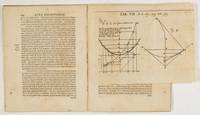
1691614691691. Acta Eruditorum 1691/ 6. - Leipzig Grossium & Gleditsch Juni 1691 4° pp.249-304 3 Kupferstichtafeln feiner Pappband. Erstdrucke dieser sehr wichtigen Arbeiten! 1. Leibniz Gottfried Wilhelm: De linea in quam flexile se pondere proprio curvat ejusque usu insignia ad inveniendas quotcumque medias proportionales & logarithmos. pp.277-281 Tab. VII . Leibniz löst hier das 1690 von Jakob Bernoulli gestellte Problem der Kettenlinie 2. Bernoulli Johann: Solutio problematis funicularii pp.274-276 Tab. VI Fig.1-4. Erste eigenständige Veröffentlichung von Johann Bernoulli. Er beschäftigt sich hier mit der logarithmischen Spirale die er auch wunderbare Spirale "spira mirabilis" nannte. Die vorliegende Arbeit stellt den Beginn der Lehre von den elliptischen Integralen dar. 3. Huygens Christian: Dynastæ in zulechem solutio ejusdem problematis pp.281-282 Tab. VII Fig.2. Hier Huygens' Lösung der Catenaria ohne Zuhilfenahme der Infinitesimalrechnung 4. Bernoulli Jacob: Specimen alterum calculi differentialis in dimetienda spirali ali logarithmica loxodromiis naturarum & areis triangulorum sphæricorum pp.282-29 Tab. VIII. In dieser grundlegenden Arbeit gelingt es Jakob Bernoulli durch die konsequente Einführung der Polarkoordinaten in die Analysis eine Theorie der Evoluten der Kata- und Diakaustiken und der Elastica aufzustellen. Ravier 110 unknown
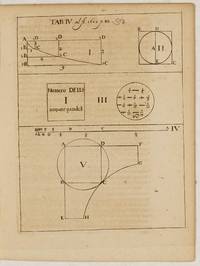
1689614461689. Acta Eruditorum 1689. - Leipzig Grossium & Gleditsch 1689 4° 8 653 7 pp. mit 15 z.T. gefalt. Kupfertafeln feiner Pappand im Stil d.Zt.: frisches Expl. First printing of these extremely important papers in which Gottfried Wilhelm Leibniz 1646-1716 claimed that he independently of Newton had discovered the principal propositions of his "Principia" and which present us with Leibniz's fundamental physico-mathematical theory his dynamics his concepts of force space and time. 1. : De Lineis Opticis et alia; Excerpta ex literis ad pp.36-38 Tab. I Fig. 1 2. : Schediasma de Resistentia Medii Motu projectorum gravium in medio resistente pp.38-46 Tab. I Fig. 2-4. 3. : Tentamen de Motuum Coelestium causis pp.82-96 Tab.II Fig. 1. 4. : De Linea Isochrona in qua grave sine acceleratione descendit & de controversia cum Dn. Abbate D.C. pp.195-198 Tab. IV Fig. 3. The "Tentamen." constitutes Leibniz's response to Newton's theories about the motion of the celestial bodies. Leibniz can be said to have anticipated the modern mathematical principle of relativity as it is his idea of individual co-ordinate systems and his practical rejection of the Galilean co-ordinate system that Newton adopted. Leibniz opposes Newton's ideas of attractions gravitational forces and calls them "occult qualities". The task of the "Tentamen." was to attain a theory mathematically equivalent to Newton's in accounting for planetary motion and especially for the inverse-square law of Kepler's laws but physically sound and capable of explaining the causes of phenomena. Newton attacked Leibniz's claim of priority in his anonymously published paper "Commercium epistolicum" Phil. Transactions 1714 and states that "in those tracts the principal propositions of that book are composed in a new manner and claimed by Mr. Leibniz as if he had found them himself before the publishing of the said book. But Mr. Leibniz cannot be a witness in his own cause. It lies upon him either to prove that he had found them before Mr. Newton or to quit his claim." The features of Leibniz's mathematical representation of motion as put forward in "Tentamen." are -Empty space does not exist. The world is filled with a variety of fluids which are responsible for physical actions including gravity. - Living force and its conservation are the fundamental notion and principle respectively in the investigation of nature however they do not figure prominently in the study of planetary motion. - Finite and infinitesimal variables are regularly employed in the study of motion and of other physical phenomena. Living force and velocity are finite; solicitation and conatus are infinitesimal. - Accelerated motion whether rectilinear or curvilinear is represented as a series of infinitesimal uniform rectilinear motions interrupted by impulses. I call this 'polygonal representation'. Usually the polygon is chosen in such a way that each side is traversed in an equal element of time dt. In polygonal representations accelerations are reduced to a macroscopic phenomenon. - Propositions are often used to safeguard dimensional homogeneity. Constant factors - such as numerical factors mass and the element of time - are usually ignored in the calculations. -cf. D.B. Meli: Equivalence and Priority. Newton versus Leibniz. pp. 90-91. Further we find in this important volume following Papers by Denis Papin - 1. : Descriptio Torcularis cujus in Actis Anni 1688 pag. 646 mentio facta a suit. pp. 96-101 Tab. II Fig. 2 2. : De Gravitatis Causa et proprietatibus Observationes pp.183-188. 3. : Examen Machinæ Dn. Perrault pp.189-195 Tab. IV Fig. 1-3. 4. : Rotatilis Suctor et Pressor Hasciacus in Serenissima Aula Cassellana demonstratus & detectus pp.317-322 Tab. VII Fig. 3-6. This paper describes and depicting Papin's famous invention of the CENTRIFUGAL PUMP 5.: In J.B. Appendicem Illam Ad Perpetuum Mobile Actis Novemb.A. 1688 p. 592. pp.322-324. 6. : Excerpta et Litteris Dn. Dion Papini ad --- de Instrumentis ad flammam sub aqua conservandam pp.485-489 Tab. XI Fig. 2-3. - and 3 papers by Jakob Bernoulli: 1. : De Invenienda Cujusque Plani Declinatione ex unica observatione projectæ a flylo umbræ pp.311-316 Tab. VII Fig. 1-2. 2. : Bernoulli Jakob : Vera Constructio geometrica Problematum Solidorum & Hypersolidorum per rectas lineas & circulos pp.454-459 Tab. X. 3.: Bernoulli Jakob : Novum Theorema Pro Doctrina Sectionum Conicarum. pp.586-588 Tab. XIV. See - Thomas Sonar : The History of the Priority Dispute between Newton and Leibniz: Mathematics . 2018 Ravier 101102103104 unknown
1682600581682. Acta Eruditorum 1682/ 2. - Leipzig Grossium & Gleditsch Februar 1682 4° pp.33-56 1 Kupferstichtafel feine Broschur. First Edition! This was Leibniz first article published in Acta Eruditorum; He deals with mensuration and describes the Leibniz series 1-1/31/5-1/7.=pi/4. Gottfried Wilhelm Leibniz's 1646-1716 Hannover appointment in the Hanoverian service gave him more time for his favourite pursuits. He used to assert that as the first-fruit of his increased leisure he invented the differential and integral calculus in 1674 but the earliest traces of the use of it in his extant note-books do not occur till 1675 and it was not till 1677 that we find it developed into a consistent system; it was not published till 1684. Most of his mathematical papers were produced within the ten years from 1682 to 1692 and many of them in a journal called the Acta Eruditorum founded by himself and Otto Mencke in 1682 which had a wide circulation on the continent. He was one of the true geniuses of modern history. Although his contributions to the development of differential calculus remain his greatest legacy his definition of identity and his work in establishing a formal notation for all mathematics provided the foundation for others like Peano nearly two hundred years later. Ravier 84 unknown
3744622517.Gpaperback. Good. Access codes and supplements are not guaranteed with used items. May be an ex-library book. paperback
1018522735.Ghardcover. Good. Access codes and supplements are not guaranteed with used items. May be an ex-library book. hardcover
3743624885.Gpaperback. Good. Access codes and supplements are not guaranteed with used items. May be an ex-library book. paperback
3787348131.Ghardcover. Good. Access codes and supplements are not guaranteed with used items. May be an ex-library book. hardcover
2006BN74743Meiner 2006. 2006. Der Briefwechsel mit den Jesuiten in China 1689 - 1714. Französisch/Lateinisch-Deutsch. <br/><br/> Meiner unknown
1018527583.Gpaperback. Good. Access codes and supplements are not guaranteed with used items. May be an ex-library book. paperback