Leibniz Fre, Gottfried WilhelmBiblio.com

1 706 résultats
116674468X.Gpaperback. Good. Access codes and supplements are not guaranteed with used items. May be an ex-library book. paperback
1120460085.Gpaperback. Good. Access codes and supplements are not guaranteed with used items. May be an ex-library book. paperback
1845F117210Louvain, C.-J. Fonteyn 1845 x + 210pp., reliure cart. moderne solide (dos décolorié), tranches supérieures rouges, bilingue: latin avec la traduction en français en regard, texte frais sauf très peu de rousseurs, bon état, F117210
16962447Leipzig: Gross & Fritsch 1696. First edition. vellum marbled boards. Very Good. FIRST PRINTINGS OF THE PAPERS DOCUMENTING THE PROPOSAL AND SOLUTION OF THE "BRACHISTOCHRONE PROBLEM" ONE OF THE MOST FAMOUS MATHEMATICAL CHALLENGES AND ONE OF THE EARLIEST PROBLEMS POSED IN THE CALCULATION OF VARIATIONS. The challenge of the brachistochrone "began in June of 1696 when Johann Bernoulli published a challenge problem in Leibniz's journal Acta Eruditorum. Obviously a legacy of public challenge remained from the days of Fior and Tartaglia. Although contests were now conducted in the sedate pages of scholarly journals they retained their power to make or break reputations as Johann himself observed:<br /> <br /> '. it is known with certainty that there is scarcely anything which more greatly excites noble and ingenious spirits to labors which lead to the increase of knowledge than to propose difficult and at the same time useful problems through the solution of which as by no other means they may attain to fame and build for themselves eternal monuments among posterity.'<br /> <br /> "Johann's particular challenge was a good one. He imagined points A and B at different heights above the ground and not lying one directly above the other. There is certainly an infinitude of different curves connecting these two points from a straight line to an arc of a circle to any number of other wavy undulating paths. Now imagine a ball rolling from A down to B along such a curve. The time it take to complete the trip depends of course on the curve's shape. Bernoulli challenged the mathematical world to find that one particular curve AMB along which the ball will roll the shortest time. He called this curve the 'brachistochrone' from the Greek words for 'shortest' and 'time'.<br /> <br /> "An obvious first guess is to take AMB as the straight line joining A and B. But Johann cautioned against this simplistic approach:<br /> <br /> '. to forestall hasty judgment although the straight line AB is indeed the shortest between the points A and B it nevertheless is not the path traversed in the shortest time. However the curve AMB whose name I shall give if no one else discovered it before the end of this year is one well-known to geometers.'<br /> <br /> "Johann gave the mathematical world until January 1 1697 to come up with a solution. However when his deadline arrived he had received but one solution from the 'celebrated Leibniz' who:<br /> <br /> 'has courteously asked me to extend the time limit to next Easter in order than in the interim the problem might be made public . that no one might have cause to complain of the shortness of the time allotted. I have not only agreed to this commendable request but I have decided to announce myself the prolongation and shall now see who attacks this excellent and difficult question and after so long a time finally masters it.'"<br /> <br /> At this point Johann and others were surprised and perhaps a little delighted that they had not received a solution from their English rival Sir Isaac Newton. Wondering if Newton has not noticed the challenge Johann sent Newton directly a personal letter outlining the problem. When Newton received the letter he did not disappoint. As Newton's niece Catherine Conduitt explained:<br /> <br /> "When the problem in 1697 was sent by Bernoulli - Sir I.N. was in the midst of the hurry of the great recoinage and did not come home till four from the Tower very much tired but did not sleep till he had solved it which was by four in the morning."<br /> <br /> "Even late in life and tired from a hectic day's work Isaac Newton triumphed where most of Europe had failed! It was a remarkable display of the powers of the great British genius. He had clearly felt his reputation and honor were on the line; after all both Bernoulli and Leibniz were waiting in the wings to publish their own solutions. So Newton rose to the occasion and solved the problem in a matter of hours. Somewhat exasperated he is reported at one point to have said 'I do not love . to be . teezed by foreigners about Mathematical things.'<br /> <br /> "Back in Europe as Easter neared a few solutions came into the hands of Johann Bernoulli. The curve that everyone was seeking - one that 'is well-known to geometers' - was none other than an upside-down cycloid. This important curve was studied by Pascal and Huygens but neither of these mathematicians had realized that it would also serve as the curve of quickest descent. Johann wrote with characteristic hyperbole '. you will be petrified with astonishment when I say that precisely this cycloid . of Huygens is our required brachistochrone.'<br /> <br /> "On Easter the challenge period had expired. All together Johann had received five solutions. There was his own and the one from Leibniz. His brother Jakob came through perhaps to Johann's dismay with a third and the Marquis de l'Hospital added a fourth. Finally there was a submission bearing an English postmark. Opening it Johann found the solution correct although anonymous. He clearly had met his match in the person of Isaac Newton. Although unsigned the solution bore the unmistakable signs of supreme genius.<br /> <br /> "There is a legend - probably of dubious authenticity but nonetheless of great charm - that Johann partially chastened partially in awe put down the unsigned document and knowingly remarked 'I recognize the lion by his claw.'" Quoted from William Dunham Journey Through Genius: The Great Theorems of Mathematics Wiley 1990 page 199-202.<br /> <br /> The Brachistochrone Papers - the proposal and the solutions included:<br /> <br /> Johann: Supplementum defectus geometria cartesianae circa inventionem locorum; 2. Leibniz: Communicatio suae pariter duarumque alienarum ad edendum sibi primum a Dn. Joh. Bernoullio; 3. Johann: Curvatura radii in diaphanis non uniformibus . ; 4. Jakob: Solutio problematum fraternorum . ; 5. L'Hospital: Solutio problematis de linea celerrimi descensus; 6. Tschirnhaus: De methodo universalia theoremata eruendi . ; 7. Newton: Epistola missa ad praenobilem virum D. Carolum Mountague .<br /> <br /> Note: Newton's solution original appeared in the Philosophical Transactions.

<br /> <br /> Provenance With stamps and withdrawal markings 7-3-1984 from the famous John Crerar Library Chicago. <br /> <br /> In: Acta Eruditorum vol. 15 and 16: no.1 in 15:264-69 1 plate; no. 2 in 16:201-5 1 plate; no. 3 in 16: 206-11; no. 4 in 16:211-17; no. 5 in 16: 217-20; no. 6 in 16: 220-23; no. 7 in 16: 223-24. Leipzig: Gross & Fritsch 1696-1697. The two entire volumes offered. Quarto 208x170 mm. Two volumes in uniform contemporary three-quarter vellum over marbled boards. pp 2 604 and 9 plates; 8 594 and 8 plates. Some heavy worming to pp 324-42 and plate vi of volume 15 which is not part of any of the above mentioned articles. 1697 volume with repaired gutter tear to plate 8; reinforcement to p.449/50 and minor restoration to binding. Some toning throughout as usual with the Acta. In all a very good set. Gross & Fritsch unknown books
169642863Leipzig Grosse & Gleditsch 1696. 4to. Entire volume present. Nice contemporary full vellum. Small yellow paper label pasted to top of spine and library-label to front free end-papers. Internally some browning and brownspotting. Overall a nice and tight copy. Bernoulli paper: pp. 264-69. Leibniz-paper: pp. 45-47. Entire volume: 2 603 1 pp. plates. <br/><br/><em>First printing of the famous 1696-edition of Acta Eruditorum in which Johann Bernoulli published a challenge to the best mathematicians:"Let two points A and B be given in a vertical plane. To find the curve that a point M moving on a path AMB must follow such that starting from A it reaches B in the shortest time under its own gravity."Johann adds that this curve is not a straight line but a curve well known to geometers and that he will indicate that curve if nobody would do so that year. Later that year Johann corresponded directly with Leibniz regarding his challenge. Leibniz solved the problem the same day he received notice of it and almost correctly predicted a total of only five solutions: from the two Bernoullis himself L'Hospital and Newton. Leibniz was convinced that the problem could only be solved by a mathematician who mastered the new field of calculus. Galileo had formulated and given an incorrect solution to the problem in his Dialogo. But by the end of the year Johann had still not received any other solutions. However Leibniz convinced Johann that he should extend the deadline to Easter and that he should republish the problem. Johann now had copies of the problem sent to Journal des sçavans the Philosophical Transactions and directly to Newton. Earlier that year Johann had accused Newton for having filched from Leibniz' papers. Manifestly both Johann and Leibniz interpreted the silence from June to December as a demonstration that the problem had baffled Newton. They intended now to demonstrate their superiority publicly. But Newton sent a letter dated Jan. 30 1697 to Charles Montague then president of the Royal Society in which he gave his solution and mentioned that he had solved it the same day that he received it. Montague had Newton's solution published anonymously in the Philosophical Transactions. However when Bernoulli saw this solution he realized from the authority which it displayed that it could only have come from Newton Bernoulli later remarked that he 'recognized the lion by its claw'. The present volume contains the following articles of interest:Jakob Bernoulli: 1 Observatiuncula ad ea quaenupero mense novembri de Dimensionibus Curvarum leguntur.2 Constructio Generalis omnium Curvarum transcendentium ope simplicioris Tractoriae et Logarithmicae.3 Problema Beaunianum universalius conceptum.4 Complanatio Superficierum Conoidicarum et Sphaeroidicarum.Johann Bernoulli5 Demonstratio Analyticea et Syntetica fuae Constructionis Curvae Beaunianae.6 Tetragonismus universalis Figurarum Curvilinearum per Construitionem Geometricam continuo appropinquantem.Tschirnhaus7 Intimatio singularis novaeque emendationis Artis Vitriariae.8 Responsio ad Observationes Dnn. Bernoulliorum quae in Act. Erud. Mense Junio continentur.9 Additio ad Intimationem de emendatione artis vitriariae. </em> hardcover
169642863Leipzig, Grosse & Gleditsch, 1696. 4to. Entire volume present. Nice contemporary full vellum. Small yellow paper label pasted to top of spine and library-label to front free end-papers. Internally some browning and brownspotting. Overall a nice and tight copy. [Bernoulli paper:] pp. 264-69. [Leibniz-paper:] pp. 45-47. [Entire volume: (2), 603, (1) pp. + plates].
9728288034.Gpaperback. Good. Access codes and supplements are not guaranteed with used items. May be an ex-library book. paperback
199836834Wiesbaden, Franz Steiner, 1998. 136 S. (23 cm) Broschierte Ausgabe
Mm 135x200 Collana "Oscar Studio Mondadori". Brossura originale, xxii-744 pagine. Prefazione all'edizione italiana di Lucio Lombardo Radice, traduzione di Adriano Carugo. Opera in buone-ottime condizioni. SPEDIZIONE IN 24 ORE DALLA CONFERMA DELL'ORDINE.
Mm 135x205 Collana "Biblioteca Einaudi" - Edizione italiana a cura di Alberto Conte. Opera completa in 2 volumi in robusta tela blu, sovraccoperta originale, xxiv-xiv-1470 pagine con numerazione continua. Copia eccellente. Spedizione in 24 ore dalla conferma dell'ordine.
Mm 140x220 Collana " Storia della Scienza " - Prima edizione italiana. Traduzione dall'inglese di Enrico Bellone. Volume in copertina rigida figurata a colori, 295 pagine. Sottolineature e postille a matita sottile in alcune parti, peraltro la copia è in buone condizioni.
198163929Wolfenbüttel: Herzog August Bibliothek 1981. 130 S. 23 x 15 cm. Original-Broschur. (= Wolfenbütteler Forschungen. Herausgegeben von der Herzog August Bibliothek. Band 16.)
Prefazione di Carlo De Frede LIGUORI 1990 356 PP. FONDO DI MAGAZZINO: SEGNI DEL TEMPO ALLA COPERTINA, VOLUME INTONSO, MAI SFOGLIATO Genoveffa Palumbo Genoveffa Palumbo Professore a contratto presso l´Istituto Universitario Orientale di Napoli, ha fatto parte del direttivo della Società Italiana delle Storiche e della commissione ministeriale su Genere, generazione e culture delle differenze. Per i nostri tipi ha pubblicato un libro sui catechismi e le immagini dei peccati (Speculum peccatorum, 1990). Tra i suoi ultimi lavori una ricerca compiuta per la Rai-Eri (Giubileo Giubilei, 1999) che ha ricevuto la menzione speciale al premio internazionale Ostia. Carlo De Frede Carlo De Frede, già professore di storia moderna nell´Università “l´Orientale”, ha dedicato la massima parte delle sue ricerche a Napoli, sua città natale, conosciuta per assiduo e scientifico studio e partecipazione emotiva alla sua vita passata e presente. Ha pubblicato con la Casa Editrice Liguori un libro su Galeazzo di Tarsia (1991) e un altro su Il Decumano Maggiore (2005), che è la rappresentazione storica della più importante strada di Napoli dall´antichità al secolo XVII. Tra le altre sue pubblicazioni: Religiosità e cultura nell´Italia del Cinquecento (1999) e Cristianità e Islam tra la fine del Medio Evo e gli inizi dell´Età Moderna (2002).
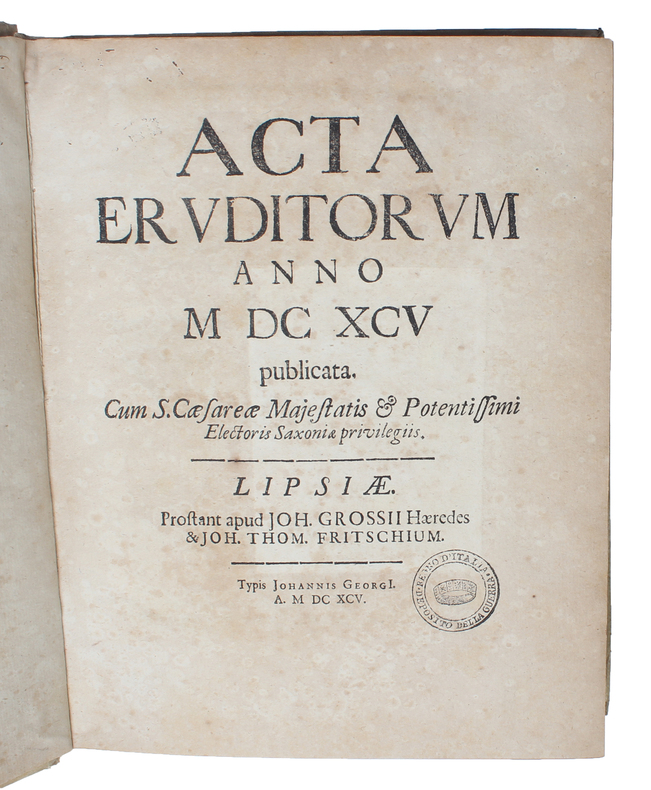
169542860Leipzig Grosse & Gleditsch 1695. 4to. Contemp. full vellum. Faint handwritten title on spine. A small stamp on titlepage and pasted library label to pasted down front free end-paper. In: "Acta Eruditorum Anno MDCXCV". 2 560 52 pp. 10 plates. As usual with various browning to leaves and plates. The entire volume offered. Leibniz's papers: pp. 145-57; 184-185; 310-316; 369-372; 493-495. Jacob Bernoulli's paper: pp. 537-553 one folding table; 65-66. Johann Bernoulli's: pp. 59-65; 374-376. <br/><br/><em>First printing of a series of influential papers by Leibniz Jacob Bernoulli and Johann Bernoulli.First publication of Jakob Bernoulli's famous and influential "Bernoulli Equation". In "Notatiuncula Constructiones Lineae" Bernoulli proposed a solution to non linear equations which today is one of the most common used solutions of the general fluid. Bernoulli equations are significant because they are nonlinear differential equations with known exact solutions. In the "Specimen dynamicum" Leibniz presents a conception of body and force which distinct between primitive and derivative forces and between active and passive forces. This article is regarded as being the clearest exposition of Leibniz' dynamics. DSB VII 151b."The first attempt at a detailed account of the dynamics was a long dialogue the "Phoranomus seu de potentia et legibus naturae" written in July 1689 while Leibniz was in Rome. This was quickly followed be the composition of the massive Dynamica de potential et legibus naturae corporeae 1689-90 . Though it was written with the intention of publication and though Leibniz work at publishing it he never considered it entirely finished and it remained unpublished during his lifetime.The later . he finally revealed some of the metaphysical foundations of the project in an essay the present paper." Garber Daniel. Leibniz: body substance monad. 2009. 132 p."Its title suggests a summary of or a selection from the earlier work . However it actually contains something in a way rather more interesting: a careful exposition of the metaphysical foundations of the new science something that is hard to find in the old Dynamica or any of the more Technical pieces." Garber Daniel. Leibniz: Body Substance Monad. 2009. 133 p. </em> hardcover
51349389like new. unknown
378734831X.Gpaperback. Good. Access codes and supplements are not guaranteed with used items. May be an ex-library book. paperback
169542860Leipzig, Grosse & Gleditsch, 1695. 4to. Contemp. full vellum. Faint handwritten title on spine. A small stamp on titlepage and pasted library label to pasted down front free end-paper. In: ""Acta Eruditorum Anno MDCXCV"". (2), 560, (52) pp. + 10 plates. As usual with various browning to leaves and plates. The entire volume offered. Leibniz's papers: pp. 145-57" 184-185 310-316 369-372 493-495. Jacob Bernoulli's paper: pp. 537-553 + one folding table 65-66. Johann Bernoulli's: pp. 59-65" 374-376.
200626149BB2006 978-3-938793-26-8. Frankfurt/Main: Ontos 2006. 8°. X 157 S. Pappband sehr gut erhalten =Process thought ; Vol. 6 unknown
35075471-nnew. unknown
35075471like new. unknown
ria9783111280868_inpHardcover. New. New Book; Fast Shipping from UK; Not signed; Not First Edition; N/A hardcover
19682110502150200556Felix Meiner 1968. Soft Cover. Fine. Volume: 1 Felix Meiner paperback
2013221022Frankfurt/Main: Klostermann 2013. XXXVIII, 894 S. Ln.mS.
1967100135863Unione Tipografico-editrice Torinese 1967. Bon état couverture défraîchie intérieur propre premier plat du tome 1 recollée. in8. 1967. Broché. 2 volumes. Unione Tipografico-editrice Torinese unknown