Leibniz, Gottfried WilhelmBiblio.com
1 706 résultats
2858162115.Gpaperback. Good. Access codes and supplements are not guaranteed with used items. May be an ex-library book. paperback
1016446454.Ghardcover. Good. Access codes and supplements are not guaranteed with used items. May be an ex-library book. hardcover
A9780226113012Paperback / softback. New. Presents the English translation of "Protogaea" a central text in natural philosophy and an account of terrestrial history. paperback
6677408University of Chicago Press pp. 216 . Papeback. New. University of Chicago Press unknown
7760244-nnew. unknown
7760244like new. unknown
0226113019.Gpaperback. Good. Access codes and supplements are not guaranteed with used items. May be an ex-library book. paperback
2010x-0226113019Univ of Chicago Pr 2010. Paperback. New. 173 pages. 8.75x6.00x0.75 inches. Univ of Chicago Pr paperback
2010SONG0226113019University of Chicago Press 2010-11-15. paperback. Used: Good. 6.00x0.60x9.00. Buy with confidence. Excellent Customer Service & Return policy. University of Chicago Press paperback
2010DADAX0226113019University of Chicago Press 2010-11-15. paperback. New. 6.00x0.60x9.00. Buy with confidence. Excellent Customer Service & Return policy. University of Chicago Press paperback
20221754371Brill 2022-07-21. hardcover. New. 6x0x9. Brill hardcover
Bologna, Il Mulino, 1965, in-8, brossura editoriale, pp. XXVI, 402, [2]. "Saggi", 50. Ottime condizioni.
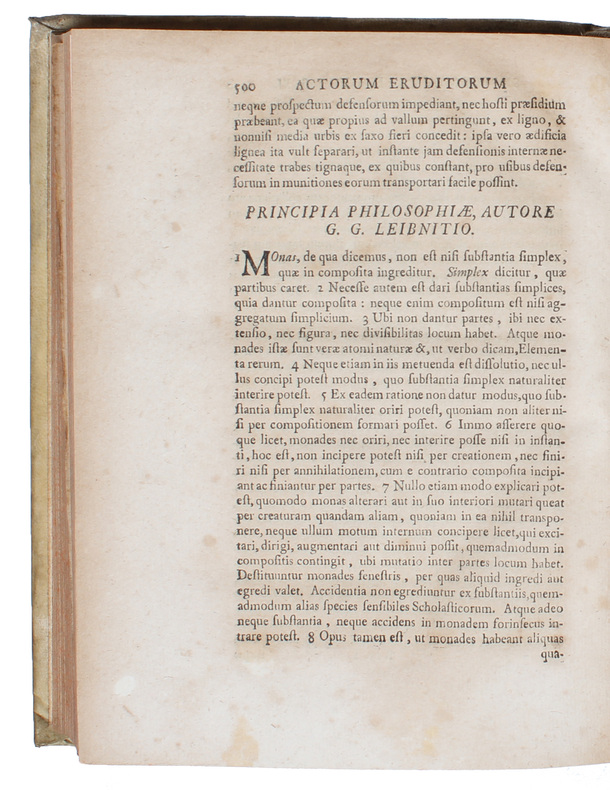
172149396Leipzig, 1721. 4to. Both entire volumes (Acta Eruditorum 1721 + Supplementa VII, 1721) present, in uniform contemporary full vellum bindings with handwriting to spines. A small later label to top of spines. Old handwritten ex libris-inscription to top of both title-pages as well as a small stamp. The supplement-volume with an additional stamp to title-page, and both volumes with library label (Archiv des k.k. militär.-geograf Institutes) to pasted down front free end-paper. As usual some brownspotting. A nice set. pp. 500-514 (Supplement-vol.) + pp. 94-95. [Entire volumes: (2), 537, (39) pp. + three plates (Suppl.-vol.) + (4), 547, (42) pp. + five plates].
172149396Leipzig 1721. 4to. Both entire volumes Acta Eruditorum 1721 Supplementa VII 1721 present in uniform contemporary full vellum bindings with handwriting to spines. A small later label to top of spines. Old handwritten ex libris-inscription to top of both title-pages as well as a small stamp. The supplement-volume with an additional stamp to title-page and both volumes with library label Archiv des k.k. militär.-geograf Institutes to pasted down front free end-paper. As usual some brownspotting. A nice set. pp. 500-514 Supplement-vol. pp. 94-95. Entire volumes: 2 537 39 pp. three plates Suppl.-vol. 4 547 42 pp. five plates. <br/><br/><em>The highly important first Latin translation of Leibnitz' seminal "The Monadology" - his main philosophical work and the work that stands as the epitomization of anti-materialism - which was not published in the original French until 1814 and which only appeared in a German translation exceedingly scarce in 1720 and in a Latin translation by Christian Wolff in 1721 as it is here. Up until then Leibnitz' key philosophical text had only circulated in manuscript form written in 1714. - Here sold together with Wolff's anonymously written review of the German version of the "Monadology" which had great impact upon the reception of the seminal philosophical text that is the "Monadology"."Until the XXth century criticism about Leibniz's "Principles of Nature and Grace" and "Monadology" has been characterised by a number of mistakes and misunderstandings which have roots in the circumstances surrounding the genesis of these manuscripts. As a consequence erroneous information about these texts was included in an anonymous review published in 1721 in the "Acta eruditorum" of Leipzig. Research on primary sources proves that the author of this review who was in fact the author of the latin translation of the Monadology published immediately afterwards was Christian Wolff who was in possession of a copy of Leibniz's manuscript as early as 1717. Wolff's initiative of translating the Monadology can be seen as part of a cultural strategy aiming to prevent any idealistic interpretation of Leibniz's monadological thought. From this point of view to consider the theory of pre-established harmony as based on a system of strictly dualistic metaphysics was an essential element of Wolff's philosophical strategy."Antonio Lamarra: Contexte génétique et première reception de la "Monadologie". Leibniz Wolff et la doctrine de l'harmonie préétablie". During his last stay in Vienna from 1712 to September 1714 Leibniz wrote two short texts which were meant as concise expositions of his philosophy namely the "Principes de la Nature et de la Grace fondés en raison" written as a letter to Prince Eugene of Savoy and the work we now know as the "Monadology" which he had been asked to write by Nicolas Redmond Duke of Orleons - the latter being the work that established Leibnitz' fame as a philosopher and which has gone down in history as not only as one of the most important philosophical texts of the 18th century but also arguably the most important work of immaterialism. After his death "Principes de la Nature et de la Grace fondés en raison" appeared in French in the Netherlands. Without having seen this publication Christian Wolff and collaborators had assumed that it contained the French original of the "Monadology" as well although this in fact remained unpublished until 1840. Thus it happened that Leibnitz' key philosophical text which came to be known as "The Monadology" was printed in German and Latin ab. 120 years before it appeared in the original French. The German translation appeared in 1720 as "Lehrsätze über die Monadologie" and the following year the Latin translation appeared in Acta Eruditorum as "Principia philosophiae". Three manuscript versions of the text exist: the first written by Leibniz and overcharged with corrections and two further emended copies with some corrections appearing in one but not the other. "Leibniz was one of the last "universal men" of the type which the Italian Renaissance had ideally postulated: philosopher historian mathematician scientist lawyer librarian and diplomat. In all these fields either all his actual achievements or his seminal suggestions have become part and parcel of European thought. Although trained for the law mathematics was his favourite subject. Independently of Newton he worked out the infinitesimal calculus introduced a number of mathematical symbols now in general use and constructed an early calculating machine the ancestor of our computers. Mathematical conceptions also determine his philosophy. In it Leibniz tried to combine physics and metaphysics and to reconcile philosophy and theology. The "essay on a Theodicy" is the only larger philosophical work published by himself; but his fame as a philosopher rests on his "Theory of Monads". The original French text of this was published for the first time in 1840; but it had circulated in manuscript in its initial form of a letter addressed to Prince Eugene of Savoy 1714 and it was printed in German 1720 and Latin 1721 translations. Leibniz proclaimed a "pre-established harmony" of the universe which he explained as composed of hierarchically ordered "monads" i.e. the ultimate substances of mind as well as matter. This concept clearly reflects the ideal of the properly organized absolutist state of the baroque period and derives partly from the "idées simples" of Descartes whom Leibniz greatly admired. A generation later Voltaire ridiculed the "pre-established harmony" in "Candide"; but modern nuclear science has vindicated Leibniz's basic ideas albeit from different presuppositions." Printing and the Mind of Man pp. 105-6. The "Monadology" is an extremely condense work that consists of 90 in this Latin version 93 numbered sections/paragraphs which outline a metaphysics of a single substance. The Monadology ends the dualistic mind-body-problem of Descartes and offers a new solution to the question of the interaction between mind and matter by explaining the pre-established harmony and the synchronous not causal relationship between the realm of final causes and that of efficient causes. Leibniz' groundbreaking work came to profoundly influence not only 18th century thought but also much later philosophy and logic. For this we have to thank Christian Wolff the translator of the "Monadology" into Latin and the first reviewer of the work. It is through Wolff and his elaboration of the development of Leibniz' speculative and metaphysical views that Leibniz becomes a recognized figure of importance particularly in Germany from the 1720'ies onwards where Wolff's writings were standardly studied. "Notably Wolff's Leibnizianism made a deep impact on Kant in whose "Critique of Pure Reason" 1781 Leibniz himself came to figure as one of the main targets of Kant's anti-metaphysical programme. In particular Kant saw Leibniz as pretending to "a priori" knowledge of the world as it is in itself and presented his own claim that the only knowledge we can have is of the world as it appears in our experience as sharply opposed to the Leibnizian vision. . today shows that his thought has survived even the extreme empiricism of the Vienna Circle in the 1930s which would have viewed its principal doctrines as unverifiable and hence utterly meaningless. Although not in evidence in the "Monadology" itself one of Leibniz' preoccupations was with the philosophy of logic and language and the twentieth-century's concern for those topics has discovered in what he had to say about them a treasure house of good sense and wisdom which can be detached from the less appealing of his metaphysical speculations. Then more recent writers who have been interested in the metaphysics of possibility and necessity have found inspiration in the Leibnizian image of possible worlds and that too has helped keep his name alive for us." Savile "Leibniz and the Monadology" pp. 6-7. "The long span of Leibniz' intellectual life and his early involvement with philosophy made for engagement with a wide variety of philosophical traditions and issues. Early studies at home exposed him to the thought of the Scholastics; during his university years he was something of a materialist influenced by the atomism of Bacon and Gassendi. In his mid-20s and early 30s becoming disenchanted with the intellectual prospects for materialist thought he turned towards the sort of immaterialism that came to shape his mature thinking after the decade between 1675 and 1685 when he was more narrowly concerned with mathematics than philosophy. It is this anti-materialism that is epitomized in the "Monadology" itself.Although Leibniz produced a prodigious quantity of philosophical writing very little of it was published in his lifetime; indeed very little was intended for publication. For the most part. his philosophical thoughts were prepared for individual scholars he had met or with whom he corresponded and were never presented as a worked-out system. it was not until the last period of his life that he found the time and the impetus to set down the whole which he did in two condensed papers written in French during a visit to Vienna.The more popular and less taxing of these was the "Principles of Nature and Grace Founded on Reason" which he prepared for Prince Eugène of Savoy and the second which he had been asked to write by the councellor of the Duke of Orleans Nicolas Remond but never sent off was the "Principles of Philosophy" or as he called it "Elucidation Concerning Monads" . The title by which that work is known today "Monadology" was not one that Leibniz ever gave it but was invented by the work's first editor Henrich Kohler who published it in a German translation under that title in 1720." Savile "Leibniz and the Monadology" pp. 3-4. "Gottfried Wilhelm Leibniz 1646-1716 was one of the great thinkers of the seventeenth and eighteenth centuries and is known as the last "universal genius". He made deep and important contributions to the fields of metaphysics epistemology logic philosophy of religion as well as mathematics physics geology jurisprudence and history. Even the eighteenth-century French atheist and materialist Denis Diderot whose views were very often at odds with those of Leibniz could not help being awed by his achievement writing in his entry on Leibniz in the Encyclopedia "Perhaps never has a man read as much studied as much meditated more and written more than Leibniz. What he has composed on the world God nature and the soul is of the most sublime eloquence. If his ideas had been expressed with the flair of Plato the philosopher of Leipzig would cede nothing to the philosopher of Athens." "Oeuvres complètes" vol. 7 p. 709 Indeed Diderot was almost moved to despair in this piece: "When one compares the talents one has with those of a Leibniz one is tempted to throw away one's books and go die quietly in the dark of some forgotten corner." "Oeuvres complètes" vol. 7 p. 678 More than a century later Gottlob Frege who fortunately did not cast his books away in despair expressed similar admiration declaring that "in his writings Leibniz threw out such a profusion of seeds of ideas that in this respect he is virtually in a class of his own." "Boole's logical Calculus and the Concept-script" in "Posthumous Writings" p. 9." SEP.Ravier: 357PMM 177b - being the Latin translation </em> hardcover
1986R200001991PUF. 1986. In-8. Broché. Bon état, Couv. convenable, Dos satisfaisant, Intérieur frais. 146 pages.. . . . Classification Dewey : 100-PHILOSOPHIE ET DISCIPLINES CONNEXES
xi + 249pp., 22cm., 2nd ed., in the series "Cambridge texts in the history of political thought", softcover, VG, ISBN 0-521-35899-X, F70801
1989F70801Cambridge, Cambridge University Press 1989 xi + 249pp., 22cm., 2nd ed., in the series "Cambridge texts in the history of political thought", softcover, VG, ISBN 0-521-35899-X, F70801
ria9781350215689_inpHardback. New. New Book; Fast Shipping from UK; Not signed; Not First Edition; In this book Lea Gerhards traces connections between three recent vampire romance series; the Twilight film series 2008-2012 The Vampire Diaries 2009-2017 and True Blood 2008-2014 exploring their tremendous discursive and ideol hardcover
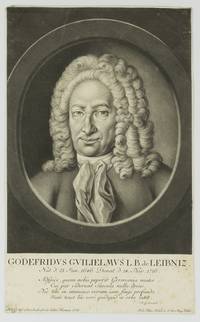
38518Augsburg J. E. Haid 1781. Single sheet 22.0 x 13.4 cm printed on one side. = A fine portrait of the mathematician physicist and philosopher Gottfried Wilhelm von Leibniz 1646-1716. After a drawing by the Austrian painter Johann Gottfried Auerbach 1697-1753 made in 1714 engraved in 1781 by the German painter and engraver Johann Elias Haid 1739-1809. Oval portrait showing Leibniz as a middle-aged man with a Latin poem by the German historian and linguist Johann Georg von Eckhart 1664-1730 here Latinized as Eccard. Eckhart was born in Duingen. After preparatory training at Schulpforta he went to Leipzig where at the desire of his mother he studied theology at first. But he soon turned his attention to philology and history. Owing to his extensive educcation he was useful to Gottfried Leibniz who in 1694 took Eckhart on as his assistant; Leibniz was until death Eckhart's large-hearted patron and generous friend. Through the efforts of Leibniz Eckhart was appointed professor of history at Helmstedt in 1706 and in 1714 councillor at Hannover see Wikipedia. Some minor spotting to the lower end and a faint crease to upper top right corner otherwise very good with a fine strong impression. unknown
19711191388Hildesheim : Olms Verlag, 1971. XXXIV, 610 S.; 25,5 cm. Originalleinen mit Schutzumschlag.
201112978(Berlin), Akademie, (2011). Gr.-8vo. XVIII, 288 S. Illustr. OPp.
ricco di illustrazioni, 380 pagg in ottimo stato, con copertina leggermente macchiata Brossura
Mm 170x240 Rivista internazionale di storia della scienza fascicolo 3. Brossura editoriale di 648-1026 pagine,alcune illustrazioni, piccolo segno d'uso alla testa del dorso. Testo inglese-italiano. Ottimo stato. Spedizione entro 24 ore dalla conferma dell'ordine.
1956299488Chicago: University of Chicago Press 1956. Hard Cover. Near Fine binding/Very Good dust jacket. Two large 8vo volumes; in the publisher’s blue cloth bindings with price-clipped dustjackets; iv v-x; 590 pages including Nores; viii pages; 591-1228 pages including the Index; there is a previous owner name on the endpaper of each volume; the spines of the jackets are darkened we see no previous owner underlining or marks in the text of the books.~~. Near Fine binding / Very Good dust jacket. University of Chicago Press unknown