Leibniz, Gottfried WilhelmBiblio.com
1 706 résultats
102137704X.Gpaperback. Good. Access codes and supplements are not guaranteed with used items. May be an ex-library book. paperback
1019686081.Ghardcover. Good. Access codes and supplements are not guaranteed with used items. May be an ex-library book. hardcover
0666529973.Ghardcover. Good. Access codes and supplements are not guaranteed with used items. May be an ex-library book. hardcover
ria9781018382012_inpHardcover. New. New Book; Fast Shipping from UK; Not signed; Not First Edition; This work has been selected by scholars as being culturally important and is part of the knowledge base of civilization as we know it.This work is in the "public domain in the United States of America and possibly other nations. Withi hardcover
1391173481.Ghardcover. Good. Access codes and supplements are not guaranteed with used items. May be an ex-library book. hardcover
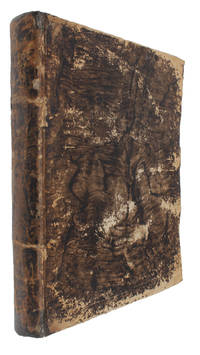
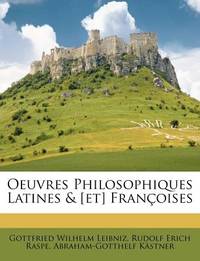
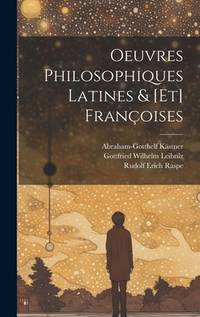
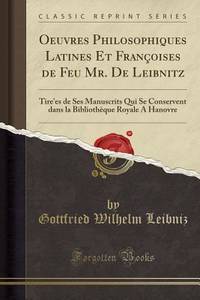
176538096Amsterdam et Leipzig Chez Jean Schreuder 1765. 4to. Uncut in the original marbled boards. Professionally rebacked preserving almost all of the original back. The fragile orginal binding is here preserved in its entirety and it has quite a bit of overall wear. Apart from a small hole to two leaves in the index affecting ab. one work on each of the four pages it is internally nice and clean. Title-page printed in red and black. Beautiful eng. title-vignette and a few other woodcut vignettes and initials. 4 XVI 2 540 18 pp. <br/><br/><em>First edition thus being the first collected edition of Leibnitz' philosophical works in French and Latin and containing the FIRST PRINTING of one of Leibnitz' most important philosophical works his "Nouveaux essays sur l'entendement humain" New Essays on Human Understanding in which he attacks and refutes Locke and his "Essay on Human Understanding" and gives important testimony to his own philosophical ideas. With its 496 pages this extensive work takes up most of this collection of philosophical works and it also constitutes one of his largest and most important of his philosophical works. As explained by Raspe the editor in his preface to this publication "LES NOUVEAUX ESSAIS SUR L'ENTENDEMENT HUMAIN qui sont la partie principale de recueil sont connûs trés imparfaitement par l'histoire de la Philosophie de Leibnitz que Mr. Ludovici a publiée" p. X and the reason why the work was known even though it had not been published is because of a letter that Leibnitz had written in 1714 in which he explains why he did not wish to publish the work. Raspe quotes the letter p. X from which it becomes clear that Leibnitz had not wished to publish an attack on Locke and his work because Locke had died in 1704 the same year that Leibnitz had actually written the work and because Leibnitz was against publishing refutations of dead authors: "Mais je me suis degouté de publier des refutations des Auteurs morts quoiqu'elles dissent paroitre Durant leur vie & étre communiqués à eux memes". Raspe points to the nobleness of this decision but he also points to what could be other reasons for Leibnitz not wishing to publish his seminal work one of them being that towards the end of his life he died in 1716 he did not wish to enter into any more controversies with the British since he was already engaged in two very important ones that occuopied much of his time and energy: The first concerned the invention of the differential calculus the second was against Mr. Clarke on liberty and important metaphysical and theological questions. Another reason could also be that he did not want to begin controversies with the friends of Locke who at that time were many and important.Locke's "An Essay Concerning Human Understanding" which is the work here being refuted by Leibnitz became the crucial groundwork for the future empiricists with David Hume in the foreground and thus Leibnitz' work though published posthumously probably came to play a bigger role in the history of philosophy than it would have done had it been published just after he wrote it. Few philosophers of his time were susceptible to Leibnitz' ideas and his application of logic to the problems of metaphysics as most of them were far more receptive to Locke's empiricism. However when Leibnitz' "Nouveaux essays." was finally published here in his "Oeuvres philosophiques" in 1765 it became hugely influential and was also an important factor in the development of Kant's transcendental philosophy.The hugely famous work by Locke in which he stated his famous theory that the mind of the newborn is like a blank slate tabula rasa and concluded that all ideas come from experience and that there are no such things as innate principles was generally sharply criticized by the rationalists the most important of them being Leibnitz. Leibnitz' response his "Les nouveaux essays sur l'entendement humain" constitutes the most important of the rationalist responses and it is written in the form of a chapter-by-chapter refutation. He refutes the major premise of Locke's work that the senses are the source of all understanding primarily by adding to this "except the understanding itself" thus going on to distinguish between his three levels of understanding which are part of the centre of his philosophy.For Leibnitz as well as for Locke the great inspiration was Descartes but they chose two fundamentally different directions Locke the materialistic one and Leibnitz the idealistic one. The present work represents the greatest clash between the two giants of late 17th century philosophy. The effect of Leibnitz' work was enormous and among the Germans he invoked a great passion for philosophical studies. Leibnitz represents a striking contrast to both Locke with his empiricism and Spinoza. One earlier collection of some of Leibnitz' works had been printed before this one but it did not contain his "New Essays on Human Understanding" and only consisted of his "Smaller Philosophical Works". This is the German 1740-edition "Kleinere philosohische Schriften". The other writings contained in this publication are "Examen du sentiment du P. Malebranche que nous voyons tout en Dieu" ""Dialogus de connexione inter res & verba" "Difficultates quaedam Logicae" "Discours touchant la methode de la certitude & de l'art d'inventer" "Historia et commendatio charactericae universalis quae simul sit ars inveniendi".Graesse IV:152. </em> hardcover
1174252529.Gpaperback. Good. Access codes and supplements are not guaranteed with used items. May be an ex-library book. paperback
1273611624.Gpaperback. Good. Access codes and supplements are not guaranteed with used items. May be an ex-library book. paperback
1143319915.Gpaperback. Good. Access codes and supplements are not guaranteed with used items. May be an ex-library book. paperback
1246175436.Gpaperback. Good. Access codes and supplements are not guaranteed with used items. May be an ex-library book. paperback
ria9782012597402_inpPaperback. New. New Book; Fast Shipping from UK; Not signed; Not First Edition; N/A paperback
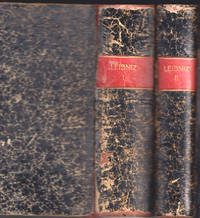
1491-03Paris Alcan 1900. 2me. éd. revue et augmentée. 2 vols. gr.-8°. XXVIII 820; 603 S. Vorderdeckel v. Bd. 2 geknickt. Pbde. d. Zt. m. goldgeprägt. Rückensch. Berieb. Paris, Alcan 1900. unknown
1022254618.Gpaperback. Good. Access codes and supplements are not guaranteed with used items. May be an ex-library book. paperback
1021003263.Ghardcover. Good. Access codes and supplements are not guaranteed with used items. May be an ex-library book. hardcover
1020955295.Ghardcover. Good. Access codes and supplements are not guaranteed with used items. May be an ex-library book. hardcover
1022575023.Gpaperback. Good. Access codes and supplements are not guaranteed with used items. May be an ex-library book. paperback
0282128352.Gpaperback. Good. Access codes and supplements are not guaranteed with used items. May be an ex-library book. paperback
0270865667.Ghardcover. Good. Access codes and supplements are not guaranteed with used items. May be an ex-library book. hardcover
2012597408.Gpaperback. Good. Access codes and supplements are not guaranteed with used items. May be an ex-library book. paperback
46960821like new. unknown
46310144like new. unknown
200610926VB2006. Olms 2006. 540 S. Hardcover. Versand aus Deutschland / We dispatch from Germany via Air Mail. Einband bestoßen daher Mängelexemplar gestempelt sonst sehr guter Zustand. Imperfect copy due to slightly bumped cover apart from this in very good condition. Stamped. hardcover
59436Amsterdam et Leipzig: Chez Jean Schreuder 1765. FIRST EDITION THUS. Large 4to.26 x 19.5 cm. pp.xvi2 Table & Errata54016Table des Principales Matières. Contemporary full mottled calf sides ruled in blind spine with raised bands and gilt-decorated with floral motifs red morocco label lettered in gilt marbled endpapers and edges. Title-page printed in red and black. Engraved vignette to title-page by O. de Vries decorative woodcut head-pieces culs-de-lampe and initials throughout. Lightly rubbed a few tiny wormholes to foot of spine occasional browning and light spotting generally an excellent copy in a handsome contemporary binding. First edition thus being the first collected edition of Leibnitz' philosophical works in French and Latin and containing the FIRST PRINTING of one of Leibnitz' most important philosophical works his "Nouveaux essays sur l'entendement humain" a riposte to John Locke's "Essay on Human Understanding" which Leibniz had read in Pierre Coste's celebrated French translation of 1704. "The New Essays.are a detailed commentary on Locke's Essay and thus represent an almost unique case in which one major philosopher produces a paragraph-by-paragraph critique of the principal work of another. Leibniz had practically completed the manuscript by 1704 but after learning that Locke had died he apparently lost interest in publishing it. He put it aside and it did not appear in print until 1765 nearly fifty years after his death" Benson Mates. Written directly in French this extensive treatise pp.1-496 comprises most of this collection and also constitutes one of the largest and most important of Leibniz's philosophical contributions being in addition to the Theodicy one of only two full-length works which Leibniz ever produced. Like many philosophical works of the time it is written in dialogue form. The two speakers in the book are Theophilus "lover of God" who represents the views of Leibniz and Philalethes "lover of truth" who represents those of Locke. The famous rebuttal to the empiricist thesis about the provenance of ideas appears at the beginning of Book II: "Nothing is in the mind without being first in the senses except for the mind itself". All of Locke's major arguments against innate ideas are criticized at length by Leibniz who defends an extreme view of innate cognition according to which all thoughts and actions of the soul are innate. In addition to his discussion of innate ideas Leibniz offers penetrating criticisms of Locke's views on personal identity free will mind-body dualism language necessary truth and Locke's attempted proof of the existence of God. The Encyclopedia of Philosophy IV p. 431. Amsterdam et Leipzig: Chez Jean Schreuder, 1765. hardcover
2012597416.Gpaperback. Good. Access codes and supplements are not guaranteed with used items. May be an ex-library book. paperback
1018386742.Gpaperback. Good. Access codes and supplements are not guaranteed with used items. May be an ex-library book. paperback