Erasmus, Desiderius; PlutarchBiblio.com
115 résultats
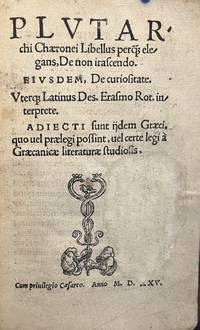
15253072Basileae Basel: apud Ioannem Frobenium 1525. First edition. In later tooled leather. Woodcut device on title page woodcut initials. Pages tanned. The title page and a few tears and wormholes inside are restored loss of letters on e8–f3 no effect on legibility. A blue inkblot at the upper edge of the first 7 leaves. Occasional stains. Near contemporary faint underlines and notes in ink throughout. Printed marginal notes shaved. Overall in good conditio. First edition. In later tooled leather. Woodcut device on title page woodcut initials. Coll.: a4 b–k7 k8 with woodcut device otherwise blank missing; ff. 75. The first edition of Erasmus’ Latin translation of Plutarch’s De curiositate printed together with the original Greek text. Dedicated to the Hungarian nobleman Alexius Thurzo.<br> <br /> <br /> De curiositate is a chapter of Plutarch’s Moralia which Erasmus after getting familiar with the original Greek text as a proofreader of the 1509 Aldina edition started to translate into Latin while in Cambridge in 1511. The first compilation of eight chapters in his translation was published in 1514 in Basel by Froben. The present book besides Erasmus’ Latin translation contains the original Greek text of De curiositate too.<br /> The book is dedicated to Alexius Thurzo Elek Thurzó Bethlenfalvi; 1490–1543 a Hungarian nobleman the Treasurer of the Kingdom of Hungary at the time of the publication between 1523 and 1527 and later the Judge Royal 1527–1543. Alexius Thurzo “and two of his brothers Johannes I bishop of Wroclaw and Stanislaus bishop of Olomouc all became correspondents and patrons of Erasmus and of many humanists in eastern Europe. Unlike his brothers Alexis followed a secular career in the mining business and in public office. After the death of King Louis Il of Hungary in the battle of Mohács 1526 he became an important supporter of the Hapsburg dynasty’s claims in the parts of Hungary not conquered by the Turks. Like his brothers the bishops however he was an active patron of humanistic learning. This dedication was offered at the urging of Jan Antonin of Košice Joannes Antoninus Cassoviensis or János Antal Kassai; 1499–1548/1563 a young physician educated at Padua who had treated Erasmus for kidney stones while visiting Basel in 1524 and who after returning to Hungary and Poland promoted contact between his wealthy patrons and Erasmus.†1572 - The Correspondence of Erasmus<br> <br /> <br /> Extremely scarce Erasmus first edition. RBH records only one copy sold at auction by the Sotheby’s in 1974.<br /> USTC 684281<br> <br /> <br /> Literature: Erasmus D Dalzell A Nauert CG. The Correspondence of Erasmus: Letters 1535-1657 January-December 1525. Toronto Ont: University of Toronto Press; 1994. [apud Ioannem Frobenium] unknown
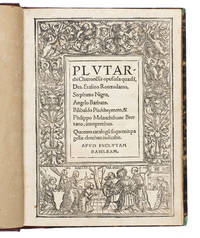
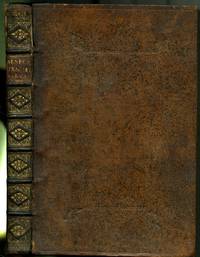
1518ABC_49754Colophon: Basel 1518. 4to. Johann Froben 19th-century richly gold-tooled quarter red morocco and decorated paper sides bound by Gardien in 1863 sewn on 4 supports with corresponding raised bands on the spine with the author title and year lettered in gold on the spine marbled endpapers the whole covered with protective plastic red sprinkled edges and with a green ribbon marker. With a woodcut decorated frame on the title page the first page of the dedication the first page of the text A3r and the first page of the text by Stephanus Niger H2r 18 woodcut decorated initials and a small woodcut illustration incorporating Frobens device. 194 2 pp. An early edition of selected opuscula short philosophical and moral treatises by the Greek author Plutarch of Chaeronea ca. 46-120 CE best known for his Moralia and Parallel lives. The present work brings together Latin translations by multiple Renaissance scholars Erasmus Philipp Melanchthon 1497-1560 Willibald Pirckheimer 1470-1530 Angelo Barbato and Stephanus Niger. It forms part of the earliest wave of humanist publications aiming to make classical Greek thought accessible to Latin readers.Included are four treatises translated by Erasmus himself including his famous version of De tuenda bona valetudine praecepta On the preservation of good health. Particularly notable is Melanchthon's translation of the Convivialem quaestiunculam de notis Pythagoricis a short platonic dialogue dealing with Pythagorean symbols and moral enigmas.With a small catalogue excerpt mounted on the front pastedown including a small modern manuscript note Ex M. Abel le franc an oval black stamp F. Fasting Ex Libris No. added in manuscript: 5080 Rio de Janeiro on the verso of the first free flyleaf and the small stamp of the binder Gardien 1863 on the recto of the second free flyleaf. With some contemporary marginal annotation and underlining of the text. The binding shows slight signs of wear mainly around the corners of the boards slightly browned throughout with minor water stains in the upper outer margins towards the end and brown staining in the upper margins from pages 115 to 169. 3 of the 4 woodcut frames are slightly shaved at the lower margin. Further with a small wormhole in the outer margin from page 127 onward not affecting the text. Overall in good condition.l Adams p. 1653; BM STC German p. 706 ; Vander Haeghen II 46; USTC 684264; VD 16 P 3748; not in: Kossmann; Meyers; De Reuck. hardcover
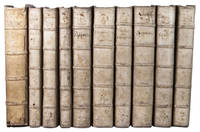
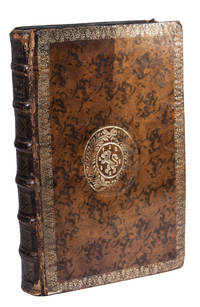
1569ABC_49477Basel: Ambrosius & Aurelius Froben 1569. Contemporary half elaborately blind-tooled pigskin over wooden boards sewn on 5 supports volume 1 on 4 with two brass clasps on the fore edge leather anchor plate brass clasp and catch plate. With the manuscript titles on the spines and the contents of each volume in manuscript on the bottom edge of all but one volume. Probably bound by Michael Hermann in Stuttgart before 1580. See for the workshop einbanddatenbank no. 502297b the rolls used: nos. r004651 and r003964. Folio 38 x 25.5 cm. With the general title page in volume 1 set within an elaborate woodcut frame all other title pages show the large woodcut Froben printer's device repeated on all but one verso of the final page in each part. Further with woodcut decorated initials. 11 parts in 10 volumes. A complete and uniformly bound set of the monumental edition of the complete works of Saint Augustine of Hippo printed by the celebrated Froben press. This edition follows the editorial tradition established by Erasmus and Johann Froben in the early 16th century and reflects the enduring influence of Augustines thought on early modern theology. The present work includes a broad range of Augustines writings: his dogmatic treatises De Trinitate De civitate Dei polemical works notably against Pelagianism and Manichaeism exegetical texts Enarrationes in Psalmos Gospel homilies ascetic and moral discourses and the Epistolae. This edition represents an early attempt to consolidate Augustines vast corpus for academic and ecclesiastical use during period following the Council of Trent. It demonstrates the persistence of Augustinian authority in Reformation-era intellectual life as well as the role of the Swiss printing houses in disseminating patristic texts throughout Europe.Aurelius Augustine 354-430 CE commonly known as Augustine of Hippo was a North African bishop theologian and philosopher widely regarded as one of the most influential figures in Western Christianity and Latin patristic thought. Born in Thagaste modern-day Souk Ahras Algeria Augustine received a classical education in rhetoric and philosophy before embracing Manichaeism and later Neoplatonism.After a period of moral and spiritual searching chronicled in his Confessiones he converted to Christianity in 386 CE under the influence of Ambrose of Milan. He was baptised in 387 ordained a priest in 391 and became bishop of Hippo Regius in 395 a position he held until his death.Augustines vast body of work addresses themes such as original sin grace free will the nature of the Church and the interpretation of Scripture. His most notable writings include Confessiones De civitate Dei the City of God and De Trinitate. His thought shaped the theological foundations of both medieval Catholicism and later Protestant traditions particularly through his doctrines of grace and predestination. He died in 430 CE during the Vandal siege of Hippo. Augustine was later declared a Doctor of the Church and his intellectual legacy remains foundational to Western theology and philosophy.With a manuscript inscription on each of the title pages and a small printed book plate mounted on the front pastedown of volume 1. The bindings are slightly stained and are occasionally slightly bumped and rubbed. The front hinge of volume one is slightly weakened lacking the upper clasp and anchor plate of volume 7 and the front board of volume 9 is slightly damaged along the fore edge. Internally the volumes are variably slightly foxed and/or browned some volumes show very minor water staining most volumes contain some minor worm holes which affect small parts of the letters. A more detailed condition report including collations etc. per volume is available upon request. The 10 volumes are overall in very good condition. A handsome and important Renaissance printing of one of the most significant corpora of Christian antiquity. Rare complete in all ten volumes here uniformly bound.l USTC 686573; VD 16 A 4153; WorldCat 1828402 1406901978 1090145458 1002789099 35656998 222081178 1322263024 1114269923; cf. for the binder see Einbanddatenbank no. 502297b rolls nos. r004651 and r003964. Ambrosius & Aurelius Froben, hardcover
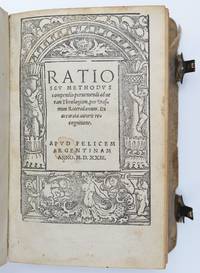
15281361Strasbourg Hagenau: Knobloch; Seltz 1528. Four works in one volume. In contemporary wooden panels with the traces of leather and a codex leaf on spine. Spine with three raised bands. The original copper clasps are presented. The title pages of the first three works by Erasmus with identical architectural borders. Signs on top edge in ink. Old collection stamp on verso of inner front pastedown. Sporadic manuscript marginal notes removed. Occasional underlines in the text throughout. Few stains throughout some leaves tanned. The title page of the fourth work Gebwiler with a tiny loss to the right edge with no effect on the text. Overall in fine condition. Four works in one volume. In contemporary wooden panels with the traces of leather and a codex leaf on spine. Spine with three raised bands. The original copper clasps are presented. The title pages of the first three works by Erasmus with identical architectural borders. <p><br /> Erasmus Desiderius<br /> Ratio seu methodus compendio perveniendi ad veram theologiam. Ratio verae theologiae.<br /> Argentorati Strasbourg: Ioannes Knoblochus Knobloch October 1523. 80 leaves.<br /> <p><p><br /> Bound with:<br /> Erasmus Desiderius<br /> Enchiridion militis Christiani saluberrimis praeceptis refertum ….<br /> Argentorati Strasbourg: Ioannes Knoblochus Knobloch November 1524. 100 leaves.<br /> <p><p><br /> Bound with:<br /> Erasmus Desiderius<br /> Modus orandi Deum. <br /> Argentorati Strasbourg: Ioannes Knoblochus J. Knobloch December 1524. 46 leaves.<br /> <p><p><br /> Bound with:<br /> Gebwiler Hieronymus<br /> Gravissimae sacrilegii ac contemptae theosebiae ultionis ethnicorum Hebraeorum et Christianorum verißimis comprobatae exemplis syngramma …. <br /> Haguenau Wilhelm Seltz 1528. 32 leaves last blank.<br /> <p><p><br /> Three sixteenth-century early Erasmus editions printed by Knobloch bound with Gebwiler’s first edition containing the earliest printed quotation from Hortus deliciarum.<br /> <p><p><br /> The third work in the volume Modus orandi Deum is generally regarded as the central text of Desiderius Erasmus’s teaching on prayer. The present edition dated December 1524 is the second following the first edition issued by Froben in October of the same year. The work circulated widely soon after publication: by the end of 1525 ten further impressions had appeared from presses across Europe. USTC records only eight surviving institutional copies of this December 1524 edition B. Er. I; Mynors 587; Bezzel 1285; Schmidt VII 284; VD16 E 3169; USTC 676366; EON 2424.<br /> <p><p><br /> The first work Ratio seu methodus October 1523 is likewise an early edition. Its editio princeps was published in Leuven by Thierry Martens in November 1518. This Knobloch edition is scarce: USTC records only four copies Augsburg Cambridge Edinburgh Neuchâtel and it is not listed in VD16 USTC 709423; Müller Knobloch 395; Benzing 544.<br /> <p><p><br /> The second work Enchiridion militis Christiani Handbook of the Christian Knight is among Erasmus’ earliest writings first printed in 1503. The preliminaries include all four Latin poems by Thomas More which first appeared together in the Mainz edition of 1520. This edition is also rare: USTC records only five institutional copies VD16 E 2774; USTC 650176.<br /> <p><p><br /> The final work in the sammelband is Gravissimae sacrilegii by Jérôme Gebwiler. Gebwiler is recognized as the earliest scholar to describe Hortus deliciarum Bischoff 1973 p. 13 the illuminated encyclopedic manuscript compiled by Herrad of Landsberg twelfth-century abbess of Hohenburg Abbey Mont Sainte-Odile destroyed in 1870 during the siege of Strasbourg. In this work Gebwiler quotes the dedicatory poem of Hortus deliciarum attributed either to Herrad herself or to Relinda of Hohenburg her predecessor as abbess Griffiths 2013 p. 231. This quotation represents the earliest appearance of the text in print VD16 G 597; USTC 660780.<br /> <p><p><br /> References: Bischoff C.: L’histoire. In: Green R. et al.: Herrad von Hohenburg Hortus deliciarum. London Leiden: The Warburg Institute University of Leiden E. J. Brill 1979. pp. 9–16.; Griffiths F.: Herrad of Hohenbourg and the Poetry of the Hortus deliciarum: Cantat tibi cantica. In: Churchill L. J. et al.: Women Writing Latin. … Volume 2. Medieval Modern Women Writing Latin. New York London: Routledge 2013. pp. 231– 264.<br /> <p>. Knobloch; Seltz unknown
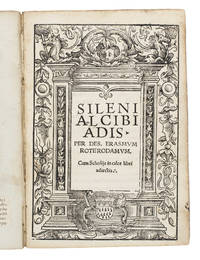
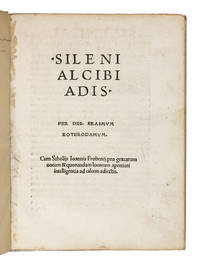
1520ABC_49888Colophon: Cologne: Servas Kruffter 1520. 19th-century marbled boards with a blue paper manuscript title label on the front board. 4to. With an elaborate woodcut border on the title page and a decorated woodcut initial. Rare early edition of an influential work by Desiderius Erasmus which is a call for reform of the Catholic Church. It uses the Ancient Greek figure Alcibiades ca. 450-404 BC and the mythical characters known as the Sileni as an allegory for looking beyond appearances in order to perceive someone's or the Church's true nature. Erasmus wrote the text as part of his compilation of proverbs the Adagia in particular for the revised 1515 edition where it became one of the most popular entries. It was then published by Froben as a separate work in 1517 with his scholia. The present edition is the fourth or fifth overall but the first by Servas Kruffter fl. ca. 1520-1538 and is of considerable scarcity with only five copies recorded in institutions and none in sales records. The Cologne printer Kruffter was repeatedly restricted by censorship and even put in jail several times. Only a comparatively small number of books from his limited production has survived.With the bookplate of the Oberherrlingen Library dated 1839 mounted on the verso of the front board together with two typed descriptions of the work. The boards are somewhat rubbed lacking most of the spine. The work is somewhat browned throughout with a water stain in the inner margin not affecting the text. Otherwise in good condition.l Bibl. Belgica E 261; Erasmus Online 3582; USTC 693956 4 copies; Vander Haeghen I 176; VD 16 E 1991; WorldCat 763214270 150404098 5 copies; not in Adams; Bezzel; BM STC German; De Reuck. Servas Kruffter, hardcover
1517ABC_49731Colophon: Basel 1517. 4to. Johann Froben Late 19th-century or early 20th-century boards red edges. With 4 decorated woodcut initials and a woodcut printer's device at the end of each part. 2 parts in 1 volume. 42 ll. First separate edition of an influential work by Desiderius Erasmus which is a call for reform of the Catholic Church. It uses the Ancient Greek figure Alcibiades ca. 450-404 BC and the mythical characters known as the Sileni as an allegory for looking beyond appearances in order to perceive someone's or the Church's true nature. Erasmus wrote the text as part of his compilation of proverbs the Adagia in particular for the revised 1515 edition where it became one of the most popular entries. It was then published by Froben as a separate work in 1517 together with his scholia. The present copy also includes the Scarabeus a similar essay from the Adagia with scholia from Beatus Rhenanus. Although these two works are now rarely found together on the market the Scarabeus was clearly intended as the second part of the Sileni Alcibiades for the present edition as both the pagination and collation continue between the two works.The boards are slightly soiled. The work is slightly browned throughout with water stains in the margins of some of the leaves and numerous near contemporary academic annotations in the margins of the first part by at least 2 different hands. Otherwise in good condition.l Bibl. Belgica E 259; BM STC German p. 277; USTC 693955; ad 1: Adams E 833; Erasmus Online 3579; Vander Haeghen I 176; VD16 E 1990; Ad 2: Adams E 830; Erasmus Online 3574; Vander Haeghen I 175; VD 16 E 1986. hardcover
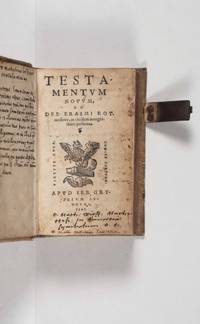
154749141Lyon: Sebastian Gryphius 1547. Hardcover. Very Good-. 16mo in 8s: a-z8 A-Z8 aa8 bb8 =384 leaves; blank bb7-8. 763 5 blankpp. Printer’s device at title woodcut lettrines. Text in italic headlines and chapter headings in roman; printed marginalia. Later pigskin over bevelled boards tooled in blind brass clasps one of two and catches manuscript title at spine. Extensive old manuscript notes at front endleaf and four blank leaves at the end including the two integral blanks; occasional marginalia and underlining. Title soiled with some slight erosion at margin from oxidation of the clasps else a very good copy with clean fresh text throughout. Complete with the two final blank leaves.<br /> <br /> Second Gryphius edition and a rather uncommon early sixteenth-century printing of Erasmus’ Latin translation of the New Testament first published at Basel in 1516. According to Baudrier Ly. V. 804101/Cat. de Lignerolles Paris Porquet 1894 no. 48 Gryphius first published this translation in 1542 and 1543 as a 16mo of 847 pages; neither of these issues appear in Deleveau & Hillard. Like the present edition these early Gryphius printings of the Erasmus New Testament survive in only a handful of copies. The text opens with Erasmus' dedication to pope Leo X followed by his preface to the reader a general index of the New Testament corpus a listing of the chapters of the four Gospels and a brief passage from Jerome's catalogue of ecclesiastical writings. The editor's introductions precede each book. The text concludes with Erasmus' translation of a brief discussion of apocryphal literature partly from Athanasius though Erasmus questions the attribution: "De libris utriusque testamenti partim reiectus aut non sine contradictione admissis partim apocryphis ex Athanasio tametsi mihi suspectus est titulus." <br /> <br /> Provenance and annotations: Extensive early annotations in more than one hand appear throughout the book; many marginal notes have been added throughout the Gospel of Matthew. At the front of the book beginning with the free endleaf: "Poeta de Pythogora" several stanzas in Latin and Greek; facing the title: A morning prayer "Oro matutina lecturis oracula divina" 11 lines; an accounting of biblical eras 10 lines since Abraham David and the Babylonian Exile appears at the verso of the title leaf. The final blank page the two intergral blank leaves and two additional blanks added by the binder are filled with notes in several different hands including: a passage from Augustine's De doctrina christianae 14 lines; noted as book 2 chapters 11 and 12 along with four lines about Tertullian; four pages of notes on the twelve disciples numbered; a Greek text discussing the divine names in which the tetragrammaton is written in Hebrew letters; a passage from a letter of Basilius Magnus in Greek with Latin translation.<br /> <br /> Printed label of Edward Davis Hoblyn 1809-1881 and his manuscript entry dated 1831 at the free endleaf. Edward was likely related to the renowned book collector Robert Hoblyn 1710-1756 of Cornwall. A catalogue of Robert’s collection was printed in 1768 as Bibliotheca Hobliniana and reissued by Murray in 1769 with a new titlepage. The library remained with Robert’s widow and was sold in 1778. The present work is not listed in the Bibliotheca though no fewer than nineteen 16th-century Latin Bibles and Testaments appear in the catalogue. Gift inscription of D. N. Goodman of San Francisco California to Father J. L. Damas at front pastedown dated 1935. References: Baudrier 8 217. Baumgarten Nach. v. merkw. Büchern 8 1755 206 noting that this and the later Gryphius edition which Le Long assigns to the master printer’s workshop are in fact identical and notable examples of elegant typography. Deleveau & Hillard 4407 BNF. Le Long Leipzig 1709 1:751 & 2:478 Bibl. Colbertina - the earlier Gryphius edition of 1542/43 is not cited in either part. Le Long-Masch 2.3 p. 599 noted as the first New Testament ex. Erasmi to appear at Lyon. Sebastian Gryphius hardcover
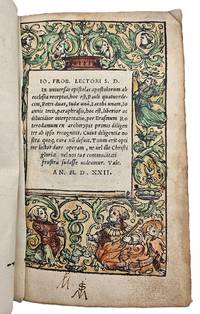
152212717Basel Johannes Froben 1522. Two parts in one 484 folio. Tall octavo H. 185 x W. 11.5 cm. contemporary binding in blindstamped brown leather over wooden boards. Title on the lower cover: ""In Epistola S. Pauli Can. RC."" The blind impression on the front cover faded but still visible is: ""ROTEROD"" as for ""Roterodami"" so from Rotterdam Erasmus' place of birth and ""WSKB"" possibly the initials of the owner. Second edition in an attractive binding the first in 8vo format. Two months before the first edition was edited in Folio. Each part has a woodcut title page. Lacking clasps some light waterstains wide margins with early manuscript annotations and thin strips of medieval manuscripts sewn inside the boards. A good copy. Literature: VD 16 E-3377; Bezzel I. Erasmusdrucke Nr. 1529. Van der Haeghen I 147 Basel, Johannes Froben hardcover
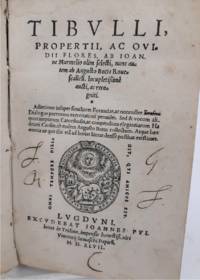
15471328082Lugdunum: Ioannes Pul Ioannes Pullonus 1547. Other. Tibulli propertii ac Ovidii flores ab Ioanne Murmelio olim selecti nunc autem ab Augusto Botta Rouescallen. Iocupletissimè aucti ac recogniti. Edited by Ioannes Murmellius and Augustus Botta Rouescallen. Lugdunum: Ioannes Pullonus 1547. 117 pp. Text in Latin. Duodecimo in early vellum boards. A partial title has been written on the spine in faded ink. The initials F.R.G.F.C. appear in ink on the title page and the name Erasmus has been crossed out in two instances. A book stamp likely placing this volume in a library or collection in Bologna in the 19th century appears on the final page of text. Condition: Very Good. The boards are very thin and have become cockled. The vellum is somewhat darkened with age and light staining and shows minor insect damage. There is evidence of a closure device now absent on both boards. Both paste downs are partially detached but the binding is overall very solid. The pages are somewhat age-toned with occasional foxing. There are a handful of small ink marks to the textblock. Dimensions 4.25 x 6.375 x 0.625 inches<br /> <br> <br /> <br> <br /> shelved case 3. 1328082. Shelved Dupont Bookstore. Ioannes Pul [Ioannes Pullonus] unknown
1514ABC_49925Paris 1514. Folio. Jodocus Badius 18th-century gold-tooled mottled calf sewn on 6 supports with corresponding raised bands on the spine the author and title lettered in gold on the spine both boards show a gold-tooled armorial centre piece incorporating the arms of the city of Nevers or the arms of the Conflans family from the Champagne region Rietstap I plate CXVIII within a gold-tooled floral frame blind-tooled board edges marbled edges. With a woodcut border and printers device on the title page printed in red and black along with numerous woodcut decorated initials throughout. 6 CCLXVII 1 ll. 1514 Paris edition of Senecas tragedies printed and edited by the humanist printer Jodocus Badius 1462-1535 with contributions from Erasmus and others. Although Erasmus had permitted Badius to use his preparatory work in his autobiographical letter to Botzheim he reflects on the painstaking effort that went into this preparation and subtly expresses his irritation at seeing Badius nostra cum alienis miscuisse that is having mixed Erasmus contributions with those of others. The present work comprises nine dramatic works and extensive scholarly commentary by leading Renaissance philologists.With a printed book plate of the Fossé d'Arcosse family and a manuscript presentation note dated 1828 Emilien Fossé Darcosse donné par Mr B. V. le 10 septembre 1828 on the front pastedown. On the first free endpaper an 18th-century Latin manuscript inscription records the awarding of a prize to Franciscus Vermeil a noble student at the Jesuit College of Nevers in France for his scholarly achievements. The prize which included an award for a Latin oration was granted on 4 September 1746 by virtue of a perpetual endowment from the city of Nevers. The award is formally attested by the Praefectus Studiorum director of studies J. Petrus Coriou whose autograph and the official seal of the college are present. The corners of the boards are bumped the front hinge is weakened the ends of the spine are slightly damaged with some minor loss of material and with some minor loss of material on the back board. The front board is slightly rubbed the outer half of both boards is slightly faded from sun exposure. The lower margin of the title page and the outer margin of the sixth preliminary leaf have been reinforced. The final privilege leaf blank on the verso except for some manuscript annotations has been mounted on the recto of the adjacent blank flyleaf. The first and last leaves are slightly water stained and the upper margins have been cut somewhat short. Otherwise in good condition.l De Reuck 497; Moreau and Renouard 967; Renouard Badius III 252-53; USTC 144361; Vander Haeghen II 49; not in Kossmann. hardcover
1514047405Paris: Jodocus Badius Ascensius 1514. First Edition. Hardcover Full Leather. Very Good Condition. Later ca. late 17th century or early 18th speckled paneled calf edges sprayed red. Front hinge cracked and a little loose but held by cords endpapers browned at edges two old bookplates contemporary signature and an old note to title. Title printed in red and black with an elaborate border with printed some red to the figures. Scattered very minor browning - a clean bright wide margined copy. 6 CCLXVII 1 leaves. Two blanks at front and two at rear. <br /> <br /> An important edition of Seneca the first with the new critical material by Erasmus including an account in the preliminaries of Seneca by Crinitus. Erasmus had done new critical work on the tragedies and supplied it to Bade who without his knowledge or consent commingled it with the criticism and notes of Caetani and Marmita. The Wrest Park copy.<br /> <br /> Bookplates of Anthony Earl of Kent 1702 and Thomas Philip Earl of Gray - Wrest Park. Old signature to title Jean Ma. and "sum I.ger amicorum" at bottom of title. <br /> <br /> Adams S 901 Size: Folio. Quantity Available: 1. Shipped Weight: 1-2 kilos. Category: Literature & Literary; Inventory No: 047405. Jodocus Badius Ascensius hardcover
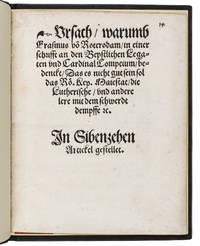
1531ABC_49886Strasbourg or Nuremberg 1531. 4to. Georg Ulricher or Wolfgang Heußler Modern blind-tooled mottled calf with a double fillet border on both boards. 3 1 blank ll. Rare German edition of a letter Erasmus sent to the papal legate Lorenzo Campeggi 1474-1539 on August 18 1530. In this letter Erasmus expresses his fear that the Holy Roman Emperor would declare war to the Protestant German princes and explains in 17 articles why violence is not the answer. He never printed the letter himself and it probably never reached Campeggi. According to Allen Erasmus wrote that "it was intercepted by the treachery of some unnamed 'evangelical' and printed without authority in Strasburg". The letter was translated into German and indeed published several times in Strasbourg Wittenberg Magdenburg and Nuremberg in 1531. The present edition does not have an imprint but was either printed in 1531 in Strasbourg by Georg Ulricher or in 1546 in Nuremberg by Wolfgang Heußler. It is quite rare as we not been able to find any other copies of the present edition in sales records of the past hundred years.With a red bookbinder's label "Period Bookbinders Bath England" mounted on the recto of the last free flyleaf. The work is lightly browned and foxed the inner margins have been reinforced. Otherwise in good condition.l Bezzel 26; Erasmus Online 1874; USTC 704493 and 704494; VD16 E 1881 and VD16 E 1882; Vander Haeghen I 88; not in Adams; BM STC German; De Reuck; cf. Allen Opus Epistolarum Erasmi vol. IX intro. to Ep. 2366. hardcover
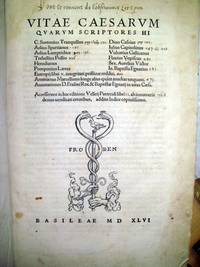
154613096Basilae Basel Bâle Basel: Froben 1546. Fine. Froben Basilae Basel Bâle Basel 1546 33 x 22.50 cm relié Colophon: Basileae per Hieronymvm Frobenivm et Nic. Episcopvm mense Septembri M.D.XLVI. First edition. Decorated with numerous historiated initials. Printer's device on the title page and verso of the final leaf. Absent from French catalogues but present in English catalogues 2 copies in Germany at the GBV union catalogue of northern Germany and one at the University of Munich. The 1544 edition published in Paris does not include Erasmus's notes and the complete assembly of authors gathered in this edition; the Parisian edition was reissued in 1551 in Lyon by Gryphium but not this Froben edition which reproduces only Egnazio's edition. The first edition of Suetonius dates from 1479. Full sheep binding 17th century decorated raised spine red morocco title label. Overall rubbed and worn on boards numerous scratches upper headcap missing 2 upper corners broken and missing. Fine interior condition with pale dampstaining running through about twenty pages at top center pp. 29 to 45. Several pagination errors same number repeated leaf skipped without lack. The evident interest of this edition was to gather together all the writers of antiquity who wrote about the Roman empire not only Suetonius but also rarer writers such as Dio Cassius translated by Merula Herodian translated by Angelo Ambrogini Poliziano Spartianus or Lampidius Velleius Paterculus Vulcatius Gallicanus Ammianus Marcellinus. Two commentators: Erasmus died in 1536 and Giovanni Battista Egnazio 1478-1553. Froben 1501-1563 is one of the great publishers of the Renaissance and the worthy successor of Johann Froben the first of the dynasty who established his printing house in Basel in 1491; it was with him that Erasmus was linked and worked and Jerome Froben merely reaped the fruits. This edition is the alliance of Froben and Nikolaus Episcopius his brother-in-law. Gothic manuscript note: ""pour le couvent de l'observance des Lyon"" and manuscript pagination of the authors. Froben hardcover