Locke JohnABAA

185 résultats
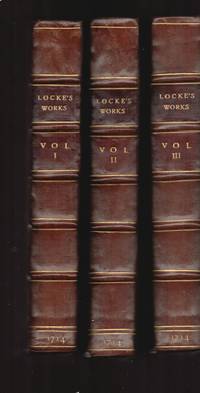
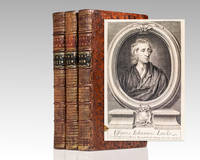
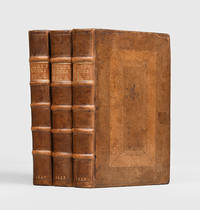
1714122652London: John Churchill and Sam. Manship 1714. Rare first edition of the collected works of John Locke "the most worthy. of the indisputably great philosophers." Folio three volumes bound in full contemporary brown calf gilt titles and tooling to the spine morocco spine labels raised bands rebacked. Frontispiece of John Locke to volume one. In very good condition. John Locke is regarded as one of the most influential of Enlightenment thinkers and the Father of Classical Liberalism. "Locke was the first to take up the challenge of Bacon and to attempt to estimate critically the certainty and the adequacy of human knowledge when confronted with God and the universe" PMM 164. This is the first edition of the first collected edition of his work and the earliest to put his name to "Two Treatises on Government" as well as the letters on "Toleration"and "The Reasonableness of Christianity". Contents include: Volume 1: An Essay concerning Human Understanding. In Four Books; A Letter to the Right Reverend Edward Lord Bishop of Worcester concerning some Passages relating to Mr. Locke's Essay of Human Understanding in a late Discourse of his Lordship's in Vindication of the Trinity; Mr. Locke's Reply to the Right Reverend the Bishop of Worcester's Answer to the Letter; Mr. Locke's Reply to the Bishop of Worcester's Answer to his Second Letter. Volume 2: Some Considerations of the Consequences of the lowering of Interest and raising the Value of Money. In a Letter send to a Member of Parliament. 1691; Short Observations on a printed Paper entitled For encouraging the coining SilverMoney in England and after for keeping it here; Further Observations concerning raising the Value of Money. Wherein Mr. Lowndes's Arguments for it in his late Report concerning An Essay for the Amendment of the Silver Coin are particularly examind'd; Two Treatises of Government. In the Former the false Principles and Foundation of Sir Robert Filmer and his Followers are detected and overthrown. The Latter is an Essay concerning the true Original Extent and End of Civil Government; A Letter concerning Toleration; A Second Letter concerning Toleration; A Third Letter for Toleration: To the Author of the Third Letter concerning Toleration; The Reasonableness of Christianity as deliver'd in the Scriptures; A Vindication of The Reasonableness of Christianity From Mr. Edwards's Reflections; A Second Vindication of the Reasonableness of Christianity. Volume 3: Some Thoughts concerning Education; A Paraphrase and Notes on the Epistles of St. Paul to the Galatians I and II. Corinthians Romans and Ephesians. To which is prefix'd An Essay for the Understanding of St. Paul's Epistles by consulting St. Paul himself; Posthumous Works viz. I. Of the Conduct of the Understanding. II. An Examination of P. Malebranche's Opinion of Seeing all things in God. III. A Discourse of Miracles. IV. Par of a Fourth Letter for Toleration. V. Memoirs relating to the Life of Anthony first Earl of Shaftesbury. VI. A new Method of the Common-Place-Book written originally in French and translated into English; Some familiar Letters between Mr. Locke and Several of his Friends.The work was published ten years after his death and is the first time his works were published as a collection. John Churchill and Sam. Manship hardcover books
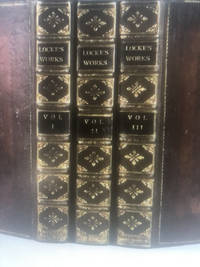
17149032182London: John Churchill/Sam. Manship 1714. 1st. Hardcover. Very Good. First edition of the Collected Works. "Printed for John Churchill at the Black Swan in Pater-noster-Row and Sam. Manship at the Ship in Cornhil." Beautifully rebacked to style with original calf covers spines stamped in gilt. Engraved frontispieces in volumes I and II. Text blocks are near fine clean and bright with sharp edges. Calf covers are rich and glossy. Some wear to extremities through cloth at some points of outer edges on all volumes. 7 3/4 x 12 1/2 inches. Images available upon request. <br/><br/> John Churchill/Sam. Manship hardcover
1714Bv1205<p>FIRST EDITION of Locke's collected works including his canonical Essay Concerning Human Understanding. This First printing further includes works by Locke acknowledged only in his will and the earliest to put his name to: Two Treatises on Government as well as the letters on Toleration and The Reasonableness of Christianity.</p><p>"Locke was the first to take up the challenge of Bacon and to attempt to estimate critically the certainty and the adequacy of human knowledge when confronted with God and the universe" PMM 164. A landmark in Enlightenment thought encapsulated in "the first modern attempt" to analyze human knowledge PMM 193 194 Locke's Essay Concerning Human Understanding: "To love truth for truth's sake is the principal part of human perfection in this world and the seed-plot of all other virtues."</p><p>The influence Locke exerted upon Jefferson and other Founding Fathers cannot be overestimated. Indeed some of Jefferson's contemporaries claimed that he borrowed central ideas in the Declaration of Independence directly from the writings of John Locke. Doubtless the political philosophy Locke bequeathed to America's Founding Fathers gave rise to the spread of freedom across the civilized world and the birth of the freest country in history the United States of America.</p><p>London: for John Churchill and Sam. Manshhip 1714. Folio contemporary full calf rebacked in period style by Bernard Middleton. Complete with and exquisite copper-engraved frontispiece portrait by George Vertue in Volume I and full-page memorial plate engraved plate of Locke's funeral monument. General light wear to bindings; text extremely clean with large margins. A very handsome set. Book #Bv1205. $10000.</p><p>We specialize in rare Ayn Rand and other legends and landmarks.</p> John Churchill and Sam Manship hardcover
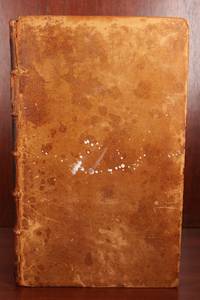
17287141London: A. Bettesworth; J. Pemberton; E. Symon 1728. Fifth Edition. Fifth Edition - as stated on the title page. Rare 1700s imprint of Locke's landmark work on government. Originally published in 1689. Measuring approximately 8" x 5" with 308 numbered pages.<br /> <br /> The book is in good condition. Moderate to heavy wear and staining to the original full leather boards. Spine leather has partially perished. Hinges are cracked but the binding is holding strong. Small half-inch chip missing from the bottom of the front endpaper. Top corner of title page has been clipped. Minor scattered soiling and some dog-eared corners found within the textblock<br /> <br /> Please view the many other rare titles available for purchase at our store. We are always interested in purchasing individual or collections of fine books.<br /> <br /> Inventory # P7-2. A. Bettesworth; J. Pemberton; E. Symon unknown
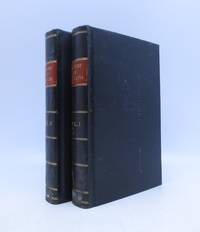
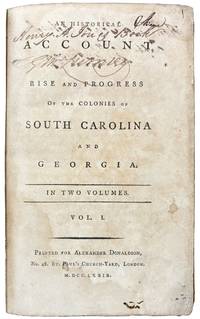
1799068560London: Printed for Alexander Donaldson 1799. First Edition. Hardcover. Very Good. 8vo. respectively. FIRST EDITION 1779. TWO VOLUME COMPLETE SET. The First History of South Carolina. Howes H452. Printed for Alexander Donaldson London 1779. Matching hardcover set. Rebound in black cloth covers are plain. Spines bear orange leather labels stamped in gilt along with the volume numbers. Top edges gilt. Endpapers are gray. Leaves are printed on laid paper. Includes "The first set of the fundamental constitutions of South Carolina / as compiled by Mr. John Locke"/ pages 321-347. Vol. I: xiv 347 pp; Vol II: ix 309 pp. On a shelf this set spans 2.5 inches. <br><br>ABOUT THIS SET: The "earliest history of the region" Howes H452. "Justin Winsor calls this work the 'earliest account of South Carolina cast in a sustained retrospective spirit'. Hewatt an Englishman who at one time lived at Charleston was a keen collector of historical documents". Streeter II 1133. "In Volume I Hewatt gives a sympathetic and balanced account of Indian life and customs based in part on his own observations. He describes the climate soil natural resources fauna snakes and insects; how to make turpentine tar and pitch; and how to cultivate silk cotton and especially rice. In Volume II he describes and criticizes slavery in the colonies and the treatment of slaves; he maintains that slaves should be given some instruction in morals and religion. He discusses diseases in Carolina and describes the cultivation of indigo in some detail. His factual account of the 'present state and condition of the colony' probably refers to the latter 1760s or early 1770s; he quotes some statistics of 1776." Clark I 225. De Renne 217. Turnbull I 223. <br><br>ABOUT THE AUTHOR: Alexander Hewatt came to Charleston in 1763 as minister of the Scots First Presbyterian Church there. Fascinated with the history of South Carolina he soon became a keen collector of historical documents. When the British fleet arrived at Charleston in 1776 Hewatt and other ministers were required to renounce their loyalty to the king. When he refused Hewatt was given sixty days to leave the colony. He sailed for Great Britain where he devoted the next two years to completing his history. In 1780 he was awarded the Doctor of Divinity form the University of Edinburgh an indication of the esteem in which he and his work were held. "Hewatt's account reflects the influence of William Robertson and the Scottish school of historiography. less concerned with a strict chronology of events Hewatt instead focused on the interrelatedness of those events and their various causes and effects. His goal in doing so was to provide moral political and practical instruction to the colonists and to those in England" both of whom he hoped would see the importance of continuing South Carolina's close ties to the Crown" ANB. The work includes detailed descriptions of the climate topography and fauna of South Carolina as well as discussions of slavery there. He warned that the mistreatment of slaves was likely to "fire them with desires of liberty and vengeance." Chapter 5 in the first volume includes a full account of the Yamasee War while chapter 10 is devoted to the war with the Cherokee. <br><br>CONDITION: This set is overall VG with general shelf wear. Removal of bookplate on the front pastedown on both volumes and clipped rectangular front endpaper removed in both volumes. Leaves are in remarkable condition with extremely minimal foxing. Completely free from marginalia or annotation. Bindings are tight. An incredible set. <br><br>Additional photographs available upon request. This set will be delivered with "adult signature required". Full refund if not satisfied. Printed for Alexander Donaldson hardcover
176567041First Collected Edition of LockeÃs " Letters Concerning Toleration" LOCKE John. Letters Concerning Toleration. London: Printed for A. Millar. 1765. First collected edition of LockeÃs four letters on toleration. Quarto 11 3/8 x 8 3/4 inches; 289 x 222 mm. 8 399 1 blank pp. Includes the Latin ìEpistola de tolerantiaî pp. 1-28 ìA Letter Concerning Tolerationî pp. 29-66 ìA Second Letter Concerning Tolerationî pp. 67-116 ìA Third Letter for Tolerationî pp. 117-379 and ìA Fourth Letter for Tolerationî pp. 381-399. Edited by Thomas Hollis and Richard Baron. Engraved frontispiece portrait of Locke by F.B. Cipriani after Kneller with a Cap of Liberty beneath the portrait. Another Cap of Liberty at foot of last page of text. Bound to style in full modern calf for front board matching rear board and spine. With the contemporary rear board still present. Boards ruled in gilt. Spine ruled in gilt. With original black morocco spine label lettered in gilt. Marbled endpapers. All edges dyed yellow. Previous owner's old ink signature on title-page dated 1789. A few light pencil marking throughout. Frontispiece portrait a bit foxed. A few neat tiny holes to title-page and final leaf not affecting text. Small previous owner Peter Laslett Trinity College Cambridge plate on front pastedown. Overall a very good copy. ìLockeÃs concern for the toleration of religious dissent for the interaction of individual conscience and public authority was long-standing. In his early tracts on the civil magistrate.he had felt that the need for order in society justified the authority of the magistrate over matters indifferent to salvation. Under the influence of Shaftesbury and of his own investigations of the scope of certain knowledge his emphasis changed. Without certainty in matters of religion the conscience must be allowed liberty; the authority of the magistrate must be confined to preserving the existence of society and the safety and property of the citizen. LockeÃs thoughts on this subject as on so many others matured during his stay in Holland where his circle of friends consisted primarily of dissenters from the established church such as the Remonstrant pastor and theologian Philippus van Limborch. In 1686 Locke drafted a letter in Latin to his friend which was published probably by Limborch in 1689î Attig p. 12. The Epistola de tolerantia was almost immediately translated into English and published in London. It was ìimmediately attacked in two anonymous pamphlets the most significant of which was ProastÃs Argument March 1690. LockeÃs own response was equally swift and his Second letter appeared in June. Proast replied to LockeÃs Second letter with his Third letter concerning toleration 1691. Locke in response published A third letter for toleration the following year. Proast did not return to the attack until 1704 when he published his Second letter to the author of the three letters for toleration. Locke was defended by an anonymous author probably John Shute Barrington in the postscript to The rights of the Protestant dissenters. At the time of his death that same year Locke had begun his own reply. The draft was published by his executors Peter King and Anthony Collins in 1706î Attig pp. 18-19. Attig 93. Rothschild 2733. Yolton 28. HBS 67041. $6000 Printed for A. Millar... hardcover books
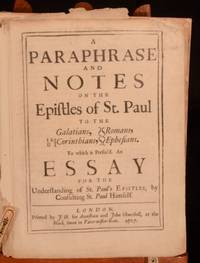
1707007735London: Printed by J.H. for Awnsham and John Churchill at the Black Swan in Pater-noster-Row 1707. This volume is compose of five parts each with its own title page and pagination the whole is proceeded by two volume title pages both dated 1707 and a preface. i-ii iii-xviv Galatians 1706 second edition title page2 publisher's message to the reader and publisher's adverts2pages 43 pages. I Corinthians 1706 advertisment2 title page1-2107 pages 208blank. II Corinthians 1706 : title page123-58 2adverts. Romans 1707 : title page1-23-142 pages. 2adverts. Ephesians 1707 : title page1-23-60 pages. 8 X 9.7 inches. Bound in contemporary full calf with tooled ruled borders and decorations title label to spine with only fragments remaining. externally very rubbed with wear to corners spine ends and edges cracking along outer and inner hinges both boards attached. Inside all complete as described here Initial "P" in ink on corner of front free endpaper and a name and date 1734 at the top of the title page. Browning and offsetting to endpapers Some browning and foxing to the pages of the preface and a water stain on the margin of several pages of the preface. Therafter all quite clean throughout with no further foxing or marking. No annotations. First Edition. Hard Cover. Good/No Jacket. Printed by J.H. for Awnsham and John Churchill, at the Black Swan in Pater-noster-Row Hardcover
1751111216London: S. Birt D. Brown T. Longman 1751. 1751 edition of the collected works of John Locke "the most worthy. of the indisputably great philosophers." Folio three volumes bound in full contemporary brown calf raised bands gilt titles and tooling to the spine morocco spine labels copper-engraved frontispiece portrait by George Vertue to volume one. In very good condition text clean with large margins. John Locke is regarded as one of the most influential of Enlightenment thinkers and the Father of Classical Liberalism. "Locke was the first to take up the challenge of Bacon and to attempt to estimate critically the certainty and the adequacy of human knowledge when confronted with God and the universe" PMM 164. This is the first edition of the first collected edition of his work and the earliest to put his name to "Two Treatises on Government" as well as the letters on "Toleration"and "The Reasonableness of Christianity". Contents include: Volume 1: An Essay concerning Human Understanding. In Four Books; A Letter to the Right Reverend Edward Lord Bishop of Worcester concerning some Passages relating to Mr. Locke's Essay of Human Understanding in a late Discourse of his Lordship's in Vindication of the Trinity; Mr. Locke's Reply to the Right Reverend the Bishop of Worcester's Answer to the Letter; Mr. Locke's Reply to the Bishop of Worcester's Answer to his Second Letter. Volume 2: Some Considerations of the Consequences of the lowering of Interest and raising the Value of Money. In a Letter send to a Member of Parliament. 1691; Short Observations on a printed Paper entitled For encouraging the coining SilverMoney in England and after for keeping it here; Further Observations concerning raising the Value of Money. Wherein Mr. Lowndes's Arguments for it in his late Report concerning An Essay for the Amendment of the Silver Coin are particularly examind'd; Two Treatises of Government. In the Former the false Principles and Foundation of Sir Robert Filmer and his Followers are detected and overthrown. The Latter is an Essay concerning the true Original Extent and End of Civil Government; A Letter concerning Toleration; A Second Letter concerning Toleration; A Third Letter for Toleration: To the Author of the Third Letter concerning Toleration; The Reasonableness of Christianity as deliver'd in the Scriptures; A Vindication of The Reasonableness of Christianity From Mr. Edwards's Reflections; A Second Vindication of the Reasonableness of Christianity. Volume 3: Some Thoughts concerning Education; A Paraphrase and Notes on the Epistles of St. Paul to the Galatians I and II. Corinthians Romans and Ephesians. To which is prefix'd An Essay for the Understanding of St. Paul's Epistles by consulting St. Paul himself; Posthumous Works viz. I. Of the Conduct of the Understanding. II. An Examination of P. Malebranche's Opinion of Seeing all things in God. III. A Discourse of Miracles. IV. Par of a Fourth Letter for Toleration. V. Memoirs relating to the Life of Anthony first Earl of Shaftesbury. VI. A new Method of the Common-Place-Book written originally in French and translated into English; Some familiar Letters between Mr. Locke and Several of his Friends.The work was published ten years after his death and is the first time his works were published as a collection. S. Birt, D. Brown, T. Longman hardcover books
1722149219London: Printed for A. Churchill and A. Manship 1722. Rare second edition of the collected works of John Locke “the most worthy… of the indisputably great philosophers.†Folio three volumes bound in full speckled brown calf with gilt titles and tooling to the spine with morocco spine labels in seven compartments within raised gilt bands gilt turn-ins all edges stained red. Frontispiece of John Locke to volume one. In very good condition bookplate to the front pastedown and ownership signature to the front free endpaper of volume one. An exceptional example. John Locke is regarded as one of the most influential of Enlightenment thinkers and the Father of Classical Liberalism. "Locke was the first to take up the challenge of Bacon and to attempt to estimate critically the certainty and the adequacy of human knowledge when confronted with God and the universe" PMM 164. This is the first edition of the first collected edition of his work and the earliest to put his name to "Two Treatises on Government" as well as the letters on "Toleration"and "The Reasonableness of Christianity". Contents include: Volume 1: An Essay concerning Human Understanding. In Four Books; A Letter to the Right Reverend Edward Lord Bishop of Worcester concerning some Passages relating to Mr. Locke's Essay of Human Understanding in a late Discourse of his Lordship's in Vindication of the Trinity; Mr. Locke's Reply to the Right Reverend the Bishop of Worcester's Answer to the Letter; Mr. Locke's Reply to the Bishop of Worcester's Answer to his Second Letter. Volume 2: Some Considerations of the Consequences of the lowering of Interest and raising the Value of Money. In a Letter send to a Member of Parliament. 1691; Short Observations on a printed Paper entitled For encouraging the coining SilverMoney in England and after for keeping it here; Further Observations concerning raising the Value of Money. Wherein Mr. Lowndes's Arguments for it in his late Report concerning An Essay for the Amendment of the Silver Coin are particularly examind'd; Two Treatises of Government. In the Former the false Principles and Foundation of Sir Robert Filmer and his Followers are detected and overthrown. The Latter is an Essay concerning the true Original Extent and End of Civil Government; A Letter concerning Toleration; A Second Letter concerning Toleration; A Third Letter for Toleration: To the Author of the Third Letter concerning Toleration; The Reasonableness of Christianity as deliver'd in the Scriptures; A Vindication of The Reasonableness of Christianity From Mr. Edwards's Reflections; A Second Vindication of the Reasonableness of Christianity. Volume 3: Some Thoughts concerning Education; A Paraphrase and Notes on the Epistles of St. Paul to the Galatians I and II. Corinthians Romans and Ephesians. To which is prefix'd An Essay for the Understanding of St. Paul's Epistles by consulting St. Paul himself; Posthumous Works viz. I. Of the Conduct of the Understanding. II. An Examination of P. Malebranche's Opinion of Seeing all things in God. III. A Discourse of Miracles. IV. Par of a Fourth Letter for Toleration. V. Memoirs relating to the Life of Anthony first Earl of Shaftesbury. VI. A new Method of the Common-Place-Book written originally in French and translated into English; Some familiar Letters between Mr. Locke and Several of his Friends.The work was published ten years after his death and is the first time his works were published as a collection. Printed for A. Churchill and A. Manship unknown
1707EXP2-E-7London: J H Awnsham and John Churchill 1707. First edition. Leather. Fair. 9.5" by 7.5". None. A scarce collection of works by John Locke. The first collected edition compiled of various editions of earlier shorter works. Each work with a separate title page and pagination. Collated: Complete. With publisher's advertisements bound out of order to BL copy. Contains: An Essay for the Understanding of St Paul's Epistles by Consulting St. Paul himself 1707 First Edition A Paraphrase and Notes on the Episdtle of St. Paul to the Galatians 1706 Second Edition A Paraphrase and Notes on the First Epistle of St Paul to the Corinthians 1706 First Edition A Paraphrase and Notes on the Second Epistle of St Paul to the Corinthians 1706 First Edition A Paraphrase and Notes on the Epistle of St Paul to the Romans 1707 First Edition A Paraphrase and Notes on the Epistle of St Paul to the Ephesians 1707 First Edition John Locke was an influential English philosopher and physician of the Enlightenment. His work greatly influenced the development of political philosophy and the works of figures such as Voltaire and Rousseau. His religious beliefs varied over his lifetime and were rarely displayed in his writings. These works published posthumously provide important insight into his theology and the final years of his life. In a calf binding. Externally worn both boards detached but present. Loss to head at tail of spine and to leather at extremities. Light rubbing and worming to boards. Lacking front free-endpaper. Internally generally firmly bound although binding strained to Romans about half way through the volume. Title page and front blank detached but present. Title page with slight loss not affecting text. Pages bright with handling marks and dusting throughout occasional spotting. Marginal age toning and offsetting to first and last few pages. Pink ink annotations roman numerals indicating chapter numbers throughout. Light marginal worming to final work Ephesians not affecting text. Closed tear to page 29 of Ephesians. Overall: FAIR binding GOOD internally Fair J H Awnsham and John Churchill hardcover
177940925London: Printed for Alexander Donaldson No. 48. St. Paul's Church-Yard London 1779. 8vo. 8 1/4 x 5 inches. First edition. Volume I: a-b4 A-Uu4 Xx2. i-xiv 2 1-347 1. 364 pp. Title Preface Contents Chapters I-VI The First Set of the Fundamental Constitutions of South Carolina as Compiled by Mr. John Locke. Volume II: a4 b1 A-Ss4 x1. i-ix 1 1-329 1. 340 pp. Last page misnumbered 309. Title Contents Chapters VII-XI With inscriptions of "Henry A. Jones" on both volumes unclear if it is the playwright of the same name. Bound to style in 18th-century calf spines with raised bands forming compartments gilt lettered red morocco lettering pieces in second compartments. Restoration to the the last text leaf in volume one<br/> <br/> First edition of the fundamental historical account of South Carolina and Georgia which Howes calls "the earliest history of this region" and Winsor states is the "earliest account of South Carolina cast in a sustained retrospective spirit." Streeter<br/> <br/> Hewatt or Hewat was a Scottish-born Presbyterian minister educated at Edinburgh who presided over the Scots First Presbyterian Church in Charleston when it was Charlestown South Carolina from 1763 to 1777. When the British fleet arrived at Charlestown in 1776 Hewatt and other ministers were forced by Patriots to renounce their loyalty to the king. When he refused Hewatt was given sixty days to leave the colony. His property was seized and he returned to the British Isles and wrote this historical account in London. Considered by Howe to be the earliest and best account of Colonial South Carolina and Georgia the book is bolstered by as Streeter states Hewatt being a "keen collector of historical documents." However his work remains important today because it is also based on his personal observations as a first-hand source from over a decade of lived experience in the region. Hewatt discusses the immigration of British French and other European migrants to the Carolinas due to religious persecution at home. He examines the lives they then created in the New World and the economies they built while doing so. But Hewatt also pays especial detail to the customs and cultures of those people these settlers displaced: the indigenous Native Americans of the region. "Hewatt gives a sympathetic and balanced account of Indian life and customs. He describes the climate soil natural resources fauna snakes and insects; how to make turpentine tar and pitch; and how to cultivate silk cotton and especially rice." De Renne An opponent of slavery as many Presbyterians were he chronicles the introduction of enslaved people from Africa and the ensuing social and economic problems it caused. He criticizes slavery in the colonies and the treatment of enslaved people while maintaining that they should be given instruction in morals and religion. He also warns that to mistreat enslaved people was to "fire them with desires of liberty and vengeance." Also covered in Volume I is the Yamasee War and in Volume II the War with the Cherokee. In 1780 after the publication of this work Hewatt was awarded the Doctor of Divinity from the University of Edinburgh an indication of the success of the present book. "Hewatt's account reflects the influence of William Robertson and the Scottish school of historiography. Less concerned with a chronology of events Hewatt instead focused on the interrelatedness of those events and their various causes and effects. His goal in doing so was to provide moral political and practical instruction to the colonists and to those in England." ANB His work especially his comments on Native Americans and enslaved people were used as the basis for David Ramsay's history though it went uncredited. The first volume includes the "first set of the fundamental constitutions of South Carolina" which have been attributed to the English political philosopher John Locke because he at the time was working as a paid secretary for one of the Province of Carolina's proprietors Anthony Ashley Cooper. The historian David Armitage and the political scientist Vicki Hsueh argue he was a co-author along with Cooper the 1st Earl of Shaftesbury. The constitutions reflect Locke's classical liberalism safeguarding religious freedom while also setting up a reactionary neo-feudal form of government.<br/> <br/> Clark I 255. De Renne 217. Howes H452 b. Sabin 31630. Servies 522. Streeter Sale 1133. Turnbull I 223. Printed for Alexander Donaldson, No. 48. St. Paul's Church-Yard, London unknown
1727PCKeLOCK34London: Printed For Arthur Bettesworth. 1727. 1727. 3 Volumes. folio. pp. 2 p.l. xxviii 2 575 16index; 1 p.l. 671 13index; 3 p.l. 668 15. 2 engraved plates incl. frontis. portrait by Vertue after Kneller & memorial plate. woodcut ornaments & initials. contemporary mottled calf neatly rebacked preserving endpapers some scarring to covers but an attractive set. Third Edition including An Essay concerning Human Understanding Some Considerations of the Consequences of lowering the Interest and raising the Value of Money Two Treatises of Government Letter concerning Toleration Some Thoughts concerning Education Some Familiar Letters &c. but not the Remains or Le Clerc's account of Locke's life which was first added in the 1751 fifth edition. Christophersen 88. Rand I 341. NCBEL II 1836. cfPrinting and the Mind of Man 164. Palgrave p. 633. London: Printed For Arthur Bettesworth., 1727. unknown
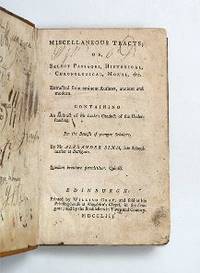
1753149022Edinburgh: Printed by William Gray 1753. Locke abridged for the younger reader First edition of this rare miscellany including an abridgement of John Locke's Of the Conduct of the Understanding 1706 a significant instance of the popularisation of Locke's philosophy in Scotland. Compiled by the retired schoolmaster Alexander Simm of the Scottish town of Bathgate the miscellany presents to "younger scholars" the "actions and sayings of the great good and wise men of antiquity as well as of the modern; which might instead of useless Trish Trash afford them an agreeable and profitable entertainment when otherwise unemployed" preface. Also included are remarks on the Copernican system Confucius the delusions of witchcraft and the raising of new islands by volcanos. A section on the Union of 1707 is present strongly in favour of the advantages which have accrued from it. Printed on poor-quality paper copies have not survived and the work is consequently rare - ESTC records only 3 copies British Library National Library of Scotland Bodleian. Octavo 170 x 102 mm. Contemporary unlettered sheep blind border to covers. Contemporary pen-trials and ownership signatures to endpapers. Light rubbing to sheep joints intact front free endpaper neatly excised a few minor nicks and peripheral chips to contents not affecting text. A very good copy. ESTC T119426; Yolton 311. unknown
1765JL002bLondon: A. Millar 1765 Modern three-quarter dark brown calf over tan cloth boards with five raised bands and red morocco spine label lettered in gilt. A very good or better copy with some foxing and soiling to frontispiece and title page small chip to top corner of frontispiece text block otherwise clean and complete boards slightly bowed binding bright and unworn. Letters Concerning Toleration is a collection of four letters written by Locke on the subject of religious tolerance in which the English philosopher argues that the acceptance of multiple religious groups is necessary in society to prevent civil unrest. Although each letter had previously been published individually as well as together in Locke's Collected Works this 1765 edition is the first time in which the four letters have been published together as an independent volume. Hard Cover. Very Good. London: A. Millar hardcover books
1714022572London: John Churchill. Volume 1 and Volume II only. Full leather. First Edition of the collected works. Previous owners names in ink Thomas Eyre and Js Paine and small bookplates with the name of another owner. One name crossed out. Locke was a highly influential British philosopher and empiricist. Loss from head and foot of spines separations along spine edges Good. . Good. Hardcover. 1st Edition. 1714. John Churchill hardcover
1751126250Florence: Andrea Bonducci 1751. Rare first edition in Italian of Some Considerations of the Consequences of the Lowering of Interest and Raising the Value of Money 1692 and Further Considerations concerning Raising the Value of Money 1695. It is the only early translation of Locke's papers on money based on the folio Works of 1740 and is furnished with extensive footnotes by the translators Giovanni Pagnini and Angelo Tavanti. It is issued here with a treatise by Pagnini appended at the end of the second volume. Locke's writings had a major influence on the then-ongoing Italian monetary debate. Economic unrest in Italy in the middle of the 18th century led to several publications on monetary theory. In the aftermath of the Succession Wars the possibility of devaluing currency to boost economic growth was considered a proposal which raised questions about Italy's move towards a commercial society and out of feudal systems. Most of the Italian writers opposed devaluation of the currency who cited Locke's similar arguments in the English recoinage crisis of the 1690s; the only major detractor was Galiani. Pagnini and Tavanti published the work in translation in the belief that Locke's ideas of sound money were relevant to the situation. "By publishing Locke's works on money in Italian Pagnini and Tavanti made available to an Italian audience a structured version of what had originally been a few long letters written to give advice on a specific issue that belonged to late seventeenth-century English politics. Yet in the following decades Locke's letters had risen to fame abroad where a myth had been formed of Locke as the defender of an honest commercial order of humankind. If Locke's letters contained a general message about commercial politics the work by Pagnini and Tavanti was supposed to bring it out" Stapelbroek p. 13. The appended treatise by Pagnini describes commercial society as one based on trust and peace; by devaluing the currency a government is undermining this society. 2 vols bound in 1 quarto 245 x 179 mm. Titles printed in red and black engraved vignette to first title large folding table at end of vol. Modern half vellum and plain paper boards new spine labels. Boards lightly marked small ownership stamp to first title and one or two minor stains; a crisp clean copy. Attig 507; Kress Italian 275; Yolton 164. Koen Stapelbroek "The Devaluation Controversy in Eighteenth-Century Italy" in History of Economic Ideas vol. 13 no. 2 2005. hardcover
1727189612London: printed for Arthur Bettesworth; Edmund Parker; John Pemberton; and Edward Symon 1727. The most influential philosopher of modern times Third edition of Locke's collected works following those of 1714 and 1722. "John Locke is the most influential philosopher of modern times. His influence in the history of thought on the way we think about ourselves and our relations to the world we live in to God nature and society has been immense. His great message was to set us free from the burden of tradition and authority both in theology and knowledge by showing that the entire grounds of our right conduct in the world can be secured by the experience we may gain by the innate faculties and powers we are born with" Chappell p. 252. 3 vols folio 318 x 202 mm. Engraved portrait frontispiece by Vertue after Kneller and engraved memorial plate. Contemporary panelled calf rebacked and recornered to style orange morocco labels. Ownership inscription to front pastedown dated 1832 of James Ford curate of St Lawrence in Exeter 1779-1850. Slight rubbing minor marking to covers tear to front free endpaper contents clean crisp and fresh. A very good copy. ESTC T115711; Yolton 365A another issue only says Parker's name in the imprint. Vere Chappell The Cambridge companion to Locke 1994. unknown
170617416London: Printed for Awnsham and John Churchill 1706. FIFTH EDITION. Index bound after Contents and before text. Contemporary full-paneled calf panels blind-stamped on front and rear boards edges partially rubbed with corners reinforced rebacked; interior excellent. Fifth edition containing expansions of all four books. This edition includes the final textual changes by Locke though it was published posthumously. It was also the last edition printed in folio format. Locke’s 1632-1704 famous work of empirical philosophy deals with the fundamental issues of how we think perceive and express ourselves through language logic and religion. All later editions were based upon this 1706 printing. Printed for Awnsham and John Churchill unknown
1773119924Amsterdam: no printer 1773. First edition in Italian of one of the most famous and influential works in the history of liberalism the second of Locke's Two Treatises on Government 1690. "'An anonymous translation from the French text of David Mazel probably the 1755 ed." Yolton. The work did not appear again in Italian until 1925. Octavo 183 x 119 mm. Contemporary quarter calf and marbled boards spine ruled and lettered gilt. Ownership stamp "G.G." to title ownership mark "Peyrot" to front pastedown. Spine ends neatly restored; occasional light spotting; a very good copy. Rare: Attig 188; Yolton 59; First Search locates 2 copies only York University Ontario and University of Texas at Austin to which we can add the copy at Yale. hardcover
1777261203London: Printed for W. Strahan J.F. and C. Rivington L. Davis W.Owen . 1777. Eighth edition & second quarto edition after the 1768 Hollis Edition. Engraved copperplate frontispiece portrait of Locke by Cipriani. Folding chart in vol. I. 4 vols. 4to. Full contemporary polished calf red and green title labels. Joints neatly repaired. Unobtrusive labels on pastedowns. Front joint of vol. I tender. Handsome copy. Eighth edition & second quarto edition after the 1768 Hollis Edition. Engraved copperplate frontispiece portrait of Locke by Cipriani. Folding chart in vol. I. 4 vols. 4to. "This edition of Locke's Works is generally considered the best" Christophersen. Yolton 370; Christophersen pp. 88-89 Printed for W. Strahan, J.F. and C. Rivington, L. Davis, W.Owen .. unknown books
1722302488London: printed for A. Churchill and A. Manship and sold by W. Taylor in Pater-noster-Row 1722. The second edition. Frontispiece portrait by George Vertur after. 3 vols. Folio. Contemporary paneled calf neatly and almost imperceptibly rebacked preserving the original backstrips and spine labels. Bookplate of John Pollexfen Bastard and the signature of Charles Wymondesold whose widow married Bastard on the front free endpapers. Fine attractive copy. The second edition. Frontispiece portrait by George Vertur after. 3 vols. Folio. ESTC T128551 printed for A. Churchill, and A. Manship, and sold by W. Taylor in Pater-noster-Row unknown books
17271508179Arthur Bettesworth London 1727. 3rd Edition. Hardcover. Very Good/No Jacket. Three volumes Folio. Very good condition clean inside. Third edition of Locke's collected works including the Essay Concerning Human Understanding Two Treatises of Government Some Thoughts Concerning Education and his Letters Concerning Toleration. Contemporary leather binding six raised bands. Arthur Bettesworth, London hardcover books
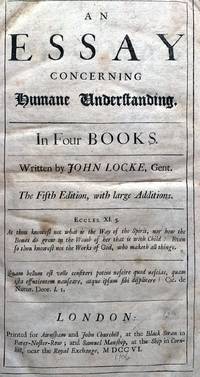
1706Embry 149827Printed for Awnsham and John Churchill at the Ship in Cornhill near the Royal Exchange London: 1706. "Fifth edition with large Additions." Inked name to front pastedown and with handsome engraved portrait of John Locke adhered to front pastedown inked notations to lower margin of title page overall a clean wide-margined and handsomely restored copy. Restoration by Glenn Fukunaga. Full dark brown speckled calf with with onlay panel of light calf decoratively edged with blind rolls. Pages 259-262 mis-paginated 260 261 255 263 but with catchwords correct and no text lacking. Pagination 285-344 lacking but once again catchwords indicate not text lacking. Printed for Awnsham and John Churchill, at the Ship in Cornhill, near the Royal Exchange, London: 1706. "Fifth edition w unknown books
1706149827London: Printed for Awnsham and John Churchill at the Ship in Cornhill near the Royal Exchange 1706. Fifth edition with large Additions. Full dark brown speckled calf with with panelled onlay of tan calf decoratively edged with blind rolls and decorations red calf spine compartment titled in gilt plain endpapers. Inked name to front pastedown and with handsome engraved portrait of John Locke adhered to front pastedown inked notations to lower margin of title page overall a clean wide-margined and handsomely restored copy. Restoration by Glenn Fukunaga. Large quarto. xliv 604pp. Pp. 259-262 mis-paginated 260 261 255 263 but with catchwords correct and no text lacking. Pagination 285-344 lacking but once again catchwords indicate not text lacking. 14" x 9.25. A foundational work of Enlightenment philosophy Locke’s Essay first published 1690 reshaped the intellectual landscape of Europe and the Americas by rejecting innate ideas and grounding all human knowledge in sensory experience. With his doctrine of the mind as a tabula rasa Locke challenged traditional metaphysics laying the groundwork for empiricism and influencing thinkers from Hume to Jefferson. His nuanced treatment of personal identity language and the limits of human understanding offered a blueprint for liberal political thought and the modern scientific method. First editions and early issues are cornerstones of any serious collection of philosophy or political theory prized both for their historical impact and enduring relevance to debates on human reason. Printed for Awnsham and John Churchill, at the Ship in Cornhill, near the Royal Exchange unknown
17271508179Arthur Bettesworth London 1727. 3rd Edition. Hardcover. Very Good/No Jacket. Three volumes Folio. Very good condition clean inside. Third edition of Locke's collected works including the Essay Concerning Human Understanding Two Treatises of Government Some Thoughts Concerning Education and his Letters Concerning Toleration. Contemporary leather binding six raised bands. Arthur Bettesworth, London hardcover