Locke, JohnBiblio.com

4 918 résultats
1021069213.Ghardcover. Good. Access codes and supplements are not guaranteed with used items. May be an ex-library book. hardcover
1022543601.Gpaperback. Good. Access codes and supplements are not guaranteed with used items. May be an ex-library book. paperback
1739BOOKS099458ILondon: R. Francklin. Very good copy. 1739. 2nd ed. 1/4 leather. 4to 119 pp. Edited by Pierre Desmaizeaux under the direction of Anthony Collins. The second edition. Probably rebound in the 19th century; spine darkened and chipped at the top; front board rubbed; contents very good. . R. Francklin hardcover
1013958632.Ghardcover. Good. Access codes and supplements are not guaranteed with used items. May be an ex-library book. hardcover
1275709192.Gpaperback. Good. Access codes and supplements are not guaranteed with used items. May be an ex-library book. paperback
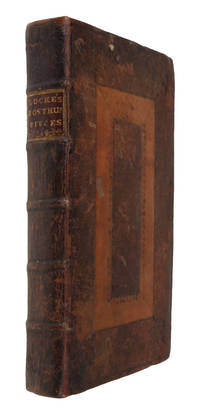
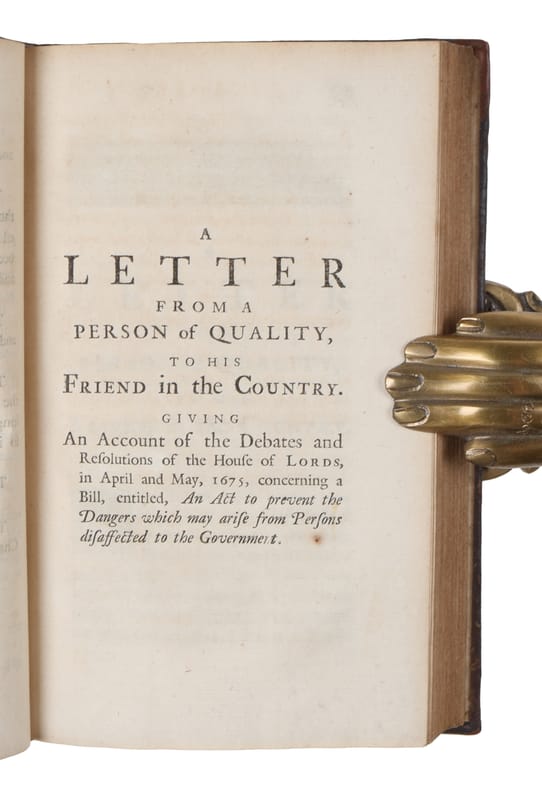
172041467London J. Bettenham 1720. 8vo. Nice contemporary English Cambridge-style full calf binding with five raised bands and gilt title-label to spine. Neat minor repair to extremities. A bit of overall wear but a nice and tight copy. Internally nice and clean with only some occasional soiling that is very light. Engraved title-vignette 36 - i.e. title-page dedication XXIV i.e. "The Character of Mr. Locke" by Peter Coste 2 - i.e. contents 362 18 - i.e. index 4 - i.e. errata advertisements pp. one plate "The Solar System". <br/><br/><em>First edition of this important collection of hitherto unpublished works by Locke containing the first printing of his unique work on Natural philosophy "The Elements of Natural Philosophy" as well as first printings of other important works. Assisted by Anthony Collins in 1720 the journalist Pierre Desmaizeaux brought out a new collection of Works and pieces by John Locke that had not previously been published. This collection "A Collection of Several Pieces" came to play a great role in the Locke scholarship not least in recent times and not least because it contains the first printing of his "Elements of Natural Philosophy"The "Elements of Natural Philosophy" constitutes Locke's main work in natural philosophy and it is a work that pas puzzled Locke scholars and readers ever since its appearance. The work seems to need some further explanation; at a firsthand glance it doesn't look very much like Locke - the greatest of the English philosophers who has so frequently been accused of not understanding the exact sciences and who even encouraged the youth not to learn these but to educate themselves in superficial and useful party-conversation. Thus numerous attempts have been made to establish the influence that resulted in this educational work of natural science. The two dominating answers to the question of influence are now: Newton and Descartes. It now seems to be fairly commonly recognized that Newton a personal friend of Locke even contributed directly to the work. "When Locke himself at the end of his life came to compose a treatise on natural philosophy for a pupil we have reason to believe that he obtained the advice and help of the most brilliant scientist of the century his close friend Isaac Newton. As we shall see this unique educational work itself "The Elements of Natural Philosophy" belies the myth of Locke the scientific smatterer." Axtell Locke Newton and the Elements of Natural Philosophy p. 244. However Descartes influence also seems to be obvious; "The influence of the "Principles" by Descartes is also obvious in Locke's posthumously published "Elements of Natural Philosophy". There is a striking similarity in the order of exposition although there are also considerable differences: Locke carefully eschewed Descartes' "a priori" metahpysics of nature. We find him rather emphasizing the essential role of experience. For example Locke introduced Newtonian universal gravitation as follows:. Thus according to Locke empirical support was necessary to establish the law of nature. Although the exposition looks quite similar to Descartes' "Principles" the "Elements" in fact contain several anti-Cartesian remarks in favour of the experimental philosophy." Aoki Descartes and Locke on the Nature of Matter. In: Hutton and Schuurmann edt. Studies on Locke p. 77."Elements of Natural Philosophy" was printed in no less than nine times during the 1th century and appeared in both Russian and French during the 18th century as well.The present "Collection of several Pieces" furthermore included a collection of letters from Locke to Anthony Collins "Remarks upon some of Mr. Norris's Books." "Some Thoughts concerning Reading and Study for a Gentleman." and "Rules of a society." all printed here for the first time as well as an English translation of Coste's Eulogy "The Character of Mr. Locke" originally published in French in 1705 and reprints of "The fundamental Constitutions of Carolina" and "A Letter from a person of Quality."."Remarks upon some of Mr. Norris's books." is the third of Locke's replies to Norris. "Some thoughts concerning reading and study for a gentleman" constitutes Locke's reply to Samuel Bold's question on behalf of a parishioner on how to create a course of reading and study. "Rules of a Society" constitutes the rules that Locke set up for a small group of friends who met once a week to discuss "useful Knowledge" and to promote "Truth and Christian Charity". Throughout his life Locke created several of these "societies" one of which led to his "An Essay Concerning Human Understanding" another one being "The College" in London after the Revolution. </em> hardcover
172041467London, J. Bettenham, 1720. 8vo. Nice contemporary English Cambridge-style full calf binding with five raised bands and gilt title-label to spine. Neat minor repair to extremities. A bit of overall wear, but a nice and tight copy. Internally nice and clean with only some occasional soiling that is very light. Engraved title-vignette (36 - i.e. title-page + dedication), XXIV (i.e. ""The Character of Mr. Locke"" by Peter Coste), (2 - i.e. contents), 362, (18 - i.e. index), (4 - i.e. errata + advertisements) pp. + one plate (""The Solar System"").
B9781498104869Paperback / softback. New. paperback
1824560674London: William Baynes & Son 1824. This book has a New Spine and Annotations and Foxing throughout.Please Email for further details. NOT SIGNED OR INSCRIBED. New Edition. Green Cloth New Spine. Very Good Annotations & Foxing/No Jacket. Illus. by Frontispiece of the Authors. 8vo - over 7¾" - 9¾". HARDBACK. William Baynes & Son Hardcover
2010DADAX1163409588Kessinger Publishing 2010-09-10. hardcover. New. 6.00x1.31x9.00. Buy with confidence. Excellent Customer Service & Return policy. Kessinger Publishing hardcover
1163409588.Ghardcover. Good. Access codes and supplements are not guaranteed with used items. May be an ex-library book. hardcover
0548101892.Ghardcover. Good. Access codes and supplements are not guaranteed with used items. May be an ex-library book. hardcover
1162954868.Gpaperback. Good. Access codes and supplements are not guaranteed with used items. May be an ex-library book. paperback
1428609121.Gpaperback. Good. Access codes and supplements are not guaranteed with used items. May be an ex-library book. paperback
149810486X.Gpaperback. Good. Access codes and supplements are not guaranteed with used items. May be an ex-library book. paperback
2007DADAX0548101892Kessinger Publishing 2007-07-25. hardcover. New. 6.00x1.31x9.00. Buy with confidence. Excellent Customer Service & Return policy. Kessinger Publishing hardcover
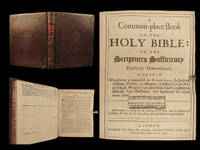
1697AQ12749London: Printed by Edw. Jones for Awnsham and John Churchill 1697. 16 310 10. With a terminal advertisement leaf. Contemporary blind-panelled speckled calf neatly rebacked and recornered in brown morocco contrasting red morocco lettering-piece gilt. Binding a trifle rubbed and a little marked new endpapers. Small rust hole to G3 without loss of sense else a crisp and clean copy. The third edition but first appearance with this title of a collection of scriptural excerpts collected together thematically which was first published as Graphautarkeia London 1676. The authorship is unknown but it is commonly misattributed to John Locke presumably because his own system of common-placing was outlined in an appendix to Humane understanding - despite this work not being organised in his fashion - to the extent that several nineteenth-century editions featured the philosopher's name in their titles. Wing L2737. Third edition. Quarto. Printed by Edw. Jones, for Awnsham and John Churchill unknown
0259241296.Gpaperback. Good. Access codes and supplements are not guaranteed with used items. May be an ex-library book. paperback
0331152177.Ghardcover. Good. Access codes and supplements are not guaranteed with used items. May be an ex-library book. hardcover
1828064227London: J. F. Dove 1828. Book. Good. Hardcover. iv-xiv 492pp; frontispiece; random light foxing; half leather marbled boards brown leather spine gilt title gilt bands to spine; light edgewear; previous owner's name with date to fep. and comment "a most helpful book". Size: 8vo - over 7¾" - 9¾" tall. J. F. Dove Hardcover
169724368<p><strong>1697 John LOCKE Commonplace Book BIBLE Interpretation Miracles Demons Angels </strong></p><p><em>"I have always thought the actions of men the best interpreters of their thoughts." </em></p><p><em>– John Locke </em></p><p>John Locke was without question one of the world's most important philosophical thinkers. He published books on human understanding and was the first to describe the idea of 'blank state' of the mind. However in 1685 Locke published the first of his 'commonplace books' in which he described the formulas for understanding ideas quotations and sayings. This style of writing proved effective for learners so many other writers began publishing common-place books to build on the popularity established by Locke.</p><p>One such work was "<em>A Commonplace Book to the Holy Bible</em>" – an anonymously published supplement to scripture reading and interpretation. It provides extensive descriptions on the character of God the relationship between Christ and the church on saints and the roles and duties believers. This book has long been attributed to John Locke but this attribution has been contested in modern scholarship.</p><p>Item number: #24368</p><p>Price: $995</p><p>LOCKE John attributed</p><p><strong><em>A common-place book to the Holy Bible or The scriptures sufficiency practically demonstrated wherein whatsoever is contain'd in scripture</em></strong></p><p>London: printed by Jones for Awnsham and Churchil 1697.</p><p><u>Details</u>: </p><p><!-- if !supportLists-->· <!--endif-->Collation: Complete</p><p><!-- if !supportLists-->o <!--endif-->16 310 10</p><p><!-- if !supportLists-->· <!--endif-->References: Wing L 2737</p><p><!-- if !supportLists-->· <!--endif-->Language: English</p><p><!-- if !supportLists-->· <!--endif-->Binding: Leather; tight and secure</p><p><!-- if !supportLists-->· <!--endif-->Size: ~8in X 6.5in 20.5cm x 16.5cm</p><p>Our Guarantee:</p><p>Very Fast. Very Safe. Free Shipping Worldwide.</p><p>Customer satisfaction is our priority! Notify us with 7 days of receiving and we will offer a full refund without reservation!</p><p>24368</p><p>Photos available upon request. </p> Jones for Awnsham and Churchil hardcover