Zange, Dr. E. M. FriedrichAntiquariat.de

66 résultats
1872127722Lepizig: Verlag von Breitkopf & Härtel, 1872. XII, 220 S. ; 21,5 x 13,5 cm ; Halbleinen.
189361CBBayreuth, Ellwanger (= handgeschr. Programm-Nr. 9), 1893. 8°, 41 S., original Heft mit Papierrückenstreifen, Erstausgabe handgeschriebene Anmerkung (1893.bayr. Progr. No 9) und schöner alter Stempel der Lehrerbibliothek eines alteingesessenen Frankfurter Gymnasiums auf Titelseite, sonst gute, kaum altersspurige Broschur (Li1, Ordner4)
190015045AStuttgart, Fr. Frommanns Verlag (E. Hauff), 1900. Porträtfrontispiz, XIV Seiten, 392 Seiten. Neuerer Halbleinenband mit goldgeprägtem Rückentitel.
19000280-17Stgt.,Frommann 1900. 1 Bl.,XIV,392,(8) S. Vlgsanzeigen. Mit 1 Porträt als Front. Oln. mit dezenter Rückenvergold., ganz min. berieben u. bestoßen, Rücken leicht aufgehellt, Exlibris eingeklebt, Titelbl. mit schwachen Stockflecken, gutes Expl. - Frommanns Klassiker der Philosophie X
18736791CBerlin:, Carl Duncker., 1873. 400 S. Schlichter neuerer grauer Pappeinband. Papierbedingt etwas gegilbt. Gut erhalten.
1886PHIL2229Wien, R. Löwit 1886. 8°. 67(1) S. Stummer HLeinenbd. d. Zeit m. marmor. Deckelbez. An den Kanten abgerieben, Ecken bestoßen, im Text papierbed. gebräunt u. etw. abgegriffen.
189418018ALeipzig, Druck von Breitkopf & Härtel, 1894. Ca. 21,5 x 14,5 cm. 2 Blätter, 84 (1) Seiten. Rückenbroschur.
182529181Wien, Chr. Fr. Schade, 1825. Kl.-8°. Zus. ca. 520 S., Ppbd. d. Zt. m. goldgepr. Rückentitel.
1825REIS0558Wien, Anton Strauß 1825. 12°. 227 S. u. Reihent., Titelbl., 257 S., 1 nn. Bl. Unbeschnittene, Bedruckte Obrosch. Rücken mit Knickspur, Umschlag fleckig u. mit eingerollten Rändern, Titelblätter schwach wasserfleckig, Blattränder mit geknickten Ecken, angestaubt u. gebräunt, Seiten sonst wenig vergilbt oder fleckig. Mit e. Besitzstempel (Archiv Katholischer Preßverein) und einer Datumsangabe von alter Hand auf der Vorderseite des Reihentitels, sowie einigen alten Bleistiftanmerkungen und -anstreichungen im Text. Engelmann. Bibliotheca geographica 506 - zweiter Teil einer Wiener Taschenbuchausgabe dieses Reisebericht der rührigen Autorin und Reiseschriftstellerin Johanna Henriette Schopenhauer (1766-1838), Mutter des Philosophen Arthur Schopenhauer.
1888PHIL1370Leipzig, Brockhaus 1888. XII, 532 S. OHLn. Einband u. Kanten stark berieben, Exlibris auf fl. Vorsatz, Gebrauchsspuren.
1877PHIL1163aLeipzig, Brockhaus 1877. VIII, 203 S., XIV, 160 S., XVI, 93 S., 58 S., 1 Tafel.; XXXVI, 633 S, 1 Tafel.; VI, 743 S., 1 Tafel.; XXXI, 147 S., XLII, 275 S.; XII, 532 S.; VI, 696 S. OHLdr. Kanten u. Deckel berieben, Titelbl. mit hs. Namenszug, vereinzelte Bleistiftanstreichungen. Im Ganzen guter und dekorativer Satz. Bd. 1: Schriften zur Erkenntnislehre. Bd. 2: Die Welt als Wille und Vorstellung. 1. Band. Bd. 3: Die Welt als Wille und Vorstellung. 2. Band. Bd. 4: Schriften zur Naturphilosophie und zur Ethik. Bd. 5: Parerga und Paralipomena. Bd. 6: Parerga und Paralipomena.
189129830Leipzig : Brockhaus 1891. XXVIII, 232 S. m. Goldschnitt. OLeinenbd. m. Goldpräg. 17x12 cm.
18901257713Leipzig; Philipp Reclam jun., (1890). 677; 762; 655; 554; 696; 450; 178; 197 und 210 Seiten; graph. Darst.; Illustr.; 14 cm; 9 klammergeh., goldgepr. Orig.-Leinenbände.
1859258810Leipzig: Brockhaus, 1859. XXXII; 634 Seiten. Originalleinen mit vergoldetem Rückentitel . 21 cm.
1900920Stuttgart Fromann, 1900. XIV, 392 S. 4 Bl. Verlagsanzeigen 8° Olwd
181828300Leipzig: F. A. Brockhaus 1818 1818. Second edition considerably revised; the first was published in 1813. Edges a little worn; spines slightly faded; very good copy. 2 vols 8vo contemporary quarter paper spines marbled paper boards gilt lettering untrimmed. With half-titles. Between 1803 and 1805 Johanna Schopenhauer 1766-1838 traveled extensively with her family in England and Scotland. She is known today primarily as the mother of the philosopher Arthur Schopenhauer 1788-1860 but in her time she was a popular novelist and travel writer and she hosted a prominent literary salon in Weimar. This second edition was significantly reorganized with a new preface explaining the changes. In addition to descriptions of the great country houses Blenheim and Chatsworth among them landmarks the Tower of London Windsor Castle Hampton Court and cultural life in London particularly the theater Schopenhauer describes the industrial north coal mines a munitions factory a steel mill and offers her observations on industrialization and social conditions of the working families in the vein of Harriet Martineau. Bookplate of Bibliotheca Congregationis SS. Redemtoris on the front paste-downs and their small shelf label at the feet of the spines. <br/><br/> Leipzig: F. A. Brockhaus, 1818 hardcover books
1886140941121Boston: J.R. Osgood & Co 1886. First American edition. Near Fine. First American edition. xxxii 532; viii 496; viii 509 pp. Publisher's brown pebbled cloth with paper title labels. Light wear to title labels and slight darkening to spines traces of paper stuck to back board of Vol. 1 else Fine with contents bright and unmarked. A scarce set in truly excellent condition.<br /> <br /> A major work of 19th century philosophy and the author's magnum opus which he spent the remainder of his life revising and promoting. The title is generally translated The World as Will and Representation. Herein Schopenhauer maintains that life is a constant struggle and suffering the "heroic life project" that is doomed to fail. His call for realism and pessimism in the face of disaster to avoid sugar-coating reality makes this work always relevant and challenging. J.R. Osgood & Co unknown books
185970142-A-66552Leipzig: Philipp Reclam jun. 1859. Third edition. 6 volumes bound in cloth gilted marbled blocks. 14x9 cm. Frontispice in vol VI. -Some minor wear on the coers name in ink whited out on title page vol I. . Philipp Reclam jun. hardcover
189195424Brockhaus; Leipzig 1891. hardcover. gebraucht gut 5 Bände von 6 Ln Schnittkanten marmoriert Rücken an den Kapitalen bestoßen Band 1 mit einem kleinen Wasserfleck hinten Buchblöcke gut und fest. Brockhaus; Leipzig, hardcover
1831026446Leipzig: F.U. Brockhaus. Good. 1831. Boards. 316 pages frontispiece Volume 1 only bound in boards interior clean.; 8vo . F.U. Brockhaus hardcover
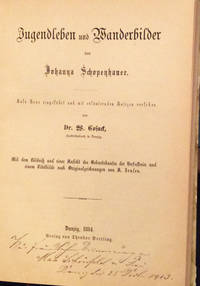
188416656Danzig/Gdansk: Theodor Bertling 1884. 1st. Hardcover. First edition thus. 8vo. 185pp plus 2pp of publisher's catalog. Black & white title page illustration. Re-bound in green paper covered boards; gilt titles to pink leather label on spine. Wear to extremities more so to spine ends and corners; previous owner's inscription. Very good. Theodor Bertling hardcover
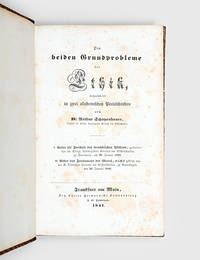
1840170880Frankfurt am Main: Joh. Christ. Hermannsche Buchhandlung 1841 i.e. 1840; 1854. I am read and I will be read First edition of the German philosopher's best and most focussed work on ethics outlining stinging attacks on both Kant and Hegel. In 1839 Schopenhauer wrote an essay titled On the Freedom of Human Will which won him the gold medal from the Royal Norwegian Society of Sciences. Buoyed he wrote a complementary essay one year later On the Foundations of Morality which did not fare as well. Although this was the only submission to a competition run by the Royal Danish Society it was rejected on the grounds that it was opinionated and brutally disrespectful to prominent philosophers - Hegel in particular. Schopenhauer responded by publishing the two papers as Two Fundamental Problems of Ethics original German - Die Beiden Grundprobleme der Ethik with a lengthy preface outlining some choice thoughts on both Hegel and the Royal Danish Society. Although the Two Fundamental Problems carries an 1841 date it was published late in 1840. This volume also includes the second edition of On the Will in Nature original German - Ueber den Willen in der Natur originally published in 1836 which aims to bring recent developments in 19th-century science in line with Schopenhauer's nascent theory of the will. By 1854 his intellectual isolation had begun to abate and as he confidently wrote in the preface to the second edition "legor et legar" "I am read and I will be read" - p. vi. Octavo 203 x 126 mm pp. xl 278 2; pp. xxiv 135 1. Near-contemporary brown quarter cloth spine ruled and lettered in gilt marbled paper sides and edges. Near-contemporary library ticket of Ad. Scheefer. Infrequent near-contemporary pencil annotations. Light bumping and rubbing minor foxing to outer leaves: a very good copy. Hübscher 33 & 37. hardcover
1860PHOeSCHO55Leipzig: F.V.Brockhaus 1860. 1860. 8vo. pp. xliv 275 1. with half-title. later cloth spine dull some foxing. Second Collected Edition first: 1841 of Schopenhauer's two essays on ethics and the problem of free will which he had sent in 1838-39 in competition for prizes offered by the Norwegian Academy of Sciences at Drontheim and the Danish Academy at Copenhagen respectively. The first essay was awarded the prize and the author elected a member of the society but the second although it was the only one in competition was refused on a number of grounds. Rand I p. 463. Hardcover. Leipzig: F.V.Brockhaus, 1860. Hardcover
1832950644Berlin: Ohne Drucker 1832. hardcover. Gut. Insgesamt über 550 Seiten. Geprägter Pappband der Zeit mit floralen Ornamenten und dreiseitigem Goldschnitt. Duodez 125 x 95 cm Einband etwas lichtspurig und fleckig leicht bestoßen und berieben Rücken knickspurig Schrift auf Vorsatz und der Rückseite des Frontispiz mit Tintendurchschlag es FEHLEN die Kupfer und das Verzeichnis der Kupfer im Ganzen aber ordentlich erhalten. Ein dekorativer eleganter hellrosa Biedermeier-Einband geprägt mit floralen Ornamenten. Ein Doppelblatt ist gelockert aber nicht lose. Auf der Rückseite des Frontispiz' mit dem Besitzeintrag einer Gräfin Wartensleben die auch den Vorsatz mit einem dreistrophigen Gedicht geschmückt hat. Die auf dem Titel erwähnten Kupferstiche fehlen in dem vorliegenden Band bis auf das Frontispiz mit dem Bildnis von Otto Prinz von Bayern ebenso wie die im Inhaltsverzeichnis erwähnte Beschreibung der Kupfer. Augenscheinlich wurden aus dem Band keine Blätter entfernt und das Buch wurde möglicherweise bei der Herstellung ohne die Kupfertafeln und deren Beschreibung aufgebunden. Johanna Henriette Schopenhauer geb. 9. Juli 1766 in Danzig; gest. 16. April 1838 in Jena war die Mutter des Philosophen Arthur Schopenhauer. Ihre Novelle "Die Reise nach Italien" erschien in Buchform erst 1836 bei Sauerländer in Frankfurt und der vorliegende Abdruck im Berliner Kalender von 1833 ist möglicherweise gekürzt. Die verwickelte Erzählung handelt von unglücklicher Liebe und vertauschten Kindern "Die Geisel der Literatur des 19. Jahrhunderts" - Arno Schmidt. "Ihre Romane spiegeln sehr stark ihre Gefühle in ihrer vergangenen von Tyrannei bestimmten Ehe wider. Die typische Johanna-Schopenhauer-Heldin verliert auf tragische Weise ihre wahre Liebe und findet sich dann aus nicht nachvollziehbaren Gründen mit einer unbefriedigenden Ehe ab was schon die zeitgenössische Kritik bemängelte." wikipedia. Sonst finden sich in dem Buch 13 Blatt mit Kalendarien; Seite 1-154: Mano "Die Geschichte des griechischen Befreiungskrieges. Fortsetzung und Schluß.": Seite 155-220: Friedrich Buchholz "Johann Graf von Capo d'Istrias oder die vier letzten Jahre der griechischen Revolution."; nach der Novelle folgt Seite 1-106 "Genealogie der regierenden hohen Häuser." und Seite 1-79 "Verzeichnis der Postcourse" i.e. die Fahrpläne der Postkutschen in Deutschland. Der Kalender ist äußerst selten die über KVK gefundenen Einträge verweisen zumeist auf eine "elektronische Resource". - Weitere Bilder auf Anfrage oder auf unserer Homepage. Wegen Urlaub kann Ihre Bestellung / Anfrage erst nach dem 21.06.2026 bearbeitet werden. - Because of holidays your order / question can be handled only after 06/21/2026. Ohne Drucker hardcover
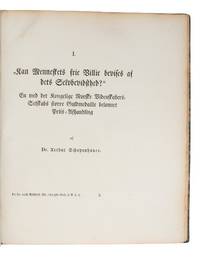
184038535Trondhjem Tønnes Andreas Høeg 1840. 4to. Entire volume present. Later very nice brown hcalf w. gilt spine Anker Kyster. Pp. 1 - 100. Entire volume: 2 127 3 pp. With the general title-page for the volume title-pages and prefaces for the two works contained in the present volume and the contents-leaf. The other work is: "Den Constitutionelle Statsform betragtet i dens Forhold til Samfundets høiere Interesser. Tale holden i det Kongl. Norske Videnskabers=Selskab paa hans Majestæt Kongens Fødselsdag den 26de Januae 1838 af Frederik Moltke Bugge Selskabets Præses." <br/><br/><em>The scarce first printing of Schopenhauer's "Prize Essay" "On the Freedom of Human Will" which constitutes one of Schopenhauer's greatest successes one of the works of which he was the most proud and the work that was awarded the large gold medal from the Royal Norwegian Society of Sciences being an answer to the proposed question from the Society "Is it possible to demonstrate human free will from self-consciousness". The following year Schopenhauer wrote his "On the Foundations of Morality" "Über die Grundlage der Moral" which he sent to the Royal Danish Society of Sciences but which was not honoured with an award although it was the only submission to the competition. It is these two works that together constitute his "Two Fundamental Problems of Ethics" "Die Beiden Grundprobleme der Ethik" which was published in 1941. The title-page and the preface are in Norwegian but the essay itself is in German "partly because a translation would undoubtedly be superfluous even unwelcome by anyone who possesses enough scientific education to lead the treatise with interest and knowledge partly because the copies that would be given to the author would probably lack all interest to him if they were printed in the Norwegian language and finally partly because the esoteric nature of the contents seem to make it preferable that the treatise as far as possible would not be made accessible to others than those who due to fairly thorough education are able to avoid misunderstandings as well as being able to properly appraise the value of the treatise with regards to its reality in general and partially own translation - Introduction pp. 2 - 3.Schopenhauer's work is generally accepted as being one of the most brilliant and elegant treatments of free will and determinism. He clearly and elegantly distinguishes between the freedom of acting and the freedom of willing. His conclusion is that human beings do have the freedom of acting whereas they do not have the freedom of willing since they are completely determined by the way that their bodies react to outside stimuli and causes. From the libraries of the two notable collectors Ejnar Christiansen and Esli Dansten. </em> unknown