66 résultats
1886140948846London: Truebner & Co 1886. First British Edition. Very Good. First British edition and first English translation. Three volumes. 8 ads dated 7/11/83 4 xxxii 532; 8 ads viii 496 pp.; 8 ads viii 506 pp. Foldout table to Volume I facing p. 64. Bound in publisher's blue cloth stamped in black and gilt brown coated endpapers. Very Good with sunned spines rubbed at the extremities soiling and light stains to covers light foxing to cloth and textblock edges. Volume I: hinges starting front free endpaper detached. Volume II: hinges tender tidemark to lower front endpapers second ad leaf torn vertically in half with marginal loss to separated half fourth ad leaf torn from binding with loss of lower two-thirds. Volume III: lacking final ad leaf hinges tender tidemark to lower gutter of front endpapers. Housed in custom clamshell cases quarter navy morocco over blue marbled boards decorative gilt stamping to spines.<br /> <br /> <p>The first British edition of Schopenhauer's magnum opus Die Welt als Wille und Vorstellung which he first published in 1818 and spent a lifetime revising. Schopenhauer's depiction of life as eternal struggle met with a chilly reception from German idealists and the pessimist was not recognized as a major philosopher until 1851. It took another thirty years for Schopenhauer's most important work to be translated into English by R. B. Haldane and J. Kemp but many of his theories were widely accepted by the end of the 19th century. His faith in art as a means to perceive the underlying truth of all things "the Will" influenced the French Decadent movement and the works of Wagner Kafka and Borges. Thomas Mann championed Schopenhauer's clear-eyed rationalism as a necessary counter to the twentieth century's glorification of instinct including bad instincts: "We have seen instead of pessimistic conviction deliberate malice." His work is as relevant now as it was when these books were first printed. Truebner & Co unknown
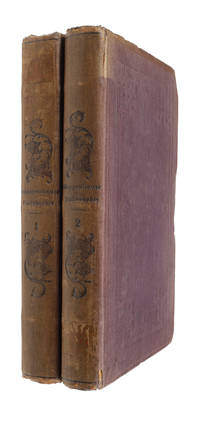
185162019Berlin Hayn 1851. 8vo. Uniformly bound in two uniform contemporary - possibly original! - embossed full cloth bindings. Embossed lettering and ornamentation to spine. Spines and borders of boards slightly faded. Spines with repairs. Front free end-paper in vol. 2 with repair. Previous owner's label Julius Kotrtsch pasted on to lower margin of title-pages. Previous owner's name in contemporary hand to upper margin of title-pages. Verso of last leaf in vol. 2 annotated in pencil. Vol. 1 with light occasinal marginal browspotting. 6 465 1 pp.; IV 531 pp. <br/><br/><em>The scarce first edition of Schopenhauer's most influential work his final masterpiece which consists in his seminal philosophical reflections. The Parerga and Paralipomena was the first of his works to gain recognition and the work that propelled the then obscure figure into lasting philosophical prominence. Seeing that all of Schopenhauer's previous publications had been complete failures it was only with great difficulty and reluctance that Hayn of Berlin was pesuaded to print the work which they then only did in a small printrun of merely 750 copies which now makes the first edition very difficult to find. The work is is two parts with the first "parerga"-part consisting in six extended essays intended as supplementary to the author's thought whereas the second "paralipomena"-part consists in shorter elaborations divided by topic into thirty-one subheadings that cover material hitherto unaddressed by Schopenhauer but complementary to the "parerga". In spite of the poor reception of his earlier works somehow the “Parerga and Paralipomena attracted the attention of John Oxenford a noted observer and translator of German literary culture who contributed a favourable review of the work in 1852 and in 1853 wrote an article on Schopenhauer's philosophy entitled "Iconoclasm in German Philosophy" which through its German translation in Vossische Zeitung sparked in immediate interest of Schopenhauer's work in Germany and propelled him into philosophical fame. “The effect was dramatic and almost overnight Schopenhauer in his own country passed from obscurity to fame and from then till his death in 1860he basked in the sunshine of belated recognition and eminence.†Payne in the Preface to his translation of Parerga and Paralipomena into English Oxford 2000p. xii The work greatly influenced later philosophers most notably Nietzsche whose fondness of aphorism is directly inspired by “Parerga and Paralipomenaâ€. “One of the most significant and fascinating works of the great philosopher Arthur Schopenhauer 1788-1860. The Parerga Volume 1 are six long essays; the Paralipomena Volume 2 are shorter writings arranged under thirty-one different subject-headings. These works won widespread attention with their publication in 1851 helping to secure lasting international fame for Schopenhauer. Indeed their intellectual vigor literary power and rich diversity are still extraordinary even today.†Payne. </em> hardcover
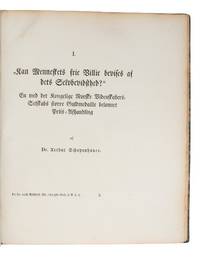
184038535Trondhjem Tønnes Andreas Høeg 1840. 4to. Entire volume present. Later very nice brown hcalf w. gilt spine Anker Kyster. Pp. 1 - 100. Entire volume: 2 127 3 pp. With the general title-page for the volume title-pages and prefaces for the two works contained in the present volume and the contents-leaf. The other work is: "Den Constitutionelle Statsform betragtet i dens Forhold til Samfundets høiere Interesser. Tale holden i det Kongl. Norske Videnskabers=Selskab paa hans Majestæt Kongens Fødselsdag den 26de Januae 1838 af Frederik Moltke Bugge Selskabets Præses." <br/><br/><em>The scarce first printing of Schopenhauer's "Prize Essay" "On the Freedom of Human Will" which constitutes one of Schopenhauer's greatest successes one of the works of which he was the most proud and the work that was awarded the large gold medal from the Royal Norwegian Society of Sciences being an answer to the proposed question from the Society "Is it possible to demonstrate human free will from self-consciousness". The following year Schopenhauer wrote his "On the Foundations of Morality" "Über die Grundlage der Moral" which he sent to the Royal Danish Society of Sciences but which was not honoured with an award although it was the only submission to the competition. It is these two works that together constitute his "Two Fundamental Problems of Ethics" "Die Beiden Grundprobleme der Ethik" which was published in 1941. The title-page and the preface are in Norwegian but the essay itself is in German "partly because a translation would undoubtedly be superfluous even unwelcome by anyone who possesses enough scientific education to lead the treatise with interest and knowledge partly because the copies that would be given to the author would probably lack all interest to him if they were printed in the Norwegian language and finally partly because the esoteric nature of the contents seem to make it preferable that the treatise as far as possible would not be made accessible to others than those who due to fairly thorough education are able to avoid misunderstandings as well as being able to properly appraise the value of the treatise with regards to its reality in general and partially own translation - Introduction pp. 2 - 3.Schopenhauer's work is generally accepted as being one of the most brilliant and elegant treatments of free will and determinism. He clearly and elegantly distinguishes between the freedom of acting and the freedom of willing. His conclusion is that human beings do have the freedom of acting whereas they do not have the freedom of willing since they are completely determined by the way that their bodies react to outside stimuli and causes. From the libraries of the two notable collectors Ejnar Christiansen and Esli Dansten. </em> unknown
1851916Berlin: A. W. Hayn 1851. First Edition. Hardcover. Very good. The Book That Finally Made Schopenhauer Popular! <br /> <br />SCHOPENHAUER Arthur Parerga und Paralipomena: kleine philosophische Schriften Appendices and Omissions: a small philosophical writing. Berlin: A. W. Hayn 1851. Volume 1: TP i = Inhalt iii-iv = Vorwort half-title 3-465 466 = Druchfehler; Volume 2: TP III-IV = Inhalt half-title 3-531; Octavo. First Edition. <br /> <br />This work published in an edition of only 750 copies is a significant supplement to The World as Will and Idea. <br /> <br />Parerga und Paralipomena Greek for "Appendices" and "Omissions" is a collection of later philosophical reflections by Schopenhauer. The selection was compiled not as a summation of or introduction to his philosophy but rather as supplementary readings for those who had already embraced it although the author did maintain that it would still be comprehensible and of interest to the uninitiated. <br /> <br />The collection is divided into two volumes covering first the parerga Appendicies and thereafter the paralipomena omissions to that philosophy. The parerga are six extended essays intended as supplementary to the author's thought. The paralipomena short ruminations divided by topic into thirty-one subheadings cover material hitherto unaddressed by the philosopher but deemed by him to be complementary to the parerga. <br /> <br />As a result of this book especially the Aphorisms of Wisdom Schopenhauer finally gained popularity in Germany as a philosopher. <br /> <br />The contents include: Fragments on the History of Philosophy On Academic Philosophy On Visions and Related Matters On Logic and Dialectic On the Philosophy of Science and Nature On Suicide On Women and others. <br /> <br />CONDITION: Very good or better in original publishers cloth Light scuffing and edgewear. Former owners name neatly inscribed to upper corner of front free endpapers. Light foxing. Overall a very desirable copy. <br /> <br /> <br/><br/> A. W. Hayn hardcover
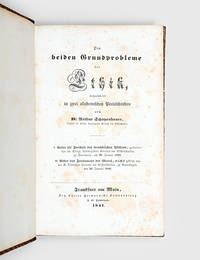
1840170880Frankfurt am Main: Joh. Christ. Hermannsche Buchhandlung 1841 i.e. 1840; 1854. I am read and I will be read First edition of the German philosopher's best and most focussed work on ethics outlining stinging attacks on both Kant and Hegel. In 1839 Schopenhauer wrote an essay titled On the Freedom of Human Will which won him the gold medal from the Royal Norwegian Society of Sciences. Buoyed he wrote a complementary essay one year later On the Foundations of Morality which did not fare as well. Although this was the only submission to a competition run by the Royal Danish Society it was rejected on the grounds that it was opinionated and brutally disrespectful to prominent philosophers - Hegel in particular. Schopenhauer responded by publishing the two papers as Two Fundamental Problems of Ethics original German - Die Beiden Grundprobleme der Ethik with a lengthy preface outlining some choice thoughts on both Hegel and the Royal Danish Society. Although the Two Fundamental Problems carries an 1841 date it was published late in 1840. This volume also includes the second edition of On the Will in Nature original German - Ueber den Willen in der Natur originally published in 1836 which aims to bring recent developments in 19th-century science in line with Schopenhauer's nascent theory of the will. By 1854 his intellectual isolation had begun to abate and as he confidently wrote in the preface to the second edition "legor et legar" "I am read and I will be read" - p. vi. Octavo 203 x 126 mm pp. xl 278 2; pp. xxiv 135 1. Near-contemporary brown quarter cloth spine ruled and lettered in gilt marbled paper sides and edges. Near-contemporary library ticket of Ad. Scheefer. Infrequent near-contemporary pencil annotations. Light bumping and rubbing minor foxing to outer leaves: a very good copy. Hübscher 33 & 37. hardcover
184072553Trondhjem 1840. Liten 4to. Samtidig skinnryggbind med marmorerte dekler. 100 s. Trykt af Tønnes Andreas Høeg Norsk. <br/><br/><em>I “Det Kongl. Norske Videnskabers-Saelskabs Skrifter i det 19de Aarhundrede. 3die Binds 2det Hefteâ€. Bindet eller har en rekke interessante artikler. Med tidligere eieres anmerkninger. Et svært viktig filosofisk skrift. </em> unknown
188938084London England: George Bell & Sons. As New. 1889. Hardcover. FREE UPGRADE to Courier/Priority Shipping Upon Request IN STOCK AND IMMEDIATELY AVAILABLE FOR SHIPMENT - TEXT PRISTINE Hinges cracked; else fine. -- with a bonus offer-- . George Bell & Sons hardcover
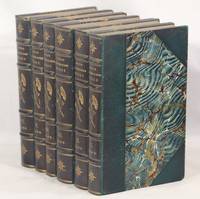
1891000013367Leipzig: F.A. Brockhaus 1891. Later edition. Hardcover. Very Good. 6 vol. 7 viii 3 4-203 6 vi-xiv 3 2-160 3 iv-xvi 1-93 3 1-58 2; 7 viii-xxxvi 3 4-633 3; 5 vi 3 4-743 3; 9 x-xxxi 1 1-275 3; 5 vi-xii 7 4-532 2; 5 vi 3 4-696 2 pp. Half contemporary green morocco over marbled boards spines in five compartments with gold lettering and decorations; all edges sprinkled purple. Bound by Otto Knoll of N.Y. Volume one illustrated with a folding chart and with two in-text diagrams volumes two and three each with a folding chart. Edited by Julius Frauenstädt. A reprint of the second edition. Volume one with works on epistemology and writings on a theory of vision and colors. Volume one's text in German except for the final essay which is in Latin. Volume two is in four books with an appendix containing a criticism of Kantian philosophy. Volume three with additions to the contents of the books in volume two. Volume four with an essay about the will in nature and an essay on "the two basic problems of ethics". The final two volumes contain Parerga und Paralipomena philosophical reflections by Schopenhauer. Stanford Encyclopedia of Philosophy "Arthur Schopenhauer". With work in aesthetics ascetics and reason Schopenhauer's philosophy was influential for Nietszche Bergson and for countless literary figures including Borges. SEP cites the authors ethics as one of his boldest ideas. His ethical framework does not require the existence of a deity for it to be justified. Each volume with a bookplate light rubbing to the extremities and the joints and corners touched up. F.A. Brockhaus hardcover
1873310562Leipzig: F. V. Brodhaus 1873. First Edition. Leather Bound. Good. 0x0x0. Good condition. Scarce German 1st editions 1873-1874 of all 6 volumes of Schopenhauer's complete works edited by Schopenhauer's executor Julius Frauenstadt. Hinge is rubbed on Volume One. Volumes Two and Three are lightly rubbed Volume Four has 3/4 inch chip and hinge is worn but sound Volume Five outer hinge is starting Volume Six has some apparent successful repair and chipping at head and hinge. Bookseller/binder's mark at top corner inside board. Now in archival acrylic jackets. Provenance: this set was formerly owned by Elizabeth Von Arnim Schlagenthin anonymous author of the beloved turn of the century classic "Elizabeth and Her German Garden". Each volume of the Sammtliche Werke features her bookplate on the inside front board stating "This book belongs to Elizabeth Chanterai Ma Chanson" with stamp of Von Arnim- Schlagenthin on the front free endpaper - likely from the large library at her estate Chalet Soleil where she seduced the young man who came to catalog it. Literary associations She was Katherine Mansfield's cousin. E. M. Forster and Hugh Walpole tutored her children. She had an affair with H. G. Wells. And then there is Schopenhauer. He influenced perhaps her notoriously mordant wit. The set is well read. Each volume is half leather. Ships from Dinkytown in Minneapolis Minnesota. Due to the size/weight of this set extra charges to apply for international shipping. F. V. Brodhaus hardcover
1860PHOeSCHO55Leipzig: F.V.Brockhaus 1860. 1860. 8vo. pp. xliv 275 1. with half-title. later cloth spine dull some foxing. Second Collected Edition first: 1841 of Schopenhauer's two essays on ethics and the problem of free will which he had sent in 1838-39 in competition for prizes offered by the Norwegian Academy of Sciences at Drontheim and the Danish Academy at Copenhagen respectively. The first essay was awarded the prize and the author elected a member of the society but the second although it was the only one in competition was refused on a number of grounds. Rand I p. 463. Hardcover. Leipzig: F.V.Brockhaus, 1860. Hardcover
1885feb103875Socec 1885. Used. 1885; French Edition of LE MONDE COMME VOLONTE ET COMME REPRESENTATION ; For more details please contact me Socec unknown
1896024792London: Swan Sonnenschein. First Edition in English. Original blue-gray cloth. Scratch near the spine edge on the front cover Very Good. . Very Good. Hardcover. 1st Edition. 1896. Swan Sonnenschein hardcover
1832950644Berlin: Ohne Drucker 1832. hardcover. Gut. Insgesamt über 550 Seiten. Geprägter Pappband der Zeit mit floralen Ornamenten und dreiseitigem Goldschnitt. Duodez 125 x 95 cm Einband etwas lichtspurig und fleckig leicht bestoßen und berieben Rücken knickspurig Schrift auf Vorsatz und der Rückseite des Frontispiz mit Tintendurchschlag es FEHLEN die Kupfer und das Verzeichnis der Kupfer im Ganzen aber ordentlich erhalten. Ein dekorativer eleganter hellrosa Biedermeier-Einband geprägt mit floralen Ornamenten. Ein Doppelblatt ist gelockert aber nicht lose. Auf der Rückseite des Frontispiz' mit dem Besitzeintrag einer Gräfin Wartensleben die auch den Vorsatz mit einem dreistrophigen Gedicht geschmückt hat. Die auf dem Titel erwähnten Kupferstiche fehlen in dem vorliegenden Band bis auf das Frontispiz mit dem Bildnis von Otto Prinz von Bayern ebenso wie die im Inhaltsverzeichnis erwähnte Beschreibung der Kupfer. Augenscheinlich wurden aus dem Band keine Blätter entfernt und das Buch wurde möglicherweise bei der Herstellung ohne die Kupfertafeln und deren Beschreibung aufgebunden. Johanna Henriette Schopenhauer geb. 9. Juli 1766 in Danzig; gest. 16. April 1838 in Jena war die Mutter des Philosophen Arthur Schopenhauer. Ihre Novelle "Die Reise nach Italien" erschien in Buchform erst 1836 bei Sauerländer in Frankfurt und der vorliegende Abdruck im Berliner Kalender von 1833 ist möglicherweise gekürzt. Die verwickelte Erzählung handelt von unglücklicher Liebe und vertauschten Kindern "Die Geisel der Literatur des 19. Jahrhunderts" - Arno Schmidt. "Ihre Romane spiegeln sehr stark ihre Gefühle in ihrer vergangenen von Tyrannei bestimmten Ehe wider. Die typische Johanna-Schopenhauer-Heldin verliert auf tragische Weise ihre wahre Liebe und findet sich dann aus nicht nachvollziehbaren Gründen mit einer unbefriedigenden Ehe ab was schon die zeitgenössische Kritik bemängelte." wikipedia. Sonst finden sich in dem Buch 13 Blatt mit Kalendarien; Seite 1-154: Mano "Die Geschichte des griechischen Befreiungskrieges. Fortsetzung und Schluß.": Seite 155-220: Friedrich Buchholz "Johann Graf von Capo d'Istrias oder die vier letzten Jahre der griechischen Revolution."; nach der Novelle folgt Seite 1-106 "Genealogie der regierenden hohen Häuser." und Seite 1-79 "Verzeichnis der Postcourse" i.e. die Fahrpläne der Postkutschen in Deutschland. Der Kalender ist äußerst selten die über KVK gefundenen Einträge verweisen zumeist auf eine "elektronische Resource". - Weitere Bilder auf Anfrage oder auf unserer Homepage. Wegen Urlaub kann Ihre Bestellung / Anfrage erst nach dem 21.06.2026 bearbeitet werden. - Because of holidays your order / question can be handled only after 06/21/2026. Ohne Drucker hardcover
188923930London: Swan Sonnenschein 1889. red cloth spine sl. sunned very slight wear at spine ends text block clean and sound. First editions of this work are quite scarce. First Edition. Hard Cover. Very Good/No Jacket. 8vo - over 7¾" - 9¾" tall. Swan Sonnenschein Hardcover
1869V39409Berlin (Otto Loewenstein) 1869 (= Erste Ausgabe). 8°, Halbleder der Zeit mit Lederecken goldgeprägtem Rücken und mamoriertem Deckelbezug (Hardcover), 132 + 124 + 82 S., 1
1877PHIL1163aLeipzig, Brockhaus 1877. VIII, 203 S., XIV, 160 S., XVI, 93 S., 58 S., 1 Tafel.; XXXVI, 633 S, 1 Tafel.; VI, 743 S., 1 Tafel.; XXXI, 147 S., XLII, 275 S.; XII, 532 S.; VI, 696 S. OHLdr. Kanten u. Deckel berieben, Titelbl. mit hs. Namenszug, vereinzelte Bleistiftanstreichungen. Im Ganzen guter und dekorativer Satz. Bd. 1: Schriften zur Erkenntnislehre. Bd. 2: Die Welt als Wille und Vorstellung. 1. Band. Bd. 3: Die Welt als Wille und Vorstellung. 2. Band. Bd. 4: Schriften zur Naturphilosophie und zur Ethik. Bd. 5: Parerga und Paralipomena. Bd. 6: Parerga und Paralipomena.
1831026446Leipzig: F.U. Brockhaus. Good. 1831. Boards. 316 pages frontispiece Volume 1 only bound in boards interior clean.; 8vo . F.U. Brockhaus hardcover
1897011417London: George Bell 1897 second printing of the revised edition of the first UK edition translated by Mme. Karl Hillebrand green cloth gilt titled spine light rubbing to joints and corners half title browned xxviii 380pp 48pp publisher's catalogue for 1898 this catalogue is on different paper stock which is foxed clean tidy copy. revised. Cloth. Very Good/No Jacket. 12mo - over 6 - 7 tall. George Bell hardcover
1888117576Leipzig, F. A. Brockhaus 1888. * Mit 1 Porträt, 1 Wappendarstellung 1 gefalteten Faksimile. 221 Seiten, 1 Blatt. 22,5 x 17,5 cm. Brauner Original-Halblederband über fünf falschen Bünden mit Buntpapierbezug, goldgeprägtem Rückentitel, hübscher Rückenvergoldung und Buntpapiervorsätzen.
1891FB5707(1&2) /8<p>Brown calf spine with gilt banding and title. Brown marbled boards. dimensions are for one volume.</p><ul><li><strong>We provide an in-depth photographic presentation of this item to stimulate your feeling and touch. More traditional book descriptions are immediately available.</strong></li></ul><p>2 quality volumes of this prestigious work. Binding and contents are in good order.</p><p><strong><em>The World as Will and Representation</em></strong> <strong><em>WWR</em></strong>; <em>Die Welt als Wille und Vorstellung</em> <strong><em>WWV</em></strong> sometimes translated as <strong><em>The World as Will and Idea</em></strong> is the central work of the German philosopher Arthur Schopenhauer. The first edition was published in late 1818 with the date 1819 on the title page. A second two-volume edition appeared in 1844: volume one was an edited version of the 1818 edition while volume two consisted of commentary on the ideas expounded in volume one. A third expanded edition was published in 1859 the year before Schopenhauer's death. In 1948 an abridged version was edited by Thomas Mann. In the summer of 1813 Schopenhauer submitted his doctoral dissertation—<em>On the Fourfold Root of the Principle of Sufficient Reason</em>—and was awarded a doctorate from the University of Jena. After spending the following winter in Weimar he lived in Dresden and published his treatise <em>On Vision and Colours</em> in 1816. Schopenhauer spent the next several years working on his chief work <em>The World as Will and Representation</em>. Schopenhauer asserted that the work is meant to convey a "single thought" from various perspectives. He develops his philosophy over four books covering epistemology ontology aesthetics and ethics. Following these books is an appendix containing Schopenhauer's detailed <em>Criticism of the Kantian Philosophy</em>. Taking the transcendental idealism of Immanuel Kant as his starting point Schopenhauer argues that the world humans experience around them—the world of objects in space and time and related in causal ways—exists solely as "representation" <em>Vorstellung</em> dependent on a cognizing subject not as a world that can be considered to exist in itself i.e. independently of how it appears to the subject's mind. One's knowledge of objects is thus knowledge of mere phenomena rather than things in themselves. Schopenhauer identifies the thing-in-itself — the inner essence of everything — as <em>will</em>: a blind unconscious aimless striving devoid of knowledge outside of space and time and free of all multiplicity. The world as representation is therefore the "objectification" of the will. Aesthetic experiences release one briefly from one's endless servitude to the will which is the root of suffering. True redemption from life Schopenhauer asserts can only result from the total ascetic negation of the "will to life". Schopenhauer notes fundamental agreements between his philosophy Platonism and the philosophy of the ancient Indian Vedas. <em>The World as Will and Representation</em> marked the pinnacle of Schopenhauer's philosophical thought; he spent the rest of his life refining clarifying and deepening the ideas presented in this work without any fundamental changes. The first edition was met with near-universal silence. The second edition of 1844 similarly failed to attract any interest. At the time post-Kantian German academic philosophy was dominated by the German idealists—foremost among them G. W. F. Hegel whom Schopenhauer bitterly denounced as a "charlatan". <strong>Arthur Schopenhauer</strong> German: 22 February 1788 – 21 September 1860 was a German philosopher. He is known for his 1818 work <em>The World as Will and Representation</em> expanded in 1844 which characterizes the phenomenal world as the manifestation of a blind and irrational noumenal will. Building on the transcendental idealism of Immanuel Kant 1724–1804 Schopenhauer developed an atheistic metaphysical and ethical system that rejected the contemporaneous ideas of German idealism. Schopenhauer was among the first thinkers in Western philosophy to share and affirm significant tenets of Indian philosophy such as asceticism denial of the self and the notion of the world-as-appearance. His work has been described as an exemplary manifestation of philosophical pessimism. Though his work failed to garner substantial attention during his lifetime he had a posthumous impact across various disciplines including philosophy literature and science. His writing on aesthetics morality and psychology have influenced many thinkers and artists. Arthur Schopenhauer's paternal grandfather Andreas Schopenhauer de 1720–1793 was a wealthy merchant in Danzig. Arthur Schopenhauer's paternal grandmother Anna Renata Schopenhauer 1726–1793 was the daughter of a Dutch merchant and the Dutch ambassador to the Hanseatic city of Danzig Hendrik Soermans 1700–1775. Arthur Schopenhauer's maternal grandfather Christian Heinrich Trosiener de 1730–1797 was a merchant in Danzig and a councilor from the middle class. Arthur Schopenhauer's maternal grandmother Elizabeth Trosiener 1745–1818 was daughter of pharmacist Georg Lehmann died 1762 and his wife Susanna Concordia Lehmann née Neumann born 1718. Arthur Schopenhauer's paternal great-grandfather Johann Schopenhauer de 1670–after 1724 was the mentioned merchant in Gdansk. Arthur Schopenhauer's paternal great-grandfather through paternal grandmother Hendrik Soermans de 1700–1775 was a Dutch merchant and Ambassador of the Netherlands in Gdansk. Arthur Schopenhauer's paternal great-great grandfather Johann Schopenhauer 1630–1701 was a farmer in Petershagen and son of Simon Schopenhauer 1580–1660 and grandson of Salomon Schopenhauer born 1550.</p> F H Brohaus. hardcover
1897191757London: George Bell and Sons Revised edition 1897. Hardcover. Heavily marked in ink on the first 200 pages top edge foxed previous owner's names else good sound condition without dust jacket. From the library of Professor Jerry Stannard and previously from the library of Professor John E. Boodin. 380pp. From page 200 pages unopened. George Bell and Sons (Revised edition) hardcover
1862612414Druck Und Verlag Von A.B. Hahn 1862. Volume 2 only; text in German; contains mildew odor; gilt lettering on spine; cover lightly rubbed/bumped corners/spine quite rubbed/bumped superficial 2-and-a-half-inch tear at the top spine end several small chips/tears at the corners/spine end; edges faintly rubbed/bumped quite soiled/sunned/mildewed; interior very lightly age-toned/soiled/foxed throughout 2 inch tears at the top/bottom edge of the hinges of the pastedowns; binding tight; cover edges and interior intact and clean except where noted; due to the size/weight of this item additional shipping charges may apply for International or Expedited orders. hardcover. Good. Druck Und Verlag Von A.B. Hahn hardcover
18901257713Leipzig; Philipp Reclam jun., (1890). 677; 762; 655; 554; 696; 450; 178; 197 und 210 Seiten; graph. Darst.; Illustr.; 14 cm; 9 klammergeh., goldgepr. Orig.-Leinenbände.