66 résultats
1877121457ABBonn, E.Strau, 1877. 8°. 45 S. Original-Broschur.
188063599Pressburg-Leipzig, Verlag von Carl Stampfel, 1880. Gr.-8°. 2 Bll., XIV S., 1 Bl., 447 S., 2 Bll., HLdr. d. Zt. m. goldgepr. Rückentitel, dreiseitigem Rotschnitt u. dem eingeb. Orig.-Umschlag.
18294370Frankfurt/Main, Johann David Sauerländer, 1829. 12°. XXIV, 358 Seiten, 5 Bl., Originalpappband mit Blindprägung. Originalschuber. Vollgoldschnitt. Mit 12 Kupfern, davon 1 Frontispiz zu Washington Irvings und Coopers Werken (Stiche von Barth zum "Letzten der Mohikaner"). - Aus dem Inhalt: Gallerie aus Irvings Werken (Erste Lieferung: Erzählungen eines Reisenden, Skizzenbuch, Eingemachtes). Gallerie aus Coopers Werken (Erste Lieferung: Der Spion, Der Lootse, Der Letzte der Mohikaner). Friederike Lohmann: Die Kirche zu allen Engeln. Erzählung (EA). L. Kruse: Das Traumbild. Erzählung (EA). Johanna Schopenhauer: Das Gelöbnis. Erzählung (EA). Einband etwas lichtrandig und berieben. Innen schwach stockfleckig.
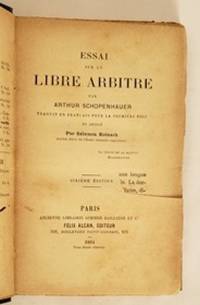
1894765<p>Notes by Salomon Reinach. Paris: Félix Alcan Éditeur 1894. Bound. 212 pages. In French. Title page with small loss on the side and age stains. Size: 14 X 21 cm.</p> Feliz Alcan hardcover
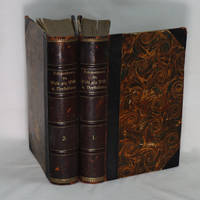
1891FB5707(1&2) /8<p>Brown calf spine with gilt banding and title. Brown marbled boards. dimensions are for one volume.</p><ul><li><strong>We provide an in-depth photographic presentation of this item to stimulate your feeling and touch. More traditional book descriptions are immediately available.</strong></li></ul><p>2 quality volumes of this prestigious work. Binding and contents are in good order.</p><p><strong><em>The World as Will and Representation</em></strong> <strong><em>WWR</em></strong>; <em>Die Welt als Wille und Vorstellung</em> <strong><em>WWV</em></strong> sometimes translated as <strong><em>The World as Will and Idea</em></strong> is the central work of the German philosopher Arthur Schopenhauer. The first edition was published in late 1818 with the date 1819 on the title page. A second two-volume edition appeared in 1844: volume one was an edited version of the 1818 edition while volume two consisted of commentary on the ideas expounded in volume one. A third expanded edition was published in 1859 the year before Schopenhauer's death. In 1948 an abridged version was edited by Thomas Mann. In the summer of 1813 Schopenhauer submitted his doctoral dissertation—<em>On the Fourfold Root of the Principle of Sufficient Reason</em>—and was awarded a doctorate from the University of Jena. After spending the following winter in Weimar he lived in Dresden and published his treatise <em>On Vision and Colours</em> in 1816. Schopenhauer spent the next several years working on his chief work <em>The World as Will and Representation</em>. Schopenhauer asserted that the work is meant to convey a "single thought" from various perspectives. He develops his philosophy over four books covering epistemology ontology aesthetics and ethics. Following these books is an appendix containing Schopenhauer's detailed <em>Criticism of the Kantian Philosophy</em>. Taking the transcendental idealism of Immanuel Kant as his starting point Schopenhauer argues that the world humans experience around them—the world of objects in space and time and related in causal ways—exists solely as "representation" <em>Vorstellung</em> dependent on a cognizing subject not as a world that can be considered to exist in itself i.e. independently of how it appears to the subject's mind. One's knowledge of objects is thus knowledge of mere phenomena rather than things in themselves. Schopenhauer identifies the thing-in-itself — the inner essence of everything — as <em>will</em>: a blind unconscious aimless striving devoid of knowledge outside of space and time and free of all multiplicity. The world as representation is therefore the "objectification" of the will. Aesthetic experiences release one briefly from one's endless servitude to the will which is the root of suffering. True redemption from life Schopenhauer asserts can only result from the total ascetic negation of the "will to life". Schopenhauer notes fundamental agreements between his philosophy Platonism and the philosophy of the ancient Indian Vedas. <em>The World as Will and Representation</em> marked the pinnacle of Schopenhauer's philosophical thought; he spent the rest of his life refining clarifying and deepening the ideas presented in this work without any fundamental changes. The first edition was met with near-universal silence. The second edition of 1844 similarly failed to attract any interest. At the time post-Kantian German academic philosophy was dominated by the German idealists—foremost among them G. W. F. Hegel whom Schopenhauer bitterly denounced as a "charlatan". <strong>Arthur Schopenhauer</strong> German: 22 February 1788 – 21 September 1860 was a German philosopher. He is known for his 1818 work <em>The World as Will and Representation</em> expanded in 1844 which characterizes the phenomenal world as the manifestation of a blind and irrational noumenal will. Building on the transcendental idealism of Immanuel Kant 1724–1804 Schopenhauer developed an atheistic metaphysical and ethical system that rejected the contemporaneous ideas of German idealism. Schopenhauer was among the first thinkers in Western philosophy to share and affirm significant tenets of Indian philosophy such as asceticism denial of the self and the notion of the world-as-appearance. His work has been described as an exemplary manifestation of philosophical pessimism. Though his work failed to garner substantial attention during his lifetime he had a posthumous impact across various disciplines including philosophy literature and science. His writing on aesthetics morality and psychology have influenced many thinkers and artists. Arthur Schopenhauer's paternal grandfather Andreas Schopenhauer de 1720–1793 was a wealthy merchant in Danzig. Arthur Schopenhauer's paternal grandmother Anna Renata Schopenhauer 1726–1793 was the daughter of a Dutch merchant and the Dutch ambassador to the Hanseatic city of Danzig Hendrik Soermans 1700–1775. Arthur Schopenhauer's maternal grandfather Christian Heinrich Trosiener de 1730–1797 was a merchant in Danzig and a councilor from the middle class. Arthur Schopenhauer's maternal grandmother Elizabeth Trosiener 1745–1818 was daughter of pharmacist Georg Lehmann died 1762 and his wife Susanna Concordia Lehmann née Neumann born 1718. Arthur Schopenhauer's paternal great-grandfather Johann Schopenhauer de 1670–after 1724 was the mentioned merchant in Gdansk. Arthur Schopenhauer's paternal great-grandfather through paternal grandmother Hendrik Soermans de 1700–1775 was a Dutch merchant and Ambassador of the Netherlands in Gdansk. Arthur Schopenhauer's paternal great-great grandfather Johann Schopenhauer 1630–1701 was a farmer in Petershagen and son of Simon Schopenhauer 1580–1660 and grandson of Salomon Schopenhauer born 1550.</p> F H Brohaus. hardcover
1885feb103875Socec 1885. Used. 1885; French Edition of LE MONDE COMME VOLONTE ET COMME REPRESENTATION ; For more details please contact me Socec unknown
189112324Leipzig, Gustav Fock Verlag 1891. Ganzleinen mit eingeprägtem Porträt, marmorierter Schnitt, 8°, 698 und 731 S., 6. Auflage,mit Einleitungen, erläuternden Anmerkungen und einer biographisch-historischen Charakteristik in Auswahl herausgegeben.
188936115Paderborn: Schöningh 1889. XII, 414 (1) S. OHalbleinen m. Rückenvergold. 20x13 cm.
1898148722-1Greifswald, Abel 1898. 2 Bll., 42 S. Pappband
1896183988Freiburg i. B. : Herder, 1896. VII, 103 Seiten. 22 cm. Originalhalbleinen.
187620218Leipzig, F. A. Brockhaus, 1876. 8vo. X, 189 S. Hldr. d. Zeit m. 2 RSchildern. u. Rückenvergoldung. Kopfgoldschnitt.
187811555Leipzig, Fues, 1878. 8°. XIII, 543 S., 1 Bl., Halblederband der Zeit. - Karl Eugen Dühring (1833 in Berlin - 1921 in Babelsberg) war Philosoph, Nationalökonom und Vertreter des deutschen Positivismus. Einband etwas bestoßen, innen gebräunt und stellenweise stockfleckig. Insgesamt schönes Exemplar.
1893177841Heidelberg, Winter, 1893. XVI, 495 S. Hldrbd. d. Zt. Rücken fehlt. Einbd. stark berieben.St. verso Tit. (Geschichte d. neueren Philosophie; Bd. 8)
189367990-1Heidelberg, Winter 1893. XVI, 495 S. Halblederband der Zeit
189823063Heidelberg : Carl Winter`s, 1898. 2. neu bearb. u. vermehrte Aufl.; XVI, 535 S. ; Gr.-8° , schwarzer Halbleinen mit Rückentitel [2 Warenabbildungen]
1888117576Leipzig, F. A. Brockhaus 1888. * Mit 1 Porträt, 1 Wappendarstellung 1 gefalteten Faksimile. 221 Seiten, 1 Blatt. 22,5 x 17,5 cm. Brauner Original-Halblederband über fünf falschen Bünden mit Buntpapierbezug, goldgeprägtem Rückentitel, hübscher Rückenvergoldung und Buntpapiervorsätzen.
188816375Leipzig, Brockhaus, 1888. 221 S., 1 Bl., 1 Bildtaf., 1 Faks. 4°, Pb. d. Zeit.
1888130176Leipzig: Verlag F. A. Brockhaus, 1888. 221 S. ; 26,5 x 20,5 cm ; Halbleinen.
1869V39409Berlin (Otto Loewenstein) 1869 (= Erste Ausgabe). 8°, Halbleder der Zeit mit Lederecken goldgeprägtem Rücken und mamoriertem Deckelbezug (Hardcover), 132 + 124 + 82 S., 1
190073686Lörrach : C. R. Gutsch, 1900 (ca.). Lebenserinnerungen eines Markgräflers 1815-1875 399 S. Broschierte Ausgabe (unbeschnitten)
188237691Berlin, Verlag von Carl Habel, 1882. 8°, 64 S., Deutsche Zeit- und Streit-Fragen. Flugschriften zur Kenntniß der Gegenwart. Hg. Von Franz von Holtzendorf. Jahrgang XI. Heft 167 & 168 Bezahlung per PayPal möglich, we accept PayPal, Einb. ger. beschabt u. ger. bestoßen u. angeschmutzt, fingerspurig, Schnitte angeschmutzt, altersbed. Bräunungen, Gebr.sp., KEINE SCHÖNHEIT Interimsbindung
1894101398Berlin: Weidmannsche Buchhandlung 1894. (4), 200 Seiten. Frakturdruck. 8° (17,5-22,5 cm). Zeitgenössischer Halbleinenband mit Leinenecken und goldgeprägtem Rücken. [Hardcover / fest gebunden].
18816236Berlin, A. Hofmann & Comp./ Allgemeiner Verein für Deutsche Literatur, 1881; EA, WGII, 21. Goldgeprägter Halbledereinband [mit Vignette "Allgemeiner Verein für Deutsche Literatur"], Lederecken, marmorierte Deckel, farbige Vorsätze, roter Farbschnitt, 8°, VIII, 335 S., zahlreiche Vignetten; -Kanten berieben, Papier gebräunt, schönes, gut erhaltenes Exemplar.
18722072068Berlin: Lüderitz 1872. (2), 53, (3) Seiten. Frakturdruck. 8° (17,5-22,5 cm). Halbleinenband der Zeit mit Buntpapierbezug und gesprenkeltem Schnitt. [Hardcover / fest gebunden].