Zeitler, JuliusAntiquariat.de
ZEITLER, JuliusAntiquariat.de
Nietzsches Ästhetik.
1900R0478-95Lpz.,Seemann 1900. (2),308 S. Priv.Hln. Einband leicht berieben, Titel geringfügig fleckig, sonst gut erhalten.

Antiquariat Krikl · AT - Wien38,00 €
84 résultats
190013816Leipzig, Lehmann, 1900. 2. Tausend 308 S. 8°, OLwd, Einband leicht fl., Innen ca. 20 S. mit Anstr., sonst guter Zust.
190019185Leipzig, Seemann, 1900. 2 Bll., 308 S. 8°. Mod. Kart. mit aufgeklebtem vorderen OU (kl. Gebrssprn., etw. gebräunt).
1900R0478-95Lpz.,Seemann 1900. (2),308 S. Priv.Hln. Einband leicht berieben, Titel geringfügig fleckig, sonst gut erhalten.
189549025Pan Couverture souple Berlin 1895
1874k1209252094xbvkTübingen, Verlag der L. Fr. Fues'schen Sortiments-Buchhandlung, 1874. IV, 67 (1) Seiten. - Originalumschlag mit Deckel- und Rückentitel; 8vo.(ca. 22 x 14,5 cm).
1897307471Hamburg, Haring, 1897. 22 Seiten. 21 cm. Halbleinenband der Zeit mit Papier-Rückenschildchen.
189729568AStuttgart, Fr. Frommanns Verlag (E. Hauff), 1897. Ca. 21,8 x 14 cm. Porträtfrontispiz, 132 Seiten, 1 Blatt Verlagswerbung. Original-Broschur.
18642401130056xbvkBerlin, Commissionsverlag der Haude- & Spener'schen Buchhandlung (F. Weidling), 1864. VII, 245 (3) Seiten. - Etwas späterer grüner Halbleineneinband mit dunkel-marmorierten Buchdeckeln; 8vo.(ca. 21,5 x 15 cm).
189717290Leipzig, C. G. Naumann, 1897. Gr.-8vo. 2 Bl., 110 S. Schlichte Hlwd. d. Zt.
189217262Berlin, F. Fontane, 1892-1901. 8vo. 3 Bl., 68 S.; 2 Bl., 64; 59; 48, 48; 30 S. Marmorierte Pp. m. RSchild. [2 Warenabbildungen]
189517284Leipzig, C. G. Naumann, 1895. 8vo. Mit Frontispiz, Faksimile, einigen Lichtdrucken u. gef. Notenbeilage. VIII, 369 S., 3 Bl. Hldr. d. Zeit m. Rückengoldpräg.
189617260Frankfurt a.M., Rütten & Loening, 1896. Gr.-8vo. VIII S., 1 Bl., 484 S., 1 Bl. Weinrote OLwd. m. goldgeprägt. Deckel- u. Rückentitel.
1898103610Paris, Société du Mercure de France - Leipzig, C. G. Naumann, 1898 (Achevé d'imprimer le 1er septembre 1897), in-8, 473-[3] pp, Maroquin moderne brun à coins signé Alix, tête dorée, couvertures originales conservées, ÉDITION ORIGINALE de la traduction. Bel exemplaire, très bien établi par Alix. Très légères salissures aux dernières pages du volume. Couverture rigide
188720695Leipzig, Fritsch, 1887. XI, 363 (recte 361) S. 8°. HLdr. der Zeit mit Rückentitel (bestoßen und beschabt). [5 Warenabbildungen]
188717423Leipzig, Naumann, 1887. XIV S., 1 Bl., 182 S., 1 Bl. 8°. HLwd. der Zeit (kl. restaurierte Läsuren). [5 Warenabbildungen]
1898116513Paris et Leipzig : Socit du Mercure de France et C. G. Naumann 1898. 235x150mm. frontispice sous serpentine 473 pages 2 ff. errata reliure de lÕpoque demi-basane coins avec titre et auteur dors au dos cinq faux-nerfs. Plat et garde papier marb. Tranche suprieure rouge. Couvertures conserves. Bel exemplaire. 812 Socit du Mercure de France et C. G. Naumann unknown
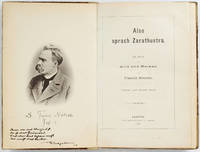
18911004<p>NIETZSCHE Friedrich. Also sprach Zarathustra Vierter und letzter Theil C. G. Naumann Leipzig 1891. Frontispiece portrait of Nietzsche TP Quote page 5-135 half title 3-21 23 = Inhalt Octavo. First Edition. Schaberg 58.</p><p>The famous first public printing of Nietzsche's notorious conclusion to Zarathustra. Although printed in 1890 and dated 1891 this book did not see public release until March of 1892 due to legal arguments between Nietzsche's sister Elisabeth and the publisher. Elisabeth was worried that the books would all be confiscated as "obscene" –and therefore negotiated until she received a contract from Naumann that protected her against this possibility. This edition –which is cited in Printing and the Mind of Man as the first edition ignoring the private printing of 1885 –is rare in any condition. When copies do make their rare appearances on the market they almost always come bound with the original three books 1883-1884 or more commonly bound with copies of the three books as re-issued in 1886. Containing the first edition printing of Nietzsche's poems: Dionysian Dithyrambs.</p><p>CONDITION: Contemporary quarter vellum with marbled boards little rubbed minor bumping to extremities. Slight browning little foxing and small marginal tears to few leaves at the end short tear to bottom gutter of title. - From the collection of archeologist and art-historian Botho Graef 1857-1917 known for his friendship with artists like Emil Nolde and Ernst Ludwig Kirchner in addition to his facilitation of the Jena art-collection. His handwritten dedication is addressed to German playwright and poet 'Ernst' Hardt 1876-1947.</p> C. G. Naumann hardcover
1880923Chemnitz: Schmeitzner 1880. First Edition. Wraps. Near fine. The Third and Final Part of Human all too Human <br /> <br />NIETZSCHE Friedrich. Der Wanderer und Sein Schatten The Wanderer and His Shadow. Schmeitzner Chemnitz 1880. 1 blank leaf TP 3-185 186 = Berichtigungen Octavo. First Edition First Issue in original wrappers. Schaberg 32. <br /> <br />Written as a second sequel to Human All Too Human The Wanderer and his Shadow was first published in the year following Nietzsches departure from academia. Perhaps the title here is somewhat autobiographical reflecting Nietzsche and his shadow heading off into the wilderness of the unknown. Wanderer contains a series of aphorisms and was published on December 20 1890. It was received enthusiastically by Nietzsches friends though failed to sell more than 200 copies. Yet it was viewed by Nietzsche himself as a triumph. In a letter to Schmeitzner written on December 18 Nietzsche remarks: "Der vollendete 'Wanderer' ist mir fast etwas Unglaubliches. Die ganze 'Menschlichkeit' mit den 2 Anhängen ist aus der Zeit der bittersten und anhaltendsten Schmerzen - und scheint mir doch ein Ding voller Gesundheit. Dies ist mein Triumph." The completed 'Wanderer' is to me something almost unbelievable. The entire 'humanity' with the 2 supplements is from a time of the most bitter and continual pains - and yet seems to me to be a thing full of health. This is my triumphThe Nietzsche Chronicle. <br /> <br />CONDITION: Very good to near fine in original front and rear wrappers. Spine restored with graphics to match the original. Interior crisp and bright. Housed in cloth-backed clamshell box. A gorgeous copy of this final installment of the Menschlisches three-book series. <br/><br/> Schmeitzner paperback
1887927Leipzig: E.W. Fritzsch 1887. First Thus. Hardcover. Very good. First complete edition of one of Nietzsches most important texts! <br /> <br /> <br />NIETZSCHE Friedrich. Die Frohliche Wissenschaft "la gaya scienza". Neue Ausgabe mit einem Anhange: Lieder des Prinsen Vogelfrei The Gay Science . E.W. Fritzsch Leipzig 1887. III XII = Vorrede 1 leaf = Half-title 5 350 1 leaf = Berichtigungen; Octavo. First Edition Second Issue Definitive. Schaberg 51. <br /> <br /> <br />A must have for any Nietzsche collection. This Neue Ausgabe consisted of the 788 unsold sheets from the first edition of 1882 with the addition of a new title page Nietzsches new 10-page Vorrede Preface 2 new half-title pages and a new 5th book "Wir Furchtlosen" We Fearless Ones. Thus 75 new pages along with fourteen pages of poetry appear here for the first time. While the first edition appeared in 1882 it was incomplete. This is truly the first edition of the complete and definitive text of what is today read as The Gay Science. Nietzsche felt that the Vorrede to this and the other reissues of 1886/7 were among the best things that he ever wrote. <br /> <br />The Gay Science which is the final and culminating volume of Nietzsches aphoristic works contains the first instance of his famous statement Gott ist tot! God is Dead first in section 108 then more elaborately detailed in the Parable of the Madman in section 125 and for a third time in section 343. It also contains the first appearance of the doctrine of the "Eternal Return of the Same" which plays such a prominent role in Zarathustra and even includes the Nietzsches first mention of the Uebermensch. <br /> <br /> <br />CONDITION: Very good in a quarter leather contemporary binding with marbled boards gilt lettering to the spine. Some wear to spine leather. Minor rubbing to marbling on front cover. Small bookseller sticker to inside corner of rear free endpaper <br /> <br /> <br/><br/>PHOTOS AVAILABLE UPON REQUEST E.W. Fritzsch hardcover
1878928Chemnitz: Schmeitzner 1878. Second Edition. Hardcover. Very good. NIETZSCHE Friedrich Die Geburt der Tragödie The Birth of Tragedy. Schmeitzner Chemnitz 1878. TP III-IV 1-144 Octavo. The famous Second Edition First Issue of Nietzsche's first book. Schaberg 30. <br /> <br />The publication history of Nietzsche s Birth of Tragedy is about as complicated as any. The 143-page first edition appeared in 1872 published by E.W. Fritzsch. Shortly after its release Fritzsch printed a second edition that included Nietzsche s corrections extending the text to 144 pages. This was completed by March of 1874 yet because of some conflicts between Nietzsche and Fritzsch and the financial difficulties Fritzsch was experiencing the 750 copies of this 144-page second edition were never available for sale. They sat in a warehouse for 4 years until Schmeitzner Nietzsche s new publisher acquired the copies. Schmeitzner affixed his own label on top of the original publisher s information and made the books available for sale. Very few sold no more than 175. In 1886 the unsold copies of both the 143-page first edition and the 144-page second edition ended up back with the original publisher Fritzsch who added Nietzsche s new preface along with a new title page for the "Neue Ausgabe" edition the definitive edition if the 144-page copy!. Thus fewer than 175 copies in this state 144-pages with the original title page and Schmeitzner label extant. A rare find and a must-have for any Nietzsche collection to be complete.Printing and the Mind of Man notes "Nietzsche's principle work during the Wagner period 1868-1878 was Die Geburt der Tragodie aus dem Geist der Musik 1872. In this he adopted a tragico-pessimistic conceptions of Greek civilization like Burckhardt but contrary to Grote. This started his career as a critic of modern civilization based on disgust with imperial Germany Christianity bourgeois ethics and so on." PMM 224. In this his first book Nietzsche theorized that Greek tragedy was built upon a wedding of two principles that he associated with the deities Apollo and Dionysus. The Apollonian principle is the principle of order static beauty and clear boundaries. The Dionysian principle in contrast is the principle of frenzy excess and the demolition of boundaries. It is in the subtle interaction of these disparate principles that the greatness of Greek tragedy resides and by extension in which the creative spirit still finds its proper soil. The book ended with a long section devoted to Richard Wagner and the importance of his music. When first released it met with only limited success. Despite Nietzsche's eventual near contempt for the book - from the perspective naturally of his later unequalled masterpieces of German prose - it must be considered along with Aristotle and Hegel among the greatest contributions to the understanding of Greek tragedy and in fact to the Greek way of life in general. <br /> <br />CONDITION: Very Good in contemporary half-calf and marbled boards. Light wear. Gilt lettering. Light foxing. Former owners name neatly inscribed to upper corner of front free endpaper. As issued with Schmeitzner's label canceling out Fritzsch's imprint. A very good copy of a very rare book. <br/><br/> Schmeitzner hardcover
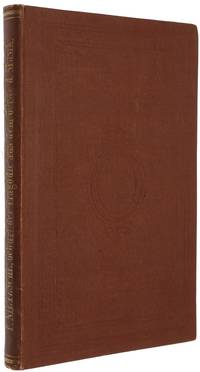
18724535Leipzig: E.W. Fritzsch 1872. First edition. <p>First edition in exceptionally rare original publisher's cloth binding. This copy previously handled by Bill Schaberg: "When I wrote The Nietzsche Canon: A Publication History and Bibliography 1995 I had never even heard of these cloth copies of Nietzsche's first book put out by his publisher Fritzsch. So it was quite a shock when someone offered this copy to me. It turns out that Fritzsch's contemporary advertisements for the book mention a cloth binding so this is not just a figment of some bookseller's imagination." This Nietzsche's first book is a compelling argument for the necessity for art in life. It is fueled by his enthusiasms for Greek tragedy for the philosophy of Schopenhauer and for the music of Wagner to whom this work was dedicated.</p>. Hardcover. IN THE EXCEPTIONALY RARE PUBLISHER'S BINDING. <p>First edition in exceptionally rare original publisher's cloth binding. This copy previously handled by Bill Schaberg: "When I wrote The Nietzsche Canon: A Publication History and Bibliography The University of Chicago Press 1995 I had never even heard of these cloth copies of Nietzsche's first book put out by his publisher Fritzsch. So it was quite a shock when someone offered this copy to me. It turns out that Fritzsch's contemporary advertisements for the book mention a cloth binding so this is not just a figment of some bookseller's imagination."</p> <br /> <p>This Nietzsche's first book is a compelling argument for the necessity for art in life. It is fueled by his enthusiasms for Greek tragedy for the philosophy of Schopenhauer and for the music of Wagner to whom this work was dedicated.</p> <br /> <p>Nietzsche argues that the tragedy of Ancient Greece was the highest form of art due to its mixture of both Apollonian and Dionysian elements into one seamless whole allowing the spectator to experience the full spectrum of the human condition. The Dionysian element was to be found in the music of the chorus while the Apollonian element was found in the dialogue which gave a concrete symbolism that balanced the Dionysiac revelry. Basically the Apollonian spirit was able to give form to the abstract Dionysian.</p> <br /> <p>In contrast to the typical Enlightenment view of ancient Greek culture as noble simple elegant and grandiose Nietzsche believed the Greeks were grappling with pessimism. The universe in which we live is the product of great interacting forces; but we neither observe nor know these as such. What we put together as our conceptions of the world Nietzsche thought never actually addresses the underlying realities. It is human destiny to be controlled by the darkest universal realities and at the same time to live life in a human-dreamt world of illusions.</p> <br /> <p>The issue then or so Nietzsche thought is how to experience and understand the Dionysian side of life without destroying the obvious values of the Apollonian side. It is not healthy for an individual or for a whole society to become entirely absorbed in the rule of one or the other. The soundest healthiest foothold is in both. Nietzsche's theory of Athenian tragic drama suggests exactly how before Euripides and Socrates the Dionysian and Apollonian elements of life were artistically woven together. The Greek spectator became healthy through direct experience of the Dionysian within the protective spirit-of-tragedy on the Apollonian stage.</p> <br /> <p>The Birth of Tragedy was the best selling book that Nietzsche ever published; still it did not sell quickly. The Wagners had feared that there might not be an audience for the work and their apprehensions proved to be well-founded. A prediction that Nietzsche had once made to Rohde proved true: "The philologists won't read it on account of the music the musicians won't read it on account of the philology and the philosophers won't read it on account of the music and the philology." False hopes for brisk sales plagued the first half-year. In mid-April Nietzsche was writing home that "a new edition of my book will be needed soon"34 but the necessity of printing a second edition did not materialize quickly. By 20 July Fritzsch complained that there had been "no results" even though he had "sent out a fair number of copies." Schaberg The Nietzsche Canon p. 27</p> <br/> <br/> 8vo 216 x 138 mm pp. i-iii iv 1 2-143 144. Original publisher's dark-rust binding with an ornate blind-stamped design on the front and rear covers and the spine lettered and filleted in gilt. There is some light browning to the edges of the page margins and light foxing throughout. Rear hinge with a 10 cm split. Entirely unrestored copy in its original state. An extremely well preserved copy of this unusual and all-but-unobtainable original publisher's cloth binding. / Hardcover. E.W. Fritzsch unknown
1894424Leipzig: C.G. Naumann 1894. Third edition. Hardcover. Very Good . NIETZSCHE Friedrich. Die Geburt der Tragödie The Birth of Tragedy 1894 C.G. naumann Leipzig: 1894. TP Half-title 1 172 I XII Octavo. THIRD EDITION. The third edition of Nietzsches look at art aesthetics and the aesthetic existence. Last leaves with three column register comparing the first three editions.CONDITION: Very good. Contemporary marbled boards with cloth spine. ORIGINAL FRONT WRAPPER affixed to front board. Clean pages throughout. <br /><br />PHOTOS AVAILABLE UPON REQUEST C.G. Naumann hardcover
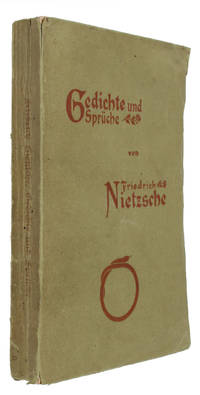
189843879Leipzig Naumann 1898. Small 8vo. Uncut in the original green printed wrappers. Spine with a bit of wear and minor wear to extremities. A very fine and clean copy in the scarce original wrappers. A 4-line presentation-inscription by Friedrich Jodl to front free end-paper dated "23.8.98". <br/><br/><em>The rare first edition of Nietzsche's poems and maxims the first complete collection of his poetry which furthermore constitutes the first appearance of all nine properly corrected "Dionysian Dithyrambs" in one volume.This one of 1.000 copies printed of the first run without "Second Edition" on the title-page as the other 1.000 copies of the first edition had. According to Elizabeth Förster-Nietzsche Nietzsche's sister who has assembled the present collection "this collection of poems and maxims shows the entire poetic development of my brother over a period of 30 years. It begins at a time when the earliest stuttering poetical expression has been overcome and ends with the highest rising of the poetic spirit who in order to find words can now only speak in dithyrambs." own translation from the Introduction p. XIII. Numerous of the poems have never been printed before and many are printed from the original manuscripts which Elizabeth had in her possession.Though Nietzsche is primarily understood and remembered as one of the greatest philosophers of all times his poems occupy a central place in his literary production and many of them e.g. the Dithyrambs are intimately linked with the philosophy for which he is so famous today. Furthermore the present volume underlines the popular modern view of Nietzsche as the not only philosophical but also literary and artistic genious. The first edition of the work is difficult to find and is rarely seen for sale.THE PRESENT COPY HAS BELONGED TO FREIDRICH JODL 1849-1914 the famous German philosopher and contemporary of Nietzsche and bears his signature as well as a 4-line dated presentation-inscription to front free end-paper. Jodl ranks as one of the most significant representatives of German expressionism and is still remembered for his original ontological works with their constant focus on empiricism as the only true strand of philosophy. He has also written a number of important works within the history of philosophy and ethics psychology and aesthetics which for decades counted as standard works and he is among the first to develop the intellectual environment that ultimately led to among many other things the founding of the Vienna Circle. His main task was to develop and spread a purely naturalistic ethics free of any religious or metaphysical elements and he is considered a modern "Enlightenment philosopher" whose consistent empiricism well-founded philosophical ideas optimistic theories of culture ethics the value of life & the progress of man inspired many later thinkers and furthermore helped promote important political and social ideas such as free popular education etc. His main works which are now standard works within ethics and psychology and which were printed over and over again are "Geschichte der Ethik als philosophischer Wissenschaft" in which he presents man's cultural development as the process of liberation from religious and metaphysical ideas and the change from a theocentric to an anthropocentric foundation of ethics. This work is followed up by his purely epirically founded "Lehrbuch der Psychologie" which grounds the same ideas psychologically. After having been Privatdzent in Munich he was named professor of philosophy at the German University in Prague and in 1896 he accepted a professorship of philosophy at the University of Vienna. He was greatly successful in Vienna and was considered the most prominent liberal professor here whose numerous lectures and articles against the reigning "Ultramintanismus" and the clerical influence in schools and universities found great resonance with scholars and students. He had a huge number of followers not only at the university but also in the public as a political figure as well. He is partly to thank for the emergence of an intellectual climate in Vienna in the 20th century which later led to Neopositivism and the founding of the Vienna Circle."We need no other mediator between us and nature except our understanding and a courageous will nor any mystery behind nature to console us for her; we are alone with nature and we feel secure because we possess intellect and she behaves according to laws" Jodl Vom wahren und vom falschen Idealismus p. 40. </em> unknown
1870170977Basel: Carl Schultze's Universitaetsbuchdruckerei 1870. Nietzsche's early work on Diogenes Laertius First edition of this scarce early article privately printed in a run of 100 copies. The Gratulationsschrift was written shortly after Nietzsche had gained tenure at the University of Basel at the age of 24. He began his academic career as a philologist and the Gratulationsschrift outlines a philological study of Diogenes Laertius the shadowy author of the Lives and Opinions of the Eminent Philosophers. Nietzsche dedicates the work to F. D. Gerlach a colleague at Basel and copies were distributed at the ceremony marking Gerlach's retirement despite the fact Gerlach had opposed Nietzsche's appointment. Some copies were issued with a half-page cancel either bound between pages 2 and 3 or pasted to the lower half of page 3 that is not present here. No priority has been identified. Provenance: Hermann Türck 1856-1933 a philosopher and Nietzsche scholar who wrote Fr. Nietzsche und seine philosophischen Irrwege in 1891 a psychological study of the man and his later works. Türck's large printed bookplate is on the front pastedown. Quarto 218 x 193 mm pp. iv 36 8. Recent sprinkled grey boards printed paper label to spine. Minor browning and foxing to outer leaves: a very good copy indeed. Schaberg 18. hardcover
1893823<p>Leipzig: Naumann 1893. Second Edition. Wraps. Very good. Second Edition of Nietzsches Twilight of the Idols in Original Printed Wraps <br /><br />NIETZSCHE Friedrich Götzen-Dämmerung Twilight of the Idols Naumann Leipzig 1893. Half title TP 1 leaf = Inhalt I-II = Vorwort 1-116. Second Edition Krummel XVIII a p. 120. <br /><br />Nietzsche began to write Twilight of the Idols at the end of June of 1888 and was finished by early Septemberanother lightning-quick production that he claimed to have been the "work of so few days that I am hesitant to mention exactly how many." His hesitancy becomes even more understandable when one remembers that part of July was devoted to the preparation of the final typescript of The Case of Wagner and that during August he produced two "Postscripts" and the "Epilogue" and then proofed the entire work. In the final analysiswhen the book was finally completedNietzsche bragged to Gast that "I could hardly have used ten days more efficiently for it certainly took me no longer to write the book." Yet another ten-day wonder! <br /><br />The new book was originally entitled A Psychologist at Leisure when Nietzsche mentioned it to Naumann on 7 September: <br /><br />I am about to give you a nice surprise. You probably think we are finished with printing but even now the cleanest manuscript I have ever sent to you is on its way. Regarding layout and design this new work should be a twin to The Case of Wagner. The title is A Psychologist at Leisure. It is imperative for me that we publish this now because by the end of next year we will have to begin the printing of my main work The Revaluation of All Values which will be a stern and serious book and I will not be able to publish anything cheerful and winsome right after it. <br /><br />This book though not very large may cause a few ears to be opened so that the main work will not be greeted with silence like my Zarathustra. <br /><br />The manuscript was mailed two days later and the single-page first draft for the Preface came three days after that. Nietzsche thought of this bookin conjunction with the Wagner bookas a light and brief respite before the publication of his masterwork: "In the final analysis both of these works are only recuperations in the midst of an immensely difficult and decisive task which when properly understood will split humanity in two." Unfortunately Nietzsche never recovered from these "recuperations" and The Revaluation of All Values was never completed <br /><br />Even as the book was being printed Peter Gast pleaded with Nietzsche to change the title: <br /><br />When I consider how other people will respond to this title I think A Psychologist at Leisure is much too unassuming. You have dragged your artillery to the highest mountains you have guns such as have never existed and even if you shoot blindly you will inspire terror all around. The stride of a Giant which can make the mountains shake to their core is hardly leisure . . . and so I pleadif an incompetent may make such a requestlet us have a more resplendent a more radiant title! <br /><br />Nietzsche immediately agreed and changed the title to Twilight of the Idols75 and three days later he penned the final version of the Preface which was dated 30 September 1888. <br />Schaberg The Nietzsche Canon pp. 166-167 <br /><br />CONDITION: Uncut copy in original wraps printed front and back as well as on the spine. The covers are very lightly chipped and have a 1½ closed tear on the right side near the center of the front cover. The rear cover has five number inked next to the advertisements for Nietzsches books presumably noting their issuing sequence in the then-in-the-press Collected Works. A bit worn but still a lovely affordable and collectible copy of this important work by Nietzsche. <br /><br />PHOTOS AVAILABLE UPON REQUEST</p> Naumann paperback