Nietzsche. - Berg, LeoAntiquariat.de

72 résultats
189617260Frankfurt a.M., Rütten & Loening, 1896. Gr.-8vo. VIII S., 1 Bl., 484 S., 1 Bl. Weinrote OLwd. m. goldgeprägt. Deckel- u. Rückentitel.
188717423Leipzig, Naumann, 1887. XIV S., 1 Bl., 182 S., 1 Bl. 8°. HLwd. der Zeit (kl. restaurierte Läsuren). [5 Warenabbildungen]
1892009362Leipzig: C.G. Naumann 1892. Book. Very Good. Hardcover. Second. 8vo - over 7¾" - 9¾" tall. xiv 182pp. Zweite Auflage marbled boards very little wear hinges and binding sound pages crisp and clean with no symptoms of 1890s-era paper rot. Very scarce. C.G. Naumann Hardcover
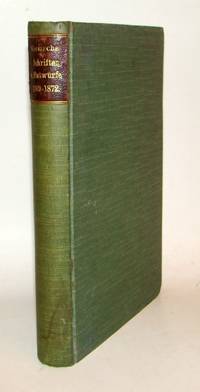
1898953605Leipzig: C.G. Naumann 1898. hardcover. Gut. XLI Seiten 2 Blatt 385 Seiten. Privates grünes Ganzleinen mit goldgeprägtem Lederrückenschilc. Oktav 223 cm Einband leicht fleckig und mit kleiner Druckstelle papierbedingt leicht gebräunt im Ganzen gut erhalten. EINZELBAND der frühen Werkausgabe. "Diese Gesammtausgabe der Werke Friedrich Nietzsche's wird im Auftrage seiner Angehörigen veranstaltet." Der "Nachbericht" des Herausgebers Koegel legt nahe dass einige Texte dieses Bandes hier im Erstdruck vorliegen da Koegel sie aus den Notizbüchern Nietzsches gezogen hat. "Friedrich Karl Adolf Koegel auch Fritz Kögel geboren 2. August 1860 in Hasserode; gestorben 20. Oktober 1904 in Jena war ein deutscher Schriftsteller Philologe Komponist und Unternehmer. . Vor 1889 zuerst auf Veröffentlichungen von Friedrich Nietzsche - 'für mich ein Fund fürs Leben' - gestoßen hielt Koegel Anfang 1892 in der Freien Literarischen Gesellschaft in Berlin einen Vortrag über Nietzsche der das Interesse an Leben und Werk des noch weitgehend unbekannten und nicht akzeptierten Philosophen wachsen ließ. Dessen Schwester Elisabeth Förster-Nietzsche wurde auf ihn aufmerksam und die Familie Oehler-Nietzsche gewann Koegel im Frühjahr 1894 als Herausgeber einer Nietzsche-Gesamtausgabe im Nietzsche-Archiv. Kurz nach Koegels Verlobung im Dezember 1896 mit Emily Gelzer die er bei Förster-Nietzsche kennengelernt hatte kam es zwischen ihm und der Archivherrin unter Beteiligung von Rudolf Steiner zu wachsenden Konflikten über die Frage der Herausgeberschaft und schließlich zu seiner Entlassung im Juni 1897. Seine heimlichen Abschriften aus Briefen und Briefentwürfen Nietzsches sind als Koegel-Exzerpte in die Wissenschaft eingegangen." Wikipedia. Der Band enthält: Homer und die classische Philologie. - Nachträge und Vorarbeiten zur Geburt der Tragödie. - Empedokles. - Homer als Wettkämpfer. - Über die Zukunft unserer Bildungsanstalten. - Bayreuther Horizontbetrachtungen. - Das Verhältnis der Schopenhauerischen Philosophie zu einer deutschen Cultur. "Friedrich Wilhelm Nietzsche geboren 15. Oktober 1844 in Röcken; gestorben 25. August 1900 in Weimar war ein deutscher klassischer Philologe und Philosoph. Nietzsche der im Nebenwerk auch Dichtungen und musikalische Kompositionen schuf sprengte mit seinem eigenwilligen Stil bis dahin gängige Muster und ließ sich kaum einer klassischen Disziplin zuordnen. Er gilt manchen als Begründer einer neuen philosophischen Schule der Lebensphilosophie. Er war zunächst preußischer Staatsbürger ab seiner Übersiedlung nach Basel 1869 wurde er auf eigenen Wunsch hin staatenlos. . Den jungen Nietzsche beeindruckte besonders die Philosophie Schopenhauers. Später wandte er sich von dessen Pessimismus ab. Sein Werk enthält scharfe Kritiken an Moral Religion Philosophie Wissenschaft und Formen der Kunst. Die zeitgenössische Kultur war in seinen Augen lebensschwächer als die des antiken Griechenlands. Wiederkehrendes Ziel von Nietzsches Angriffen sind vor allem die christliche Moral sowie die christliche und platonistische Metaphysik. Er stellte den Wert der Wahrheit überhaupt in Frage und wurde damit Wegbereiter postmoderner philosophischer Ansätze. Auch Nietzsches Konzepte des 'Übermenschen' des 'Willens zur Macht' oder der 'ewigen Wiederkunft' geben Anlass zu Deutungen und Diskussionen. Nietzsche schuf keine systematische Philosophie. Oft wählte er den Aphorismus als Ausdrucksform seiner Gedanken. Seine Prosa seine Gedichte und der pathetisch-lyrische Stil von Also sprach Zarathustra verschafften ihm Anerkennung auch als Schriftsteller." Wikipedia. - Weitere Bilder auf Anfrage oder auf unserer Homepage. Wegen Urlaub kann Ihre Bestellung / Anfrage erst nach dem 21.06.2026 bearbeitet werden. - Because of holidays your order / question can be handled only after 06/21/2026. C.G. Naumann hardcover
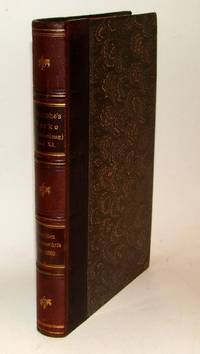
1897953623Leipzig: C.G. Naumann 1897. leather_bound. Gut. VII Seiten 1 Blatt 437 Seiten. Dunkelbraunes Orig.-Halbleder mit Goldprägung auf dem Rücken. Oktav 223 cm Einband leicht berieben und bestoßen papierbedingt leicht gebräunt dekoratives gepflegtes und gut erhaltenes Exemplar. EINZELBAND der frühen Werkausgabe. "Diese Gesammtausgabe der Werke Friedrich Nietzsche's wird im Auftrage seiner Angehörigen veranstaltet." Der "Nachbericht" des Herausgebers Koegel legt nahe dass einige Texte dieses Bandes hier im Erstdruck vorliegen da Koegel sie aus den Notizbüchern Nietzsches gezogen hat. Der Band enthält: Die Pflugschar. - Die Sorentiner Papiere. - Der neue Umblick. - Nachträge zu den "Vermischten Meinungen und Sprüchen". - Nachträge zu "Der Wanderer und sein Schatten". Vorarbeiten und Nachträge zur "Morgenröthe". "Friedrich Karl Adolf Koegel auch Fritz Kögel geboren 2. August 1860 in Hasserode; gestorben 20. Oktober 1904 in Jena war ein deutscher Schriftsteller Philologe Komponist und Unternehmer. . Vor 1889 zuerst auf Veröffentlichungen von Friedrich Nietzsche - 'für mich ein Fund fürs Leben' - gestoßen hielt Koegel Anfang 1892 in der Freien Literarischen Gesellschaft in Berlin einen Vortrag über Nietzsche der das Interesse an Leben und Werk des noch weitgehend unbekannten und nicht akzeptierten Philosophen wachsen ließ. Dessen Schwester Elisabeth Förster-Nietzsche wurde auf ihn aufmerksam und die Familie Oehler-Nietzsche gewann Koegel im Frühjahr 1894 als Herausgeber einer Nietzsche-Gesamtausgabe im Nietzsche-Archiv. Kurz nach Koegels Verlobung im Dezember 1896 mit Emily Gelzer die er bei Förster-Nietzsche kennengelernt hatte kam es zwischen ihm und der Archivherrin unter Beteiligung von Rudolf Steiner zu wachsenden Konflikten über die Frage der Herausgeberschaft und schließlich zu seiner Entlassung im Juni 1897. Seine heimlichen Abschriften aus Briefen und Briefentwürfen Nietzsches sind als Koegel-Exzerpte in die Wissenschaft eingegangen." Wikipedia. "Friedrich Wilhelm Nietzsche geboren 15. Oktober 1844 in Röcken; gestorben 25. August 1900 in Weimar war ein deutscher klassischer Philologe und Philosoph. Nietzsche der im Nebenwerk auch Dichtungen und musikalische Kompositionen schuf sprengte mit seinem eigenwilligen Stil bis dahin gängige Muster und ließ sich kaum einer klassischen Disziplin zuordnen. Er gilt manchen als Begründer einer neuen philosophischen Schule der Lebensphilosophie. Er war zunächst preußischer Staatsbürger ab seiner Übersiedlung nach Basel 1869 wurde er auf eigenen Wunsch hin staatenlos. . Den jungen Nietzsche beeindruckte besonders die Philosophie Schopenhauers. Später wandte er sich von dessen Pessimismus ab. Sein Werk enthält scharfe Kritiken an Moral Religion Philosophie Wissenschaft und Formen der Kunst. Die zeitgenössische Kultur war in seinen Augen lebensschwächer als die des antiken Griechenlands. Wiederkehrendes Ziel von Nietzsches Angriffen sind vor allem die christliche Moral sowie die christliche und platonistische Metaphysik. Er stellte den Wert der Wahrheit überhaupt in Frage und wurde damit Wegbereiter postmoderner philosophischer Ansätze. Auch Nietzsches Konzepte des 'Übermenschen' des 'Willens zur Macht' oder der 'ewigen Wiederkunft' geben Anlass zu Deutungen und Diskussionen. Nietzsche schuf keine systematische Philosophie. Oft wählte er den Aphorismus als Ausdrucksform seiner Gedanken. Seine Prosa seine Gedichte und der pathetisch-lyrische Stil von Also sprach Zarathustra verschafften ihm Anerkennung auch als Schriftsteller." Wikipedia. - Weitere Bilder auf Anfrage oder auf unserer Homepage. Wegen Urlaub kann Ihre Bestellung / Anfrage erst nach dem 21.06.2026 bearbeitet werden. - Because of holidays your order / question can be handled only after 06/21/2026. C.G. Naumann hardcover
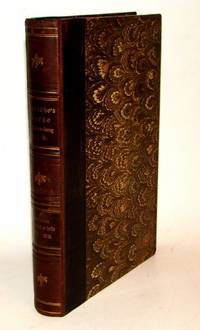
1896953622Leipzig: C.G. Naumann 1896. leather_bound. Gut. IV Seiten 2 Blatt 478 Seiten 1 Blatt. Dunkelbraunes Orig.-Halbleder mit Goldprägung auf dem Rücken. Oktav 223 cm Einband leicht berieben und bestoßen papierbedingt leicht gebräunt dekoratives gepflegtes und gut erhaltenes Exemplar. EINZELBAND der frühen Werkausgabe. "Diese Gesammtausgabe der Werke Friedrich Nietzsche's wird im Auftrage seiner Angehörigen veranstaltet." Der "Nachbericht" des Herausgebers Koegel legt nahe dass einige Texte dieses Bandes hier im Erstdruck vorliegen da Koegel sie aus den Notizbüchern Nietzsches gezogen hat. Der Band enthält: Die Philosophie im tragischen Zeitalter der Griechen. - Über Wahrheit und Lüge im aussermoralischen Sinne. - Der Philosoph. - Die Philosophie in Bedrängniss. - Nachträge und Vorarbeiten zu den Unzeitgemässen Betrachtungen. - Prometheus. - Einzelne Gedanken und Entwürfe. "Friedrich Karl Adolf Koegel auch Fritz Kögel geboren 2. August 1860 in Hasserode; gestorben 20. Oktober 1904 in Jena war ein deutscher Schriftsteller Philologe Komponist und Unternehmer. . Vor 1889 zuerst auf Veröffentlichungen von Friedrich Nietzsche - 'für mich ein Fund fürs Leben' - gestoßen hielt Koegel Anfang 1892 in der Freien Literarischen Gesellschaft in Berlin einen Vortrag über Nietzsche der das Interesse an Leben und Werk des noch weitgehend unbekannten und nicht akzeptierten Philosophen wachsen ließ. Dessen Schwester Elisabeth Förster-Nietzsche wurde auf ihn aufmerksam und die Familie Oehler-Nietzsche gewann Koegel im Frühjahr 1894 als Herausgeber einer Nietzsche-Gesamtausgabe im Nietzsche-Archiv. Kurz nach Koegels Verlobung im Dezember 1896 mit Emily Gelzer die er bei Förster-Nietzsche kennengelernt hatte kam es zwischen ihm und der Archivherrin unter Beteiligung von Rudolf Steiner zu wachsenden Konflikten über die Frage der Herausgeberschaft und schließlich zu seiner Entlassung im Juni 1897. Seine heimlichen Abschriften aus Briefen und Briefentwürfen Nietzsches sind als Koegel-Exzerpte in die Wissenschaft eingegangen." Wikipedia. "Friedrich Wilhelm Nietzsche geboren 15. Oktober 1844 in Röcken; gestorben 25. August 1900 in Weimar war ein deutscher klassischer Philologe und Philosoph. Nietzsche der im Nebenwerk auch Dichtungen und musikalische Kompositionen schuf sprengte mit seinem eigenwilligen Stil bis dahin gängige Muster und ließ sich kaum einer klassischen Disziplin zuordnen. Er gilt manchen als Begründer einer neuen philosophischen Schule der Lebensphilosophie. Er war zunächst preußischer Staatsbürger ab seiner Übersiedlung nach Basel 1869 wurde er auf eigenen Wunsch hin staatenlos. . Den jungen Nietzsche beeindruckte besonders die Philosophie Schopenhauers. Später wandte er sich von dessen Pessimismus ab. Sein Werk enthält scharfe Kritiken an Moral Religion Philosophie Wissenschaft und Formen der Kunst. Die zeitgenössische Kultur war in seinen Augen lebensschwächer als die des antiken Griechenlands. Wiederkehrendes Ziel von Nietzsches Angriffen sind vor allem die christliche Moral sowie die christliche und platonistische Metaphysik. Er stellte den Wert der Wahrheit überhaupt in Frage und wurde damit Wegbereiter postmoderner philosophischer Ansätze. Auch Nietzsches Konzepte des 'Übermenschen' des 'Willens zur Macht' oder der 'ewigen Wiederkunft' geben Anlass zu Deutungen und Diskussionen. Nietzsche schuf keine systematische Philosophie. Oft wählte er den Aphorismus als Ausdrucksform seiner Gedanken. Seine Prosa seine Gedichte und der pathetisch-lyrische Stil von Also sprach Zarathustra verschafften ihm Anerkennung auch als Schriftsteller." Wikipedia. - Weitere Bilder auf Anfrage oder auf unserer Homepage. Wegen Urlaub kann Ihre Bestellung / Anfrage erst nach dem 21.06.2026 bearbeitet werden. - Because of holidays your order / question can be handled only after 06/21/2026. C.G. Naumann hardcover
19007622Berlin. Franz Wunder 1900. 109 Seiten, Schrift: Antiqua, Eigentümerstempel auf Titelblatt nachgebundene Ausgabe, Halbleinen, ohne Rückenbeschriftung, innen einige Bleistiftanstreichungen, sonst guter Zustand
1873165812Leipzig: E. W. Fritzsch Schopenhauer: Schloss-Chemnitz: Ernst Schmeitzner 1873; 1874; 1874. Nietzsche in the culture war First editions of the first three of Nietzsche's four individually published Untimely Meditations bound together in a contemporary binding and unusual thus. Nietzsche originally conceived a series of 13 essays on the condition of contemporary European culture and its leading figures specifically German. The first published was an attack on David Strauss. The composer Richard Wagner who had taken an immediate dislike to Strauss's latest book Der alte und der neue Glaube The Old and the New Faith suggested Nietzsche publish the work with his own publisher E. W. Fritzsch. Nietzsche remained with Fritzsch for the publication of the second essay the only one not centred on a specific person but instead on the proper understanding and use of history. Finding payment slow Nietzsche switched publishers to Ernst Schmeitzner for the third essay which describes how Schopenhauer's genius despite his admitted pessimism might bring about a renaissance in German culture. The fourth work in the series Richard Wagner in Bayreuth was published in 1876 and is not present here - the collection was likely bound before its publication. The planning and publication of the Unzeitgemässe Betrachtungen series was quite haphazard and affected by Fritzsch's financial difficulties slow sales and Nietzsche's loss of enthusiasm for the project. No more of the planned thirteen works appeared after the Wagner essay though an uncompleted fifth essay was published posthumously. Schmeitzner negotiated to buy the remainders of the first two works from Fritzsch but was disappointed to find them in poor condition so that complete sets of all four essays which were all originally issued in wrappers are very rarely found bound together. Three works bound in a single vol. octavo 225 x 139 mm. Contemporary red morocco spine lettered in gilt red mottled sides black speckled edges. Errata of first work bound following p. 6 leaves in sig. 5 of same bound out of sequence. Spine a little darkened and trivial wear to tips contents with light foxing more pronounced towards rear some pencilled underlining and pencilled annotations to terminal endpapers a few leaves opened a little roughly in third work. In very good condition. Schaberg Nietzsche Canon 23 25 & 26. unknown
1873946Leipzig: E. W. Fritzsch 1873. First Edition. Hardcover. Very good. Nietzsche Destroys David Strauss <br /> <br />NIETZSCHE Friedrich. Unzeitgemässe Betrachtungen I: David Strauss Unconventional Observation I: David Strauss. Leipzig: E. W. Fritzsch 1873. TP 1-101 102 = advertisements Octavo. First Edition First Issue. Schaberg 23a <br /> <br />The first of Nietzsche's Unconventional Observations was an attack on David Strauss the writer who had made his reputation with his scandalous Life of Jesus in 1835. Here Nietzsche attacks his most recent book The Old and the New Faith which advocated the rejection of the Christian faith in favor of a Darwinian materialistic and patriotic world-view. Nietzsche accuses Strauss of being a "Cultural Philistine" and denounces him as an exemplar of pseudo-culture. Although erudite the essay is extremely intemperate and filled with references to many of Nietzsche's scholarly contemporaries. The climax is a literary tour de force in which Nietzsche cites a litany of malapropisms from Strauss interspersed with his own barbed comments. For Nietzsche Strauss's book was the incarnation of the Zeitgeist: unproductive smugness intellectual snobbery superficial assimilation of great works of art and new scientific theories myopic criticism and patronizing praise of even the greatest genius But what enraged him most was Strauss's comfortable and untroubled renunciation of Christianity coupled with an easy conviction that Darwin was one of mankind's greatest benefactors and that traditional values could of course be maintained. It is in the present work that Nietzsche first publicly addresses the problem of the derivation of moral values that would infuse so much of his most important work. <br /> <br />CONDITION: Very Good in recently rebound contemporary marbled paper over boards with new spine lettered in gilt. Internally bright and clean. A very good copy of one of Nietzsche s early works. <br/><br/> E. W. Fritzsch hardcover
1886649Leipzig: E. W. Fritzsch 1886. first Edition second issue. contemporary boards. Very good. A Complete Set of the First Edition Second Issues <br />of the Four Unzeitgemässe Betrachtungen <br /> <br /> <br />NIETZSCHE Friedrich Unzeitgemässe Betrachtungen I-IV Untimely Meditations E. W. Fritzsch Leipzig 1886. TP 1-101 102 = Fritzschs original publishers ads TP III-VI = Vorwort 7-111 TP 3-113 TP 3-98 99 = Printers information Octavo. First Edition Second Issue Schaberg 46-49. <br /> <br />When Nietzsches first publisher Fritzsch bought back his remaindered stock from Schmeitzner in 1886 the inventory included 212 351 350 and 768 copies respectively of the original editions of the four Untimely Meditations. The first of these had originally been published by Fritzsch and remaindered to Schmeitzner when Fritzsch went bankrupt. These were reissued with new title pages and covers but without the addition of new Prefaces that were written for several others of these 1886/1887 reissues. <br /> <br />This copy has as usual the Richard Wagner in Bayreuth marked as "Second Edition" on the title page. <br /> <br />At the same time as Also sprach Zarathustra was being reissuedand with similar uncertainty regarding the specific release datethe four Unconventional Observations were reissued. Nietzsche claimed that he "wanted to leave them as they are" and Fritzsch agreed. They were published individually without changes or additions except for the new undated title pages. The fourth ObservationRichard Wagner in Bayreuthwas listed as a "Second Edition" on the cover and the title page NOTE: 800 of the original 1500 copies printed of this piece had been falsely marked Second Edition. <br /> <br />Schaberg The Nietzsche Canon pp. 135-136 <br /> <br />CONDITION: Very good in contemporary quarter leather with black boards. Gilt faded on spine. Minor edge wear especially to corners of boards. Moderate foxing to first few leaves. and title pages.Internally bright and clean. <br /> <br/><br/>PHOTOS AVAILABLE UPON REQUEST E. W. Fritzsch hardcover
1893697Leipzig: C. G. Naumann 1893. Second Edition. Wraps. Very good. The Second Edition of Nietzsches Four Untimely Meditations <br /> <br />NIETZSCHE Friedrich Unzeitgemässe Betrachtungen Unconventional Observations I-IV. C. G. Naumann Leipzig 1893 Volume 1: Original front wrap TP III-XV 2 half titles 1-206 207-208= Publisher's ads; Volume 2: Original front wrap TP 2 half titles 3-205 206-208 = Publisher's ads Octavo. Second Edition Krummel II-V b p. 114 <br /> <br /> <br />This is the second volume of the soon to be aborted "Collected Works" edited by Nietzsche's closest friend Peter Gast whose introduction appears here as a Foreword. The second attempt to put out a complete edition was more successful - mostly because it was driven to completion by Nietzsche's harridan sister Elisabeth. <br /> <br />CONDITION: Two volumes bound with original front wraps and expertly matching but recent spines and rear covers. There are some scattered pencil underlinings and marginalia. Otherwise this is a really well-preserved and excellent copy of all four of Nietzsche's "Unconventional Observations" which are more usually but a bit inaccurately translated as the "Untimely Meditations". <br /> <br/><br/>PHOTOS AVAILABLE UPON REQUEST C. G. Naumann paperback
190014812Leipzig 1900. Drittes und viertes Stück Gering stockfl. 7./8. Tsd.des dritten 8. Tsd. Des vierten Stückes 8°. Ln. Deutsche Literatur unknown
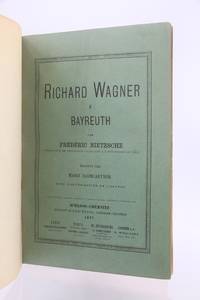
1876326Schloss-Chemnitz:: Schmeitzner 1876. First edition. Hardcover. Very Good. NIETZSCHE Friedrich. Unzeitgemässe Betrachtungen IV: Richard Wagner in Bayreuth 1876 Schloss-Chemnitz: Schmeitzner 1876 First Edition. TP 3-98 1 pp. Of the first edition only 700 copies were printed. Beautiful contemporary halfcloth with brown marbled boards. Minor browning as usual. Interior exceptionally clean and well preserved. Quite rare due to small printrun. The 1st copies became available just before the Bayreuther Festspiele. Wagner had invited Helen Zimmern based on his favorable opinion on her biography of Schopenhauer. Nietzsche also attended and their meeting resulted in later invitations. Zimmern spent a few weeks in Sils Maria in the summer of 1886 where Nietzsche used to reside in the summer months in those years. Their discussions in this summer must have helped Zimmern quite a lot when later translating Jenseits of which she got 2 presentation copies. The last favorable publication of Nietzsche on Wagner followed by bitter attacks in FALL WAGNER and NIETZSCHE CONTRA WAGNER. The 4th and last Observation a series originally. CONDITION: Beautiful contemporary halfcloth with brown marbled boards. Minor browning as usual. Interior exceptionally clean and well preserved. Very Good <br /><br />PHOTOS AVAILABLE UPON REQUEST Schmeitzner hardcover
1874416Leipzig: E. W. Fritzsch 1874. First edition. Hardcover. Good. Attacks German Historians NIETZSCHE Friedrich. Unzeitgemässe Betrachtungen II: Vom Nutzen und Nachtheil Unconventional Observation II: The Use and Disadvantage of History for Life. E. W. Fritzsch Leipzig 1874. TP III-VI 7-111 Octavo. First Edition First Issue. Schaberg 25a. There were approximately 650 copies of the first edition in the first issue state. The second Unconventional Observation attacked the then current faith in historical research that was one of Nietzsche's major complaints with contemporary German culture and a topic to which he returned with some regularity in his later works. Contrary to prevailing opinion Nietzsche argued that historical knowledge is valuable only when it has a positive effect on human beings sense of life contending that history can play only three positive roles which he termed the "monumental" the "antiquarian" and "critical" explaining each of these in some detail before going on to enumerate the dangers of the current scholarly fascination with "history for its own sake." Finally Nietzsche suggests an antidote to the psychologically and ethically devastating effects of the conventional approaches to history proposing an amalgam of what he terms the historical the unhistorical and the suprahistorical attitudes as the healthiest approach to the integration of a historical sense into the life of the individual and of course for Nietzsche this always means the exceptional individual. As he remarks in the present essay tellingly for the understanding of the Nietzschean philosophy as a whole: The goal of humanity cannot lie in the end Ende but only in its highest specimens. In the words of Walter Kaufmann: Perhaps there is no more basic statement of Nietzsches philosophy in all of his writings than this sentence. CONDITION: ." Contemporary drab boards with a hand written paper label on the spine which is worn and a bit chipped along the edges. Edges and covers rubbed. Seal of a previous owner Ludwig Seiber / Basel on the top of the front free end paper. On the whole a very respectable copy. <br/><br/>PHOTOS AVAILABLE UPON REQUEST E. W. Fritzsch hardcover
1899189172London: T. Fisher Unwin. 1899. fair. Hardcover. binding copy. xxiii 488pp; 1 blank leaf half-title verso states "The Works of / Friedrich Nietzsche" with publisher's ads and information stating that this is the sole authorized translation; black free front end page is disbound but present back free ep is missing; pages toned with about 10 pp with ink notations; previous owner name & date on front ep; uncut fore & bottom edges; sewn binding is cracked in 2 halves; 9-1/8" tall; dark blue cover with gilt lettering front & spine; blind-stamped publisher's device on front & spine; heavy wear to edges of cover with boards in evidence at corners; tears along gutters . T. Fisher Unwin hardcover
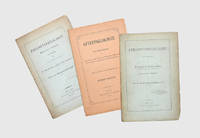
1872174288Berlin & Leipzig: Gebrüder Borntraeger & E. W. Fritsch 1872-73. Wagner Nietzsche and the battle for antiquity First editions of three key entries in the controversy over Nietzsche's first book a dispute which damaged his academic reputation confirmed his early Wagnerian allegiance and made his name in the German cultural scene. Both authors had known Nietzsche in his youth yet each offered a completely different analysis of his capacities methods and intentions. Die Geburt der Tragodie The Birth of Tragedy Nietzsche's first book outlined an analysis of ancient tragedy that "fell outside of every known convention in classical studies" Porter p. 74. For Nietzsche Socratic philosophy had killed Greek tragedy and Wagner was the man to revive it in modern Germany. For many this exposed a dangerous rift between Western tradition and the subversive followers of Schopenhauer and Wagner. Objections were first expressed by Ulrich von Wilamowitz-Moellendorff 1848-1931 in the Zukunftsphilologie Future Philology. Although Wilamowitz had been a fellow student with Nietzsche his response was a vitriolic demolition of Nietzsche's style logic and research. Wagner defended Nietzsche but his argument unwittingly bolstered Wilamowitz's claim that the Geburt was not intended for the academic establishment. Nietzsche persuaded Erwin Rohde 1845-1898 - another old schoolmate - to conduct his defence. The Afterphilologie False Philology which was shaped by suggestions from Nietzsche answers Wilamowitz in kind: exposing his own lack of academic rigour and painting him as an immature arriviste. Wilamowitz responded in the Zweites Stück Part II reiterating his disgust with Nietzsche's abandonment of Western philosophy. The Zukunftsphilologie captured the zeitgeist and recent academics "have remained broadly behind him" Silk & Stern p. 156. Wilamowitz became the most celebrated Greek scholar of his age while Rohde wrote a study of the Greek Pysche 1890-4 which remains prominent in modern classical studies. The three papers are: 1 WILAMOWITZ-MOELLENDORFF Ulrich von. Zukunftsphilologie! Eine erwidrung. Berlin: Gebrüder Borntraeger 1872. Pp. 32. 2 ROHDE Erwin. Afterphilologie. Zur Beleuchtung des von dem Dr. phil Ulrich von Wilamowitz-Möllendorff herausgegeben Pamphlets: "Zukunftsphilologie!" Sendschreiben eines Philologen an Richard Wagner. Leipzig: E. W. Fritsch 1872. Pp. 48. 3 WILAMOWITZ-MOELLENDORFF Ulrich von. Zukunftsphilologie! Zweites Stück. Eine erwidrung au die rettungsversuche für Fr. Nietzsches "geburt der tragödie". Berlin: Gebrüder Borntraeger 1873. Pp. 24. 3 works octavo. Original orange or green printed wrappers. Spines repaired. Light toning chipping and creasing to wrappers minor browning and foxing to contents: very good copies in the fragile original wrappers. James L. Porter "'Don't Quote Me on That!': Wilamowitz Contra Nietzsche in 1872 and 1873" The Journal of Nietzsche Studies no. 42 2011; M. S. Silk & J. P. Stern Nietzsche on Tragedy 2016. unknown
1896COLLECTI014822INEW YORK NY: MACMILLAN AND CO. VERY GOOD NO D.J. 1896. FIRST EDITION. HARDCOVER. EDITED BY ALEXANDER TILLE / TRANSLATED BY THOMAS COMMON ALSO INCLUDES "THE ANTI-CHRIST"PAGES 233-351 . PUBLISHER'S LIGHT GREEN CLOTH-COVERED BOARDS WITH GILT SPINE TITLES AND 8 PAGE UNDATED CATALOG AT THE REAR OF TEXT. THE CLOTH OF THE SPINE IS DARKENED WITH SPINE TITLES A BIT DULLED BUT QUITE READABLE AND WITH FRONT AND REAR BOARDS' CLOTH SLIGHTLY DARKENED. A VERY NICE COPY BUT LACKING THE HALF TITLE. A VERY NICE COPY OF A RARE FIRST EDITION WITH NIETZSCHE'S "TWILIGHT OF THE IDOLS". . MACMILLAN AND CO. hardcover
189953210London: T. Fisher Unwin 1899. Spine sprung gutters cracked and strained rear gutter particularly cracked exposing netting. Boards lightly rubbed with a few small stains base edges chipped with tearing to foot of spine. Titles foxed with the odd spot throughout otherwise pp generally clean and bright. Cloth. Fair/No Jacket. 8vo. T. Fisher Unwin Hardcover
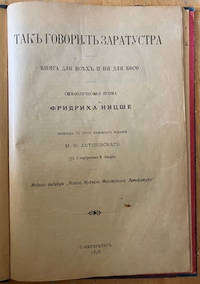
1898886<p>Petersburg: New Journal of Foreign Literature 1898. First Edition. Hardcover. Very good. First Russian Translation of Nietzsche <br /><br />NIETZSCHE Friedrich Tak govoril Zaratustra Also Sprach Zarathustra New Journal of Foreign Literature St Petersburg 1898. Blank leaf TP 3 - 5 = translators introduction 6 - 90 1 leaf = advertisements 1 blank leaf thin octavo. First Russian translation of Nietzsches Also Sprach Zarathustra translated by Yu Antonovsky. <br /><br />This is the very first translation of Zarathustra in Russian written by Yu Antonovsky in 1898 just really a few months before a second bilingual edition translated by Nani. With so much censorship in Russia any translation was really an art form creatively trying to communicate Nietzsches or any philosophers! ideas into a voice acceptable to the heightened sensitivities of the authorities under both Tsars Alexander III and Nicholas II. Hence the incomplete translations of both Antonovsky in 1898 and Nani in 1899. This first Russian translation based on the 10th German edition comprises all but part IV. Perhaps there were contents of part IV that ruffled the feathers of the censors; perhaps Antonovsky actually relied upon the 1886 German edition which only included parts I - III as part IV was not published publicly in Germany until 1892. <br /><br />Thus Spoke Zarathustra is one of Nietzsche's most famous works and Nietzsche regarded it as among his most significant. Thoroughly studied and re-studied by scholars throughout the 20th century the character of Zarathustra stands as a figure marking the end of Modernity by some i.e. Heidegger the beginning of Post-Modernity by others i.e. Derrida; the text a personal soteriological narrative of Nietzsches own self-overcoming and a parable for others towards the same transformation. Though Thus Spoke Zarathustra attempts to destroy and replace the Judeo-Christian world-view Nietzsches style borrows heavily from the Old and New Testament. Nietzsche also adopts myriad metaphors invoking animals earth air fire water celestial bodies plants all in the service of describing the spiritual transformation of Zarathustra a solitary reflective exceedingly strong-willed sage-like laughing and dancing voice of self-mastery who accompanied by a proud sharp-eyed eagle and a wise snake believed in a mode of being beyond the common human condition but without the need to posit a transcendent other world. Nietzsche refers to this higher mode of being as superhuman übermenschlich one that embraces the doctrine of eternal recurrence a doctrine for only the strongest who can love life in its entirety who embrace their suffering and would only again will it to be thus! <br /><br />CONDITION: Very good in original quarter cloth with purple boards. Light edgewear. Pages 11 - 14 with small erasure mark that wore through the paper. A few scattered pencil marks otherwise an excellent well-preserved copy all in original condition. <br /><br /><br /></p> New Journal of Foreign Literature hardcover
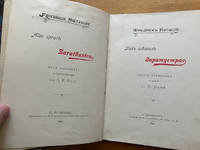
1899887<p>Petersburg: M.M. Stasyulevicha 1899. First Thus. Hardcover. Very good. First Bilingual German-Russian Edition of Nietzsches Zarathustra <br /><br />NIETZSCHE Friedrich Tak govoril Zaratustra / Also Sprach Zarathustra Bilingual edition in German and Russian M.M. Stasyulevicha Petersburg 1899. Blank leaf half-title TP 1 leaf = dedication vii - xiv = translators forward half title half-title 2 - 103 1 leaf = contents blank leaf octavo. First Russian-German Dual-Language. <br /><br />First edition of the second translation of Thus Spoke Zarathustra. Translated from German by S. Nani. Bilingual edition in both German and Russian of nine selected excerpts printed side-by-side: the Night-Song the Grave-Song the Academic Chairs of Virtue the Soothsayer the Three Metamorphoses Scholars the Way of the Creating One Reading and Writing and the Three Evil Things. <br /><br />Thus Spoke Zarathustra is one of Nietzsche's most famous works and Nietzsche regarded it as among his most significant. Thoroughly studied and re-studied by scholars throughout the 20th century the character of Zarathustra stands as a figure marking the end of Modernity by some i.e. Heidegger the beginning of Post-Modernity by others i.e. Derrida; the text a personal soteriological narrative of Nietzsches own self-overcoming and a parable for others towards the same transformation. Though Thus Spoke Zarathustra attempts to destroy and replace the Judeo-Christian world-view Nietzsches style borrows heavily from the Old and New Testament. Nietzsche also adopts myriad metaphors invoking animals earth air fire water celestial bodies plants all in the service of describing the spiritual transformation of Zarathustra a solitary reflective exceedingly strong-willed sage-like laughing and dancing voice of self-mastery who accompanied by a proud sharp-eyed eagle and a wise snake believed in a mode of being beyond the common human condition but without the need to posit a transcendent other world. Nietzsche refers to this higher mode of being as superhuman übermenschlich one that embraces the doctrine of eternal recurrence a doctrine for only the strongest who can love life in its entirety who embrace their suffering and would only again will it to be thus! <br /><br />The first translation of Zarathustra was done by Yu Antonovsky in 1898 just really a few months before this bilingual edition translated by Nani. With so much censorship in Russia any translation was really an art form creatively trying to communicate Nietzsches or any philosophers! ideas into a voice acceptable to the heightened sensitivities of the authorities under both Tsars Alexander III and Nicholas II. Hence the incomplete translations of both Antonovsky in 1898 and Nani in 1899. <br /><br />CONDITION: Very good in original quarter leather with marbled boards. Light edgewear. Former owners name in ink to top edge of half-title page. Text block coming loose from front cover along inner hinge but holding along bottom. Rear hinge firm. One leaf xiii - xiv loose. Blank rear endpaper with small tear in center. A very nice untouched copy all in original condition. <br /><br /></p> M.M. Stasyulevicha hardcover
187788235Schloss-Chemnitz: Ernest Schmeitzner 1877. Fine. Ernest Schmeitzner Schloss-Chemnitz 1877 12.50 x 18.50 cm relié The rare first edition of Friedrich Nietzsche's first work translated into French. Light rubbing to head of spine small brown stains at foot of second cover some foxing. Full khaki cloth Bradel binding smooth spine decorated with gilt floral motif gilt date and double fillet at tail navy blue shagreen title-label covers preserved contemporary binding signed Carayon. Ernest Schmeitzner hardcover
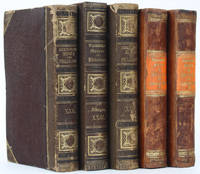
18671001<p>1867-73 First Edition of Seven of Nietzsche's Philological Articles Accepted as his Dissertation Requirement – Qualifying Him to Become a Professor at Age 24</p><p>Rheinisches Museum für Philologie Edited by F.G. Welcker & F. Ritschl 1867-68 F.G. Welcker F. Ritschl A. Klette 1869 Friedrich Ritschl & Anton Klette 1870 & 1873 Johann David Sauerländer Frankfurt am Main 1867-1870 1873. 1867 Volume: Facing TP TP V-XVI 1-648; 1868 Volume: Facing TP TP V-XVI 1-704; 1869 Volume: Facing TP TP V-XVI 1-640; 1870 Volume: Facing TP TP V-XV 1-640; 1873 Volume: Facing TP TP V-XV 1-640; First Edition of seven of the eight philological articles written by Nietzsche Schaberg 9-14 & 16.</p><p>Friedrich Nietzsche began his publication career at the age of twenty-two while he was a student of philology at the University of Leipzig. In Nietzsche's day to be a philologist meant that one studied ancient languages texts history philosophy art and even archeology in an attempt to recapture and understand the meaning of Greece and Rome. Nietzsche was a prize student first at the University of Bonn and then in Leipzig and as such he published several papers in scholarly journals… All but one of these essays appeared in the Rheinisches Museum für Philologie which was—and remains today—a respected journal in the field of classical studies. The single exception was The So-Called Contest of Homer and Hesiod which appeared in Volume I of the Acta Societatis Philologae a compendium organized in 1870 by Ritschl that published just four volumes before its demise in 1875.</p><p>Four of the philological articles were written in German and four in Latin. At least one of the articles On the Sources of Diogenes Laertius was originally composed in German and then translated into the required Latin. The German articles were signed at the end either as 'Friedrich Nietzsche.' or 'F. Nietzsche.' In the Latin articles the author was credited on the first page of each as 'Fridericus Nietzsche'. .</p><p>In later years Nietzsche was understandably dismissive of his philological works. He once wrote to Georg Brandes that "there are of course also Philologica by me but that need not concern either of us anymore." Certainly this was true in 1888 but twenty years earlier when these articles were published they were of major personal importance. Nietzsche's mentor Ritschl used the first four articles as justification for the recommendation that resulted in Nietzsche's spectacularly early appointment to Basel as professor at the age of twenty-four. Ritschl then went further and allowed the articles to be accepted as the dissertation requirement for Nietzsche's doctorate which was conferred without oral examination on 23 March 1869…</p><p>All of his philological works were published prior to the appearance of The Birth of Tragedy January 1872 except for the last article the second half of The Florentine Manuscript concerning Homer and Hesiod dated August of 1872 which appeared in February of 1873. It was the last piece of traditional classical scholarship that Nietzsche published.</p><p>Schaberg The Nietzsche Canon pp. 8-14</p><p>CONDITION: Very good or better in contemporary boards leather spines with gilt lettering. Two different styles of binding. Light edgewear. Three volumes in quarter leather with black boards and marbled endpapers; two volumes in quarter leather with marbled boards. See photos.</p> Johann David Sauerländer hardcover
189717290Leipzig, C. G. Naumann, 1897. Gr.-8vo. 2 Bl., 110 S. Schlichte Hlwd. d. Zt.