83 résultats
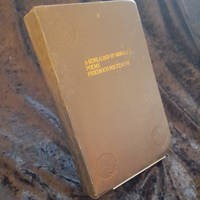
18983014# AUTEUR: Nietzsche Frédéric # ÉDITEUR: Mercure de France Paris # ANNÉE ÉDITION: 1898 # COUVERTURE: sans le 1er plat # DÉTAILS: In 8° broché 1ff.(page de titre)+ portrait en frontispice + 473pp.+ 2ff. (errata). Etat d'usage, le 1er plat est absent, léger manque au dos, coins inférieurs du 2eme plat déchirés. Ouvrage à relier. # PHOTOS visibles sur www.latourinfernal.com
189565466[Berlin, F. Fontane & Co., 1895]. Plattengröße 29,6 x 22,8 cm, Blattgröße 36,9 x 27 cm.
1899001274London: T. Fisher Unwin 1899. 1st Edition . Hardcover. Good. 1st UK Edition first English translation originally published in the USA1897. Large 8vo xix pp286 with introduction by Alexander Tille. Hardcover no dust jacket. Original publishers blue cloth binding with gilt titles to front board and blind tooled decorations to front board and spine in good condition. There are some old water marks to back board gilt titles to spine have rubbed off and a little shelf wear to top & tail of spine. Inside some yellowing to pages and sporadic foxing throughout otherwise all rough cut pages very good. Cracked to a few places but binding still solid. Very Scarce. <br/> <br/> T. Fisher Unwin hardcover
1872179413Leipzig: E. W. Fritzsch 1872. First edition of Rohde's contribution to the pamphlet war sparked by the publication of Nietzsche's Die Geburt der Tragödie aus dem Geiste der Musik. "The book caused a furor. Wagnerians embraced it while philologists were appalled. Among his colleagues only Nietzsche's friend Rohde was willing to praise the book in public and the first review he submitted to the Literarisches Centralblatt was rejected by the editors. A rewritten review was printed by the Norddeutsche Allgemeine Zeitung on 26 May. Four days later the young Ulrich von Wilamowitz-Möllendorff attacked the book savagely in a thirty-two page pamphlet entitled Future-philology! Zukunftsphilologie! which sold out quickly. Wagner replied on 23 June defending Nietzsche in an open letter published in the Norddeutsche Allgemeine Zeitung. Unfortunately Wagner's amateurish attempt at support did nothing more than confirm the worst fears of the scholarly forces lining up against Nietzsche. Rohde who was totally committed to the defence of his friend - although possibly against his better judgement at this point - counterattacked Wilamowitz-Möllendorff in a forty-eight page pamphlet entitled Pseudo-philology Afterphilologie which was published on 15 October. The final entry in this exchange occurred on 21 February 1873 when Wilamowitz-Möllendorff published his Future-philology! Part Two Zukunftsphilologie! Zweites Stück a twenty-four page rejoinder to both Rohde and Nietzsche" Schaberg. Octavo pp. 48. Recent stiff buff paper wrappers the original printed wrappers cut down and mounted. Original wrappers slightly soiled contents lightly browned title page with small chip at head and in the gutter; a good copy. W. Schaberg The Nietzsche Canon 1995. unknown
1898116513Paris et Leipzig : Socit du Mercure de France et C. G. Naumann 1898. 235x150mm. frontispice sous serpentine 473 pages 2 ff. errata reliure de lÕpoque demi-basane coins avec titre et auteur dors au dos cinq faux-nerfs. Plat et garde papier marb. Tranche suprieure rouge. Couvertures conserves. Bel exemplaire. 812 Socit du Mercure de France et C. G. Naumann unknown
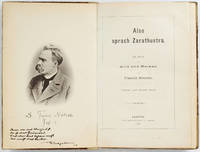
18911004<p>NIETZSCHE Friedrich. Also sprach Zarathustra Vierter und letzter Theil C. G. Naumann Leipzig 1891. Frontispiece portrait of Nietzsche TP Quote page 5-135 half title 3-21 23 = Inhalt Octavo. First Edition. Schaberg 58.</p><p>The famous first public printing of Nietzsche's notorious conclusion to Zarathustra. Although printed in 1890 and dated 1891 this book did not see public release until March of 1892 due to legal arguments between Nietzsche's sister Elisabeth and the publisher. Elisabeth was worried that the books would all be confiscated as "obscene" –and therefore negotiated until she received a contract from Naumann that protected her against this possibility. This edition –which is cited in Printing and the Mind of Man as the first edition ignoring the private printing of 1885 –is rare in any condition. When copies do make their rare appearances on the market they almost always come bound with the original three books 1883-1884 or more commonly bound with copies of the three books as re-issued in 1886. Containing the first edition printing of Nietzsche's poems: Dionysian Dithyrambs.</p><p>CONDITION: Contemporary quarter vellum with marbled boards little rubbed minor bumping to extremities. Slight browning little foxing and small marginal tears to few leaves at the end short tear to bottom gutter of title. - From the collection of archeologist and art-historian Botho Graef 1857-1917 known for his friendship with artists like Emil Nolde and Ernst Ludwig Kirchner in addition to his facilitation of the Jena art-collection. His handwritten dedication is addressed to German playwright and poet 'Ernst' Hardt 1876-1947.</p> C. G. Naumann hardcover
189584476Leipzig, Naumann,, 1895. Original-Leinenband, Gr.-8°, 476 Seiten. Vierte Auflage (= Nietzsche`s Werke. Erste Abtheilung. Band VI).
189557674Leipzig: Druck und Verlag von C. B. Naumann 1895. First edition 2 volumes 8vo pp. 13 4-369 1 6 ads; pp. 7 vi-ix 4 2-341 1 2 ads; photographic frontispieces of Nietzche's home and a portrait of Nietzsche; contemporary and likely original black cloth-backed pebble-grain boards manuscript paper labels on spines; rubbed corners bumped but sound. Ownership inscription of Isidor Rubel on front free endpapers stamp on title pages. This biography of Nietzsche was compiled by his sister Elisabeth Förster-Nietzsche 1846-1935. Both volumes were published prior to Nietzsche's death in 1900 but the mental illness that dominated the final decade of his life was so severe that he lost all autonomy. Elisabeth's work received significant criticism both from scholars as well as family and friends. As the sole editor of her brother's estate she garnered a reputation for altering and recontextualizing his life and work to complement her own ideology which was in line with the values of the Nazi Party. A third part was published in 1904 not present here. <br/><br/> Druck und Verlag von C. B. Naumann hardcover books
189517284Leipzig, C. G. Naumann, 1895. 8vo. Mit Frontispiz, Faksimile, einigen Lichtdrucken u. gef. Notenbeilage. VIII, 369 S., 3 Bl. Hldr. d. Zeit m. Rückengoldpräg.
189536112ALeipzig, C. G. Naumann, 1895. Ca. 23 x 15,5 cm. Frontispiz, VIII Seiten, 380 Seiten, mit Faksimile-Abbildungen, einigen Lichtdrucken und gefalteter Notenbeilage, 2 Blätter Verlagswerbung. Original-Halbleinenband mit Farbschnitt.
1899177787Berlin, Schwertschke & Sohn, 1899. 264 S. OLwd. m. goldgepr. Deckel- u. Rtit., Rotschn. u. Rsign.Namenszug a. Vorsatz.
18998508Berlin: C.A. Schwetschke. 1899. 2 Bll., 264 S., 4 Bll. 8°. EA. OLeinen.
190014915Kirchheim Verlag; Mainz 1900. 398 Seiten; Schrift: Antiqua, gebundene Ausgabe, Halbleinen, innen einige Bemerkungen und Unterstreichungen mit Bleistift, leichte Gebrauchsspuren am Einband, sonst guter Zustand
1880923Chemnitz: Schmeitzner 1880. First Edition. Wraps. Near fine. The Third and Final Part of Human all too Human <br /> <br />NIETZSCHE Friedrich. Der Wanderer und Sein Schatten The Wanderer and His Shadow. Schmeitzner Chemnitz 1880. 1 blank leaf TP 3-185 186 = Berichtigungen Octavo. First Edition First Issue in original wrappers. Schaberg 32. <br /> <br />Written as a second sequel to Human All Too Human The Wanderer and his Shadow was first published in the year following Nietzsches departure from academia. Perhaps the title here is somewhat autobiographical reflecting Nietzsche and his shadow heading off into the wilderness of the unknown. Wanderer contains a series of aphorisms and was published on December 20 1890. It was received enthusiastically by Nietzsches friends though failed to sell more than 200 copies. Yet it was viewed by Nietzsche himself as a triumph. In a letter to Schmeitzner written on December 18 Nietzsche remarks: "Der vollendete 'Wanderer' ist mir fast etwas Unglaubliches. Die ganze 'Menschlichkeit' mit den 2 Anhängen ist aus der Zeit der bittersten und anhaltendsten Schmerzen - und scheint mir doch ein Ding voller Gesundheit. Dies ist mein Triumph." The completed 'Wanderer' is to me something almost unbelievable. The entire 'humanity' with the 2 supplements is from a time of the most bitter and continual pains - and yet seems to me to be a thing full of health. This is my triumphThe Nietzsche Chronicle. <br /> <br />CONDITION: Very good to near fine in original front and rear wrappers. Spine restored with graphics to match the original. Interior crisp and bright. Housed in cloth-backed clamshell box. A gorgeous copy of this final installment of the Menschlisches three-book series. <br/><br/> Schmeitzner paperback
182513557Augmentée du précis de l'explication universelle. Portrait de l'auteur. Pleine basane mouchetée, dos long orné, pièces de titre et de tomaison. Très bon Paris Eymery 1825 1 volume in-4°
18642401130056xbvkBerlin, Commissionsverlag der Haude- & Spener'schen Buchhandlung (F. Weidling), 1864. VII, 245 (3) Seiten. - Etwas späterer grüner Halbleineneinband mit dunkel-marmorierten Buchdeckeln; 8vo.(ca. 21,5 x 15 cm).
1887927Leipzig: E.W. Fritzsch 1887. First Thus. Hardcover. Very good. First complete edition of one of Nietzsches most important texts! <br /> <br /> <br />NIETZSCHE Friedrich. Die Frohliche Wissenschaft "la gaya scienza". Neue Ausgabe mit einem Anhange: Lieder des Prinsen Vogelfrei The Gay Science . E.W. Fritzsch Leipzig 1887. III XII = Vorrede 1 leaf = Half-title 5 350 1 leaf = Berichtigungen; Octavo. First Edition Second Issue Definitive. Schaberg 51. <br /> <br /> <br />A must have for any Nietzsche collection. This Neue Ausgabe consisted of the 788 unsold sheets from the first edition of 1882 with the addition of a new title page Nietzsches new 10-page Vorrede Preface 2 new half-title pages and a new 5th book "Wir Furchtlosen" We Fearless Ones. Thus 75 new pages along with fourteen pages of poetry appear here for the first time. While the first edition appeared in 1882 it was incomplete. This is truly the first edition of the complete and definitive text of what is today read as The Gay Science. Nietzsche felt that the Vorrede to this and the other reissues of 1886/7 were among the best things that he ever wrote. <br /> <br />The Gay Science which is the final and culminating volume of Nietzsches aphoristic works contains the first instance of his famous statement Gott ist tot! God is Dead first in section 108 then more elaborately detailed in the Parable of the Madman in section 125 and for a third time in section 343. It also contains the first appearance of the doctrine of the "Eternal Return of the Same" which plays such a prominent role in Zarathustra and even includes the Nietzsches first mention of the Uebermensch. <br /> <br /> <br />CONDITION: Very good in a quarter leather contemporary binding with marbled boards gilt lettering to the spine. Some wear to spine leather. Minor rubbing to marbling on front cover. Small bookseller sticker to inside corner of rear free endpaper <br /> <br /> <br/><br/>PHOTOS AVAILABLE UPON REQUEST E.W. Fritzsch hardcover
188232173Chemnitz: Schmeitzner 1882. First edition first issue. 8vo 2 leaves 5-255 pp. Bound to period style in marbled boards with red morocco spine and black leather labels. Fine condition. From the library of Viennese bibliographer Dr Moriz Grolig with his circular stamp on the title page verso. Of 1000 copies originally printed 788 remainders were sold to E.W. Fritsch in 1886 and reissued with a new title page and additional material. Schaberg 35. <br/><br/> Schmeitzner hardcover books
1878928Chemnitz: Schmeitzner 1878. Second Edition. Hardcover. Very good. NIETZSCHE Friedrich Die Geburt der Tragödie The Birth of Tragedy. Schmeitzner Chemnitz 1878. TP III-IV 1-144 Octavo. The famous Second Edition First Issue of Nietzsche's first book. Schaberg 30. <br /> <br />The publication history of Nietzsche s Birth of Tragedy is about as complicated as any. The 143-page first edition appeared in 1872 published by E.W. Fritzsch. Shortly after its release Fritzsch printed a second edition that included Nietzsche s corrections extending the text to 144 pages. This was completed by March of 1874 yet because of some conflicts between Nietzsche and Fritzsch and the financial difficulties Fritzsch was experiencing the 750 copies of this 144-page second edition were never available for sale. They sat in a warehouse for 4 years until Schmeitzner Nietzsche s new publisher acquired the copies. Schmeitzner affixed his own label on top of the original publisher s information and made the books available for sale. Very few sold no more than 175. In 1886 the unsold copies of both the 143-page first edition and the 144-page second edition ended up back with the original publisher Fritzsch who added Nietzsche s new preface along with a new title page for the "Neue Ausgabe" edition the definitive edition if the 144-page copy!. Thus fewer than 175 copies in this state 144-pages with the original title page and Schmeitzner label extant. A rare find and a must-have for any Nietzsche collection to be complete.Printing and the Mind of Man notes "Nietzsche's principle work during the Wagner period 1868-1878 was Die Geburt der Tragodie aus dem Geist der Musik 1872. In this he adopted a tragico-pessimistic conceptions of Greek civilization like Burckhardt but contrary to Grote. This started his career as a critic of modern civilization based on disgust with imperial Germany Christianity bourgeois ethics and so on." PMM 224. In this his first book Nietzsche theorized that Greek tragedy was built upon a wedding of two principles that he associated with the deities Apollo and Dionysus. The Apollonian principle is the principle of order static beauty and clear boundaries. The Dionysian principle in contrast is the principle of frenzy excess and the demolition of boundaries. It is in the subtle interaction of these disparate principles that the greatness of Greek tragedy resides and by extension in which the creative spirit still finds its proper soil. The book ended with a long section devoted to Richard Wagner and the importance of his music. When first released it met with only limited success. Despite Nietzsche's eventual near contempt for the book - from the perspective naturally of his later unequalled masterpieces of German prose - it must be considered along with Aristotle and Hegel among the greatest contributions to the understanding of Greek tragedy and in fact to the Greek way of life in general. <br /> <br />CONDITION: Very Good in contemporary half-calf and marbled boards. Light wear. Gilt lettering. Light foxing. Former owners name neatly inscribed to upper corner of front free endpaper. As issued with Schmeitzner's label canceling out Fritzsch's imprint. A very good copy of a very rare book. <br/><br/> Schmeitzner hardcover
18724535Leipzig: E.W. Fritzsch 1872. First edition. <p>First edition in exceptionally rare original publisher's cloth binding. This copy previously handled by Bill Schaberg: "When I wrote The Nietzsche Canon: A Publication History and Bibliography 1995 I had never even heard of these cloth copies of Nietzsche's first book put out by his publisher Fritzsch. So it was quite a shock when someone offered this copy to me. It turns out that Fritzsch's contemporary advertisements for the book mention a cloth binding so this is not just a figment of some bookseller's imagination." This Nietzsche's first book is a compelling argument for the necessity for art in life. It is fueled by his enthusiasms for Greek tragedy for the philosophy of Schopenhauer and for the music of Wagner to whom this work was dedicated.</p>. Hardcover. IN THE EXCEPTIONALY RARE PUBLISHER'S BINDING. <p>First edition in exceptionally rare original publisher's cloth binding. This copy previously handled by Bill Schaberg: "When I wrote The Nietzsche Canon: A Publication History and Bibliography The University of Chicago Press 1995 I had never even heard of these cloth copies of Nietzsche's first book put out by his publisher Fritzsch. So it was quite a shock when someone offered this copy to me. It turns out that Fritzsch's contemporary advertisements for the book mention a cloth binding so this is not just a figment of some bookseller's imagination."</p> <br /> <p>This Nietzsche's first book is a compelling argument for the necessity for art in life. It is fueled by his enthusiasms for Greek tragedy for the philosophy of Schopenhauer and for the music of Wagner to whom this work was dedicated.</p> <br /> <p>Nietzsche argues that the tragedy of Ancient Greece was the highest form of art due to its mixture of both Apollonian and Dionysian elements into one seamless whole allowing the spectator to experience the full spectrum of the human condition. The Dionysian element was to be found in the music of the chorus while the Apollonian element was found in the dialogue which gave a concrete symbolism that balanced the Dionysiac revelry. Basically the Apollonian spirit was able to give form to the abstract Dionysian.</p> <br /> <p>In contrast to the typical Enlightenment view of ancient Greek culture as noble simple elegant and grandiose Nietzsche believed the Greeks were grappling with pessimism. The universe in which we live is the product of great interacting forces; but we neither observe nor know these as such. What we put together as our conceptions of the world Nietzsche thought never actually addresses the underlying realities. It is human destiny to be controlled by the darkest universal realities and at the same time to live life in a human-dreamt world of illusions.</p> <br /> <p>The issue then or so Nietzsche thought is how to experience and understand the Dionysian side of life without destroying the obvious values of the Apollonian side. It is not healthy for an individual or for a whole society to become entirely absorbed in the rule of one or the other. The soundest healthiest foothold is in both. Nietzsche's theory of Athenian tragic drama suggests exactly how before Euripides and Socrates the Dionysian and Apollonian elements of life were artistically woven together. The Greek spectator became healthy through direct experience of the Dionysian within the protective spirit-of-tragedy on the Apollonian stage.</p> <br /> <p>The Birth of Tragedy was the best selling book that Nietzsche ever published; still it did not sell quickly. The Wagners had feared that there might not be an audience for the work and their apprehensions proved to be well-founded. A prediction that Nietzsche had once made to Rohde proved true: "The philologists won't read it on account of the music the musicians won't read it on account of the philology and the philosophers won't read it on account of the music and the philology." False hopes for brisk sales plagued the first half-year. In mid-April Nietzsche was writing home that "a new edition of my book will be needed soon"34 but the necessity of printing a second edition did not materialize quickly. By 20 July Fritzsch complained that there had been "no results" even though he had "sent out a fair number of copies." Schaberg The Nietzsche Canon p. 27</p> <br/> <br/> 8vo 216 x 138 mm pp. i-iii iv 1 2-143 144. Original publisher's dark-rust binding with an ornate blind-stamped design on the front and rear covers and the spine lettered and filleted in gilt. There is some light browning to the edges of the page margins and light foxing throughout. Rear hinge with a 10 cm split. Entirely unrestored copy in its original state. An extremely well preserved copy of this unusual and all-but-unobtainable original publisher's cloth binding. / Hardcover. E.W. Fritzsch unknown
1894424Leipzig: C.G. Naumann 1894. Third edition. Hardcover. Very Good . NIETZSCHE Friedrich. Die Geburt der Tragödie The Birth of Tragedy 1894 C.G. naumann Leipzig: 1894. TP Half-title 1 172 I XII Octavo. THIRD EDITION. The third edition of Nietzsches look at art aesthetics and the aesthetic existence. Last leaves with three column register comparing the first three editions.CONDITION: Very good. Contemporary marbled boards with cloth spine. ORIGINAL FRONT WRAPPER affixed to front board. Clean pages throughout. <br /><br />PHOTOS AVAILABLE UPON REQUEST C.G. Naumann hardcover
189959132Dresden und Leipzig: Carl Reißner. 1899. LXIX S., 1 Bl., 216 S. 8°. Mit Titelportrait. Deutsche EA. Halbleinenband der Zeit mit goldgepr. Rückentitel.
19001734Ohne Ort und Jahr. Um 1900. Gr.-8°. 2 Seiten auf einseitig beschriebenen Blättern.
1874k1209252094xbvkTübingen, Verlag der L. Fr. Fues'schen Sortiments-Buchhandlung, 1874. IV, 67 (1) Seiten. - Originalumschlag mit Deckel- und Rückentitel; 8vo.(ca. 22 x 14,5 cm).
189217262Berlin, F. Fontane, 1892-1901. 8vo. 3 Bl., 68 S.; 2 Bl., 64; 59; 48, 48; 30 S. Marmorierte Pp. m. RSchild. [2 Warenabbildungen]