80 résultats
184227959Kjöbh., 1842. 8vo. Nice cont. hcalf w. gilt back. Internally very nice and clean. Old owner's name on t-p., a few leaves w. marginal linings. Excellent copy.
184227959Kjöbh. 1842. 8vo. Nice cont. hcalf w. gilt back. Internally very nice and clean. Old owner's name on t-p. a few leaves w. marginal linings. Excellent copy. <br/><br/><em>First Danish edition of the only of Hegel's works to be translated into Danish until recent times. It is translated from the German second issue as stated on the title-page. This work has had immence influence on 19th century philosophy and this only Danish translation was of great importance to Danish philosophy at the time the time of Kierkegaard. "I snævreste forstand er den hegelianske periode i dansk filosofi afgrænset til årene omkring 1840 ! en kort men væsentlig periode i den danske tænknings historie da det var i denne at Søren Kierkegaard tog afsæt i sit senere så overvældende forfatterskab." "In the most restricted sense the hegelian period in Danish philosophy is limited to the years around 1840 ! a short but significant period in the history of Danish thought as it was in this period that the basis of the later so overwhelming writings of Søren Kierkegaard was founded. Koch Den danske idealisme 2004 p. 219. "Også blandt de unge historikere fængede Hegel. Det er næppe en tilfældighed at det eneste af hans værker der blev oversat til dansk var hans forelæsninger over historiens filosofi." "Also amongst the young historians did Hegel catch on. It is hardly a coincidence that the only one of his works to be translated into Danish were his lectures on the history op philosophy." Koch Den danske idealisme 2004 p. 221.The fist English translation did not appear until 1895. </em> unknown
1894024401Oxford: At the Clarendon Press. Although the date on the title page is 1984 this copy differs in a number of ways from the First Edition which I also possess at this time. The pagination is continous and differs from the First Edition in not having roman numerals for pagination. There has been a redesign of the typesetting then. The copyright page differs from the First Edition in having "Henry Frowde M.A. Publisher to the University of Oxford London Edinburgh New York Toronto and Melbourne." After the index is "Oxford: Printed at the Clarendon Press by Horace Hart M.A." Half leather and black cloth. All edges red. I would guess that the Clarendon Press printed this copy at some point between 1900 and 1910. The leather has some edge wear previous owner's signature dated 1921 Very Good. . Very Good. Hardcover. 1894. At the Clarendon Press hardcover
1895483<p><strong>FIRST EDITION. Complete 3 volume set. All 3 books are tight and square with sturdy bindings and strong hinges. Previous owner's name and bookplate in front of all 3. Volumes 1 and 2 have small abrasions to the cloth at fore-edge; light foxing to endpapers and cloth covers. Each volume is mylar protected and housed in a custom blue slipcase. First edition in English of the philosopher's examination of the conceptual foundations of religion first published in Berlin in 1832 and deriving from notes taken by Hegel's students at the University of Berlin. In Lectures Hegel 1770-1831 argues that the dogmatic creeds of organized Christianity serve to underpin rationally the instinctive nature of religious feeling. This approach which elevates rational philosophy above traditional theological practice yields a more developed understanding of God. This edition was edited and partially translated by Ebenezer Brown Speirs 1854-1900 a minister from Perthshire while much of the first two volumes was translated by Jane Burdon Sanderson who died during the publication process.</strong></p> Kegan Paul, Trench, Trubner & Co hardcover
18862412230487xbvkLeipzig, F. A. Brockhaus, 1886. XI, (1) 137 / XII, (2) 144 Seiten. - Ornamental blind- und goldgeprägte überwiegend dunkelblaue Original-Leineneinbände mit goldgepr. Deckel- und Rückentitel, Lesebändchen, Papierschnitt rundherum dunkelblau marmoriert; 8vo.(ca. 17 x 12 cm).
1869016717St. Louis MO: Wm. T. Harris. Original grey wrapper. Small area of dampstain in the bottom margin of the front cover without any bleedthrough to the pages small area of dampstain in the fore-edge margin of both wrappers and all of the pages slight loss at the head and foot of the spine Good. Internals apart from the dampstain very nice. The pages are still unopened and the journal has obviously never been read. Volume II of The Journal of Speculative Philosophy contained three first printings of articles by C. S. Peirce presenting theories of cognition reality and logical validity and this issue of the volume contains one of these articles Grounds of Validity of the Laws of Logic: Further Consequences of Four Incapacities. This article is one of five by Peirce constituting the modern founding of semiotic the general theory of signs. Peirce was a physicist mathematician and philosopher. He founded pragmatism and revolutionized logic. Bertrand Russell called Peirce "one of the most original minds of the later nineteenth century" and "the greatest American thinker ever." This issue also contains a partial translation of Hegel's Phenomenology of Spirit. . Good. Soft cover. First Edition. 1869. Wm. T. Harris paperback
1868016715St. Louis MO: Wm. T. Harris. Original pale green wrapper. Dampstain in the bottom margin of both the front and back wrapper and three additional leaves adjacent to them four small chips along the bottom edges the top two inches of the spine missing Good. Internals apart from the barely discernable dampstain very nice. The pages are still unopened and the journal has obviously never been read. Volume II of The Journal of Speculative Philosophy contained three first printings of articles by C. S. Peirce presenting theories of cognition reality and logical validity and this issue of the volume contains one of these articles Questions Concerning Certain Faculties Claimed for Man. This article is recognized as one of five by Peirce constituting the modern founding of semiotic the general theory of signs. Peirce was a physicist mathematician and philosopher. He founded pragmatism and revolutionized logic. Bertrand Russell called Peirce "one of the most original minds of the later nineteenth century" and "the greatest American thinker ever." This issue also contains partial translations of Fichte's Sun-clear Statement and Hegel's Phenomenology of Spirit. . Good. Soft cover. First Edition. 1868. Wm. T. Harris paperback
1869016716St. Louis MO: Wm. T. Harris. Original grey wrapper. Small area of dampstain in the bottom margin of the front cover without any bleedthrough to the pages the top inch of the spine missing and slight loss at the bottom else Very Good. Internals very nice. The pages are still unopened and the journal has obviously never been read. Volume II of The Journal of Speculative Philosophy contained three first printings of articles by C. S. Peirce presenting theories of cognition reality and logical validity and this issue of the volume contains one of these articles Some Consequences of Four Incapacities. This issue also contains a letter by Peirce to the editor William Torrey Harris What Is Meant by "Determined". The article is recognized as one of five by Peirce constituting the modern founding of semiotic the general theory of signs. Peirce was a physicist mathematician and philosopher. He founded pragmatism and revolutionized logic. Bertrand Russell called Peirce "one of the most original minds of the later nineteenth century" and "the greatest American thinker ever." This issue also contains partial translations of Fichte's Sun-clear Statement and Hegel's Phenomenology of Spirit. . Very Good. Soft cover. First Edition. 1869. Wm. T. Harris paperback
183343486Berlin, 1833-36. 8vo. Three contemporary uniform brown half calf bindings with gilt title- and tome-labels. Professional restorations to capitals and hinges. Elegant library-stamp to inside of front boards of the first two volumes. Vol. 2 with a few pencil-underlinings, and vol. 3 with pencil-annotations to last leaf. A bit of occasional brownspotting. With all three title-pages for ""Werke. Vollständige Ausgabe"", vol. 13-15, facing the title-pages for the ""Vorlesungen"". XX, 418, (1, -errata)" VI, 586" VIII, 692 pp.
183343486Berlin 1833-36. 8vo. Three contemporary uniform brown half calf bindings with gilt title- and tome-labels. Professional restorations to capitals and hinges. Elegant library-stamp to inside of front boards of the first two volumes. Vol. 2 with a few pencil-underlinings and vol. 3 with pencil-annotations to last leaf. A bit of occasional brownspotting. With all three title-pages for "Werke. Vollständige Ausgabe" vol. 13-15 facing the title-pages for the "Vorlesungen". XX 418 1 -errata; VI 586; VIII 692 pp. <br/><br/><em>First edition of Hegel's seminal "Lectures on the History of Philosophy" which was published posthumously by Michelet. The work comprises Hegel's nine lectures on the history of philosophy given in Jena in the winter of 1805-6 Heidelberg in the winters of 1816-17 and 1817-18 Berlin in the summer of 1819 and the winters of 1820-21 1823-23 1825-26 1827-28 and 1829-30. Just before his death in November 1931 Hegel had begun his tenth lecture course on the history of philosophy but only get two give the first two hours of it. The work is based on Hegel's own lecture manuscript from Jena which is stilized throughout and written in full "er wagte damals noch nichts dem freien mündlichen Vorträge zu überlassen" -Michelet Preface p. VI his shorter draft written in Heidelberg meant for further development at the lectures as well as number of later endorsements and additions written in the margins of the two manuscripts and on loose leaves "Diese Blätter sind von unschätzbarem Werthe weil sie die höchst reichen Zusätze aller Vorlesungen spätere Jahre durch seine eigene Handschrift dokumentieren" Michelet Preface p. VI. Besides this a number of lecture notes from learned students including those of Michelet and the other "Freunde des Verewigten" have been used to establish the text as correctly as possible. These highly influential lectures which attracted philosophers from all over Europe make up a cornerstone in the philosophy of Hegel and his view on the history of philosophy is something that understreams all of his thought. These lectures and not least the publication of them after his death have seminally influenced later philosophy and the following fifty years after Hegel's death were philosophically culturally and historically much indebted to them. It is the Hegelianism that also springs from Hegel's lectures on the history of philosophy that carries historicism the conception of cultural and social relations as products of history through the 19th century. </em> hardcover
1894024400Oxford: At the Clarendon Press. First English Translation. Original blue cloth with the gilt shield. From the library of notable book collector Sydney Ross who focused on science technology philosophy and Scotland. Hegel is the most systematic of the German idealists. Near Fine. A really nice copy. . Near Fine. Hardcover. 1st Edition. 1894. At the Clarendon Press hardcover
181779271Heidelberg: August Oswald. Very Good. 1817. Hardcover. 8 1/4 x 5 1/4 inches in an early 20th century binding of marbled boards with a black cloth spine. Ex-library with bookplate to front pastedown and stamp to title. There are also numbers on the spine and the front hinge is beginning to separate. The contents though modestly foxed throughout are in very good condition with just a few early marginal annotations in ink and some occasional underlining in the same ink. Bound with a later theological work by Hegel published in 1846. . August Oswald hardcover
184018245André Hachette Joubert et Grimblot Raybois | Paris & Nancy 1840-1852 | 14.50 x 23 cm | 5 volumes brochés
1812COLLECTI014466INURNBERG: JOHANN LEONHARD SCHRAG. VERY GOOD. PUB 1812. FIRST EDITION. HARDCOVER. HALF-BOUND DECORATED PAPER BOARDS WITH LEATHER SPINE AND CORNERS SPINE TITLES IN GILT AND ALL EDGES STAINED RED. OTHER THAN SOME WORMING TO THE FIRST 15 AND LAST 11 LEAVES VERY MARGINAL EFFECT TO TEXT AND SOME FUGITIVE LIGHT PENCIL UNDERLININGS AND MARGINAL LINES RUBBING AND LIGHT WEAR TO THE CORNERS AND EDGES A VERY NICE COPY OF THE RAREST OF THE 3 VOLUMES OF THE LOGIC. . JOHANN LEONHARD SCHRAG hardcover
184018245Paris & Nancy: AndréHachetteJoubert et GrimblotRaybois 1840. Fine. André Hachette Joubert et Grimblot Raybois Paris & Nancy 1840-1852 14.50 x 23 cm 5 volumes brochés First edition in French. Spine of second volume missing one tear with lack to lower cover of this volume a few small lacks to head and foot of spine of other volumes small lacks to upper cover of third volume. Internally very fresh despite a little spotting. This edition was published only two years after the original in Berlin. This first edition in French translated by Charles Bénard at first had very little impact before becoming one of the foundations of the modern philosophy of art. Very rare in its original covers. AndréHachetteJoubert et GrimblotRaybois unknown
182167890The State as Perfect Organization. First Edition with Additional Title-Page HEGEL Georg Wilhelm Friedrich. Grundlinien der Philosophie des Rechts. Berlin: In der Nicolaischen Buchhandlung 1821. First edition. Octavo 7 11/16 x 4 13/16 inches; 196 x 123 mm. 2 xxvi 355 1 printerÃs imprint pp. With the additional title page: "Naturrecht und Staatswissenschaft im Grundrisse. Zum Gebrauch f¸r seine Vorlesungen". Leaf bound on a stub Contemporary marbled paper over boards. Spine with paper label printing rubbed off. Boards rubbed and chipped mainly along edges and at head and tail of the spine. Very small early ink signature on title page. Pages lightly browned. No rear free endpaper. Overall an excellent clean copy. ìThe Grundlinien deals with moral and political philosophy and is a complete system in which the concept of a sociology dominated by the idea of the State is laid down. It turns away from the apparent chaos of the democratic advocates of individual right in favour of an overwhelming sense that liberty cannot exist apart from order and that the vital connexion of all parts of the body politic is the source of all good. As the family is without contract the instinctive realization of the moral life so equally without contract the State is the fullest expression of the moral spirit where interdependence is combined with free will. The State is the perfection of man as a finite entity whence the spirit moves into the absolute existence of art religion and philosophy. Taken apart from the rest of his system HegelÃs political philosophy has been much misrepresented by totalitarian propagandists. He was however one of the most profound and intellectual thinkers of the nineteenth century. Theology philosophy political theory all have been radically influenced by his systemî Printing and the Mind of Man. This is the most important work of political philosophy before Marx whose work is explicitly constructed as a reaction to Hegel. Borst 1361. Printing and the Mind of Man 283. HBS 67890. $2750 Nicolaischen Buchhandlung hardcover books
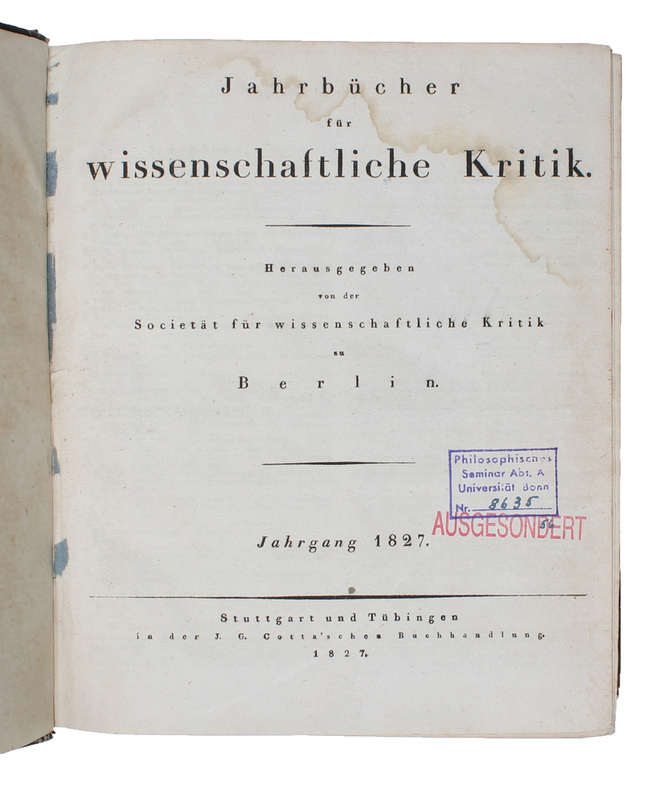
182757047Stuttgart und Tübingen, Cotta, 1827. 4to. In the original patterned paper boards, with contemporary handwritten paper-title to spine and old handwritten library paper-label to lower spine. Wear to extremities and lacking some paper at spine. Stamp to first title-page (general title-page for the wntire year) and stamp to verso of title-page for the front wrapper of the January-issue. A damp stain to the first two leaves, otherwise internally quite good. Bound with the general title-page for the entire year and with some of the original wrappers for the individual months (among these that of January). 1856 colomns (i.e 928 pp.).
182757047Stuttgart und Tübingen Cotta 1827. 4to. In the original patterned paper boards with contemporary handwritten paper-title to spine and old handwritten library paper-label to lower spine. Wear to extremities and lacking some paper at spine. Stamp to first title-page general title-page for the wntire year and stamp to verso of title-page for the front wrapper of the January-issue. A damp stain to the first two leaves otherwise internally quite good. Bound with the general title-page for the entire year and with some of the original wrappers for the individual months among these that of January. 1856 colomns i.e 928 pp. <br/><br/><em>The extremely rare first printing of all twelve issues constituting the entire first year of the seminal organ for the philosophical school that developed around Hegel namely the "Yearbooks for Scientific Critique" issued by Hegel himself constituting the starting-point of this greatly influential journal of the Hegelian right. This entire first year with its 12 issues contains a wealth of highly important contributions one being Hegel's own highly important review of Humboldt's lectures on the Bhagavad-Gita delivered in June 1825 and 1826 "On The Episode of the Mahabharata Known by the Name Bhagavad-Gita" in which Hegel puts this Indian work in his large context of world history. Hegel's review which appeared in two parts in the present publication for the first time Jan. nos. 7-8 pp. 51-63 Oct. nos. 181-88 pp. 1441-92 is now considered an extremely important document dealing with India. Humboldt's lectures had praised the Gita as the greatest most beautiful and presumably the only real philosophical poem of all known literatures; Hegel's review was meant as a critical assessment of the Hindu world-view in toto in a comparison with European Weltanschauung.In 1818 Hegel took over Fichte's chair at the University of Berlin. With his great lectures on the different fields of philosophy he soon became widely famous and an important school formed around him. This Hegelian school grew to be extremely influential from the 1820'ies and onwards. From 1827 "the Jahrbücher" founded by Hegel himself began appearing working as the official organ for this seminal school. </em> hardcover
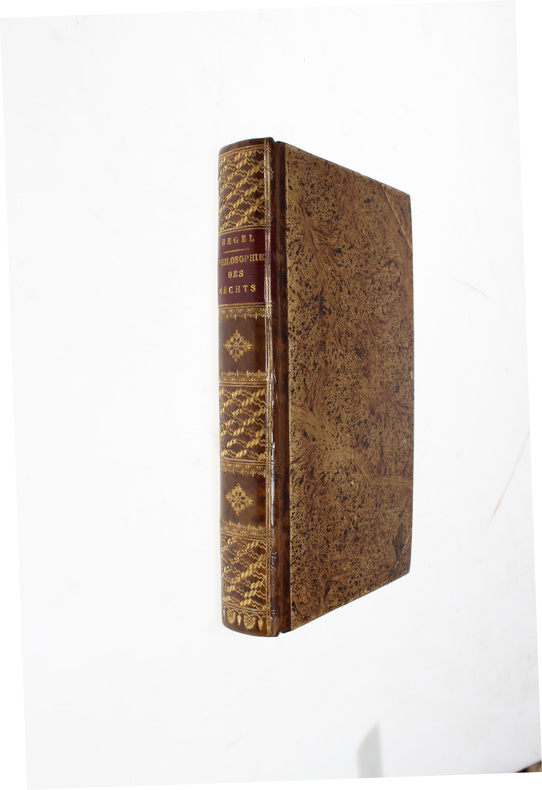
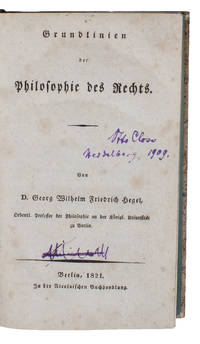
182150543Berlin, 1821. 8vo. A beautiful and excellently made pastiche binding in brown half calf with richly gilt spine and red gilt leather title-label. Previous owner's name to title-page (dated 1909) and a few light pencil-marginalia, otherwise internally very nice and clean with only occasional minor brownspotting. XXVI, 355, (1) pp. A very fine copy.
182150543Berlin 1821. 8vo. A beautiful and excellently made pastiche binding in brown half calf with richly gilt spine and red gilt leather title-label. Previous owner's name to title-page dated 1909 and a few light pencil-marginalia otherwise internally very nice and clean with only occasional minor brownspotting. XXVI 355 1 pp. A very fine copy. <br/><br/><em>The scarce first edition of Hegel's seminal "The Outline or later Elements of the Philosophy of Right" the last of Hegel's major works which represents the culmination of a life-long interest in politics and political phenomena. Hegel was perhaps more than any other German philosopher influenced by the French Revolution and this masterpiece of philosophy constitutes a grandiose attempt to make freedom the foundation of human society. "Taken apart from the rest of his system Hegel's political philosophy has been much misrepresented by totalitarian propagandists. He was however one of the most profound and influential thinkers of the nineteenth century. Theology philosophy political theory all have been radically influenced by his system; Strauss 300 Baur 322 Bradley Kierkegaard 314 Marx 326 359 Lenin 392 all came under his spell and his indirect influence has been limitless." PMM 283. </em> hardcover
1817163719Heidelberg: In August Oswald's Universitätsbuchhandlung 1817. The only form in which Hegel published his entire mature philosophical system First edition of the Encyclopedia of the Philosophical Sciences the only complete compendium of Hegel's philosophical system and a masterwork of absolute idealism. The Encyclopedia is the critical text for understanding Hegel's overarching conception of philosophy as a system. The tripartite treatise begins with a condensed version of the Science of Logic 1812-16 Hegel's comprehensive account of logical enquiry before applying its principles to the philosophy of nature and of spirit. In the Encyclopedia Hegel methodically derives each concept from its predecessor to provide a comprehensive logically rigorous account of the ideal structures underlying all reality. The work was written for Hegel's lectures as professor of philosophy at Heidelberg 1816-18. Following its publication he was offered the chair of philosophy at Berlin "the most prestigious position in the German philosophical world" Stanford Encyclopedia of Philosophy. Octavo 200 x 118 mm. Recent half calf spine with raised bands and black calf label earlier marbled paper sides edges sprinkled red. Short contemporary ink annotation to p. 14 not touching text loss to upper outer corner of initial blank minor foxing to contents: a very good copy. Croce I 3; Steinhauer 0341. hardcover
181734668Heidelberg, (Druck und Papier von Brede in Offenbach), 1817. 8vo. Nice cont. cardboardbdg. w. title-label to back. Corners and capitals professionally restored. Hinges w. a bit of paper-loss. Occational brownspotting. Front free end-paper w. vast cont. annotations by former owner Fr. Selasinski.
181734668Heidelberg Druck und Papier von Brede in Offenbach 1817. 8vo. Nice cont. cardboardbdg. w. title-label to back. Corners and capitals professionally restored. Hinges w. a bit of paper-loss. Occational brownspotting. Front free end-paper w. vast cont. annotations by former owner Fr. Selasinski. <br/><br/><em>The rare first edition of Hegel's immensely important work the "Encyclopaedia of the Philosophical Sciences" by himself and his contemporaries considered his main work and likewise an absolute main work of philosophy in general. Hegel is considered one of the four greatest philosophers of all times and his contributions to philosophy are incomparable to other than perhaps those of Aristotle Plato and Kant. In 1816 Hegel chose the professorship of philosophy at the University of Heidelberg and here he taught his courses with great enthusiasm. He lectured no less than 16 hours a week mostly over his own system which is the object of this chronologically speaking third main work generally just called the "Encyclopaedia".Hegel himself considered his "Encyclopedia" to be the most important of his works and his contemporaries likewise judged it his actual main work. Hegel was considered the epitome of the great systematic thinker of the 19th century and his "Encyclopaedia" forms the epitome of his work at the same time as it to his own mind constitutes his greatest achievement. Hegel's main aim was to systematically comprise all spiritual and natural knowledge and thus his philosophy peaks with his all-comprising Encyclopaedia which remained of the greatest importance to himself throughout his life-time. He kept working on the book and no less than three different altered editions appeared within his lifetime the last in 1830 the year before he died confirming his lasting devotion to this work.The book has belonged to one Friedrich Selasinski perhaps a midshipman from the aristocracy who has annotated the entire front free end-paper ab. 1830. </em> unknown
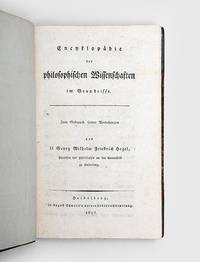
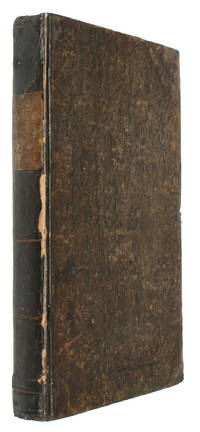
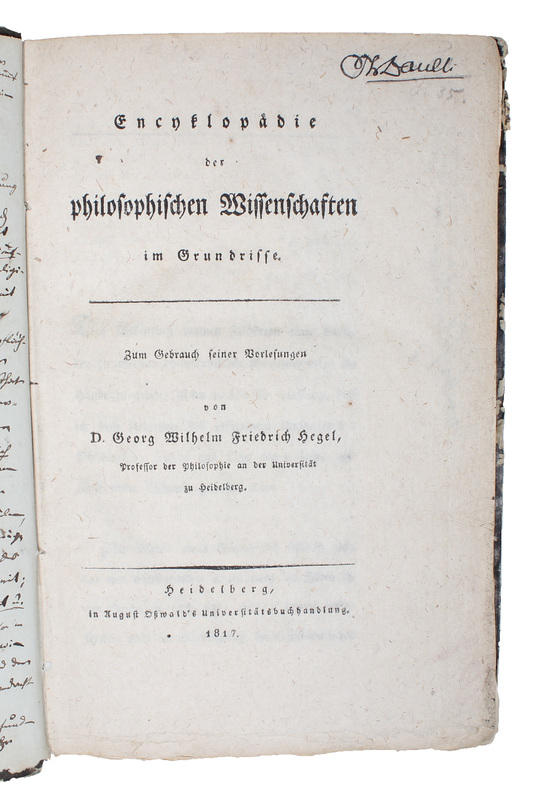
181746416Heidelberg, 1817. 8vo. COMPLETELY UNCUT in contemporary (original interim?) marbled paper-binding with handwritten paper title-label to spine. Boards rubbed and corners a bit worn. Internally unusually clean. Last ten leaves with a small marginal worm-tract, not affecting lettering. Extensive contemporary hand-written scholarly notes (seemingly in three different hands) to all end-papers, in all 6 closely-written pages, in French and German. Contemporary owner's name to title-page (Th. Daulli [?]). A fabulous copy, with very varying sizes of pages. XVI, 288 pp.
181746416Heidelberg 1817. 8vo. COMPLETELY UNCUT in contemporary original interim marbled paper-binding with handwritten paper title-label to spine. Boards rubbed and corners a bit worn. Internally unusually clean. Last ten leaves with a small marginal worm-tract not affecting lettering. Extensive contemporary hand-written scholarly notes seemingly in three different hands to all end-papers in all 6 closely-written pages in French and German. Contemporary owner's name to title-page Th. Daulli . A fabulous copy with very varying sizes of pages. XVI 288 pp. <br/><br/><em>The rare first edition extremely scarce in original uncut condition of Hegel's immensely important work the "Encyclopaedia of the Philosophical Sciences" by himself and his contemporaries considered his main work and likewise an absolute main work of philosophy in general. Hegel is considered one of the four greatest philosophers of all times and his contributions to philosophy are incomparable to other than perhaps those of Aristotle Plato and Kant. In 1816 Hegel chose the professorship of philosophy at the University of Heidelberg and here he taught his courses with great enthusiasm. He lectured no less than 16 hours a week mostly over his own system which is the object of this chronologically speaking third main work generally just called the "Encyclopaedia".Hegel himself considered his "Encyclopedia" to be the most important of his works and his contemporaries likewise judged it his actual main work. Hegel was considered the epitome of the great systematic thinker of the 19th century and his "Encyclopaedia" forms the epitome of his work at the same time as it to his own mind constitutes his greatest achievement. Hegel's main aim was to systematically comprise all spiritual and natural knowledge and thus his philosophy peaks with his all-comprising Encyclopaedia which remained of the greatest importance to himself throughout his life-time. He kept working on the book and no less than three different altered editions appeared within his lifetime the last in 1830 the year before he died confirming his lasting devotion to this work. </em> hardcover