HEGEL, Georg Wilhelm FriedrichBiblio.com
80 résultats
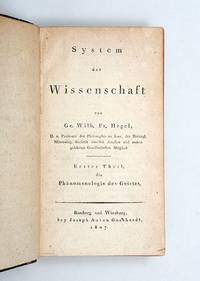
1807144735Bamberg and Würzburg: Joseph Anton Goebhardt 1807. The phenomenology of spirit First edition first issue of Hegel's best-known and first major work. Known in English as "The Phenomenology of Spirit" this was the only part published. He develops the idea of Geist realizing itself in the intellectual development of mankind. "It begins with a dialectical discussion of sense perception in which it is argued that knowledge of physical things presupposes the view that the physical world consists of forces interacting according to laws. Hegel maintained that knowledge of such a world is really a type of self-knowledge since in penetrating to the forces behind phenomena we become aware of what we ourselves have devised and put there. 'Behind the so-called curtain which is to hide the internal constitution of things there is nothing to be seen unless we ourselves go behind'. The physical world of scientific theory presupposes self-conscious beings. When he analyzed self-consciousness Hegel argued that it presupposes a plurality of living and desiring beings each of whom seeks to subdue the world to his own wishes to make it part of himself" Edwards. This copy in the first issue with leaf A1 the sub-title reading "Erster Theil. Wissenschaft der Erfahrung des Bewusstseyns". At Hegel's request this leaf was substituted with a cancel reading "I. Wissenschaft der Phänomenologie des Geistes." Octavo 202 x 114 mm. Complete with the final advertisement leaf. Contemporary interim marbled boards rebacked and corners consolidated red edges. Printed ex-libris of Karl Engel to front pastedown. Library stamp removed from title verso leaving a very small hole small wormtrack to lower outer corner of first 8 leaves occasional marginalia in pencil with one or two in ink ink notes to rear free endpaper; a good copy. Croce I 1. Edwards: Encyclopedia of Philosophy 1972. hardcover
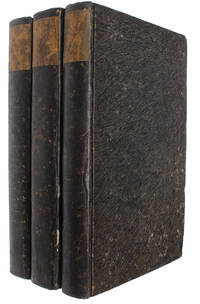
181248133Nürnberg Johann Leonhard Schrag 1812-1813-1816. 3 vols. 8vo. 3 contemporary uniform ! marbled paper bindings with hand-written paper title-labels to spines hand-writing not legible. Very minor excellently executed and barely noticeable professional restorations to a couple of hinges and corners. An excellent set also internally very nice clean and fresh wih only very minor occasional brownspotting. Old owner's inscription in the form of a poem and an old vague owner's stamp Giulini to front free end-paper of volume one. Same stamp to title-page and verso of title-page respectively of volumes 2 and 3. Old owner's name neatly removed from title-page of volume 3.XIV = title-page Vorrede Inhalt XXVIII = Einleitung 334; VI = title-page Inhalt 282; 2 = general title-page stating second volume of Wissenschaft der Logik X = title-page Vorbericht Inhalt 403 1 pp. <br/><br/><em>The scarce first editions of all three volumes that together constitute Hegel's second main work his "Science of Logic" also called his "Greater Logic" as opposed to the Logic section of the Encyclopaedia in which logic is seen as the science of pure thought concerning the principles by which concepts are formed and therefore also as that which reveals to us the principles of pure knowing. THIS IS THE RAREST OF ANY OF HEGEL'S MAJOR WORKS TO FIND COMPLETE - IT IS A TRUE SCARCITY TO FIND A SET IN UNIFORM CONTEMPORARY BINDINGS. Hegel's "Logic" is begun five years after his first major work the "Phänomenologie des Geistes" and the five years which Hegel has had to develop his philosophy in the meantime are clearly reflected in his monumental second masterpiece. The "Logic" can be regarded as a more systematic and well organized epistemological and ontological work. It is in this groundbreaking work of German Idealism that Hegel develops his famous dialectic which comes to determinate all later reading of his philosophy. It is Hegel's dialectic theory later condensed as "thesis-antithesis-synthesis" that is developed in this main work of 19th century philosophy. The dialectical process constitutes the movement of thought and consciousness from basic to complex ideas and thus demonstrates how the categorical infrastructure of thought can be laid bare by thought itself alone. With this work Hegel is considered as having created a revolution in the understanding of Logic because he widens it from being merely concerned with formal rules of propositions to including all of humanity. He elaborates the laws that govern the development of human practice and as a consequence he also uncovers the objective laws that govern the entire objective material world. Throughout the 20th century Hegel's logical philosophy was largely neglected but the last 40-50 years have shown a revived interest in this most fundamental of works which is of the greatest importance for the understanding of his systematic thought.Hegel himself considered his "Logic" to be of the utmost importance and he kept revising it throughout the years. It is very difficult to find a set of all three volumes in first editions. </em> unknown
181248133Nürnberg, Johann Leonhard Schrag, 1812-1813-1816. 3 vols. 8vo. 3 contemporary uniform (!) marbled paper bindings with hand-written paper title-labels to spines (hand-writing not legible). Very minor, excellently executed and barely noticeable professional restorations to a couple of hinges and corners. An excellent set, also internally very nice, clean, and fresh, wih only very minor occasional brownspotting. Old owner's inscription in the form of a poem and an old, vague owner's stamp (Giulini) to front free end-paper of volume one. Same stamp to title-page and verso of title-page respectively of volumes 2 and 3. Old owner's name neatly removed from title-page of volume 3.XIV (= title-page + Vorrede + Inhalt), XXVIII (= Einleitung), 334 VI (= title-page + Inhalt), 282" (2 = general title-page stating second volume of Wissenschaft der Logik), X (= title-page, Vorbericht + Inhalt), 403, (1) pp.
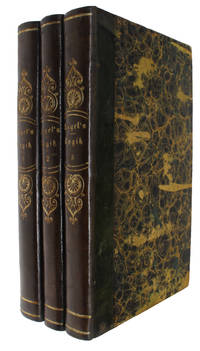
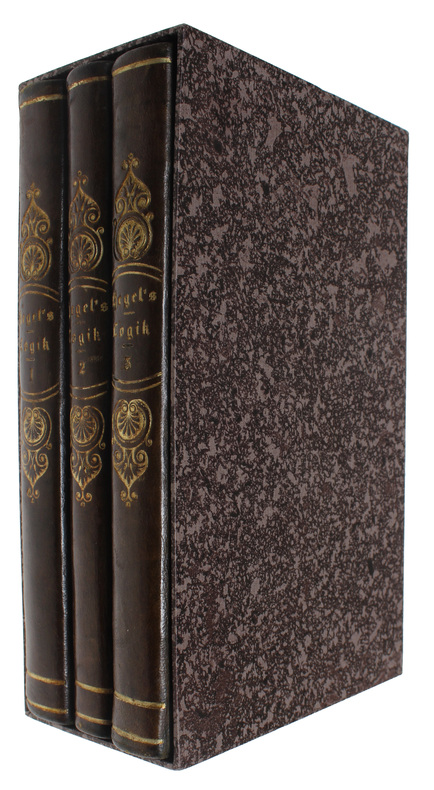
181255245Nürnberg Johann Leonhard Schrag 1812-1813-1816. 3 vols. 8vo. Bound in three lovely contemporary uniform ! green half calf bindings with gilt spines. Very minor excellently executed and barely noticeable professional restorations to small pieces of spines and boards. A magnificent set in lovely contemporary uniform bindings. Some brownspotting as usual. Housed in a custom-made marbled paper cassette. XIV = title-page Vorrede Inhalt XXVIII = Einleitung 334; VI = title-page Inhalt 282; 2 = general title-page stating second volume of Wissenschaft der Logik X = title-page Vorbericht Inhalt 403 1 pp. <br/><br/><em>The scarce first editions of all three volumes that together constitute Hegel's second main work his "Science of Logic" also called his "Greater Logic" as opposed to the Logic section of the Encyclopaedia in which logic is seen as the science of pure thought concerning the principles by which concepts are formed and therefore also as that which reveals to us the principles of pure knowing. THIS IS THE RAREST OF ANY OF HEGEL'S MAJOR WORKS TO FIND COMPLETE - IT IS A TRUE SCARCITY TO FIND A SET IN UNIFORM CONTEMPORARY BINDINGS. Hegel's "Logic" is begun five years after his first major work the "Phänomenologie des Geistes" and the five years which Hegel has had to develop his philosophy in the meantime are clearly reflected in his monumental second masterpiece. The "Logic" can be regarded as a more systematic and well organized epistemological and ontological work. It is in this groundbreaking work of German Idealism that Hegel develops his famous dialectic which comes to determinate all later reading of his philosophy. It is Hegel's dialectic theory later condensed as "thesis-antithesis-synthesis" that is developed in this main work of 19th century philosophy. The dialectical process constitutes the movement of thought and consciousness from basic to complex ideas and thus demonstrates how the categorical infrastructure of thought can be laid bare by thought itself alone. With this work Hegel is considered as having created a revolution in the understanding of Logic because he widens it from being merely concerned with formal rules of propositions to including all of humanity. He elaborates the laws that govern the development of human practice and as a consequence he also uncovers the objective laws that govern the entire objective material world. Throughout the 20th century Hegel's logical philosophy was largely neglected but the last 40-50 years have shown a revived interest in this most fundamental of works which is of the greatest importance for the understanding of his systematic thought.Hegel himself considered his "Logic" to be of the utmost importance and he kept revising it throughout the years. It is very difficult to find a set of all three volumes in first editions. </em> hardcover
181255245Nürnberg, Johann Leonhard Schrag, 1812-1813-1816. 3 vols. 8vo. Bound in three lovely contemporary uniform (!) green half calf bindings with gilt spines. Very minor, excellently executed and barely noticeable professional restorations to small pieces of spines and boards. A magnificent set in lovely contemporary, uniform bindings. Some brownspotting as usual. Housed in a custom-made marbled paper cassette. XIV (= title-page + Vorrede + Inhalt), XXVIII (= Einleitung), 334 VI (= title-page + Inhalt), 282" (2 = general title-page stating second volume of Wissenschaft der Logik), X (= title-page, Vorbericht + Inhalt), 403, (1) pp.