713 résultats
8944P., Alcan (Les Grands Philosophes), 1912, in 8° relié demi-percaline vert sapin, VIII-270 pages ; cachets.
2008800822008 Paris, CNRS, 2008, fort volume in 8° broché, 441 pages ; couvetrure illustrée.
1953139831953 Paris, Vigot, 1953, grand in 8° broché, 166 pages ; schémas et figures.
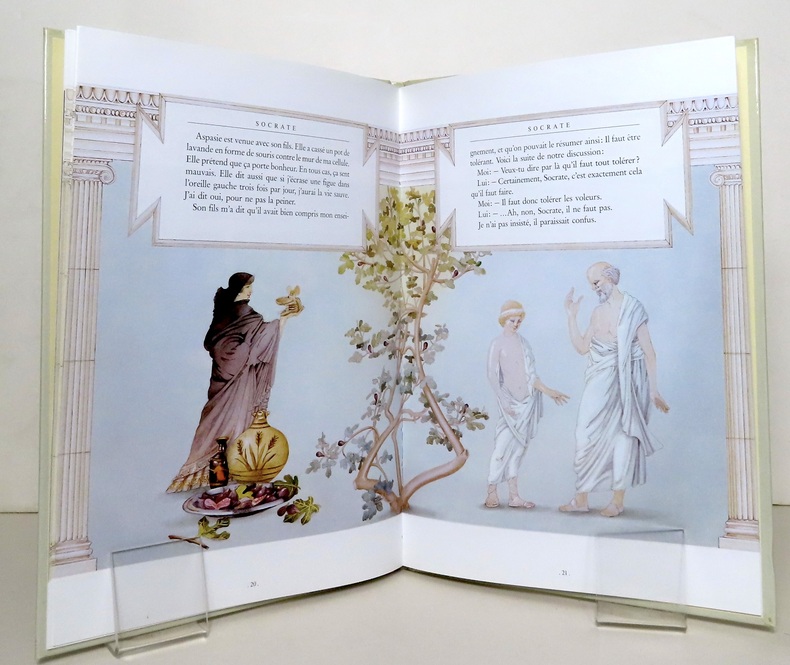
199219014Genève, La joie de lire, collection Connus, méconnus, 1992. Grand in-8, cartonnage couleurs. En belle condition.
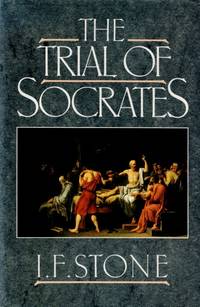
198832402AB1988. First Edition London Jonathan Cape 1988. Octavo. XI282 pages. Original Hardcover with original dustjacket in protective collector's mylar. Very good condition with only minor signs of wear. Name and date of preowner on endpaper. Newspaper-clipping with a Review of this book by Peter Levi loosely inserted / Newspaper-clipping of an article related to the book by Peter Jenkins also loosely inserted: "Socratic questions for today's society". Includes chapters like: Socrates and Athens / Socrates and Homer / The Good life: The Third Socratic Divergence / The Prejudices of Socrates / Xenophon Plato and the Three Earthquakes / How Socrates did his best to antagonize the Jury / How Socrates easily might have won Acquittal / The Four Words / Why did they wait until he was Seventy / etc. etc. Epilogue: Was there a witch-hunt in ancient Athens hardcover
GUIDA 2004 242 PP. FONDO DI MAGAZZINO: PERFETTO E INTONSO. Parole e frasi comuni alcun assoluto Auschwitz banalità del male Baum Carl Schmitt compito comunità concezione coscienza costituisce costruire Cracovia crisi Cristo dell'Olocausto dell'uomo dice diritto domanda ebraica ebraismo ebrei Eckardt Eichmann Elie Wiesel esiste esso etica f1glio fascismo fede filosofia funzione Germania Gerusalemme Gesù ghetto Giobbe guerra Gumplovicz Hannah Arendt headship Hegel Heidegger Hitler Ibid ideologica Ihid interpretazioni interrogativi Israele Judenrat Judenriite Kafka l'ebreo L'Olocausto l'uomo lager Lévinas liberalismo Lissa lotta male naturale mente Metz mistico mondo morte Movimenti giovanili nazista nemico notte nulla nuovo parlare parola passato Paul Celan pensare poema poesia politica anti - ebraica possibile potere problema processo proprio questione radicale Raul Hilberg razze realtà Reich religiosa responsabilità resurrezione Ruether ruolo sembra senso Shoah signif1cato silenzio situazione sociale sofferenza Sombart storia storico sviluppi tedesco Tel Aviv teodicea teologia cristiana termini Terzo Reich totalitario totalmente tradizione tratta trova umano vuol dire XX secolo
192612471Librairie Alphonse Lemerre 1926 300 pages in12. 1926. broché. 300 pages. Premières Méditations Poétiques est le premier recueil d'Alphonse de Lamartine publié en 1820. Composé de 24 poèmes écrits entre 1815 et 1820 il marque le début du romantisme en France et explore des thèmes comme l'amour la nature la mélancolie et la spiritualité souvent inspirés par la relation du poète avec Julie Charles
Volume degli anni '30 del '900 in stato discreto, coperta in cartoncino goffrato semimorbido, molto consumata con mancanza e pieghe, tagli, con barbe, e margini delle pagine un po' bruniti, pagine discretamente conservate, lievemente ambrate, punta superiore delle prime pagine usurata. Presenta firma d'appartenenza con data su guardia, Introduzione e traduzione di Giuseppe Bronzini. Numero pagine 188 USATO
A. LABRIOLA Socrate di Antonio Labriola. Bari, Laterza 1953 italian, 167 BTT107A Brossura editoriale, volume in discrete condizioni, 5° edizione, segni di usura causati dal fattore tempo sulla copertina, pagine ingiallite, legatura salda, pagine leggermente sfalzate 167pagine circa Copertina come da foto
Mm 115x185 Brossura editoriale di pp. 138, con scritti di Solmi, Anceschi, Perniola, Barbolini, Titli, Vattimo. SPEDIZIONE IN 24 ORE DALLA CONFERMA DELL'ORDINE.
aa.vv Socrate, la democrazia contro il libero pensiero. , corriere della sera 2019, Libro complessivamente in buono stato. Buono (Good) . <br> <br> <br> 156<br>
CAPPELLI 1981 113 PP. FONDO DI MAGAZZINO: LIEVI SEGNI DEL TEMPO ALLA COPERTINA, VOLUME INTONSO, MAI SFOGLIATO. "Il Simposio di San Silvestro" si presenta quale dialogo modellato sul Simposio platonico, offrendo significative diversità rispetto all'illustre originale. La più intrigante: Diotima partecipa in prima persona alla conversazione, pienamente riconosciuta dagli altri convitati nelle sue capacità intellettuali, designata quale "madrina di concetti". Ella assume con naturalezza il ruolo di guida nella discussione quale personaggio centrale del confronto speculativo: paziente mediatrice, dotata di ironia, abile nel condurre i ragionamenti, ma senza dimenticare le ragioni del cuore. Un'altra innovazione è rappresentata da due figure femminili, Hermia e Helena, accanto a Diotima: le tre donne sono amiche e affettuose, ma molto diverse di carattere, ironiche e sincere. Infine emerge il livello più propriamente helleriano di quest'opera, che tuttavia non è scisso dal primo: l'Autrice, affrontando il tema dei sentimenti e la teoria dei bisogni, si sofferma sulla responsabilità di essi e delle azioni che ne scaturiscono, e dedica molte pagine alla loro funzione sociale. Ne risulta un cammino di riscoperta e insieme di re-invenzione di interrogativi teoretici e pratici con l'apporto innovativo di "una voce di donna", riconosciuta ormai come Maestra, la cui abbondante produzione ci ha accompagnato lungo tutto il Novecento.
Questi bellissimi busti ritraggono Euripide, drammaturgo greco antico, e Socrate, filosofo greco antico. Socrate (Atene, 469 a.C. – Atene, 399 a.C.) è stato un uno dei più importanti esponenti della tradizione filosofica occidentale; Euripide (Salamina, 480 a.C. – Pella, 406 a.C.) fu un considerato, insieme ad Eschilo e Sofocle, uno dei maggiori poeti tragici greci. Inserita nell'opera "Il Museo Pio-Clementino descritto da Ennio Quirino Visconti Direttore del Museo Capitolino - Tomo sesto - Dedicato alla Santita di Nostro Signore PIO SESTO Pontefice Massimo. Edito da Luigi Mirri / Mercante di quadri incontro il Palazzo Bernini. In Roma MDCCXCII con Privilegio Pontificio. Opera dedicata ai Busti del Museo Pio-Clementino. Leggeri segni di foxing
19396288Paris, Paul Hartmann, 1939 ; in-12, broché ; 306 pp. , (4) pp. ; couverture beige imprimée rouge et noir.
1989100133936Yale University Press 1989 352 pages 15 6x23 3x1 1cm. 1989. Broché. 352 pages.
19951316704Jerusalem: The Hebrew University of Jerusalem 1995. Softcover. Octavo; G; Paperback; Spine black with white print; DJ has slight edgewear but is clean and bright; Cover has slight edgewear creasing to hinges slight shelfwear; Text block clean and tight; In Arabic and English; 207 English pages Arabic pages separately numbered. 1316704. FP New Rockville Stock. The Hebrew University of Jerusalem unknown books
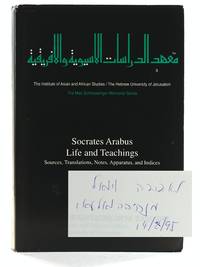
1995507596Magnes Press Hebrew University 1995. Paperback. NEAR FINE/Very Good. SIGNED and inscribed by the author in Hebrew on the title page to fellow scholar of Jewish and Islamic philosophy Joel Kraemer. Max Schloessinger Memorial Series: Texts 8. 207pp English; 207pp Arabic. Perfectbound in printed wraps with dust jacket. Very clean sharp copy; DJ with a bit or rubbing to the extremities. From the DJ flap: 'Socrates a universal cultural figure was adopted by Islamic culture in the Middle Ages. In Islamic writings he was cited in support of various arguments in religious debates. The characteristics attributed to him in Islamic culture are mainly in the realm of ethics. Nevertheless he was also a sort of proto-Muslim sage though only infrequently was he portrayed as a systematic rationalist philosopher. His wisdom was recorded in medieval Islamic literature in the form of sayings or description of behavior in a style very reminiscent of hadith. The Arab Socrates is thus different from other philosophers such as Plato and Aristotle who were seen as systematic philosophers probably due to their writings that were translated into Arabic. For these and other reasons the figure of Socrates struck a chord among Muslims of different strata: some saw him as a prophet or a sort of prophet some as an infidel others as an ethical figure and still others as a sage par excellence. Among the more important issues in the legacy of the Arab Socrates who was sometimes confused with Diogenes was his encounter with the king and his trial and death on the one hand and his views on God this world life and death speech and silence and wisdom and stupidity on the other. The book contains some 900 items of information culled from various philosophical historical literary and theological Arabic sources. The material is organized in two main sections biography and teachings and is accompanied by footnotes indices and a detailed critical apparatus. This book complements another study by the author Socrates in Mediaeval Arabic Literature published by Magnes and Brill in 1991.'. Magnes Press Hebrew University paperback
1978991441978 Théraplix - 1978 - In-8 broché - Tome I - 93 pages
Play based on Socrates and his trial and death in Athens.101p. Blue-Green blue cloth binding faded on spine and edges Faint foxing on end papers, but interior very neat and clean. Book
1957AUB-477Lausanne, La Guilde du Livre 1957. Edition originale. Bel exemplaire relié, couverture ornée et rempliée d'éd., gd in-8 numéroté, 305 pages avec annexes + 32 planches.
EDIZIONI ATHENA 1927 SEGNI DEL TEMPO, BUONE SE NON OTTIME CONDIZIONI GENERALI
Mm 140x210 Volume cartonato di pp. 300 con 54 tavole fuori testo. sovraccoperta editoriale. Opera in buonissime condizioni. SPEDIZIONE IN 24 ORE DALLA CONFERMA DELL'ORDINE
13758In 4 cartonné, dos toilé rouge, premier plat illustré en couleurs. 230x300mm. Titre, 38 pages, illustrations en bleu à pleine page et dans le texte, ainsi que 6 illustrations en couleurs à pleine page ; Fris décorative en encadrement. Alexandre et Diogène- La mort de Socrate- Pline le grand- Christophe Colomb- La révolution française de 1789- le couronnement de Napoléon. Imprimerie Fortier Nevers 1937 sans mention d’éditeur, de lieu, illustrations non signées. Bon exemplaire.