Charles FourierBiblio.com

353 résultats
0332715507.Ghardcover. Good. Access codes and supplements are not guaranteed with used items. May be an ex-library book. hardcover
0366242679.Gpaperback. Good. Access codes and supplements are not guaranteed with used items. May be an ex-library book. paperback
0366242822.Ghardcover. Good. Access codes and supplements are not guaranteed with used items. May be an ex-library book. hardcover
2013098375.Gpaperback. Good. Access codes and supplements are not guaranteed with used items. May be an ex-library book. paperback
2329014546.Gpaperback. Good. Access codes and supplements are not guaranteed with used items. May be an ex-library book. paperback
2013098383.Gpaperback. Good. Access codes and supplements are not guaranteed with used items. May be an ex-library book. paperback
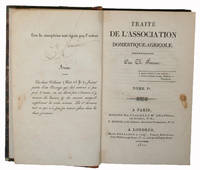
182248285Paris Bossange père; Londres Martin Bossange et Comp. 1822 & 1823. 8vo. Traité: Two lovely contemporary uniform half calf bindings with gilding and blindstamped ornamentations to spines. "E. C." in gilt lettering to top of spine on both volumes Sommaire: a bit later red half cloth with marbled paper over boards. Gilt title to spine. Traité: signed by the author on verso of half-title in vol. 1: "Ch Fourier". Title-page of vol. 1 with a small light brown stain probably candle-starin far from affecting lettering. Both volumes in lovely condition with only very light occassional brownspoting. LXXX 592 pp.; VIII 648 pp. Sommaire: Title-page slightly browned evenly. Otherwise very nice clean and fresh. 16 pp pp. 1329 -1448 4 ff. = A8 unnumbered - on two leaves first recto and second verso blank B8 C8 D8 E8.A lovely set. <br/><br/><em>Scarce first edition of Fourier's milestone work of political theory which is considered a founding work of Utopian Socialism and a main inspiration for Marx. The work which contains "the essence of Fourier's doctrine" David Owen Evans Social Romanticism in France 1830-1848 p. 129. is here presented together with the exceedingly rare complete supplement which was published the following year.It is in the "Traité." that Fourier presents the revolutionary ideas that Marx were to adopt and use in his "Kapital" namely the theory of poverty and exploitation and its relation to the means of production. These same ideas are those that made Marx speak of Fourier's "Gargantuan view of man".It is due to the "Traité de l'association" that Fourier is considered one of the founding fathers of Utopian Socialism being by far the most utopian of them; in his quest for a more equal society he became one of the very first to defend things such as same-sex sexuality and the rights of women - in fact it is Fourier that later coins the word "Feministe" while stating that the position of women in society was equal to that of slaves. Many of his publications preceded those of de Saint-Simon Owens and Marx but his ideas seemed to find greater influence when interpreted by others. Due to the lack of success of the "Traité" Fourier decided the following year to publish the "Sommaire" in an attempt to draw attention to his revolutionary ideas in the "Traité". The "Sommaire" constitutes a short more easily understood summary though also containing some additional new work. The "Sommaire" is often referred to as "The Appendix" to the "Traité" and is considered as belonging to that work. One of the central themes of the work is the thought of "harmony": "The word harmonisme - here fully explained and described for the first time - was first applied to the highest of the passions or motives of humankind; then as a synonym for Harmonie to the ultimate stage of social evolution. The fortunate inhabitants of the perfected world he called harmoniens a word coined in the present work. These words were duly translated by the Fourierites of other lands. Harmony the Harmonic state Harmonization or integral contrasted association were the terms used in the earliest English translations in 1841 to describe Fourier's proposed social system; and Harmonism was employed in the 1850's. The inhabitants were spoken of as Harmonians; and Fourier's philosophy as a whole was sometimes described as the Harmonian Doctrine. Even the word harmonious was called into service as a technical term one English disciple writing of a Harmonious Phalanx." Bestor The Evolution of the Socialist Vocabulary p. 264.Charles Fourier claimed to find inspiration in the exorbitant price of an apple in a Parisian restaurant and he convinced himself that he could design a more efficient way to produce and deliver goods. Unlike other socialists of his day Fourier believed that the pursuit of self interest served as an effective incentive to productive work. He simply did not believe that the market economy of his day successfully mobilized the pursuit of self interest for the common good and he was offended by the low productivity of labor. He argued that most people were employed in deadening jobs that failed to fully utilize their energies and that nearly two thirds of all workers were performing virtually useless tasks. A more efficient economic organization promised enormous benefits to all if only a benefactor capitalist would advance the money necessary to set up the first community or ''phalanstery''.Phalanxes structures called Phalanstères or "grand hotels" were four level apartment complexes where the richest had the uppermost apartments and the poorest occupied the ground floor residence. Wealth was determined by one's job jobs were assigned based on the interests and desires of the individual. There were incentives: jobs people might not enjoy doing would receive higher pay. Fourier considered trade which he associated with Jews to be the "source of all evil" and advocated that Jews be forced to perform farm work in the phalansteries. Furthermore he believed that there were twelve common passions which resulted in 810 types of character it is not clear why exactly this number so the ideal phalanx would have exactly 1620 people. One day there would be six million of these loosely ruled by a world "omniarch" or a World Congress of Phalanxes.Fourier and his contemporaries such as Owen and Saint-Simon were named utopian socialist because of their visions of imaginary ideal societies. Many saw them as not being grounded in the material conditions of society and as reactionary. Despite Fourier's lacking sense of practicality his ideas profoundly influenced all later socialist political and economic though; Not only was he immortalized by Marx "John Stuart Mill shared the same enthusiasm for Fourier as did the German Marx and Engels and the American George Ripley. Fourier's was "the most skillfully combined and with the greatest foresight of objections of all the forms of Socialism." Feuer The Influence of the American Communist Colonies on Engels and Marx P. 466. Fourier's views inspired in the mid 19. century the founding of the communities in Utopia Ohio La Reunion near present-day Dallas Texas and several other communities within the United States of America including the North American Phalanx in Red Bank New Jersey; Brook Farm in West Roxbury Massachusetts and the Community Place and Sodus Bay Phalanx in New York State.In the mid 20th Century Fourier's influence began to rise again among writers appraising socialist ideas outside the Marxist doctrines. After the Surrealists had broken with the French Communist Party André Breton turned to Fourier writing Ode à Charles Fourier in 1947."Traité de l'association domestique-agricole ":Kress C864 Goldsmiths 23694 Einaudi 1960 including both works. "Sommaire du traité":Kress C1060Goldsmiths 23997. </em> hardcover
0265716136.Gpaperback. Good. Access codes and supplements are not guaranteed with used items. May be an ex-library book. paperback
0260909483.Ghardcover. Good. Access codes and supplements are not guaranteed with used items. May be an ex-library book. hardcover
0266823343.Gpaperback. Good. Access codes and supplements are not guaranteed with used items. May be an ex-library book. paperback
1390031799.Gpaperback. Good. Access codes and supplements are not guaranteed with used items. May be an ex-library book. paperback
1390031926.Ghardcover. Good. Access codes and supplements are not guaranteed with used items. May be an ex-library book. hardcover
0366587552.Gpaperback. Good. Access codes and supplements are not guaranteed with used items. May be an ex-library book. paperback
0260847704.Ghardcover. Good. Access codes and supplements are not guaranteed with used items. May be an ex-library book. hardcover
0265438357.Ghardcover. Good. Access codes and supplements are not guaranteed with used items. May be an ex-library book. hardcover
1103435639.Gpaperback. Good. Access codes and supplements are not guaranteed with used items. May be an ex-library book. paperback
0282120548.Gpaperback. Good. Access codes and supplements are not guaranteed with used items. May be an ex-library book. paperback
1990D7684New York: Leonard Hutton 1990. Paperback. Very Good. Wraps; 4to; pp. 64 listing 77 of the artist's works many of them reproduced in b/w or full-color. Catalogue for an exhibition held April 27 to June 8 1990. Covers very faintly rubbed; top corner of front cover a little wrinkled. A nice internally clean copy. <br/><br/> Leonard Hutton paperback
71-6156New York: Leonard Hutton Galleries 1990. 4to. 64 pp. Soft Cover. Color and black and white plates throughout. Very Good minor edge wear.Provenance: From the Collection of the Art Historian Peter Selz. New York: Leonard Hutton Galleries, 1990. paperback
19702111902153201427Meiji tosho 1970. Soft Cover. Fine. Number of books: 1 Meiji tosho paperback
338440386X.Ghardcover. Good. Access codes and supplements are not guaranteed with used items. May be an ex-library book. hardcover
182444820Leipzig Johann Ambrosius Barth 1824. Without wrappers as issued in "Annalen der Physik und Chemie. Hrsg.von Poggendorff" Bd. 2 Jahrgang 1824 Zwölftes Stück. Pp. 345-448 entire issue offered. Fourier's paper: pp. 359-402. <br/><br/><em>First German edition in the same year as the French " Résumé théorique des Propriétés de la chaleur rayonnante" of this importent paper which gives an analytical account of surface-emissions and absorption based on the principle of equilibrium of temperature forecasting the more elaborated theories which he published in his famous work "La Therorie analytique de la chaleur. 1822". His analytical mathematical method that any continous function can be represented as a sum of sine and cosine curves is here applied to physical problems f.i. his treatment of the warming and cooling of the earth and terrestrial temperatures. The theory of terrestrial temperatures played a central role in Fourier's mathematical physics. </em> unknown
1980__3112746023De Gruyter 1980. Hardcover. New. reprint edition. 310 pages. German language. 6.14x0.81x9.21 inches. De Gruyter hardcover
49882137-nnew. unknown
49882137like new. unknown