"DESCARTES, RENATUS.Livre Rare Book

92 résultats
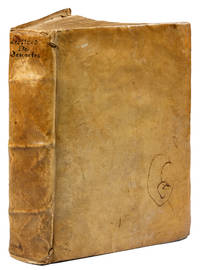
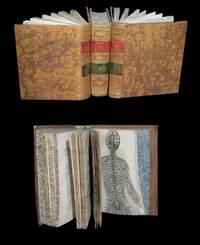
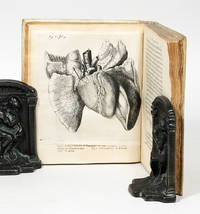
166252487Lugduni Batavorum (Leyden), Apud Petrum Leffen & Franciscum Moyardum, 1662. 4to. Contemporary full calf with gilt title-laebl to spine. (36), 121, (1) pp. + 10 plates. Complete with all 56 woodcut and engraved text-illustrations (many of which are full-page) and the 10 full-page engraved plates (several folded), one of which is the heart-plate with the 6 moveable parts, the Cardiac-flaps (of which only the smallest is missing). One folded plate cropped at fore-margin.
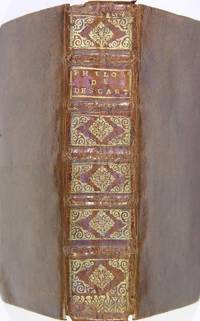
1672CLL-278Leyde et Amsterdam, 1672 In-4 d'un titre, (2) ff., 50 pp., veau fauve, plats ornés d'un décor doré à la Duseuil, dos à nerfs orné de caissons dorés, pièce de titre de maroquin aubergine, coupes et bordures décorées, tranches dorées (reliure vers 1880).
16642341508London: Excudebat J.F. James Flesher pro Jona Hart 1664. First Thus. Hard Cover. Near Fine/No Jacket. Rebound with new end sheets: brown leather spine marbled paper over boards red morocco spine label gilt titles and rules. Binding tight pages clean and unmarked. 1664 Hard Cover. viii 230 pp. Last text page misnumbered 216. Descartes's fundamental and originating work of the modern era in Western philosophy bound together with a work by one of the Utrecht Cartesians Lambert van Velthuysen. This is the first British printing of the Meditations though it does not include Descartes's 'Objections and Replies' as many editions do. Velthuysen was connected by marriage to Descartes's friend Henry Regnier and corresponded with scientists and philosophers such as von Leeuenhoek Spinoza and Leibniz. The work included here shows the influence of Thomas Hobbes - unsurprising given that Velthuysen is credited with translating Leviathan into Dutch. John Locke may have met Velthuysen while in Utrecht in 1684/85 and had eight titles by Velthuysen in his personal library including the Rheims edition of the present title. Bound into this volume are two plates not called for in either work which may be taken from the Hart printing of Principia Philosophia which was published the same year. Wolf 736 Wing D1133a. Excudebat J.F. [James Flesher] pro Jona Hart hardcover
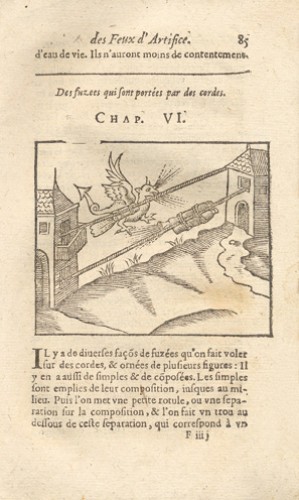
163811191Paris, Robert Boutonne, 1638 ; in-8 ; plein vélin ivoire de l'époque, titre manuscrit au dos ; (16), 280 pp. ; 106 (Seconde partie avec titre séparé), (9) pp. de table, (1 bl.) ; (1) f. blanc. SUIVI DE : Notes sur les récréations mathématiques ; En la fin de divers problèmes servant à l'intelligence des choses difficiles et obscures, par D.H.P.E.M. (Denis Henrion, Professeur en mathématiques). Paris, Robert Boutonne, 1638 ; 39 pp. ; en tout, plus de 80 bois gravés dans le texte, titre séparé.
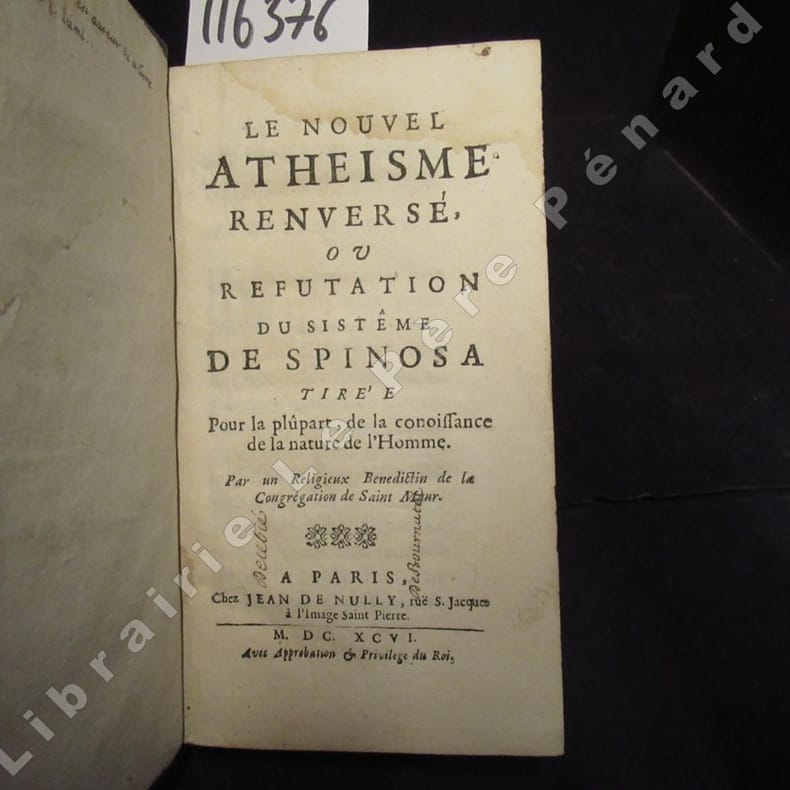
16961163761696 A Paris, chez Jean de Nully, rue S. Jacques à l'image de Saint Pierre - MDCXCVI (1696) - Avec Approbation & Privilege du Roi - In-12, pleine peau brune, 5 nerfs avec titres et caissons dorés au dos, tranches rouge - 540 pages
168816537Paris, Auboüin, Emery et Clousier (Imprimerie Antoine Lambin), 1688 ; in-12, veau jaspé, dos à nerfs décoré et doré, pièce de titre grenat, roulette sur les coupes, tranches rouges mouchetées (reliure d’époque) ; (20), 304 pp.
1664BOOKS109286IAmsterdam: Elizeum Weyerstraeten. Very good copy. 1664. 4th ed. leather. 8vo Includes the following separately paginated books: 1 Philosophiae sev Dissertatio de Methodo Recte regendae rationis & veritatis in scientiis investigandae: Dioptrice et Meteora Ex Gallico translata & ab Auctore perlecta variisque in locis emendata. Nunc denno hac Editione diligenter recognita & mendis expurgata 196 pp. 2 Dissertatio de Methodo recte utendi ratione Et veritatem in scientiis investigandi 216 pp. 3 Passiones Animae Gallice ab ipso conscriptae nunc autem in exterorum gratium Latina civitate donatae ab H.D.M. I.V.L. 18 pp. & 4 Passiones Sive Affectus Animae in three parts with indices 83 pp. indices. . Elizeum Weyerstraeten hardcover
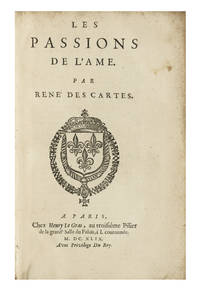
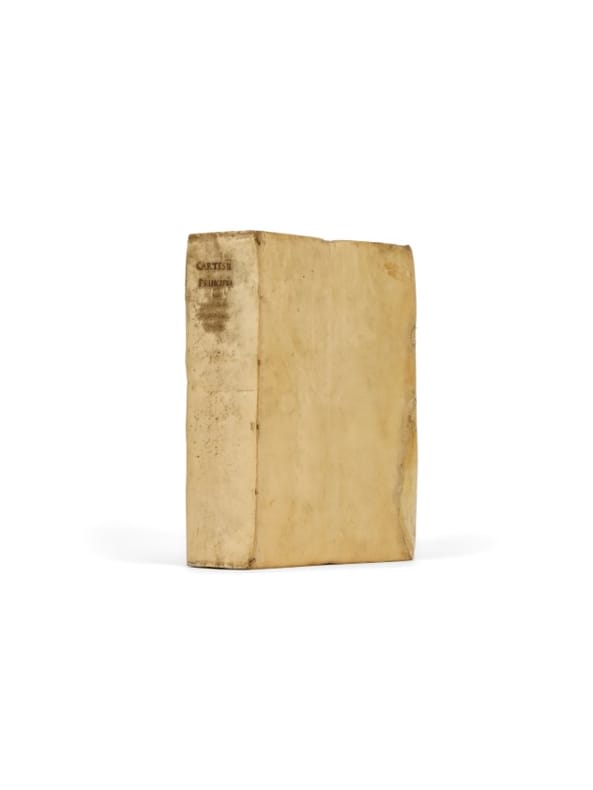
164975<p><b>First edition of Descartes' last philosophical text published one year before his death.</b></p><p>Tchemerzine II 791 ; Guibert 150 ; Brunet II 611 ; Willems 1083; E. Rahir <i>Bibliothèque de l'amateur</i> 396.</p><p>"<i>The 1649 edition is quite rare." </i>Willems</p><p>"<i>This edition was jointly published by L. Elzevier wit the Parisian bookseller Le Gras. Some copies bear the address of Louis Elzevier in Amsterdam with the Minerva fleuron. The two aspects of this edition are of Elzeverian printing.</i>" Tchemerzine</p><p>Published in November 1649 written directly in French like the <i>Discours de la méthode</i> <i>Les Passions de l'âme</i> is divided into three parts : <i>Des passions en général</i> <i>Du nombre & de l'ordre des passions </i>and <i>Des Passions particulières</i>.</p><p>The first part analyses the links between the soul and the body ; in the second part Descartes analyses the passions by studying them from the inside giving us a definition for each ; in the third part he examines the different passions. </p><p>This treaty on <i>Passions</i> was written in French for the attention of the Palatine princess Madame Elisabeth with whom Descartes shared an active correspondence. </p><p>Except for the part on the personal and temporary moral rules exposed in the Discours de la Méthode this is the only text where Descartes adventures himself on a moral terrain subject to as much criticism or condemnation or maybe even more than metaphysics.</p><p><b>An attractive copy very pure wide-margined preserved in its contemporary vellum.</b></p><p>Provenance : Libraries of <i>de la Morandière</i> <i>de la Prevostière</i> lawyer <i>Henri Le Court</i> and <i>Jean Siegler</i> with ex-libris.</p> (Amsterdam, L. Elzevier pour) Henry le Gras hardcover
165777<p><b>First edition Tchemerzine containing " <i>119 French and Latin letters mostly addressed to the queen of Sweden the Palatine princess Mersenne Chanut Le Roy Morin. They are sometimes associated with woodcuts. </i>" Guibert</b></p><p>Guibert pp.77-79 ; Tchemerzine II 785; Brunet II 611.</p><p>The publication of the letters of Descartes 1657-1667 had cooled the Jansenists' zeal towards him d'Arnauld's and de Nicole's in particular and certainly Pascal's also who accused him of wanting to forgo God in his metaphysics.</p><p><i>"Despite the attacks targeting him his reputation as an innovative philosopher had surpassed the small scholarly world and reached the world of the patron princes. The princess Elisabeth the Palatine princess exiled in The Hague who was an educated woman and interested in philosophy reached out to him and they maintained a steady correspondence which makes up the bulk of the Letters. The marquis of Newcastle and the queen Christine of Sweden did the same</i>." Dictionnaire des auteurs</p><p>For the most part these letters were written between 1637 and 1647.</p><p>From 1642 to 1649 the period of his life ranging from the <i>Méditations métaphysiques</i> to his death in Stockholm Descartes maintained a steady correspondence with the princess Elisabeth daughter of Frederick V Palatine elector and king of Bohemia. This cultivated woman who had studied mathematics had read the <i>Méditations métaphysiques</i> with much interest and great admiration. Descartes kept her up to date on his own writings recommended books and discussed physics philosophy and mathematics with her.</p><p>"<i>Clerselier had chosen the letters of this volume well : those interested in questions on morals physics and even medicine were satisfied ; the names of the queen Christine and the princess Elisabeth both still alive and also of this English gentleman M. More and this lord whose name he kept a secret attracted attention and gave the philosopher who had written to these illustrious individuals great prestige. The success of the book was inevitable and two years later when Clerselier published a second volume he acknowledged in the preface that the first one was already "completely sold"." </i><i>Œuvres de Descartes</i> Adam et Tannery</p><p>This correspondence is fascinating because Descartes explains himself and develops certain points exposed in his work ; it is also one of the only documents that we have that allow us to peer into the thinker's intimate thoughts.</p><p><b>A beautiful copy very pure preserved in its attractive contemporary vellum.</b></p><p>Handwritten ex-libris from 1685 on title page.</p> Charles Angot hardcover
164432320Cogito, ergo sum Amstelodami, Apud Ludovicum Elzevirium, 1644. 1 vol. (150 x 190 mm) de 12 f., 310 p. et 1 f. ; 8 f. et 331 p. Vélin blond, dos lisse, titre à l'encre, petits rabats (reliure hollandaise de l'époque).
16841180Amsterdam, Henry Deshorbes, 1684 ; in-12, [22] – 333 - [2] pp., reliure du Second Empire maroquin noisette, grand fleuron central doré au centre, fleurettes aux angles des plats, dos à nerfs orné de fleurons, dentelle intérieure dorée, tranches dorées sur marbrures (Belz-Niedrée).
1698228921698. A Rouen chez Jean Baptiste Besongne 1698. In/12 17 x 10 cm reliure plein veau moucheté du temps dos à nerfs à caissons dorés 20 f. p. titre et faux-titre préface et table de la première et seconde partie 599 pages avec 6 f. & 7 f. intercalés tables des troisième et quatrième partie un tableau hors-texte nombreuses illustrations in-texte. Défauts mineurs en coiffes et coins inférieurs ouvrage frais. unknown
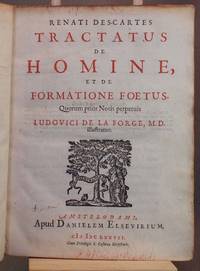
1647305091647. A Paris chez la Veuve de Jean Camusat et Pierre Le Petit 1647 - Amstelodami Amsterdam apud Danielem Elzevirium Daniel Elzevier / Elsevier 1664 - Amstelodami apud Danielem Elzevirium 1664 - Amstelodami apud Ludovicum & Danielem Elzevirios 1664 - Lugduni Batavorum Leyde / Leyden apud Franciscum Moyardum & Petrum Leffen 1662 - A Paris chez Michel Bobin et Nicolas Le Gras 1677. 3 vol. au format pt in-4 208 x 165 mm de 1 f. bl. 7 ff. n.fol. 606 pp. 1 f. n.fol. et 1 f. bl. ; 1 f. bl. 20 dont frontispice gravÂŽ ff. n.fol. et 222 pp. ; 1 f. bl. 8 ff. n.fol. et 248 pp. ; 12 ff. n.fol. 92 pp. et 2 ff. n.fol. ; 18 ff. n.fol. 121 pp. et 1 f. bl. ; 32 ff. n.fol. 511 pp. 4 ff. n.fol. et 1 f. bl. Reliures uniformes dÂŽbut XIXÂme de pleine basane racinÂŽe blonde plats jansÂŽnistes dos lisses ornÂŽs de jeu de filets gras et maigres dorÂŽs larges fleurons dorÂŽs entrelacs de petits filets dorÂŽ formant croisillons piÂces de titre de maroquin carmin piÂces de tomaison de maroquin vert-bronze titre dorÂŽ tomaison dorÂŽe palette dorÂŽe en queue filet dorÂŽ sur les coupes tranches mouchetÂŽes. PrÂŽcieux ensemble renfermant six oeuvres de Descartes en ÂŽditions XVIIÂme. Les MÂŽditations mÂŽtaphysiques sont ici proposÂŽes dans leur premiÂre ÂŽdition franÂaise ; en partie originale. ''PremiÂre traduction franÂaise des MÂŽditations faite par le Duc de Luynes. C'est Descartes qui a lui-mÂme corrigÂŽ et revu la traduction en franÂais de ses MÂŽditations en prÂŽcisant certains passages insuffisamment claires dans leur forme latine''. in Guibert. Edition originale pour De homine figuris ; dont la marque d'imprimeur en page de titre figure un ange avec une lyre sous des lauriers. ''Cette ÂŽdition originale latine a ÂŽtÂŽ faite sur une copie du manuscrit original franÂais. Elle renferme 58 figures sur bois et cuivre dont 10 hors-texte''. in Guibert. On trouve ˆ la suite la traduction franÂaise de L'Homme ; dont c'est lˆ la seconde ÂŽdition ; en partie originale. ''L'ouvrage contient de nombreuses figures anatomiques et gÂŽomÂŽtriques sur bois''. in Guibert. Quant aux Principia philosophiae Specimina philosophiae et Passiones animae ''on trouve ces oeuvres dans le recueil factice des Oeuvres philosophiques de Descartes 1670-72''. in Guibert. Guibert Bibliographie des Oeuvres de Descartes publiÂŽes au XVIIÂme siÂcle p. 45 ; p. 126 ; p. 107 ; p. 163 ; p. 196 ; p. 203. LÂŽgÂres altÂŽrations superficielles affectant les reliures. Titre de s MÂŽditations rognÂŽ court en marge infÂŽrieure. rares rousseurs dans les corps d'ouvrages. Petite cerne angulaire affectant une dizaine de feuillets. Restauration anciene au revers d'une des planches. Du reste ensemble en belle condition. b42961 unknown
165367749First Edition in English of Descartes Earliest Surviving Work DESCARTES RenÈ. Excellent Compendium of Musick: with Necessary and Judicious Animadversions Thereupon. By a Person of Honour. London: Printed by Thomas Harper for Humphrey Moseley 1653. First English edition. Small quarto 7 5/16 x 5 3/8 inches; 187 x 135 mm. 16 94 1 errata 1 blank pp. Two parts in one volume. With three engraved plates and with numerous woodcuts including head-and-tail pieces and initials. Title-pages with woodcut vignette. Much of the illustrations are of musical notes staffs and various charts relating to music theory. Also with a detailed and attractive engraving of a lute. The translator the "Person of Honour" refers to Lord Brouncker. His name has been printed neatly on the title-page in old ink by a previous owner. A separate title-page for Animadversions vpon the musick-compendium of Renat. Des-Cartes is included but the pagination and collation is continuous. Modern half calf over marbled boards. Morocco spine label lettered in gilt. Newer endpapers. Front pastedown with previous owner's bookplate. Some toning and spotting throughout the first two leaves being the worst. Tiny burn hole to top margin of two leaves in the "To the Reader" not affecting text. Written in 1618 when he was 22 the Compendium was not published until after his death. "Although it is his earliest surviving work the Compendium was not published until 1650 shortly after his death in Stockholm. The English translation was published in 1653 by William Brouncker 2nd Viscount Brouncker 1620ñ1684 a mathematician who became the first President of the Royal Society in 1662 and was a close friend of both Samuel Pepys and John Evelyn. He is named on the title page of the Compendium as a "Person of Honour" and his commentary the "animadversions" on Descartes work constitute his only publication. They include an unsuccessful mathematical attempt to divide the diapason into seventeen equal semitones. Descartesà study of the mathematical basis of music was also an examination of methodology: the application of empirical deductive and scientific approaches to the study of sensory perception. It is thus among the earliest attempts to define the dual relationship between the physical and psychological phenomena in music." Thomas Fisher Rare Book Library University of Toronto. ESTC R13570. HBS 67749. $3750 Printed by Thomas Harper, for Humphrey Moseley hardcover books
16622203Leydon: Peter Leffen & Francis Moyard 1662. First edition. contemporary vellum. Very Good. FIRST EDITION OF THE FIRST TEXTBOOK OF PHYSIOLOGY. "René Descartes's Treatise of man De homine 1662; Traité de l'homme 1664 was never intended to stand as a work on its own. It was one part of a much larger work Le monde The world. Although this was finished around 1633 Descartes did not publish it himself because he was alarmed by the Italian Inquisition's condemnation of Galileo Galilei that year. Some time after Descartes's death in 1650 his French manuscript copies of which had circulated among his friends and correspondents was edited and published. The first version was a Latin translation De homine by Florentius Schuyl in 1662 the second the now better known 'original' French version Traité de l'homme edited by Descartes's self-appointed literary executor Claude Clerselier in 1664. In the seventeenth century the 1662 Latin version was probably much more widely read than the French text" Donaldson J R Coll Physicians Edinb 2009; 39:375-6. Heirs of Hippocrates 295. Garrison-Morton 574. With 10 engraved plates; with 2 lift-up flaps on plate depicting the heart but without flap on plate of the brain as usual; numerous full-page and text engravings and woodcuts. Inscribed on title to Mart. Christian Sweerts "ex dono Autoris". The "author" in this case is most likely the translator Schuyl. De homine figuris et latinitate donatus a Florentio Schuyl. Leyden: Peter Leffen & Francis Moyard 1662. Small quarto contemporary vellum with leather spine label. Evidence of old label at base of spine. Remnants of old stamp on title occasional very light browning to margins. A beautiful copy. Peter Leffen & Francis Moyard unknown books
1668006874Amsterdam: Apud Danielem Elzevirium 1668 1682. First Edition. Full Vellum. Near Fine. 8vo. First volume: 19.5 by 15 cm. 8 383 pp. Second volume: 21 by 16 cm. 4 404 4 pp. Many diagrams and small drawings throughout. Vellum of first volume with a blindstamped centerpiece and other ruled/geometric decoration. Also raised bands. Second volume has smoother plainer vellum and simple spine with exposed cords by joints. Both volumes with handwritten/inked title on spine. Both volumes have some light soiling on vellum. Second volume with small red ink blotch upper front board. Both volumes' endpapers now loose exposing vellum flaps which also now lifted. <br /> Apud Danielem Elzevirium hardcover books
1649140941260Lugduni Batavorum Leiden: Ex Officina Ioannis Maire 1649. First Separate Edition. Good. First separate edition and first edition in Latin of Descartes' magnum opus. Bound in early 20th century quarter leather with spine lettered in gilt. Good. Binding rubbed at extremities with shallow loss to the crown. Front and rear inner hinge exposed though binding is holding; binding tender at pages 3-6 and 139-142. Evidence of small label removal from front pastedown markings and edge-tear to title page. English mathematician and astronomer Richard Towneley's 1629-1707 name to title page and his bookplate to verso of title page. Two contemporary ink notations. A work of monumental importance which influenced the thinking of Isaac Newton and Gottfried Wilhelm Leibniz it was the first to propose the idea of uniting algebra and geometry reducing geometry to a form of artimetic and algebra and transforming geometric shapes into algebraic equations. Originally published in French in 1637 as an appendix to Discours de la Methode; a separate French edition would not be published until 1664. Ex Officina Ioannis Maire unknown books
16642305722Amstelodami Amsterdam: Danielem Elzevirium / Elizeum Weyerstraeter 1664. Half-Leather. Good/No Jacket. Minor professional repairs to binding modern leather spine label added but otherwise left as we found it. Loss of leather from fore edge and corners boards rubbed bookplate of E.A. Landon and another ink nameWilliam W. Clarke Dec. 19th 1869 on front endpapers. 1664 Half-Leather. 30 196; 14 216; 20 83 5 pp. 4to. Full leather gilt titles rules and decorations. An early edition possibly the fourth of Descartes's philosophical works in Latin including: Principia Philosophiae; Specimen Philosophiae sev Dissertatio de Methodo; Dioptrica et Meteora; Passiones Animae. Herein Descartes discusses his theories of mind matter physics mechanics light thermodynamics and the first scientific theory of magnetism Copernican astronomy vs. the Bible the nature of human knowledge psychology and physiology. Descartes is considered the father of modern philosophy and best known for laying the foundation for rationalism. Illustrated with engravings throughout. "Rene Descartes 31 March 1596 [Danielem Elzevirium] / Elizeum Weyerstraeter hardcover books
1668D4760Paris: Chez Charles Angot 1668. Hardcover. Very Good. 4to 223 x 160mm. 303pp. xxiii of tables. Full contemporary calf; well rubbed; tear to top of spine. Over 100 fine woodcut diagrams throughout several full-page. Woodcut printers device to title; small tear to title at upper right margin slighty browned; slightly rubbed corners bumped. From the collection of J. Richard D.M. Ex Bibliotheca 18th-century armorial rubber stamp to title and p. 3 possibly French 1638-1739. Early Illustrated Edition of Descartes Discourse on the Method one of the most influential works in the history of modern philosophy and important to the evolution of natural sciences. This work features Descartes famous line I think therefore I am which he wrote in French Je pense donc je suis thereby reaching a wider audience in his country than that of scholars. The Discours was originally published in Leiden in 1637. Published also in Paris the same year as this edition is an edition by Bobel and De Gras. Descartes started his line of reasoning by doubting everything so as to assess the world from a fresh perspective clear of any preconceived notions. In the Discourse Descartes tackles the problem of skepticism which had previously been studied by Sextus Empiricus Al- Ghazali and Michel de Montaigne. The Discourse divided into six parts was intended as an introduction to three of his works Dioptrique Météores and Géométrie. His statements of the elementary laws of matter and movement in the physical universe the theory of vortices and many other speculations threw light on every branch of science from optics to biology; all this found its starting-point in the Discourse. La Géométrie contains Descartes first introduction of the Cartesian coordinate system. Together with his Meditations on First Philosophy Meditationes de Prima Philosophia Principles of Philosophy Principia philosophiae and Rules for the Direction of the Mind Regulae ad directionem ingenii the Discourse forms the base of the Epistemology known as Cartesianism. The Discours was Descartes first published work the much-talked about World or Cosmos having been suppressed or destroyed on his hearing of the condemnation of Galileo in 1632. In 1636 however when 40 years of age he felt that it was time to bring his views before the public and publish them abroad. Descartes endeavored to preserve the anonymity of his work with scrupulous care but in the end he found himself compelled to avow his authorship Osler 928. Descartes Discourse thoroughly a foundational work in the history of modern philosophy this augmented edition with many fine woodcuts remaining fresh and bright. <br/><br/> Chez Charles Angot hardcover books
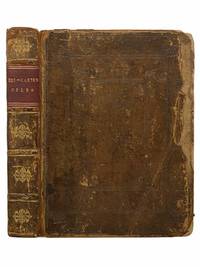
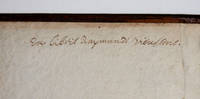
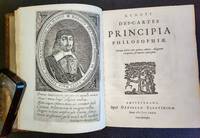
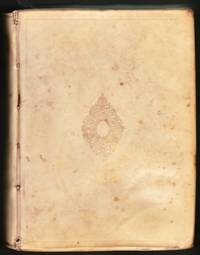
16684897Paris: Bobin & Le Gras 1668. Hardcover. Very Good. 4to - over 9¾ - 12" tall. 55 477 pp 2. With 22 full-page woodcuts 1 folding and 70 woodcut illustrations in text. Ink ownership inscription of Raymond Vieussens to front pastedown & shelf mark on front free endpaper. Bound in contemporary French calf spine in six compartments with gilt florets and title; some wear to boards but generally an excellent copy clean and fresh. Scarce edition of Descartes' magnum opus bearing the manuscript ex-libris of Raymond Vieussens 1635-1715 Royal Physician to Louis XIV and an important anatomist in his own right. Drawing directly on the dualistic theories of Descartes Vieussens became fascinated by the actions of the heart and of the brain in particular. "In his speculations on physiology Vieussens drew inspiration from both the mechanistic philosophy of Descartes and the iatrochemical ideas of F. de la Boë Sylvius. He believed that he had demonstrated the existence of the nervous fluid." DSB "Without Descartes the seventeenth-century mechanization of physiological conceptions would have been inconceivable" notes the DSB ".No other great philosopher except perhaps Aristotle can have spent so much time in expermintal observation. According to Baillet over several years he studied anatomy dissected and vivisected embryos of birds and cattle and went on to study chemistry. His correspondence from the Netherlands described dissections of dogs cats rabbits cod and mackerel; eyes livers and hearts obtained from an abattoir.". Descartes' magnum opus his Principia Philosophiae presented to the world the purest expression of his mechanist vision of the universe seized upon eagerly by later anatomists such as Thomas Willis Nicolas Steno and as is evident from the present copy Raymond Vieussens. Intended to replace the Aristotelian texts used in universities with a curriculum based on physical and immutable laws of nature Descartes' Principles especially in its French editions comes replete with numerous plates of his famous swirling vortices as well as discussions of the Copernican system. Curiously as C. F. Fowler has noted a direct reference to the Principia is lacking from the Index Librorum Prohibitorum of 1664 which otherwise banned most of Descartes' works - although a blanket clause is also given "and the philosophical works of same author". Evidently the decree of the Catholic Church disuaded neither French publishers from printing the work nor the Royal Physician from purchasing it! In particular Veussens seems to have been inspired by the Cartesian concept of cerebral localization; but while Descartes considered the pineal body to be the seat of animal spirits and the soul Veussens regarded the corpora striata as the seat of the imagination. "Inspired by both Descartes's mechanistic and the iatrochemical philosophies Vieussens studied the white matter of the brain by tracing the path of its fibers" Schlager & Lauer eventually providing us with an early description of the brain's centrum semiovale sometimes referred to as Vieussens' centrum. Following his well-received Neurographica Universalis 1685 the Royal Physician issued his Traité nouveau des Liqeurs de Corps Humain 1705 in which he describes the three Cartesian elements in detail and their functions within the body. Guilbert "Les Principes" 13; cf also Schlager & Lauer eds Science and Its Times 3 Gale 2001 p. 154; Fowler Descartes on the human soul: philosophy and the demands of Christian doctrine Kluwer 1999 pp 8-10. For the impact of Descartes' philosophy see PMM 129. Bobin & Le Gras hardcover books
16726345Amsterdam: Daniel Elzevir 1672. Fine/According to Guibert the general title page "Opera philosophica" with its table of contents listing four works was slapped onto blocks of the three works included here in anticipation of finishing the Meditations which in fact was not printed until six years later in 1678 Willems #1545. Some volumes were bound with the 1670 printing of the Meditations but when that ran out examples such as the one offered here continued to go to market until 1678 when the companion printing of Meditations finally appeared. Quarto 20 cm. Three parts in one volume of four--see below. Each part with separate title page. Principia philosophiae xxxvi 222; Specimina philosophiae xvi 248; Passiones animae xxiv 92 4; all preceded by general title with contents on verso and engraved portrait frontispiece. Numerous figures in text. Bound in contemporary speckled calf rebacked. Armorial bookplate. References: Willems 1469; Guibert p. 231. Daniel Elzevir unknown books
16856380Amsterdam: Blaeu 1685. Editio ultima. Good/Based on the Elzevir edition of 1678 "the last edition" The "Meditiations" which should complete the contents of Opera Philosophica was published in a separate volume. . Quarto 22 cm; Three works in one volume each with separate title page and pagination. 6; 36 222 2 blank; 16 248; 24 92 4 pages including engraved portrait frontispiece. Title pages with Blaeu's armillary device. Woodcut illustrations in text many of them full-page. Shoulder notes. Occasional reader's notes in margins contemporary hand and occasional underlining. In contemporary polished vellum over boards stamped in blind with arabesque cartouche on both boards. Hinges cords and linings exposed pastedowns never pasted down. Blaeu hardcover books
169539902Francofurti ad Moenum: Sumptibus Friderici Knochii 1695. 4to 21.3 cm 8.3". 8 420 4 42368 2 pp.; diagrs. <br><br>Important gathering of Cartesian mathematical thought opening with van Schooten's Latin introduction to and commentary on Descartes' La Géométrie followed by De aequationum natura constitutione & limitibus by de Beaune Elementa curvarum linearum by de Witt Tractatus de concinnandis demonstrationibus geometricis ex calculo algebraïco by van Schooten and the closing Notae et animadversiones tumultuariae in universum opus by Bartholin who edited the texts. Each work has a separate title-page and numerous equations and small in-text diagrams appearing throughout; the volume ends with a one page list of errata chiefly of errors in the mathematical notations.<br>Â Â Â Â The trio here was first published as the second volume of the two volume edition of the Latin translation of Descartes' Geométrie issued in Amsterdam by the Elzevirs 165961.<br>Â Â Â Â Provenance: From the residue of the stock of the F. Thomas Heller bookselling firm est. ca. 1928.<br>Â Â Â Â Searches of NUC and WorldCat locate only four U.S. libraries UChicago U.S. Naval Observatory UMinnesota Linda Hall reporting ownership. <br>Â Â Â Â <br>Â Â Â Â VD17 3:301520H. 19th-century half calf and marbled papercovered sides spine with gilt-stamped leather title and date label; mildly rubbed overall. Title-page with rectangular portion on either side of printer's device excised and repaired repair apparently done some time ago with excision just barely touching the ends of the motto banner. First few leaves browned; foxing and offsetting throughout. => A worthwhile exploration of mathematical thought as it stood toward the close of the 17th century and a good solid copy. Sumptibus Friderici Knochii hardcover books
16776332Amsterdam: Daniel Elzevir 1677. Good/The first illustrated Latin edition of this seminal textbook on physiology. Descartes prepared the manuscript in the early 1630s but shelved it when news of Galileo's conviction reached him in 1633. He revisited it in 1648 but was unable to finish the project of provide the necessary illustrations. Editors recovered the manuscript after Descartes died in 1650 and eventually assigned it to Louis de la Forge together with Gerard van Gutschoven for preparation. The "Traité de l'Homme" with extensive notes by La Forge was published in 1664. An expanded version with further development of the text by La Forge came out four years later. Claude Clerselier editor of Descartes' posthumous works translated the 1664 text into Latin and delivered it to Daniel Elzevir for publication. . Small quarto 21 cm; 76 239 pages. Title in red and black. Woodcut anatomical illustrations in text. Bound in polished panel calf ruled in blind and tooled at panel corners with diamond-shaped fern tool on both boards. Gilt tooling along board edges and on spine. Text edges stained red. Covers re-attached with strong Japanese paper. Boards somewhat splayed. References: Willems 1531; Osler 932; Garrison-Morton 5th ed. 574. Daniel Elzevir hardcover books
1664212511664 Paris, Nicolas Le Gras, 1664, in-4 de (70)-448-(8) pp., reliure strictement de l'époque de plein veau brun moucheté, dos à nerfs orné de caissons de fers dorés, encadrement de double-filets sur les plats, anciennes restaurations, rousseurs et quelques feuillets papier roussis dont les quatre premiers, sinon bon exemplaire.