2 377 résultats
1911F113456Bonn, Carl Georgi 1911 65pp., 22cm., text in German, Doctoral Dissertation (Inaugural-Dissertation zur Erlangung der Doktorwürde genehmigt von der Philosophischen Fakultät der Rheinischen Friedrich-Wilhelms-Universität zu Bonn), stamp at verso of title page, text is clean and bright, F113456
65pp., 22cm., text in German, Doctoral Dissertation (Inaugural-Dissertation zur Erlangung der Doktorwürde genehmigt von der Philosophischen Fakultät der Rheinischen Friedrich-Wilhelms-Universität zu Bonn), stamp at verso of title page, text is clean and bright, F113456
2004F108838Köln, 2004 140pp., 21cm., softcover, text in German, Doctoral dissertation (Inaugural-Dissertation zur Erlangung des Doktorgrades im Fachbereich Philosophie der Universität zu Köln), stamp at verso of title page, text is clean and bright, good condition, F108838
140pp., 21cm., softcover, text in German, Doctoral dissertation (Inaugural-Dissertation zur Erlangung des Doktorgrades im Fachbereich Philosophie der Universität zu Köln), stamp at verso of title page, text is clean and bright, good condition, F108838
A CURA E CON INTRODUZIONE DI FABRIZIO LOMONACO ANASTATICA DELL'EDIZIONE FELICE MOSCA DEL 1721 CON POSTILLE AUTOGRAFE MS. XII B 62 LIGUORI 2013 304 PP. FONDO DI MAGAZZINO: LIEVI SEGNI DEL TEMPO ALLA SOVRACCOPERTA, VOLUME INTONSO, MAI SFOGLIATO. Le nostre ristampe anastatiche dei codici del De Uno, del De Constantia e delle Notae (così come è stato per le Scienze Nuove) intendono richiamare, con rinnovata impostazione critica, l’attenzione degli studiosi su un complesso di pagine che segnano una “fase” centrale della riflessione e nella riflessione di Vico. Si tratta, con le ristampe del Diritto universale, di porre in evidenza la maturata e matura opzione di Vico per la conoscenza di un mondo unitario.
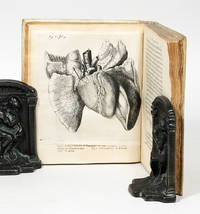
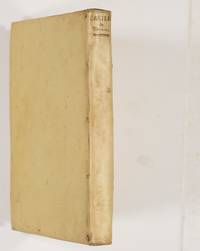
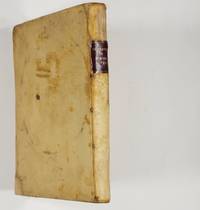
16622203Leydon: Peter Leffen & Francis Moyard 1662. First edition. contemporary vellum. Very Good. FIRST EDITION OF THE FIRST TEXTBOOK OF PHYSIOLOGY. "René Descartes's Treatise of man De homine 1662; Traité de l'homme 1664 was never intended to stand as a work on its own. It was one part of a much larger work Le monde The world. Although this was finished around 1633 Descartes did not publish it himself because he was alarmed by the Italian Inquisition's condemnation of Galileo Galilei that year. Some time after Descartes's death in 1650 his French manuscript copies of which had circulated among his friends and correspondents was edited and published. The first version was a Latin translation De homine by Florentius Schuyl in 1662 the second the now better known 'original' French version Traité de l'homme edited by Descartes's self-appointed literary executor Claude Clerselier in 1664. In the seventeenth century the 1662 Latin version was probably much more widely read than the French text" Donaldson J R Coll Physicians Edinb 2009; 39:375-6. Heirs of Hippocrates 295. Garrison-Morton 574. With 10 engraved plates; with 2 lift-up flaps on plate depicting the heart but without flap on plate of the brain as usual; numerous full-page and text engravings and woodcuts. Inscribed on title to Mart. Christian Sweerts "ex dono Autoris". The "author" in this case is most likely the translator Schuyl. De homine figuris et latinitate donatus a Florentio Schuyl. Leyden: Peter Leffen & Francis Moyard 1662. Small quarto contemporary vellum with leather spine label. Evidence of old label at base of spine. Remnants of old stamp on title occasional very light browning to margins. A beautiful copy. Peter Leffen & Francis Moyard unknown books
16622203Leydon: Peter Leffen & Francis Moyard 1662. First edition. contemporary vellum. Very Good. FIRST EDITION OF THE FIRST TEXTBOOK OF PHYSIOLOGY. "René Descartes's Treatise of man De homine 1662; Traité de l'homme 1664 was never intended to stand as a work on its own. It was one part of a much larger work Le monde The world. Although this was finished around 1633 Descartes did not publish it himself because he was alarmed by the Italian Inquisition's condemnation of Galileo Galilei that year. Some time after Descartes's death in 1650 his French manuscript copies of which had circulated among his friends and correspondents was edited and published. The first version was a Latin translation De homine by Florentius Schuyl in 1662 the second the now better known 'original' French version Traité de l'homme edited by Descartes's self-appointed literary executor Claude Clerselier in 1664. In the seventeenth century the 1662 Latin version was probably much more widely read than the French text" Donaldson J R Coll Physicians Edinb 2009; 39:375-6. Heirs of Hippocrates 295. Garrison-Morton 574. With 10 engraved plates; with 2 lift-up flaps on plate depicting the heart but without flap on plate of the brain as usual; numerous full-page and text engravings and woodcuts. Inscribed on title to Mart. Christian Sweerts "ex dono Autoris". The "author" in this case is most likely the translator Schuyl. De homine figuris et latinitate donatus a Florentio Schuyl. Leyden: Peter Leffen & Francis Moyard 1662. Small quarto contemporary vellum with leather spine label. Evidence of old label at base of spine. Remnants of old stamp on title occasional very light browning to margins. A beautiful copy. Peter Leffen & Francis Moyard unknown
1662176381662. Lugduni Batavorum: Apud Petrum Leffen & Franciscum Moyardum 1662 4° 36 121 pp. 123 111/112 repeated 1 p. Nota 56 woodcut and engraved text-illustrations 10 engraved plates contemporary vellum; complete fine copy. First Edition! Complete with all 56 woodcut and engraved text-illustrations many of which are full-page and the 10 full-page engraved plates several folded one of which is the heart-plate with the 6 moveable parts the Cardiac-flaps. This edition was posthumously published and translation by Florentius Schuy. A seminal work René Descartes 1596-1650 'Treatise on man' is known as the first European textbook of physiology and the first purely mechanistic account of bodily functions. "In the Treatise of man Descartes did not describe man but a kind of conceptual models of man namely creatures created by God which consist of two ingredients a body and a soul. "These men will be composed as we are of a soul and a body. First I must describe the body on its own; then the soul again on its own; and finally I must show how these two natures would have to be joined and united in order to constitute men who resemble us"." SEP. "This highly influential work was the first to present a coherent description of bodily responses in neurophysiological terms that are still to a wide extent accepted today. In his attempt to solve the central question around which almost all philosophical thought had revolved since the time of Aristotle what the relation between the soul and the body actually is Descartes came to create a milestone work of physiology which changed the entire trajectory of modern physiological conceptions. "Without Descartes the seventeenth-century mechanization of physiological conceptions would have been inconceivable." He believed that the relationship between the soul and the body was mediated by the brain and the nervous system and his seminal attempts to explain neural mechanisms drew a great deal on the engineering developments of his time. He developed a hydro-mechanical theory of how the soul controlled the contraction of muscle through the intermediary of the pineal and the cerebral ventricles and he produced an explanation of how it received through the nerves from the periphery signals that gave rise to sensation. Descartes' theories quickly spread throughout Europe and the work in which he had developed them his "De Homine" became extremely influential. "Descartes was one of the first to embrace Harvey's doctrine of the circulation and the book opens with an account of the cardiovascular system illustrated by a plate of the heart with movable flaps. From a mechanistic survey of general physiology Descartes moves to the nervous system which he treats in great detail. Particularly important is his discussion of the eye drawing on Kepler for the optical part and the physiology of perception. 'The impact of the Cartesian physiological program once it was publicly known was enormous. In two ways -philosophically and physiologically -Descartes transformed long-standing beliefs about animals and men. Philosophically of course his notions of mind-body dualism and animal automatism had extremely important implications that were not lost on Henry More Malebranche Spinoza and Leibniz along with many others in the seventeenth century . But physiologically too Descartes' conceptions had an impact that in many ways was even more impressive than the philosophical influence because it affected the actual course of contemporary science'. DSB. Descartes was prepared to publish this book in 1633 but decided to withhold it when he learned of Galileo's condemnation by the Church. As a result the first edition was not published until 1662. This first Latin translation De homine by Florentius Schuyl in 1662 was probably much more widely read than the two years later published French edition. Guibert Nr. 1. Edition Originale. Grolier Medicine 31; Garrison-Morton 574; Wellcome II p. 453; Krivatsy 3120; Norman 627 hardcover
1662679671662. Lugduni Batavorum: Apud Franciscum Moyardum & Petrum Leffen 1662 4° 36 121 pp. 123 111/112 repeated 1 p. Nota 56 woodcut and engraved text-illustrations 10 engraved plates contemporary vellum; complete fine copy. First Edition! Complete with all 56 woodcut and engraved text-illustrations many of which are full-page and the 10 full-page engraved plates several folded one of which is the heart-plate with the 2 moveable parts the Cardiac-flaps and one for flab for the brain Fig. 54. This edition was posthumously published and translation by Florentius Schuy. A seminal work René Descartes 1596-1650 'Treatise on man' is known as the first European textbook of physiology and the first purely mechanistic account of bodily functions. "In the Treatise of man Descartes did not describe man but a kind of conceptual models of man namely creatures created by God which consist of two ingredients a body and a soul. "These men will be composed as we are of a soul and a body. First I must describe the body on its own; then the soul again on its own; and finally I must show how these two natures would have to be joined and united in order to constitute men who resemble us"." SEP. "This highly influential work was the first to present a coherent description of bodily responses in neurophysiological terms that are still to a wide extent accepted today. In his attempt to solve the central question around which almost all philosophical thought had revolved since the time of Aristotle what the relation between the soul and the body actually is Descartes came to create a milestone work of physiology which changed the entire trajectory of modern physiological conceptions. "Without Descartes the seventeenth-century mechanization of physiological conceptions would have been inconceivable." He believed that the relationship between the soul and the body was mediated by the brain and the nervous system and his seminal attempts to explain neural mechanisms drew a great deal on the engineering developments of his time. He developed a hydro-mechanical theory of how the soul controlled the contraction of muscle through the intermediary of the pineal and the cerebral ventricles and he produced an explanation of how it received through the nerves from the periphery signals that gave rise to sensation. Descartes' theories quickly spread throughout Europe and the work in which he had developed them his "De Homine" became extremely influential. "Descartes was one of the first to embrace Harvey's doctrine of the circulation and the book opens with an account of the cardiovascular system illustrated by a plate of the heart with movable flaps. From a mechanistic survey of general physiology Descartes moves to the nervous system which he treats in great detail. Particularly important is his discussion of the eye drawing on Kepler for the optical part and the physiology of perception. 'The impact of the Cartesian physiological program once it was publicly known was enormous. In two ways -philosophically and physiologically -Descartes transformed long-standing beliefs about animals and men. Philosophically of course his notions of mind-body dualism and animal automatism had extremely important implications that were not lost on Henry More Malebranche Spinoza and Leibniz along with many others in the seventeenth century . But physiologically too Descartes' conceptions had an impact that in many ways was even more impressive than the philosophical influence because it affected the actual course of contemporary science'. DSB. Descartes was prepared to publish this book in 1633 but decided to withhold it when he learned of Galileo's condemnation by the Church. As a result the first edition was not published until 1662. This first Latin translation De homine by Florentius Schuyl in 1662 was probably much more widely read than the two years later published French edition. Guibert mentions two states of the the title-page: the first with the imprint "Apud Leffen & Franciscum Moyardum and a woodcut printer's device of a phoenix rising from the flames motto "ex morte immortalia"; and the second with the names of the publishers reversed and a device showing an angel under a laurel tree "motto insigne maxime laurus". He does not establish any priority of issue. Guibert Nr. 2. Edition Originale. Grolier Medicine 31; Garrison-Morton 574; Wellcome II p. 453; Krivatsy 3120; Norman 627 hardcover
166252487Lugduni Batavorum Leyden Apud Petrum Leffen & Franciscum Moyardum 1662. 4to. Contemporary full calf with gilt title-laebl to spine. 36 121 1 pp. 10 plates. Complete with all 56 woodcut and engraved text-illustrations many of which are full-page and the 10 full-page engraved plates several folded one of which is the heart-plate with the 6 moveable parts the Cardiac-flaps of which only the smallest is missing. One folded plate cropped at fore-margin. <br/><br/><em>First edition of Descartes' seminal treatise on man the first European textbook of physiology constituting an epochal work of modern thought defining the mechanism of man as it does. "In the Treatise of man Descartes did not describe man but a kind of conceptual models of man namely creatures created by God which consist of two ingredients a body and a soul. "These men will be composed as we are of a soul and a body. First I must describe the body on its own; then the soul again on its own; and finally I must show how these two natures would have to be joined and united in order to constitute men who resemble us"." SEP. This highly influential work was the first to present a coherent description of bodily responses in neurophysiological terms that are still to a wide extent accepted today. In his attempt to solve the central question around which almost all philosophical thought had revolved since the time of Aristotle what the relation between the soul and the body actually is Descartes came to create a milestone work of physiology which changed the entire trajectory of modern physiological conceptions. "Without Descartes the seventeenth-century mechanization of physiological conceptions would have been inconceivable." DSB. He believed that the relationship between the soul and the body was mediated by the brain and the nervous system and his seminal attempts to explain neural mechanisms drew a great deal on the engineering developments of his time eg. the hydraulic automata that had been installed at the Versailles. He developed a hydro-mechanical theory of how the soul controlled the contraction of muscle through the intermediary of the pineal and the cerebral ventricles and he produced an explanation of how it received through the nerves from the periphery signals that gave rise to sensation. Descartes' theories quickly spread throughout Europe and the work in which he had developed them his "De Homine" became extremely influential. This posthumously published work was actually written in the 1630's but after the condemnation of Galilei in 1633 Descartes did not dare publish it; "although it thus had to await posthumous publication in the 1660's his writing of the Traité de l'homme proved extremely important in the further maturation of Descartes's physiological conceptions." D.S.B. p.62. "Some time after Descartes's death in 1650 his French manuscript copies of which had circulated among his friends and correspondents was edited and published. The first version was a Latin translation De homine by Florentius Schuyl in 1662 the second the now better known 'original' French version Traité de l'homme edited by Descartes's self-appointed literary executor Claude Clerselier in 1664. In the seventeenth century the 1662 Latin version was probably much more widely read than the French text. There were problems for the editors of both versions. Firstly there were differences between the manuscripts: Clerselier in Paris claimed that his version was Descartes's own that the others were 'corrupt' and that Schuyl had been 'misled' by them. However a more important difficulty was raised because it was clear that the text was intended to be illustrated - Descartes refers to figures and to features within these labelled by letters. But no set of figures accompanied the manuscripts. Both editors have left quite detailed accounts in their long prefaces - little treatises in themselves. Here I consider only Schuyl the editor of the Latin De homine. Schuyl 1619-69 was a professor of philosophy in the town of 's-Hertogenbosch in the Netherlands the country in which Descartes was living during the writing of Le monde. Two of the author's friends had copies of the manuscript that they supplied to Schuyl and with one of these were included two sketches of illustrations apparently in Descartes's own hand. These Schuyl included. One of them represents the medial and lateral rectus muscles in the orbit which deflect the eye nasally and temporally. The other figures Schuyl had to have made and since he mentions no one else one supposes that he designed them himself." IML Donaldson J R Coll Physicians Edinb 2009; 39:375-6.Wellcome II:453; Osler 931; Garrison and Morton 574. Waller only has a later edition. </em> unknown
1664002480Ex Officina Hackiana 1664 Title: De Homine Figuris et La Tinitate Donatus a Florentio Schuyl Inclytæ Urbis Sylvæ-Ducis Senatore & ibidem Philosophiæ Professore. Author: Renatus Des Cartes Publisher: Ex Officina Hackiana Place: Lugduni Batavorum Leiden Publication date: 1664 Description: 1664. Second edition only two years after the first appeared in the same city contemporary with the final definitive edition. Latin text. 38 121 Pp. 10 plates 2 folded and 1 with 2 movable overlays showing the interior regions of the heart. Profusely adorned with numerous splendid anatomical illustrations engraved in copper and wood many in half or full page. Woodcut title-page device; head and tailpieces. Small 4to. Full contemporary red morocco with gilt stamped title and design over spine and boards red marble endpapers. Provenance: Ex-Libris label of M. Gonzalez-Ulloa of Mexico book plate. Notes: As is known Descartes labored on the work since 1630 but decided not to publish it privy to knowledge of Galileos conviction in 1633. In acknowledgement of Harveys important discovery Descartes did not believe that blood circulation was caused by heartbeats but considered the human body as a machine directed by a rational principle located in the pineal gland. Considered the first attempt to embrace all animal physiology the De Homine . is actually a kind of physiological supplement to the Discours de la Methode published in 1637 a source of inspiration for many scholars. This book was the first attempt to cover the whole field of animal physiological appendix to his Discourse on method. Garrison-Morton. Work of fundamental importance among the most eminent products of human ingenuity. Good example Garrison-Morton 574. Wellcome Catalogue. II 453. Measures: 8.25 H x 6.5 D x 1 W inches. 2nd Edition. Hardcover. Very Good/No Jacket. Ex Officina Hackiana hardcover
166252487Lugduni Batavorum (Leyden), Apud Petrum Leffen & Franciscum Moyardum, 1662. 4to. Contemporary full calf with gilt title-laebl to spine. (36), 121, (1) pp. + 10 plates. Complete with all 56 woodcut and engraved text-illustrations (many of which are full-page) and the 10 full-page engraved plates (several folded), one of which is the heart-plate with the 6 moveable parts, the Cardiac-flaps (of which only the smallest is missing). One folded plate cropped at fore-margin.
In-4to piccolo, (36), 121, (1) pp., 10 tavole. Completo delle 56 silografie nel testo (molte delle quali a piena pagina) e delle 10 tavole incise in rame fuori testo, una delle quali (cuore) con volvelle. Vitello coevo, dorso ben restaurato.
166276611Lugduni Batavorum [Leyde], Apud Franciscum Moyardum & Petrum Leffen, 1662, in-4, [36], 121 (i.e.123), [1] pp, 10 pl. [Signatures : a-d4 ; e2 ; A-P4 ; Q2], Basane granité havane, dos à nerfs orné, tranches jaspées de rouge. Reliure de l?époque, Édition originale, parue posthume, de cet ouvrage dans lequel Descartes expose sa célèbre théorie de « l'animal machine », ainsi qu'une théorie mécanique du mouvement involontaire, parfois considérée comme le germe de la conception du réflexe conditionné. Il reconnaît ici l'importance de la découverte de Harvey mais ne croit pas que la circulation du sang ait pour cause les pulsations cardiaques. Descartes en avait achevé la rédaction, en français, en 1633. La même année, Galilée était condamné pour la publication de son Dialogue sur les deux grands systèmes du monde ; le philosophe français, craignant que sa vision matérialiste-mécaniste ne soit également considérée comme hérétique, se ravisa et ne fit pas publier ce traité de son vivant. L'ouvrage parait finalement en 1662 à Leyde, traduit du français par Florent Schuyl (1619-1669) à partir d'une copie manuscrite considérée comme insuffisante. L'édition fait l'objet, la même année, de deux tirages simultanés, issus l'un de l'imprimerie de Peter Leffen, l'autre de celle Francis Moyard : notre exemplaire fait partie de ceux imprimés par Moyard, reconnaissables au fait que le nom de ce dernier apparait avant celui de son confrère, et surtout à sa marque typographique représentant Apollon jouant de la lyre sous le laurier. Le livre est orné de nombreuses gravures sur bois et sur cuivre dans le texte, ainsi que de dix très belles planches en taille-douce, certaines dépliantes ; l'une d'entre elles, représentant le coeur, comporte six parties mobiles montrant l'intérieur de l'organe. La partie mobile sur la planche du cerveau manque comme toujours. Bel exemplaire. Reliure restaurée avec soin. Guibert, p. 197. Norman 627. Tchemerzine, II, 798. Osler 931. Couverture rigide
1676109521676 un volume, reliure plein veau brun raciné (binding full calfskin) in-douze (duodecimo), dos à nerfs (spine with raised bands) décoré or (gilt decoration) filets or (gilt line) et filets à froid (blind-stamping line decoration) - entre-nerfs - compartiments or à fleuron fleurette (floweret) - titre frappé or (gilt title) - pièce de titre sur fond marron foncé (label of title) avec filet or (label of title with gilt line), roulettes sur les coupes (fillets on the cuts) manque de dorure (blurred gilding) - tranches jaspées (marbled edges), rouges (reds edges), gouttière rognée (fore-edge smooth) , sans illustration (no illustration) excepté une petite vignette en bas de la page de titre (engraved title page) + fronts-de-chapitre bandeaux (headpiece) + lettrines (dropped initial) + culs-de-lampe (tailpiece), (11) feuillets + 359 pages avec Approbation & Privilège du Roi Roy, 1676 Lyon Anisson et Posuel Editeurs,
in-16 (poche), 345 pp., broche, couverture illustree. Petit accroc au 1er plat de couverture (manque 0,5 cm) sinon très bel exemplaire. [PP-1]
1661367501661 In-4, plein veau brun de l'époque, dos à 5 nerfs orné de compartiments entièrement garnis d'une résille dorée aux petits fers, roulette dorée en tête et pied, tranches rouges, (1) f., (42), 637, (1) p., bandeaux et culs de lampes gravés et historiés. Paris, Imprimerie Royale, 1661.
In-4, plein veau brun de l'époque, dos à 5 nerfs orné de compartiments entièrement garnis d'une résille dorée aux petits fers, roulette dorée en tête et pied, tranches rouges, (1) f., (42), 637, (1) p., bandeaux et culs de lampes gravés et historiés. Edition originale de cet essai dédié à Louis XIV et publié à l'imprimerie royale l'année même de la mort de Mazarin dont l'auteur avait été le secrétaire et le protégé depuis 1642. Philosophe proche de Descartes, Jean de Silhon (1596-1667) devint secrétaire de Richelieu, conseiller d'État, secrétaire de Mazarin et l'un des premiers fondateurs et membre de l'Académie française (1634). Il est l'un des principaux théoriciens et idéologues du pouvoir absolu de la période. "Le propos se divise en deux moments: la réfutation de la philosophie de Montaigne - figure emblématique du scepticisme aux yeux de Silhon - et de sa thèse sur la nature trompeuse des sens (…). Point remarquable: on trouvera au livre I de l'ouvrage la formulation d'un curieux cogito (…) qui précède de trois ans le Discours de la méthode, il est peut-être le fruit de discussions avec Descartes (…). Les livres III et IV, coeur de l'ouvrage, sont consacrés à la justification du principe fondamental de l'obéissance au Prince qu'illustrent des exemples empruntés aux épisodes de la Ligue et des Guerres de religion" (cf. Christian Nadeau, éd. Fayard). Si le titre annonce une suite qui ne parut jamais, 'De la Certitude des connoissances humaines' fut plus tard réimprimé par l'auteur à la suite de son 'Ministre d'Etat'. (Brunet, V, 381. Sources de l'Histoire de France, n°6120). Mors fendus, plats épidermés, coiffes et coins usés. Intérieur frais. Exemplaire grand de marges.
2008F66697Groningen, Historische Uitgeverij 2008 232pp., 23cm., in de reeks "Filosofie & retorica", gecart.band (linnen rug), zeer mooie staat, [Nederlandse vertaling]
232pp., 23cm., in de reeks "Filosofie & retorica", gecart.band (linnen rug), zeer mooie staat, [Nederlandse vertaling]
1898F112966Divione [Dijon], Barbier-Marilier 1898 75pp., 23cm., text in Latin, Doctoral Dissertation (University of Paris), original softcover, stamp at verso of title page, text is clean and bright, F112966
75pp., 23cm., text in Latin, Doctoral Dissertation (University of Paris), original softcover, stamp at verso of title page, text is clean and bright, F112966
A CURA DI FABRIZIO LOMONACO, PRESENTAZIONE DI FULVIO TESSITORE, LIGUORI 2007 268 pp. FONDO DI MAGAZZINO: LIEVI SEGNI DEL TEMPO ALLA SOVRACCOPERTA, VOLUME INTONSO, MAI SFOGLIATO, PERFETTO L'iniziativa si inscrive nel progetto di edizione critica delle Opere di Vico, promosso dalla Fondazione "P. Piovani per gli Studi Vichiani" con le anastatiche della Scienza Nuova 1730 (esemplare postillato XIII H 59) e delle "Origines" del Gravina (2004). In particolare, la scelta dell'anastatica ha inteso rispondere alla necessità - sollecitata dagli studi vichiani di Pietro Piovani della fine degli anni Sessanta del Novecento - di avviare un inventario di tutta l'opera vichiana (a stampa e in manoscritto).
1937171470Berlin, Verlag für Staatswissenschaften u. Geschichte, 1937. 202 S., 1 Bl. Hlwd. M. Rsign. Vors. m. kl. Fleck. St. u. Sign. verso Tit.
3787340777.Ghardcover. Good. Access codes and supplements are not guaranteed with used items. May be an ex-library book. hardcover