DESCARTES, ReneBiblio.com

2 377 résultats
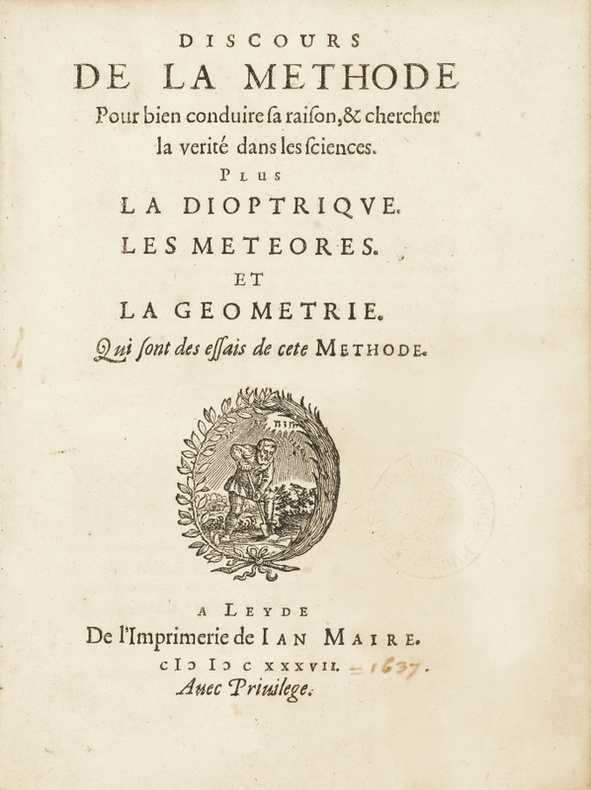
16375910Leiden: Jan Maire 1637. First edition. <p>First edition of the founding text of modern philosophy - containing the cogito Descartes' sine law of refraction the first geometrically correct explanation of the rainbow and in the Géométrie the birth of analytic geometry which Mill called "the greatest single step ever made in the progress of the exact sciences" - in a strictly contemporary Parisian armorial binding bearing the gilt arms of Louis Hesselin 1602-1662 choreographer of the court ballets in which the young Louis XIV learned to dance host at Chantemesle to Queen Christina of Sweden. The juxtaposition is the point. Descartes in exile in the Netherlands published anonymously and suppressed his cosmology after Galileo's condemnation; Hesselin was in Paris producing the spectacles of the king's reign. The chain of custody is documented without gap from 1668: acquired at Paris from the Hesselin library dispersal through three Orléans clergymen into the library of Eugène Paillet sold Paris 1902. A copy traceable by inscription through six named hands across two and a half centuries is effectively without parallel in the modern trade.</p>. Cogito Ergo Sum in the Court Ballet-Master's Library. <p>First edition of the founding text of modern philosophy in a strictly contemporary Parisian armorial binding bearing the gilt quartered arms of Louis Hesselin 1602-1662 - maître ordinaire de la Chambre aux deniers conseiller du Roi and surintendant des plaisirs du Roi choreographer of the court ballets in which the young Louis XIV learned to dance builder with Le Vau of the most admired cabinet de curiosités on the ÃŽle Saint-Louis host at Chantemesle to John Evelyn and to Queen Christina of Sweden. The juxtaposition is not trivial. Descartes in 1637 had withdrawn from court life to the Netherlands published his method anonymously and suppressed its cosmological foundations after the condemnation of Galileo. Hesselin in the same decade was choreographing the court ballets in which the young Louis XIV would learn to dance. Two volumes of seventeenth-century French culture - the austere philosophical method and the courtly spectacle - are bound here into a single object. Contemporary armorial copies of the Discours with named aristocratic descent are the rarest form in which the book survives; a copy traceable by inscription through six named hands across two and a half centuries is effectively without parallel in the modern trade.</p> <br /> <br /> <p>The Discours is a book that exists only because a larger one could not be. Descartes had been writing Le Monde since October 1629 - a comprehensive natural philosophy founded on the heliocentric hypothesis and designed as his magnum opus treating everything he believed he knew about material nature: light the Sun and fixed stars the heavens the planets and comets the Earth terrestrial bodies and finally man observing them. The condemnation of Galileo in June 1633 arrested it. Galileo's fate was a legal warning Descartes took seriously: in letters to Mersenne through the autumn of 1633 and spring of 1634 he described the Roman decision as theologically unfounded and politically menacing and hoped it would be reversed so that Le Monde could be published without fear of censure. It would not be in his lifetime. He salvaged from the unpublishable work the portions that were theologically survivable - the geometrical optics the meteorology and the analytic geometry - and released them four years later as three Essais with a hastily composed methodological preface anonymously in Leiden. Posterity has inverted the book's original proportions. What Descartes wrote and conceived as a preface to his science is now read as one of the canonical texts of Western philosophy while the three Essais it was meant to introduce have lapsed in the modern handbooks into what are routinely called its appendices. Yet the Géométrie contains the birth of analytic or coordinate geometry which Florian Cajori called 'of epoch-making importance' History of Mathematics p. 174 and which John Stuart Mill named 'the greatest single step ever made in the progress of the exact sciences' An Examination of Sir William Hamilton's Philosophy 1865. It in A. R. Hall's phrase 'rendered possible the later achievements of seventeenth-century mathematical physics' Nature and Nature's Laws 1970 p. 91. The Dioptrique states the sine law of refraction independently of the Leiden mathematician Willebrord Snellius; the Météores gives the first geometrically correct explanation of the rainbow. The foundations of seventeenth-century mathematical physics are here released only because the cosmological framework that would have carried them had been made politically unpublishable by the Galileo affair.</p> <br /> <br /> <p>The Dioptrique the first of the three Essais opens with a mathematical analysis of reflection and refraction. Descartes demonstrates that the angle of incidence equals the angle of reflection and derives the sine law of refraction - the same conclusion reached independently around 1621 by Snellius whose unpublished work Descartes may or may not have known and whose priority has generated a four-century controversy of which Descartes' published statement is the first public trace. The third discourse contains a cross-sectional description of the human eye written without recourse to the technical vocabulary of iris pupil or optical lens but with enough detail to support the analysis of vision that follows and evidently drawing on Descartes' own anatomical dissections during his Amsterdam years. The fourth fifth and sixth discourses develop a philosophical account of perception that anticipates the Meditations: it is the mind that senses not the body or rather the mind in the brain exercising what Descartes calls the sens commun; nerves transmit information through the motion of their inner filaments; there need be no pictorial resemblance between the retinal image and the idea the soul forms of the object. The text closes with a long discussion of lens-grinding in which Descartes argues that hyperbolic and elliptical sections are to be preferred to any others for optical instruments - an ingenious if impractical recommendation that Huygens was to pursue over the decade that followed.</p> <br /> <br /> <p>The Météores treats the phenomena of the atmosphere - winds clouds rain hail snow lunar and solar haloes parhelia - with the stated polemical aim of displacing the language of omens and prodigies from meteorology. Much of what is explained derives from specific experiences Descartes dates from his own observation: the shapes of snowflakes seen at Amsterdam in the winter of 1635 the avalanches he watched when crossing the Alps in May 1625 the coronas around a lighted candle seen while crossing the Zuiderzee and the parhelia observed at Rome in March 1629. The centrepiece however is Descartes' explanation of the rainbow which depends on the sine law established in the Dioptrique. A ray of light striking a raindrop he proposes undergoes two refractions on entering and leaving the drop and one internal reflection; for rays passing through many raindrops at the requisite angle to the Sun the cumulative geometry yields the bow. A secondary bow - fainter with the colour order reversed - results from two internal reflections rather than one. The physical account of colour itself rests on the assumption that light is a tendency to motion impressed by the Sun on a subtle medium with colour arising from rotational changes in the medium's particles - a hypothesis Descartes was already willing to call provisional in correspondence and which later proved wide of the mark. The geometrical construction of the bow however is essentially correct and stands with Newton's later prismatic supplement on the origin of colours as the foundation of the modern theory.</p> <br /> <br /> <p>The Géométrie had been partly written while the Météores was already at press and Descartes warned in a preliminary Avertissement that it presupposed a mathematical training the rest of the book did not require. His interest in geometry had been stimulated in 1631 when Jacob Golius professor of mathematics and oriental languages at Leiden sent him the Pappus problem of three or four lines - a problem solved by the ancients whose solution was lost which became the test case that runs through the Géométrie. Book One demonstrates that every arithmetical operation - addition subtraction multiplication division and root extraction - admits of a geometrical interpretation and introduces the exponential notation x² x³ in place of the cumbersome cossic abbreviations of the older algebra. The move from old notation to new marks what Niccolò Guicciardini has called a 'gigantic innovation' Isaac Newton on Mathematical Certainty and Method p. 38 tightening the connection between algebra and geometry in a way that made their unified treatment for the first time possible. Descartes applies the apparatus to the Pappus problem and solves not only the four-line case but generalises to the n-line case the ancient geometers had left open. Book Two develops the distinction between geometric and mechanical curves - curves of well-defined algebraic degree against the conchoids spirals and quadratrices the Greeks had grouped as linear - and the supremacy of the algebraic criterion becomes thereafter canonical: Newton extends the classification to fractional and irrational exponents Leibniz to variable or transcendental exponents. Book Three treats the theory of equations and the geometrical construction of their roots gathering results partly due to Cardano Harriot and Girard and setting them out for the first time in modern notation in an exposition Newton would take up and extend in the Arithmetica universalis 1707 and the De limitibus aequationum. It includes the celebrated rule of signs - the maximum number of positive and negative roots of an equation is given by the alternations and permanences of sign among its coefficients - asserted without proof in 1637 and rigorously demonstrated only in the eighteenth century.</p> <br /> <br /> <p>The Discours that introduces these three essays was itself written last and hastily while the book was already going through Maire's press. It had been conceived as a brief preface and expanded under Mersenne's importunate pressure into an autobiographical method-manifesto. Its six parts move from autobiography to method the four famous rules through the provisional moral code to the metaphysical core - the cogito ergo sum of Part IV with its argument from the certainty of the thinking subject to the existence of God and thence to the reliability of clear and distinct ideas - and finally to the long and pointedly apologetic Part VI on publication in which Descartes explains why he has not released the full physics: the theories in the Essais he concedes are presented as suppositions which could have been argued more certainly if Le Monde had appeared. It is as close as the 1637 book comes to naming the cosmological ghost in its own machinery. Printing and the Mind of Man summarised the whole in terms still close to Descartes' own: he had set out to find the simple indestructible proposition that gives to the universe and to thought their order and system and what he offered - the truth of thought when true to itself the elevation of the partial state of finite consciousness to the infinite existence of God and the reduction of the material universe to extension and local motion - became the starting-point from which the whole of subsequent Western philosophy has proceeded. Descartes' preference for French over the scholarly Latin of the universities was itself a polemical choice: he wished to dissociate his work from the scholastic tradition that it criticised and trusted readers including women he conceded who had not been contaminated by school learning more than academic readers - a position that later became one of the central features of Cartesian arguments for women's education.</p> <br /> <br /> <p>Maire's printing ran from mid-1636 through to early summer 1637. Descartes had initially approached the Elzeviers at Leiden but they raised many difficulties and assumed since the prospective author had travelled so far to petition their services that he had little choice but to accept their terms. This bargaining strategy failed and Descartes moved to Maire in the same town who housed the young Frans van Schooten - the son of a Leiden professor of mathematics of the same name - under his own roof to ensure the engravings were completed on time partly from an editor's concern for quality and partly from a publisher's fear that van Schooten would escape. By 13 July 1636 the printer was promising to have all the illustrations ready within three weeks and to begin printing immediately and the Dioptrique was pulled by 30 October but the engravings for the other two Essais deferred publication to Easter 1637. The Dutch privilege was granted on 20 December 1636; the French privilege - needed because the book was in French and Maire required protection against Parisian piracy - was delayed by difficult negotiations in which Huygens and Mersenne eventually had to intervene and was finally issued on 4 May 1637. Maire pulled the final sheet on 8 June. Descartes' name appears nowhere on the title-page and the French privilege as printed was abridged to omit it. His anonymity at publication was deliberate and of a piece with the decision to withhold the underlying physics.</p> <br /> <br /> <p>The armorial binding on this copy carries the quartered arms of Cauchon and Hesselin in gilt at the centres with alternating griffin and fleur-de-lys cross tools in the spine compartments - both charges diagnostic of the family Guigard Nouvel armorial du bibliophile 1890 II pp. 259-260; Olivier Hermal & Roton Manuel de l'amateur de reliures armoriées françaises XVII no. 1687. Louis Hesselin - christened Louis Cauchon and authorised by lettres patentes of Louis XIII registered in the Parlement of Paris on 19 December 1626 to adopt the surname of a childless great-uncle whose estate he inherited - was born in 1602 into a Champagne family of royal officiers. As maître ordinaire of the Chambre aux deniers conseiller du Roi and from about 1655 surintendant des plaisirs du Roi he was the producer of the young Louis XIV's court ballets himself dancing in the Ballet des fêtes de Bacchus of May 1651 alongside the thirteen-year-old king. He travelled twice to Italy in the 1630s - to Venice and Florence in 1631-33 and to Venice and Rome in 1636-37 - returning with paintings objets d'art and optical instruments and maintaining thereafter his collecting networks with Tinelli in Venice Torelli and Della Bella in Florence and the natural philosopher and perspectivist Jean-François Niceron in Rome. The Le Vau-designed hôtel he commissioned on the ÃŽle Saint-Louis built between 1640 and 1644 at what is now 24 quai de Béthune housed the most admired cabinet of seventeenth-century Paris; Father Niceron writing in the 1630s described it in effect as a compendium of all the Parisian cabinets so densely filled with rarities paintings and books that the whole house was indistinguishable from its cabinet. At his country residence Chantemesle near Essonnes on the Paris-Fontainebleau road Le Vau built the first salle à l'italienne in France where Hesselin received John Evelyn in 1644 and in 1656 Queen Christina of Sweden - the sovereign whose insistence on early-morning philosophy lessons in an unheated Stockholm library had killed Descartes four years earlier.</p> <br /> <br /> <p>Hesselin died on 8 August 1662 in his Paris hôtel. The pose of seals and the inventory after his death are documented in the Archives nationales Y 11111 and the Minutier central XX/310 and ground R. de Crèvecoeur's 1895 monograph and Moana Weil-Curiel's 2001 thèse de doctorat at the École pratique des hautes études the fullest modern treatment of his life and collections. The claim repeated from Bonnaffé's 1884 Dictionnaire des amateurs français au XVIIe siècle that he died poisoned by a servant - elsewhere embroidered into a story of death by indigestion after consuming 294 walnuts on a wager - is a nineteenth-century embellishment for which the archival record provides no support. The form of the surname he himself used and on the arms as struck is simply Louis Hesselin: the form he signed the form recorded in the official records and the form under which he is known in every art-historical source. His library was dispersed six years after his death. The note on the rear paste-down of the present copy 'achepté a Paris de la bibliotheque de Mr Hesselin 1668' is one of the scant direct witnesses to that dispersal. No printed auction catalogue was ever issued; none is recorded in Frits Lugt's Répertoire des catalogues de ventes publiques comprehensive for France from 1600. This is consistent with the state of the Parisian book trade at that date - the earliest Paris book auctions for which catalogues survive being those of Mentel in 1669 and Marescot in 1673 themselves on the very threshold of the auction catalogue's emergence as a medium. Hesselin's books were therefore sold privately à l'amiable through one or more Paris booksellers in the years immediately after his death; Bonnaffé writing in 1884 already found them 'difficiles à trouver'.</p> <br /> <br /> <p>From 1668 onwards the book's history belongs to the diocese of Orléans. Its next owner was Jacques Borde priest of the diocese of Orléans and canon of the Collégiale Saint-Liphard de Meung-sur-Loire who signed twice - Ex Libris J. Borde Presbyt. Aurel. Canon. Magdun. 1673 on the rear paste-down and in a larger freer hand on the front paste-down - just five years after the Hesselin purchase. A family connection is plausible: Hesselin's first cousin was named Henry Godet des Bordes and the surname Borde recurs in the Champenois branches of the Cauchon network. The next mark on the title-page and once on the inside cover cancelled is that of Petrus Anianus Douberion; the forename Anianus French Anien is that of the fifth-century bishop-saint who defended Orléans against Attila in 451 used almost exclusively by Orléanais families. The third Orléans owner the rhetoric-professor Jean-Baptiste Amy-Demeré - whose surname has long been misread in the dealer literature as Amici Deméré which is in fact the Latin genitive of its first element - is the most fully documented. Trained by the Sulpicians at the Orléans petit séminaire ordained priest and having taken a baccalauréat in law he won by competitive examination in December 1775 the chair of troisième at the Collège royal d'Orléans - the former Jesuit foundation which had passed to secular masters after the suppression of the Society of Jesus in 1762 - presenting on Cicero Horace and Tacitus. He was promoted to the chair of rhetoric in 1785 L.-H. Tranchau Le Collège et le Lycée d'Orléans 1762-1892 1893 p. 146 which is precisely the title he claims in the note on the front paste-down: Ex libris Joannis Baptistae Amici Demeré Presbyteri in Collegio Aureliansi Rhetoricae Professoris An. 1792. The Collège itself closed in the Revolution and re-emerged only as the École centrale of the Loiret in 1796; Amy-Demeré's post-1792 fate is undocumented though his Sulpician formation makes a refractory non-juring stance the likelier hypothesis.</p> <br /> <br /> <p>The blank facing the title-page carries an eighteenth-century French manuscript note in a trained rhetorician's hand opening with the claim that 'Le seul discours de la méthode eut suffi pour immortaliser son auteur' developing a mine-and-quarry metaphor for the inexhaustible richness of the work - that the more one excavates the more riches one discovers although the exploitation of the seam is not given to every reader - and closing with the Virgilian tag 'hoc opus hic labor est'. The note is not an original composition but a paraphrase of Antoine-Léonard Thomas's Éloge de René Descartes which won the Académie française prize in 1765 and became the most quoted eighteenth-century appreciation of the philosopher - Victor Cousin reprinted it in his 1824 edition of Descartes' Å’uvres philosophiques. Thomas writing specifically of the Dioptrique calls it one of the finest monuments of its author qui suffiroit seul pour l'immortaliser. The annotator lifts the distinctive construction and re-applies it with greater justice to the Discours itself. The Latin tag is from Virgil Aeneid VI.129 - the Sibyl's warning to Aeneas that descending to the underworld is easy but returning from it is the task and the labour. The combination - a paraphrase of the most-read French éloge of Descartes a Virgilian sententia flagged in quotation marks a developed metaphor of philosophical inheritance framed in rhetorical symmetry - is the professional signature of a Latin-trained professor rhetorices. The hand is of the late eighteenth or very early nineteenth century. The attribution to Amy-Demeré himself in or shortly after 1792 is the economical hypothesis: the textbook Thomas the Virgilian tag and the rounded French periodicity all match what one would expect of a professor of rhetoric at an ancien régime Collège marking a first edition of modern philosophy in the season when the institution housing his chair was about to dissolve with the ancien régime itself.</p> <br /> <br /> <p>After 1792 the book disappears from view for most of a century and resurfaces in the library of Eugène Paillet 1829-1901 a Paris juge d'instruction who became a conseiller at the Cour d'Appel and more lastingly one of the great bibliophiles of the Second Empire and Third Republic. Co-founder in 1874 of the Société des Amis des Livres and its president from 1880 until his death Paillet was famous for reading his rare books: Roger Portalis in his 1901 memoir Eugène Paillet; bibliophile 1829-1901 records that visitors to the Sunday afternoons at the rue de Berlin would find him volume in hand - the original edition of Descartes' Discours or alternatively Rabelais. The anecdote almost certainly refers to the present copy which Paillet had already furnished with his Greek leather book-label á¼Îº βιβλιον Ευγενιου Παιλλη mounted on the rear paste-down beneath an eagle in gilt. Paillet's library was dispersed in three stages: two privately printed catalogues in 1885 and 1887 the first collection sold to Morgand & Fatout for 500000 francs followed by the posthumous Catalogue des livres composant la bibliothèque de feu M. Eugène Paillet sold by Damascène Morgand in Paris in 1902. The present copy is lot 60 of Part I.</p> <br /> <br /> References:<br /> Dibner Heralds of Science 81 - Evans 5 - Grolier/Horblit 24 - Guibert Bibliographie des Å“uvres de Descartes no. 1 - Norman 621 - Printing and the Mind of Man 129 - Sparrow Milestones of Science 54 - Tchemerzine-Scheler II p. 789 - Guigard Nouvel armorial du bibliophile 1890 II pp. 259-260 - Olivier Hermal & Roton Manuel de l'amateur de reliures armoriées françaises XVII no. 1687 - Bonnaffé Dictionnaire des amateurs français au XVIIe siècle 1884 pp. 139-141 - R. de Crèvecoeur Louis Hesselin amateur parisien intendant des plaisirs du Roi 1895 - M. Weil-Curiel EPHE thèse de doctorat 2001 - L.-H. Tranchau Le Collège et le Lycée d'Orléans 1762-1892 1893 - R. Portalis Eugène Paillet; bibliophile 1829-1901 1901 - Catalogue des livres composant la bibliothèque de feu M. Eugène Paillet Paris Damascène Morgand 1902 Part I lot 60.<br /> <br/> <br/> <br /> <p>4to 206 × 155 mm pp. 78 Discours; 2 413 Essais 1 Avertissement; 34 tables errata French and Dutch privileges. Woodcut printer's device on title woodcut initials numerous woodcut diagrams and text illustrations. Strictly contemporary French polished veau écaille tortoiseshell-stained calf covers with double gilt fillet frame and the gilt quartered arms of Cauchon and Hesselin at centres; spine in six compartments with five raised bands tooled alternately with griffins and fleur-de-lys crosses drawn from the Hesselin arms with double gilt fillet divisions; mottled edges. Spine-ends and corners restored with matching calf lightly rubbed small split at head of upper joint; occasional light staining to text. Modern morocco pull-off case.</p> . Jan Maire unknown
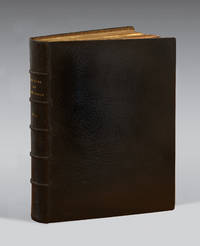
NYBF14<p>Leyden Ian Maire 1637.</p><p>4to 207 x 155 mm of 78 pages 1 l. 413 pp. 1 p. of notice and 18 ll. the last one blank. Full fawn calf gilt fillet on the covers spine ribbed mottled edges minor restorations. <i>Elegant contemporary Parisian binding</i>. </p><p> <b>"Precious first edition of Descartes' masterpiece."</b></p><p>Tchemerzine II 776; PMM 129; Horblit <i>One hundred book famous in science</i> 24; <i>En Français dans le texte</i> n°90; Dibner <i>Heralds</i> 81 "<i>The Dioptrique contains the earliest statement of Willebrord Snell's law of refraction</i>"; Norman Library 621.</p><p>After Galileo's sentence in 1633 Descartes had made a resolution not to print any book during his lifetime. From Holland where his aspiration for loneliness and isolation had driven him the philosopher still corresponds with his nearest and dearest. It is in the face of their entreaties that he gave in and published in 1637 an anthology of his researches to which he gave the meaning of a peculiar and personal process. </p><p>After having thought of entrusting the Elsevier and then a Parisian printer with his work Descartes ended dealing with the bookseller and printer Ian Maire established in Leyden in return 200 author's copies.</p><p><b>Founding work written in French in order to be more intelligible and accessible</b> the<i> Discourse on the Method</i> <b>marks a considerable step in the advancement of western thought in the 17th century.</b></p><p>The<i> Discourse on the Method</i> <b>is followed by 3 scientific reports</b> "<i>La Dioptrique</i>" "<i>Geometry</i>" and the <i>Meteors</i> <b>abundantly illustrated with woodcuts.</b></p><p>Besides Descartes mentions Harvey's discoveries on blood circulation <i>Exercitadio anatomica de motu cordis et sanguinis</i> 1628. <b>It is the first discussion on this matter by a French philosopher.</b></p><p>The <i>Discourse on the Metho</i>d is divided in six parts. Descartes presents an outline at the beginning of the work "<i>In the first will be found various considerations touching Sciences. In the second the main rules of the method which the author has been searching for. In the third some of the rules of Morals which he has deduced from this Method. In the fourth the reasons by which he establishes the existence of God and of the human soul which are the foundations of his Metaphysics. In the fifth the order of the Physical questions which he has investigated and in particular the explanation of the motion of the heart and of some other difficulties which are part of Medicine as also the difference between the soul of a man and that of the beasts. And in the last what the Author believes to be required in order to greater advancement in the investigation of Nature than has yet been made with the reasons that have induced him to write</i>." The author presents as well in the first part his biography until 1619.</p><p><b>Like most of important scientific books the price of the</b> <i>Discourse on the Method</i> <b>greatly increased in the past twenty years.</b></p><p><b>The best condition for the international market is obviously a copy in contemporary binding. </b></p><p>Three copies preserved in contemporary vellum without a significant provenance appeared on the market in the last few years: the first one was sold for 180 000 € "<i>Beguin</i>'scopy described with<i> 'restored wormholes in the margin of several leaves and some fowing'</i>; Paris 2006." The second one for 247 000 € "a copy sold by <i>Christie's</i> London on June 2nd 2004 lot n°54 described as "<i>a little light browning a few spot</i>'; the third one offered already 12 years ago in New York was knocked down for 200 000 €.</p><p><b>A precious copy preserved in its elegant contemporary Parisian binding.</b></p><p><br /></p><p><b><u>Français</u></b></p><p>À Leyde Ian Maire 1637.</p><p>In-4 de 78 pp. 1 f. 413 pp. 1 p. d'avertissement et 18 ff. le dernier blanc. Plein veau fauve double filet doré encadrant les plats dos à nerfs orné tranches mouchetées infimes restaurations. <i>Élégante reliure parisienne de l'époque</i>.</p><p>207 x 155 mm.</p><p><b>Précieuse édition originale du chef-d'œuvre de Descartes.</b></p><p>Tchemerzine II 776 ; PMM 129 ; Horblit <i>One hundred book famous in science</i> 24 ; <i>En Français dans le texte</i>n°90 ; Dibner <i>Heralds</i> 81 "<i>The Dioptrique contains the earliest statement of Willebrord Snell's law of refraction</i>" ; Norman Library 621.</p><p>Après la condamnation de Galilée en 1633 Descartes avait pris la résolution de ne laisser imprimer aucun ouvrage de son vivant. De la Hollande où l'avait conduit son aspiration à la solitude et à l'isolement le philosophe continue cependant à correspondre avec ses proches. C'est aux instances de ceux-ci qu'il cède en publiant en 1637 une anthologie de ses recherches à laquelle il laissa le sens d'une démarche toute singulière et toute personnelle.</p><p>Après avoir pensé confier son ouvrage aux Elzevier puis à un imprimeur parisien Descartes finit par traiter avec le libraire imprimeur Jean Maire établi à Leyde moyennant la rémunération de 200 exemplaires d'auteur.</p><p><b>Œuvre fondamentale rédigée en français afin d'être plus intelligible et accessible</b> <i>Le Discours de la Méthode</i> <b>marque une étape considérable dans la progression de la pensée occidentale au XVIIe siècle.</b></p><p>" <i>Le Discours de la Méthode</i> " <b>est suivi de 3 mémoires scientifiques</b>. " <i>La Dioptrique</i> " " <i>La Géométrie</i> " et " <i>Les Météores</i> " <b>abondamment illustrés de figures sur bois.</b></p><p>Descartes y mentionne par ailleurs les découvertes de Harvey sur la circulation sanguine <i>Exercitadio anatomica de motu cordis et sanguinis</i> 1628<b>. Il s'agit de la première discussion sur ce sujet par un philosophe français.</b></p><p>Le<i>Discours de la Méthode</i> est divisé en six parties. Descartes en donne lui-même un aperçu au début de l'ouvrage : " <i>En la première on trouvera diverses considérations touchant les sciences. En la seconde les principales règles de la méthode que l'auteur a cherchée. En la 3 quelques unes de celles de la Morale qu'il a tirée de cette Méthode. En la 4 les raisons par lesquelles il prouve l'existence de Dieu & de l'âme humaine qui sont les fondements de sa Métaphysique. En la 5 l'ordre des questions de Physique qu'il a cherchées & particulièrement l'explication du mouvement du cœur & de quelques autres difficultés qui appartiennent à la Médecine puis aussi la différence qui est entre nostre âme & celle des bestes. Et en la dernière quelles choses il croit estre requises pour aller plus avant en la recherche de la Nature qu'il n'a esté & quelles raisons l'ont fait escrire</i>. " L'auteur livre aussi dans la première partie sa biographie jusqu'en 1619.</p><p><b>Comme la plupart des livres scientifiques importants le</b><i><b>Discours de la Méthode</b></i><b> a vu son prix fortement progresser depuis une vingtaine d'années.</b></p><p><b>La condition idéale pour le marché international est bien sur la reliure de l'époque.</b></p><p>Trois exemplaires en vélin d'époque sans provenance significative sont apparus sur le marché ces dernières années : le premier fut vendu 180 000 € " Exemplaire <i>Beguin</i> décrit avec des "<i>trous de vers restaurés dans la marge de plusieurs dizaines de feuillets et quelques piqûres</i>" ; Paris 2006 " ; le second 247 000 € " exemplaire vendu par <i>Christie's London</i> le 2 juin 2004 lot n° 54 décrit "<i>a little light browning a few spot</i>" " ; le troisième proposé il y a déjà 12 ans à New-York fut alors adjugé 200 000 €.</p><p><b>Précieux exemplaire revêtu d'une élégante reliure parisienne de l'époque.</b></p> hardcover
LCS-17797Précieuse édition originale du chef-d’œuvre de Descartes. À Leyde, Ian Maire, 1637. In-4 de 78 pp., (1) f., 413 pp., (1) p. d’avertissement et (18) ff., le dernier blanc. Plein veau fauve, double filet doré encadrant les plats, dos à nerfs orné, tranches mouchetées, infimes restaurations. Élégante reliure parisienne de l’époque. 207 x 155 mm.
1637LCS-18458<p><strong>First edition of the <em>Discourse on the method</em> containing the first printed appearance of Descarte's famous "I think therefore I am."</strong></p><p><strong>Leiden 1637.</strong></p><p>4to 198 x 150 mm of 78 pp. 1 l. 413 pp. 1 p. of advertissement and 18 ll. the last one blank. Jansenist brown morocco spine ribbed and decorated inner gilt border gilt over marbled edges. <em>Binding from the 19th century</em> signed <em>Thibaron</em>.</p><p>Precious first edition of Descartes' masterpiece.</p><p>Tchemerzine II 776; PMM 129; Horblit <em>One hundred book famous in science</em> 24; <em>En Français dans le texte</em> n°90; Dibner <em>Heralds</em> 81 "<em>The Dioptrique contains the earliest statement of Willebrord Snell's law of refraction</em>"; Norman Library 621.</p><p>After Galileo's sentence in 1633 Descartes had made a resolution not to print any book during his lifetime. From Holland where his aspiration for loneliness and isolation had driven him the philosopher still corresponds with his nearest and dearest. It is in the face of their entreaties that he gave in and published in 1637 an anthology of his researches to which he gave the meaning of a peculiar and personal process.</p><p>After having thought of entrusting the Elsevier and then a Parisian printer with his work Descartes ended dealing with the bookseller and printer Jean Maire established in Leyden for the remuneration of 200 author's copies.</p><p>Founding work written in French in order to be more intelligible and accessible "<em>Le Discours de la Méthode</em>" marks a considerable step in the advancement of western thought in the 17th century.</p><p>The"<em>Discours de la Méthode</em>" is followed by 3 scientific reports "<em>La Dioptrique</em>" "<em>La Géométrie</em>" and "<em>Les Météores</em>" abundantly illustrated with woodcuts.</p><p>Besides Descartes mentions Harvey's discoveries on blood circulation <em>Exercitadio anatomica de motu cordis et sanguinis</em> 1628. It is the first discussion on this matter by a French philosopher.</p><p>The <em>Discourse on the Metho</em>d is divided in six parts. Descartes presents an outline at the beginning of the work "<em>In the first will be found various considerations touching Sciences. In the second the main rules of the method which the author has been searching for. In the third some of the rules of Morals which he has deduced from this Method. In the fourth the reasons by which he establishes the existence of God and of the human soul which are the foundations of his Metaphysics. In the fifth the order of the Physical questions which he has investigated and in particular the explanation of the motion of the heart and of some other difficulties which are part of Medicine as also the difference between the soul of a man and that of the beasts. And in the last what the Author believes to be required in order to greater advancement in the investigation of Nature than has yet been made with the reasons that have induced him to write</em>." The author presents as well in the first part his biography until 1619.</p><p>Like most of important scientific books the price of the <em>Discourse on the Method</em> greatly increased in the past twenty years.</p><p>Beautiful and very pure wide-margined copy finely bound by Thibaron.</p><p>Provenance: <em>Thomas Powell</em> and <em>A. F. Gougy</em> 1930 with ex libris.</p><p>FRANCAIS</p><p><strong>Édition originale du <em>Discours de la méthode.</em></strong></p><p><strong>Leyde 1637.</strong></p><p>In-4 de 78 pp. 1 f. 413 pp. 1 p. d'avertissement et 17 ff. Maroquin brun janséniste dos à nerfs orné double filet doré sur les coupes roulette intérieure dorée tranches dorées sur marbrures. <em>Reliure du XIXe siècle </em>signée<em> Thibaron.</em></p><p>198 x 150 mm.</p><p>Précieuse édition originale du chef-d'uvre de Descartes.</p><p>Tchemerzine II 776 ; PMM 129 ; Horblit <em>One hundred book famous in science</em> 24 ; <em>En Français dans le texte</em> n°90 ; Dibner <em>Heralds</em> 81 "<em>The Dioptrique contains the earliest statement of Willebrord Snell's law of refraction</em>" ; Norman Library 621.</p><p>Après la condamnation de Galilée en 1633 Descartes avait pris la résolution de ne laisser imprimer aucun ouvrage de son vivant. De la Hollande où l'avait conduit son aspiration à la solitude et à l'isolement le philosophe continue cependant à correspondre avec ses proches. C'est aux instances de ceux-ci qu'il cède en publiant en 1637 une anthologie de ses recherches à laquelle il laissa le sens d'une démarche toute singulière et toute personnelle.</p><p>Après avoir pensé confier son ouvrage aux Elzevier puis à un imprimeur parisien Descartes finit par traiter avec le libraire imprimeur Jean Maire établi à Leyde moyennant la rémunération de 200 exemplaires d'auteur.</p><p>uvre fondamentale rédigée en français afin d'être plus intelligible et accessible <em>Le Discours de la Méthode</em> marque une étape considérable dans la progression de la pensée occidentale au XVIIe siècle.</p><p>" <em>Le Discours de la Méthode</em> " est suivi de 3 mémoires scientifiques. " <em>La Dioptrique</em> " " <em>La Géométrie</em> " et " <em>Les Météores</em> " abondamment illustrés de figures sur bois.</p><p>Descartes y mentionne par ailleurs les découvertes de Harvey sur la circulation sanguine <em>Exercitadio anatomica de motu cordis et sanguinis</em> 1628. Il s'agit de la première discussion sur ce sujet par un philosophe français.</p><p>Le <em>Discours de la Méthode</em> est divisé en six parties. Descartes en donne lui-même un aperçu au début de l'ouvrage : " <em>En la première on trouvera diverses considérations touchant les sciences. En la seconde les principales règles de la méthode que l'auteur a cherchée. En la 3 quelques unes de celles de la Morale qu'il a tirée de cette Méthode. En la 4 les raisons par lesquelles il prouve l'existence de Dieu & de l'âme humaine qui sont les fondements de sa Métaphysique. En la 5 l'ordre des questions de Physique qu'il a cherchées & particulièrement l'explication du mouvement du cur & de quelques autres difficultés qui appartiennent à la Médecine puis aussi la différence qui est entre nostre âme & celle des bestes. Et en la dernière quelles choses il croit estre requises pour aller plus avant en la recherche de la Nature qu'il n'a esté & quelles raisons l'ont fait escrire</em>. " L'auteur livre aussi dans la première partie sa biographie jusqu'en 1619.</p><p>Comme la plupart des livres scientifiques importants le <em>Discours de la Méthode</em> a vu son prix fortement progresser depuis une vingtaine d'années.</p><p>Bel exemplaire très pur et grand de marges finement relié par Thibaron.</p><p>Provenance : <em>Thomas Powell</em> et <em>A. F. Gougy</em> 1930 avec ex libris.</p> Ian Maire.
LCS-18458Leyde, 1637. À Leyde, Ian Maire, 1637. In-4 de 78 pp., (1) f., 413 pp., (1) p. d’avertissement et (17) ff. Maroquin brun janséniste, dos à nerfs orné, double filet doré sur les coupes, roulette intérieure dorée, tranches dorées sur marbrures. Reliure du XIXe siècle signée Thibaron. 198 x 150 mm.
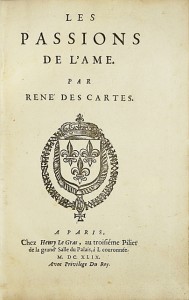
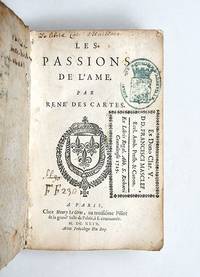
LCS-8065Édition originale des Passions de l’âme de Descartes conservée dans son vélin à recouvrement de l’époque. Paris, chez Henry Le Gras, 1649.In-8, de (24) ff., titre compris, 286 pages, (1) f.bl. Relié en plein vélin ivoire à recouvrement de l’époque, dos lisse. Reliure de l’époque. 159 x 90 mm.
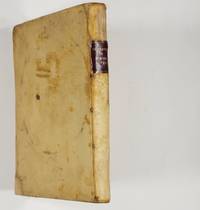
164975<p><b>First edition of Descartes' last philosophical text published one year before his death.</b></p><p>Tchemerzine II 791 ; Guibert 150 ; Brunet II 611 ; Willems 1083; E. Rahir <i>Bibliothèque de l'amateur</i> 396.</p><p>"<i>The 1649 edition is quite rare." </i>Willems</p><p>"<i>This edition was jointly published by L. Elzevier wit the Parisian bookseller Le Gras. Some copies bear the address of Louis Elzevier in Amsterdam with the Minerva fleuron. The two aspects of this edition are of Elzeverian printing.</i>" Tchemerzine</p><p>Published in November 1649 written directly in French like the <i>Discours de la méthode</i> <i>Les Passions de l'âme</i> is divided into three parts : <i>Des passions en général</i> <i>Du nombre & de l'ordre des passions </i>and <i>Des Passions particulières</i>.</p><p>The first part analyses the links between the soul and the body ; in the second part Descartes analyses the passions by studying them from the inside giving us a definition for each ; in the third part he examines the different passions. </p><p>This treaty on <i>Passions</i> was written in French for the attention of the Palatine princess Madame Elisabeth with whom Descartes shared an active correspondence. </p><p>Except for the part on the personal and temporary moral rules exposed in the Discours de la Méthode this is the only text where Descartes adventures himself on a moral terrain subject to as much criticism or condemnation or maybe even more than metaphysics.</p><p><b>An attractive copy very pure wide-margined preserved in its contemporary vellum.</b></p><p>Provenance : Libraries of <i>de la Morandière</i> <i>de la Prevostière</i> lawyer <i>Henri Le Court</i> and <i>Jean Siegler</i> with ex-libris.</p> (Amsterdam, L. Elzevier pour) Henry le Gras hardcover
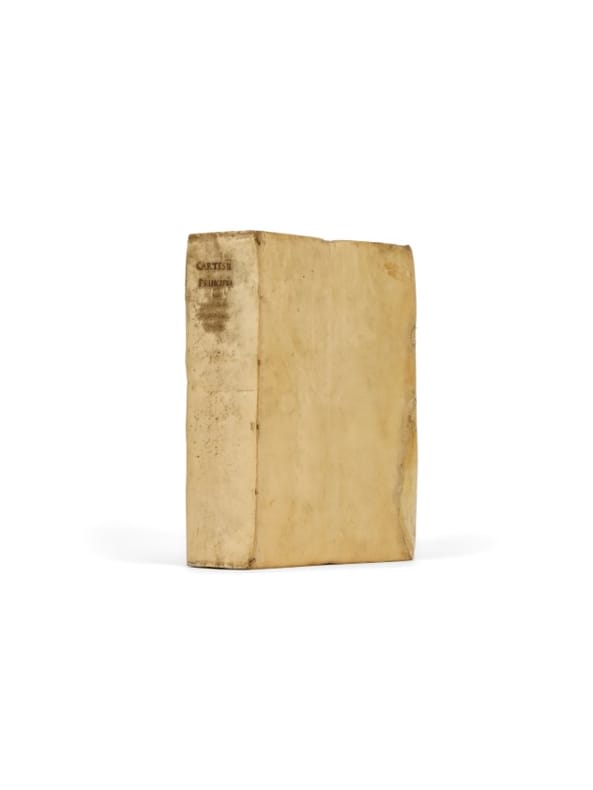
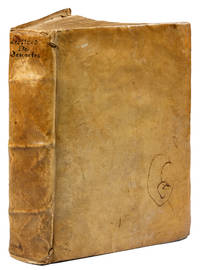
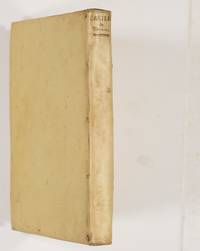
32320Amstelodami Apud Ludovicum Elzevirium 1644. 1 vol. 150 x 190 mm de 12 f. 310 p. et 1 f. ; 8 f. et 331 p. Vélin blond dos lisse titre à l'encre petits rabats reliure hollandaise de l'époque. Elle contient notamment les Principia en édition originale. A la suite les Specimina philosophiae : sous ce titre sont regroupés le Discours de la méthode la Dioptrique et les Météores toutes en première traduction latine par Estienne de Courcelles. Le Discours de la Méthode fut dans cette traduction un peu modifiée par Descartes. Le volume contient la toute première occurrence du célèbre « je pense donc je suis » sous sa forme latine du « cogito ergo sum » la formule philosophique sans doute la plus célèbre au monde. Cette pensée s'est forgée à partir des Méditations métaphysiques sous la forme première de « Ego sum ego existo »en 1641 puis donnée en français dans Le Discours de la méthode en 1637 avec « Je pense donc je suis » avant de livrer sa forme latine d'une « Ego cogito ergo sum » en 1644 dans ces Principia philosophiae où elle apparraît à la dernière ligne de la première partie « De principiis cognitionis humanae » De nombreuses figures sur bois illustrant ses travaux sur la réfraction de la lumière la vision et les phénomènes de l'arc-en-ciel et des vents accompagnent le texte de la Dioptrique et des Météores où Descartes explique les mouvements des astres dans le système solaire par l'intervention de forces en supposant que chacun des astres est entouré d'un tourbillon de matière subtile qui l'entraîne. C'est la première édition du système de physique de Descartes dans laquelle il développe sa théorie des vortex point de départ de tous les travaux sérieux en théorie physique au milieu du XVIIe siècle y compris celui de Newton. Au verso du titre se trouve le privilège qui est suivant Nodier « le plus mémorable monument de la protection que les rois de France ont accordé aux lettres ». Les oeuvres philosphiques de Descartes seront imprimées six fois par les Elzevier dans ce format quarto et cette édition de 1644 est la toute première. Exemplaire bien complet de ses deux feuillets blancs b4 et l'autre en QQ4 avec des 83 figures géométriques et scientifiques gravées sur bois dont 21 planches comprises dans la pagination pour les Principia. La marge droite du premier plat de reliure a été anciennement restaurée sinon très bel exemplaire très frais en parfaite condition intérieure. Provenance : Edouard du Basty ex-libris et ex-libris manuscrit « A Madame du Basty » ; Henri Leclerq ex-libris et vente Bruxelles 1947 ; collection privée. En français dans le texte 90 ; Guibert Descartes p. 118-119 ; Tchemerzine Éditions originales et rares II 777 et 787 ; DSB IV 52 ; Norman 622 et 623 ; Willems 1006-1008. Amstelodami, Apud Ludovicum Elzevirium, 1644. 1 vol. (150 x 190 mm) de 12 f., 310 p. et 1 f. ; 8 f. et 331 p. Vélin blond, dos unknown
164432320Cogito, ergo sum Amstelodami, Apud Ludovicum Elzevirium, 1644. 1 vol. (150 x 190 mm) de 12 f., 310 p. et 1 f. ; 8 f. et 331 p. Vélin blond, dos lisse, titre à l'encre, petits rabats (reliure hollandaise de l'époque).
1649156923Paris: Henry Le Gras 1649. Descartes's mind-body dualism in its final form First edition Paris issue of Descartes's last major philosophical treatise "his fullest account of the interaction between soul and body and his most significant contribution to moral philosophy" Moriarty p. xviii. The Passions of the Soul Descartes's last lifetime publication grew out of his correspondence with Princess Elisabeth of Bohemia during the 1640s. Drawing heavily on their discussion of mind-body duality and the then-unpublished Traité de l'homme it makes the "essential distinction between the soul and the divinely-endowed seat of consciousness will and rational thought and the body as a machine or automaton subject to the laws of physics and only indirectly controlled by the soul through the nerves" Norman. Descartes locates the soul in the pineal gland and for the first time uses the word "reflex" in connection with the action of the nervous system. "The first part of the text explains the nature of passion in general the second describes the principal passions and the third the further passions that derive from these; but each part ends with some definite recommendations concerning the attitudes or behaviour we should adopt in the light of the foregoing explanations" Moriarty p. xviii. It remains the "most extensive account of Descartes's behavioural physiology to be published in his lifetime. Portions of this work constitute what we have of Descartes' moral theory" Stanford Encyclopaedia of Philosophy. This is one of two issues of the same first edition sheets. As Guibert explains the printing and publishing rights for this work were shared between Louis Elzevier in Amsterdam and Henry le Gras in Paris. There are no differences beyond the title pages which bear different imprints and devices Elzevier: Minerva under an olive tree versus le Gras: French royal crest. Descartes was in Sweden at the time of publication so he relied upon Abbé Picot as intermediary to oversee the distribution in France. Provenance: from the library of the French Hebraist François Masclef 1663-1728 with an estate ex-libris dated 1729 after which the book passed to the Abbey of Saint-Riquier Somme. Small octavo 152 x 94 mm. Woodcut printer's device on title page head- and tailpieces initials. Contemporary limp vellum. Vellum soiled front free endpaper missing. Contents lightly browned and in places foxed; expertly restored vertical tear on title leaf coat of arms stamp ownership entry and bookplate on title page; a very good copy. Garrison-Morton 4965; Guibert 1649 1 p. 150; Norman 626; Willems 1083 "L'édition de 1649 est assez rare surtout avec l'adresse primitive". Michael Moriarty intr. & trans. The Passions of the Soul and Other Late Philosophical Writings by René Descartes 2015. hardcover
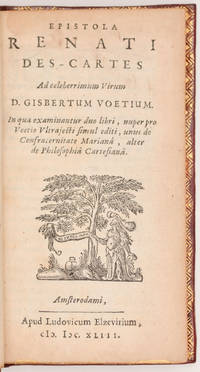
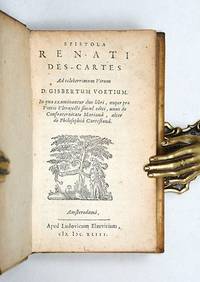
16431820Amsterodami Amsterdam: Apud Ludovicum Elzevirium Elzevier 1643. First edition. In later red maroquin. Gilt panels spine and inner edges. Marbled endpapers. Gilt edges. Woodcut device on the title page. Woodcut initials and tailpieces. 19th-century presentation inscription and possessor’s inscription on flyleaf. In fine condition. First edition. In later red maroquin. Gilt panels spine and inner edges. Marbled endpapers. Gilt edges. Woodcut device on the title page. Woodcut initials and tailpieces. 12 282 p. <p><br /> The scarce first edition of this fundamental text for the history of philosophy and human thought in which Descartes defends the autonomy of reason and doubt.<br /> <p><p><br /> Ad celeberrimum is Descartes’ offensive open letter published in May 1643 a response to Gisbertus Voetius’ two earlier books attacking Descartes Confraternitas Mariana 1642; Admiranda Methodus 1643 and a reaction to the condemnation of Cartesianism by the University of Utrecht of which Voetius was Rector. In the text Descartes calls for criticism by reasoning and not by authority argues for the primacy of education over learning and for the importance and autonomy of reason Hoon Woo 2013. <br /> <p><p><br /> Scarce WorldCat locates only 6 copies worldwide.<br /> <p><p><br /> Literature: Cottingham J.; et al.: The Philosophical Writings of Descartes. Volume 3: The Correspondence. Cambridge: Cambridge University Press 1985.; Hoon Woo B.: The Understanding of Gisbertus Voetius and René Descartes on the Relationship of Faith and Reason and Theology and Philosophy. In: Westminster Theological Journal 75 no. 1 2013. pp. 45–63. <br /> <p>. Apud Ludovicum Elzevirium [Elzevier] unknown
165777<p><b>First edition Tchemerzine containing " <i>119 French and Latin letters mostly addressed to the queen of Sweden the Palatine princess Mersenne Chanut Le Roy Morin. They are sometimes associated with woodcuts. </i>" Guibert</b></p><p>Guibert pp.77-79 ; Tchemerzine II 785; Brunet II 611.</p><p>The publication of the letters of Descartes 1657-1667 had cooled the Jansenists' zeal towards him d'Arnauld's and de Nicole's in particular and certainly Pascal's also who accused him of wanting to forgo God in his metaphysics.</p><p><i>"Despite the attacks targeting him his reputation as an innovative philosopher had surpassed the small scholarly world and reached the world of the patron princes. The princess Elisabeth the Palatine princess exiled in The Hague who was an educated woman and interested in philosophy reached out to him and they maintained a steady correspondence which makes up the bulk of the Letters. The marquis of Newcastle and the queen Christine of Sweden did the same</i>." Dictionnaire des auteurs</p><p>For the most part these letters were written between 1637 and 1647.</p><p>From 1642 to 1649 the period of his life ranging from the <i>Méditations métaphysiques</i> to his death in Stockholm Descartes maintained a steady correspondence with the princess Elisabeth daughter of Frederick V Palatine elector and king of Bohemia. This cultivated woman who had studied mathematics had read the <i>Méditations métaphysiques</i> with much interest and great admiration. Descartes kept her up to date on his own writings recommended books and discussed physics philosophy and mathematics with her.</p><p>"<i>Clerselier had chosen the letters of this volume well : those interested in questions on morals physics and even medicine were satisfied ; the names of the queen Christine and the princess Elisabeth both still alive and also of this English gentleman M. More and this lord whose name he kept a secret attracted attention and gave the philosopher who had written to these illustrious individuals great prestige. The success of the book was inevitable and two years later when Clerselier published a second volume he acknowledged in the preface that the first one was already "completely sold"." </i><i>Œuvres de Descartes</i> Adam et Tannery</p><p>This correspondence is fascinating because Descartes explains himself and develops certain points exposed in his work ; it is also one of the only documents that we have that allow us to peer into the thinker's intimate thoughts.</p><p><b>A beautiful copy very pure preserved in its attractive contemporary vellum.</b></p><p>Handwritten ex-libris from 1685 on title page.</p> Charles Angot hardcover
166252487Lugduni Batavorum (Leyden), Apud Petrum Leffen & Franciscum Moyardum, 1662. 4to. Contemporary full calf with gilt title-laebl to spine. (36), 121, (1) pp. + 10 plates. Complete with all 56 woodcut and engraved text-illustrations (many of which are full-page) and the 10 full-page engraved plates (several folded), one of which is the heart-plate with the 6 moveable parts, the Cardiac-flaps (of which only the smallest is missing). One folded plate cropped at fore-margin.
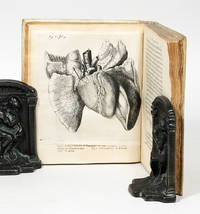
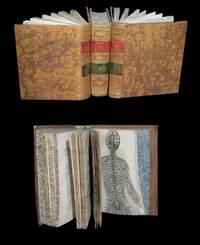
166252487Lugduni Batavorum Leyden Apud Petrum Leffen & Franciscum Moyardum 1662. 4to. Contemporary full calf with gilt title-laebl to spine. 36 121 1 pp. 10 plates. Complete with all 56 woodcut and engraved text-illustrations many of which are full-page and the 10 full-page engraved plates several folded one of which is the heart-plate with the 6 moveable parts the Cardiac-flaps of which only the smallest is missing. One folded plate cropped at fore-margin. <br/><br/><em>First edition of Descartes' seminal treatise on man the first European textbook of physiology constituting an epochal work of modern thought defining the mechanism of man as it does. "In the Treatise of man Descartes did not describe man but a kind of conceptual models of man namely creatures created by God which consist of two ingredients a body and a soul. "These men will be composed as we are of a soul and a body. First I must describe the body on its own; then the soul again on its own; and finally I must show how these two natures would have to be joined and united in order to constitute men who resemble us"." SEP. This highly influential work was the first to present a coherent description of bodily responses in neurophysiological terms that are still to a wide extent accepted today. In his attempt to solve the central question around which almost all philosophical thought had revolved since the time of Aristotle what the relation between the soul and the body actually is Descartes came to create a milestone work of physiology which changed the entire trajectory of modern physiological conceptions. "Without Descartes the seventeenth-century mechanization of physiological conceptions would have been inconceivable." DSB. He believed that the relationship between the soul and the body was mediated by the brain and the nervous system and his seminal attempts to explain neural mechanisms drew a great deal on the engineering developments of his time eg. the hydraulic automata that had been installed at the Versailles. He developed a hydro-mechanical theory of how the soul controlled the contraction of muscle through the intermediary of the pineal and the cerebral ventricles and he produced an explanation of how it received through the nerves from the periphery signals that gave rise to sensation. Descartes' theories quickly spread throughout Europe and the work in which he had developed them his "De Homine" became extremely influential. This posthumously published work was actually written in the 1630's but after the condemnation of Galilei in 1633 Descartes did not dare publish it; "although it thus had to await posthumous publication in the 1660's his writing of the Traité de l'homme proved extremely important in the further maturation of Descartes's physiological conceptions." D.S.B. p.62. "Some time after Descartes's death in 1650 his French manuscript copies of which had circulated among his friends and correspondents was edited and published. The first version was a Latin translation De homine by Florentius Schuyl in 1662 the second the now better known 'original' French version Traité de l'homme edited by Descartes's self-appointed literary executor Claude Clerselier in 1664. In the seventeenth century the 1662 Latin version was probably much more widely read than the French text. There were problems for the editors of both versions. Firstly there were differences between the manuscripts: Clerselier in Paris claimed that his version was Descartes's own that the others were 'corrupt' and that Schuyl had been 'misled' by them. However a more important difficulty was raised because it was clear that the text was intended to be illustrated - Descartes refers to figures and to features within these labelled by letters. But no set of figures accompanied the manuscripts. Both editors have left quite detailed accounts in their long prefaces - little treatises in themselves. Here I consider only Schuyl the editor of the Latin De homine. Schuyl 1619-69 was a professor of philosophy in the town of 's-Hertogenbosch in the Netherlands the country in which Descartes was living during the writing of Le monde. Two of the author's friends had copies of the manuscript that they supplied to Schuyl and with one of these were included two sketches of illustrations apparently in Descartes's own hand. These Schuyl included. One of them represents the medial and lateral rectus muscles in the orbit which deflect the eye nasally and temporally. The other figures Schuyl had to have made and since he mentions no one else one supposes that he designed them himself." IML Donaldson J R Coll Physicians Edinb 2009; 39:375-6.Wellcome II:453; Osler 931; Garrison and Morton 574. Waller only has a later edition. </em> unknown
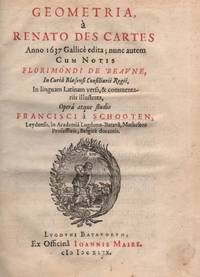
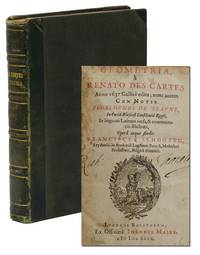
1649307Lugduni Batavorum Leiden: Ex Officinâ Ioannis Maire 1649. First separate and first Latin edition of “La Géometrie†second printing overall. Title page in red and black with printer’s device. In 18th century blind-stamped leather spine with four raised bands. Spine lettered in ink. Small traces of worming on the lower margin of the first five leaves. Slight damages on spine otherwise in fine condition. With numerous illustrations of diagrams in the text. With numerous illustrations of diagrams in the text. First separate and first Latin edition of “La Géometrie†second printing overall. Title page in red and black with printer’s device. In 18th century blind-stamped leather spine with four raised bands. Spine lettered in ink. 4°; 12 336 2 2 blank p. <p><br /> Descartes’ Geometria with brief notes by de Beaune 1601–1652; French mathematician and commentary by van Schooten. Frans van Schooten 1615–1660 was introduced to Descartes in 1632. Their first cooperation is dated a few years later when Descartes asked van Schooten to make the illustrations for “La Géométrie†1637 the first work to propose the idea of uniting algebra and geometry into a single subject which invented an algebraic geometry called analytic geometry. Van Schooten was one of the earliest and most important people to promote the Cartesian geometry.<br /> <p><p><br /> Tchemetzine IV 305. Wolf 196. Honeyman 858.<br /> <p><p><br /> With:<br /> <p><p><br /> Descartes René<br /> <p><p><br /> Musicae Compendium.<br /> <p><p><br /> Trajecti ad Rhenum Utrecht 1650. Gisberti à Zijll & Theodori ab Ackersdijck. 4°; 58 2 blank p.<br /> <p><p><br /> First edition of Descartes’ only work on music. Printer’s device on title page with numerous woodcut illustrations of diagrams figures and sheet music.<br /> <p><p><br /> Descartes wrote this study on music in 1618 but it was first published only after a year of his death. During his service in the army Descartes met Isaak Beeckman 1588–1637 the Dutch philosopher and scientist who introduced him into problems in mechanics and acoustics. The result of their meeting was this eassay “Musicae Compendium†a treatise on music and a study in methodology. The German music theorist Hugo Riemann declared this work to be “among the ablest musical writings of its timeâ€. <br /> <p><p><br /> MGG III 209.<br /> <p><p><br /> With:<br /> <p><p><br /> Descartes René<br /> <p><p><br /> Epistola Renati Des Cartes ad celeberrimum Virum D. Gisbertum Voetium in qua <br /> examinatur duo libri nuper pro Voetio Ultajecti simul editi unus Confraternitate Mariana alter de Philosophia Cartesianâ.<br /> <p><p><br /> Amstelodami 1650. Apud Ludovicum Elzevirium. 4°; aa1–ll4; 88 p.<br /> <p><p><br /> With half-title. Part of “Renati Des Cartes meditationes de prima philosophia in quibus Dei existentia & animae à corpore distinctio demonstratur . Tertia editio prioribus auctior & emendatior .â€. In this edition this epistle published with a special half-title and separate paging.<br /> <p><p><br /> Gisbertus Voetius Gijsbert Voet 1568–1676 was a Dutch Calvinist theologian. In 1642 while serving as rector of University of Utrecht persuaded the university’s academic senate to issue a formal condemnation of the Cartesian philosophy. Descartes responded to the offense with this epistle.<br /> <p>. Ex Officinâ Ioannis Maire unknown
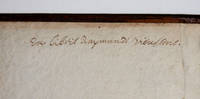
16684897Paris: Bobin & Le Gras 1668. Hardcover. Very Good. 4to - over 9¾ - 12" tall. 55 477 pp 2. With 22 full-page woodcuts 1 folding and 70 woodcut illustrations in text. Ink ownership inscription of Raymond Vieussens to front pastedown & shelf mark on front free endpaper. Bound in contemporary French calf spine in six compartments with gilt florets and title; some wear to boards but generally an excellent copy clean and fresh. Scarce edition of Descartes' magnum opus bearing the manuscript ex-libris of Raymond Vieussens 1635-1715 Royal Physician to Louis XIV and an important anatomist in his own right. Drawing directly on the dualistic theories of Descartes Vieussens became fascinated by the actions of the heart and of the brain in particular. "In his speculations on physiology Vieussens drew inspiration from both the mechanistic philosophy of Descartes and the iatrochemical ideas of F. de la Boë Sylvius. He believed that he had demonstrated the existence of the nervous fluid." DSB "Without Descartes the seventeenth-century mechanization of physiological conceptions would have been inconceivable" notes the DSB ".No other great philosopher except perhaps Aristotle can have spent so much time in expermintal observation. According to Baillet over several years he studied anatomy dissected and vivisected embryos of birds and cattle and went on to study chemistry. His correspondence from the Netherlands described dissections of dogs cats rabbits cod and mackerel; eyes livers and hearts obtained from an abattoir.". Descartes' magnum opus his Principia Philosophiae presented to the world the purest expression of his mechanist vision of the universe seized upon eagerly by later anatomists such as Thomas Willis Nicolas Steno and as is evident from the present copy Raymond Vieussens. Intended to replace the Aristotelian texts used in universities with a curriculum based on physical and immutable laws of nature Descartes' Principles especially in its French editions comes replete with numerous plates of his famous swirling vortices as well as discussions of the Copernican system. Curiously as C. F. Fowler has noted a direct reference to the Principia is lacking from the Index Librorum Prohibitorum of 1664 which otherwise banned most of Descartes' works - although a blanket clause is also given "and the philosophical works of same author". Evidently the decree of the Catholic Church disuaded neither French publishers from printing the work nor the Royal Physician from purchasing it! In particular Veussens seems to have been inspired by the Cartesian concept of cerebral localization; but while Descartes considered the pineal body to be the seat of animal spirits and the soul Veussens regarded the corpora striata as the seat of the imagination. "Inspired by both Descartes's mechanistic and the iatrochemical philosophies Vieussens studied the white matter of the brain by tracing the path of its fibers" Schlager & Lauer eventually providing us with an early description of the brain's centrum semiovale sometimes referred to as Vieussens' centrum. Following his well-received Neurographica Universalis 1685 the Royal Physician issued his Traité nouveau des Liqeurs de Corps Humain 1705 in which he describes the three Cartesian elements in detail and their functions within the body. Guilbert "Les Principes" 13; cf also Schlager & Lauer eds Science and Its Times 3 Gale 2001 p. 154; Fowler Descartes on the human soul: philosophy and the demands of Christian doctrine Kluwer 1999 pp 8-10. For the impact of Descartes' philosophy see PMM 129. Bobin & Le Gras hardcover books
16684897Paris: Bobin & Le Gras 1668. Hardcover. Very Good. 4to - over 9¾ - 12" tall. 55 477 pp 2. With 22 full-page woodcuts 1 folding and 70 woodcut illustrations in text. Ink ownership inscription of Raymond Vieussens to front pastedown & shelf mark on front free endpaper. Bound in contemporary French calf spine in six compartments with gilt florets and title; some wear to boards but generally an excellent copy clean and fresh. Scarce edition of Descartes' magnum opus bearing the manuscript ex-libris of Raymond Vieussens 1635-1715 Royal Physician to Louis XIV and an important anatomist in his own right. Drawing directly on the dualistic theories of Descartes Vieussens became fascinated by the actions of the heart and of the brain in particular. "In his speculations on physiology Vieussens drew inspiration from both the mechanistic philosophy of Descartes and the iatrochemical ideas of F. de la Boë Sylvius. He believed that he had demonstrated the existence of the nervous fluid." DSB "Without Descartes the seventeenth-century mechanization of physiological conceptions would have been inconceivable" notes the DSB ".No other great philosopher except perhaps Aristotle can have spent so much time in expermintal observation. According to Baillet over several years he studied anatomy dissected and vivisected embryos of birds and cattle and went on to study chemistry. His correspondence from the Netherlands described dissections of dogs cats rabbits cod and mackerel; eyes livers and hearts obtained from an abattoir.". Descartes' magnum opus his Principia Philosophiae presented to the world the purest expression of his mechanist vision of the universe seized upon eagerly by later anatomists such as Thomas Willis Nicolas Steno and as is evident from the present copy Raymond Vieussens. Intended to replace the Aristotelian texts used in universities with a curriculum based on physical and immutable laws of nature Descartes' Principles especially in its French editions comes replete with numerous plates of his famous swirling vortices as well as discussions of the Copernican system. Curiously as C. F. Fowler has noted a direct reference to the Principia is lacking from the Index Librorum Prohibitorum of 1664 which otherwise banned most of Descartes' works - although a blanket clause is also given "and the philosophical works of same author". Evidently the decree of the Catholic Church disuaded neither French publishers from printing the work nor the Royal Physician from purchasing it! In particular Veussens seems to have been inspired by the Cartesian concept of cerebral localization; but while Descartes considered the pineal body to be the seat of animal spirits and the soul Veussens regarded the corpora striata as the seat of the imagination. "Inspired by both Descartes's mechanistic and the iatrochemical philosophies Vieussens studied the white matter of the brain by tracing the path of its fibers" Schlager & Lauer eventually providing us with an early description of the brain's centrum semiovale sometimes referred to as Vieussens' centrum. Following his well-received Neurographica Universalis 1685 the Royal Physician issued his Traité nouveau des Liqeurs de Corps Humain 1705 in which he describes the three Cartesian elements in detail and their functions within the body. Guilbert "Les Principes" 13; cf also Schlager & Lauer eds Science and Its Times 3 Gale 2001 p. 154; Fowler Descartes on the human soul: philosophy and the demands of Christian doctrine Kluwer 1999 pp 8-10. For the impact of Descartes' philosophy see PMM 129. Bobin & Le Gras hardcover
1643156918Amsterdam: L. Elzevir 1643. Descartes's most significant contribution to the Querelle d'Utrecht First edition of one of Descartes's rarest works his famous open letter to the Dutch Calvinist Gisbert Voetius 1589-1676 who as rector of the University of Utrecht engineered a condemnation of Cartesianism and accused Descartes of actively encouraging atheism. The so-called "Querelle d' Utrecht" was a fierce public argument between Descartes and Voetius which lasted from 1639 until Descartes's death in 1650. Descartes's Letter was written as a response to two works by Voetius and his colleagues: the Confraternitas Mariana 1642 and the Admiranda Methodus 1643. Both attacked Descartes's philosophy and the latter - attributed to Martin Schoock 1614-1669 a supporter of Voetius - charged Descartes with rejecting the traditional proofs for the existence of God. It also implied that he deserved the same treatment as heretics such as Lucilio Vanini the Italian free-thinking philosopher who was executed in 1619 for atheism and blasphemy. In his Letter Descartes defended his philosophy at length and argued for the autonomy of human reason and religious tolerance. "As to moral philosophy the Letter to Voetius contains much of interest not only because it contains extensive discussions of the passions but also because much more than the Passions de l'âme it establishes a link between virtue and knowledge between morality and method" Verbeek. A Dutch translation was issued simultaneously Amsterdam: Van Baerdt 1643 and the original Latin was reprinted several times by the Elzevirs in the quarto editions of the Meditationes. Duodecimo 124 x 70 mm. Woodcut printer's device on title page tailpieces initials.q Contemporary vellum spine hand-lettered gilt single fillet border and fleur-de-lys cornerpieces on covers gilt gauffered edges. Small gilt bookplate on front pastedown with ink shelf marks of Tibulle Desbarreaux-Bernard 1798-1880 a Toulousian doctor author and noted collector of incunables and Elzevir imprints in particular. Vellum a little splayed spine and top edge of book block darkened; contents browned heavier to margins with very occasional spots. Overall a very good unsophisticated copy presenting handsomely in contemporary vellum. Guibert 75 1 "très rare"; Willems 998. Theo Verbeek "Descartes's Letter to Voetius" Church History and Religious Culture vol. 100 2020. hardcover
16622203Leydon: Peter Leffen & Francis Moyard 1662. First edition. contemporary vellum. Very Good. FIRST EDITION OF THE FIRST TEXTBOOK OF PHYSIOLOGY. "René Descartes's Treatise of man De homine 1662; Traité de l'homme 1664 was never intended to stand as a work on its own. It was one part of a much larger work Le monde The world. Although this was finished around 1633 Descartes did not publish it himself because he was alarmed by the Italian Inquisition's condemnation of Galileo Galilei that year. Some time after Descartes's death in 1650 his French manuscript copies of which had circulated among his friends and correspondents was edited and published. The first version was a Latin translation De homine by Florentius Schuyl in 1662 the second the now better known 'original' French version Traité de l'homme edited by Descartes's self-appointed literary executor Claude Clerselier in 1664. In the seventeenth century the 1662 Latin version was probably much more widely read than the French text" Donaldson J R Coll Physicians Edinb 2009; 39:375-6. Heirs of Hippocrates 295. Garrison-Morton 574. With 10 engraved plates; with 2 lift-up flaps on plate depicting the heart but without flap on plate of the brain as usual; numerous full-page and text engravings and woodcuts. Inscribed on title to Mart. Christian Sweerts "ex dono Autoris". The "author" in this case is most likely the translator Schuyl. De homine figuris et latinitate donatus a Florentio Schuyl. Leyden: Peter Leffen & Francis Moyard 1662. Small quarto contemporary vellum with leather spine label. Evidence of old label at base of spine. Remnants of old stamp on title occasional very light browning to margins. A beautiful copy. Peter Leffen & Francis Moyard unknown books
1649140941260Lugduni Batavorum Leiden: Ex Officina Ioannis Maire 1649. First Separate Edition. Good. First separate edition and first edition in Latin of Descartes' magnum opus. Bound in early 20th century quarter leather with spine lettered in gilt. Good. Binding rubbed at extremities with shallow loss to the crown. Front and rear inner hinge exposed though binding is holding; binding tender at pages 3-6 and 139-142. Evidence of small label removal from front pastedown markings and edge-tear to title page. English mathematician and astronomer Richard Towneley's 1629-1707 name to title page and his bookplate to verso of title page. Two contemporary ink notations. A work of monumental importance which influenced the thinking of Isaac Newton and Gottfried Wilhelm Leibniz it was the first to propose the idea of uniting algebra and geometry reducing geometry to a form of artimetic and algebra and transforming geometric shapes into algebraic equations. Originally published in French in 1637 as an appendix to Discours de la Methode; a separate French edition would not be published until 1664. Ex Officina Ioannis Maire unknown books
16622203Leydon: Peter Leffen & Francis Moyard 1662. First edition. contemporary vellum. Very Good. FIRST EDITION OF THE FIRST TEXTBOOK OF PHYSIOLOGY. "René Descartes's Treatise of man De homine 1662; Traité de l'homme 1664 was never intended to stand as a work on its own. It was one part of a much larger work Le monde The world. Although this was finished around 1633 Descartes did not publish it himself because he was alarmed by the Italian Inquisition's condemnation of Galileo Galilei that year. Some time after Descartes's death in 1650 his French manuscript copies of which had circulated among his friends and correspondents was edited and published. The first version was a Latin translation De homine by Florentius Schuyl in 1662 the second the now better known 'original' French version Traité de l'homme edited by Descartes's self-appointed literary executor Claude Clerselier in 1664. In the seventeenth century the 1662 Latin version was probably much more widely read than the French text" Donaldson J R Coll Physicians Edinb 2009; 39:375-6. Heirs of Hippocrates 295. Garrison-Morton 574. With 10 engraved plates; with 2 lift-up flaps on plate depicting the heart but without flap on plate of the brain as usual; numerous full-page and text engravings and woodcuts. Inscribed on title to Mart. Christian Sweerts "ex dono Autoris". The "author" in this case is most likely the translator Schuyl. De homine figuris et latinitate donatus a Florentio Schuyl. Leyden: Peter Leffen & Francis Moyard 1662. Small quarto contemporary vellum with leather spine label. Evidence of old label at base of spine. Remnants of old stamp on title occasional very light browning to margins. A beautiful copy. Peter Leffen & Francis Moyard unknown
1649140941260Lugduni Batavorum Leiden: Ex Officina Ioannis Maire 1649. First Separate Edition. Good. First separate edition and first edition in Latin of Descartes' magnum opus. Bound in early 20th century quarter leather with spine lettered in gilt. Good. Binding rubbed at extremities with shallow loss to the crown. Front and rear inner hinge exposed though binding is holding; binding tender at pages 3-6 and 139-142. Evidence of small label removal from front pastedown markings and edge-tear to title page. English mathematician and astronomer Richard Towneley's 1629-1707 name to title page and his bookplate to verso of title page. Two contemporary ink notations. A work of monumental importance which influenced the thinking of Isaac Newton and Gottfried Wilhelm Leibniz it was the first to propose the idea of uniting algebra and geometry reducing geometry to a form of artimetic and algebra and transforming geometric shapes into algebraic equations. Originally published in French in 1637 as an appendix to Discours de la Methode; a separate French edition would not be published until 1664. Ex Officina Ioannis Maire unknown
1662176381662. Lugduni Batavorum: Apud Petrum Leffen & Franciscum Moyardum 1662 4° 36 121 pp. 123 111/112 repeated 1 p. Nota 56 woodcut and engraved text-illustrations 10 engraved plates contemporary vellum; complete fine copy. First Edition! Complete with all 56 woodcut and engraved text-illustrations many of which are full-page and the 10 full-page engraved plates several folded one of which is the heart-plate with the 6 moveable parts the Cardiac-flaps. This edition was posthumously published and translation by Florentius Schuy. A seminal work René Descartes 1596-1650 'Treatise on man' is known as the first European textbook of physiology and the first purely mechanistic account of bodily functions. "In the Treatise of man Descartes did not describe man but a kind of conceptual models of man namely creatures created by God which consist of two ingredients a body and a soul. "These men will be composed as we are of a soul and a body. First I must describe the body on its own; then the soul again on its own; and finally I must show how these two natures would have to be joined and united in order to constitute men who resemble us"." SEP. "This highly influential work was the first to present a coherent description of bodily responses in neurophysiological terms that are still to a wide extent accepted today. In his attempt to solve the central question around which almost all philosophical thought had revolved since the time of Aristotle what the relation between the soul and the body actually is Descartes came to create a milestone work of physiology which changed the entire trajectory of modern physiological conceptions. "Without Descartes the seventeenth-century mechanization of physiological conceptions would have been inconceivable." He believed that the relationship between the soul and the body was mediated by the brain and the nervous system and his seminal attempts to explain neural mechanisms drew a great deal on the engineering developments of his time. He developed a hydro-mechanical theory of how the soul controlled the contraction of muscle through the intermediary of the pineal and the cerebral ventricles and he produced an explanation of how it received through the nerves from the periphery signals that gave rise to sensation. Descartes' theories quickly spread throughout Europe and the work in which he had developed them his "De Homine" became extremely influential. "Descartes was one of the first to embrace Harvey's doctrine of the circulation and the book opens with an account of the cardiovascular system illustrated by a plate of the heart with movable flaps. From a mechanistic survey of general physiology Descartes moves to the nervous system which he treats in great detail. Particularly important is his discussion of the eye drawing on Kepler for the optical part and the physiology of perception. 'The impact of the Cartesian physiological program once it was publicly known was enormous. In two ways -philosophically and physiologically -Descartes transformed long-standing beliefs about animals and men. Philosophically of course his notions of mind-body dualism and animal automatism had extremely important implications that were not lost on Henry More Malebranche Spinoza and Leibniz along with many others in the seventeenth century . But physiologically too Descartes' conceptions had an impact that in many ways was even more impressive than the philosophical influence because it affected the actual course of contemporary science'. DSB. Descartes was prepared to publish this book in 1633 but decided to withhold it when he learned of Galileo's condemnation by the Church. As a result the first edition was not published until 1662. This first Latin translation De homine by Florentius Schuyl in 1662 was probably much more widely read than the two years later published French edition. Guibert Nr. 1. Edition Originale. Grolier Medicine 31; Garrison-Morton 574; Wellcome II p. 453; Krivatsy 3120; Norman 627 hardcover
1662679671662. Lugduni Batavorum: Apud Franciscum Moyardum & Petrum Leffen 1662 4° 36 121 pp. 123 111/112 repeated 1 p. Nota 56 woodcut and engraved text-illustrations 10 engraved plates contemporary vellum; complete fine copy. First Edition! Complete with all 56 woodcut and engraved text-illustrations many of which are full-page and the 10 full-page engraved plates several folded one of which is the heart-plate with the 2 moveable parts the Cardiac-flaps and one for flab for the brain Fig. 54. This edition was posthumously published and translation by Florentius Schuy. A seminal work René Descartes 1596-1650 'Treatise on man' is known as the first European textbook of physiology and the first purely mechanistic account of bodily functions. "In the Treatise of man Descartes did not describe man but a kind of conceptual models of man namely creatures created by God which consist of two ingredients a body and a soul. "These men will be composed as we are of a soul and a body. First I must describe the body on its own; then the soul again on its own; and finally I must show how these two natures would have to be joined and united in order to constitute men who resemble us"." SEP. "This highly influential work was the first to present a coherent description of bodily responses in neurophysiological terms that are still to a wide extent accepted today. In his attempt to solve the central question around which almost all philosophical thought had revolved since the time of Aristotle what the relation between the soul and the body actually is Descartes came to create a milestone work of physiology which changed the entire trajectory of modern physiological conceptions. "Without Descartes the seventeenth-century mechanization of physiological conceptions would have been inconceivable." He believed that the relationship between the soul and the body was mediated by the brain and the nervous system and his seminal attempts to explain neural mechanisms drew a great deal on the engineering developments of his time. He developed a hydro-mechanical theory of how the soul controlled the contraction of muscle through the intermediary of the pineal and the cerebral ventricles and he produced an explanation of how it received through the nerves from the periphery signals that gave rise to sensation. Descartes' theories quickly spread throughout Europe and the work in which he had developed them his "De Homine" became extremely influential. "Descartes was one of the first to embrace Harvey's doctrine of the circulation and the book opens with an account of the cardiovascular system illustrated by a plate of the heart with movable flaps. From a mechanistic survey of general physiology Descartes moves to the nervous system which he treats in great detail. Particularly important is his discussion of the eye drawing on Kepler for the optical part and the physiology of perception. 'The impact of the Cartesian physiological program once it was publicly known was enormous. In two ways -philosophically and physiologically -Descartes transformed long-standing beliefs about animals and men. Philosophically of course his notions of mind-body dualism and animal automatism had extremely important implications that were not lost on Henry More Malebranche Spinoza and Leibniz along with many others in the seventeenth century . But physiologically too Descartes' conceptions had an impact that in many ways was even more impressive than the philosophical influence because it affected the actual course of contemporary science'. DSB. Descartes was prepared to publish this book in 1633 but decided to withhold it when he learned of Galileo's condemnation by the Church. As a result the first edition was not published until 1662. This first Latin translation De homine by Florentius Schuyl in 1662 was probably much more widely read than the two years later published French edition. Guibert mentions two states of the the title-page: the first with the imprint "Apud Leffen & Franciscum Moyardum and a woodcut printer's device of a phoenix rising from the flames motto "ex morte immortalia"; and the second with the names of the publishers reversed and a device showing an angel under a laurel tree "motto insigne maxime laurus". He does not establish any priority of issue. Guibert Nr. 2. Edition Originale. Grolier Medicine 31; Garrison-Morton 574; Wellcome II p. 453; Krivatsy 3120; Norman 627 hardcover
1647305091647. A Paris chez la Veuve de Jean Camusat et Pierre Le Petit 1647 - Amstelodami Amsterdam apud Danielem Elzevirium Daniel Elzevier / Elsevier 1664 - Amstelodami apud Danielem Elzevirium 1664 - Amstelodami apud Ludovicum & Danielem Elzevirios 1664 - Lugduni Batavorum Leyde / Leyden apud Franciscum Moyardum & Petrum Leffen 1662 - A Paris chez Michel Bobin et Nicolas Le Gras 1677. 3 vol. au format pt in-4 208 x 165 mm de 1 f. bl. 7 ff. n.fol. 606 pp. 1 f. n.fol. et 1 f. bl. ; 1 f. bl. 20 dont frontispice gravÂŽ ff. n.fol. et 222 pp. ; 1 f. bl. 8 ff. n.fol. et 248 pp. ; 12 ff. n.fol. 92 pp. et 2 ff. n.fol. ; 18 ff. n.fol. 121 pp. et 1 f. bl. ; 32 ff. n.fol. 511 pp. 4 ff. n.fol. et 1 f. bl. Reliures uniformes dÂŽbut XIXÂme de pleine basane racinÂŽe blonde plats jansÂŽnistes dos lisses ornÂŽs de jeu de filets gras et maigres dorÂŽs larges fleurons dorÂŽs entrelacs de petits filets dorÂŽ formant croisillons piÂces de titre de maroquin carmin piÂces de tomaison de maroquin vert-bronze titre dorÂŽ tomaison dorÂŽe palette dorÂŽe en queue filet dorÂŽ sur les coupes tranches mouchetÂŽes. PrÂŽcieux ensemble renfermant six oeuvres de Descartes en ÂŽditions XVIIÂme. Les MÂŽditations mÂŽtaphysiques sont ici proposÂŽes dans leur premiÂre ÂŽdition franÂaise ; en partie originale. ''PremiÂre traduction franÂaise des MÂŽditations faite par le Duc de Luynes. C'est Descartes qui a lui-mÂme corrigÂŽ et revu la traduction en franÂais de ses MÂŽditations en prÂŽcisant certains passages insuffisamment claires dans leur forme latine''. in Guibert. Edition originale pour De homine figuris ; dont la marque d'imprimeur en page de titre figure un ange avec une lyre sous des lauriers. ''Cette ÂŽdition originale latine a ÂŽtÂŽ faite sur une copie du manuscrit original franÂais. Elle renferme 58 figures sur bois et cuivre dont 10 hors-texte''. in Guibert. On trouve ˆ la suite la traduction franÂaise de L'Homme ; dont c'est lˆ la seconde ÂŽdition ; en partie originale. ''L'ouvrage contient de nombreuses figures anatomiques et gÂŽomÂŽtriques sur bois''. in Guibert. Quant aux Principia philosophiae Specimina philosophiae et Passiones animae ''on trouve ces oeuvres dans le recueil factice des Oeuvres philosophiques de Descartes 1670-72''. in Guibert. Guibert Bibliographie des Oeuvres de Descartes publiÂŽes au XVIIÂme siÂcle p. 45 ; p. 126 ; p. 107 ; p. 163 ; p. 196 ; p. 203. LÂŽgÂres altÂŽrations superficielles affectant les reliures. Titre de s MÂŽditations rognÂŽ court en marge infÂŽrieure. rares rousseurs dans les corps d'ouvrages. Petite cerne angulaire affectant une dizaine de feuillets. Restauration anciene au revers d'une des planches. Du reste ensemble en belle condition. b42961 unknown