DESCARTES, RENEBiblio.com

1 037 résultats
9786555618242NOVO SECULO. new. "De todas as coisas do mundo o bom senso � aquilo mais distribu�do igualmente entre os homens."" Discurso sobre o M�todo: para bem conduzir a razo e buscar a verdade na cincia � a obra de Ren� Descartes em que ele desafia conceitos estabelecidos e explora a natureza do conhecimento e a importncia da dvida met�dica. Com clareza Descartes estabelece fundamentos que transcendem a filosofia influenciando �reas to diversas quanto a f�sica a matem�tica e a �tica al�m de trazer racioc�nios pelos quais estabelecemos a existncia de Deus e da alma humana. Este livro no apenas instrui mas tamb�m inspira uma jornada intelectual em busca da verdade e do entendimento profundo da realidade. NOVO SECULO unknown
1995315699Easton Press 1995. Hardcover. Near Fine. Twelve volumes in uniform bindings of full bright red leather stamped in gilt spine titles in black labels. No corners or spine ends bumped or pushed. All have an unused bookplate laid in. Three have no flaws whatsoever to the page edge gilt eight have very minor almost imperceptible flaws Plato has two white spots on the top edge. This set will be remarkably attractive on your shelf. Please request a shipping quote before ordering. Easton Press hardcover
2738461123.Gpaperback. Good. Access codes and supplements are not guaranteed with used items. May be an ex-library book. paperback
2008Q-160796032XBN Publishing 2008-11-10. Paperback. New. In shrink wrap. Looks like an interesting title! BN Publishing paperback
2007DADAX8446027895Ediciones Akal S.A 2007-11-01. 1. paperback. New. 4.72x2.36x7.09. Buy with confidence. Excellent Customer Service & Return policy. Ediciones Akal, S.A paperback
1955002300Chicago Ill: The Great Books Foundation 1955. ELEVEN VOLUME SET : Ecclesiastes Oedipus Rex Oedipus at Colonus The Odyssey Meno Ethics Selections Of the Nature of Things Books I-III Confessions Books I-VIII Hamlet Discourse on Method Leviathan Selections Pensees Selections Gulliver's Travels On the Origin of Inequality Perpetual Peace On Liberty Huckleberry Finn and Readings for Discussion Second Year Course. Good condition Softcover 12mo 1955 Eleven volume set encompassing 16 books and an index in a Fair condition Slip Case. All books clean and tight. Spines showing minimal wear and soiling but most are creased. A couple of the volumes have some pencil notetaking within. The slip case is split along one edge and has wear and chipping. All in all a good condition set of philosophy books. 2nd Edition. Paperback. Good. 12mo - over 6" - 7" tall. Set. The Great Books Foundation Paperback
17657144<p>Paris: Chez Regnard 1765 First edition. Later wrappers. Octavo. Very good. Thomas wrote numerous such eulogies winning much critical acclaim. This work is 84 pages with notes of 42 pages.</p> Chez Regnard,
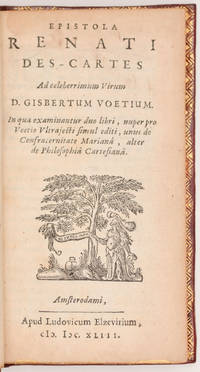
1643156918Amsterdam: L. Elzevir 1643. Descartes's most significant contribution to the Querelle d'Utrecht First edition of one of Descartes's rarest works his famous open letter to the Dutch Calvinist Gisbert Voetius 1589-1676 who as rector of the University of Utrecht engineered a condemnation of Cartesianism and accused Descartes of actively encouraging atheism. The so-called "Querelle d' Utrecht" was a fierce public argument between Descartes and Voetius which lasted from 1639 until Descartes's death in 1650. Descartes's Letter was written as a response to two works by Voetius and his colleagues: the Confraternitas Mariana 1642 and the Admiranda Methodus 1643. Both attacked Descartes's philosophy and the latter - attributed to Martin Schoock 1614-1669 a supporter of Voetius - charged Descartes with rejecting the traditional proofs for the existence of God. It also implied that he deserved the same treatment as heretics such as Lucilio Vanini the Italian free-thinking philosopher who was executed in 1619 for atheism and blasphemy. In his Letter Descartes defended his philosophy at length and argued for the autonomy of human reason and religious tolerance. "As to moral philosophy the Letter to Voetius contains much of interest not only because it contains extensive discussions of the passions but also because much more than the Passions de l'âme it establishes a link between virtue and knowledge between morality and method" Verbeek. A Dutch translation was issued simultaneously Amsterdam: Van Baerdt 1643 and the original Latin was reprinted several times by the Elzevirs in the quarto editions of the Meditationes. Duodecimo 124 x 70 mm. Woodcut printer's device on title page tailpieces initials.q Contemporary vellum spine hand-lettered gilt single fillet border and fleur-de-lys cornerpieces on covers gilt gauffered edges. Small gilt bookplate on front pastedown with ink shelf marks of Tibulle Desbarreaux-Bernard 1798-1880 a Toulousian doctor author and noted collector of incunables and Elzevir imprints in particular. Vellum a little splayed spine and top edge of book block darkened; contents browned heavier to margins with very occasional spots. Overall a very good unsophisticated copy presenting handsomely in contemporary vellum. Guibert 75 1 "très rare"; Willems 998. Theo Verbeek "Descartes's Letter to Voetius" Church History and Religious Culture vol. 100 2020. hardcover
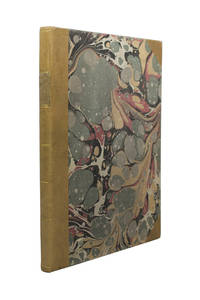
16431820Amsterodami Amsterdam: Apud Ludovicum Elzevirium Elzevier 1643. First edition. In later red maroquin. Gilt panels spine and inner edges. Marbled endpapers. Gilt edges. Woodcut device on the title page. Woodcut initials and tailpieces. 19th-century presentation inscription and possessor’s inscription on flyleaf. In fine condition. First edition. In later red maroquin. Gilt panels spine and inner edges. Marbled endpapers. Gilt edges. Woodcut device on the title page. Woodcut initials and tailpieces. 12 282 p. <p><br /> The scarce first edition of this fundamental text for the history of philosophy and human thought in which Descartes defends the autonomy of reason and doubt.<br /> <p><p><br /> Ad celeberrimum is Descartes’ offensive open letter published in May 1643 a response to Gisbertus Voetius’ two earlier books attacking Descartes Confraternitas Mariana 1642; Admiranda Methodus 1643 and a reaction to the condemnation of Cartesianism by the University of Utrecht of which Voetius was Rector. In the text Descartes calls for criticism by reasoning and not by authority argues for the primacy of education over learning and for the importance and autonomy of reason Hoon Woo 2013. <br /> <p><p><br /> Scarce WorldCat locates only 6 copies worldwide.<br /> <p><p><br /> Literature: Cottingham J.; et al.: The Philosophical Writings of Descartes. Volume 3: The Correspondence. Cambridge: Cambridge University Press 1985.; Hoon Woo B.: The Understanding of Gisbertus Voetius and René Descartes on the Relationship of Faith and Reason and Theology and Philosophy. In: Westminster Theological Journal 75 no. 1 2013. pp. 45–63. <br /> <p>. Apud Ludovicum Elzevirium [Elzevier] unknown
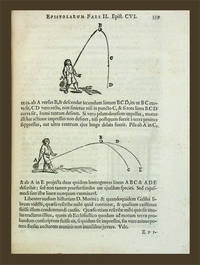
166840662DB1668. 2 Bände. Amsterdam Daniel Elzevier 1668. Kl.-4°. 4 n.n. Bl. 383 S.; 4 n.n. Bl. 404 S. Mit ca. 180 Holzschnittillustrationen im Text. Lederbände der Zeit mit Rückenvergoldung. Willems 1393. - Erste lateinische Ausgabe aus dem Nachlass herausgegeben. Descartes beschreibt gesammelte Experimente die er als Lehrer während seines fast 20-jährigen Aufenthaltes in Holland verfasste. - Einbände stark beschabt. Rückenvergoldung oxydiert. unknown
1682006874Amsterdam: Apud Danielem Elzevirium 1682. First Edition. Full Vellum. Near Fine. First Latin edition of the first part second issue of the second part. 8vo. First volume: 19.5 by 15 cm. 8 383 pp. Second volume: 21 by 16 cm. 4 404 4 pp. Many diagrams and small woodcut drawings throughout. Letters include ones addressed to Hobbes Fermat de Roberval Henry More and Mersenne. Descartes comments of Galileo's Dialogo on p. 276 part II. Vellum of first volume with a blindstamped centerpiece and other ruled/geometric decoration. Also raised bands. Second volume has smoother plainer vellum and simple spine with exposed cords by joints. Both volumes with handwritten/inked title on spine. Both volumes have some light soiling on vellum. Second volume with small red ink blotch upper front board. Both volumes' endpapers now loose exposing vellum flaps which also now lifted. Apud Danielem Elzevirium unknown
ABAA-75TH-VBF-23<p>Amsterdam Blaeu 1682-1683.</p><p>3 parts in 3 volumes 4to I/ 1 bl.l. 4 ll 383 pp 1 bl.l.; II/ 1 bl.l. 2 ll 404 pp. 2 ll. 1 bl.l.; III/ 1 bl.l. 8 ll. 427 pp. 1 bl.l. small burnhole pp. 249 and 413 with damage to 2 letters.</p><p>Full Dutch vellum blindstamped fleuron in the center of the covers double blindstamped fillet around the covers flat spines speckled edges. <em>Contemporary binding by the editor Blaeu.</em></p><p>201 x 154 mm.</p><p><strong>First complete edition of Descartes' Letters to princess Elisabeth and Mersenne.</strong> The 3rd volume contains the continuation of Descartes' Latin correspondence and appears here for the first time.</p><p>Tchemerzine II 786.</p><p><strong>For several years from 1642 to the end of 1649 i.e. during the period of his life from the "Meditations Metaphysiques" to his death in Stockholm Rene Descartes 1596-1650 corresponded assiduously with princess Elisabeth daughter of Frederic V elector palatine and king of Bohemia.</strong></p><p><em>"Princess Elisabeth a highly cultured woman with a special interest in mathematics had read the 'Méditations métaphysiques' with great interest and admiration. Through a French émigré and friend of Descartes Palotti she had penetrated further into the thinking of the man she soon considered her master.</em></p><p><em>And in her very first letter May 1643 she asked the philosopher to explain a point in his "Meditations" that she didn't quite grasp: how it could be that "the soul can determine the spirits animals of the body to do voluntary actions being only a thinking substance" and therefore unexpanded. Descartes explains why this point may have remained obscure in his exposition. This discussion which is the most interesting in the whole "Correspondence" occupies all the letters of 1643. In the years that followed the problems that arose with the publication of Descartes' works he sent them to his friend and dedicated his "Passions de l'amour" to her were of all kinds: about the "Principles of Philosophy" about books he advised her to read or on which she asked his opinion about new scientific developments the princess asked for clarification and discussed certain points of physics mathematics morals and metaphysics that she had not grasped or that seemed questionable. "My admiration increases every time I reread the objections made to you how it is possible that people who have spent so many years meditating and studying could not understand things so simple and clear that most in disputing the true and the false seem not to know how they should be discerned and that the sieur Gassendus Gassendi who is in the greatest repute for his learning has made after the Englishman Hobbes objections less reasonable than all the others. "</em></p><p><strong>This correspondence is of very great interest; for in connection with the questions of his interlocutor Descartes was led to take up a certain number of problems and to give a clearer and more complete account of them than in his works</strong>;<em> but above all it is the only direct document that lets us get to know him intimately and in him the man and not just the philosopher. "We learn that he had planned to write a 'Traité de l'érudition' Treatise on Erudition; we gain interesting details about the life all secluded and devoted to study and above all meditation he led in Holland and about the few months he spent at the court of Christine of Sweden."</em></p><p><strong>Descartes also wrote to Mersenne</strong> improvising answers to countless questions with extraordinary ease.</p><p>"The 3 volumes of this correspondence are illustrated with numerous figures and geometric woodcuts". Guibert <em>Bibliographie des Œuvres de René Descartes</em> p. 94.</p><p><strong>A fine copy preserved in its contemporary Dutch vellum binding.</strong></p><p><strong>FR</strong></p><p>Amsterdam Blaeu 1682-1683.</p><p>3 parties en 3 volumes in-4 I/ 1 f.bl. 4 ff. 383 pp. 1 f.bl. ; II/ 1 f.bl. 2 ff. 404 pp. 2 ff. 1 f.bl. ; III/ 1 f.bl. 8 ff. 427 pp. 1 f.bl. pte. brulure pp. 249 et 413 avec atteinte à 2 lettres.</p><p>Plein vélin hollandais fleuron à froid au centre des plats double filet à froid autour des plats dos lisses tranches jaspées. <em>Reliure de l'époque de l'éditeur Blaeu</em>.</p><p>201 x 154 mm.</p><p><strong>Première édition originale complète des Lettres de Descartes à la princesse Élisabeth et à Mersenne.</strong>Le 3ème volume contient la suite de la correspondance latine de Descartes et paraît ici pour la première fois.</p><p>Tchemerzine II 786.</p><p><strong>Pendant plusieurs années de 1642 à la fin de 1649 c'est-à-dire pendant la période de sa vie qui va des " Méditations métaphysiques " à sa mort à Stockholm René Descartes 1596-1650 échangea une correspondance assidue avec la princesse Élisabeth fille de Frédéric V électeur palatin et roi de Bohême.</strong></p><p><em>" Celle-ci femme fort cultivée et spécialement versée dans les sciences mathématiques avait lu avec beaucoup d'intérêt et une vive admiration les 'Méditations métaphysiques'. Par un émigré français ami de Descartes Palotti elle avait pénétré plus avant dans la pensée de celui qu'elle considéra bientôt comme son maître.</em></p><p><em>Et dès sa première lettre mai 1643 elle demande au philosophe quelques explications sur un point de ses " Méditations " qu'elle ne saisit pas bien : comment peut-il se faire que " l'âme puisse déterminer les esprits animaux du corps pour faire les actions volontaires n'étant qu'une substance pensante " donc inétendue. Descartes explique pourquoi ce point a pu demeurer obscur dans son exposé. Cette discussion qui est la plus intéressante de toute la " Correspondance " occupe toutes les lettres de l'année 1643. Au cours des années suivantes les problèmes qui se poseront à l'occasion de la parution des œuvres de Descartes celui-ci les faisait parvenir à son amie et lui dédia ses " Passions de l'amour " sont de tous ordres : à propos des " Principes de la Philosophie " à propos des livres qu'il lui conseille de lire ou sur lesquels elle lui demande son avis à propos des nouveautés scientifiques la princesse se fait éclaircir et discute certains points de physique de mathématiques de morale et de métaphysique qu'elle n'a point saisis ou qui lui semblent contestables. " Mon admiration s'augmente toutes les fois que je relis les objections qu'on vous a faites comment il est possible que des personnes qui ont employé tant d'années à la méditation et à l'étude ne sauraient comprendre des choses si simples et si claires que la plupart en disputant du vrai et du faux semblent ne pas connaître comment il les faut discerner et que le sieur Gassendus Gassendi qui est en la plus grande réputation pour son savoir a fait après l'Anglais Hobbes des objections moins raisonnables que tous les autres. "</em></p><p><strong>Cette correspondance présente un très grand intérêt ; car à propos des questions de son interlocutrice Descartes se trouve amené à reprendre un certain nombre de problèmes et à en donner un exposé plus clair et plus complet que dans ses œuvres </strong>; <em>mais surtout c'est le seul document direct qui nous le fasse connaître dans son intimité et en lui l'homme et non plus seulement le philosophe. " Nous y apprenons qu'il avait projeté d'écrire un " Traité de l'érudition " ; nous y gagnons d'intéressants détails sur la vie toute retirée et consacrée à l'étude et surtout à la méditation qu'il mena en Hollande et sur les quelques mois qu'il passa à la cour de Christine de Suède.</em> "</p><p><strong>Descartes écrit aussi à Mersenne</strong><strong> </strong>improvisant des réponses à d'innombrables questions avec une facilité extraordinaire.</p><p>" Les 3 volumes de cette correspondance sont illustrés de nombreuses figures et dessins géométriques sur bois ". Guibert <em>Bibliographie des Œuvres de René Descartes</em> p. 94.</p><p><strong>Bel exemplaire conservé dans son vélin hollandais de l'époque. </strong></p> hardcover
35575Amsterdam. Daniel Elzevier. 1668. 1st Edition. Hardcover. 4to 19.5cm first Latin edition viii383p. title page vignette numerous woodcut text illustrations index black leather label contemporary full vellum yapped front edges some light foxing binding is somewhat dust soiled about usual for vellum very good to fine ds1. ~ Volume one of three volume set. The spine title reads : Cartesii. Epistol. Tom. I." A Latin edition of Descartes' "Letters" whereby the fundamentals of Cartesian doctrines are laid out. Amsterdam. Daniel Elzevier. 1668 hardcover
193626337Paris: Boivin & Cie 1936. Very Good. Paris: Boivin & Cie 1936. First Edition. Octavo; publisher's cream printed card wrappers; 234pp. Minor shelf wear and moderate soil to wrappers textblock uniformly toned and brittle later 1977 ownership inscription inside upper cover else Very Good and sound. Boivin & Cie unknown
0666413835.Gpaperback. Good. Access codes and supplements are not guaranteed with used items. May be an ex-library book. paperback
2004Q-190491912XCrw Pub Ltd 2004-08-31. Hardcover. New. New. In shrink wrap. Looks like an interesting title! Crw Pub Ltd hardcover
165367749London: Printed by Thomas Harper for Humphrey Moseley 1653. First English edition. Small quarto 7 5/16 x 5 3/8 inches; 187 x 135 mm. 16 94 1 errata 1 blank pp. Two parts in one volume. With three engraved plates and with numerous woodcuts including head-and-tail pieces and initials. Title-pages with woodcut vignette. Much of the illustrations are of musical notes staffs and various charts relating to music theory. Also with a detailed and attractive engraving of a lute.<br> <br> The translator the "Person of Honour" refers to Lord Brouncker. His name has been printed neatly on the title-page in old ink by a previous owner. A separate title-page for Animadversions vpon the musick-compendium of Renat. Des-Cartes is included but the pagination and collation is continuous.<br> <br> Modern half calf over marbled boards. Morocco spine label lettered in gilt. Newer endpapers. Front pastedown with previous owner's bookplate. Some toning and spotting throughout the first two leaves being the worst. Tiny burn hole to top margin of two leaves in the "To the Reader" not affecting text.<br> <br> Written in 1618 when he was 22 the Compendium was not published until after his death. "Although it is his earliest surviving work the Compendium was not published until 1650 shortly after his death in Stockholm. The English translation was published in 1653 by William Brouncker 2nd Viscount Brouncker 1620-1684 a mathematician who became the first President of the Royal Society in 1662 and was a close friend of both Samuel Pepys and John Evelyn. He is named on the title page of the Compendium as a "Person of Honour" and his commentary the "animadversions" on Descartes work constitute his only publication. They include an unsuccessful mathematical attempt to divide the diapason into seventeen equal semitones. Descartes' study of the mathematical basis of music was also an examination of methodology: the application of empirical deductive and scientific approaches to the study of sensory perception. It is thus among the earliest attempts to define the dual relationship between the physical and psychological phenomena in music." Thomas Fisher Rare Book Library University of Toronto.<br> <br> ESTC R13570.<br> <br> HBS 67749.<br> <br> $3750. Printed by Thomas Harper, for Humphrey Moseley unknown
1896002500Librairie Garnier Freres 1896 Title: French Age of Enlightenment and Drama - 18 Books. Publisher: Librairie Garnier Freres. Printer: C. Whiting Beaufort-House Savill Edwards and Co E. Capiomont et Cie A. Derse E. Grevin Leve L. Maretheux Orleanaise. Publication date: Late 19th Century no date circa 1890s. Editions: Nouvelle Editions. "Garnier Classiques". Place: Paris. Language: French. Author - Individual titles pages p. R. Descartes - Oeuvres Choisies de Descartes 438 p. J. De la Fontaine - Contes et Nouvelles de la Fontaine 508 p. H. Murger -Scenes de la Vie de Boheme 423 p. J. Racine - Theatre Complet de J. Racine. 760 p. J. Rousseau - Emile 638 p. Contrat Social 512 p. Les Confessions 656 p. Stendhal - La Chartreuse de Parme. Edition Complet. 321 p. Voltaire - Romans 572 p. Histoire de Charles XII 390 p. Le Siecle de Louis XIV 611 p. Précis du Siecle de Louis XV 564 p. Theatre 717 p. Lettres Choisies Vols. 1 441 p.& 2 406 p. La Henriade 404 p. La Pucelle D'Orleans 390 p. Le Sottisier 333 p. About this item: 7726 Pp total. 8vo. Published circa 1920s. 18 uniformly bound volumes. 3/4 Red Morocco binding 4 raised bands on spine covers with gilt titles with gilt/blind stamped design matching marble boards and end papers contents included tables and appendices a few illustrated with tissue guarded frontispiece portraits. Dimensions: 7.5 H x 5 D x 1 - 2 23 overall W inches. Provenance/Publisher: In 1833 two brothers from the department of Manche Auguste and Hippolyte Garnier opened a bookstore in the tradition of nineteenth-century publisher-booksellers under the arches of the Palais Royal in Paris then one of the liveliest centers in the capital. They were soon joined by another of their brothers Pierre. The business took off very quickly and the Garnier brothers bought up the backlists of Delloye Dubochet and Salvat publishers of the works of the great romantic authors followed by the classical lists of Panckoucke. They also struck up connections with Sainte-Beuve Musset Gautier Sand and Vigny publishing some of their works. The Maison Garnier Frères gained even more prestige in 1853 when it moved to the former government building on the corner of the rue de Lille and the rue des Saints-Pères. The Garnier brothers worked to expand and improve their catalog publishing numerous dictionaries popular titles and books for young readers while also continuing with their literary publications: collections of Latin and Greek classics and modern works. In 1896 the appearance of the first "Nouvelle Editions" of the Classiques Garnier a new collection combining the previous Classiques latins Classiques grecs and Bibliothèque choisie collections. In the words of the catalog the new collection offered the best French and foreign ancient and modern works. It was a success and frequent references to the Classiques Garnier is featured in autobiographical works thereafter. Over the course of the twentieth century scholarly editions increasingly took precedence. In the 1960s to produce low-cost versions of the "Classiques Garnier" a deal was struck with Flammarion. The low-cost versions were stripped of critical commentary. This was the start of Garnier-Flammarion an independent company in 1970 under the name GF Flammarion. This was one of many deals to assure the solvency of the publisher though eventually Editions Garner Freres went bankrupt in June 1983 their list was bought up by Presses de la Cite. InfoMédia acquired the collection in 1998 with the prime aim of upholding the editorial policies that have made the Classiques Garnier famous for over a century. Since 2009 under the editorial direction of Claude Blum Editions Classiques Garnier has expanded its catalog to include all aspects of literature and the humanities publishing both editions of texts and studies and essays by top specialists. Hardcover. Very Good/No Jacket. Librairie Garnier Freres hardcover
1910188738New York: P. F. Collier & Son 1910. Edition De Luxe; First Printing. Hardcover. Very Good in boards. Moderately sunned spine. Top text block edge gilded. Serialed as part of limited set 2495.; Alumni Edition. P. F. Collier & Son hardcover
B9781498081184Paperback / softback. New. paperback
1162626917.Gpaperback. Good. Access codes and supplements are not guaranteed with used items. May be an ex-library book. paperback
0766181871.Gpaperback. Good. Access codes and supplements are not guaranteed with used items. May be an ex-library book. paperback
1163210463.Ghardcover. Good. Access codes and supplements are not guaranteed with used items. May be an ex-library book. hardcover
1498081185.Gpaperback. Good. Access codes and supplements are not guaranteed with used items. May be an ex-library book. paperback
2001346222Easton Press 2001. FIRST THUS. Hardcover. Like New/No Jacket. First Edition Thus. Published by Easton Press 2001. Octavo. Hardcover. Deluxe genuine fine red leather binding with extra gilt decoration on inside edges. The Harvard Classics Eliot Edition/Millennium Edition. Book is like new very fine. No writing names or ownership markings or bookplates. Binding tight and pages crisp. Gilt staining has no scratches. A wonderful crisp and clean copy of this deluxe edition of this Harvard Classics volume. 100% positive feedback. 30 day money back guarantee. NEXT DAY SHIPPING! Excellent customer service. All books packed carefully and ship with free delivery confirmation/tracking. All books come with free bookmarks. Ships from Sag Harbor New York. Easton Press hardcover