Renard, Otto (Photography)Biblio.com
957 résultats
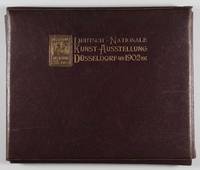
190252612Düsseldorf: Verlag der Dt. Nat. Kunstausstellung 1902. First edition. Loose leaf. Very good to fine condition. Oblong Quarto. 35 original silver gelatin prints. Original brown leather portfolio with gilt emblem and gilt lettering on gilt-framed cover. Red silk inside front cover and portfolio flaps. The bottom flap gilt-stamped Otto Renard Paul Adam Buchbinderei Düsseldorf.<br /> <br /> Album of thirty-five original photographs 9 3/4 x 11 1/4" by court photographer Otto Renard that document National Art exhibtion of 1902 by room. The photographs include a exterior panorama view of the newly built Art Palace its courtyard an interior view of the dome the large gallery the large hall and various galleries with work of artist groups and art organizations e.g. Kunstgenossenschaft Berlin Secession Berlin Dresden Düsseldorf 6 Munich Luitpold Group Munich Secession Munich Art Association Rhineland and Westfalia Art Alliance "Hagen" from Vienna 2 Art Collective Vienna Secession Vienna recreation room Secession Vienna the Van der Velde room the art historian gallery 5 old Japanese art. The exhibition includes paintings furniture sculpture and statuettes and a variety of interiors. The Art Palace was built for the 1902 Industry and Craft Exhibition for the Rhineland Westfalia and neighboring districts. <br /> <br /> The building of the Kunstpalast was in large part due to the efforts of Fritz Roeber director of the Düsseldorf Art Academy the painter Georg Oeder and the art historian Paul Clement in the late 1800s who were able to convince Heinrich Lueg director of the association for commerce that the time for another great art and commerce exhibition had come. The goal was the establishment of a new permanent venture for art exhibitions that was to become the center of the arts in the Rhinelands and Westfalia. Lueg took the lead and started the planing for the Kunstpalast already in 1898. The goal was to exhibit the development of the past 20 years in a formidable gallery and the 1900 Paris World exhibition was the model for the undertaking. Despite the fact that some of the planned buildings were not ready by the opening of the two exhibitions it opened on May 1st and closed on October 20th 1902 the exhibitions became a huge success. Two OCLC entries.<br /> <br /> Text in German. Portfolio with light wear one inch closed tear at top right of portfolio cover. Some light worm damage in silk of inside front cover and right flap. Few plates with minor damage at edges and lightly age-toned in margins. Images fine. Otto Renard 1855-1943 was known for his documentation of art exhibitions among them the 1902 art and commerce exhibition in 1902. The distinction "Hof Fotograf Court photographer" he earned while working at the court of Zar Nikolaus II. Renard returned to Germany after the turn of the century to open photo-studios in Düsseldorf and Aachen. He became wealthy due to his invention of a photo-paper moved to Berlin and then to Darmstadt. Verlag der Dt. Nat. Kunstausstellung unknown
17911909070003Florence: Niccolo Pagni and Giuseppe Bardi 1791 & 1795 1791. First Edition. Hardcover. Good. A Monumental Work of 18th century Italian engraving 2 volumes. Large folios 51 x 35 cm 19 3/4 x 13 in. 1st edition. Bound in contemporary 1/2 vellum over marbled boards. Some cover wear. Rear joint of v.1 cracked. Hinges of v. 2 cracked. Text in Italian and French printed in parallel columns. Collation: v.1 Engraved title frontispiece 64 leaves 60 plates. v.2 Engraved title 62 leaves 60 plates. Many of the plates are printed in colored ink: siena shades of brown or green and blue. 120 artists' portraits. <br> A gorgeous and large format work on Tuscan painting beginning with Guido da Siena and considering all the great painters of Florence such as Buffalmaco Cimabue Giotto Paolo Uccello Andrea Verrocchio Masaccio Fra fifilppo Lippi Andrea del Castagno Pollaiolo Botticelli Leonardo da Vinci Michelangelo Andrea del Sarto Antonio Tempesta Giuseppe Grisoni etc. Carlo Lasinio 1759-1838 was responsible for many of the engravings. Other engravers included: Giovanni Francisco Ravenet Marco Lastri Giuseppe Bardi Niccolo Pagni Matteo Carboni Ferdinando Gregori Gaetano Vascellini and Cosomo Colombini. <br> Refs: "Pregevole opera" Cicognara 3387. Cohen-Ricci 366. Thieme-Becker XXII 404. Brunet II 1095. Graesse II 509. Moreni I 509: "Ciascuno di questi volumi racchiude 60 articoli di notizie di altrettanti pittori toscani scritti in italiano da M.L. promotore di questa eccellente impresa e tradotti in francese da Bartolomeo Renard. Ognuno di essi ha una stampa incisa in rame scelta dalle Opere le piu stimate di quel pittore." <br> Armorial bookplates of Paul Beilby Thompson 1784-1852. Thompson was a Whig MP for Wenlock and East Riding; later made a Baron. <br> This is an oversized or heavy book which requires additional postage for international delivery outside the US. Florence: Niccolo Pagni and Giuseppe Bardi, 1791 & 1795 hardcover
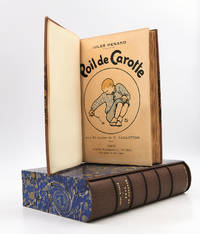
190287525Paris: Flammarion 1902. Fine. Flammarion Paris s. d. 1902 11.50 x 19 cm relié sous chemise et étui Second edition with some parts in first edition with 5 added tales Félix Vallotton's illustrations in first issue one of 20 numbered copies on japon only deluxe issue. Bradel binding brown 3/4 cloth smooth spine with floral motif stamped in gilt at center twice ruled in gilt at foot slightly chafed morocco title-label marbled paper boards original covers and spine preserved contemporary binding signed Carayon. Small clear stains to the top edge of first board one corner slightly rubbed a spot of foxing at foot of the first few pages. Illustrated with 50 drawings by Félix Vallotton. Rare and handsome copy housed in a contemporary binding by Carayon. Renard and Vallotton the foreign nabi had met in the offices of La Revue Blanche a famous avant-garde journal which frequently featured Vallotton's woodcuts and published numerous contributions by Jules Renard. The writer invited Vallotton to illustrate this ""other first edition of Poil de Carotte which includes 5 previously unpublished stories: My dear Vallotton Would it amuse you to illustrate - in complete freedom - Poil de Carotte for Flammarion Renard wrote him in a letter dated June 21 1902. Vallotton was chosen ahead of Toulouse-Lautrec and Alexandre Steinlen two other great artists of the time who had shown an interest in the project. Renard's affinity with Vallotton's style is easy to understand as Vallotton's raw simplicity perfectly matches Poil de Carotte's incisive depiction of a loveless childhood: A few words a few lines are enough for these two artists. They both ruthlessly cut away the superfluous Léon Guichard L'Interprétation graphique cinématographique et musicale des uvres de Jules Renard. Flammarion hardcover
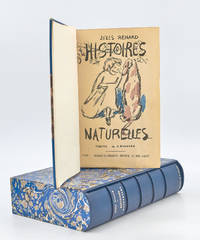
190487526Paris: Flammarion 1904. Fine. Flammarion Paris s.d. 1904 11.50 x 19 cm relié sous chemise et étui New edition and first printing of the superb illustrations by Pierre Bonnard one of 20 numbered copies on japon the only deluxe paper issue. Half blue percaline bradel binding with corners smooth spine adorned with a central gilt fleuron and double gilt fillet at the foot chocolate brown shagreen title label with minor scuffing french curl on Turkish patterned paper boards covers and spine preserved contemporary binding signed Carayon. Spine slightly browned corners slightly dulled. Our copy is housed under a half morocco chemise with five raised bands ill. de P. Bonnard stamped in gilt at foot of spine boards of tiger patterned paper and a slipcase bordered with blue Morocco with boards of tiger patterned paper signed T. Boichot. Illustrated with 68 drawings by Pierre Bonnard the second cover is also illustrated with a drawing by Félix Vallotton for the edition of Poil de Carotte published by the same publisher two years earlier. A rare and pleasant copy in a contemporary binding by Carayon. Flammarion hardcover
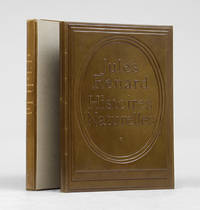
189997129Paris: Floury 1899. Toulouse-Lautrec's masterpiece of the illustrated book First edition number 84 of 100 copies only one of the most celebrated and sought-after of all livres d'artiste some of Lautrec's finest illustrations and the prototype of nearly all modern bestiairies Garvey. Lautrec and Jules Renard met first in 1894. The artist asked to illustrate some of the charming and witty portraits of animals and his first sketches were made at the Jardin d'Acclimatation and Jardin des Plantes in 1896. The last two illustrations printed were executed by Lautrec while he was a patient at the Neuilly clinic of Dr Sémalaigne. Renard's Histoire naturelles "contains some of Toulouse Lautrec's most refined draftsmanship and with Yvette Guilbert it is considered one of the masterpieces of the illustrated book. It was Lautrec who requested the pleasure of illustrating Renard's bestiary and Renard agreed hoping for descriptions that 'would please the animals themselves'. The two creative personalities clashed. Lautrec resented the book's limitation to mundane animals while Renard although paid homage to by a cover design of a fox objected to a number of Lautrec's drawings. Today we are amazed that it took Floury twenty years to sell out the edition of 100 copies" Donson/Gripp. Small folio 310 x 220 mm. With an original transfer lithograph to front wrapper on Japan paper and 22 throughout the text on vélin paper by Toulouse-Lautrec. Finely bound in 1973 by Pierre Lucien Martin 1913-1985 in olive green modelled calf titles to covers in raised lettering. Housed in a matching quarter calf chemise and slipcase. Foot of spine lightly rubbed with one small nick contents fresh; slipcase slightly sunned and rubbed. A finely bound copy. Adhémar 333-355; The Artist and the Book 304; Delteil 297-319; Donson/Gripp Great Lithographs by Toulouse-Lautrec nos. 78/79; Garvey 304 "Now one of the greatest rarities of the 19th century. Not only does it contain some of Lautrec's finest illustration but it is the prototype of nearly all modern bestiaries"; Rauch 17; Wittrock Toulouse-Lautrec I 202-224. unknown
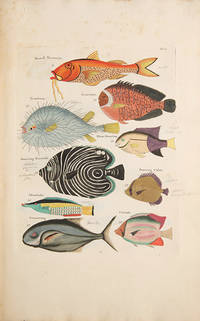
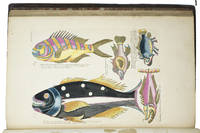
118288Amsterdam Reinier & Josué Ottens 1754. . Second edition; 2 volumes bound in 1 folio 41.5 x 26.5 cm; 100 hand-coloured engraved plates of which 1 is folding title printed in red and black engraved dedication leaf divisional title printed 19th century bookplate of Dr. Henry Petit later pencilled notes identifying species short closed tear to plate 22 not affecting the image some spotting primarily to the front matter and index but plates overall clean; later paste-paper boards in red blue and yellow marbled paper backstrip in tree-calf pattern manuscript title to spine some wear hinges and spine professionally conserved a very good copy housed in a custom marbled slipcase with chemise.<br /> The first colour plate book on ichthyology among the rarest and most beautiful of all works of this type. One of only approximately 35 remaining copies of the second edition.<br /><br />The first edition of Poissons Ecrevisses et Crabes was produced by Amsterdam publisher Louis Renard in 1718 or 1719. This edition and the two that followed it 'each contain 100 color plates bearing a total of 460 brilliantly colored copper engravings representing 415 fishes 42 crustaceans two stick-insects a dugong and a mermaid. With one exception all of the illustrations represent tropical species of the East Indies said to have been drawn from nature on the island of Ambon in the South Moluccas by an artist named Samuel Fallours in the employ of the Dutch East India Company. The original drawings were obtained by Renard from various individuals who brought them to Holland in 1708 and 1715'. A recent survey by biologist and historian of science Theodore Pietsch determined that of the one hundred copies printed only sixteen are still know to exist Pietsch 'Louis Renard and his Poissons' in Ichthyology in Context 2023.<br /><br />The second edition is 'only slight more accessible' than the first'. 'It seems that the publishing firm of Ottens took the 30 or 36 unbound copies purchased from Renard's estate had the plates colored replaced the old undated title page of Renard and added a "Preface" provided by Vosmaer and the 'Declaration sur cet Ouvrage' of Renard. These then together with some 70 additional copies newly printed from the original coppers save for the new title page and "Preface" constitute the second edition' of which around 35 copies still exist Pietsch.<br /><br />While the illustrations have been criticised in the past for their 'dazzling' colour and embellishments they are in fact based on real specimens and were considered a valuable source of information by naturalists including Georges Cuvier who in 1828 described them as 'still indispensable'. 'Indeed fully 91% of the 460 organisms depicted in the book have been identified at least to the taxonomic level of family' Pietsch.<br /> Amsterdam, Reinier & Josué Ottens, 1754. hardcover
1754ABC_46313Amsterdam: Reinier & Josua Ottens 1754. Contemporary calf richly-gold tooled spine and bords green morocco spine label with title in gold decorated edges marbled endpapers. Preserved in a professionally made black cloth box with a black morocco spine label with the author title and imprint in gold. Folio. Title-page in red and black a divisional-title for each volume and 100 engraved plates numbered 1-43 & I-LVII no. LVII folding vividly hand-coloured as published showing 460 fishes and other marine animals. 2 volumes bound as 1. Renard's famous but rare work noted for the spectacular imagery of colourful but also bizarre tropical fishes crabs and lobsters from the Indo-Pacific being the first colour-plated fish book here in its rare second edition. The book contains 100 plates with 460 originally and extraordinary hand-coloured copper engravings divided over two volumes with their own half-title 'Histoire naturelle des plus rare curiositez de la mer des Indes' of 415 fishes 41 crustaceans two stick insects a dugong and even a mermaid all living in the Indian Ocean between the East Indies. Sometimes the descriptions specifically refer to fishes of some islands in the East Indies as Ambon the Moluccas or Buton but they also contain references to the "fishes of the Antilles Brazil" Sabin and Mauritius. The illustrations in the first volume seems to be quite realistic in contrast to those in the second volume which are sometimes quite surreal which is even more emphasized by the short anecdotical and highly entertaining descriptions.The Amsterdam publisher and bookseller Louis Renard compiled this collection of ichtyological illustrations by copying the sets of drawings which were brought to Amsterdam by Frederik Julius Coyett the son of the governor and ambassador of Ambon and Banda Balthasar Coyett. The drawings in the first part were copied after the collection of Balthasar Coyett. The illustrations in the second part were copied by Samuel Fallours a soldier in the service of the Dutch East India Company who started drawing marine life in the East Indies for the governors after those in the collection of Andriaen van der Stel governor of the Moluccas.The book shows marine life in the East Indies and the Indo-Pacific when Europe knew very little on this subject there. Because of the brilliant colours fantastic shapes and the described habits of its subjects the work however was often dismissed in its own time as fantasy. Nevertheless Renard's Poissons ecrevisses et crabes is nowadays still one of the rarest and most magnificent ichtyological works being the first colour-plated fish book and a highly interesting scientific effort to represent the Indo-Pacific maritime life mixed with flights of fantasy.Spine and joints professionally restored preliminaries a little foxed some minor browning especially in volume 1 but overall in good condition with brightly coloured plates. One of 35 known copies of a rare ichthyological work.l Landwehr Coloured plates 159; Nissen ZBI 3361; Nissen Schone Fischbucher 103; Sabin 69600; cf. Grace Costantino Renard's book of fantastical fish 2016 on https://blog.biodiversitylibrary.org; Julie Gardham Louis Renard: Poissons ecrevisses et crabes 2002 on www.gla.ac.uk; Theodore W. Pietsch Fishes crayfishes and crabs . 1995 pp. 22-26. Reinier & Josua Ottens, hardcover