George SAND - (to Gustave FLAUBERT)Biblio.com
790 résultats
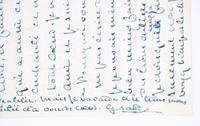
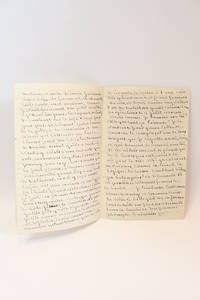
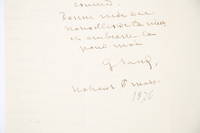
187676872Nohant Nohant-Vic 1876. Fine. Nohant Nohant-Vic 6 mars 1876 13.20 x 20.70 cm deux pages sur un feuillet remplié Autograph letter signed by George Sand addressed to Gustave Flaubert. Two pages written in black ink on a double sheet bearing at the head of the first page the sender's dry stamp. This letter was published in the complete correspondence of George Sand established by Georges Lubin. Fine letter written by George Sand a few months before her death and addressed to her lifelong friend Gustave Flaubert. The writer wishes to offer her friend a seat so he may attend the revival of her play Le Mariage de Victorine : ""Je t'écris en courant ce matin parce que je viens de recevoir de Mr Perrin avis de la 1ère représentation de la reprise du Mariage de Victorine une pièce de moi au théâtre français. Je n'ai ni le temps d'y aller ni l'envie de partir comme cela au pied levé mais j'aurais voulu y envoyer quelques amis et il ne m'offre pas une seule place. Je lui écris une lettre qu'il recevra demain et je le prie de t'envoyer au moins un orchestre."" ""I'm writing to you hurriedly this morning because I've just received notice from Mr Perrin of the first performance of the revival of Le Mariage de Victorine a play of mine at the Théâtre Français. I have neither the time to go nor the desire to leave like that at a moment's notice but I would have liked to send some friends and he doesn't offer me a single seat. I'm writing him a letter which he will receive tomorrow and I ask him to send you at least an orchestra seat."" Letters from the correspondence between George Sand and Gustave Flaubert are renowned and highly sought after. unknown
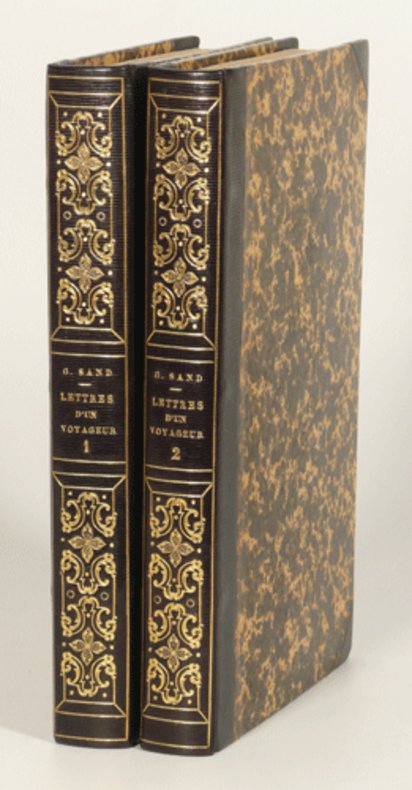
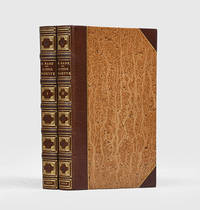
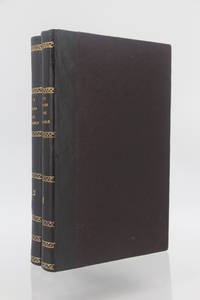
18370030531837 Paris, Félix Bonnaire, 1837. Deux volumes in-8 (146 X 227 mm) demi-maroquin noir à grain long et à petits coins, dos lisse composé de deux grands compartiments entièrement ornés de fers dorés à décor rocaille et d'un petit compartiment central contenant auteur, titre et tomaison dorés, plats et dos (petits manques aux dos) de la couverture conservés (BERNASCONI). Tome I : faux-titre, titre, 422 pages ; Tome II : faux-titre, titre, 414 pages.
185976839Nohant Nohant-Vic 1859. Fine. Nohant Nohant-Vic 16 août 1859 13.50 x 20.90 cm 4 pages sur un double feuillet Autograph letter signed by George Sand addressed to Ernest Feydeau. Four pages written in blue ink on a double sheet bearing at the head of the first page the sender's blind stamp. This letter was published in the complete correspondence of George Sand established by Georges Lubin. Fine and lengthy letter discussing literature and friendship between writers. Initially a stockbroker and specialist in Antiquity Ernest Feydeau launched himself late into fiction. Anxious to occupy a literary space in which he did not feel justly appreciated he used his connections and maintained a regular epistolary relationship with illustrious correspondents such as Gustave Flaubert Sainte-Beuve and George Sand to whom he sent drafts of his novels and whose opinions he sought. This letter forms Sand's response after having just finished reading Daniel Feydeau's second novel. George Sand then at the height of her literary career describes herself thus: ""I am quite old enough to be your mother for I am 55 years old and I have good hands quite skillful but not beautiful at all. I have earned the right to no longer be coquettish I have been quite reproached for never having been so. I will tell you anything about myself that you wish."" As was her habit much solicited by her peers she delivers a very detailed critique of the text her colleague submits to her: ""I am not against sentences that jar where they need to jar but I am not for harmony being sacrificed to rhythm. Nor am I for the contrary. Understand me well I only blame what is too noticeable what reveals the technique. Do not touch the passages you speak of they are excellent. And in sum I will not insist furiously on the question of form in style seeing that if the qualities of yours should disappear with what sometimes seems to me a flaw I would be in despair at having pointed out the flaw."" Herself very close to Flaubert whom she nicknamed her ""leaden bottom"" Sand seems delighted that the two men know each other: ""I do not have time. But I will have time to receive you when you are free you must come with Flaubert who also has in me an enchanted reader and a wholehearted literary friend. I did not know he was your friend and I am pleased that he is."" The friendship goes so far that Sand soon brings the two writers together placing them on complete equal footing: ""It is no misfortune for you any more than for Flaubert to belong to the race of seers."" A form of solidarity then establishes itself in the face of critical adversity: ""All this is felt better than it can be said and that is why criticism loses its reason three-quarters of the time."" For criticism has had the misfortune of labeling Feydeau as it did with Flaubert a realist: ""People have taken it upon themselves to baptize your manner and his as realism. I do not know why; unless realism is something entirely different from what the first adherents attempted to explain to us. I suspect indeed that there is a way of envisaging the reality of things and beings which is great progress and you bring triumphant proof of it. But the name realism does not suit because art is a multiple infinite interpretation. It is the artist who creates reality within himself his own reality and not that of another. Two painters paint the portrait of the same person. Both create a work that represents the person if they are both masters. And yet the two paintings do not resemble each other. What has become of reality"" This long diatribe - a true manifesto - forms a powerful testimony to the repulsion of George Sand and Flaubert for theorists obsessed with the idea of classifying literature according to a ""system that . blinds"". unknown
186780208Michel Lévy frères | Paris 1867 | 11.50 x 18.50 cm | relié
185074490Alexandre Cadot | Paris 1850 | 13.50 x 21 cm | 2 volumes reliés
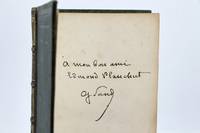
186780208Paris: Michel Lévy frères 1867. Fine. Michel Lévy frères Paris 1867 11.50 x 18.50 cm relié New edition. Contemporary binding in half green shagreen spine in four compartments set with gilt stippling gilt fillets and gilt fleurons in the corner pieces multiple blind tooled frames on the boards white iridescent paper endpapers all edges gilt. Some leaves shorter in the bottom margin. Handwritten inscription signed by George Sand on the first endpaper: à mon bon ami Edmond Plauchut. G. Sand"". Today the only outsider to the family buried in the cemetery of the Nohant house is Lucien-Joseph-Edmond Plau chut 1824-1909 who began an epistolary relationship with George Sand in the autumn of 1848 when he was a voluntary expatriate after the fall of the Republic. Leaving for Singapore he was shipwrecked off the coast of the Cape Verde Islands and was able to save only one cassette containing Sand's letters that he had preciously bound. These missives were his salvation: they allowed him to be collected fed and laundered by a rich Portuguese admirer of the Lady of Nohant Francisco Cardozzo de Mello. After several journeys toward the Far East and several exotic presents sent to his distant and yet so close friend Plauchut finally met George Sand in 1861. In 1870 she paid a vibrant tribute to him in the preface of her novel Malgrétout. Despite everything she recounts the shipwreck of which he was a victim and expresses with emotion her friendship for this courageous friend. Plauchut much loved by the Sand family and particularly George's granddaughters who nicknamed him Uncle Plauchemar was an integral part until his death in January 1909. The handwritten signed inscriptions on La Mare au Diable are very rare this one is from a superb provenance. Michel Lévy frères hardcover
185074490Paris: Alexandre Cadot 1850. Fine. Alexandre Cadot Paris 1850 13.50 x 21 cm 2 volumes reliés Rare and much sought-after first edition cf. Clouzot published at the correct date of 1850 with some unsold copies later reissued by the same publisher in 1852. Bradel bindings in full bottle-green boards decorated with blind-stamped floral motifs brown morocco title labels bookplates pasted on the pastedowns. A small paper loss at the foot of the final page of the second volume without any loss of text a few occasional spots of foxing. A very rare and handsome copy elegantly bound strictly contemporaneous with the publication. Alexandre Cadot hardcover
183777301Félix Bonnaire Victor Magen Comon Hippolyte Souverain | Paris 1837-1841 | 13 x 20.50 cm, longueur totale de la série 72 cm | 27 volumes reliés
186771232Nohant 21 décembre 1867 | 13.40 x 20.70 cm | deux feuillets sous chemise et étui
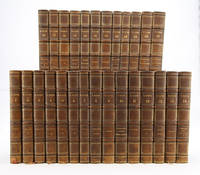
183777301Paris: Félix BonnaireVictor MagenComonHippolyte Souverain 1837. Fine. Félix Bonnaire Victor Magen Comon Hippolyte Souverain Paris 1837-1841 13 x 20.50 cm longueur totale de la série 72 cm 27 volumes reliés Extremely important edition comprising a large number of works appearing here in their first edition. The complete set of these 27 volumes is rare Clouzot. The titles present in first edition are: Mattea Lettres dun Voyageur La Dernière Aldini Les Maîtres mosaïstes LUscoque Spiridion Les Sept Cordes de la lyre Gabriel Pauline and Un hiver à Majorque.Illustrated with a portrait of the author at the head of the first volume. Bound in contemporary half brown sheep spines uniformly faded with four raised bands decorated with double gilt panels double gilt fillets at head and foot marbled-paper boards marbled endpapers and pastedowns marbled edges a few very lightly rubbed corners contemporary bindings. Some occasional foxing a light dampstain affecting the final leaves of the twenty-first volume. A very rare complete set in contemporary bindings. Félix BonnaireVictor MagenComonHippolyte Souverain hardcover
186771232Nohant Nohant-Vic 1867. Fine. Nohant Nohant-Vic 21 décembre 1867 13.40 x 20.70 cm deux feuillets sous chemise et étui Autograph letter from George Sand to Gustave Flaubert dated December 21 1867 8 pages on two lined leaves. Published in Sand's Correspondance XX pp. 642-645. From one of the finest literary correspondences of the century this letter written on Christmas Eve 1867 is a sublime testament to the frank friendship between George Sand the old troubadour and Gustave Flaubert christened cul de plomb leaden ass after declining his invitation to Nohant to complete L'Éducation sentimentale. Despite their seventeen year-age gap opposing temperaments and divergent outlooks on life the reader is gripped by the tenderness and astonishing verve of George Sand's long confession to Flaubert. At the height of her literary fame and enjoying her theater in Nohant Sand talks at length about politics their separation their conception of the writer's work and life itself. In this stream-of-consciousness letter Sand naturally and freely sets down on paper eight pages of conversations with Flaubert who made only too rare and brief appearances in Nohant: But how I chat with you! Do you find all this amusing I'd like a letter to replace one of our suppers which I too miss and which would be so good here with you if you weren't a cul de plomb leaden ass who won't let yourself be dragged along to life for life's sake whereas Flaubert's motto then busy writing L'Éducation sentimentale was rather art for art's sake. In the end of 1867 Sand grieved the death of an almost brother François Rollinat which Sand appeased with letters to Flaubert and lively evenings at Nohant: This is how I've been living for the last 15 days since I stopped working . Ah'! . Ah! when you're on vacation work logic and reason seem like strange swings. Sand was quick to criticize him for working tirelessly in his robe the enemy of freedom while she was running up and down mountains and valleys from Cannes to Normandy even to Flaubert's own home which she had visited in September. On this occasion Sand had happily reread Salammbô where she picked up a few lines for her latest novel Mademoiselle Merquem. Their literary and virile friendship similar to Rollinat's defied the old guard of literati who declared the existence of a sincere affair between man and woman utterly impossible. Sand who has been described in turn as a lesbian a nymphomaniac and made famous for her resounding and varied love affairs began a long and intense correspondence with Flaubert for whom she was a mother and an old friend. She called herself in their letters old troubadour or old horse and no longer even considered herself a woman but a quasi-man recalling her youthful cross-dressing and formidable contempt for gender norms. To Flaubert had compared the female writers as Amazons denying their femininity: To better shoot with the bow they crushed their nipples Sand replied in this letter: I don't share your idea that you have to do away with the breast to shoot with the bow. I have a completely opposite belief for my own use which I think is good for many others probably for the majority. A warrior yes but a peaceful warrior Sand willingly adopted the customs of a world of misogynistic intellectuals while remaining true to herself: I believe that the artist should live in one's nature as much as possible. To the man who loves struggle war; to the man who loves women love; to the old man who like me loves nature travel and flowers rocks great landscapes children too family everything that moves everything that fights moral anemia she then adds. A fine evocation of her green period this passage marks the time of Sand's country novels when mellowed by the years she gave herself over entirely to contemplation to write François le Champi La Mare au diable and La Petite Fadette. But her love of nature didn't stop unknown
1833YQV-142 volumes in-8 (207 x 122 pp) de 4 ff.n.ch. (faux-titre, titre, dédicace, exergue) et 350 pp. pour le premier volume ; 3 ff.n.ch. (faux-titre, titre, vers d Alfred de Musset) et 383 pp. pour le second (comme dans la plupart des exemplaires reliés à l époque, le relieur a supprimé le dernier feuillet blanc du tome I et le premier feuillet blanc du tome II) ; demi-veau fauve, dos lisses, compartiments de filets et chaînettes ornés de grands fleurons géométriques dorés, roulette en pied, plats recouverts de papier marbré, tranches marbrées dans les mêmes tons (reliure de l époque).
184688172Desessart | Paris 1846 | 12.80 x 20.80 cm | 2 volumes reliés
1849178642Paris: Michel Lévy Frères Libraires-Éditeurs 1849. Beautifully preserved in a fine Parisian binding First edition fine paper issue of the author's major novel one of her best known today. Together with La Mare au diable 1846 and François le Champi 1848 La Petite Fadette is one of Sand's pastoral "rustic novels" which drew inspiration from the author's love of the countryside and sympathy for the rural poor. In these works "the familiar theme of Sand's work - love transcending the obstacles of convention and class - regained pride of place" Ency. Brit. The fine bindings were executed by the Parisian master bookbinder Émile Mercier 1855-1910 the apprentice and successor to Francisque Cuzin 1836-1890. Mercier worked for Cuzin for eight years during which they established the elegant "Cuzin style" characterized by fine gilding and finishing. Following his mentor's death Mercier took over his workshop and sustained the firm's reputation for two decades signing bindings "Mercier Successeur de Cuzin". Mercier's bindings are "noted for the excellence of their tooling" and the binder himself was celebrated in Paris as "l'artiste impeccable" Coutts & Stephen p. 182. Provenance: Paul Villeboeuf b. c. 1856 with his bookplate. Villeboeuf was a distinguished collector of Romantic literature and fine bindings mostly by Cuzin and Mercier. He was the father of the artist André Villeboeuf. 2 vols octavo 227 x 150 mm. Late 19th- or early 20th-century straight-grain half morocco by Mercier spines lettered and decorated in gilt covers ruled in gilt marbled sides and endpapers edges untrimmed original wrappers bound in. Binding and contents exceptionally well-preserved a fine copy. Henry T. Coutts & George A. Stephen Manual of Library Bookbinding: Practical and Historical 1911. unknown
184688172Paris: Desessart 1846. Fine. Desessart Paris 1846 12.80 x 20.80 cm 2 volumes reliés Rare and highly sought-after first edition. Contemporary binding in black half shagreen flat spines richly decorated with gilt ornamental rolls discreet and skilful restoration to the foot of one joint black paper-covered boards marbled endpapers and pastedowns sprinkled edges. Discreet restoration to the lower hinge of the first volume. Exceptionally clean copy virtually free of foxing a rarity according to Clouzot who notes that most copies are usually heavily spotted. Provenance: from the libraries of Saint-Germain with printed crowned bookplate beneath the titles on the half-titles; Count de Bonvouloir with his printed bookplate Château de Magny in Calvados above the title on the half-title of the second volume and above the next bookplate on an endpaper of the first volume; Charles-Albert Gigault de Crisonoy de Lyonne with his bookplate mounted on a pastedown and endpaper; and more recently Max Brun with his bookplate mounted on the front pastedown of the first volume. Shelving labels mounted at the top of the rear pastedowns minor losses to white paper and some corner stains on the endpapers. A rare copy preserved in a strictly contemporary binding. Desessart hardcover