Sand, MauriceBiblio.com

2 877 résultats
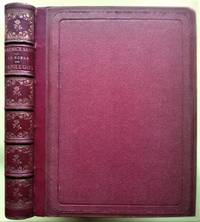
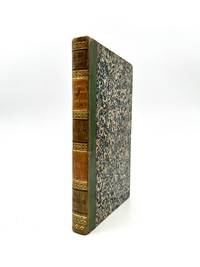
1862006327Paris: A. Lévy Fils 1862. Half Morocco. Very Good. Sand Maurice. All the plates are here rendered in three states -- full hand-colored black and white and sepia and white! 2 volumes 4to. 28 by 20 cm. viii 356 2 384 pp. 50 hand-colored plates and 100 additional in the two other formats featuring the stock characters of the improvisational Theatre Italienne such as Harlequino Arlechino Pulcinella Colombine Pagliaccio Pierrot Pantalon L'Apothicaire Le Notaire Scaramuccia Pasquariello etc. Nowadays these characters are most familiar to opera-goers thanks to the comical works of Donizetti Mascagni Busoni Mozart etc. Most of these characters grew out of the roaming theatrical troupes that originated in Italy of the sixteenth and seventeenth centuries. The costume and basic personality of the character remained stable from one performance to the next but within those parameters the characters in a troupe usually following the broad contours of a story line would improvise bringing in buffonery perhaps relating to the events of the day the specific venue where they were appearing or whatever else might spring into their mind on the spur of the moment. In the eighteenth century the free form went into decline replaced by more scripted plays but its influence is very evident in the plays of Goldoni Moliere who worked well before the form vanished and besides the opera buffa early twentieth century Vaudeville ballet and more current comedy. Also the costume from the Theatre Italienne has never failed to excite enthusiasm and thus it is often celebrated in the decorative arts as perhaps most magnificently in porcelain beginning in the eighteenth century with Meissen Nymphenburg and many other makes. Today the style of Harlequin or Arlecchino continue to be emulated in clothes design with some regularity. This two volume celebration of the costume and characters of this theater was written by Maurice Sand who was the son of the novelist George Sand who wrote the preface. Maurice Sand 1823 -1889 was an accomplished illustrator and writer in his own right. Provenance: this copy comes from the heirs of John James Audobon. The initials "V.A." are stamped on both front boards; these initials probably refer to Victor Gifford Audubon Jr. 1847-1915 the artist's grandson. Condition: some minor scuffs and abrasions on the leather spine shelfwear on the edges. A few some light soil spots here and there but overall quite clean and bright. A. Lévy Fils unknown
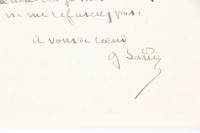
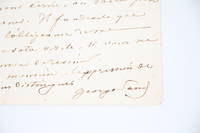
1848293976Paris 1848. framed. very good. Important A.L.S. as Sand had recently began writing for the soon-to-be-banned Le Vrai Republique with integral address page personal stationary with blind stamped monogrammed initials: "G.S." 8vo. 1 page Paris March 16th 1848 to radical journalist and fellow supporter of the French Revolution Theophile Thore in French with translation explaining that she has not yet met with Louis and Charles Blanc and apologizes for not having responded to his letters because all of her time has been consumed writing material for the Republique. In closing she signs herself "a vous de tout Coeur / George Sand". Evenly toned and set into a white matte gatefold whereby both the letter and the integral address page are both visible then placed into a simple gold-stained wooden frame to 13" x 11.5". Louis Blanc 1811-1882 was a staunch French Socialist and reformer who only three months after this letter was written was exiled to England where he would remain until 1870. Also two weeks prior to this letter being sent George Sand had agreed to provide the Republique with no less than 13 original articles for publication. An exceptional letter written during the heart of the French Revolution of 1848.<br/> <br/> French novelist and socialist whose works were immensely popular in Europe during her lifetime and whose fame eclipsed both that of Victor Hugo and Honore de Balzac in the 1840's and 1850's.<br/> <br/> unknown
1862003597Paris: A. Levy Fils 1862. Quarter Morocco pebbled cloth boards. Very Good. Sand Maurice. 2 volumes 4to. 28 by 19 cm. viii 356 2 384 pp. 50 hand-colored plates featuring the stock characters of the improvisational Theatre Italienne such as Harlequino Arlechino Pulcinella Colombine Pagliaccio Pierrot Pantalon L'Apothicaire Le Notaire Scaramuccia Pasquariello etc. Nowadays these characters are most familiar to opera-goers thanks to the comical works of Donizetti Mascagni Busoni Mozart etc. Most of these characters grew out of the roaming theatrical troupes that originated in Italy of the sixteenth and seventeenth centuries. The costume and basic personality of the character remained stable from one performance to the next but within those parameters the characters in a troupe usually following the broad contours of a story line would improvise bringing in buffonery perhaps relating to the events of the day the specific venue where they were appearing or whatever else might spring into their mind on the spur of the moment. In the eighteenth century the free form went into decline replaced by more scripted plays but its influence is very evident in the plays of Goldoni Moliere who worked well before the form vanished and besides the opera buffa early twentieth century Vaudeville ballet and more current comedy. Also the costume from the Theatre Italienne has never failed to excite enthusiasm and thus it is often celebrated in the decorative arts as perhaps most magnificently in porcelain beginning in the eighteenth century with Meissen Nymphenburg and many other makes. Today the style of Harlequin or Arlecchino continue to be emulated in clothes design with some regularity. This two volume celebration of the costume and characters of this theater was written by Maurice Sand who was the son of the novelist George Sand who wrote the preface. Maurice Sand 1823 -1889 was an accomplished illustrator and writer in his own right. Occasional soiling sometimes toning around perimeter outside of tissue guards which have survived remarkably well. Rubbing along joints and moderate wear of boards. Very handsome marbled painting of edges. A. Levy Fils unknown
2010122361Stiftung. New. 2010. Hardcover. 8872833914 . FREE UPGRADE to Courier/Priority Shipping Upon Request - IN STOCK AND IMMEDIATELY AVAILABLE FOR SHIPMENT - Flawless copy brand new pristine never opened. Text in German and Italian. with a bonus offer-- . Stiftung hardcover
199518509San Francisco California U.S.A.: Mercury House. New. 1995. Paperback. 156279082X . FREE UPGRADE to Courier/Priority Shipping Upon Request - IN STOCK AND IMMEDIATELY AVAILABLE FOR SHIPMENT - Fine -- with a bonus offer-- . Mercury House paperback
199868853Prestel. New. 1998. Hardcover. 3791319485 . FREE UPGRADE to Courier/Priority Shipping Upon Request - IN STOCK AND IMMEDIATELY AVAILABLE FOR SHIPMENT - Flawless copy brand new pristine never opened -- Text in English. 160 pp. With 103 ills. 76 col. . 31 x 25 cm. -- with a bonus offer--; 0.73 x 12.1 x 9.64 Inches . Prestel hardcover
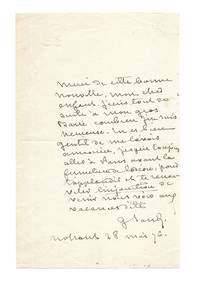
1876Sand2<p><strong>SAND George 1804-1876</strong></p><p>Autograph letter signed "GSand" to Paul Porel Dry monogrammed G S initial on letterhead Nohant May 28 1876 1 page in-8 in black ink</p><p><strong>A moving letter one of the very last less than 10 days before her death</strong></p><p><em>"Merci de cette bonne nouvelle mon cher enfant. J'écris tout de suite à mon gros</em> Léopold<em> Barré combien je suis heureuse. Tu es bien gentil de me l'avoir annoncée. J'espère toujours aller à Paris avant la fermeture de l'Odéon pour t'applaudir et te renouveler l'injonction de venir nous voir aux vacances d'été. </em> <em>GSand</em> <em>Nohant 28 mai 76″</em></p><p>This moving letter is one of George Sand's last. After the three letters written on 28 May one to Miss Marguerite Thuillier the other to her doctor Henri Favre and finally this one and a note in the Agenda on 29 May she will take up the pen one last time on the 30th to write to her nephew Oscar Cazamajou Corr. XXIV p. 638</p><p>George Sand who died on 8 June 1876 of an intestinal obstruction was already suffering of stomach pain on 28 May as evidenced by her letter to Dr. Henri Favre: "<em>I wonder where I am going and whether to expect a sudden departure one of these mornings. I'd rather know right away than by surprise.</em>" Her condition will deteriorate on May 30 before the symptoms worsen significantly on June 3. On June 7 in agony she whispers to her daughter Solange who is caring for her and to her daughter-in-law Lina Calamatta: "<em>Goodbye farewell I am dying.</em>" She died on June 8 at 10:00 a.m. in her 72nd year.</p><p>Paul Porel 1843-1917 is a French actor director and theater director. He was married to the actress Réjane and was close to literary and musical circles notably attending Alphonse Daudet Emile Zola Léon Hennique George Sand Gabriel Fauré etc.</p><p>This letter unpublished in the correspondence edited by Lubin will appear in the next volume of <em>Nouvelles lettres retrouvées</em>.</p><p>Provenance: René Vallet Archives</p>
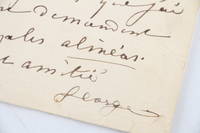
1838866321838. Fine. Sand publishes her response to Lerminier s. d. 23 février 1838 11 x 20.40 cm 1 page sur feuillet Autograph letter signed by George Sand addressed to François Buloz. One page in black ink on a single sheet. Fold marks sheet reinforced with paper on verso. Published in her correspondence ed. Georges Lubin vol. IV pp. 331-332. Exasperated by the attitude of the Revue des deux mondes of her friend Buloz George Sand decides to defend the progressive thinker Félicité Lammenais targeted by a scathing critique published in the review. She takes up her pen here and orders Buloz to publish her response article without changing a single line. Mon cher Buloz voici la lettre à M. Lerminier n'y changez rien. Relisez-en vous même et vous seul l'épreuve. Corrigez les fautes de typographie. Veuillez à la ponctuation et aux guillemets. Il va sans dire que les blancs de mon manuscrits sont le résultat de coupures et de transcriptions que j'ai faites et ne demandent que de simples alinéas. Bonjour et amitié George ""My dear Buloz here is the letter to M. Lerminier change nothing. Proofread it yourself and yourself alone. Correct the typographical errors. Mind the punctuation and quotation marks. It goes without saying that the blanks in my manuscript are the result of cuts and transcriptions I have made and require only simple paragraphs. Good day and friendship George"" This letter perfectly illustrates the stormy yet fruitful collaboration that united François Buloz and George Sand. The latter gave Sand for many years a platform and a means to live by her pen. She published in the Review a great number of masterpieces including Lettres d'un voyageur 1834-1836 Mauprat 1837 Spiridion 1839 Gabriel 1839 Mademoiselle La Quintinie 1863 Césanne Dietrich 1870. Through his mediation she also actively participated in the political debates of her time. In 1838 Buloz was the great orchestrator of an ideological duel when Sand ""decided to take on the critic Lerminier who had just made a very critical analysis of the Livre du peuple in the review. Buloz out of desire for publicity allowed his two collaborators to publicly exchange blows in the review. Through Lerminier and his superior tone the review then revealed its rather misogynistic vision of literature and philosophy: 'the time has come for you to give your philosophical opinions more consistency and scope because you are entering a new phase of life and talent. Inspiration and fantasy have raised you to a height where they would not suffice to maintain you. Draw now madam new strength from reflection and science'"" Marie-Eve Thérenty George Sand François Buloz et la Revue des Deux Mondes. Sand reacted immediately and sent her response article accompanied by this peremptory missive ordering Buloz to publish her text as it stood. Lamennais was very touched by her gesture: ""I shall always count among the happy circumstances of my life where I don't count many to have been defended by you. In publishing my last book I knew well that it would shock almost everyone legitimists juste-milieu Catholics even republicans those at least who want neither God nor liberty and their number is great and they have a terrible faith in themselves. I have hoped only in the people who do not make systems and who under the influence of primitive and imperishable human instincts judge by the heart and judge alone infallibly. Without them I don't know what would become of liberty on earth. M. Lerminier and many others imagine that I speak at random according to whatever idea of the moment occurs to me. They are mistaken"" Yves Chastagnaret George Sand Lerminier et le Livre du Peuple de Félicité Lamennais. Flying to the rescue of a defender of the people Sand writes this scathing missive at a key moment in her tumultuous relationship with Buloz. unknown
1868784821868. Fine. s. d. mai 1868 13.50 x 20.70 cm 2 pages sur un double feuillet Autograph letter signed by George Sand addressed to Alphonse Peyrat two pages written in black ink on a double sheet. Transverse folds inherent to mailing. Interesting letter evoking one of her faithful friends: Jean Patureau-Francoeur. George Sand had published a long obituary article in tribute to this close friend in L'Avenir national on May 2 1868. She described her late friend with great tenderness: ""C'était un simple paysan un vigneron des faubourgs de Châteauroux. Il avait appris tout seul à écrire et il écrivait très remarquablement avec ces naïves incorrections qui sont presque des grâces dans un style rustique et spontané. . Ce petit homme robuste à grosse tête ronde au teint coloré à l'il bleu étincelant et doux était doué d'une façon supérieure. Il voyait la nature il l'observait il l'aimait et il la savait. . Son existence parmi nous fut pénible agitée méritante. Naturellement un esprit aussi complet que le sien devait se passionner pour les idées de progrès et de civilisation. Il fut avant la Révolution le représentant populaire des aspirations de son milieu et il travailla à les diriger vers un idéal de justice et d'humanité. ."" ""He was a simple peasant a wine-grower from the suburbs of Châteauroux. He had taught himself to write and he wrote remarkably well with those naive incorrections that are almost graces in a rustic and spontaneous style. . This sturdy little man with his large round head his ruddy complexion his sparkling and gentle blue eyes was gifted in a superior way. He saw nature observed it loved it and understood it. . His existence among us was painful agitated meritorious. Naturally a mind as complete as his had to be passionate about ideas of progress and civilization. He was before the Revolution the popular representative of his milieu's aspirations and he worked to direct them toward an ideal of justice and humanity. ."" In 1848 Patureau was elected mayor of Châteauroux and became the spokesman for the workers of his commune. ""Au moment du coup d'État il fut poursuivi mais il se cacha dans des familles amies et échappa à la police. George Sand obtint difficilement sa grâce ce qui lui permit de regagner Châteauroux. Il fut arrêté en janvier 1858 à la suite de la loi de sûreté générale."" ""At the time of the coup d'état he was pursued but he hid with friendly families and escaped the police. George Sand obtained with difficulty his pardon which allowed him to return to Châteauroux. He was arrested in January 1858 following the general security law."" ""Il resta un mois au cachot sur la paille en plein hiver. Quand on le mit dans la voiture cellulaire qui le dirigeait vers l'Afrique il était presque aveugle et depuis il a toujours souffert cruellement des yeux"" ""He remained a month in the dungeon on straw in the middle of winter. When they put him in the prison van that was taking him to Africa he was almost blind and since then he has always suffered cruelly with his eyes"" George Sand. In September 1858 following an intervention by George Sand with her friend Jérôme-Napoléon Napoleon III's cousin he was released but remained under surveillance. He settled in Algeria after obtaining permission to come to Châteauroux to sell his house and vineyard and to fetch his family. In Algeria he lived by his trade as a wine-grower was part of the Agricultural Society of Philippeville and wrote a treatise on viticulture."" Maintron ""À présent je viens vous demander de me payer ce petit article le plus cher que vous pouvez et d'envoyer le prix directement à Joseph Patureau rue de cluis n°7 à Châteauroux. Indre. Et cela le plus tôt possible."" ""Now I come to ask you to pay me for this little article as dearly as you can and to send the payment directly to Joseph Patureau rue de cluis n°7 à Châteauroux. Indre. And this as soon as possible."" Jos unknown
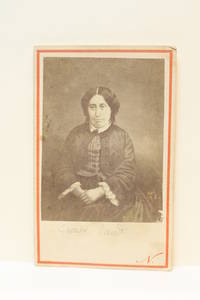
185273020Paris: Nadar 1852. Fine. Nadar Paris s. d. circa 1852 6.50 x 10.30 cm une photographie Original albumen photograph representing George Sand in carte-de-visite format mounted on studio cardboard from Nadar ""35 boulevart des Capucines"". This photograph taken in 1852 by Nadar after a daguerreotype by Richebourg was commercialized between 1862 and 1871 as evidenced by the photographer's address on the back of the cardboard. Pencil annotation in lower margin of the portrait as well as on the back. A period bookseller's label pasted on the back of the cardboard. One copy at the Musée d'Orsay. Nadar unknown
186721.0247Paris: J. Rothschild Éditeur 1867. 1st ed. Contemporary quarter morocco with gilt titles decorations and raised bands. 22.5x27.5. 50 lithographic plates of which 49 are hand coloured. . Bookdealer's blind sttamp on title page; corners slightly bumped; very occasional foxing the half title of the second part - see photo - is the most foxed; there are four others in a similar condition otherwise a very clean and attractive copy J. Rothschild, Éditeur hardcover
184077244Paris 1840. Fine. Paris jeudi 7 mai 1840 13.60 x 20.90 cm une page sur un double feuillet Autograph letter signed by George Sand addressed to publisher Léon Curmer. One page written in black ink on a double sheet. This letter was published in the complete correspondence compiled by Georges Lubin. ""Monsieur J'ai parcouru votre recueil avec beaucoup d'intérêt et j'accepte la collaboration que vous m'avez offerte mais je ne pourrais m'occuper de vous satisfaire que dans six semaines ou deux mois. Si cette époque vous convient veuillez bien me le faire savoir ainsi que les conditions de la rédaction."" ""Sir I have perused your collection with great interest and I accept the collaboration you have offered me but I could not undertake to satisfy you for six weeks or two months. If this timing suits you please let me know as well as the conditions of the writing."" The ""recueil"" ""collection"" in question here is none other than Les Français peints par eux-mêmes. Sand would not however collaborate on this monumental compendium of types preferring instead several years later Le Diable à Paris published under the direction of her close friend publisher Hetzel. unknown
183560346Paris: Félix BonnaireVictor Magen 1835. Fine. Félix Bonnaire Victor Magen Paris 1835 13 x 20.50 cm relié First edition. Half shagreen two corners slightly bumped contemporary binding. A little light spotting library label to pastedown. Félix BonnaireVictor Magen unknown
184072174Paris: Félix Bonnaire 1840. Fine. Félix Bonnaire Paris 1840 14 x 23 cm relié First edition rare published in the Complete Works of George Sand by Bonnaire. The half-title indicates volume XXIV. Modern half black straight-grained morocco binding with small corners signed René Aussourd at the top of the endpaper. Jansenist spine with raised bands. Title author and date gilt. Covers preserved. Upper right corner of the front cover lacking 0.5cm. Light rubbing to boards. Very handsome copy with perfectly fresh uncut paper. Ex libris Paola Sanjust. Dialogue novel featuring a young Italian noblewoman during the Renaissance raised as a man for succession reasons. Gabriel will be confronted with the hypocrisy of society and rebels against the abyssal difference between the rights granted to men and the oppression reserved for women. The author analyzes with irony the differences in education between girls and boys. Balzac enthusiastic upon reading the work did not hesitate to compare it to a Shakespeare play. Félix Bonnaire hardcover
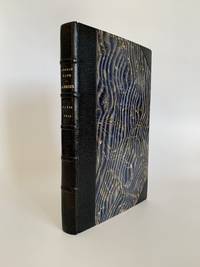
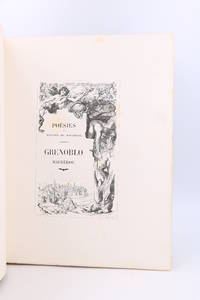
186490471Grenoble: Rahoult et Dardelet 1864. Fine. Rahoult et Dardelet Grenoble 1864-1874 24.6 x 33 cm 2 volumes reliés en 1 Illustrated edition with drawings by D. Rahoult and numerous wood engravings by E. Dardelet Vicaire I 812813; Carteret III 9596.Preface by George Sand. Grenoble Rahoult et Dardelet 18641874 issued in two parts bound in one volume large quarto.Half brown morocco over corners spine with five raised bands decorated with gilt fleurons and blind tooling minor rubbing to the spine covers of marbled paper framed with double gilt fillets surface wear to the boards comb-marbled endpapers and pastedowns gilt top edge.The first part issued in nine instalments between 1859 and 1864 consists of a poem in local patois on the flooding of Grenoble in 1733 first published in that year.The author François Blanc 16621742 known as La Goutte was a grocer in Grenoble described as impotent and consumed by gout.The second part published in 1874 and illustrated by the same artists contains a copy of the letter written by François Blanc to one of his friends concerning the flood that struck Grenoble on 20 December 1740; Jacquety de le Comare by the same author pp. 2353; and a glossary by Michal-Ladichère pp. 5578.These last two items appear to be lacking from the copies described by Vicaire and Carteret who record only 21 pages.Printed stamp used as an ex-libris of G. Magnin of Grenoble on an endpaper.Some foxing and a light waterstain in the right-hand margin of a few leaves. Rahoult et Dardelet hardcover
1851JC16176Paris: Michel Levy Freres 1851. First Edition. Hardcover. Very Good. 8vo; pp. 262; t.e.g. Bound in near-uniform half green morocco for Henry Harrisse peacock marbled covers the foot of each spine with his monogram. Some scuffing and rubbing to binding but overall a very good or better copy. Inscribed by the author to her friend: "a mon ami/Henry Harrisse/G. Sand". With Harrisse's ownership signature in ink on the verso of the front free endpaper. Harrisse was born in Paris but spent most of his younger years in America where he was a lawyer and historian and an eminent Americanist. He returned to France in late 1866/early 1867 and began to mingle in French literary circles where he met and formed a close friendship with George Sand. He became a fixture in the salons frequented by Sand Gustave Flaubert Saint-Beuve and others. His friendship with Sand survived until her death in 1876 and with most of literary France he attended her funeral at her house in Nohant. Works inscribed by Sand are uncommon on the market. <br/><br/> Michel Levy Freres hardcover
183450030Paris: Félix Bonnaire 1834. Fine. Félix Bonnaire Paris 1834 13.50 x 22 cm 2 tomes en 2 volumes reliés First edition rare. Fictitious statement of second edition. On the half-title: Publications de la Revue des deux mondes. The review had published the novel in serial form in 1833. Contemporary half glazed black calf binding. Spine handsomely decorated with rococo tools. Gilt title and volume number. Some rubbing to edges. Scattered foxing but fine copy in a quality binding. Sentimental epistolary novel. This is the author's third novel and the first to bear the masculine pen name Georges Sand. NB: This work is available at the bookstore upon request within 48 hours. Félix Bonnaire unknown
183578365Paris: Félix BonnaireVictor Magen 1835. Fine. Félix Bonnaire Victor Magen Paris 1835 12.50 x 20.70 cm relié First edition. The half-title indicates: Publications de la Revue des deux mondes where the novel had indeed appeared in pre-publication form in 1834. Contemporary half glazed tender green calf binding. Smooth spine with false flat raised bands decorated with blind tooling and roulettes. Cherry red glazed shagreen title label. Spine now light brown. Scattered foxing. Romantic work written during her stay in Italy where her liaison with Musset ended George Sand admits to having been inspired by Manon Lescaut in Leone Leoni but by reversing the characters. The novel relates the harmful passion of a naive woman for an Italian nobleman with destructive vices. She is taken in by Don Aleo who is in love with the young woman. This love triangle will have a tragic destiny. Félix BonnaireVictor Magen hardcover
183979954Paris: Félix Bonnaire 1839. Fine. Félix Bonnaire Paris 1839 13 x 21.20 cm relié First edition. Printed on fine laid paper. Contemporary full black shagreen binding. Spine with raised bands decorated with blind-tooled compartments. Two blind-ruled frames on covers. Edges gilt. Double gilt inner fillet. Some rubbing. Generally fresh throughout with occasional light foxing notably some leaves with scattered spots. Handsome copy. At the time when George Sand wrote Spiridion one of her most important novels alongside Consuelo and Lelia the author was considered a novelist of ideas whose every book seemed to consist of illustrating a thesis or a cause. Drawing upon the ruins of the Gothic novel for setting and plot with a supernatural atmosphere Spiridion is an initiatory novel that presents itself as a series of embedded narratives of the spiritual and philosophical journeys of four generations of monks over the course of a century. This dark and austere work did not find its audience but was praised by Renan Taine Gustave Doré and Dostoevsky. Félix Bonnaire hardcover
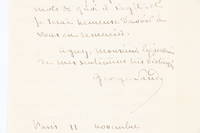
186478465Paris 1864. Fine. Paris s. d. entre 1864 et 1868 13.40 x 20.70 cm 2 pages sur un double feuillet Autograph letter signed addressed to an unknown correspondent written in black ink on a double leaf with dry stamp bearing the writer's initials. This letter probably unpublished was written on ""November 11th"" between 1864 and 1868 according to the address at the bottom: ""rue des feuillantines 97"". ""Une amie commune et pleine de confiance en votre bonté me fait espérer monsieur que vous m'accorderez un peu de sympathie. Si je suis indiscrète d'y croire ne vous en prenez qu'à elle comme elle est de ces personnes à qui l'on ne peut en vouloir je ne crains pas de vous la dénoncer. Vous pouvez vendre un immense service au fils de mon ami d'enfance. Le voudrez-vous quelque difficile que la chose puisse être Elle ne l'est peut-être pas je ne sais pas. Mais si elle l'est j'espère quand même depuis ce que Madame de Voisins me dit de vous. ."" ""A mutual friend full of confidence in your kindness gives me hope sir that you will grant me some sympathy. If I am indiscreet to believe it blame only her as she is one of those persons one cannot hold a grudge against I do not fear to denounce her to you. You can render an immense service to the son of my childhood friend. Will you do so however difficult the matter may be Perhaps it is not difficult I do not know. But if it is I still hope so from what Madame de Voisins tells me about you. ."" unknown
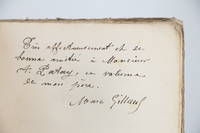
184984805Paris: Chez l'auteur 1849. Fine. Chez l'auteur Paris 1849 14 x 20.50 cm broché First edition published in a small number of copies. Small marginal tears on the covers as well as at head and foot of spine slight corner losses and small stains on the covers. Preface by George Sand. Rare signed autograph inscription from the son of the locksmith Jérôme-Pierre Gilland to Monsieur A. Patay. Chez l'auteur unknown
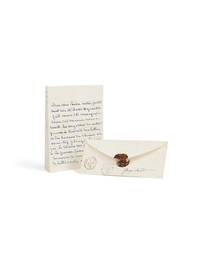
28219Nohant 4 mars 1858. 3 p. ½ en 1 f. plié 210 x 135 mm à en-tête « G.S. » timbre à sec rédigées à l'encre bleue enveloppe conservée avec cachet de cire rouge à la devise « Vitam impendere vero » cachet de la poste du « 5 mars 1858 La Châtre ». . « Mon cher Faivre votre petit mot m’a été aussi agréable qu’il vous a été ennuyeux à écrire car Maurice nous a révélé les mystères de votre paresse à l’endroit des lettres et les horreurs du rhume ou vous étiez plongé. J’espère que le rhume est fini ; quant à la paresse j’avais dit à Maurice de vous dispenser de lutter contre elle. Je sais que vous ne nous oubliez pas et je compte toujours sur votre promesse de revenir pour plus longtemps beaucoup plus longtemps souligné cette année. Vous savez que j’ai une commande à vous donner outre les grands travaux dramatiques qui vous réclament. Maurice m’écrit que vous donnez de superbes représentations de marionnettes avec lui puis que vous êtes l’orchestre à grands effets à vous tout seul. Je regrette de n’être pas là pour partager de si puissantes émotions. … pourtant que Maurice travaille un peu et que la peinture trouve son heure au milieu de tous ces enivrements. Manceau vous envoie mille bonnes amitiés avec les miennes. Il a verni le portrait qui est de plus en plus charmant à regarder et dont je vous remercie en moi-même à toute heure. G. Sand. Nohant 4 mars ». . Dans Le Théâtre de marionnettes de Nohant paru en 1876 George Sand se rappelle de l'installation du premier théâtre de marionnette dans la maison de Nohant : « C'est en 1847 que pour la première fois avec l'aide d'Eugène Lambert Maurice installa une baraque de marionnettes dans notre vieux salon » Et George Sand de concevoir aussitôt les costumes des marionnettes l'occasion de se livrer à un réel travail d'imagination et de faire preuve d'un génial talent de « bricoleur ». Maurice Sand et Eugène Lambert fabriquent eux-mêmes leurs marionnettes dites « Burattini » : des marionnettes à gaine ou à manchon en tissu dont ils peuvent sculpter la tête. Plus d'une centaine de marionnettes sont fabriquées à Nohant en trente ans dans du bois de tilleul puis peintes avec des clous pour les yeux et de vrais cheveux récupérés chez le coiffeur de La Châtre. Excellent aquarelliste Antoine Jean Étienne Faivre dit Tony Faivre est un ancien élève de l'école de dessin de Besançon. Il exécuta de jolis éventails et de charmants panneaux décoratifs et fut avec Eugène Lambert le fidèle compagnon de Maurice Sand à Paris comme à Nohant où il ajoute des effets de voix et participe à la mise en scène. Il séjourna au moins quatre fois dans l'Indre entre 1857 et 1859 participant activement aux représentations théâtrales : « Faivre est dans le fond qui nous passe les sujets. Je dirige le tout et cela fait un spectacle assez complet » en attestera Maurice Sand à sa mère dans plusieurs lettres enthousiastes. Correspondance t. XIV n° 7758. Deux lettres de Maurice Sand à George Sand font état de leur amitié avec Tony Faivre conservées au Fonds patrimonial de la Bibliothèque de La Châtre lettres du 8 février 1858 et du 5 mars 1858. Nohant 4 mars [1858]. 3 p. ½ en 1 f. plié (210 x 135 mm) à en-tête « G.S. » (timbre à sec), rédigées à l'encre bleue, unknown
1895185801Boston: Little Brown & Company 1895. First Edition; First Printing. Hardcover. Good in boards. Sticker owner personalization on FEP. Front hinge starting. Little, Brown & Company hardcover
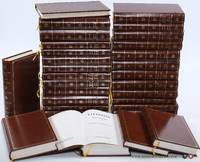
197654984Plan de la Tour Var: Éditions d'Aujourdhui 1976. 30 vols. 8vo 20x125 cm. Imitation leather spines gilt gilt ornemental border on frontcovers "relié à l'ancienne selon la meilleure tradition artisanale et conforme à l'edition de Michel Lévy par Jacques Fazan". Printed in 800 numbered copies. This is copy no. 255. Texts conformable of the editions of Lévy Perrotin a.o. - 1 Conformable of Perrotin 1842-43: Indiana Valentine Jacques André Leone Leoni Spiridon Le Compagnon du Tour de France 2 vols. - 2 -- of Dupuis et Tenré 1833: Lélia 2 vols. - 3 -- of Hetzel: Jeanne 1852 Lucrezia Floriani 1855 - 4 -- of La Librairie Nouvelle: Les Maîtres sonneurs 1858. - And in chronological order of Lévy and Calmann-Lévy 1856-1879: Teverino Le Péché de M. Antoine 2 vols La Ville noire Jean de la Roche Le Château des Désertes Tamaris Simon Le Meunier d'Angibault Cadio Nanon Impressions et Souvenirs Nouvelles Lettres d'un Voyageur Contes d'une Grand'mere 2 vols Questions politiques et sociales Souvenirs de 1848. - "Un choix qui permet d'embrasser toute la vie llittéraire de George Sand". - Nice set in perfect condition with bookplates pasted - text in French Éditions d'Aujourdhui hardcover
1833046866Paris: Urbain Canel Adolphe Guyot 1833. First Edition. Hardcover Quarter Leather. Very Good Condition. Scarce collection of 26 works of fiction by French women - contemporary quarter leather over marbled boards. Scattered foxing paper of mixed quality and some pages browned. Includes an early Sand "Une Vielle Histoire". 407pp; 429pp; 413pp; 491pp; 446pp; 403pp Size: Octavo 8vo. 6-volume set complete. Quantity Available: 1. Shipped Weight: Under 1 kilo. Category: Literature & Literary; Inventory No: 046866. Urbain Canel, Adolphe Guyot hardcover