ANONYMOUSABAA
92 résultats
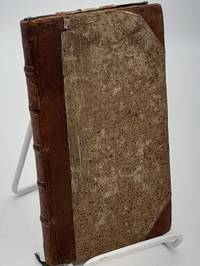
177868338A Collection of Five Eighteenth-Century British Revolutionary Pamphlets Anonymous. T.M. A letter to His Grace the Duke of Buccleugh of national defence to which is now added a postscript relative to the regiments of fencible men raising in Scotland. Edinburgh Sold by J. Dickson bookseller 1778. A reissue of the London edition of the same year with a cancel title-page and the addition of a postscript dated: LincolnÃs Inn July 20th 1778. 4 72 10 Postscript. With the letter signed "T.M." Previous owner's old ink signature on title-page. This also includes remarks on Adam Smith's Wealth of Nations. Adam Smith's Remarks were not in the London Edition. We could find no other copies at auction. ESTC T179898. Bound with DOUGLAS JOHN Anonymous. A Letter Addressed to Two Great Men on the Prospect of Peace; And on the Terms necessary to be insisted upon in the Negotiation. London: A. Millar 1760. First edition first issue with no errata below Finis on final leaf. 4 55 1 blank pp. With half-title and final leaf verso blank. " This tract relating to the Treaty of Utrecht and the French Canadian question has been attributed to Junius also to William Pulteney Earl of Bath but with more probability to John Douglas. The ìTwo Great Menî were Wm. Pitt and the Duke of Newcastle. The writer urges upon the government in making peace with France to require from her the relinquishment of all Canada Guadaloupe and Senegal." Sabin 40263. ESTC T37753. Bound with Macpherson James Anonymous. The rights of Great Britain asserted against the claims of America: Being an answer to the declaration of the general Congress. The third edition with additions. London Printed for T. Cadell 1776. The Third edition. 6 96 pp. With folding chart "Appendix." Half-title and advertisement leaf after the title-page. "Also attributed to Sir John Dalrymple Lord George Germaine and Henry Mackenzie." ESTC T45081. Half-title is soiled and some minor toning to a few pages." A reply to the July 1775 declaration of the Continental Congress commissioned and widely distributed by the British government. ìThis celebrated performance is said to have been written printed and liberally distributed both in Great Britain and America at the instance and expense of government; but whether this be true or not the work itself we are afraid will answer no other purpose than to exasperate the people of Great Britain against their brethren of America; and by inflaming misrepresentations and invective aggravate the evils of our present civil discord.î---Monthly Review." Sabin 18347. Howes D37. Evans 14727. Bound with LIND JOHN. Anonymous. An answer to the Declaration of the American Congress. The Fourth Edition. London Printed for T. Cadell 1776. Fourth Edition. 1-132 pp. Leaves D2 and D3 trimmed close at fore-edge just slightly affecting the printed marginal notes. " This anonymous work was ascribed to English barrister John Lind by Richard Price and others. In the work Lind a close associate of Jeremy Bentham treats each of the Declaration's grievances individually refuting them on philosophical and factual grounds. Pages 119-132 include a discussion of the Preamble to the Declaration which he describes as an "absurd and visionary" theory of government." National Book Auctions. " In these later editions the outline of a counter declaration is omitted. With regard to the theory of government set forth in the preamble to the ìDeclarationî the writer adds ìa theory as absurd and visionary as the system of conduct in defence of which it is established is nefarious;î indeed each article of the Declaration of Independence is carefully examined and every assertion disputed." Sabin 41281. Howes L349 ESTC N5626. Bound with Burke William Anonymous. Remarks on the letter addressed to two great men. In a letter to the author of that piece. London Printed in the year 1760. A pirated reprint According to Todd 263 item 98. 32 pp. Bound without the half-title. Previous owner's old ink signature on title-page." Occasionally attributed to Charles Townshend but more generally assigned to William Burke and Ãin partà to Edmund" Todd. A respond to the first pamphlet in this volume "The ÃLetter addressed to two great menà is by John Douglas Bishop of Salisbury." "Argues against giving Guadeloupe to the French. Attributed to Charles Townshend by Evans; however the Dictionary of national biography attributes the Remarks to William Burke secretary to Guadeloupe" Evans 8751. ESTC N26297. Octavo 8 1/4 x 5 inches; 210 x 128 mm. All pamphlets bound together in contemporary half calf over marbled boards. Red morocco spine label lettered in gilt. Some occasional foxing but otherwise very clean. Previous owners old ink notes on front endpapers. A very good copy. HBS 68338. $5000 Sold by J. Dickson, bookseller hardcover books
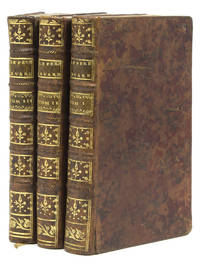
1770307572Paris: Desventes de Ladoué 1770. First edition. xvi 359 iii; 334; 360pp. 3 vols. 12mo. Bound in full contemporary mottled calf. With the bookplate of the Vicomte de Noailles engraved by Agry in each volume. Upper joint of vol. III with short start at foot otherwise a fine and fresh copy. First edition. xvi 359 iii; 334; 360pp. 3 vols. 12mo. Contemporary Satire of Rousseau's 'Émile'. A satirical response to Rousseau's Emile ou l'Education 1762. Where Émile is guided by a wise tutor the author of Le Père avare mocks from the outset Rousseau's dictum "le véritable précepteur est le père" for the narrator's father M. d'Erigny grew up poor and gained wealth through his friendship with a government minister; his child has been spoiled from infancy. <br/>While M. d'Erigny is drunk his mistress gets him to sign an order from her jeweler for 20000 francs of precious stones and skips out. The extravagance is discovered and the father becomes miserly in the extreme. The son now 15 years old is entrusted to a unscrupulous précepteur or tutor who involves the youth in a swindle and vanishes with the money. <br/>This is a confessional so we learn it all: the narrator soon discovers love and devotes himself to pleasure using the family name to run up accounts everywhere before being deceived and fleeced. M. d'Erigny is furious; Madame intercedes: his debts are paid and he is sent off to exile in a provincial town. He is befriended by a well-connected gentleman but repays this trust with deceit. Besotted with an actress he forges a criminal denunciation of a rival but his scheme is discovered and his in consigned to "une de ces maisons de force" a private prison for the reform of licentious youth. <br/>To escape this close confinement the narrator embarks with a flotilla of colonists bound for the island of C in the new world. His mother's continued good influence follows him across the ocean cushioning him from the worst excesses of a brutal colonial regime amply detailed. Florainville a mistress who has managed her money well comes to the colony to rescue him but falls afoul of the corrupt Intendant and her health fails her. She dies but not before she has made him her legatee. The narrator assists the colonial governor in prosecuting the Intendant and returns to France. He retires to a rural abbey and contemplates his experiences. Before long he becomes the benefactor of a village community and sees it thrive.<br/>Only edition of this little-known work of fiction set partly in the Americas. OCLC records two copies in N. America Princeton UCLA two in France and one at Trinity College Dublin Desventes de Ladoué unknown books
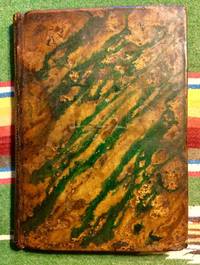
179268343A Collection of Five Political Tracts from the Years 1792-1793 Anonymous. Six essays on natural rights liberty and slavery consent of the people equality religious establishments the French Revolution which were greatly approved and have been in much request since their original appearance in the Public Advertiser. London Printed for S. Woodfall 1792. First edition. 8 48 pp. We could find no copies at auction and only four are listed at libraries according to ESTC N62745 Bound with ANDERSON George. A general view of the variations which have been made in the affairs of the East-India Company since the conclusion of the war in India in 1784. By George Anderson. London Printed in the Year 1792. First Edition. 8 102 2 blank 11 folding appendix tables pp. With half-title and 11 folding appendix tables. There have been no copies at auction since 1978. George Anderson was a colonial official and writer. In 1792 he published this present highly regarded study as to the condition of Indian trade and finance. ESTC T97303 Bound with Anonymous Callender James T. The political progress of Britain; or an impartial account of the principal abuses in the government of this country from the revolution in 1688. The Whole tending to prove the ruinous Consequences of the popular System of War and Conquest. Part first. Edinburgh Printed for Robertson & Berry 1792. First edition. 80 pp. We could find no copies at auction in over 50 years. Previous owner's old ink notes on blank verso of title-page. "In February 1792 Callender published in the Edinburgh Bee the first of eight parts of what was to become a very successful pamphlet The Political Progress of Britain. As an inflammatory critique of imperialism war and corruption with a strong Scottish nationalist flavour Callender's work rivalled Thomas Paine's in its radicalism. It sold well although not in the numbers of the Rights of Man." Oxford DNB. ESTC T43967. Bound with CARLYLE Alexander. A sermon on the death of Sir David Dalrymple Bart. Lord Hailles; from Eccles. VII.3. Preached In the Church of Inveresk on Sunday the 9th day of December 1792. By Alexr. Carlyle D. D. F. R. S. E. Chaplain to His Majesty & Minister of that Parish. With an address to the congregation suited to the circumstances of the times. Edinburgh Printed for John Balfour 1792. First edition. 33 1 blank pp. We could find no copies at auction in over 50 years. ESTC T53279. "Carlyle was a Church of Scotland minister and memorialist. During the French Revolution he was equally conservative in regard both to domestic issues.and to foreign issues such as the war with France which he exalted as a divinely sanctioned cause and a test of British virtue and resolve in three published sermons including: Sermon on the Death of Sir David Dalrymple Bart. Lord Hailes 1792." Oxford DNB. Bound with Mallet du Pan M. Jacques. ConsidÈrations sur la nature de la rÈvolution de France et sur les causes qui en prolongent la durÈe. A Bruxelles et se trouve a Londres chez Owen 1793. Early edition. viii 79 1 table pp. ESTC T75704. Mallet du Pan was a Swiss journalist who "Published with the approval of the foreign representatives a work which was to make a prodigious sensation and which is still the best know of his writings his Considerations on the Revolution." Mallet du Pan and the French revolution by Mallet Bernard. He is considered a pioneer of modern political journalism. Octavo 8 1/8 x 4 7/8 inches; 205 x 125 mm. All tracts bound together in contemporary half calf over marbled boards. Red morocco spine label lettered in gilt. Some occasional foxing but otherwise very clean. Previous owners old ink notes on front endpapers. Outer hinges cracked but holding. Top of spine chipped. Otherwise a very good copy. HBS 68343. $5000 Printed for S. Woodfall hardcover books
1780265361780. Pastel on laid watermarked paper. The sheet retains signs of having been stretched as these types of portraits typically were. Dampstain upper right corner tear lower right corner otherwise excellent condition. A strikingly well done portrait of a successful European gentleman with piercing eyes.<br/> <br/>Pastel portraits were popular in Europe Great Britain and America during most of the 18th century especially in the 1770s and 80s. They provided a more rapid way of rendering a likeness in bright colors that didn't yellow. This was a golden age for portrait painting which exemplified the optimistic views of the Enlightenment: a sitter was not ashamed to show his or her wealth contentment or character. Our self -assured subject looks directly at the viewer with piercing eyes calm practical not likely to be fooled. It is an astounding accomplishment; we feel that this was exactly how he was. The artist allowed himself or herself there were a number of excellent female pastel portraitists particularly in France to be subject entirely to what was seen and sensed about this strong indomitable personality.<br/> <br/>Baetjer & Shelly Pastel Portraits. Images of the 18th Century. Metropolitan Museum of Art 2011. unknown books
17904147London: Published by Robert Sayer 1790. Colour printed mezzotint with additional hand-colouring. State vi/viii with the publication line altered to: ' Printed for ROBERT SAYER Map & Printseller No. 53 Fleet Street London'. A magnificent portrait of Lord Grosvenor's celebrated Arabian horse by the master equine painter George Stubbs.<br/> <br/>George Stubbs is considered one of the greatest English painters. His ingenious animal and sporting pictures remain unrivalled in their passionate depiction of emotion and their commitment to naturalistic observation. Stubbs was briefly apprenticed to the painter Hamlet Winstanley a relationship that quickly ended leaving the young artist to his own tuition. In contrast to contemporary academic theory Stubbs' attached great importance to the belief that art should imitate nature not the work of other artists. He spent years carefully studying human and equine anatomy so that he could truthfully represent natural form and movement. A result of this study was his famous 'Anatomy of the Horse' which details with beautiful engraving the various elements of a horse's anatomy from skeletal form to muscular definition. Continuing in search on innovation Stubbs began experimenting with a myriad of different mediums becoming accomplished in both enamels and printmaking. Through arduous application he became a talented mezzotint engraver and worked with ease in both soft ground and etching techniques. Stubbs' masterful paintings inspired some of the greatest engravers of the day to reproduce his work for publication. Stubbs was elected director of the Society of Artists and a Royal Academician and today his prized paintings are housed in some of the finest museums in the world. Stubbs was often commissioned to paint accurate portraits of specific mares for proud aristocratic patrons who wished to highlight their horses' racing success. This practice is expertly exemplified in this magnificent print. The Arabian horse in this print belonged to the first Lord Grosvenor one of Stubbs' earliest and most important patrons. Lord Grosvenor had two passions horse racing and collecting paintings; by glorifying one passion he was able to indulge the other. In this clever work Stubbs made the Arabian horse the clear center of attention even the groom is made to appear secondary to the horse. The artist's anatomical knowledge is displayed in the musculature of the horse's legs and shoulders and by the veins on the muzzle and right hind leg.<br/> <br/>Lennox-Boyd George Stubbs 21 vi/viii; Gilbey Life of George Stubbs no.28; Siltzer The Story of British Sporting Prints p.270. Published by Robert Sayer unknown books
17904138London: Published by Robert Sayer 1790. Hand-coloured mezzotint. State vi/viii. A remarkable portrait of Lord Grosvenor's Pangloss by the master equine painter George Stubbs.<br/> <br/>George Stubbs is considered to be one of the greatest English painters. His ingenious animal and sporting pictures remain unrivalled in their passionate depiction of emotion and their commitment to naturalistic observation. Stubbs was briefly apprenticed to the painter Hamlet Winstanley a relationship that quickly ended leaving the young artist to his own education. In contrast to contemporary academic theory Stubbs attached great importance to the belief that art should imitate nature not the work of other artists. He spent years carefully studying human and equine anatomy so that he could truthfully represent natural form and movement. A result of this study was his famous Anatomy of the Horse which details with beautiful engraving the various elements of a horse's anatomy from skeletal form to muscular definition. By the 1760's Stubbs had developed a considerable reputation as a sporting artist and had attracted a number of distinguished patrons. Continuing in search of innovation Stubbs began experimenting with a myriad of different mediums becoming accomplished in both enamels and printmaking. Through arduous application he became a talented mezzotint engraver and worked with ease in both soft ground and etching techniques. Stubbs' masterful paintings inspired some of the greatest engravers of the day to reproduce his work for publication including his own son George Townly Stubbs who reproduced with faithful accuracy the sublime emotion inherent in his father's exquisite works. Stubbs was elected Director of the Society of Artists and a Royal Academician and today his prized paintings are housed in some of the finest museums in the world. Stubbs was often commissioned to paint accurate portraits of specific racehorses for proud aristocratic patrons who wished to highlight their horses' racing success. This practice is expertly exemplified with this magnificent print of Pangloss Lord Grosvenor's beloved horse. Pangloss was foaled in 1755 and named after a character in Voltaire's Candide; little is known about Lord Grosvenor's horse apart from the fact that his racing career was ended by a broken leg. This print was the second of a series of engraved horse portraits begun by the publisher Ryland in 1771 and extended by Robert Sayer in 1777. Although the inscription on the print establishes Stubbs as the painter the painting has not been identified making this print extremely intriguing since it is the only record of Stubbs' lost work.<br/> <br/>Lennox-Boyd George Stubbs 20 vi/viii; Gilbey Life of George Stubbs no.39; Siltzer The Story of British Sporting Prints p.270. Published by Robert Sayer unknown books
17400000645Italy 1740. Contemporary vellum on boards. Very Good. Tom I. 4to20.5 x 15.0 cm. Contemporary vellum with ink label on spine. There are no free endpapers or title page.Text block attached to boards by threads; all edges with marbling. Collation: 298 pp.293-298 blank 38 ll 3 folding containing 99 numbered ink drawings. The drawings are labeled as numbered Figures for each of the five V Tabula. These illustrations are grouped into V Tables with a Tabula IV Supplement for a total of 6 Tabula of images: Tab. I - 6 ll 18 Fig.; Tab. II - 4 ll 23 Fig.; Tab. III - 8 ll 17 Fig.; Tab. IV -6 ll 19 fig.; Tab.IV Suppl. - 9 ll 17 Fig.; Tab.V - 5 ll 5 Fig. There is a colophon on p. 286. <br />Note in Italian on front free pastedown mentions the colophon on p. 286 which reads “FINEM POSUI DIE I JUNY MLCCXXXX/ SUB DISCIPLINA U.J.D. MAR. I J LAMA. This manuscript was completed on June 1 1740. <br />There is a Tabula Index for the manuscript on pp. 289-292. Beneath the title is the Introduction that is followed by Liber I Physica Generalis or Book I General Physics. <br />The remainder of the manuscript text is organized with four 4 Dissertations different areas of physics that are treated with a number of chapters or addition of theorems as pertinent to the theme of Dissertation. Reference to figures at rear is made by noting the figure number in the margin that is found for the particular chapter in one of the Dissertations. The index at rear contains detail information for each Dissertation Chapter number and where appropriate Theorems. <br/><br/>Writing is in a fine hand and drawing very accurate and well laid out on page. <br />Although the ink writing in spine indicates volume 1 major areas of physics viz. motion of bodies mechanics friction color optics etc. are covered. hardcover books
17400000634France: Author 1740. Contemporary French calf binding. Very Good. 8vo 16.5 X 9.4 cm Contemporary French calf binding; spine with raised bands red morocco label with gilt title; panels with decorative floral design; hinges with breaks along head and tail regions; worm hole on rear hinge; gilt dentelle pattern on edges of boards; text block with speckled red on all sides. Collation: 4 xiii 3-Blank 37 37-246 247-249blank 250-268 7-blank title p. for plates 52 numbered folded plates 4 blank plates with border. There are two in text tables pp149-150. All plates are expertly prepared with exacting detail of drawing and numbering for various calculations noted in text. The title page has break in paper along lower border due to heavy inking and most likely age and use. The ink on leaves with table of matters is in lighter and faint. Writing in the main body of text is clear and bold by comparison. The text is a geometric guide written in a fine clear cursive hand with reference to individual plates where appropriate. The text and plates cover use of sine tangents and secants measuring heights of various objects surveying terrain of all kinds of land and rivers use of planchete with everything explained in writing and figures on plates gathered at end. There are numerous propositions presented for the different sections as well as practical calculations. The author of this unpublished treatise most probably was a surveyor who recorded this extensive treatment of practical geometry. <br/><br/> Author unknown books
1781291930London: MacGowan 1781. hardcover. very good. 2 Volumes. 33 engraved maps & plans 3 folding & 28 engraved plates. Thick 4to unpaginated text in double columns. Full contemporary calf. Heraldic bookplate in each volume. London: MacGowan 1781. Scarce. Well-worn and joints cracked but attractive and overall very good.<br/><br/> The work contains numerous entries for North American battles of the Seven Years' War American Revolutionary War &c. including Annapolis Royal Beauséjour Brandy-Wine Lake Champlain Charlestown Fort Frontenac Louisbourg Fort Necessity Fort Niagara Penobscot Fort Pitt Quebec Saratoga Ticonderoga New York &c. Appended are an essay on fortification.<br/><br/> MacGowan unknown books
175927359London: Printed for T. Caslon and Sold by J. Smith and M. Jackson 1759 1759. First edition. ESTC T10583 which records four copies in the UK BL Cambridge Rylands Trinity and five in the US Boston Public Duke Newberry two at Yale. Title-page a little browned; repairs to the edges; very good copy enclosed in a chemise and marbled paper slipcase. 4ro self-wrappers stitching renewed 30 pages untrimmed. A celebratory poem in four cantos on the four election paintings of William Hogarth The prefatory Advertisement is signed by John Smith who states that he is writing on behalf of the "concealed Author" and that while Hogarth's paintings have been explained by others "none ever gave him Hogarth so much satisfaction as the present Performance." At the conclusion a small notice states that "speedily will be published" a poem on Hogarth's "The Roast Beef of Old England" but that apparently was not published. <br/><br/> London: Printed for T. Caslon and Sold by J. Smith, and M. Jackson, 1759 unknown books
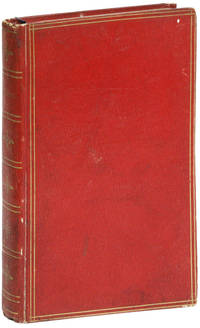
178426075Londres i.e. Paris: Et se trouve à Paris chez Pissot 1784. First Edition. Octavo; pp. 6264pp.; 4 A-Q8 R4; woodcut title page vignette head- and tail-pieces; full contemporary red imitation morocco double ruled in gilt flat spine decorated in gilt. Extremities rubbed with boards occasionally exposed contemporary blue ribbon marker detached but present. A Very Good attractive copy. Pechmeja's best-selling prose poem published anonymously under the patronage of one Madame de Beauvau presumably the Marquise de Boufflers. The work enjoyed both enthusiastic and scathing reviews from the most celebrated literary figures of the time. Readers admired the work's literary beauty and its touching description of friendship while others found fault with the moral and economic message which would be described as socialist in the modern sense. Among the most notable Télephe detractors was the author Jean-François de la Harpe who wrote "The author seems like Rousseau to make a crime out of private property without which no society could exist. He doesn't want children to inherit their fathers' fortunes as if inheritance wasn't a natural right and as if the fathers themselves didn't work for the sake of their children" my translation. Others including the relatively enthusiastic reviewer the Baron von Grimm were nonplussed by Pechmeja's dour description of the fate of man and the injustices of oppression maintaining that while virtue must always be exercised little happiness can ultimately be experienced even with the purest intentions my paraphrase of Michaud and Grimm. Grimm rejects comparisons made to Fénelon's novel Les Aventures de Télemaque 1699 saying that if Marmontel's Les Incas 1747 is the Télemaque for the age of the encyclopedia then Télephe is the Télemaque for economists. Within three weeks of publication sales had dropped dramatically and while the book was reprinted once in the 1790s and subsequently translated into English and German Télephe never re-experienced its initial popularity. ESTC T132203.<br/> <br/>References:<br/> <br/>Baron von Grimm and Denis Diderot's Correspondance Littéraire Philosophique et Economique Vol. XII mars 1794 pp. 80-3. <br/> <br/>Joseph Fr. Michaud Biographie Universelle Ancienne et Moderne Vol. 33 pp. 244-6. . Et se trouve à Paris, chez Pissot unknown books
1749136504London: Henry Lintot 1749. hardcover. Three tables 32 372pp. 4to full contemporary calf raised bands gilt-lettered spine label; corners bumped top of hinge starting. London In the Savoy: Printed by Henry Lintot for Daniel Browne 1749. Scarce. Very Good .<br/><br/> Not in Halkett & Laing.<br/><br/> Henry Lintot unknown books
17937441Mexico City: Felipe de Zuniga y Ontiveros 1793. First edition. Quarto 20.4 x 15.8 cm pp 10 ii 165 3 with striking copper-engraved frontispiece plate by Jose Simon de la Rea of Maria Ignacia de Azlor the founder and spiritual head of the Convento de la Sagrada Compania de Maria Santissima de la Ensenanza de Mexico. This important convent which still exists just off the zocalo in Mexico City was popularly called the Ensenanza because it served as a school for the daughters of the elite in the city. The foundress was the daughter of wealthy parents which enabled her to buy the property for the convent and adjacent school. The fine portrait of Azlor shows her with rosary standing at her desk with pens ink wells sea etc. In th eprologue it is stated that the nuns in the convent themselves wrote the book - an unusual source of authorship most of these nuns' biographies being written by men. Rare in commerce a half a dozen in a hundred years; OCLC shows some 20 copies in library collections. Medina Mexico 8255 This copy is has the marca de fuego of the Colegio de San Fernando in Mexico City identified in the Navarro edition of Beristain vol. 5 Supl. p 595 a center of Franciscan missionary activity; the old shelf numbers are still faintly visible on the upper spine; the back free end-paper is lacking; there is some very minor pin-hole worming in the some of the margins not affecting the text. It is bound in a contemporary original mottled full calf binding spine with red title label and gilt fillets and panels. Very good copy. <br/><br/> Felipe de Zuniga y Ontiveros unknown books
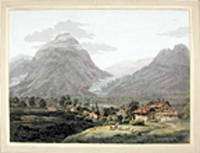
1770103701770. Hand-coloured engraving. Title is inscribed in a contemporary hand on verso of sheet. In excellent condition. Trimmed as usual and mounted on washline background. Mounting sheet is watermarked laid paper. Image size: 13 1/2 x 19 inches. A wonderful continental view in the grand tradition of the romantic landscape.<br/> <br/>Towards the middle of the eighteenth century a trend developed amongst artists and printmakers which sought to visually record the natural beauties of their surroundings. English printmakers began to publish topographical prints of the important sights in the British Isles and on the Continent. Theses image not only inspired a sense of national pride but also served as cherished mementos for eager collectors on the "Grand Tour". Prints and paintings of Ruins and antiquities were aimed at English and foreign tourists who desired a reminder of their travels or at those vicarious tourists who collected topographical prints instead of traveling. This is a wonderful example of a picturesque eighteenth century landscape print. By trimming the image within the platemark and mounting it on a decorative washline background the print has the effect of a landscape painting. The likeness is heightened by the addition of added body colour in the image and the use of a heavy painterly technique of engraving. This practice was common amongst engravers and printsellers who wished to capitalize on this trend for picturesque landscapes. This print is from the famed Oettingen-Wallerstein collection which was compiled over two centuries by various members of the royal household. The collection is known for its stunning impressions and the immaculate condition of its prints.<br/> <br/>Clayton The English Print 1688-1802 p. 155; Lugt Les Marques de Collections Supplement 2715a. unknown books
1770103721770. Hand-coloured engraving. Trimmed as usual and mounted on washline background. Mounting sheet is watermarked laid paper. Image size: 14 1/8 x 20 1/8 inches. A wonderful romantic view in the grand tradition of the picturesque English landscape.<br/> <br/>Towards the middle of the eighteenth century a trend developed amongst English artists and printmakers which sought to visually record the natural beauties of England and Wales. Sparked by a sense of national confidence and patriotism English printmakers began to publish topographical prints of the important sights in the British Isles. In addition to being a visual record of the countryside they were meant to encourage public recognition of the beauty and history of England. They were aimed at English and foreign tourists who desired a memento of their travels or at those vicarious tourists who collected topographical prints instead of traveling. This is a wonderful example of a picturesque eighteenth century landscape print. By trimming the image within the platemark and mounting it on a decorative washline background the print has the effect of a landscape painting. The likeness is heightened by the addition of added body colour in the image and the use of a heavy painterly technique of engraving. This practice was common amongst engravers and printsellers who wished to capitalize on this trend for picturesque landscapes of the English countryside. This print is from the famed Oettingen-Wallerstein collection which was compiled over two centuries by various members of the royal household. The collection is known for its stunning impressions and the immaculate condition of its prints.<br/> <br/>Clayton The English Print 1688-1802 p. 155; Lugt Les Marques de Collections Supplement 2715a. unknown books
1755289780Danezig.: Johann Christian Schuster. 1755. Contemporary half speckled calf over speckled boards raised bands gilt spine title red edges ribbon marker. Very good light wear to covers spine label chipped a tight clean copy in a nice contemporary binding. 8vo. 17.8x10 cm. . German text. Scarce. weight: 0.3 lb. Johann Christian Schuster. hardcover books
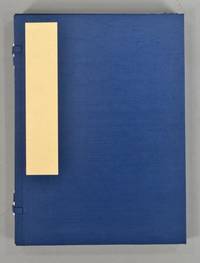
1793899051793. EHON. TOBA-E SANGOKU-SHI. 3 Vols. Osaka Kawachiya Kihei and Kawachiya Eisuke Kansei 5 1793. 25.8 x 18.5 cm. Original dark blue covers string-bound Japanese style fukuro toji with the pink printed paper title labels. A nice 18th century edition of this work in good impression. Originally published in the 1720's. Though the artist is unnamed several candidates have been mentioned including Ooka Shumboku. 18th century editions of Toba-e books are becoming increasingly uncommon. In a custom clasped chitsu case. The covers are worn but overall a good copy of this book. An excellent example of the somewhat madcap humor of the Toba-e genre. With a bookseller's advertisement at the end which indicates this edition of the book was part of a series of Toba-ehon brought out by the same publisher - SANGOKUSHI OGI NO MATO and TOBA GURUMA. unknown books
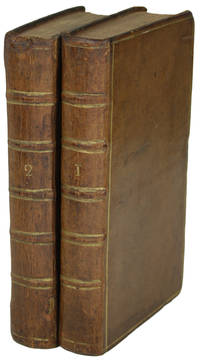
1765154541London: Printed for W. Nicoll 1765. 12mo two volumes pp. 1-2 i-iii iv-x xi-xiv 1 2-336; i-viii 1 2-358 full calf all panels ruled in gold edges speckled red. First edition. Highway robbery piracy on the Thames murder rape a midwife tried for "not doing his duty" and more. Female miscreants are well represented. Many of the cases concern conspiracy forgery. counterfeiting and fraud. ESTC T114036. Half titles present lacks front free endpaper in volume II a very clean attractive copy. Scarce in commerce. #154541 Printed for W. Nicoll unknown books
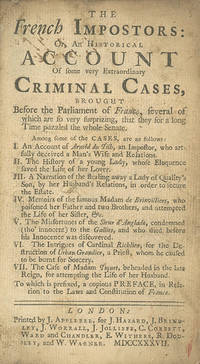
173728073London: Printed by J. Applebee for J. Hazard J. Brindley J. Worrall J. Jolliffe C. Corbet Ward and Chandler E. Withers R. Dodsley and W. Warner 1737 1737. First edition second issue with a cancel title; first published earlier the same year under the title Gallick Reports. This second issue retains the running title Gallick Reports. ESTC N6568 which records six copies of this issue Cambridge Columbia Cornell Harvard Princeton and National Library of Medicine; cf. ESTC T116539 for the first issue. Two leaves misbound following the preface; title-page somewhat soiled and with a small hole not affecting the text; edges of the binding rubbed; very good copy. 12mo contemporary sheep skillfully rebacked red leather spine label gilt rules and lettering. Five pages of publisher's terminal advertisements. ¶ An unusual collection of seven "extraordinary" and "surprizing" French criminal cases as recorded by an anonymous English author who has also supplied an interesting 43-page preface on French law. Among the cases is the 16th century story of Martin Guerre later used by Janet Lewis for her novella The Wife of Martin Guerre Colt Press 1941; that's followed by stories of a man who "debauched" a young woman but is saved from execution by that woman; Mary Margaret de Aubrey who poisoned her father and two brothers; the celebrated history of Urbain Grandier condemned as a Magician; a child claimed by two women to be its mother; Madam Tiquet who attempted to "assassinate" her husband. Interspersed with the cases are relevant extracts from French law the king's edicts against witches and poisoners etc. Modern nautical bookplate on the front free endpaper of Robert J. Hayhurst retail pharmacist and book collector. <br/><br/> London: Printed by J. Applebee, for J. Hazard, J. Brindley, J. Worrall, J. Jolliffe, C. Corbet, Ward and Chandler, E. Withers, R unknown books
18000000568Np.England: Author 1800 <br />. Original wraps. Very Good. Sm. 4to. Later marbled paper covers. Collation: 31 pp. with 7 pen and ink drawings of dials and several tables. The manuscript is a practical manual with seven Problems for making accurate sundials “To draw and equinoctial dial or an horizontal dial under the poles”; “To draw a horizontal dial under the equinoctial”; “To draw a horizontal dial for any latitude”; “To draw an erect direct south dial”; “To draw a direct North Dial”; “To draw an erect direct east Dial”; “To make an erect direct west Dial.” The writer has used a fine calligraphic style that is complemented with clear and exacting drawings. <br/><br/> Author paperback books
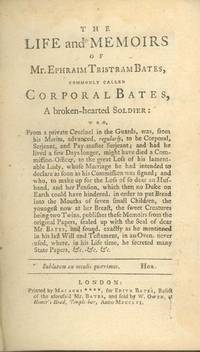
175627951London: Printed by Malachi for Edith Bates Relict of the Aforesaid Mr. Bates and sold by W. Owen 1756 1756. First edition. ESTC T77673; Block The English Novel page 140. Hinges rubbed and starting but sound; light damp-staining to the endpapers; very good copy. 12mo contemporary sprinkled calf gilt rules. One page of publisher's terminal advertisements. A forerunner to Laurence Sterne's The Life and Opinions of Tristram Shandy with numerous parallels in style and subject matter. In the 1770s Mrs. Piozzi wrote to Dr. Johnson that she had found a copy of this "strange book about Corporal Bates which I bought and read . . . and found to be the very novel from which Sterne took his first idea . . . even the name Tristram itself seems to be borrowed from this stupid history of Corporal Bates forsooth." See Helen Sard Hughes "A Precursor of Tristram Shandy" in the Journal of English and German Philology vol. 17 no. 2 who concludes that the story of Corporal Bates "was but one of many minor novels which in halting fashion prepare the way for the more perfect works of masters coming after . . ." Contemporary ink signature of Robert Parsons on the front paste-down. <br/><br/> London: Printed by Malachi****, for Edith Bates, Relict of the Aforesaid Mr. Bates, and sold by W. Owen, 1756 unknown books
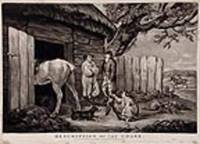
179815286London: Published by Haines & Son No. 19 Rolls Buildings Fetter Lane 1798. Mezzotint. Printed on wove paper. Image size: 9 1/4 x 13 7/8 inches. A post- hunting scene of a gentleman recounting the details of the hunt.<br/> <br/>This early hunting scene follows the tradition of James Seymour by presenting a small format sporting picture in a bold decisive style. The artist and engraver are not recorded on the plate which was typical of works published at the period by Haines & Son. Haines & Son were prolific publishers and printsellers who catered to the decorative print market they often republished earlier plates which they acquired from other publishers such as Carington Bowles and Robert Sayer. Published by Haines & Son, No. 19 Rolls Buildings, Fetter Lane unknown books
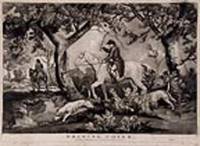
179815285London: Published by Haines & Son No. 19 Rolls Buildings Fetter Lane 1798. Mezzotint. Printed on wove paper. In excellent condition with the exception of some glue residue on the verso of the sheet. Four vertical creases in sheet. A small abrasion in image. Image size: 9 1/4 x 13 7/8 inches. A bold hunting scene of a rider drawing cover.<br/> <br/>This early hunting scene follows the tradition of James Seymour by presenting a small format sporting picture in a bold decisive style. The artist and engraver are not recorded on the plate which was typical of works published at the period by Haines & Son. Haines & Son were prolific publishers and printsellers who catered to the decorative print market they often republished earlier plates which they acquired from other publishers such as Carington Bowles and Robert Sayer. This image which is listed as plate 2 is most likely the second plate in a set of six prints. Published by Haines & Son, No. 19 Rolls Buildings, Fetter Lane unknown books
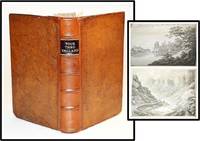
1793013845London: Printed at the Minerva Press Leadenhall-Street for R. Edwards 1793. Book. Very Good. Near Fine. 1st Edition. Beginning in Portsmouth Hampshire the tour continues through Wiltshire Cornwall and all surrounding counties ending in Middlesex. --------------- Modern rebacked spine with 5 spine bands and black with gilt lettering lable to original leather boards endpages original. Bindings are tight and square. Text clean Moderate shelf handling wear. Older bookseller pencil marks on front past down Author's name added in pencil on the title page. A 'crease / impression' in center of text until p32. 8vo; 8.5 inches tall; xxx 2 403 1 pages 12 leaves of plates: engravings ; 22 cm 8vo ------------ Folded Plates uncolored aquatints titles from captions: Three of the etchings are signed by H. Spence 910 11. ----- A view from the inside of the circles looking east -- Plan of Stone-henge on Salisbury Plain -- Inward view looking westward -- An exterior view south west -- Inward view looking west nore west -- An outside view looking to the north east -- Pont-pren in Coomb Ryddol -- The Devil's Bridge near the great Fall of the Monach -- Mountain scene -- Mountains and river -- Carnarvon Castle towards the Menai taken from the Isle of Anglesea -- Part of the inside of Carnarvon Castle. ---------- Edward Daniel Clark an English clergyman naturalist mineralogist and traveller in 1790 after his traditional schooling began tutorships common to the sons of the nobility some of which enabled him to travel extensively. ----- In 1791 the nucleus of his mineralogical collection was formed in the course of a tour of southern England Wales and Ireland. Ref: Encydotcom wiki; ODNB ----- REF: English Short Title Catalogue T145932; YCBA; Abbey J.R. Scenery of Great Britain and Ireland in aquatint and lithography 1770-1860 3; Cox E. Literature of Travel. Seattle 1949. V.III p.39 . Printed at the Minerva Press, Leadenhall-Street, for R. Edwards Hardcover books
1790202804London: Nichols 1790. First. hardcover. very good. Thick 4to xxii 476 pages. Title page soiled and chipped and first few pages are creased. Attractively rebound in simple 3/4 calf. London: Printed for the Society of Antiquaries by John Nichols 1790. First Edition. A very good copy.<br/><br/> Oxford 119; Bitting 532.<br/><br/> Nichols unknown books