[ANONYMOUS]Biblio.com
693 résultats
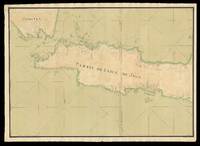
173317524Probably Paris: Dépôt des cartes et plans de la Marine c1733-1739. 530 by 1500mm. 20.75 by 59 inches overall. Manuscript chart pen and black ink and colour wash on two separate sheets of paper watermarked with Strasburg Lily within a shield initials "VDL" beneath and countermark "IV" closest to Churchill 405 dated to 1733 from the mill of Pieter van der Ley son of Gerrit Pieters van der Ley who worked De Wever - the Weaver - and De Bonsem - the Polecat - mills at Koog aan de Zaan Holland from 1674 onwards. The conquest of Jakarta by the Dutch who immediately renamed the port Batavia in 1619 gave the VOC its Asian headquarters from which it commanded a vast trading empire eventually extending from southern Africa to Japan that lasted for nearly two hundred years. By the end of the 1730s the British and French had begun to flex their seafaring muscles in the area and were publishing their own maps. This large-scale and detailed French chart of Java is clear evidence of a hostile interest that is directed at the very the heart of the Dutch empire. It is very similar to Francois Valentyn's large chart 'Nieuwe en zeer naaukeurige kaart van t Eyland Java Major of Groot Java' published in his 'Oud en Nieuw Oost-Indien vervattende een Naaukeurige en Uitvoerige Verhandelinge van Nederlands Mogentheyd in die Gewesten' 1724-1726 based on his own research correspondence and from previously unpublished material secured from the VOC officials. Some of this information must also have been available to the Chatelain family who published their 'Carte de l'Ile de Java: Partie Occidentale Partie Orientale.' 1719 which included details of inland topography not found on this manuscript chart nor on Valentyn's. The Chatelain map is avowedly based on Hadriaan Reland's work which was not published by the Dutch until Johannes van Keulen issued it as 'Insulae Iavae pars Occidentalis edente Hadriano Relando' in 1728. Interestingly this manuscript chart includes soundings that are not expressed on the Chatelains' chart implying some more recent knowledge of the coastline. However it does not reflect VOC knowledge of the southern coastline of Java dating from 1739 when Paulus Paulsz. in the sloop de Valk went on a surveying expedition there. His report and much more detailed chart which "remained the best sea chart of this area until the end of the VOC rule" Schilder page 173 survive. In 1513 Francisco Rodrigues sailed with the "Portuguese expedition from Malacca to find the unknown source of the rich trade in nutmeg mace and other spices. They sailed along the north coast of Java a trip from which Rodrigues prepared the first European map of Java's basic outline only of the north coast from direct observation. The Dutch who followed the Portuguese also ignored the interior in their mapping. In 1619 when the VOC established Batavia present-day Jakarta as a trading entrepot the south coast remained relatively unknown: it did not lie on the route to the valuable Molucca Spice Islands. The interior lands away from Batavia were ignored as long as the Javanese kingdoms remained quiescent; the VOC was intent only on ensuring a profitable return for its investors. Pursuit of these immediate economic goals restricted the exploration and associated topographic cartography of Java for nearly a century. A trivial cartographic misunderstanding reveals much about the stagnant state of mapping in Java at that time. The VOC sent Cornelius Coops by ship in 1698 to update the charts of the south coast; until this time charting was largely restricted to the northern coast where the Dutch ports and trading centres were located. Several schematic manuscript maps of the whole island appeared in Isaak de Graaf's 'Atlas Amsterdam' compiled by the VOC at the end of the seventeenth century but not published until the 1980s chiefly showing unnamed rivers and several VOC strongholds in the island's interior. At the beginning of the eighteenth century further mapping of the interior was conducted in a spasmodic and uncoordinated manner. The maps mostly by anonymous cartographers are in manuscript form and are held by the Netherlands National Archives The Hague. They were prepared internally by the VOC as administrative planning and strategic documents for circulation and use by VOC officials. VOC maps were closely guarded trade secrets; however commercial maps of the whole of Java and the neighbouring island of Madura were becoming readily available in Europe by the second decade of the eighteenth century" Simpson. This anonymous manuscript chart was probably prepared by the Dépôt de la Marine known more formally as the Dépôt des cartes et plans de la Marine the central charting institution of France. The centralization of hydrography in France began in earnest when Jean-Baptiste Colbert became First Minister of France in 1661. Under his watch the first Royal School of Hydrography began operating as did the first survey of France's coasts 1670-1689. The Dépôt itself began as the central deposit of charts for the French Navy. In 1720 the Navy consolidated its collection with those government materials covering the colonies creating a single large repository of navigation. By 1737 the Dépôt was creating its own original charts and from 1750 they participated in scientific expeditions to determine the accurate calculation of longitude. In 1773 the Dépôt received a monopoly over the composition production and distribution of navigational materials solidifying their place as the main producer of geographic knowledge in France. Dépôt-approved charts were distributed to official warehouses in port cities and sold by authorized merchants. The charts were of the highest quality as many of France's premier mapmakers worked at the Dépôt in the eighteenth century including Philippe Bauche Jacques-Nicolas Bellin Rigobert Bonne Jean Nicolas Buache and Charles-François Beautemps-Beaupré. The Dépôt continued to operate until 1886 when it became the Naval Hydrographic Service. In 1971 it changed names again this time to the Naval and Oceanographic Service SHOM. Although its name has changed its purpose is largely the same to provide high quality cartographic and scientific information to the France's Navy and merchant marine. Simpson 'Java Emerging Unfolding Cartographic Views' The National Library Magazine December 2010. Dépôt des cartes et plans de la Marine,
180018412c1800. 470mm in diameter. Instruments""Planispherum Lunare A unique manuscript lunar astrolabe Ink and polychromy on paper over pine. The instrument comprises a circular base plate and three rotatable cardboard volvelles and a brass radius pointer attached to each other in the centre. A brass ring is attached to the base plate for suspending. All four paper covered discs are finely inscribed in manuscript with various scales and symbols. Content 1. The smallest volvelle bears a scale covering 12 hours on its outer ring. It also shows the ecliptical motion of the Sun the Moon's orbit the line of nodes and the arguments of latitude in other words the distances from the nodes. 2. On the second volvelle a scale covers the years from 1801 to 1825. each year is subdivided in twelve months with the abbreviated name written for each month. 3. The following volvelle carries a series of scales showing a monthly calendar a zodiac calendar with skilfully drawn pictures and the symbols of the signs. Below the zodiac is a scale for the declination of the sun throughout the year set in four sequences of three. 4. On the outside rim of the volvelle is another calendar scale in which the months are unevenly distributed. This scale presumably was to be used in conjunction with the outer scale on the circular base plate. In addition the volvelle holds two brass studs that most probably helped the user turn the disc to the desired position. This latter scale gives the days subdivided in hours. The days are numbered I to XXXI with the number I coinciding with XXVII and 8 hours the sidereal period of the Moon which results in a double numbering from XXVIII to XXXI. Below this scale for days there is a series of dates all confined to the period 1801 to 1825 presumably for solar eclipses. The brass rule or pointer holds a horizontal scale from 5 to 0 LA-southern declination and from 0 to 5 LB-northern declination indicating the latitude of the moon with respect to the ecliptic. The closer to 0 at new moon or full moon the likelier an eclipse is to occur. The rule is engraved with """"Locus Lunae"""". The circular scales serve to set the moon's position and node relative to the sun from which the user can then infer the lunar phase and whether an eclipse will occur at new moon or full moon. Manuscript instruments of this type are rare especially in such good condition as no other exact copy is recorded to date. Similar instruments were produced at the end of the sixteenth century mostly in brass. Sir Robert Dudley 1573-1649 see item 17 had a lunar calculator made by Charles Whitwell c. 1568-1611 a brass disc of 72 cm diameter overall which was the most complex instrument made during the sixteenth century. Inscribed 'Sir Robert Dudley was the inventor of this instrument' its purpose was to calculate the place of the moon over a period of thirty years. It is now in the Museo di Storia della Scienza in Florence Italy. Another similar paper device was printed with detailed instructions in 1786 in Vlissingen Flushing in the Netherlands advertised as a """"Starkundige Maan-Wyzer en Almanach"""" Astronomical Moon Pointer and Almanac by Henricus Schortinghuis. Oxford Dictionary of National Biography; Webster Roderick and Marjorie 'Western Astrolabes' Adler Planetarium & Astronomy Museum 1998; Museo di Storia della Scienza Florence Italy unknown
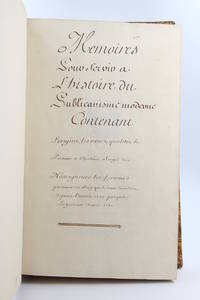
175078168s. l. 1750. Fine. s. l. 1750 23 x 38 cm 2 manuscrits reliés en un volume Manuscript entitled Mémoires pour servir à l'histoire du publicanisme moderne contenant l'origine les noms qualités le portrait et l'histoire abrégée de nosseigneurs les fermiers généraux du Roy qui se sont succédés depuis l'année 1720 jusqu'à la présente année 1750 with Mémoires pour servir à l'histoire du publicanisme ou l'Origine des receveurs généraux des finances du royaume 1750 folio 23 x 38 cm 330 pp 4 p. bl. 8 p. 4 p. bl. 83 pp. contemporary full calf Important and long manuscript composed of two parts written by two different hands retracing in total 160 biographies of the Fermiers Généraux active between 1720 and 1750 lavish and unpopular collectors of indirect taxes in the Ancien Régime. Each of the parts also contains a very useful index. The entries with the exception of 19 of them are all decorated with a coat of arms drawn in pencil painted by hand in colour and sometimes enhanced with gold or silver. Some modern notes some juicy in pencil in the margin of certain leaves. These memoirs have never been the object of a publication and we know of only a few handwritten copies with varying texts. The other examples that we have been able to find including the one digitised by the French National Library contain fewer biographies that ours and are not illustrated. Contemporary binding in full blond marbled calf title pieces in black and red morocco. Joints top of the first board and spine head repaired joints of the first board split but solid scratches on the boards corners damaged. A very beautiful manuscript richly painted retracing the history of the most despised institution of the Ancien Régime. Provenance: library of Count Chandon de Briailles descendent of the founders of the famous house of Champagne then of the Michel de Bry library with its motto Pro captu lectoris with their ex-libris glued to the first endpapers. hardcover
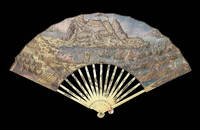
17802221Spain c1780. Folding paper fan with a fine large hand-coloured engraved view of the Siege of Gibraltar with Spanish ships and troops in the foreground the verso with engraved key in Spanish decorated with weapons of war on either side mounted on ivory sticks the ivory sticks decorated in silver and gilt with a fort ship and flag the gaurdsticks carved and pierced and with silver and gilt depicting a ship and drums. The unsuccessful siege of Gibraltar began in 1779 and lasted until February 1783 when the siege was lifted. This fan which it has been suggested belonged to the Earl of Minto is not in the Schreiber Collection. unknown
171086508Edinburgh: Various. Very Good; Compilation Bound Together of 12 Books/Pamphlets Etc From . Early 1700's About Religious Persecution in Eng. & Scotland. 1710-1717. Leather. PROFESSIONALLY REBOUND IN FINE LEATHER WITH RAISED BANDS GILT LETTERING AND NEW MARBLED BOARDS AND ENDPAPERS. GORGEOUS!! VERY VERY SCARCE!! The title continues: "More particularly her approving of and going into the legal establishment of the Prelatic constitutions of England. The generality of ministers swearing in the Oath of Abjuration to maintain Erastianism Prelacy and English Popish Ceremonies. Non-Jurants joining with Jurants judicially approving that practice to be free of scandal. The Church's establishing tyranny in government against all who will not join in communion with her and approve her practices without redress of grievances. Wherein these and several other causes of withdrawing are proven to be justly chargeable on the Church demonstrated to be contrary to the Word of God and Reformed principles of this Church and just grounds of withdrawing and setting up judicatures distinct from her; and the objections of Jurants and others fully answered."This is a classic detailed statement of the old covenanted principles and the biblical attainments of the second Reformation like the Solemn League and Covenantthe Westminster standards etc. It is also an excellent defense against the modern malignants who counsel Christ's children to remain in the backsliding and covenant breaking denominations that abound in our day. This constitutes 264 pages. The next largest ones bound in this book is: SHIELDS ALEXANDER. A true and faithful relation of the sufferings of the Reverend and learned Mr. Alexander Shields minister of the Gospel.; 772 pages . Various hardcover
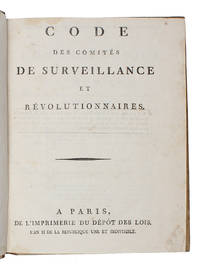
179360748Paris Impremerie du depot des lois An II 1793. 4to. In contemporary half calf with gilt lettering and ornamentation to spine. Wear to extremities. Upper part of back hinge split with minor loss of letters. Small dampstain to upper inner margin otherwise a nice copy. 2 VII 2-116 100 8 pp. <br/><br/><em>Exceedingly rare first edition of this highly interesting document being the Code of the Committees of Surveillance containing 106 regulations and guidelines for the functioning of these committees during the French Revolution. The Committees of Surveillance were established during the Reign of Terror September 5 1793 - July 27 1794 as part of the revolutionary government's efforts to identify and suppress counter-revolutionary activities. These committees were tasked with monitoring individuals' behavior enforcing revolutionary laws and ensuring loyalty to the revolutionary government. The document outlines the powers duties and procedures of these committees as well as the penalties for those found to be opposing the revolution providing a unique and fascinating insight into the legal and administrative framework of revolutionary France – arguable one of the most profound and radical moments in modern European history. The Committee of Surveillance in France during 1793 was established as a part of the radical phase of the French Revolution. Its function was to oversee and monitor the activities of suspected counter-revolutionaries and enemies of the Revolution as well as to enforce laws related to internal security and revolutionary principles. The committee was tasked with identifying individuals or groups deemed to be a threat to the revolutionary government often leading to arrests interrogations and in some cases executions by the Revolutionary Tribunal. It played a significant role in the Reign of Terror a period marked by extreme political violence and repression in France. The present work is of the utmost scarcity. We have not been able to trace a single copy at auction and OCLC only lists one copy in Paris. Nadaillac Catalogue d’une Collection Importante Sur la Revolution Francaise 724 </em> unknown
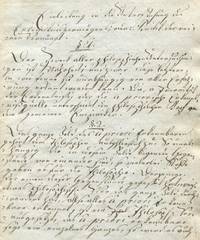
1790846<p>n/a: n/a 1790. First Edition. Cardboard covers. Very good. Early Manuscript Defense of the Critique of Pure Reason <br /><br />Original one-of-a-kind handwritten manuscript defense of Kants Epistemology. 196-page manuscript in clear German cursive with some deletions and corrections ink on clean paper. 1790 Quarto. <br /><br />An extensive presentation and defense of Kant's theory of knowledge probably written as the basis for a lecture or series of lectures. There are five main sections: <br /><br />Einleitung 34 paragraphs <br />Theorie des Vorstellungsvermögens überhaupt 30 paragraphs <br />Theorie der Sinnlichkeit 35 paragraphs <br />Theorie des Verstandes 64 paragraphs <br />Kritik der bisherigen Methaphisick 21 paragraphs <br /><br />Many of the paragraphs contain numbered Anmerkungen" further reflections. In these the author shows himself to be a stout defender of Kant's controversial new theories: "Vor Kant ist es keinem eingefallen die Gemüthsvermögen zu untersuchen die Erkenntniße aus dem Erkennbaren zu schöpfen und die Philosophie nicht von den so genannten Objeckten zu erbetteln. Man begehet keine tolle Freiheit wenn man behauptet daß es vor Kant wohl resonierende Köpfe und philosophische Versuche aber eigentlich keine Philosophie und Philosophen gegeben habe. <br /><br />The identity of the author remains unknown. Interestingly the final sentence announces a sequel: "Näher darüber in unseren zukünftigen moralischen Untersuchungen wo wir für das Ens Entium einen begreiflicheren Gott wieder finden werden. <br /><br />CONDITION: Very good or better in contemporary plain boards with minimal spotting edges untrimmed. <br /><br /><br />PHOTOS AVAILABLE UPON REQUEST</p> n/a
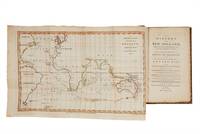
17875001050London: John Stockdale 1787. Octavo with two folding maps hand coloured in outline; a very good copy edges uncut in contemporary calf gilt spine neatly repaired. <p><p>An important book and a sometimes neglected precursor to the Australian First Fleet: this was one of the earliest descriptions of Australia published to coincide with the departure from England of the First Fleet. "It is an extremely interesting work and an essential inclusion in all comprehensive collections" Davidson. In discussing the fleet's imminent departure the anonymous compiler lists numbers and equipment as well as the principal officers and there is also material in both preface and text about transportation as well as an "Introductory Discourse" on the subject by William Eden which has often led to the misattribution of the whole book to him.</p> <p>This is an example of the important second edition published the same year as the first and after parliamentary approval of the Botany Bay plans and with a very significant new section: an additional ten prefatory pages appear for the first time in this edition discussing in detail the hopes for the new settlement. The anonymous writer reports that many of the convicts awaiting transportation have embraced the idea with excitement: "strange to tell! there have not been wanting voluntary candidates for banishment to that remote shore.".</p> <p>The "Eden" as it is often called was written "to present at one view a connected description of the whole country of New Holland". The book is clearly aimed at a public eager for information on the new colonial venture and for details of Botany Bay itself which is here described at length. This is the form in which many of the participants in the First Fleet must have absorbed what little information existed about conditions in Australia. The maps show the continent Botany Bay and most interestingly the "passage from England to Botany Bay in New Holland 1787" highlighting the route that the fleet must take.</p> <p>The book is of some importance too for its Cook material: as Cook's bibliographer Holmes points out "the greater part of the book is devoted to Cook's discoveries.". His charting of the east coast of Australia is here put into context in a form anticipating the actual settlement of the new coastline.</p> </p> . John Stockdale unknown
175090724n. l.: s. n. 1750. Fine. s. n. n. l. s. d. 1750 20.5 x 31 cm Relié Eighteenth-century manuscript second half comprising 258 foliated pages. Contemporary binding expertly restored in full tan calf with a smooth spine adorned with gilt compartments and decorative gilt tooling some now faded; signs of rubbing; title label missing; gilt rampant lion at the centre of both boards; handmade paper endpapers and pastedowns; gilt double fillets on board edges; corners slightly worn. Notable manuscript featuring extracts and summaries of orders and dispatches issued by the Ministry of the Navy during the Regency and the first year of Louis XVs reign. Collated from original documents carefully dated and with folio references these extracts are written in a highly legible hand. Topics covered include: general armament; the War of the Quadruple Alliance 1718 1719 1720; Barbary States; Guinea Coast; colonies; trade Spain Portugal Guinea Compagnie dAfrique Compagnie des Indes; justice police and discipline; munitions; goods and timber; fishing; ports and roadsteads; prizes and more. The manuscript is in excellent condition preserved in its original binding. Contemporary pencil note on the front endpaper: ""Aux armes du Maréchal Duc de Duras de lAcadémie française"" 17151789. s. n. hardcover
1770307572Paris: Desventes de Ladoué 1770. First edition. xvi 359 iii; 334; 360pp. 3 vols. 12mo. Bound in full contemporary mottled calf. With the bookplate of the Vicomte de Noailles engraved by Agry in each volume. Upper joint of vol. III with short start at foot otherwise a fine and fresh copy. First edition. xvi 359 iii; 334; 360pp. 3 vols. 12mo. A satirical response to Rousseau's Emile ou l'Education 1762. Where Émile is guided by a wise tutor the author of Le Père avare mocks from the outset Rousseau's dictum "le véritable précepteur est le père" for the narrator's father M. d'Erigny grew up poor and gained wealth through his friendship with a government minister; his child has been spoiled from infancy. <br /> While M. d'Erigny is drunk his mistress gets him to sign an order from her jeweler for 20000 francs of precious stones and skips out. The extravagance is discovered and the father becomes miserly in the extreme. The son now 15 years old is entrusted to a unscrupulous précepteur or tutor who involves the youth in a swindle and vanishes with the money. <br /> This is a confessional so we learn it all: the narrator soon discovers love and devotes himself to pleasure using the family name to run up accounts everywhere before being deceived and fleeced. M. d'Erigny is furious; Madame intercedes: his debts are paid and he is sent off to exile in a provincial town. He is befriended by a well-connected gentleman but repays this trust with deceit. Besotted with an actress he forges a criminal denunciation of a rival but his scheme is discovered and his in consigned to "une de ces maisons de force" a private prison for the reform of licentious youth. <br /> To escape this close confinement the narrator embarks with a flotilla of colonists bound for the island of C in the new world. His mother's continued good influence follows him across the ocean cushioning him from the worst excesses of a brutal colonial regime amply detailed. Florainville a mistress who has managed her money well comes to the colony to rescue him but falls afoul of the corrupt Intendant and her health fails her. She dies but not before she has made him her legatee. The narrator assists the colonial governor in prosecuting the Intendant and returns to France. He retires to a rural abbey and contemplates his experiences. Before long he becomes the benefactor of a village community and sees it thrive.<br /> Only edition of this little-known work of fiction set partly in the Americas. OCLC records two copies in N. America Princeton UCLA two in France and one at Trinity College Dublin Desventes de Ladoué unknown
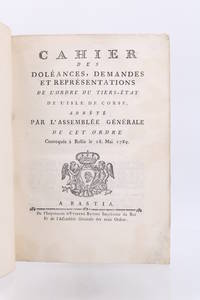
178989656Bastia: Batini 1789. Fine. Batini Bastia 2 juin 1789 16.3 x 22.4 cm Broché Very rare first edition bilingual quarto in format and printed on laid paper of the Corsican cahier de doléances.Cf. Starace 4747. Not in Roland Bonaparte. Conlon xxiv 89:1617 who notes only the 32-page octavo edition. No copy located in CCF or Worldcat.Our copy is preserved in a plain grey paper wrapper with minor internal flaws a few discreet paper restorations to the lower right margin of the opening leaves not affecting the text.""Les cahiers des Tiers en même temps que des mesures spécifiques exigent les mêmes réformes que le reste du royaume. Cette imbrication du régional et du national est jalonnée d'événements illustrant la dynamique révolutionnaire: agitation lors des assemblées primaires émeute de Bastia le 1er mai 1789 ""révolution municipale"" du mois d'août à l'annonce du 14 Juillet parisien et sous le signe de la cocarde tricolore."" Soboul Dict. hist. de la Révolution française.Among the specific measures requested are the following: authorisation for Corsican vessels to fly the Moors Head on the French white ensign as several towns and provinces of the kingdom already displayed their own arms; establishment of a university at Corte funded by the former revenues of the Carthusians Jacobins and Olivetans; establishment of a lazaretto to facilitate trade with the Levant; creation of a free port; preference in appointments to be given to Corsicans or to French inhabitants established on the island etc.Light foxing to the lower and upper right corners of the leaves not affecting the text.A well-preserved and appealing copy. Batini unknown
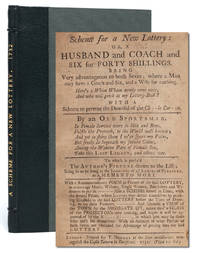
17326120London: Printed for T. Dormer 1732. First edition. Modern quarter morocco over cloth with gilt to spine. Measuring 180 x 111mm and collating complete including frontis folding game board and concluding woodcut: 2 62 2. From the collection of stage magician Ricky Jay with his bookplate to upper pastedown. Top margin trimmed close with consistent loss to running headers and occasional loss to page numbers with no other text effected. Pages somewhat toned with minor marginal chips but otherwise unmarked. A scarce satire playing both on the rising popularity of get-rich-quick schemes and on the economics of the marriage market the present is the only example to appear in the auction record. OCLC locates only twelve institutional copies. The present is the only example currently in trade.<br /> <br /> A Scheme for a New Lottery warns readers against the dangers posed by get-rich-quick schemes targeting large-scale scams like the recently burst South Sea Bubble sometimes called the world's first Ponzi scheme and the pawn-broking swindle of the so-called Charitable Corporation. These scams were appealing to ordinary people at a time when few were "successful in using wealth from trade to found a landed family" Rapp. Mocking both the conmen and the conned A Scheme satirically proposes "Another Lottery which may prove a general benefit to all concern'd; as there is no better Remedy for a Bite from a Mad Dog than the Liver of the Dog that bit." The proposed lottery filled with abstruse rules and convoluted promises ensures that the cycle continues.<br /> <br /> A Scheme also mocks marriage as a scam in which women could either make a wise match in a rich man or lose it all by marrying down. The lottery provides "Fifty Thousand tickets to be deliver'd to Maids or Widows or any that appear to be such" in the hopes of winning a financially stable husband represented by the tickets drawn. Such a match could be a good one: "A Ware-House Keeper with the Salary of a Hundred Pounds" or "the Governour." It could also by virtue of lottery be a loss: "2 Scotchmen both Pedlars 500 Broken Booksellers" and a range of other ruinous bounders are also listed as prizes. For those who desire an advance attempt the folding game bound in the book invites blindfolded women to stick a pin in the board to claim their prize. The present copy was played gently with pin marks revealing a Blacksmith and a Valet de Chambre among those husbands won<br /> <br /> The popularity of A Scheme resulted in a reissue the same year with a canceled title page as The Ladies Lottery and falsely attributed to Swift.<br /> <br /> ESTC N20921. Printed for T. Dormer unknown
17271405949London: W. Mears 1727. First Edition. Hardcover. Octavo 192 pages. In Very Good condition. Spine marbled paper with red textblock and gilt lettering. Fully bound in later marbled boards. Minor shelfwear and soiling. Textblock toning consistent with age. Minimal soiling. Bookplate pasted to inside of front board. GH consignment. Shelved in Case showcase. This work of early English viticulture printed for W. Mears is presumed to be authored by the 18th century botanical writer Richard Bradley 1688-1732 whose work Mears had published before. This text is exceptionally scarce especially in the original form. 1405949. Shelved Dupont Bookstore. W. Mears hardcover
1798FLO147<p>Six volumes only of this rare eight-volume set. Vol. VIII was discontinued after only 4 issues with 12 plates.<br /><br />With 352 hand-coloured engraved plates of 360.<br /><br />Incomplete set of this rare handy pocket-sized edition of 18th century natural history describing many newly discovered species.<br /><br />Text and plates copied from accounts published by Count Buffon George Edwards George Shaw James Bruce Thomas Pennant Maria Sybilla Merian and others. <br /><br />Includes the extinct dodo and sukotyro endangered animals and birds Siau Island tarsier white rhinoceros polar bear Indian bustard great green macaw wild water buffalo banded cotinga Russian mink African grey parrot. <br /><br />Also notable for the early images of plants and animals discovered in New South Wales Australia short-beaked echidna kangaroo black swan eastern quoll waratah Banksia etc.<br /><br />Half contemporary calf with red and black morocco gilt spine labels marbled boards scuffed front board off Vol. VI. Some plates loose or trimmed foxing and finger-marks to text and plates.</p> Harrison, Cluse and Co. hardcover
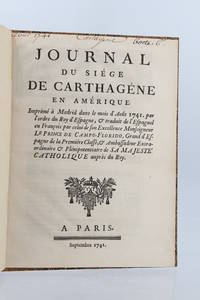
174182479Paris: S. n. 1741. Fine. S. n. Paris septembre 1741 19.50 x 25 cm relié Journal du siège de Carthagène en Amérique Diary of the Siege of Cartagena in America n.p. Paris September 1741 4° 195x25cm 16 pp. bound. First edition of the French translation. Originally published in Spanish a month before. Translated by Luis Reggio Branciforte and Colonna Prince of Campoflorido Spanish ambassador in France. Later half camel cloth binding boards in caillouté paper the first one with a gilt black morocco label. Spine-top a little rubbed white end-papers shaded. Contemporary handwritten notes on the upper part of the title page. Extremely rare copy of this diary about one of the greatest naval campaigns of the British Navy and its bitter defeat against the Spanish Treasure Fleet West Indias Fleet. S. n. hardcover
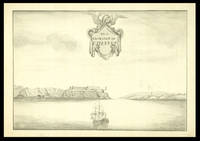
176011350c1760. 280 by 390mm. 11 by 15.25 inches. Manuscript map in pen and ink en grisaille on paper. View of the mouth of Havana Harbour taken from a shipboard vantage point emphasising the two forts that guarded the mouth: on the left the 'Castillo de los Tres Reyes Magos del Morro' Morro Castle and on the right 'Castillo de San Salvador de la Punta and marking the boom chain barrier stretched between the two. Havana was attacked by the British towards the end of the Seven Years' War and this would seem an appropriate date for this image. Seeing that Morro Castle presented a formidable challenge should it be attacked from the seaward the British simply landed troops on Cuba who approached from the landward side and commenced siege operations on 11th June gradually battering the walls into ruin. A breach was made on 30th July and the castle taken by storm. With the key to its defences lost Havana was quickly compelled to surrender. unknown
1760052729London: D. Chamberlaine 1760. The Third Edition . Hardcover. Good/No Jackets. 16mo - over 5¾" - 6¾" tall. 2vol.set: v1: 136&138pp. v2: 148&170pp. HBs full leather w/red&gilt-5 bands; covers detached ft.coverv1; both coversv2; rubbedscuffed&worn; staining on endpapers; ft.endpaperv2 detached; PON Geo. King 1779; cleantight pgs. Sterne's experimental fiction about fiction writing <br/> <br/> D. Chamberlaine hardcover
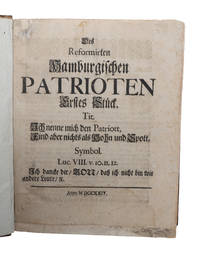
172661963No place but Hamburg no printer 1724 - 1726. 4to. In contemporary full calf with four raised bands and gilt lettering to spine. Light wear to extremities. A few leaves closely trimmed slightly touching text but generally nice and clean. 321 ff. No. 1 - 156. All that was published. <br/><br/><em>Exceedingly rare first edition fully complete of the famous Hamburg-journal “Der Patriot†– it was the most significant German weekly journal at the beginning of the 18th century and served as an important platform for the emerging Enlightenment. It was published weekly in Hamburg from 1724 to 1726. Due to its popularity it saw four reprints until 1765 and was also translated into Dutch and French. The genre of moral weeklies was inspired by English periodicals particularly the highly successful publications edited and written by Joseph Addison and Richard Steele which appeared three times a week or even daily The Tatler The Guardian and The Spectator. Unlike some other German moral weeklies Der Patriot had an independent editorial team that did not simply translate English counterparts but instead selected and developed its own topics. Many German scholars and writers contributed to Der Patriot but all published their articles under pseudonyms. Their true identities were not revealed until three years after the last issue was published. “In the course of the seventeenth and especially the eighteenth centuries Hamburg’s press evolved from a mere supplier of information to a vehicle of public opinion. During the first half of the eighteenth century Hamburg’s growing print culture was closely connected to the development of the city’s enlightened reform movement embodied in the first Patriotic Society 1724–1726. For example Hamburg’s own moral weekly Der Patriot a product of the Patriotic Society informs both the rise of periodical press and the spread of enlightened ideals. Modeled on British periodicals The Tatler and The Spectator Der Patriot contained instructive essays on a variety of subjects generally articulating middle-class norms and values. By appealing to a wide audience and disseminating useful knowledge and enlightened philosophy such journals aimed to reorient the reader’s moral outlook and lifestyle in particular to raise the intellectual and moral standards of its readers. Hamburg’s Der Patriot ran from 1724 until 1726 and was so popular that it was published in book form several times between 1728 and 1765. It was the most influential of the German moral weeklies. Der Patriot seeking to enlighten and influence the morals of its readers set itself in direct competition with the church. Aiming to “root out or at least expose all ridiculous or dangerous actions mistakes abuses and harmful habits through the orderly use of human reason†Der Patriot's elevation of reason over faith angered Hamburg’s strong orthodox Lutheran church which initiated a “pamphlet war†denouncing the journal. Der Patriot found both a multitude of detractors and supporters; roughly thirty-five pamphlets against and twenty-one in favor of the periodical appeared. This ‘battle of the pens’ certainly encouraged popular interest in Der Patriot and caused the publisher to print six thousand copies instead of the four hundred initially planned reflecting both an expanding readership and growing popular interest in Enlightenment tenets. Der Patriot furthermore reflects the republic’s civic morality as it strove to promote the common good. If its attitude toward Hamburg’s governance was generally positive it openly presented concrete proposals for improvement in the republic as well as the dangers of extravagance and excess the loss of civic-mindedness and political apathy. Indeed Der Patriot asserted both the right and the duty of Hamburgers to speak out on any question regarding the welfare of their city-state.†Aaslestad Place and Politics. </em> hardcover
1745MSA6746London: J. Fuller At the Dove. Poor with no dust jacket. 1745. Hardcover. Hard cover published by J. Fuller at the Dove in London in 1745. No dust jacket. Both covers are detached. Title page is with front cover. Rear endpaper is with back cover. Leather covers. Spine has creases lengthwise and has wear at the ends. Corners of covers are bumped and worn. Pages have some tanning and spotting and some pages have foxing. Several pages at beginning of book have a cut in them near bottom. Book is in acceptable condition. 396 pages .8 lbs.; 24mo 5" - 6" tall; 396 pages . J. Fuller At the Dove hardcover
179268343London: Printed for S. Woodfall 1792. A Collection of Five Political Tracts from the Years 1792-1793<br> <br> Anonymous. Six essays on natural rights liberty and slavery consent of the people equality religious establishments the French Revolution which were greatly approved and have been in much request since their original appearance in the Public Advertiser. London Printed for S. Woodfall 1792.<br> <br> First edition. 8 48 pp. We could find no copies at auction and only four are listed at libraries according to ESTC N62745<br> <br> Bound with<br> <br> ANDERSON George. A general view of the variations which have been made in the affairs of the East-India Company since the conclusion of the war in India in 1784. By George Anderson. London Printed in the Year 1792.<br> <br> First Edition. 8 102 2 blank 11 folding appendix tables pp. With half-title and 11 folding appendix tables. There have been no copies at auction since 1978. George Anderson was a colonial official and writer. In 1792 he published this present highly regarded study as to the condition of Indian trade and finance. ESTC T97303<br> <br> Bound with<br> <br> Anonymous Callender James T. The political progress of Britain; or an impartial account of the principal abuses in the government of this country from the revolution in 1688. The Whole tending to prove the ruinous Consequences of the popular System of War and Conquest. Part first. Edinburgh Printed for Robertson & Berry 1792.<br> <br> First edition. 80 pp. We could find no copies at auction in over 50 years. Previous owner's contemporary notes on blank verso of title-page which read "It is impossible that Lord Gardenstone could be so great a rogue as to write this tract as has been universally given out." "In February 1792 Callender published in the Edinburgh Bee the first of eight parts of what was to become a very successful pamphlet The Political Progress of Britain. As an inflammatory critique of imperialism war and corruption with a strong Scottish nationalist flavour Callender's work rivalled Thomas Paine's in its radicalism. It sold well although not in the numbers of the Rights of Man." Oxford DNB. ESTC T43967.<br> <br> Bound with<br> <br> CARLYLE Alexander. A sermon on the death of Sir David Dalrymple Bart. Lord Hailles; from Eccles. VII.3. Preached In the Church of Inveresk on Sunday the 9th day of December 1792. By Alexr. Carlyle D. D. F. R. S. E. Chaplain to His Majesty & Minister of that Parish. With an address to the congregation suited to the circumstances of the times. Edinburgh Printed for John Balfour 1792.<br> <br> First edition. 33 1 blank pp. We could find no copies at auction in over 50 years. ESTC T53279. "Carlyle was a Church of Scotland minister and memorialist. During the French Revolution he was equally conservative in regard both to domestic issues.and to foreign issues such as the war with France which he exalted as a divinely sanctioned cause and a test of British virtue and resolve in three published sermons including: Sermon on the Death of Sir David Dalrymple Bart. Lord Hailes 1792." Oxford DNB.<br> <br> Bound with<br> <br> Mallet du Pan M. Jacques. Considérations sur la nature de la révolution de France et sur les causes qui en prolongent la durée. A Bruxelles et se trouve a Londres chez Owen 1793.<br> <br> Early edition. viii 79 1 table pp. ESTC T75704. Mallet du Pan was a Swiss journalist who "Published with the approval of the foreign representatives a work which was to make a prodigious sensation and which is still the best know of his writings his Considerations on the Revolution." Mallet du Pan and the French revolution by Mallet Bernard. He is considered a pioneer of modern political journalism.<br> <br> Octavo 8 1/8 x 4 7/8 inches; 205 x 125 mm. All tracts bound together in contemporary half calf over marbled boards. Red morocco spine label lettered in gilt. Some occasional foxing but otherwise very clean. Previous owners old ink notes on front endpapers. Outer hinges cracked but holding. Top of spine chipped. Otherwise a very good copy.<br> <br> HBS 68343.<br> <br> $3500. Printed for S. Woodfall unknown
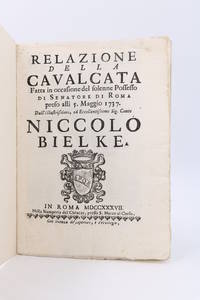
173789687Roma Rome Rome: Nella Stamperia del Chracas 1737. Fine. Nella Stamperia del Chracas Roma Rome Rome 1737 16.3 x 22.5 cm Broché First edition illustrated with woodcut armorial bearings at the head of the first page of text.Description of the equestrian procession that accompanied through Rome the new Roman senator Count Nils Bielke 17061765 a Swedish knight chamberlain to the King of Sweden and papal chamberlain following his recent conversion to Catholicism.The text gives a detailed account of the sumptuous costumes worn by the participants and of the various decorative settings. It concludes with the names and titles of all those who took part in the procession.Ink annotations at the head of the final page.Our copy is preserved in its original wrappers now protected by modern plain paper covers.A rare and attractive copy. Nella Stamperia del Chracas unknown
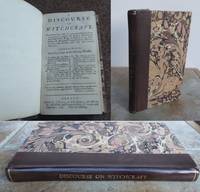
173652197<p>London printed for J. Read in White-Fryars and sold by the booksellers and pamphlet-shops of London and Westminster1736. TITLE CONTINUED: Containing Seven Chapters on the following Heads. I. To prove that the Bible has been falsely translated in those Places which speak of Witchcraft. II. That the Opinion of Witches has had its Foundation in Heathen Fables. III. That it hath been improved by the Papal Inquisitors seeking their own private Gain as also to establish the Usurped Dominion of their Founder. IV. That there is no such Thing as a Witch in the Scriptures and that there is no such Thing as a Witch at all. V. An Answer to their Arguments who endeavour to prove there are Witches. VI. How the Opinion of Witches came at first into the World. Vii. The Conclusion. FIRST EDITION 1736. 8vo approximately 175 x 100 mm 7 x 4 inches pages: iv 5-47 1 last page blank rebound in modern quarter calf over marbled boards gilt title to spine new brown endpapers padded out with many blank leaves. Very good copy of a scarce item. See: Harry Price Supplement to Short-Title Catalogue Of Works on Psychical Research Phenomena Spiritualism Magic Witchcraft Legerdemain etc. page 31; ESTC N6532. MORE IMAGES ATTACHED TO THIS LISTING ALL ZOOMABLE FURTHER IMAGES ON REQUEST. POSTAGE AT COST.</p> London, printed for J. Read, in White-Fryars, and sold by the booksellers and pamphlet-shops of London and Westminster,1736. hardcover
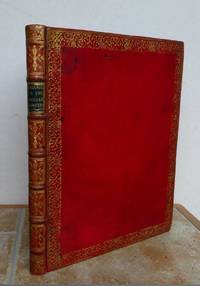
175752808<p>TITLE CONTINUED: And Particularly the most essential and recent Parts of the FOOT-EXERCISE. With Several Articles never before made Public. The whole Translated from the Original GERMAN Manuscript and illustrated with various Representations of the Exercise in SIXTEEN COPPER-PLATES. FIRST EDITION 1757 SCARCE LARGE PAPER COPY WITH HAND COLOURED PLATES BOUND IN FULL18th CENTURY WINE COLOURED GILT DECORATED MOROCCO. 4to approximately 290 x 230 mm 11½ x 9¼ inches engraved hand coloured encampment headpiece to dedication to the Duke of Marlborough 16 engraved hand coloured double page plates on 15 folding sheets 2 images on plate 5. Pages: viii 1-26 followed by: 3 unnumbered leaves of text on recto only with explanatory text of the plates 27-54 plus1 unnumbered leaf of explanatory text to recto only 55-59 1 text and plates printed on quality paper. FINE BINDING in full contemporary crushed red morocco elaborate gilt border to covers of fleurs de lys and 3 styles of crowns gilt raised bands to spine gilt decoration of flowers and acorns in compartments gilt lettered black morocco label gilt decorated board edges all edges gilt gilt decorated dentelles turn ins blue endpapers which partially obscure the upper and lower dentelles may be later replacements a few minor marks to covers including 2 tiny ink spots on upper cover a light scratch to lower cover bookseller's tiny label and armorial bookplate of Alfred Acland on front pastedown and that of Frank E. D. Acland pasted upside down on rear pastedown front endpaper lightly wrinkled plates I and VIII lightly browned at the centre fold a couple of tiny pale fox spots to plates I and IV otherwise contents clean and bright. A very good copy in fine binding. This work is translated from a German manuscript apparently a copy of Regulations issued by Frederick the Great some time after 1742. The regulations relate in Part I to Field-Duty for infantry cavalry and artillery in Part II to forming battalions marching passing a bridge regiments in action regulations for artillery when marching. The unknown editor states in his preface that in this work "many Articles of the Prussian Service are made public which have hitherto been kept secret". See ESTC T112373 listing a coloured copy in the British Library. MORE IMAGES ATTACHED TO THIS LISTING ALL ZOOMABLE FURTHER IMAGES ON REQUEST. POSTAGE AT COST AND ALL PARCELS SENT FULLY TRACKED AND FULLY INSURED. </p> London, J. Rivington and J. Fletcher, in Pater-Noster Row, A. Linde in Catherine-Street in the Strand, and Thomas Pote, Serjeant hardcover
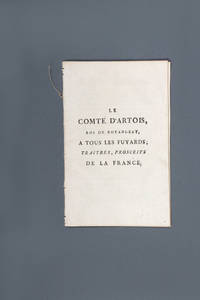
17904504805Paris 1790. Small hole to A4 affecting one word otherwise fine. Octavo 19 1 pp; disbound from a volume. <p><p>A very rare early "satire on French politics and English colonization" Ferguson. Likening those who fled the tumult of the French Revolution to the English convicts transported to Australia the author petitions them to join the future king of France in the newly established penal colony at Botany Bay: "le vaste continent des Terres Australes leur offre un pays nouveau asyle fait pour eux" "The vast continent of the Southern Lands offers them a new country a refuge made for them". The "count" continues that "c'est la Nation que vous etes dignes d'etentre c'est la Nation que je suis fait pour commander" "this is the nation that you deserve and that I am meant to command" and explains that in the Antipodes the laws are very different and virtue and vice are often upended.</p> <p>The satire evidently found an audience in Revolutionary France: a second edition was published in 1799. It appeared in the very first years of the English colonisation of Australia at a time when France had its own interests in the region and its own problems at home. La Pérouse commanding the Astrolabe and the Boussole arrived at Botany Bay on 24 January 1788 just as Arthur Phillip was moving the English settlement to Port Jackson. They spent six weeks in Australia before moving on.</p> <p>Toby R. Benis uses the pamplet to begin the introduction to his Romantic Diasporas: French Émigrés British Convicts and Jews 2009: "In 1799 a satirical pamphlet aimed at French émigrés and those inside the republic who sympathized with them appeared in England. Claiming to be produced in London the text was framed as an appeal from the Comte d'Artois Louis XVI's youngest brother calling on the 'cowards who fled France and to all those who have been banned from France-princes and valets traitors and bandits princesses and prostitutes' to join him in the British penal colony of Botany Bay: 'a new country made especially for them'. Styling d'Artois the "king of Botany Bay" the writer characterizes Australia as a de Sadian refuge for the worst elements of both Britain and the ancien regime bequeathed by the British government to the emigrant Prince and his circle to rule. A historical curiosity this document nonetheless points to a political and social dimension to exile in the Romantic period.". Romantic Diasporas focuses on how French emigrés Australian convicts and Britain's Jews embodied this state for Georgian society.</p> </p> . unknown
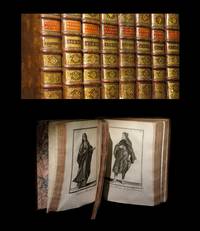
1714232301714. A Paris chez Jean-Baptiste Coignard 1714 1715 1725 1718 et 1719. 8 forts vol. au format in-4 258 x 202 mm de 1 f. bl. xcviii pp. 3 ff. n.fol. 399 pp. 12 ff. n.fol. et 1 f. bl. ; 1 f. bl. 4 ff. n.fol. 436 pp. 15 ff. n.fol. et 1 f. bl. ; 1 f. bl. xvi pp. 4 ff. n.fol. 456 pp. 23 ff. n.fol. et 1 f. bl. ; 1 f. bl. 3 ff. n.fol. 464 pp. 20 ff. n.fol. et 1 f. bl. ; 2 ff. bl. 3 ff. n.fol. 488 pp. 10 ff. n.fol. et 1 f. bl. ; 1 f. bl. 4 ff. n.fol. 446 pp. 13 ff. n.fol. et 1 f. bl. ; 1 f. bl. 4 ff. n.fol. 493 pp. 17 ff. n.fol. et 1 f. bl. ; 1 f. bl. 4 ff. n.fol. 446 pp. 19 ff. n.fol. et 1 f. bl. Reliures uniformes de l'ÂŽpoque de plein veau glacÂŽ et marbrÂŽ havane triple filet ˆ froid encadrant les plats dos ˆ nerfs ornÂŽs de filets gras ˆ froid caissons et caissons d'encadrement en pointillÂŽs dorÂŽs large dÂŽcor fleuronnÂŽ dorÂŽ semis de fleurettes et de pointillÂŽs dorÂŽs filets verticaux dentelÂŽs dorÂŽs piÂces de titre de maroquin rouille titre dorÂŽ tomaison dorÂŽe palette dorÂŽe en queue tranches mouchetÂŽes roulette dorÂŽe sur les coupes. Edition originale rare ; complÂte des 8 volumes la constituant un volume appartient ˆ la rÂŽimpression de 1721. Ensemble complet de ses 807 planches. ''Ouvrage trÂs recherchÂŽ et dont les exemplaires bien conservÂŽs sont rares et chers'' notait dÂŽjˆ Brunet. ''Planches gravÂŽes par Cl. Duflot Giffart de Poilly Thomassin ou non signÂŽes''. in Cohen. ''Planches fort bien gravÂŽes''. in Colas. ''On ne fait aucun cas de l'ÂŽdition de Paris 1792''. in QuÂŽrard. ''Cet ouvrage fruit d'un travail de 25 ans est plein de savantes recherches''. Barbier II Dictionnaire des ouvrages anonymes 759 - Colas I Bibliographie gÂŽnÂŽrale du costume et de la mode 1417 - Brunet III Manuel du libraire et de l'amateur de livres 92 - Cohen I Manuel de l'amateur de livres ˆ gravures du XVIIIÂme siÂcle 480 - Rahir La BibliothÂque de l'amateur p. 454 - Graesse III TrÂŽsor de livres rares et prÂŽcieux p. 238 - QuÂŽrard IV La France littÂŽraire p. 61 - Lipperheide 1846. Angles ÂŽlimÂŽs. Coiffes arasÂŽes pouvant parfois prÂŽsenter de petits manques. Dos prÂŽsentant un ÂŽclat lÂŽgÂrement altÂŽrÂŽ. LÂŽgÂres altÂŽrations superficielles affectant les plats ; quoique davantage marquÂŽes sur l'un d'entre-eux. Petit manque en marge infÂŽrieure de la page de titre du premier volume. Quelques claires rousseurs ou petites t‰ches dans les corps d'ouvrages davantage prononcÂŽes sur de trÂs rares feuillets. Inversion de 12 planches par le relieur. Cerne claire affectant les fonds de cahiers des feuillets liminaires du troisiÂme volume. Irisation dans la premiÂre moitiÂŽ des feuillets du quatriÂme volume ; dont plusieurs planches sont dÂŽsolidarisÂŽes et dont une vingtaine de fonds de cahiers prÂŽsente en outre une galerie de vers sans atteinte ˆ l'illustration ou au texte. Cerne claire en marge supÂŽrieure des premiers feuillets du cinquiÂme volume ; dont quelques planches sont ÂŽgalement dÂŽreliÂŽes. Infimes galerie de vers en marge gauche des derniers feuillets du sixiÂme tome. L'ensemble demeure cependant trÂs sÂŽduisant. b42961 unknown