ZARATE Augustin deLivre Rare Book

1 634 résultats
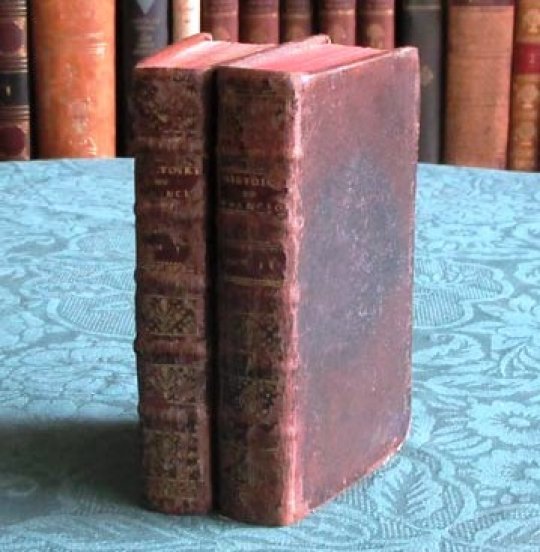
171614143Traduite de l'espagnol d'Augustin de Zarate par S.D.C. 13 gravures dont 2 dépliantes + 1 carte repliée et 1 frontispice. Titre imprimé en rouge et noir. Bandeaux, lettrines et culs-de-lampe gravés.A Paris, chez Michel Guignard -1716 - 360 et 479 pages.Reliure plein veau de l'époque. Dos à nerfs orné et doré avec pièces de titre et de tomaison. Tranches marbrées. Plats frottés. Pas de rousseur. Très bon état intérieur. Format in-12°(17x10).
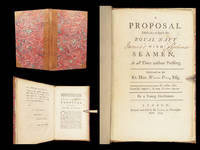
175929364<p>Printed in London by M. Lewis in 1759 this rare 18th-century pamphlet is attributed to an anonymous "Young Gentleman." Dedicated to William Pitt the Elder it addresses the problem of sailor recruitment during the height of the Seven Years' War. The 35-page tract suggests measures to encourage voluntary service including regular pay fixed complements and immediate wages upon arrival at port. The proposals reflect contemporary debates on naval administration and liberty. Very Good; modern leather binding with marbled boards is secure text block tight and pages show light age toning. Format: Octavo 8vo single volume. Collation: 35 pp. No illustrations. Edition: First edition 1759. Item number: #29364. PHOTOS AVAILABLE UPON REQUEST.</p> Printed and sold by M. Lewis hardcover
1719WRCLIT66441London: Printed for W. Mears . and Sold by J. Bettenham 1719. 751pp. Octavo. Extracted from nonce pamphlet volume. Old ink numbers in top margin of title leaf and lower margin of A2 a few small faint spots very good. First edition of this pointed reply to Wagstaffe's pamphlet: " The author. appears very formidable in his title-page and promises mighty Feats . But when we come to his performances we find this mighty champion no better than a Knight-Errant." ESTC locates two copies in North America: Emory and General Theological. ESTC T39938. Printed for W. Mears ... and Sold by J. Bettenham unknown books
1766141441- La Pucelle d'Orléans, Poème (21 chants). Suivi Du Temple du Gout - Notes - Lettre à M. de C*** sur le Temple du Goût - Variantes sur le Temple du Goût. Sans lieu, non nommé - 1775 - 416 pages. Portrait-frontispice et 21 gravures pour les 21 chants.2- La Guerre civile de Genève, ou les Amours de Robert Covelle. Poème héroïque. Avec des Notes instructives. A Besançon, chez Nicolas Grandvel - 1768 - 67 pages.3- Bagatelles anonymes. Recueillies par un Amateur. A Genève, non nommé - 1766 - vj et 30 pages. Vignettes. Ex-libris armorié de Brossay Duperaray.Reliure plein veau marbré de l'époque. Dos à nerfs orné et doré avec pièce de titre noir et initiales de Brossay Duperaray en tête. Tranches rouges. Filet doré sur les coupes. Filet à froid encadrant les plats. Epidermure de 5cm sur le premier plat. Coins frottés. Pas de rousseur. Bon état. Format in-8°(20x13).
1787131776[ Lisboa, Na Officina Typographica], 1787 In-4 broché, couverture muette posterieure, 28 pp. Sans le titre. Présente en modèle le Certificat et la Carte de la Surintendance d'Olivais Lisbonne,
171027424Cologne Jaques Kainkus 1710 In-12 1 portrait, vignette au titre (4) et 508 pp. Utopie. D'après Versins (p 901) : Jacques Massé et deux de ses compagnons naufragés découvrent une côte inconnue au sud de Madagascar et à la hauteur de la Tasmanie où vit et croit une faune et une flore extraordinaire, ils découvrent ensuite une civilisation vieille de 7000 ans . Le pays, très fertile et très peuplé est divisé bien régulièrement par cantons ou villages de 1500 pas de côté en forme de carrés parfaits tous séparés par des fossés. Les maisons n'ont pas plus d'un étage en raison de la violence des vents ; chaque canton a 22 habitations dont celle du prêtre et celle du juge sont les plus distinguées. La peine de mort est inconnue et la religion humble. Reliure d'époque, plein veau, accidents aux coiffes sup. et Inf. Barbier, IV, 1103
179715653Avec un recueil d'Observations analogues par F. Teytaud, chirurgien à Paris.RARE. Troisième Édition, revue, corrigée, considérablement augmentée et enrichie de planches anatomiques et pathologiques. 3 planches dépliantes reliées in fine.Paris, chez l'Auteur, Méquignon, et Fuchs - An VI (1797) - xiij (préface) et 366 pages. Glose, signet.Reliure pleine basane de l'époque. Dos lisse orné et doré avec pièce de titre. Coiffes accidentées. Pas de rousseur. Bon état. Format in-8°(21x13).
17904138London: Published by Robert Sayer 1790. Hand-coloured mezzotint. State vi/viii. A remarkable portrait of Lord Grosvenor's Pangloss by the master equine painter George Stubbs.<br/> <br/> George Stubbs is considered to be one of the greatest English painters. His ingenious animal and sporting pictures remain unrivalled in their passionate depiction of emotion and their commitment to naturalistic observation. Stubbs was briefly apprenticed to the painter Hamlet Winstanley a relationship that quickly ended leaving the young artist to his own education. In contrast to contemporary academic theory Stubbs attached great importance to the belief that art should imitate nature not the work of other artists. He spent years carefully studying human and equine anatomy so that he could truthfully represent natural form and movement. A result of this study was his famous Anatomy of the Horse which details with beautiful engraving the various elements of a horse's anatomy from skeletal form to muscular definition. By the 1760's Stubbs had developed a considerable reputation as a sporting artist and had attracted a number of distinguished patrons. Continuing in search of innovation Stubbs began experimenting with a myriad of different mediums becoming accomplished in both enamels and printmaking. Through arduous application he became a talented mezzotint engraver and worked with ease in both soft ground and etching techniques. Stubbs' masterful paintings inspired some of the greatest engravers of the day to reproduce his work for publication including his own son George Townly Stubbs who reproduced with faithful accuracy the sublime emotion inherent in his father's exquisite works. Stubbs was elected Director of the Society of Artists and a Royal Academician and today his prized paintings are housed in some of the finest museums in the world. Stubbs was often commissioned to paint accurate portraits of specific racehorses for proud aristocratic patrons who wished to highlight their horses' racing success. This practice is expertly exemplified with this magnificent print of Pangloss Lord Grosvenor's beloved horse. Pangloss was foaled in 1755 and named after a character in Voltaire's Candide; little is known about Lord Grosvenor's horse apart from the fact that his racing career was ended by a broken leg. This print was the second of a series of engraved horse portraits begun by the publisher Ryland in 1771 and extended by Robert Sayer in 1777. Although the inscription on the print establishes Stubbs as the painter the painting has not been identified making this print extremely intriguing since it is the only record of Stubbs' lost work.<br/> <br/> Lennox-Boyd George Stubbs 20 vi/viii; Gilbey Life of George Stubbs no.39; Siltzer The Story of British Sporting Prints p.270. Published by Robert Sayer unknown
17904147London: Published by Robert Sayer 1790. Colour printed mezzotint with additional hand-colouring. State vi/viii with the publication line altered to: ' Printed for ROBERT SAYER Map & Printseller No. 53 Fleet Street London'. A magnificent portrait of Lord Grosvenor's celebrated Arabian horse by the master equine painter George Stubbs.<br/> <br/>George Stubbs is considered one of the greatest English painters. His ingenious animal and sporting pictures remain unrivalled in their passionate depiction of emotion and their commitment to naturalistic observation. Stubbs was briefly apprenticed to the painter Hamlet Winstanley a relationship that quickly ended leaving the young artist to his own tuition. In contrast to contemporary academic theory Stubbs' attached great importance to the belief that art should imitate nature not the work of other artists. He spent years carefully studying human and equine anatomy so that he could truthfully represent natural form and movement. A result of this study was his famous 'Anatomy of the Horse' which details with beautiful engraving the various elements of a horse's anatomy from skeletal form to muscular definition. Continuing in search on innovation Stubbs began experimenting with a myriad of different mediums becoming accomplished in both enamels and printmaking. Through arduous application he became a talented mezzotint engraver and worked with ease in both soft ground and etching techniques. Stubbs' masterful paintings inspired some of the greatest engravers of the day to reproduce his work for publication. Stubbs was elected director of the Society of Artists and a Royal Academician and today his prized paintings are housed in some of the finest museums in the world. Stubbs was often commissioned to paint accurate portraits of specific mares for proud aristocratic patrons who wished to highlight their horses' racing success. This practice is expertly exemplified in this magnificent print. The Arabian horse in this print belonged to the first Lord Grosvenor one of Stubbs' earliest and most important patrons. Lord Grosvenor had two passions horse racing and collecting paintings; by glorifying one passion he was able to indulge the other. In this clever work Stubbs made the Arabian horse the clear center of attention even the groom is made to appear secondary to the horse. The artist's anatomical knowledge is displayed in the musculature of the horse's legs and shoulders and by the veins on the muzzle and right hind leg.<br/> <br/>Lennox-Boyd George Stubbs 21 vi/viii; Gilbey Life of George Stubbs no.28; Siltzer The Story of British Sporting Prints p.270. Published by Robert Sayer unknown books
17904138London: Published by Robert Sayer 1790. Hand-coloured mezzotint. State vi/viii. A remarkable portrait of Lord Grosvenor's Pangloss by the master equine painter George Stubbs.<br/> <br/>George Stubbs is considered to be one of the greatest English painters. His ingenious animal and sporting pictures remain unrivalled in their passionate depiction of emotion and their commitment to naturalistic observation. Stubbs was briefly apprenticed to the painter Hamlet Winstanley a relationship that quickly ended leaving the young artist to his own education. In contrast to contemporary academic theory Stubbs attached great importance to the belief that art should imitate nature not the work of other artists. He spent years carefully studying human and equine anatomy so that he could truthfully represent natural form and movement. A result of this study was his famous Anatomy of the Horse which details with beautiful engraving the various elements of a horse's anatomy from skeletal form to muscular definition. By the 1760's Stubbs had developed a considerable reputation as a sporting artist and had attracted a number of distinguished patrons. Continuing in search of innovation Stubbs began experimenting with a myriad of different mediums becoming accomplished in both enamels and printmaking. Through arduous application he became a talented mezzotint engraver and worked with ease in both soft ground and etching techniques. Stubbs' masterful paintings inspired some of the greatest engravers of the day to reproduce his work for publication including his own son George Townly Stubbs who reproduced with faithful accuracy the sublime emotion inherent in his father's exquisite works. Stubbs was elected Director of the Society of Artists and a Royal Academician and today his prized paintings are housed in some of the finest museums in the world. Stubbs was often commissioned to paint accurate portraits of specific racehorses for proud aristocratic patrons who wished to highlight their horses' racing success. This practice is expertly exemplified with this magnificent print of Pangloss Lord Grosvenor's beloved horse. Pangloss was foaled in 1755 and named after a character in Voltaire's Candide; little is known about Lord Grosvenor's horse apart from the fact that his racing career was ended by a broken leg. This print was the second of a series of engraved horse portraits begun by the publisher Ryland in 1771 and extended by Robert Sayer in 1777. Although the inscription on the print establishes Stubbs as the painter the painting has not been identified making this print extremely intriguing since it is the only record of Stubbs' lost work.<br/> <br/>Lennox-Boyd George Stubbs 20 vi/viii; Gilbey Life of George Stubbs no.39; Siltzer The Story of British Sporting Prints p.270. Published by Robert Sayer unknown books
1760052729London: D. Chamberlaine 1760. The Third Edition . Hardcover. Good/No Jackets. 16mo - over 5¾" - 6¾" tall. 2vol.set: v1: 136&138pp. v2: 148&170pp. HBs full leather w/red&gilt-5 bands; covers detached ft.coverv1; both coversv2; rubbedscuffed&worn; staining on endpapers; ft.endpaperv2 detached; PON Geo. King 1779; cleantight pgs. Sterne's experimental fiction about fiction writing <br/> <br/> D. Chamberlaine hardcover
172116968Composée par Nicolas de Moulinet, Sieur du Parc Gentilhomme Lorrain, soigneusement revue et corrigée dans cette nouvelle édition. Charles Sorel (1599-1674) a publié en 1633 la troisième version de sa vraye histoire comique de Francion sous le pseudonyme de Nicolas de Moulinet sieur du Parc, gentilhomme lorrain.A Leyde, chez Henry Drumond - 1721 - 10 ff, 390 et 3 ff, 473 pages. Grand ex-libris armorié collé au verso du titre du T1. 2 titres-frontispice et 11 figures gravées hors textes, dont 1 gravure supplémentaire non prévue.Reliure plein veau de l'époque. Dos à 5 nerfs ornés et dorés. Pièces de titre et de tomaison maroquin rouge (petits manques aux pièces). Tranches rouges. 1 coin émoussé. Dos frottés. Rares rousseurs. Bon état. Format in-12°(17x10).La Vraye Histoire comique de Francion est un roman, dont la première version est écrite par Charles Sorel en 1623. Elle constitue l'une des premières et des plus importantes histoires comiques. Il raconte les aventures amusantes de Francion, gentilhomme français à la recherche du grand amour. Elles permettent à Sorel de faire une satire assez vive de la société de son temps.L'histoire comique de Francion, est publiée d'abord en sept livres, revue et allongée en onze livres en 1626, puis en douze livres en 1633
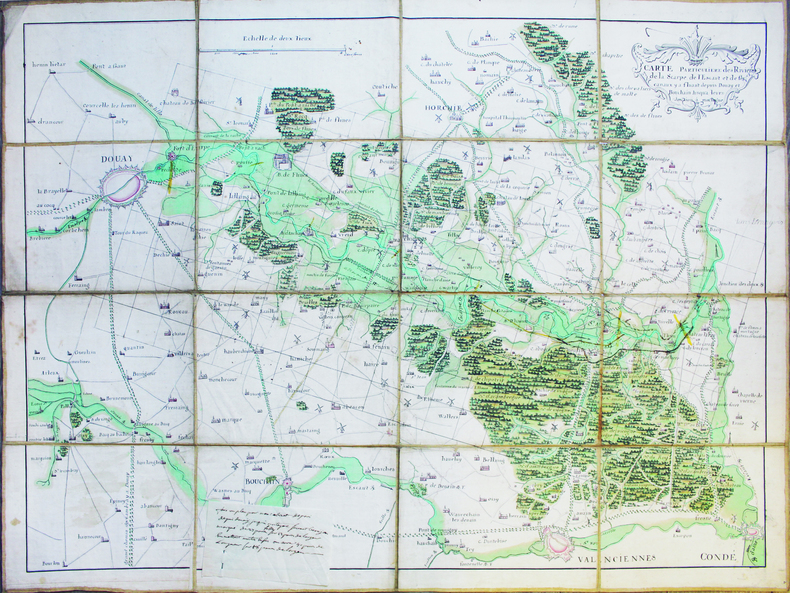
1780LBW-2820[circa 1780]. En 16 sections montées sur toile et pliées, formant une carte de 0,77 x 1,03 m.
178518225Où l'on trouve le parallèle des moeurs anciennes et modernes de ses habitans, où l'on décrit l'état, le commerce, l'agriculture, le gouvernement du pays, et la descente de S. Louis à Damiette, tirée de Joinville et des Auteurs Arabes, avec des Cartes Géographiques. Par M. Savary.Édition originale. A Paris, Chez Onfroi - 1785 - x, 395 et 310 pages. Avec Approbation et Privilège du Roi. Bien complet des 4 planches dépliantes. Bandeaux, lettrines et culs-de-lampe.Reliure demi basane mouchetée de l'époque. Dos lisse orné de filets dorés. Pièces de titre rouge et de tomaison verte. Quelques rousseurs. Plats frottés, et taché au tome 1. Bon état. Format in-8°(21x13).Claude-Étienne Savary (1750-1788) est pionnier de l'égyptologie et traducteur du Coran.
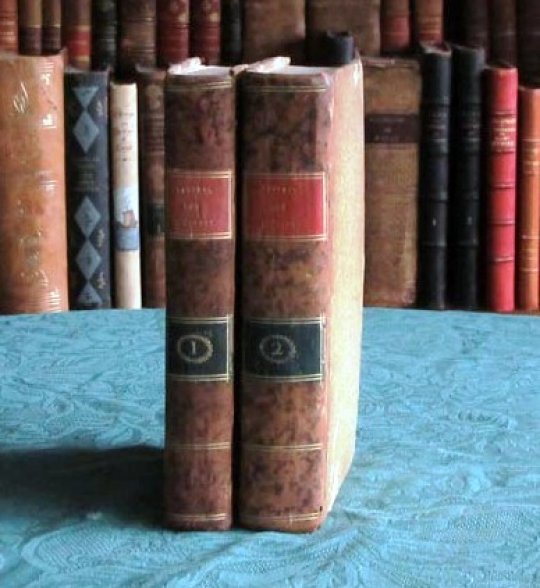
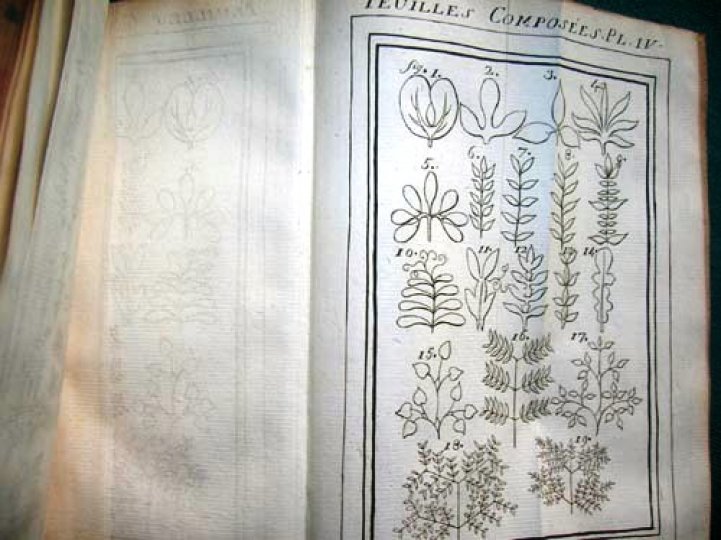
1766150722 tomes en 1 volume.Tome 1. 272 pages + table et 8 planches repliées. Tome 2. 652 pages + table et index.Édition originale. A Lyon, chez Jean-Marie Bruyset 1766.Reliure plein veau marbré de l'époque. Dos à 5 nerfs orné et doré avec pièce de titre maroquin rouge. Tranches marbrées. Filet doré sur les coupes. Pas de rousseur. Très bon état. Format in-8°(20x13).
17902576London: Printed for G.G. J. and J. Robinson and J. Bew Paternoster-Row 1790. Second Edition. Tree calf. Very good. Five volumes : twelvemo : pp 4 318 2 blank; viii 442; 2 380 2 blank; 4 397 398 6 Key to the Abbreviations; 2 blank iv 418 6 Table 2 blank :uniformly bound in contemproary tree calf : recently rebacked with gilt lettering and roman numerals double lines separating the panels and decorative stamps : bookplate of Frederick William Cosens in each. Corners rounded; occasional foxmark. Rousseau's Confessions first appeared in English translation in 1783. Lowndes vol 3 p 2134 Bookplate: Frederick William Cosens 1819-89 was a book and art collector and port wine importer. His library was sold by Sotheby's in 1890 with several volumes bought by the British Library. Printed for G.G. J. and J. Robinson and J. Bew, Paternoster-Row unknown
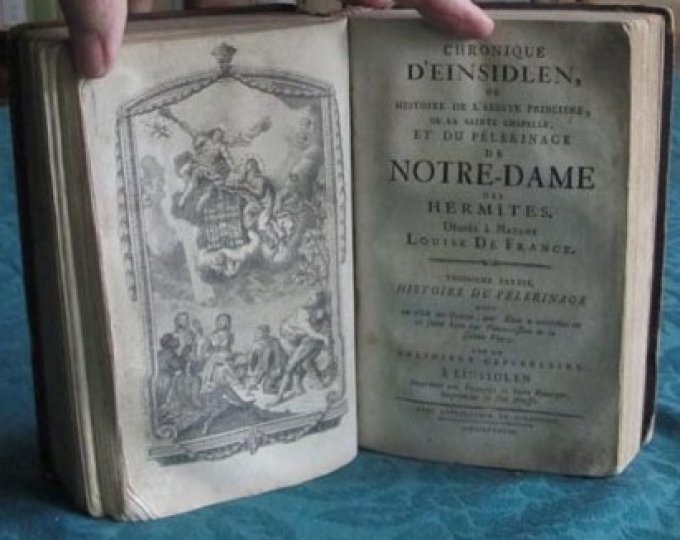
178715812Avec un récit des principaux Miracles que Dieu y a faits, & des Grâces singulières qu'il y a accordées par l'intercession de la Sainte Vierge. Dédiée à Madame Louise de France. Par un religieux capitulaire.3 parties en 1 volume ornées de 3 frontispices, un portrait de Madame Louise Marie de France, une vignette de titre et culs-de-lampe.Première partie, Histoire de l'Abbaye - 16, x et 304 pages.Seconde partie, Histoire de la Sainte Chapelle - 4 et 80 pages.Troisième partie, Histoire du Pèlerinage - x et 258 pages. Table des matières.Édition originale rare. A Einsidlen (Einsiedeln en Suisse), Imprimée par François de Sales Benziger, Imprimeur de Son Altesse. Avec approbation et permission 1787.Reliure plein veau de l'époque. Dos à 4 nerfs avec pièce de titre. Coiffes, plats et coins frottés. Rares rousseurs. Déchirures sur les bords de 2 des frontispices dont 1 consolidé au dos avec de l'adhésif. Quelques rousseurs. Format in-12°(18x11).
172819911Written originally in french by monsieur Rapin. Translated into English by George Stanhope. Second edition.London, printed for Thomas Wotton - 1728 - iv et 224 pages. Frontispice.Reliure plein veau de l'époque. Dos à nerfs muet. Coiffe inférieure frottée. Filets dorés encadrant. Plats frottés. Pas de rousseur. Bon état. Format in-8°(20x13).
174845449London: J. & P. Knapton 1748. 1st Edition 1st Printing. No Binding. Good/No Jacket. First edition first printing. viii 280 pp. Disbound with marbled end papers i.e has lost its boards. Otherwise in Good condition and very scarce. Interesting section on "An account of the English settlements in the East-Indies together with some proposals for the Propogation of Christianity in those parts of the world". <br/> <br/> J. & P. Knapton unknown
175246402148Paris, d’Houry, 1752 ; plaquette in-8, cartonnage bradel, demi-toile verte. (Sudre, relieur à Cognac- Titre, 19 pp., (1 p)ÉDITION ORIGINALE de cette curiosité. L’approbation du 8 mai 1752 est signée Crébillon.Nous n’avons pas pu identifier, pas plus que M. Graesse ou le catal. de la BN, ce docteur en médecine qui s’est amusé à traduire en latin (avec talent) l’histoire du célèbre perroquet de Nevers.“Garrulus ergo fuit niverni“Psittacus olim (...) Vir-Viridis, sic nomen erat...”L’exemplaire provient de la bibliothèque du dr. FÉLIX DUROSIER (avec son bel ex-libris), puis de celle de Raymond QUENEAU (bibliopola jurejurando confirmat !)
171921983New York: Alfred A. Knopf 1917 but 1918. First Edition. Octavo 19.25cm.; original rose paper-covered boards upper cover lettered in gilt unadorned spine; 31pp.; frontispiece. Spine faded to tan gilt lettering a bit dulled else Very Good and sound. One of 1000 copies published. Written anonymously by Eliot and edited by Pound. Eliot's second published work. GALLUP Eliot A2; GALLUP Pound B17. Alfred A. Knopf unknown books
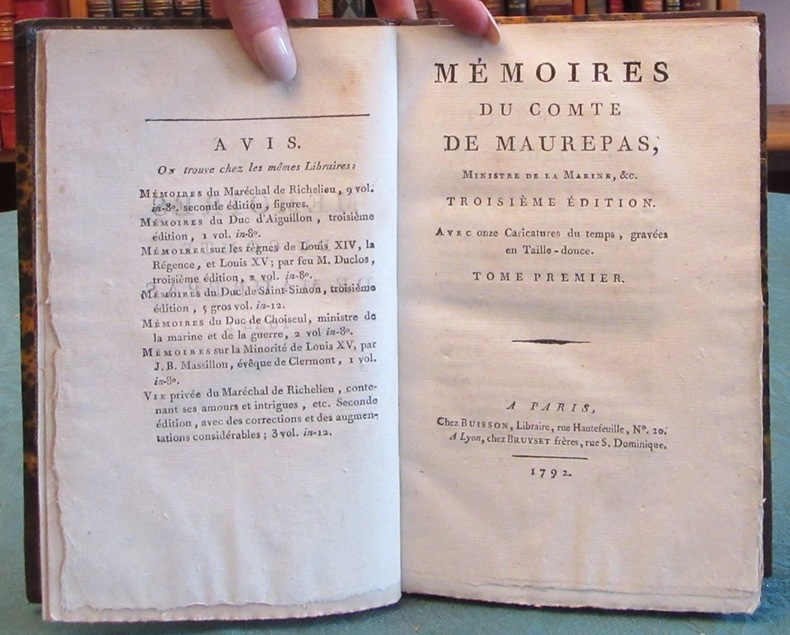
179218896Troisième édition. Avec onze caricatures du temps, gravées en taille-douce.Paris, chez Buisson, libraire, et Lyon, chez Bruyset frères - 1792 - (8pp + 342pp) - (328 pp), et (358pp). Complet des 11 caricatures sur le T3.Reliure demi chagrin à coins du XIXème. Dos à 5 nerfs avec titre, auteur, et tomaison et dorés. Mouillures marginales sur les 10 premières pages du T3. Pas de Rousseur. Très bon état. Format in-8°(22x14).Jean-Frédéric Phélypeaux de Maurepas, dit comte de Maurepas (1701-1781) fut secrétaire d'état de la marine de Louis XV de 1723 à 1749, puis ministre d'état sous Louis XVI de 1774 à 1781.Les Mémoires de Maurepas, prétendument rassemblés par son secrétaire et publiés par Jean-Louis Giraud-Soulavie en 1792, sont apocryphes.
175321157Amsterdam Aux Dépens De La Compagnie 1753 In-12 ( 6 ) - 431 pp, mors fendu
175321199Amsterdam Aux Dépens De La Compagnie 1753 In-12 8 - 534 pp, Mors fendu