677 résultats
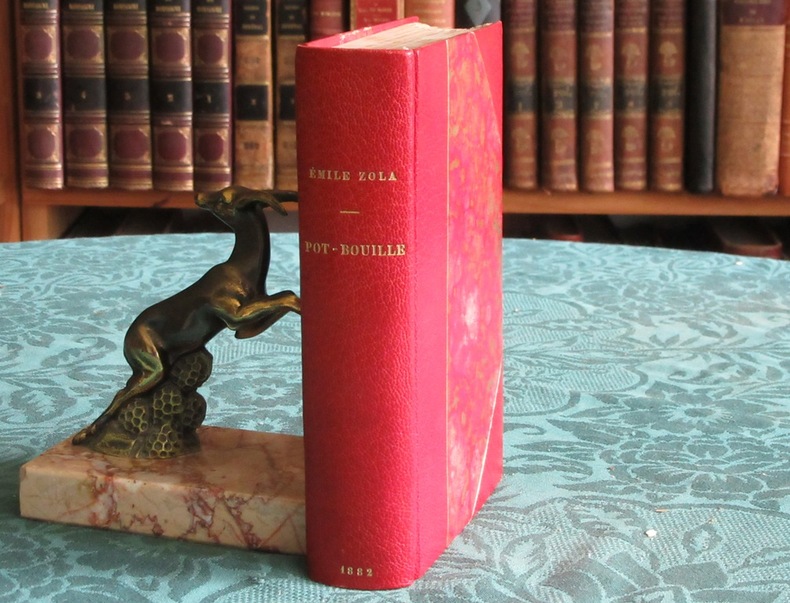
188283518Charpentier & Cie | Paris 1882 | 11 x 17.50 cm | broché
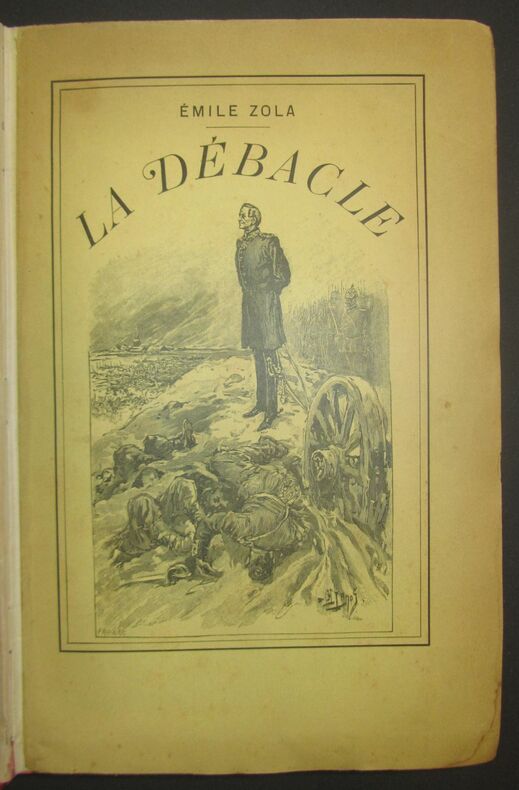
1893510991893 Paris, Marpon et Flammarion, sans date (1893), fort volume grand in 8° relié demi-percaline rouge marbrée de noir à la bradel, dos orné d'un fleuron doré, étiquette basane noire, couverture jaune illustrée et dos conservés, 527 pages ; à toutes marges (tête rognée) ; infime tache marginale angulaire en pied de quelques feuillets ; coins émoussés.
187584966Reliure postérieure demi-percaline vert bouteille. Dos lisse à pièce, fleuron central et date dorée en talon. Rousseurs éparses. Reliure non signée de Devauchelle.
189084423Paris 20 Février 1890 | 13.50 x 20.50 cm | une page
189386093Paris 15 octobre 1893 | 13.50 x 20.50 cm | une page 1/4 sur un bifeuillet
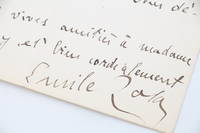
189186092Paris 1891. Fine. Paris 22 octobre 1891 13.30 x 20.50 cm une page sur un bifeuillet Autograph letter dated and signed by Emile Zola addressed to his friend the physician Maurice de Fleury dated in his hand October 22 1891. 16 lines in black ink on one page. ""Mon cher de Fleury je crois bien que j'ai trouvé quelque chose pour le supplément du Figaro. Venez donc causer entre cinq et dix heures . Si vous étiez au Théâtre libre samedi soir je songe que nous pourrions en causer dans un entr'acte ce qui vous éviterait de vous déranger ."" ""My dear de Fleury I do believe I have found something for the Figaro supplement. Do come to chat between five and ten o'clock . If you were at the Théâtre Libre Saturday evening I think we could discuss it during an intermission which would save you the trouble of making a special trip ."". Fleury indeed held the medical column at Le Figaro - it is perhaps following this letter and their ""conversations"" that Fleury writes these lines in the supplement of October 31 1891: ""toute l'école naturaliste ayant fait de la médecine les médecins logiquement ont fait de la littérature"" ""the entire naturalist school having practiced medicine doctors logically have practiced literature"". Zola relied on the expertise and scientific knowledge of Maurice de Fleury a student of Charcot to nourish his writing work on the Rougon-Macquart. De Fleury particularly shared publications from his library relating to heredity a subject at the heart of Zola's great social fresco - most particularly the generational transmission of nervous diseases fits of violence and alcoholism. Maurice de Fleury is also famous for having made ten years after this letter a medico-psychological study of Zola himself through the prism of his working habits: ""De dix heures à midi Zola rédige encore - moins facilement et moins bien que pendant l'heure initiale - et c'est fini pour toute la journée il ne sera plus bon qu'à écrire des lettres. C'est là la puissance du plus puissant cerveau dans le domaine littéraire à la fin du siècle. Avec ce tout petit traintrain modeste trois heures par jour en deux séances cet homme dont l'attention est modique . trouve moyen de nous donner tous les dix mois un de ces livres où ne manquent ni la solidité de la charpente . ni rien de ce qui constitue la force créatrice le génie pour dire le mot"" ""From ten o'clock to noon Zola still writes - less easily and less well than during the initial hour - and it's finished for the whole day he will only be good for writing letters. This is the power of the most powerful brain in the literary domain at the end of the century. With this very modest little routine three hours a day in two sessions this man whose attention is modest . manages to give us every ten months one of those books which lack neither the solidity of the framework . nor anything that constitutes creative force genius to say the word"". ""Maurice de Fleury entretient des relations étroites avec Émile Zola et Joris-Karl Huysmans avec lesquels il correspond dans les années 1880-1890. Fervent admirateur de l'auteur des Rougon-Macquart Fleury conseille Zola pour Le Docteur Pascal 1893 et confie son admiration dans un article du Figaro en 1896. Très « à la mode » parmi les « intellectuels » selon le mot de Victor Segalen le jeune médecin figure également dans la liste des auteurs symbolistes - aux côtés de Paul Adam Henri de Régnier et Gustave Kahn - dans un essai d'André Barre en 1911"" ""Maurice de Fleury maintains close relations with Émile Zola and Joris-Karl Huysmans with whom he corresponds in the years 1880-1890. Fervent admirer of the author of the Rougon-Macquart Fleury advises Zola for Le Docteur Pascal 1893 and confides his admiration in an article in Le Figaro in 1896. Very 'fashionable' among the 'intellectuals' according to Victor Segalen the young physician also appears in the list of symbolist authors - unknown
188283518Paris: Charpentier & Cie 1882. Fine. Charpentier & Cie Paris 1882 11 x 17.50 cm broché First edition one of 250 numbered copies on Holland paper the only deluxe copies after a few rare copies on China paper. First cover skillfully restored printed library stamp with numbering on the half-title page. Copy as issued. Charpentier & Cie unknown
188395884Paris: G. Charpentier 1883. Rare first edition of Zola's novel exploring human weakness and desire written at the height of his career. Octavo bound in three quarters morocco over marbled boards gilt titles and tooling to the spine marbled endpapers top edge gilt. Association copy inscribed by the author on the half-title page "a Edouard Noel mon de'voue confrere Emile Zola." The recipient Edouard Noel was a lawyer writer and playwright and secretary general of the Opera-Comique between 1880 and 1891. In 1894 he was made Knight of the Legion of Honor for his action as captain during the campaign 1870-1871. In very good condition. Rare and desirable signed and inscribed by Zola. The most prominent French novelist of late 19th century French novelist and critic Emile Zola became the best-known practitioner of the literary school of naturalism and an important contributor to the development of theatrical naturalism. Also a major figure in the liberalization of France Zola was nominated for the first and second Nobel Prize in Literature in 1901 and 1902. Written at the height of Zola's career Le Capitaine Burle follows the downfall of a disciplined French military officer who becomes involved in a scandal to support his mistress. G. Charpentier hardcover books
1892008454Paris 1892 Letter. Very fine. No Binding. Signed by Authors. ZOLA Emile 1840-1902. Autographed letter signed. One page. 8x5 inches. In French. 10 lines. With original addressed and postmarked envelope. Two minor creases to letter where folded. Both items beautifully and professionally matted and framed along with a color lithographed portrait of the author the whole measuring 23x25½ inches. English translation taped to verso. Very fine. Paris: January 16 1892. . unknown
188395884Paris: G. Charpentier 1883. Rare first edition of Zola's novel exploring human weakness and desire written at the height of his career. Octavo bound in three quarters morocco over marbled boards gilt titles and tooling to the spine marbled endpapers top edge gilt. Association copy inscribed by the author on the half-title page "a Edouard Noel mon de'voue confrere Emile Zola." The recipient Edouard Noel was a lawyer writer and playwright and secretary general of the Opéra-Comique between 1880 and 1891. In 1894 he was made Knight of the Legion of Honor for his action as captain during the campaign 1870-1871. In very good condition. Rare and desirable signed and inscribed by Zola. The most prominent French novelist of late 19th century French novelist and critic Emile Zola became the best-known practitioner of the literary school of naturalism and an important contributor to the development of theatrical naturalism. Also a major figure in the liberalization of France Zola was nominated for the first and second Nobel Prize in Literature in 1901 and 1902. Written at the height of Zola's career Le Capitaine Burle follows the downfall of a disciplined French military officer who becomes involved in a scandal to support his mistress. G. Charpentier hardcover
189382290Reliure demi-chagrin rouge à coins. Dos à nerfs avec titre doré. Tête dorée. Couverture conservée. Non rogné. Dos habilement refait par l'atelier Devauchelle.
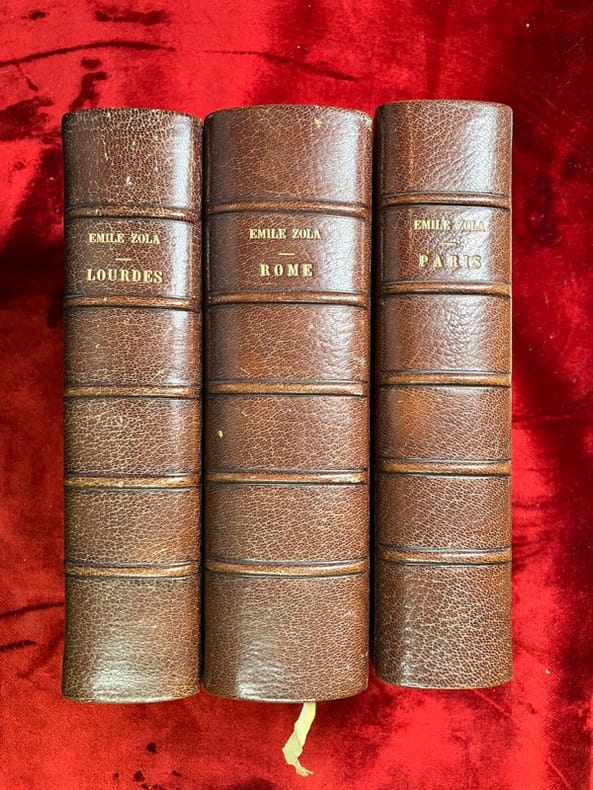
18945083Paris Bibliothèque Charpentier 1894-1896 Trois volumes in-12 (h. 19 cm.) 598-751 et 608 pp. couvertures conservées, demi-reliures à coins de maroquin chocolat, dos à nerfs, signées de Kaufmann-Horglois. Editions originales, exemplaires numérotés sur Hollande (tirages de 300 et 340 exemplaires).
188446912Paris Charpentier 1884 1 vol. relié in-12, demi-maroquin cerise à coins, dos à nerfs, caissons ornés d'entrelacs et fleurons dorés, tête dorée, couvertures conservées, non rogné (David), 379 pp. Édition originale ornée d'un beau portrait de l'auteur gravé à l'eau-forte en frontispice par Guillaumot fils. Un des 100 exemplaires numérotés sur Hollande, seul grand papier avec 25 Chine. Fine reliure signée et bel ex-libris gravé A. Gallet.
188142546Reliure postérieure bradel demi-percaline bordeaux. Dos lisse avec pièce de titre noireet fleuron doré central. Reliure signée P. GOY et C. Vilaine. Couverture et dos conservés.
186428266J. Hetzel et A. Lacroix | Paris s. d. [1864] | 12 x 18 cm | relié
188145284Charpentier | Paris 1881 | 12 x 18.50 cm | relié
189384893Paris 5 Avril 1893 | 13.50 x 20.50 cm | une page et demie
189023990La Vie Populaire | Paris 1er Janvier 1888 au 28 Décembre 1890 | 24.50 x 32.50 cm | 312 fascicules reliés en 6 volumes
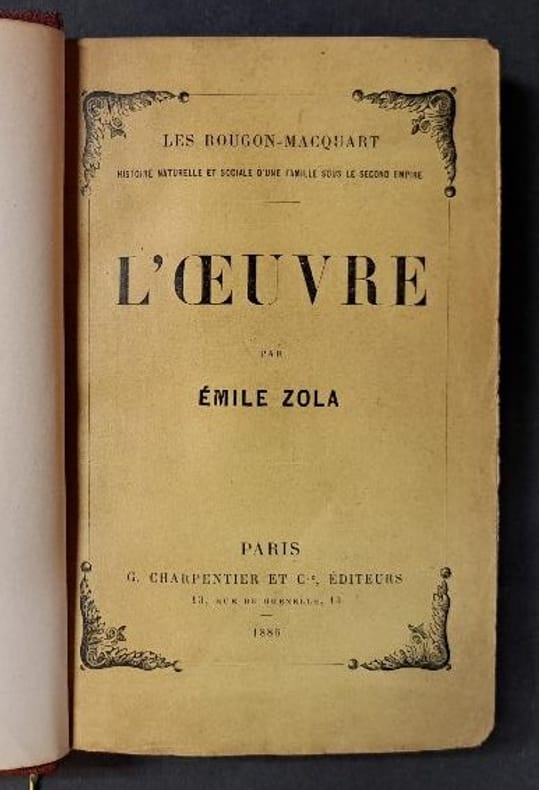
1886121199Paris, G. Charpentier et Cie, impr. Typographie Georges Chamerot, à Paris 1886 In-12 19 x 12 cm. Reliure demi-chagrin rouge, dos à nerfs, couvertures conservées, 491 pp. édition originale sur papier d’éditeur.
188219214Histoire naturelle et sociale d'une famille sous le Second Empire.Édition originaletirée à 250 exemplaires numérotés sur papier de Hollande, celui-c (N°139).Paris, G. Charpentier - 1882 - 495 pages. Ex Libris Pierre Duché.Très belle reliure demi maroquin rouge à coins à la bradel. Dos lisse aux titre, auteur et date en pied dorés. Filet doré bordant les plats. Tête dorée sur témoins, non rogné. Couverture jaune conservée. Pas de rousseur. Parfait état. Format in-12°(19x13).
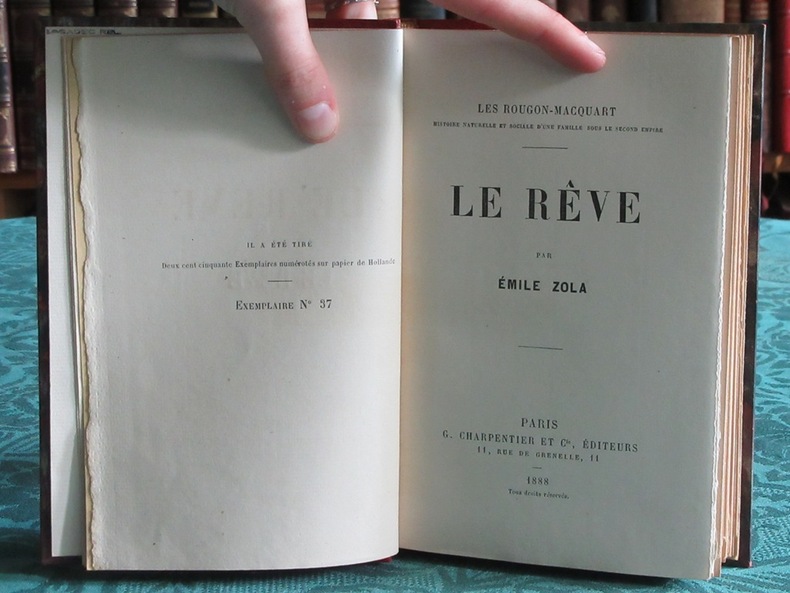
188819213Les Rougon-Macquart. Histoire naturelle et sociale d'une famille sous le second Empire.Édition originale. Un des 250 exemplaires numérotés sur papier de Hollande (N°37).Paris, G. Charpentier et Cie. - 1888 - 310 pages. Relié in fine 10 pages Choix de romans, Contes et Nouvelles de la bibliothèque-Charpentier.Très belle reliure demi maroquin rouge, signée Lagadec. Dos à nerfs avec titre, auteur et date en pied dorés. Filets à froid bordant les nerfs. Tête dorée sur témoins, non rogné. Couverture jaune et dos conservés. Pas de rousseur. Parfait état. Format in-12°(19x13).
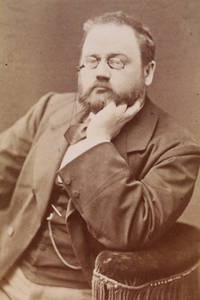
187072935Paris: Ernest Ladrey 1870. Fine. Ernest Ladrey Paris 1870 6.50 x 10.50 cm une photographie Very rare original albumen photograph in carte-de-visite format mounted on yellow cardboard with red border. Manuscript annotation on verso. The address at Passage des Princes on the back of the photograph indicates that the photograph was taken before 1875. Handsome copy of this photograph of the writer with his lorgnette and beard. Ernest Ladrey unknown
189084423Paris 1890. Fine. Paris 20 Février 1890 13.50 x 20.50 cm une page Autograph letter dated and signed by Emile Zola 12 lines in black ink addressed to librettist Louis Gallet concerning the operatic adaptation by Alfred Bruneau of the novel ""Le rêve"". Folds inherent to postal dispatch. Emile Zola was to meet jointly with Alfred Bruneau who had adapted the novel ""Le rêve"" for the opera and Louis Gallet the librettist of this adaptation. ""Je vous attends demain matin. pour causer des trois derniers tableaux. J'écris également à Bruneau pour lui donner rendez-vous"" ""I await you tomorrow morning. to discuss the last three tableaux. I am also writing to Bruneau to arrange a meeting with him"" and shows himself very satisfied with this prospect: ""Tout va bien."" ""All goes well."" unknown
189386093Paris 1893. Fine. An appointment with Gilles de La Tourette Paris 15 octobre 1893 13.50 x 20.50 cm une page 1/4 sur un bifeuillet Autograph letter dated and signed by Emile Zola addressed to his friend the physician Maurice de Fleury dated in his hand October 15 1893. 1 page 1/4 19 lines in black ink on a double sheet. Horinzontal and vertical folds due to mailing. Stain on verso not affecting the text. A most unusual invitation from the master of Naturalism who wishes to organize a luncheon with two eminent specialists in nervous diseases: ""Vous êtes bien aimable de m'inviter à déjeuner. Mais cela va vous faire perdre du temps et à moi aussi . pourquoi ne prendriez-vous pas un rendez-vous pour deux heures et demie par exemple avec M. Gille de la Tourette soit jeudi soit vendredi. Nous irions chez lui simplement ."" ""You are very kind to invite me to lunch. But this will make you lose time and me as well . why wouldn't you make an appointment for two-thirty for example with M. Gille de la Tourette either Thursday or Friday. We would go to his place simply ."" Zola relied on the expertise and scientific knowledge of Maurice de Fleury a student of Charcot to nourish his writing work on the Rougon-Macquart. De Fleury particularly shared publications from his library relating to heredity a subject at the heart of Zola's great social series of novels - most particularly the generational transmission of nervous diseases fits of violence and alcoholism. Maurice de Fleury is also famous for having made ten years after this letter a medico-psychological study of Zola himself through the prism of his working habits: ""De dix heures à midi Zola rédige encore - moins facilement et moins bien que pendant l'heure initiale - et c'est fini pour toute la journée il ne sera plus bon qu'à écrire des lettres. C'est là la puissance du plus puissant cerveau dans le domaine littéraire à la fin du siècle. Avec ce tout petit traintrain modeste trois heures par jour en deux séances cet homme dont l'attention est modique . trouve moyen de nous donner tous les dix mois un de ces livres où ne manquent ni la solidité de la charpente . ni rien de ce qui constitue la force créatrice le génie pour dire le mot"" ""From ten o'clock to noon Zola still writes - less easily and less well than during the initial hour - and it's finished for the whole day he will only be good for writing letters. This is the power of the most powerful brain in the literary domain at the end of the century. With this very modest little routine three hours a day in two sessions this man whose attention is modest . manages to give us every ten months one of those books which lack neither the solidity of the framework . nor anything that constitutes creative force genius to say the word"". ""Maurice de Fleury maintained close relations with Émile Zola and Joris-Karl Huysmans with whom he corresponded in the years 1880-1890. Fervent admirer of the author of the Rougon-Macquart Fleury advised Zola for ""Le Docteur Pascal"" 1893 and confided his admiration in an article in Le Figaro in 1896. Very 'fashionable' among the 'intellectuals' according to Victor Segalen the young physician also appears in the list of symbolist authors - alongside Paul Adam Henri de Régnier and Gustave Kahn - in an essay by André Barre in 1911"" Lola Kheyar Stibler Autograph letter dated and signed by Emile Zola addressed to his friend the physician Maurice de Fleury dated in his hand October 15 1893. 1 page 1/4 19 lines in black ink on a double sheet. Transverse folds inherent to mailing. unknown