Albert-Emile ARTIGUE - (Emile ZOLA)Biblio.com

3 001 résultats
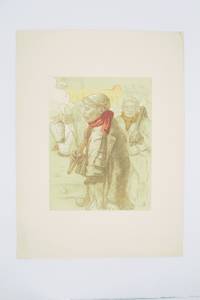
189874340Paris: Imprimerie Champenoispour CH. MassonH. Piazza 1898. Fine. Imprimerie Champenois pour CH. Masson H. Piazza Paris Février 1898 31 x 27 cm une feuille et une serpente Rare original colour lithograph executed by Albert-Émile Artigue for L'Estampe Moderne series no. 10 published in February 1898. One of 50 deluxe proofs printed on Japon with wide margins artist's signature within the stone publisher's blindstamp depicting a child's profile in the lower margin numbered stamp of the deluxe issue on the verso; the print is preceded by a captioned tissue guard with the artist's name the title and an excerpt from the work; with additional plain tissue guard. Lithograph inspired by an excerpt from Emile Zola's novel La Faute de l'abbé Mouret reproduced on the tissue guard of the print. A magnificent French monthly publication issued between May 1897 and April 1899 L'Estampe Moderne comprises original chromolithographs which unlike other periodicals such as Les Maîtres de l'Affiche and as specified on the tissue guards were created expressly for the journal by each artist. In all 100 prints were published encompassing the major artistic movements of the late 19th century: Symbolism Art Nouveau the Pre-Raphaelites Orientalism and the Belle Époque. Each issue of four plates was printed in 2000 copies sold at 3.50 francs and 100 on Japon paper offered at 10 francs. Henri Piazza also planned an exclusive printing of the utmost luxury: 50 copies on Japon with wide margins and 50 in black on China paper at the considerable price of 30 francs. This large-format print is superbly printed on the most prestigious of papers: Japon. Thick silky satin-finished and pearly it elevates each sheet into a work of art in its own right. Its exceptional capacity for ink absorption and affinity with colour make it the ideal medium for these splendid lithographs. The interest of French collectors in artistic posters intensified at the beginning of the 1890s. Octave Uzanne to describe this craze coined the term affichomanie. The poster originally popular and pasted up on the streets of the capital then became an art object its ephemeral support transformed into something precious and destined for preservation. Piazza resolved to remove the poster from its advertising purpose and elevate it to the rank of a work of art in its own right on a par with the deluxe illustrated book. In this way he assembled a prestigious collection of entirely original works by the most prominent European artists of the time: Georges de Feure Eugène Grasset Henri Detouche Emile Berchmans Louis Rhead Gaston de Latenay Lucien Lévy-Dhurmer Gustave-Max Stevens Charles Doudelet Hans Christiansen Henri Fantin-Latour Steinlen Ibels Engels Willette Henri Meunier Evenepoël Bellery-Desfontaines Charles Léandre etc. A handsome copy. Imprimerie Champenoispour CH. MassonH. Piazza unknown
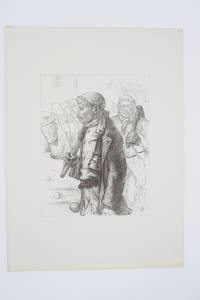
189874855Paris: Imprimerie Champenoispour CH. MassonH. Piazza 1898. Fine. Imprimerie Champenois pour CH. Masson H. Piazza Paris Juin 1898 24.50 x 32 cm une feuille et une serpente Rare original color lithograph executed by Jules-Gustave Besson for L'Estampe Moderne series number 14 published in June 1898. One of 50 deluxe proofs printed on Japan paper with wide margins artist's signature in the plate publisher's blind stamp depicting a child's profile in lower margin numbered luxury edition stamp on verso; engraving preceded by a tissue guard captioned with the artist's name title and text. Lithograph inspired by an extract from Germinal by Emile Zola reproduced on the print's tissue guard. Magnificent French monthly publication edited between May 1897 and April 1899 L'Estampe moderne consists of original chromolithographs which unlike other periodicals such as Les Maîtres de l'Affiche and as stipulated on the tissue guards were created specifically by each artist for the review. Thus 100 prints appeared in total covering the major artistic movements of the late 19th century: Symbolism Art Nouveau Pre-Raphaelites Orientalists and Belle Époque. Each delivery of four prints was issued in 2000 copies sold for 3.50F and 100 on Japan paper offered at 10F. Henri Piazza also planned a confidential deluxe printing: 50 copies on Japan paper with wide margins and 50 in black on China paper at the considerable price of 30F. This print of handsome format is superbly printed on the most prestigious of papers: Japan. Thick silky satiny and lustrous it contributes to making each page a work in its own right. Its ink absorption quality and affinity with colors also make it the ideal support for these very beautiful lithographs. French collectors' interest in artistic posters intensified at the beginning of the 1890s. Octave Uzanne to describe this fever invented the term ""poster mania"". The poster originally popular and plastered in the streets of the capital then became an art object and its ephemeral support became precious and destined for preservation. Piazza decided to remove the poster from its advertising vocation and elevate it to the rank of a complete work of art on the same level as the deluxe illustrated book. He thus composed a prestigious collection of entirely original works by the most prominent European artists of the moment: Georges de Feure Eugène Grasset Henri Detouche Emile Berchmans Louis Rhead Gaston de Latenay Lucien Lévy-Dhurmer Gustave-Max Stevens Charles Doudelet Hans Christiansen Henri Fantin-Latour Steinlen Ibels Engels Willette Henri Meunier Evenepoël Bellery-Desfontaines Charles Léandre etc. Handsome copy. Imprimerie Champenoispour CH. MassonH. Piazza unknown
189874856Paris: Imprimerie Champenoispour CH. MassonH. Piazza 1898. Fine. Imprimerie Champenois pour CH. Masson H. Piazza Paris Juin 1898 24.50 x 32 cm une feuille Rare original lithograph executed by Jules-Gustave Besson for L'Estampe Moderne series number 14 published in June 1898. One of 50 deluxe proofs printed on China paper with large margins artist's signature in the plate publisher's dry stamp showing a child's profile in the lower margin mounted on a sheet of laid paper with the numbered stamp of the deluxe edition on verso some foxing. Lithograph inspired by an extract from Germinal by Emile Zola. Magnificent French monthly publication edited between May 1897 and April 1899 L'Estampe moderne consists of unpublished chromolithographs which unlike other magazines such as Les Maîtres de l'Affiche and as stipulated on the tissue guards were created specially by each artist for the magazine. Thus 100 prints appeared in total covering the major artistic movements of the late 19th century: Symbolism Art Nouveau Pre-Raphaelites Orientalists and Belle Époque. Each delivery of four prints was printed in 2000 copies sold at 3.50F and 100 on Japan paper offered at 10F. Henri Piazza also planned a confidential very deluxe printing: 50 copies on Japan paper with large margins and 50 in black on China paper at the considerable price of 30F. This print of handsome format is superbly printed on one of the most prestigious papers: China. ""Despite all its qualities China paper too insubstantial owes its reputation not to its own beauty but indeed to its particular affinities with printing ink. Its texture smooth and soft together is more apt than any other to receive a beautiful printing. This property makes China paper sought after for printing engravings."" Anatole France. The interest of French collectors in artistic posters intensified at the beginning of the 1890s. Octave Uzanne to qualify this fever invented the term ""affichomanie."" The poster originally popular and posted in the streets of the capital then became an art object and its ephemeral medium became precious and devoted to conservation. Piazza decided to remove the poster from its advertising vocation and elevate it to the rank of a complete work of art on the same level as the deluxe illustrated book. He thus composed a prestigious collection of entirely original works by the most prominent European artists of the moment: Georges de Feure Eugène Grasset Henri Detouche Emile Berchmans Louis Rhead Gaston de Latenay Lucien Lévy-Dhurmer Gustave-Max Stevens Charles Doudelet Hans Christiansen Henri Fantin-Latour Steinlen Ibels Engels Willette Henri Meunier Evenepoël Bellery-Desfontaines Charles Léandre etc. Handsome copy. Imprimerie Champenoispour CH. MassonH. Piazza unknown
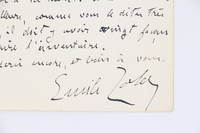
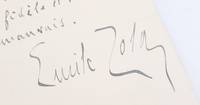
188279111Médan 1882. Fine. Médan 1er décembre 1882 13.60 x 21.40 cm 2 pages sur un double feuillet - enveloppe jointe Autograph letter signed by Emile Zola - apparently unpublished - written in black ink on a double sheet and addressed to Léon Carbonnaux department head at Bon Marché. Folds inherent to mailing. Envelope included. Only two letters from Léon Carbonnaux to Emile Zola are known: they can be consulted in the digitized preparatory file for Au bonheur des dames made available online by the Bibliothèque nationale de France. However we know from this same file which contains a long section entitled ""Notes Carbonnaux"" that this department head at Bon Marché provided Zola with a significant amount of information particularly about employee customs their remuneration and especially inventory techniques. The two men probably met when Emile Zola eager for information about the workings of department stores conducted field research in February and March 1882. Very important unpublished letter shedding new light on the pre-original publication of Au bonheur des dames. In his biography of Emile Zola Henri Mitterrand writes: ""Even before the novel was completed Zola gave an extract to Panurge in November; and on November 23 1882 Gil Blas announced its imminent publication in its columns."" Our letter discussing precisely this alleged pre-publication in Panurge attests that it was simply a joke and thus contradicts Henri Mitterrand: ""But your letter surprises and saddens me somewhat. How could you have been taken in by Panurge's stupid joke Did you not notice that the entire issue is a 'farce' Not one of the articles is authentic they are parodies and very poorly done ones at that."" Indeed reading the said extract cannot fool the assiduous reader of Zola despite the introduction that the journalists wrote: ""After Nana and Pot-Bouille those epics of elegant vice and bourgeois vice M. Emile Zola wanted to create one of honesty: Au bonheur des Dames which will appear shortly is a reassuring painting of innocence and virtue; the greatest success is assured for this new work whose characters move in the setting of a large novelty store; Parisian high commerce will not long await its observer and painter. We thank Emile Zola for having kindly cut out especially for Panurge a few pages from his still unpublished work and we are proud to give the public first an extract from this work of such high morality and such powerful interest."" Panurge no. 4 of October 22 1882 The sentences of this false Zolian text are exaggeratedly long and Panurge took the liberty of endowing the novel with a male main character Denis Mouret an amalgam of Denise the true heroine of the book to appear and Octave Mouret. One can think that it is a text composed from elements of Pot-Bouille the previous volume of Rougon Macquart where Octave - future owner of Bonheur des Dames - exercised the function of clerk before his meteoric social rise: ""For already more than two months he had been attached to the 'silks and furs' department; he arrived in the morning at seven o'clock to return home his day finished only at nine o'clock in the evening when all of Paris buzzed strangely with a feverish animation of pleasure and enjoyment and on his way back he followed gawking the great crowded boulevards where blazed the cafés full of girls and where on the asphalt at theater doors the crowd jostled with here and there in the vague rumor of trampling and pressing the roguish intonation of the cries of program vendors and ticket sellers."" Panurge In his letter of November 30 1882 Léon Carbonnaux - reading the extract from Panurge - had reproached Zola for his errors: ""Nowhere except at the Fabriques de France near Les Halles does one arrive at 7 a.m. It's at the earliest 7:30 but more often 8 a.m. and even then. There is no silk and fur counter at the Louvre. . It is so easy for you to be accurate that errors of this kind especially if t unknown
20334263like new. unknown
1304085015.Gpaperback. Good. Access codes and supplements are not guaranteed with used items. May be an ex-library book. paperback
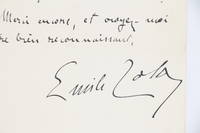
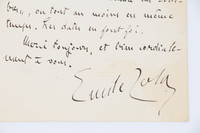
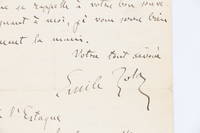
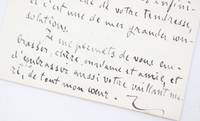
189886837Weybridge 1898. Fine. In the midst of universal cowardice you wouldn't believe how moved I am to feel a few faithful people around me Weybridge 19 août 1898 13.50 x 20.50 cm quatre pages sur un bifeuillet Autograph letter signed by Emile Zola to Octave Mirbeau dated August 19 1898. Four pages in black ink on a bifolium written to Octave Mirbeau. Usual trace of horizontal fold. Published in Zola's uvres complètes t. XLIX ed. F. Bernouard 1927 p. 808. Exceptional testament of friendship and self-sacrifice from Emile Zola in exile after being sentenced to the maximum penalty for writing ""J'accuse!"" the most famous article proclaming Captain Dreyfus's innocence. After his historic article in L'Aurore Zola was sentenced a first time by a jury on February 23 1898 to one year's imprisonment and a fine of three thousand francs. The verdict was overturned and the case was referred back to the Versailles court of justice which upheld only three of the eight hundred lines in ""J'accuse!"" as a charge. Unwilling to accept such a stifling of the proceedings Zola's defense decided to default and the conviction was upheld. After his eventful exit from the courthouse Clémenceau and his lawyer Labori advised him to leave the country before the judgment could become enforceable. Zola left on the last train that evening with only a shirt hastily rolled up in newspaper as luggage. A month after his departure the writer writes this superb reply to a letter from his loyal supporter Octave Mirbeau who had written to him a few days earlier: ""We think only of you; there isn't a minute of our existence that you don't fill entirely"" August 14 1898. Settled in the London suburb of Weybridge he angrily receives the ""echoes of Paris"" and is enraged to see Esterhazy the true culprit of the Dreyfus Affair once again cleared - this time by civil courts. ""My dear friend Thank you for your kind letter . In the midst of universal cowardice you wouldn't believe how moved I am to feel a few faithful people around me. My existence here has become possible since I've been able to get back to work. Work has always comforted me saved me. But my poor hands are still trembling with a shiver that cannot end. You wouldn't believe the outrage I feel at the echoes from France that reach me. In the evening when daylight falls I think it's the end of the world. You think I should go back and make myself a prisoner without returning to Versailles. That would be too good to have the peace of prison and I don't think it's possible. I didn't set out to go back like that; our attitude would be neither logical nor beautiful. Rather I think I'm in indefinite exile unless I run the abominable risk of a new trial. Besides we won't be able to make up our minds until October. And by then who knows Although I'm counting on a miracle in which I have little faith. So let us be brave my friend and let our work be done! If I can keep working things won't be too bad yet. . I shake your hand my good friend the faithful and rare friend of bad days"". Poignant manuscript confession from Zola forced into exile. Death would strike him in the midst of his glory days without him ever knowing the outcome of the affair he had devoted so many years of struggle. unknown
188279108Médan 1882. Fine. Médan 23 juin 1882 13.40 x 21.60 cm 1 page 1/2 sur un double feuillet - enveloppe jointe Autograph letter signed by Emile Zola - apparently unpublished - addressed to Léon Carbonnaux written in black ink on a double sheet. Folds inherent to mailing. Envelope included. Important testimony to the colossal documentation work and the capital role of Emile Zola's informants in depicting his immense natural and social fresco. This letter was sent to Léon Carbonnaux department head at Bon Marché who transmitted precious information to Emile Zola for the creation of the eleventh volume of the Rougon-Macquart series: Au Bonheur des Dames. Only two letters from Léon Carbonnaux to Emile Zola are known: they can be consulted in the digitization of the preparatory file for Bonheur des Dames made available online by the Bibliothèque nationale de France. However we know thanks to this same file which contains a long section entitled ""Notes Carbonnaux"" that this department head at Bon Marché provided a significant amount of information to Zola particularly about employee customs and their remuneration. The two men undoubtedly met when Emile Zola eager for information about the functioning of department stores conducted field research in February and March 1882. This response would therefore be the very first that the writer addressed to the department head in reply to his letter of June 19 1882. Far from imagining the keen success that this new novel would achieve Zola even seems to take it lightly: ""Je désire simplement toucher au sujet dans mon livre pour le besoin du petit drame commercial qui me sert de fable. Vos notes sont excellentes. . Enfin me voilà au travail. Le sujet est à la fois bien vaste - et bien ingrat pour un roman. On devra me tolérer un peu de fiction car il faut bien que je passionne la matière. Mais je tâche de m'en tenir le plus strictement possible à mes notes."" ""I simply wish to touch on the subject in my book for the needs of the little commercial drama that serves as my fable. Your notes are excellent. . Finally here I am at work. The subject is both very vast - and very thankless for a novel. One will have to tolerate a bit of fiction from me for I must make the material passionate. But I try to stick as strictly as possible to my notes."" It must be said that Carbonnaux takes his role as informant very much to heart and having no doubt about the book's success he writes: ""Dans le bâtiment chez nous d'ailleurs partout on attend votre livre. Les lecteurs ne vous manqueront pas. Soyez-en sûr. Vous n'en êtes plus à compter les succès celui-là s'annonce comme devant dépasser les autres."" letter of June 19 1882 For another work on the same subject has just appeared: ""J'ai lu le volume de Pierre Giffard. Il me paraît comme vous injuste et même faux dans plusieurs parties. C'est bâclé. Il aurait fallu pour un pareil ouvrage de documents purs une entière exactitude. Moi qui écris une uvre d'imagination je ne me permettrai pas de tels écarts."" ""I have read Pierre Giffard's volume. It seems to me like you unjust and even false in several parts. It is hastily done. For such a work of pure documents complete accuracy would have been necessary. I who write a work of imagination would not allow myself such deviations.""It was Carbonnaux who had pointed out the work to Zola: ""Pierre Giffard du Figaro vient de faire paraître chez Havard un vol de 300 pages intitulé « Les Grands bazars de Paris ». . On sait que le Figaro est inféodé au Louvre magasin concurrent au Bon Marché & on peut assurer que ce livre a été commandé et bâclé dès que votre intention de traiter le même sujet a été connue. . Il fallait déguiser un peu la réclame pour le Louvre."" letter of June 19 1882 We can clearly see here how much department stores fascinate and we understand the immense success that this novel by Zola describing their advent and supremacy would achieve. unknown
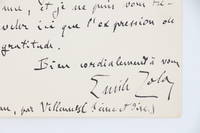
188879098Paris 1888. Fine. Paris 11 février 1888 13.20 x 20.50 cm 2 pages sur un double feuillet Autograph letter signed by Emile Zola addressed to Henry Fouquier written in black ink on a bifolium. Usual folds from mailing. This letter was transcribed in the complete correspondence of Emile Zola published by the CNRS and the Presses de l'Université de Montréal. A fine letter evoking La Terre and Tolstoy's The Power of Darkness. Henry Fouquier 1838-1900 was a literary critic and columnist for numerous newspapers. A close friend of Guy de Maupassant he supported Emile Zolas candidacy for the Académie française. This letter was written to him the day after the performance of Tolstoy's The Power of Darkness at the Théâtre-Libre. We have not found evidence of an article in which the journalist explicitly drew a parallel between the Russian drama and Zolas La Terre but Zola here addresses his thanks: « Merci mon cher Fouquier de ce que vous voulez bien dire de « la Terre » si attaquée. J'en suis touché vivement et croyez à toute ma gratitude. » It must be said that the fifteenth volume of the Rougon-Macquart cycle was harshly received unleashing passions from the moment of its serial publication in Gil Blas. On 18 August 1887 even before the conclusion of the novel was revealed to the public Le Figaro published the Manifeste des Cinq written by Paul Bonnetain J.-H. Rosny Lucien Descaves Paul Margueritte and Gustave Guiches. These young authors issued a severe verdict: « La Terre a paru. La déception a été profonde et douloureuse. Non seulement l'observation est superficielle les trucs démodés la narration commune et dépourvue de caractéristiques mais la note ordurière est exacerbée encore descendue à des saletés si basses que par instants on se croirait devant un recueil de scatologie : le Maître est descendu au fond de l'immondice. . Nous répudions ces bonshommes de rhétorique zoliste ces silhouettes énormes surhumaines et biscornues dénuées de complication jetées brutalement en masses lourdes dans des milieux aperçus au hasard des portières d'express. De cette dernière uvre du grand cerveau qui lança L'Assommoir sur le monde de cette Terre bâtarde nous nous éloignons résolument mais non sans tristesse. Il nous poigne de repousser l'homme que nous avons trop fervemment aimé. » Zola who had been developing the idea of a peasant novel for a decade was deeply affected. Though he never responded publicly to these accusations his correspondence is strewn with clarifications about the work whose sheer brutality alone seemed to occupy readers minds: « Mais vous ajoutez que notre thèse à Tolstoï et à moi est la même et peut se résumer en ceci : le travail de la terre est corrupteur. Tolstoï il me semble protesterait bien haut et quant à moi je vous affirme que je n'ai jamais voulu prouver une telle chose radicalement fausse à mon avis. Ce que je pense c'est que la petite propriété telle qu'elle existe chez nous c'est que la suite de faits sociaux qui ont abouti à notre forme sociale nous ont donné notre paysan d'aujourd'hui avec ses qualités et ses vices. Notre paysan est le prisonnier de sa terre et non l'homme libre qu'il devrait être. Comment voulez-vous qu'il n'y étouffe pas dans son ignorance et sa passion unique Labourer est très sain mais à la condition qu'on sera le maître de son champ au lieu d'en être le forçat. Je me suis exténué à faire sortir cette vérité de mon livre si l'on ne m'a pas compris la faute en est sans doute à moi. » A remarkable letter from the master of Naturalism shedding new light on one of the most brutal volumes of the Rougon-Macquart series. unknown
187779046L'Estaque - Marseille Marseille 1877. Fine. L'Estaque - Marseille Marseille 22 septembre 1877 13.30 x 20.80 cm 3 pages 1/2 sur un double feuillet Autograph letter signed by Emile Zola addressed to Louis-Edmond Duranty written in black ink on a double leaf. Some deletions and corrections; folds inherent to postal transmission. This letter has been transcribed in the complete correspondence of Emile Zola published by the CNRS and the Presses of the University of Montreal. Long letter evoking the heat wave at L'Estaque Une page d'amour and Edouard Manet. ""Il y a quatre mois que nous sommes ici et je vous avais promis de vous écrire. Mais j'ai tant travaillé et j'ai eu si chaud que vous m'excuserez de mon apparente paresse. Imaginez-vous que jusqu'au 15 août la température a été très agréable ; il faisait beaucoup moins chaud qu'à Paris et nous respirions chaque soir une brise de mer délicieuse. Puis voilà que brusquement lorsque je nous croyais hors de toutes mauvaises plaisanteries de la chaleur le thermomètre est monté à 40 degrés et s'y est maintenu nuit et jour. Nous avons ainsi passé deux semaines intolérables. Aujourd'hui la fraîcheur est revenue et nous allons rester jusqu'aux premiers jours de novembre pour jouir des charmes d'un bel automne."" ""We have been here for four months and I had promised to write to you. But I have worked so much and have been so hot that you will excuse my apparent laziness. Imagine that until August 15th the temperature was very pleasant; it was much less hot than in Paris and we breathed each evening a delicious sea breeze. Then suddenly when I thought we were safe from all the nasty tricks of the heat the thermometer rose to 40 degrees and stayed there night and day. We thus spent two unbearable weeks. Today the coolness has returned and we will stay until the first days of November to enjoy the charms of a beautiful autumn."" In this summer of 1877 Zola left the tumultuous capital for a five-month stay at L'Estaque ""banlieue de Marseille"" ""suburb of Marseille"" in the company of his wife Alexandrine and his mother Emilie Aubert. This long southern interlude reminded him of his youth in Aix: ""Je suis d'ailleurs enchanté de mon été. Les pays est splendide et me rappelle toute ma jeunesse."" ""I am moreover delighted with my summer. The country is splendid and reminds me of all my youth."" ""Pour finir avec moi j'ajouterai que j'ai travaillé vigoureusement à mon roman sans pourtant l'avancer autant que je l'aurais voulu. Ce roman doit paraître dans le Bien Public à partir du 14 novembre. J'en serai quitte pour donner encore un vigoureux coup de collier à Paris."" ""To finish with myself I will add that I have worked vigorously on my novel without however advancing it as much as I would have liked. This novel must appear in the Bien Public starting November 14th. I will have to give another vigorous push in Paris."" The new novel in question here is Une page d'amour whose plot and style contrast completely with the previous volume of the Rougon-Macquart: ""Je ne sais vraiment pas ce que vaut mon travail. J'ai voulu donner une note absolument opposée à celle de L'Assommoir ce qui me déroute parfois et me fait trouver mon roman bien gris. Mais je vais tout de même bravement mon chemin. Il faudra voir."" ""I really don't know what my work is worth. I wanted to give a note absolutely opposite to that of L'Assommoir which sometimes disconcerts me and makes me find my novel quite gray. But I am nonetheless bravely going my way. We will have to see."" But this ""page of love"" conceals another and during this stay in the Marseilles furnace Emile Zola was already thinking about the following volume: ""What is simmering in his southern pot is nothing less than a new bomb. Not Une page d'amour: 'it is a work too gentle to excite the public.' But Nana is already announced: 'I dream here of an extraordinary Nana. You will see that.' letter to Marguerite Charpentier of August 21 1877"" Henri Mitterrand Zola Even t unknown
1898867501898. Fine. ""The nervous and passionate man that I am is not made for exile for resignation and silence"" 15 décembre 1898 13.50 x 20.50 cm quatre pages sur un bifeuillet Autograph letter initialed by Emile Zola dated in his hand April 10 1898. Four pages in black ink on a bifolium addressed to Octave Mirbeau's wife. Horizontal fold mark inherent to mailing very rare and discrete foxing on the first leaf. A particularity of this exile correspondence Zola chose to omit his signature in his letters - or as here to initial only protecting himself from censorship or police investigations. Published in his Complete Works vol. XXV ed. F. Bernouard 1927 p. 820. Heart-wrenching letter by Zola written in complete exile the most unknown retreat the most absolute silence. The justiciar writer is secluded in England forced to leave Paris after being condemned to the maximum penalty for having written ""J'accuse!"" during these cruel hours. After his historic cry from the heart in l'Aurore Zola was condemned a first time by the Seine jury on February 23 1898 to one year in prison and three thousand francs fine. The judgment was annulled on appeal and the case was referred to the Versailles assizes which retained only three lines out of the eight hundred that ""J'accuse!"" contains as the charge. To not accept such a stifling of the debates Zola's defense decided to default and the condemnation was confirmed. The very evening of his tumultuous exit from the Palace of Justice Clémenceau and his lawyer Labori advised him to leave the country before the judgment could become executable. The writer struggles to bear this voluntary exile so contrary to his character and opens his heart in this missive he addresses to Mirbeau's wife who was for him unconditional support alongside her husband. He does not hide the feeling of guilt that gnaws at him and exposes his strategy: ""Dear Madam and friend what a good and comforting letter you wrote to me! I confess that I needed this cordial somewhat for the nervous and passionate man that I am is not made for exile for resignation and silence. You perfectly guessed that my torture is to be sheltered in too much peace and security while others are fighting. And you know that my resolution was taken to say nothing to anyone and to return one fine morning. Now here you are writing to me and you are not the only one everyone writes to me that I must stay where I am under penalty of unleashing the worst catastrophes. I don't believe it I confess I remain convinced that my project was brave even useful and that we would have been victorious once more. But faced with unanimous opinion I must bow. As I write to Labori this is the greatest sacrifice I have yet made to the cause for one cannot imagine all that I suffer here morally intellectually in the powerlessness to act in which I find myself. And I do not speak of my poor heart torn from all that it loved. As for leaving this country I will not even attempt it. All my suffering would be renewed. I have reflected on it at length all good reasons are that I stay where I am even if the affair must last months more. It seems to me that this is better for it would only be lacking that I go amuse myself in the sun while others are fighting. You already guess the articles of the vile press France sold to Italy for the thirty pieces of silver of Judas. Tell your husband how much I love and admire him. There he is thrown into action too and he behaves superbly in it. Thanks also to both of you for the affection with which you surround my dear wife devoting yourselves to our interests ensuring that she is not alone in Paris in the midst of battle. I am infinitely touched by your tenderness and it is one of my great consolations. I take the liberty of embracing you dear madam and friend and of also embracing your valiant husband with all my heart."" While his own camp forces him into exile events unfold in Fran unknown
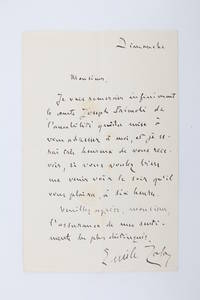
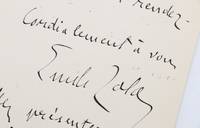
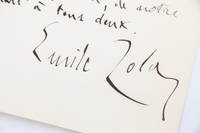
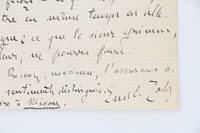
189480728s. l. Rome Rome 1894. Fine. s. l. Rome Rome Dimanche 4 novembre 1894 13.20 x 20.50 cm une page sur un double feuillet et une enveloppe Autograph letter signed by Emile Zola addressed to Ugo Ojetti. One page written in black ink on the first page of a double sheet. Folding inherent to postal transmission. Envelope included. This letter was addressed by the father of naturalism to journalist Ugo Ojetti when he had just arrived in Rome: ""Monsieur je vais remercier infiniment le comte Joseph Primoli de l'amabilité qu'il a mise à vous adresser à moi et je serai très heureux de vous recevoir si vous voulez bien me venir voir le soir qu'il vous plaira à six heures."" ""Sir I wish to thank Count Joseph Primoli infinitely for the kindness he has shown in directing you to me and I shall be very happy to receive you if you would be so good as to come and see me any evening that suits you at six o'clock."" Having arrived a few days earlier in the eternal city to conduct research for Rome Emile Zola hoped to meet Count Joseph Primoli there. The latter was unfortunately in Paris but he sent him this young journalist from La Tribuna who would serve as his guide but also as secretary. The two men clearly got along well and Zola even authorized Ojetti to adapt an opera libretto from his famous Nana. The project would unfortunately never come to fruition. Joseph Napoléon Count Primoli 1851-1927 was the great-great-nephew of Napoleon Bonaparte. Very close to the imperial family under the Second Empire he subsequently remained faithful to the salon of his beloved aunt Princess Mathilde in her private mansion on rue de Berri. His refined and witty conversation worked wonders there and he met as a passionate bibliophile some of the greatest writers of his time: Gustave Flaubert Théophile Gautier the Goncourts and Guy de Maupassant. unknown
189084423Paris 1890. Fine. Paris 20 Février 1890 13.50 x 20.50 cm une page Autograph letter dated and signed by Emile Zola 12 lines in black ink addressed to librettist Louis Gallet concerning the operatic adaptation by Alfred Bruneau of the novel ""Le rêve"". Folds inherent to postal dispatch. Emile Zola was to meet jointly with Alfred Bruneau who had adapted the novel ""Le rêve"" for the opera and Louis Gallet the librettist of this adaptation. ""Je vous attends demain matin. pour causer des trois derniers tableaux. J'écris également à Bruneau pour lui donner rendez-vous"" ""I await you tomorrow morning. to discuss the last three tableaux. I am also writing to Bruneau to arrange a meeting with him"" and shows himself very satisfied with this prospect: ""Tout va bien."" ""All goes well."" unknown
190187263Paris 1901. Fine. ""I have finished my crushing task and I am going to rest a little because I am exhausted"" Paris 4 Mars 1901 13.50 x 20.50 cm deux pages sur un bifeuillet Autograph letter signed by Emile Zola addressed to Octave Mirbeau dated in his hand March 4 1901. Two pages in black ink on a bifolium. Horizontal fold mark inherent to postal delivery. Published in his Correspondence vol. X p. 242. Precious letter from Zola to his great supporter Octave Mirbeau who had paid his fine at the end of his second trial for ""J'accuse!"". Now amnestied the writer attempts - in vain - to recover the sum to reimburse him. After his historic cry from the heart in l'Aurore Zola was first condemned by the Seine jury on February 23 1898 to one year in prison and a three thousand franc fine. The judgment was overturned on appeal and the case was referred to the Versailles assizes which retained only three lines out of the eight hundred that make up ""J'accuse!"" as grounds for accusation. To avoid accepting such a stifling of the debates Zola's defense decided to default and the conviction was confirmed on July 18 - Zola left that very evening for London to avoid prison. The tribunal also demanded 7555 francs from him which Mirbeau spontaneously decided to pay from his own funds. It was also Octave Mirbeau who prevented the seizure of Zola's furniture by obtaining from Joseph Reinach the 40000 francs in damages that Zola had been condemned to pay to the three pseudo-experts in handwriting that he had ""defamed"" in J'accuse!. Following the amnesty law that ended judicial proceedings for ""all criminal or delictual acts connected to the Dreyfus affair"" Zola was acquitted but was not reimbursed. This letter attests to the writer's desire to compensate Mirbeau for his act of generosity: ""Labori his lawyer will attempt an approach to try to recover the seven thousand and some francs that you paid on my behalf for the Versailles affair. He simply wishes to have a letter from you in order to show it and thus be authorized to speak in your name. You certainly do not have down there the receipt that was issued to you. Perhaps you remember its terms. In any case if we must wait we will wait for nothing is urgent after all. The important thing today is only to test the ground to see if they will return the money to us"". However the prosecutor's office refused his request. Furious Zola wrote two days later a letter to Labori asking him to give up claiming the slightest cent - he published it in L'Aurore under the title ""Let them keep the money"": ""they torture the text of the law and the State too keeps the money. If the prosecutor's office persists in this interpretation it will be yet another monstrosity in the unworthy way they have refused me all justice . I do not want to be complicit by accepting anything whatsoever from their amnesty ."". According to Pierre Michel these unsuccessful recovery attempts of which this letter bears witness ""incited Zola to adopt an attitude that emphasizes even more his disinterestedness and that of his 'friend' who is not named in the L'Aurore article probably at Mirbeau's request."" Dreyfus's pardon and the amnesty of his supporters did not satisfy the writer but nevertheless marked the end of long years of struggle: ""I have finished my crushing task and I am going to rest a little because I am exhausted"". Struck down in full glory the following year he would not be able to witness Captain Dreyfus's rehabilitation. Beautiful lines from Zola to Mirbeau who gave him the means to continue his fight for justice. unknown
188379106Bénodet 1883. Fine. Bénodet 10 septembre 1883 13.20 x 20.30 cm 2 pages sur un double feuillet Signed autograph letter by Emile Zola - apparently unpublished - addressed to an unknown correspondent written in black ink on a double sheet. Folds inherent to mailing. Interesting letter relating the translation of Emile Zola's works and the legal disputes inherent to their clandestine distribution. This missive is visibly addressed to a correspondent considered for the German translation of La Joie de vivre: ""I would ask you to give me the promptest possible response regarding the translation of La Joie de vivre; for I am already receiving proposals from Germany and I would like to know where I stand."" In this autumn of 1883 Zola - though vacationing in Brittany - is very occupied with managing the translation of his works which he handles directly with publishers. We see here the determination with which he conducts negotiations: ""I repeat that I will only accept a fixed sum paid in advance. It is simpler and without possible surprises."" But things are not simple and Zola whose works already enjoy great success must fight against the clandestine publication of his novels. Completely overlooked by biographers the disputes with Hungarian publisher Gustav Grimm are nonetheless a leitmotif of Zolian correspondence: ""Monsieur Grimm of Budapest is a simple thief who has my novels translated as they are published in French newspapers without any authorization. Already the Neue Freie Presse of Vienna has sued him in my name. But it appears we have no treaty with Hungary. I await the signing of a treaty which they say is imminent."" Indeed Grimm had already published without Zola's authorization German translations of two novels: Nana 1881 and Pot-Bouille Der häusliche Herd 1882. These illegal publications discouraged German publishers Curt Busch and George Kuhr who very interested in distributing the novel to German-speaking readers declared forfeit. Gustav Grimm who finally agreed to respect commercial treaties won the battle and published the very first German translation of La Joie de vivre in 1889 under the title Die Lebensfreude. The man whom Zola here calls a ""simple thief"" would finally obtain authorization to distribute the German translation of the entirety of the twenty volumes of the Rougon-Macquart between 1892 and 1899. Interesting letter revealing the editorial mechanisms of the Rougon-Macquart and testifying to the ardor with which Zola conducted negotiations inherent to the translation of his great hereditary fresco. unknown
188279109Médan 1882. Fine. Médan 16 novembre 1882 13.60 x 21.40 cm 2 pages sur un double feuillet - enveloppe jointe Autograph letter signed by Emile Zola - apparently unpublished - addressed to Léon Carbonnaux written in black ink on a double sheet. Folds inherent to mailing. Envelope included. Important testimony to the colossal documentation work and the capital role of Emile Zola's informants in depicting his immense natural and social fresco. This letter was sent to Léon Carbonnaux department head at Bon Marché who transmitted precious information to Emile Zola for the creation of the eleventh volume of the Rougon-Macquart series: Au Bonheur des Dames. Only two letters from Léon Carbonnaux to Emile Zola are known: they can be consulted in the digitization of the preparatory file for Bonheur des Dames made available online by the Bibliothèque nationale de France. However we know thanks to this same file which contains a long section entitled ""Notes Carbonnaux"" that this department head at Bon Marché provided a significant amount of information to Zola particularly about employee customs and their remuneration. The two men undoubtedly met when Emile Zola eager for information about the functioning of department stores conducted field research in February and March 1882. ""J'ai pris l'inventaire comme cadre à un de mes chapitres. D'ailleurs je n'ai spécialement besoin que du travail dans le rayon des confections et dans le rayon des soieries. Il est inutile de me renseigner sur les autres rayons."" ""I have taken the inventory as the framework for one of my chapters. Moreover I specifically only need the work in the ready-to-wear department and in the silk department. It is unnecessary to inform me about the other departments."" Thanks to this important letter we understand that it was Léon Carbonnaux who provided the essential information to Emile Zola for writing his very beautiful eleventh chapter devoted to the inventory: ""Vous avez eu l'obligeance de me donner certains détails sur l'inventaire. Vous m'avez dit qu'on choisissait le premier dimanche d'août qu'on fermait les portes et que tous les employés s'y mettaient. On vide toutes les cases n'est-ce pas on jette les marchandises sur les comptoirs ou à terre et l'inventaire n'est terminé que lorsqu'il n'y a plus absolument rien en place."" ""You were kind enough to give me certain details about the inventory. You told me that the first Sunday in August was chosen that the doors were closed and all the employees set to work. All the compartments are emptied aren't they The merchandise is thrown onto the counters or on the ground and the inventory is only finished when there is absolutely nothing left in place.""The final version of Bonheur des Dames contains all the precious information provided by the department head of Bon Marché: ""Le premier dimanche d'août on faisait l'inventaire qui devait être terminé le soir même. Dès le matin comme un jour de semaine tous les employés étaient à leur poste et la besogne avait commencé les portes closes dans les magasins vides de clientes. . Neuf heures sonnaient. . Dans le magasin inondé de soleil par les grandes baies ouvertes le personnel enfermé venait de commencer l'inventaire. On avait retiré les boutons des portes des gens s'arrêtaient sur le trottoir regardant par les glaces étonnés de cette fermeture lorsqu'on distinguait à l'intérieur une activité extraordinaire. C'était d'un bout à l'autre des galeries du haut en bas des étages un piétinement d'employés des bras en l'air des paquets volant par-dessus les têtes ; et cela au milieu d'une tempête de cris de chiffres lancés dont la confusion montait et se brisait en un tapage assourdissant. Chacun des trente-neuf rayons faisait sa besogne à part sans s'inquiéter des rayons voisins. D'ailleurs on attaquait à peine les casiers il n'y avait encore par terre que quelques pièces d'étoffe. La machine devait s'échauffer si l'on voulait finir le soir même. unknown
1024691543.Ghardcover. Good. Access codes and supplements are not guaranteed with used items. May be an ex-library book. hardcover
127085318X.Gpaperback. Good. Access codes and supplements are not guaranteed with used items. May be an ex-library book. paperback
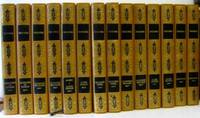
1979262128Famot 1979. Bon à très bon état de conservation tranche un peu ternies; légères rousseurs intérieur frais bonne tenue. in8. 1979. Broché. 8 romans en 14 volumes: La conquête de Plassans t. I et II; la fortune des Rougon t. I et II; le Rêve; la bête humaine t. I et II; le docteur Pascal t. I et II Au bonheur des dames t. I et II la joie de vivre t. I et II; l'assommoir t. I et II Famot unknown
19090008050LOS ANGELES CALIFORNIA. Good. 1909. On offer is an outstanding travel journal written by a young girl in California in the early years of the 20th century. This well-written journal measures 9.25 inches by 7.5 inches and contains 60 pages. It is 60% complete. The cover and pages are in good condition and the handwriting is legible and quite easy to read. Also included is a black and white photograph a map/itinerary and a number of newspaper clippings - all in very good condition. The author is Zola Grace Strawser a 14 year old school girl. Born in 1895 she grew up in Los Angeles where her father Bert was a successful businessman. She had 3 sisters - Nellie Merle and Bertie. Casual research has not discovered any additional biographical information. In July of 1909 she left on a long train trip from Los Angeles to the Worlds Fair in Seattle. Along the way she makes stops in Las Vegas and Salt Lake City amongst other places. She is a keen observer and her descriptions are detailed and well-written. "The train slowly pulled out of the Salt Lake City Station and our long hoped for journey began. Nellie Merle Bertie Papa and Daisy Clark were there to say "goodbye." Daisy Clark gave us our first box of candy and also a beautiful bunch of carnations. The ride to Pomona was not so interesting as we made so many trips to San Bernardino before. Our next stop was Ontario. From Ontario you have a very beautiful view of the mountains which is very interesting. We next passed through Riverside and Coulton and arrived in San Bernardino 12:12. Between Los Angeles and San Bernardino can be seen orange trees and mountains while from San Bernardino is a vast stretch of desert. We then went to lunch and from the window you could see right down between the mountains on which were some snow. I saw an automobile filled with men and for a long time had great fun waving back and forth. They at last got ahead of us. We had to go so slow up a high incline . the rest of the landscape was desert desert desert. ." July 8. In Salt Lake City she visited a number of sites: ". we saw all the important buildings the temple tabernacle the Lion House Bee Hive grave of Brigham Young and the "Eagle Gate" July 9. She goes out to visit Saltair - an amusement park and resort built at the south end of Great Salt Lake. At one time Saltair was the largest and most popular family resort west of New York. Today it is abandoned a victim of shrinking water and the ravages of a changing climate. Each day's entry is accompanied by a small pen and ink drawing representing some remark in the entry. She writes an excellent description of a wedding accompanied by a drawing of wedding bells and music notes and the inscription "No Wedding Bells For Me.: "THE WEDDING: Talk about your presents you ought to have seen Bessie's. Cut glass china silverware well it was enough to make anyone wish it was them getting married. She also received four chairs three tables bedding and linen. The few people assembled to see her married arrived about half past seven. Bessie who was naturally nervous broke right down and cried but as soon as the ceremony was over she was as happy as a lark and was receiving many congratulations. Well while we are waiting for the guests to arrive I will describe the appearance of the house. The rooms were all decorated in carnations roses ferns palms and small trees. On the electric lights were twined smilax and over the globes were different color flower shades. The long porch was made beautiful with small green palms and at the father end a Hawaiian orchestra played the whole evening. The yard which was very large was strung with lanterns of all manner and shapes. There was a wall of canvas all around so as to keep intruders out. The guests have now arrived and the air was sweet with lavender and violet perfume. Ladies with low neck chiffon dresses; with white satin evening coats; ladies with the tight fitting empire ladies in simple white ladies in red pink blue and every imaginable color. In the evening lunch was served and while the bride and groom were eating they threw handfuls of rice at them. Of course their dinner was spoilt and they had to get more dinner. About an hour after the bride and groom were missed and the whole party set out to look for them. The bride was found and the girls who were quite rough drew her across the bed and a hat pin stuck in her and hurt her. Mrs. Brook fought them and Bessie got free again and escaped in the crowd and hid in the cellar. She was so scared and sick that she could hardly stand. She then slipped in the back bedroom and changed her wedding dress for her brother's clothes. There she slipped in the automobile barn until the crowd had gone around the front and slipped over the fence and went in the house next door and mingled with the crowd who did not know her dressed as a boy. Cora the girl next door put on a long black coat and put something over her head. Her brother was waiting in a buggy outside. With one jump Cora was in the buggy and was driving away as fast as possible. The whole party thought it was Bessie and Vic and started after the buggy. Cora's brother had heart trouble and when they were about a block away he fainted and Cora had to drive home with her brother in her arms. When she reached home she fainted and they had an awful time. Of course the crowd found it was not the bride and groom. The bride and groom left for the canyon 20 min. to one. While all the excitement was going on the groom was next door asleep." July 14. After a number of adventures she continues her trip to Seattle and the World's Fair: "In the morning Irene mother and I went to the fairgrounds. I can't very describe how they look only by showing you postcards. They have an imitation geyser which goes up and down all the time. "The Cascades" are simply beautiful. You can stand at the top and look right over the falls and the geyser and see Mt. Rainier. The buildings are all white and the flowers are beautiful. In the evening we went to a show and saw the smallest woman in the world "Princess Checita" July 31. We again went to the fair and visited many buildings. Our feet were just covered with blisters from all the walking up the hills. Mama isn't feeling well. She is lonesome for papa. Aug 1 "As this was to be our last day at the fair we visited all the buildings we had not seen before. In the government building were articles from the "Dead Letter Office." Skulls snakes a pig's tail money jewelry a bustle the hair of a woman who had been scalped guns swords and all manners of weapons beads small funny statues locks of hair old books and dirty table covers pencils and everything imaginable. We had a nice time at the fair and had our pictures taken several times."Aug 6. Before they return to Los Angeles they travel up to Portland on August 8th and on the 9th take a boat trip up the Columbia River all the way to The Dalles. There are two brochures included from this trip and two pages of wonderful descriptions. On Aug 11th they board their train for their return trip. She arrived back in San Francisco on Aug 12th and met her father the next day: ". In the evening we took dinner at the Cafe Bismark a German-influenced restaurant in San Francisco in the 1900s. It was called "the largest and finest café in the city." and then went to the Orpheum a long-vanished vaudeville theatre. After the theatre we met papa on his way to Chicago. Aug 13. Her trip ends when she reaches home on Aug 17th. Following her account of the trip are 4 pages with some notes made in 1910 and 1911. "Nellie and I gave a masquerade party" Dec 3 1910 "Merle Bertie and Mother and I start for Catalina to spend the month."Aug 3 1911. A historian looking at the early history of California would find this journal simply rich in local detail. The descriptions are excellent and her keen eye misses nothing. There are interesting observations about the towns she visits and the people she encounters. It is clear that she comes from a well-to-do family and this would be an interesting contrast to the majority of people living in California at this time.; Manuscript; 4to - over 9¾" - 12" tall; KEYWORDS: HISTORY OF EARLY 20TH CENTURY 1900S PROGRESSIVE ERA UNITED STATES CALIFORNIA LOS ANGELES ZOLA GRACE STRAWSER; BERT STRAWSER; ACME LAUNDRY; SAN BERNARDINO; SEATTLE WORLD FAIR 1909 BISMARK CAFE; ORPHEUM THEATRE DEAD LETTER OFFICE DLO TRAVEL JOURNALS TRAVEL BY RAIL EXPOSITIONS FAIRS TRAIN JOURNEYS TRAIN TRIPS WEDDING CEREMONIES BLACK AND WHITE PHOTOS MAPS DRAWINGS SOCIAL HISTORY AMERICANA HANDWRITTEN MANUSCRIPT DOCUMENT LETTER AUTOGRAPH WRITER HAND WRITTEN DOCUMENTS SIGNED LETTERS MANUSCRIPTS DIARY DIARIES JOURNALS PERSONAL HISTORY SOCIAL HISTORY HISTORICAL HOLOGRAPH WRITERS AUTOGRAPHS PERSONAL MEMOIR MEMORIAL ANTIQUITÉ CONTRAT VÉLIN DOCUMENT MANUSCRIT PAPIER ANTIKE BRIEF PERGAMENT DOKUMENT MANUSKRIPT PAPIER OGGETTO D'ANTIQUARIATO ATTO VELINA DOCUMENTO MANOSCRITTO CARTA ANTIGÜEDAD HECHO VITELA DOCUMENTO MANUSCRITO PAPEL . hardcover
2026244033Charpentier 2026. Etat Correct. poche. 2026. Relié. Charpentier unknown
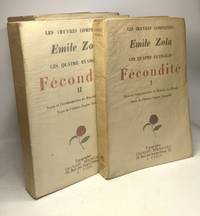
2026100110998François bernouard 2026. dos recollés tranches fanées ternies rousseurs intérieur propre. in8. 2026. Broché. 6 volumes. 6 volumes "Les oeuvres complètes Emile Zola texte de l'édition Eugène Fasquelle voir description: La conquêtet de plassans Thérèse Raquin suivi de Madeleine Férat Vérité 2 tomes Fécondité 2 tomes La confession de Claude suivi de Le Voeu d'une Morte François bernouard unknown
9788578441616-11-19611Disal. New. Disal unknown
9788537812914-11-30426Zahar. New. Zahar unknown
1992Q-048627134XDover Publications 1992-06-01. Paperback. New. In shrink wrap. Looks like an interesting title! Dover Publications paperback