Wilde OscarBiblio.com
302 résultats
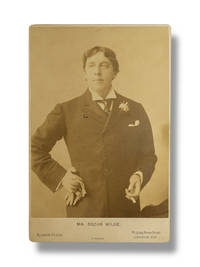
1894#15<p>Oscar Wilde<br />Salome. A Tragedy in One Act: Translated from the French of Oscar Wilde; Pictured by Aubrey Beardsley.<br />Salomé une tragédie en un acte traduite du français illustrée par Aubrey Beardsley.<br />London Elkin Mathews & John Lane; Boston Copeland & Day 1894.<br /><br />Small quarto. 5 unnumbered leaves half-title engraved title dedication to Alfred Douglas list of characters engraved list of illustrations 67 pp. and 16 pp. of publisher's advertisements. 10 engraved plates printed on Japan paper and one historiated tailpiece.<br /><br />A precious copy from the library of Jules Claretie accompanied by an autograph letter and a superb original photograph of Oscar Wilde.<br /><br />Contemporary binding signed by Gruel. Full olive morocco covers framed with a quadruple blind fillet spine with five raised bands extending onto the covers inner dentelles with gilt fillets gilt edges at the head edges ruled.<br /><br />First English edition printed in 500 copies.<br /><br />Copy enriched with:<br />– An original photograph of Oscar Wilde 145 × 105 mm by Alfred Ellis albumen print of the period.<br />– A press clipping announcing Wilde's death and another reporting on his funeral.<br />– An autograph letter signed by Oscar Wilde to Jules Claretie dated "The Cottage Goring-on-Thames" 1894 4 pages 12mo in black ink on a folded vellum paper bifolium.<br /><br />Translation of the letter originally in French:<br />"Dear Monsieur Claretie<br />Pray allow me the pleasure of asking you to accept a copy of my play Salomé and permit me to assure you how highly I value the privilege of meeting the artistic director of the most artistic theatre in the world.<br />I have retired to the country to reflect upon a new play but before the season ends I hope to return to London and to have the opportunity of seeing you again.<br />The only hope I see for our English drama lies in the establishment of a theatre like the French Theatre. I hope we may find a director possessing as much sympathy for art as yourself.<br />Pray accept this expression of my respect and admiration.<br />Oscar Wilde."<br /><br />One year after its first appearance in French the English version of Salome was published. The dedication reads: "To my friend Lord Alfred Bruce Douglas the translator of my play." In fact the translation gave rise to a dispute between Wilde and his young protégé whose command of French was rather limited. Wilde redid the entire work and refused to allow Douglas's name to appear on the title page. Douglas saw between this dedication and the absence of his name on the title page "the difference between a tribute of admiration from an artist and a tradesman's receipt."<br /><br />The book is one of the masterpieces of the English illustrated book featuring the striking compositions of Aubrey Beardsley 1872–1898 who also designed two magnificent historiated borders for the title page and the list of illustrations as well as the final tailpiece. These stylized and sinuous drawings show the artist at the height of his powers playing with bold areas of deep black ink contrasted with untouched white spaces and sophisticated decorative elements inspired equally by Renaissance ornament and the then-fashionable Japanese style. For Salome the young artist created the archetype of the poisonous woman typical of Symbolism surrounded by grotesque and perverse secondary figures. Wilde paid tribute to him declaring that Beardsley was "the only artist who knew what the dance of Salome was and who could see that invisible dance."<br /><br />This copy belonged to the novelist playwright and critic Jules Claretie 1840–1913 who from 1885 until his death served as administrator of the Comédie-Française which Wilde here does not hesitate to call "the most artistic theatre in the world." Claretie introduced contemporary authors such as Henry Bataille and Octave Mirbeau into its repertoire.<br /><br />This was a bold undertaking and Wilde here pays tribute to it: "The only hope I see for our English drama lies in the establishment of a theatre like the French Theatre."<br /><br />The very fine portrait of Oscar Wilde mounted at the beginning of this copy was taken in 1892 by the London photographer Alfred Ellis 1854–1930. The writer is captured as he truly was at the height of his career: impeccably dressed posing in a high-buttoned double-breasted jacket flower in his buttonhole white pocket square a cigarette in his left hand and his gloves in his right the latter resting on his hip.</p> Elkin Mathews & John Lane
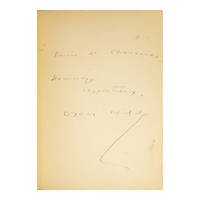
1893#16<p>Oscar Wilde Salomé. Drame en un acte. Paris Librairie de l'Art indépendant; London Elkin Mathews and John Lane 1893. Square 12mo 196 × 145 mm. 2 blank leaves 84 numbered pages the first 8 unnumbered: half-title title dedication to Pierre Louÿs list of characters; text beginning on p. 9 and 2 unnumbered leaves 1 leaf with the colophon dated 6 February 1893 and 1 blank leaf. Modern binding. Half black morocco with small corner pieces bluish paper sides smooth spine title in gilt untrimmed top edge with matte gilt doublures and endleaves of the same paper. Original violet wrappers and spine the upper cover printed in silver lettering preserved. Excellent condition. A few small spots; upper edges of the boards slightly faded; wrappers somewhat sunned. First edition. This celebrated play was written directly in French by Wilde between 1891 and 1892; first performed in 1896 its text was revised at the author's request by Marcel Schwob Stuart Merrill and Pierre Louÿs. The first English edition appeared the following year. Limited edition of 600 copies with no special issue on large paper. The second blank leaf bears the following autograph inscription signed in black ink: "<em>À Puvis de Chavannes / </em><em>Hommage respectueux / </em><em>Oscar Wilde</em>" To Pierre Puvis de Chavannes respectful homage Oscar Wilde. The celebrated painter and muralist Pierre Puvis de Chavannes 1824–1898 like Oscar Wilde 1854–1900 lived in the cult of Beauty. Renowned for his compositions of noble and hieratic character influenced both by Greco-Roman classicism and by Symbolism his work exerted a profound fascination on late nineteenth-century painters and sculptors particularly Edgar Degas Paul Gauguin Aristide Maillol and Maurice Denis. The aesthetic connection between Oscar Wilde and Puvis de Chavannes is to be sought precisely around Salomé since the artist had painted in 1869 a Beheading of Saint John the Baptist that may well have inspired the author. Moreover it is known that when Aubrey Beardsley—who would illustrate the English version of the play in 1894—came to Paris in 1893 he was strongly encouraged by the French painter who introduced him as "a young English artist who produces astonishing things." The inscription in Salomé is therefore particularly significant and of greater import than a simple tribute. A very fine provenance for this celebrated drama written directly in French by Oscar Wilde.</p> Librairie de l’Art indépendant
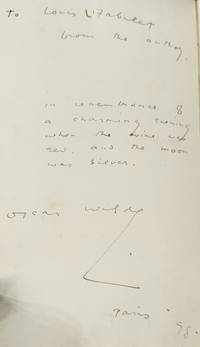
18986<p><strong>Oscar Wilde</strong></p><p><strong>The Ballad of Reading Goal by C.3.3.</strong></p><p><em>Leonard Smithers Royal Arcade London W. 1898.</em></p><p>Original white quarter cloth spine lettered in gilt yellow cloth sides.</p><p>Inscribed in ink on the back of the half-title:</p><p><em>To Louis Fabulet</em></p><p><em>from the author</em></p><p><em>in remembrance of</em></p><p><em>a charming evening</em></p><p><em>when the wine was </em></p><p><em>red and the moon</em></p><p><em>was silver</em></p><p><em>Oscar Wilde</em></p><p><em>Paris</em></p><p><em>98</em></p><p>Autograph note from Louis Fabulet:<em><br /><br />"This book: "The Ballad of Reading Jail" was given to me by Oscar Wilde in June 1898 a few days after the dinner that after his release from prison in England I persuaded my friend the poet Edouard Ducôté then director of the magazine "L'Ermitage" to offer in his honor.<br />Hugues Rebell André Gide Henri Ghéon René Boylesve and I were the guests.<br />Louis Fabulet.<br /><br /></em>Attached is the business card bearing the name under which Oscar Wilde then lived in Paris. The address in pencil: <em>"Hôtel d'Alsace rue des Beaux-Arts is in his handwriting.<br /></em></p><p>"<em>Melmoth" is the man "who sold his soul for eternal youth."</em></p><p>Louis Fabulet 1862-1933 was one of the main translators from English to French in his time notably of the works of Kipling and Thoreau. It is said that it was Oscar Wilde who introduced him to <em>The Jungle Book.</em></p><p>This inscription exceptionally long and colorful which is almost akin to a brief poem refers to the dinner that Louis Fabulet speaks of in his note.</p><p>Wilde had arrived in Paris in March and the French literati were keen to pay him public homage with this banquet which he presided over.</p><p>The inscription makes a nice reference to the event with perhaps a reminiscence of the <em>Ballad</em> itself where we read in the second verse: <em>"For blood and wine are red"</em> .</p><p>Mounted in the copy is Wilde's rare card in the name of Sebastian Melmoth. The aged ruined writer abandoned by almost everyone hid himself under the name of the hero of Robert Mathurin's novel <em>Melmoth the Wanderer.</em></p><p>The card does not have an address. Wilde in fact lived at the Hôtel d'Alsace in Saint-Germain des Prés a shabby establishment at the time <em>"it's so dirty so totally depressing and hopeless"</em> he wrote. He wrote down the address of his hand in pencil. It was there that he died two years later. The hotel took the name "L'Hôtel" in 1963 and became a rather chic place.</p><p>These combined elements: the poetic inscription which evokes a happy moment and the moving card which evokes his misery make this copy one of the most precious there is.</p> Leonard Smithers
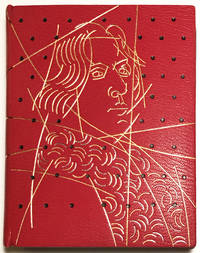
1891BBO50<p><b>WILDE</b> Oscar: </p><p><i><b>The Picture of Dorian Gray</b></i>.<br /></p><p>London: Ward Lock and Co. 1891.</p><p>First English edition Deluxe Issue Limited to 250 copies #43. <b>Signed by Oscar Wilde</b>.</p><p>4to vii viii 334 pp.; <b>design binding by Robert Wu</b> in gilt red goat morocco.</p><p>A Landmark work of Literature.</p> Ward Lock and Co. hardcover books
189916660Bruxelles: Ad.Mertens 1899. Gebunden. Ad.Mertens unknown
186947911No place 1869. 8vo. In the original printed wrappers no backstrip. Offprint from the "Philosophical Magazine" January 1869. With authors presentation inscription to front wrapper: "With the author's Compliments.". Fine and clean. 9 pp. <br/><br/><em>Offprint issue with author's presentation insciption to front wrapper of Wilde's paper on how to control and render the magneto-electri current which nearly led to the discovery of the principle of self-excitation. This was however achieved by other inventors first notably Charles Wheatstone and the Siemens brothers."In 1856 Wilde established a business in Manchester as an electric-telegraph and lightning-conductor engineer and spent some years on the development of a magneto-electric alphabetic telegraph which was demonstrated at the international exhibition in London in 1862. In December 1863 he patented a twin-armature machine in which a magneto-electric generator provided excitation current for the field winding of another generator. These machines were made in quantity by Wilde & Co. but in use they had the disadvantage of becoming very hot. In 1867 Described in the present paper. he patented an entirely different type of multipolar machine which was used for electro-deposition and arc lighting. Among his other patents was one in 1875 for the making of copper rollers for calico printing.". Oxford DNB. Henry Wilde 1833 - 1919 was a wealthy individual from Manchester England who used his self-made fortune to indulge his interest in electrical engineering. He invented the dynamo-electric machine or self-energising dynamo an invention for which Werner von Siemens is more usually credited and in fact discovered independently. At any rate Wilde was the first to publish his paper was communicated to the Royal Society by Michael Faraday in 1866. The self-energising dynamo replaces the permanent magnets of previous designs with electro-magnets and in so doing achieved an enormous increase in power. The machine was considered remarkable at the time especially since Wilde was fond of spectacular demonstrations such as the ability of his machine to cause iron bars to melt. </em> unknown
187346830London Taylor and Francis 1873. 8vo. Offprint seperately paginated with author presentation inscription to top of front wrapper "Joseph Sidelbotham / with the Author's best regards". Fine and clean. 8 pp. 1 folded plate. <br/><br/><em>Scarce offprint issue with a most interesting presentation inscription to one of the fathers of photography of Wilde's paper on improvements of his electromagnetic induction machine introduced in 1866. Wilde discovered independently of Werner von Siemens who is usually credited for the invention the dynamo-electric machine. Despite Siemens being the one credited for the invention Wilde was the first to publish a paper describing it; this was communicated to the Royal Society by Michael Faraday in 1866.Joseph Sidebotham 1824-1882 was the first to practice photography in Manchester and of the most important local photographers in general. His interest was however not confined to photography; he was an amateur botanist entomologist and astronomer. He was also a Fellow of the Royal Astronomical Society and lectured to the Mechanics Institute on astronomy and electro-magnetism. </em> unknown
189548924Manchester 1895. 8vo. In the original printed wrappers. Offprint from: "Memoirs and Proceedings of the manchester Literary and Philosophical Society" Volume Nine Fourth series. With the authors presentation inscription to top of first page: "With the Author's Compliments". Lacking backwrapper. Internally fine and clean. Pp. 95-107. <br/><br/><em>Offprint with the author's presentation inscription. Henry Wilde a wealthy individual from Manchester England who used his self-made fortune to indulge his interest in electrical engineering. He invented the dynamo-electric machine or self-energising dynamo published in 1866. The machine was considered remarkable at the time especially since Wilde was fond of spectacular demonstrations such as the ability of his machine to cause iron bars to melt. </em> unknown
189648036Manchester The Manchester Literary and Philosophical Society 1896. 8vo. In the original printed wrappers. Offprint from "Memoirs and Proceedings of the Manchester Literary and Philosophical Society" Tenth 10 volume Fourth series. With author's presentation inscription to top of front wrapper: "With the Author's Compliments.". Lacking 1 cm of lower part of front wrapper not affecting text otherwise a very fine and clean copy. Pp. 61-71 1 plate. <br/><br/><em>Scarce offprint issue with author's presentation inscription of Wilde's important contribution to the quantitative relations of the physical and chemical forces especially in relation to batteries. Henry Wilde 1833 - 1919 a wealthy individual from Manchester England who used his self-made fortune to indulge his interest in electrical engineering. He invented the dynamo-electric machine or self-energising dynamo published in 1866. The machine was considered remarkable at the time especially since Wilde was fond of spectacular demonstrations such as the ability of his machine to cause iron bars to melt. </em> unknown
189448038Manchester The Manchester Literary and Philosophical Society 1894. 8vo. In the original printed wrappers. Offprint from "Memoirs and Proceedings of the Manchester Literary and Philosophical Society" Ninth 9 volume Fourth series. With author's presentation inscription to top of front wrapper: "With the Author's Compliments.". Light soiling to extremities. Very fine and clean. Pp. 181-186 1 folded plate. <br/><br/><em>Scarce offprint issue with author's presentation inscription of Wilde's contribution to the magnetic declination of the Earth.Henry Wilde 1833 - 1919 a wealthy individual from Manchester England who used his self-made fortune to indulge his interest in electrical engineering. He invented the dynamo-electric machine or self-energising dynamo published in 1866. The machine was considered remarkable at the time especially since Wilde was fond of spectacular demonstrations such as the ability of his machine to cause iron bars to melt. </em> unknown
189548037Manchester The Manchester Literary and Philosophical Society 1895. 8vo. In the original printed wrappers. Offprint from "Memoirs and Proceedings of the Manchester Literary and Philosophical Society" Ninth 9 volume Fourth series. With author's presentation inscription to top of front wrapper: "With the Author's Compliments.". Front wrapper loose and back wrapper detached light miscolouring to wrappers. Internally fine and clean. Pp. 67-85 1 folded plate. <br/><br/><em>Scarce offprint issue with author's presentation inscription of Wilde's contribution to helium and its place in the natural classification. Henry Wilde 1833 - 1919 a wealthy individual from Manchester England who used his self-made fortune to indulge his interest in electrical engineering. He invented the dynamo-electric machine or self-energising dynamo published in 1866. The machine was considered remarkable at the time especially since Wilde was fond of spectacular demonstrations such as the ability of his machine to cause iron bars to melt. </em> unknown
1892009173Manchester: George Falkner and Sons 1892. Reissue of the 1878 offprint with new preface and French translation. Inscribed "with Author's Compliments." Small pieces torn from outer edge of rear wrapper; blank corners of final leaf and folding table torn off; two library ink stamps on front wrapper; embossed stamp on title page. Privately published version. Unrecorded on OCLC/WorldCat. Collation: vi 17 1 iv 18 pp. folding table. Reissue. Original Printed Wrappers. Good. George Falkner and Sons Paperback
189248041London Paris Kegan Paul Gauthier-Villars et fils 1892. Large4to. Without front wrapper and backtrip. Internally fine and clean. VI 18 pp 1 folded plate. <br/><br/><em>Second issue with alterations and additional material of Wilde's contribution to the origin of elements and his views on the newly created periodic system including the first French translation. Wilde states in the preface printed here for the first time that: "The reprinting of this paper is all the more desirable as some of the views set forth therein have been modified by subsequent investigatiors without advancing much beyond what had already been accomplished; while in other instances there has been a distinct retrogression from the solid position which chemical philosophy had attained more than forty years ago." Henry Wilde 1833 - 1919 a wealthy individual from Manchester England who used his self-made fortune to indulge his interest in electrical engineering. He invented the dynamo-electric machine or self-energising dynamo published in 1866. The machine was considered remarkable at the time especially since Wilde was fond of spectacular demonstrations such as the ability of his machine to cause iron bars to melt. </em> unknown
187848040Manchester T. Sowler and Co. 1878. 8vo. In the original printed wrappers. Offprint from "The Proceedings of the Manchester Literary and Philosophical Society" April 30. Author's presentation inscription to front wrapper "Edmund J Mills / with the Author's Compliments". Miscolouring to lower part of front wrapper. Internally fine and clean. 25 pp. 1 folded plate. <br/><br/><em>Scarce offprint issue with author's presentation inscription of Wilde's contribution to the origin of elements and his views on the newly created periodic system.Henry Wilde 1833 - 1919 a wealthy individual from Manchester England who used his self-made fortune to indulge his interest in electrical engineering. He invented the dynamo-electric machine or self-energising dynamo published in 1866. The machine was considered remarkable at the time especially since Wilde was fond of spectacular demonstrations such as the ability of his machine to cause iron bars to melt. </em> unknown
188878557Boston:: Ticknor and Company 1888. First American edition. publisher's brown cloth with printed paper label on spine. The spine label is tanned with shallow chipping at the edges and a few abrasions; shallow use at extremities of spine; clean tight and sound. 12mo. To Which is Appended a Chapter on "The Ancient Race of Ireland." by the Late Sir William Wilde. Lady Jane Wild was the mother of Oscar Wilde. Ticknor and Company, hardcover
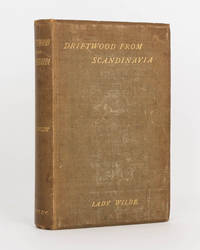
1884124354London: Richard Bentley and Son 1884. First Edition. Hardcover. Very Good. London Richard Bentley and Son 1884. Octavo iv 297 pages with the title page printed in red and black. Original cloth lettered in gilt on the spine and front cover; cloth a little rubbed mottled and sunned with minimal wear to the head of the front joint; paper lightly tanned; small nameplate on the front pastedown; minimal signs of age and use; a very good copy. A rare and spirited travel book by Jane Francesca Agnes Wilde circa 1821-1896 influential Irish poet translator and feminist and the mother of Oscar Wilde. 'From 1846 she began to contribute prose as "John Fanshawe Ellis" and verse as "Speranza" to the "Nation" where on 23 January 1847 her poem "The stricken land" retitled "The famine year" was the great famine's first major poetic response. It indicted her own Anglo-Irish landlord class in terms used in Longfellow's anti-slavery poems . "Driftwood from Scandinavia" 1884 based on old friendships with Swedes and her voyages to Sweden with her husband Sir William in 1858 included much of value on Scandinavian sociology and German romanticism' 'Dictionary of Irish Biography'. The appendix consists of an essay by Sir William Wilde: 'On the Scandinavian Antiquities lately discovered at Islandbridge near Dublin'. Richard Bentley and Son hardcover
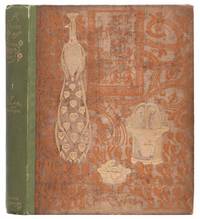
18917941London: James R. Osgood 1891. First edition. Very Good . One of 1000 copies. A Very Good copy fresh and clean throughout. Publisher's pictorial tan cloth stamped in gilt. Cloth a bit faded and foxed. Gilt very bright and attractive. Dent to edge of lower board at bottom corner. Modern bookplate D. Chisholm Simpson and ink ownership stamp Yew Tree Cottage to upper endpapers. A some toning to upper free endpaper otherwise very fresh and clean internally. Complete with the four plates illustrated by Charles Shannon which have faded but are somewhat clearer than is usually seen.<br /> <br /> A collection of fairytales from the famed writer wit and aesthete A House of Pomegranates compiles four stories of mermaids hunchbacks kings and princesses. This was actually Wilde's second collection of fairy tales - he had been writing such stories for years - after The Happy Prince and Other Tales published in 1888. A House of Pomegranates was met with some controversy with many reviewers finding the stories too complex and morally ambiguous for children. Wilde clearly had more wide-ranging ambitions than the standard children's tale however and found it absurd that "the extremely limited vocabulary at the disposal of the British child is the standard by which the prose of an artist is to be judged.in building this House of Pomegranates I had about as much intention of pleasing the British child as I had of pleasing the British public." Very Good . James R. Osgood unknown
1891019038London : James R. 0SG00D McILVAINE & C0. 1891. Hardcover. Very Good. C. RICKETTS & C. H. SHANNON Design & Decoration by. . B00K: Very G00D/ $837.90 WILDE 0scar a H0USE of P0MEGRANATES C. RICKETTS & C. H. SHANNON Design & Decoration by. James R.OSGOOD McILVAINE & C0. L0ND0N 1891 There is no limited edition or edition statement. Wide H/c Brown Top And Balance Of Tan Spine With Title And Design In Polished Gold Letters Hard Cover B00K: Very Good/ Slight Shelf Edge And Corner Wear. Corners Are Square. 157 Numbered Pages Printed On Tan Paper Browning And Spotting From Aging In Very Good/Fine/ Condition Clean And Tight To The Spine Slight Wear. The Exterior Covering Of The Boards Are Not Decorated. D/j: None. Description Applies To This B0K Only. This B0k Is Hard To Find Will Be Packaged And Shipped Carefully To Avoid Shipping Damage And Will Make It An Excellent Addition To Your Own Personal Library Collection Or As A Gift For The Collector / Reader. WORLD WIDE SHIPPING AVAILABLE. <br/> <br/> James R. 0SG00D McILVAINE & C0. hardcover
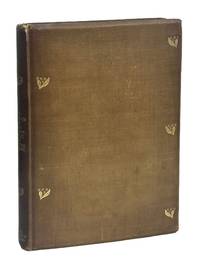
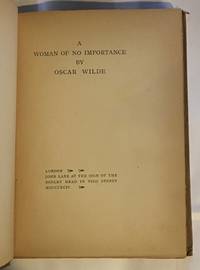
1894OW056London: John Lane at the Sign of The Bodley Head 1894 First edition limited large paper copy with "Of this edition 50 copies have been printed" statement on the verso of the fourth preliminary page and no publisher's catalogue at the back of the book. Publisher's yellow buckram boards with gilt decorations by Charles Shannon to covers and spine spine lettered in gilt. Near fine with some toning to spine and board edges light wear to spine ends with a very shallow chip to cloth at foot of spine bottom right corner of front board worn to boards and heavy offsetting to endpapers. Overall a beautiful copy of one of Wilde's four celebrated drawing-room plays. Mason 365. A Woman of No Importance is a four-act play that was first produced in London at the Haymarket Theatre on April 19 1893. Like many of Wilde's plays it satirizes the English upper-class and criticizes Victorian society. The title "a woman of no importance" refers to the character Mrs. Arbuthnot who bears the illegitimate son of Lord Illingworth. Although societal conventions deem her a sinful woman Wilde proves Arbuthnot a respectable widow who is rewarded with a son who treats women respectfully. In contrast Illingworth one of Wilde's archetypal dandy figures is rejected by his son and many of the women in the play making him a "man of no importance." A Woman of No Importance was published simultaneously in two formats: small octavo the standard edition of 500 copies and quarto the "Large Paper" issue of 50 copies. While both constitute the first edition of A Woman of No Importance the large paper copies are decidedly rarer than the octavos; intended to be more exclusive and deluxe publications large paper formats were typically produced using higher quality materials lacked the publisher's advertisements and were printed in small print runs. Because they were intended as collectibles from publication large paper copies of Wilde's plays are exceedingly scarce. First Edition Limited Large Paper Copy. Hard Cover. Near Fine. London: John Lane at the Sign of The Bodley Head hardcover
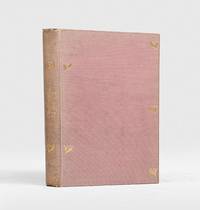
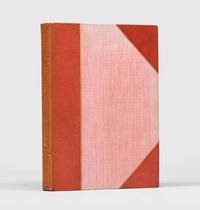
1894182536London: John Lane at the Sign of the Bodley Head 1894. Mr Oscar Wilde is not in the house First edition one of 500 trade copies. The play's opening show was met with applause for the actors and boos for the playwright causing Wilde to announce from behind a curtain "Ladies and gentlemen I regret to inform you that Mr Oscar Wilde is not in the house" Ellmann p. 381. Wilde's opulent production used "the market forces of luxury dressmaking to comment upon the worlds of his Haymarket patrons. Audiences in the stalls and boxes continued to be both flattered and vexed by the antics of their on-stage doubles while viewers in the upper galleries enjoyed the additional spectacle of fashionable Society catching its likeness in Wilde's cunningly set mirrors" Kaplan p. 252. The play premiered at Haymarket Theatre on 19 April 1893 and ran until 16 August for 113 performances. A further 50 large paper copies were also issued. Small quarto. Publisher's 16-page catalogue dated March 1894 at rear. Original pink linen with gilt floral decorations by Charles Shannon spine lettered in gilt fore and bottom edges untrimmed. Housed in a custom green cloth slipcase and chemise. Faint marks and fading to spine ends slightly bumped cloth lightly rubbed contents toned as usual. A very good copy. Mason 364. Richard Ellmann Oscar Wilde 1988; Joel Kaplan "Wilde on the Stage" in Peter Raby ed. The Cambridge Companion to Oscar Wilde 1997. hardcover
1894186848London: John Lane at the Sign of the Bodley Head 1894. Mr Oscar Wilde is not in the house First edition one of 500 trade copies. The opening show of this satirical play on English manners met with applause for the actors and boos for the playwright causing Wilde to announce from behind a curtain "Ladies and gentlemen I regret to inform you that Mr Oscar Wilde is not in the house" Ellmann p. 381. Wilde's opulent production used "the market forces of luxury dressmaking to comment upon the worlds of his Haymarket patrons. Audiences in the stalls and boxes continued to be both flattered and vexed by the antics of their on-stage doubles while viewers in the upper galleries enjoyed the additional spectacle of fashionable Society catching its likeness in Wilde's cunningly set mirrors" Kaplan p. 252. The play premiered at Haymarket Theatre on 19 April 1893 and ran until 16 August for 113 performances. A further 50 large-paper copies were also issued. Quarto. Publisher's 16-page catalogue dated March 1894 bound at the rear. Original pink cloth spine lettered in gilt stylised flower and leaf motifs by Charles Shannon in gilt to spine and covers edges untrimmed. Cloth lightly marked and bumped small spots of wear to extremities faint vertical crease to rear cover contents generally toned some browning to pp. 42-3. A very good copy. Mason 364. Richard Ellmann Oscar Wilde 1988; Joel Kaplan "Wilde on the Stage" The Cambridge Companion to Oscar Wilde ed. by Peter Raby 1997. hardcover
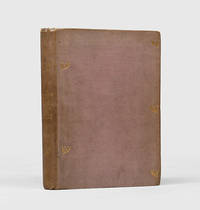
1894023252London: John Lane 1894. First edition. hardcover. Good. Mauve cloth faded and soiled. Gilt on spine very faded. Paper browned. Mason 364. One of 500 copies. Always securely packed. Professional booksellers since 1994. Satisfaction guaranteed. John Lane unknown
1894149906London: John Lane at the Sign of the Bodley Head 1894. Attractively bound First edition trade issue one of 500 copies printed; a further 50 copies were also issued on handmade paper. An attractively bound copy with the bookplate to the rear pastedown of the eccentric sportsman and artist William Eden 1849-1915 father of future Prime Minister Anthony Eden and who like Wilde had a dispute with the artist James McNeill Whistler. Eden excelled at a range of sports from boxing and horse riding to shooting "the epitome of the sporting squire" ODNB a member of several clubs and well known in London society. So too was he a keen amateur artist and aesthete building a fine collection of paintings and was a member of the aristocratic group The Souls. The contrast between the sportsman and the aesthete has been noted: "There was little that was harmonious in his nature and the aesthetic side warred with and exacerbated rather than complemented his athleticism making him a bored sportsman and a militant aesthete. As he grew older the world's failure to correspond to his ideals drove him to furious rages and the debased taste of humanity confirmed his atheism - for how could a God have made such a botch of things" ibid. His dispute with Whistler was occasioned when Eden commissioned a portrait of his wife which Whistler executed but then kept the cheque without handing over the painting leading to a legal case which resulted in Whistler's book The Baronet and the Butterfly 1899. Wilde too had a lengthy rivalry with Whistler out of the courts but with very public sparring. Small quarto 204 x 148 mm. Early 20th-century pink straight-grain morocco for Hatchards of Piccadilly spine lettered in gilt pink cloth sides marbled endpapers top edge gilt pink silk page marker. Bound without initial blank. A few pencilled lines in margins. Spine lightly sunned very light rubbing at extremities slight split in hinge preceding dedication leaf contents clean; an excellent copy. Mason 364. hardcover
1894164122London: John Lane at the Sign of the Bodley Head 1894. Epigrammatic brilliance and shrewd social observation First edition one of 500 trade copies. The opening show of this satirical play on English manners was greeted with applause for the actors and boos for the playwright causing Wilde to announce from behind a curtain "Ladies and gentlemen I regret to inform you that Mr Oscar Wilde is not in the house" Ellmann p. 381. Wilde's opulent production used "the market forces of luxury dressmaking to comment upon the worlds of his Haymarket patrons. Audiences in the stalls and boxes continued to be both flattered and vexed by the antics of their on-stage doubles while viewers in the upper galleries enjoyed the additional spectacle of fashionable Society catching its likeness in Wilde's cunningly set mirrors" Kaplan p. 252. The play premiered at Haymarket Theatre on 19 April 1893 and ran until 16 August for 113 performances. An additional 50 large-paper copies were also issued. Small quarto. Publisher's advertisement bookplate on front pastedown and their 16-page catalogue dated March 1894 at end all as called for. Original pink linen with gilt floral decorations by Charles Shannon spine lettered in gilt top edge trimmed others uncut. Welsh-language bookplate of John Evans on front free endpaper. Spine and edges faded light wear to spine ends and corners splits to inner hinges mild toning and spots to contents. A very good copy. Mason 364. Richard Ellmann Oscar Wilde 1988; Joel Kaplan "Wilde on the Stage" The Cambridge Companion to Oscar Wilde ed. by Peter Raby 1997. unknown
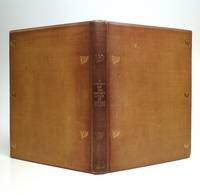
1894282902London: John Lane 1894. Limited. hardcover. very good. Tall 8vo lavender cloth faded to tan with gilt designs considerably browned on the spine and edges; pages untrimmed London: John Lane 1894. Limited First Edition.<br/> <br/> Mason 365. One of only 50 copies printed simultaneously with the first trade edition. Internally fine and clean.<br/> <br/> John Lane unknown