87 résultats
186411974GB1864. Leipzig W. Engelmann 1864. 8°. 8 1 gef. Kupfertafeln VII 158 S. 1 Bl. Halbleinenband der Zeit mit goldgeprägtem Rückentitel leicht beschabt Kapitale leicht bestoßen. Durchgehend leicht wasserwellig bzw. wasserrandig. Sonst in schöner Erhaltung. unknown
1896833K16London: Herr T. Willy 1896. Cloth. Very Good. 8.5" by 5.5". Herr Willy. A very scarce second edition of this profusely illustrated guide to the patisserie skill of piping. With advertisements to the rear of the work. The second edition of the work. Very scarce in any edition. First published in 1891. Profusely illustrated throughout with many demonstrative plates and vignette illustrations. A charming work detailing the skill of patisserie piping demonstrating a number of techniques including piping styles almond icing and detailed guides to the equipment required. In the original pictorial boards. Externally smart with bumping to the extremities. Marks to the boards. Front hinge slightly strained but firm. Internally firmly bound. Pages bright and clean with marginal age toning and just the odd spot. Very Good Herr T. Willy hardcover
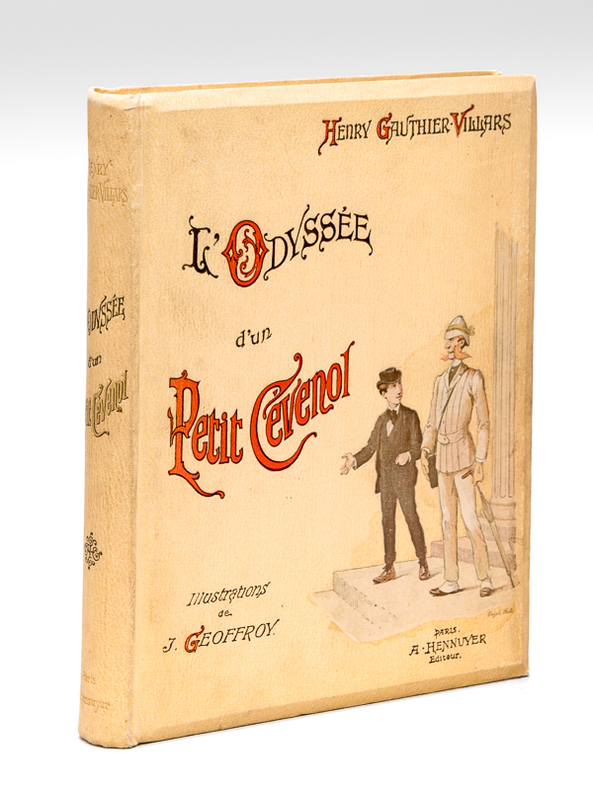
190060746Illustrations de J. Geoffroy, 1 vol. in-8 reliure éditeur pleine percaline jaune, premier plats historié (le petit cévenol et son mentor anglais), coupes biseautées, toutes tranches dorées, cartonnage signé de "Engel rel.", Bibliothèque Nouvelle de la Jeunesse, A. Hennuyer, Paris, s.d. [ circa 1900 ], 310 pp. et 1 f.
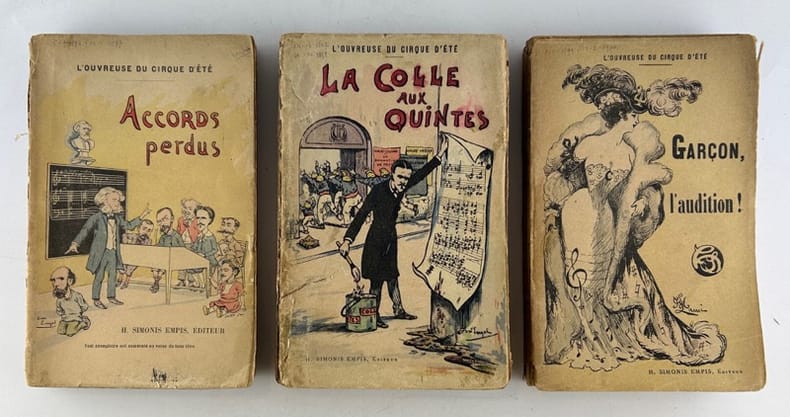
189884627Paris, H. Simonis Empis, Editeur, 1898, 1899, 1901, in-12, broché, 263, 274 & 301pp. Exemplaires numérotés, sans justification. Couvertures présentant les marques du temps, dos absent pour Accords perdus et fendu pour La colle aux quintes. Garçon, l'audition ! en bon état. Intérieur propre.
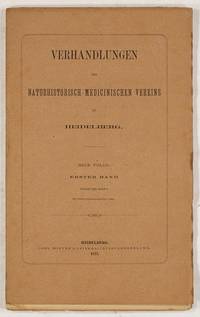
1877622021877. Verh. Naturhist.-Med. Ver. NF 1/5. - Heidelberg Carl Winter's Universitätsbuchhandlung 1877 8° pp.445-512 1 lith. Taf. orig. Broschur; ungeöffnetes Exemplar. First Edition! ". he went to Heidelberg to work in the laboratory of Wilhelm Kühne thus preceding Langley's visit there by a year or two. In 1876 in a paper published jointly with Kühne Lea argued in opposition to the widely accepted view of Rudolf Heidenhain that the pancreatic cells became less rather than more granular during the act of secretion. Langley later extended this view to a wide range of glands showing that granules were stored up during rest and released during secretion. Lea after returning to Cambridge concentrated on physiological chemistry. For Foster's Textbook of Physiology first ed. 1877 he wrote a large chemical section which was later expanded and issued as a separate volume under the title The Chemical Basis of the Animal Body. By 1890 Lea had published a dozen research papers all but one of which were notes or brief ar¬ticles. The longer paper a comparative study of natural and artificial digestions shows the continued strong influence of Kühne." Gerald L. Geison Michael Foster and the Cambridge School of Physiology: The Scientific . p.183 Arthur Sheridan Lea FRS 1853-1915 - "Lea was born in New York but his family returned to England and settled in Liverpool where he went to school. In 1872 he entered Trinity College Cambridge and took a first class in National Sciences Tripos in 1875 MA in 1879 and DSc in 1886. Soon after his success in the Natural Sciences Tripos he accepted a suggestion from Michael Foster that he should devote himself to teaching and research in physiology and he immediately became Demonstrator in Foster's classes. In 1881 he was appointed Lecturer in Physiology and Assistant Tutor at Caius College in 1885 he was elected a Fellow of that College and for two to three years acted as Bursar. In 1884 he became University Lecturer in Physiology. His special interest was Physiological Chemistry although he had no special training as a chemist. His contribution to the teaching was to establish an advanced course of Physiological Chemistry from 1876 until it rather lapsed with his ill-health in 1893. To continue the course Foster then persuaded F. Gowland Hopkins to join his staff in Cambridge. In Foster's Textbook of Physiology of 1877 Lea wrote an appendix on the chemical aspects of the subject which later was enlarged to a separate volume The Chemical Basis of the Animal Body 1892. He was elected a member of the Physiological Society in 1877 at its first annual meeting." W. J. O'Connor Founders of British Physiology: A Biographical Dictionary 1820-1885 p.180 Further we find in this issue - Ewald A. & Kühne W.: Die Verdauung als histologische Methode. Ewald A. & Kühne W.: Ueber einenn neuen Bestandtheil des Nervensystems. Kühne W.: Zur Photochemie der Netzhaut. unknown
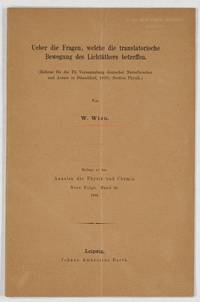
1898113871898. Ann. Phys. 3. Folge 65. Beilage - Leipzig Verlag von Johann Ambrosius Barth 1898 8° XVIII pp. orig. Broschur; St.a.Tit. Rare Offprint! "Referat für die 70. Versammlung deutscher Naturforscher und Aerzte in Düsseldorf 1898: Section Phys." Wilhelm Wien 1865-1928 "grew up in the east Prussian town of Rastenburg today Ketrzyn Lithuania. He then studied at the prominent universities of Heidelberg and Göttingen before he eventually completed his doctorate in Berlin. In 1900 he succeeded W.C. Röntgen 1901 Physics Laureate as a professor in Würzburg. Wien's research concerned how various metals radiate heat and he received the Nobel Prize for the law of black-body radiation now known as Wien-Planck's law. It was drawn up jointly with Max Planck Physics 1918 and many felt that they should have shared in the award." "When a completely dark body is heated it emits visible light and other electromagnetic radiation. The spectrum of the radiation is entirely dependent on the temperature of the body and not its composition. In 1893 Wilhelm Wien formulated his displacement law which indicates at which wavelength the radiation is most intense at a certain temperature. He subsequently also formulated a law indicating how the radiation spectrum varies as temperature changes. However this does not apply to long wavelengths and in 1900 Max Planck formulated a law that conforms better." Wilhelm Wien - Facts. NobelPrize/org The Nobel Prize in Physics 1911 unknown
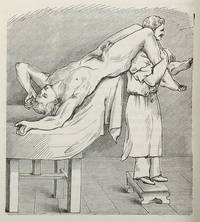
1887125101887. Arch. klin. Chir. 31/3. - Berlin Verlag von August Hirschwald 1887 8° 1 pp.435-682 Abbildungen 3 lith.Taf. orig. Broschur; unaufgeschnitten. First Edition! "The first description of Friedrich Trendelenburg's 1844-1924 elevated pelvic position was given by one of his students Willy Meyer 1858-1932 in Arch. klin. Chir 1885 31 pp.494-525". Garrison & Morton No.6091 unknown
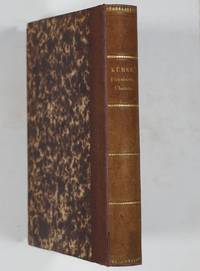
1868511421868. Leipzig Verlag von Wilhelm Engelmann 1866-1868 8° VIII 605 pp. mit 40 Holzschnitten und einem vollständigen Register Leinenband d.Zt. Erste Ausgabe - "Den Herren C. Ludwig und R. Virchow in Dankbarkeit und Verehrung gewidmet". 1. Lieferung: Verdauung 1866. 2. Lieferung: Chemie der thierischen Flüssigkeiten der Gewebe und der Drüsen 1866. 3. Lieferung: Chemie der thierischen Aussscheidungen 1868. Willy Kühne 1837-1900 gehört zu den Begründern der physiologischen Chemie. Ausschlag zu diesem Urteil gab das vorliegende Lehrbuch. Bereits im Alter von 17 Jahren begann er in Wöhlers Laboratorium mit chemischen Arbeiten. C. Bernard C. Ludwig und E. Brücke übten größten Einfluß auf ihn aus. Ihm verdankt man die Entdeckung des Myosins des flüssigen kontraktilen Muskelplasmas er prägte den Begriff des Enzyms für die umgeformten Fermentvorstufen und des Trypsins für das Pankreasenzym für die Eiweißverdauung. First Edition! "It clearly and concisely presented the state of the science of the time". Kühne introduced the term "enzyme". DSB VII pp.519-521 unknown
1860337391860. Leupzig Verlag von Veit und Comp. 1860 8° 1 Bl. 226 pp. 1 gefalt. Taf. orig. Broschur; unaufgeschnittenes leicht fleckiges Exemplar. Erste Ausgabe! Wilhelm Kühnes 1837-1900 erste Monographie die seine Forschungen über die kontraktilen Substanzen von 1859 fortführt und den Wiederabdruck seiner "Untersuchungen über Bewegung und Veränderungen der contractilen Substanzen" 1859 enthält. "Kühne's most outstanding gift was the ability to select problems . using a wide variety of technical devices. He substantially advanced research in . the physiology of muscle and nerves . Many of his result and observations were immediately integrated into standard texts ."He isolated and named "myosin" in muscles. DSB VII pp.519-521 unknown
1867433941867. Virch. Arch. path. Anat. 39. - Berlin Verlag von Georg Reimer 1867 8° IV 618 pp. 18 Tafeln Halbdereinband d.Zt. unknown
185987521859. Arch. Anat. Phys. 1859/56. - Leipzig Veit et Comp. 1859 8° pp.549-853 6 gefalt. lith. Tafl. 2 OBroschBde. Firt Edition! Proof of the coagulability of muscle proteins. Rothschuh Nr.1235: Willy Kühne 1837-1900 beweist die von Nervensystem unabhängige Fähigkeit der Muskelfaser zur Erregungsleitung und Erregbarkeit. Chemische Muskelreizung. Rothschuh Nr.1437: Nachweis der doppelsinnigen Leitung durch Zweizipfelversuch. Garrison & Morton No.620 unknown
189553391Paris Librairie Ch. Delagr sans date (1895) In-8, broch, couverture imprime.Edition originale de la cinquime et dernire srie de L'Anne fantaisiste publie pour l'anne 1895 de ce recueil de chroniques, illustre par Godefroy de 59 vignettes in texte. Tirage non prcis. Exemplaire sur papier ordinaire enrichi sur la page de titre de cet envoi autographe sign de lauteur qui fut antidrufusard avant de reconnatre l'innocence du capitaine : A Madame Bergerot, antinapolonienne. Trs cordial hommage dun Wil lypend par les dreyfusards. La publication des sries de LAnne fantaisiste fut rpartie sur quatre ans, de 1892 1895; les deux premires annes ont t illustres par Albert Guillaume, celle de 1894 par Albert Guillaume et Godefroy et celle de 1895 seulement par Godefroy.
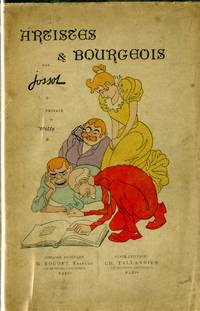
1896048100Paris: G. Boudet 1896. First Edition. Softcover. Very Good Condition. Trade edition of a scarce illustrated book by Jossot with a preface by Willy Paper jacket over card covers. Collette's first husband. 24 color illustrations cover a little worn and soiled inner panel of the jacket detached. wear to page edges. Illustrations generally fine and bright Size: Octavo 8vo. Quantity Available: 1. Shipped Weight: Under 1 kilo. Category: Art & Design; Inventory No: 048100. G. Boudet unknown
189657576BBParis, H.Simonis Empis. 1896. 12°. 238 p. Reliure demi cuir blonde décor et titre doré, premier plat de la couverture illustrée conservée.
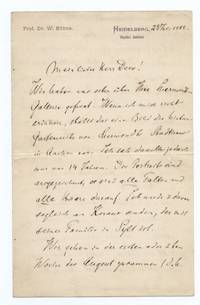
1885367471885. Heidelberg 23.VII.1885 2 2/3 Seiten gr.-8° mit gedrucktem Briefkopf. Wilhelm Friedrich Kühne 1837-1900 Physiologe entdeckte den Sehpurpur erforschte das Protoplasma und führte den Begriff "Enzym" ein. - An Professor A.G. Dew Smith in Cambridge mit dem er in regem freundschaftlichem und wissenschaftlichem Verkehr stand. Dew Smith plante eine Europa-Reise und Kühne schlägt ein Treffen "in Aachen oder in Antwerpen" vor. ". Schreiben Sie nur wenn Sie erst auf dem Continente sind von irgendwo eine Karte an meine hiesige Adresse die mich immer erreichen wird und ein Zusammenkommen wird sich arrangiren lassen. Sie müssten auch Hugo Kronecker mal in Bern wo ich im März war und es sehr angenehm fand besuchen. Haben Sie im Anfang des Jahres die Instrumente die ich Ihnen zum Copiren in Platin-Iridium schickte erhalten Grüssen Sie herzlich die Freunde in Cambridge ." unknown
1859667761859-1860. Arch. Anat. Phys. 1859/3. 1860/3. - Leipzig 1859 8° 41 pp.; 1860 8° 42 pp. 1 Abb. 2 orig. Broschuren. 2 Seltene Sonderdrucke! "Seit dem Erscheinen meiner Untersuchungen aber directe und indirecte Muskelreizung mittelst chemischer Agentien aus denen ich eine Anregung zum Studium der Irritabilitätsfrage entnahm sind über denselben Gegenstand neue Angaben veröffentlicht. welche in dem thatsächlichen Theile den meinigen widersprechen. Hauptsächlich wird der von mir aufgestellte Satz bestritten dass Muskel und Nerv sich zu denselben chemischen Reizen verschieden verhalten. Die Herren Wundt und Schelske Verhandlungen des naturhist.-medicin. 'Vereins zu Heidelberg. Ueber die chemischen Muskelreize. Von Dr. Schelske suchen zu dem Ende nachzuweisen dass erstens meine Behauptung nicht richtig sei dass einzelne Lösungen nur in concentrirtem Zustande erregend auf die Nerven wirken während sie selbst in äusserster Verdünnung vom Muskelquerschnitt noch Zuckungen hervorrufen und dass zweitens kein chemischer Körper existire der nicht entweder gleichzeitig ein Reiz für beide Organe sei oder den Nerven sowohl als den Muskel ganz unerregt lasse. Ich werde mich bemühen diese Widersprüche so viel als möglich zu lösen wo mir dies nicht möglich ist vermag ich nichts Besseres zu thun als die Physiologen welche diesem Gebiete näher stehen einzuladen diese Versuche entweder selbst zu wiederholen oder sie sich bei mir anzusehen indem ich jeder Zeit mit Vergnügen bereit bin Alles ad oculos zu wiederholen." Wilhelm "Willi" Kühne 1837-1900 Sohn eines wohlhabenden Kaufmanns legte 1854 am Johanneum Lüneburg das Abitur ab. Er begann im selben Jahr ein Studium an der Universität Göttingen wo er Chemie bei Friedrich Wöhler Physiologie bei Rudolf Wagner und Anatomie bei Jakob Henle studierte. 1856 wurde er bei Wagner mit einer Arbeit über künstlichen Diabetes bei Fröschen zum Dr. phil. promoviert. Anschließend forschte er an der Universität Jena bei Karl Gotthelf Lehmann zum Zuckerstoffwechsel. 1858 wechselte Kühne erst nach Berlin wo er als Mitarbeiter von Felix Hoppe-Seyler an der Chemischen Abteilung des Pathologischen Instituts tätig war und bei Emil Du Bois-Reymond Studien zur Muskulatur betrieb und anschließend nach Paris zu Claude Bernard. 1860 folgte ein Aufenthalt in Wien bei Ernst Brücke und Carl Ludwig. Ab 1861 leitete Wilhelm Kühne das Chemische Labor im Pathologischen Institut Rudolf Virchows in Berlin wo er sich mit Zellphysiologie auseinandersetzte. Von 1868 bis 1871 hatte er den Lehrstuhl für Physiologie der Universität von Amsterdam inne 1871 ging er an die Universität Heidelberg wo er als Nachfolger Hermann von Helmholtz' bis zu seinem Lebensende das Physiologische Institut leitete." Rothschuh Nr.1344: Beobachtet die Wirkung chemischer Substanzen auf den Muskel und die Gerinnbarkeit von Muskelpreßsaft. unknown
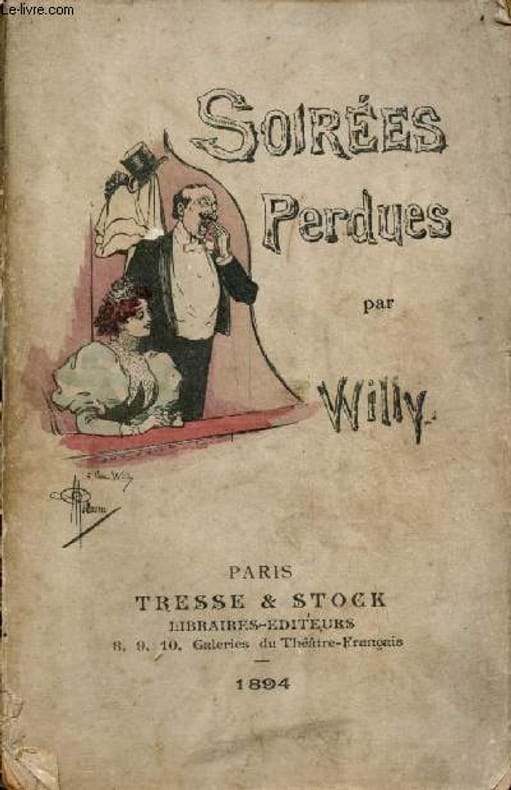
1894RO80275309Tresse & Stock. 1894. In-12. Broché. Etat d'usage, Couv. défraîchie, Dos abîmé, Papier jauni. 360 pages - dédicace de l'auteur Willy sur la première page (photo disponible) - plats tâchés - dos fendu, ouvrage désolidarisé - coiffes abîmées.. . . . Classification Dewey : 97.2-Dédicace, envoi
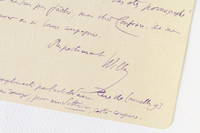
1900644351900. Fine. s. d. 11.50 x 8 cm une carte Autograph letter signed by Henry Gauthier-Villars known as Willy 6 lines in purple ink sender's address at foot: ""Rue de Courcelles 93"". Amusing letter from Willy central personality of Parisian social life at the turn of the 19th century where all his taste for humor and provocation shows through: ""Ah! Ah! You too are a pornographer! I am not displeased my dear colleague to find myself in such good company"". unknown
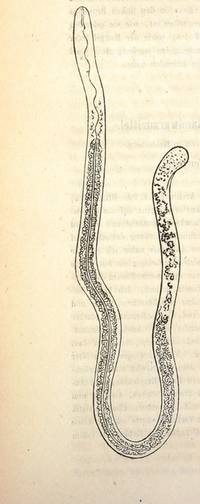
1863531201863. Virch. Arch. path. Anat. 26. - Berlin Verlag von Georg Reimer 1863 8° IV 588 pp. 14 Tafeln Halbledereinband d.Zt. First Edition! Wilhelm Friedrich Kühne "saw a nematode swimming freely within muscle fiber. In its movements the parasite clearly passed through the striated part of the muscle which closed again behind the nematode's tail. He concluded that the fiber was not as solid as most people thought and reasoned that they consisted of a concentrated solution of albumins". James Southworth Steen A Selected Chronological Bibliography of Biology and Medicine No.300 unknown
1878401781878. Unters. phys. Inst. Heidelberg 1/3. - Heidelberg Verlag von Carl Winter's Universitätbuchhandlung 1878 8° 34 pp. Rückenbroschur. Rare Offprint! One of Wilhelm Friedrich Kühne's 1837-1900 main areas of interest was digestive physiology. He discovered the protein-cleaving digestive enzyme trypsin which he named in 1867. He observed the presence of an inactive precursor zymogen of the enzyme characterised it with regard to its activity in an alkaline environment and described separation processes. In 1867 he succeeded in isolating trypsin to a large extent. The term "enzyme" was coined by him and replaced the term "ferment" which had been widespread until then. Garrison & Morton No. 700.1 unknown
1867667751867. Virch. Arch. path. Anat. 39. - Berlin Verlag von Georg Reimer 1867 8° 47 pp. Broschur mit eingebundener orig. Titelbroschur. Seltener Sonderdruck! Ein wesentlicher Interessensschwerpunkt Kühnes war die Verdauungsphysiologie. Er entdeckte das eiweißspaltende Verdauungsenzym Trypsin welches er 1867 benannte. Er beobachtete das Vorliegen einer inaktiven Vorstufe Zymogen des Enzyms charakterisierte es hinsichtlich seiner Aktivität im alkalischen Milieu und beschrieb Trennverfahren. Ihm gelang 1867 die weitgehende Isolierung des Trypsins. Der Begriff "Enzym" wurde durch ihn geprägt und verdrängte den bis dahin verbreiteten Begriff "Ferment". Wilhelm "Willi" Kühne 1837-1900 Sohn eines wohlhabenden Kaufmanns legte 1854 am Johanneum Lüneburg das Abitur ab. Er begann im selben Jahr ein Studium an der Universität Göttingen wo er Chemie bei Friedrich Wöhler Physiologie bei Rudolf Wagner und Anatomie bei Jakob Henle studierte. 1856 wurde er bei Wagner mit einer Arbeit über künstlichen Diabetes bei Fröschen zum Dr. phil. promoviert. Anschließend forschte er an der Universität Jena bei Karl Gotthelf Lehmann zum Zuckerstoffwechsel. 1858 wechselte Kühne erst nach Berlin wo er als Mitarbeiter von Felix Hoppe-Seyler an der Chemischen Abteilung des Pathologischen Instituts tätig war und bei Emil Du Bois-Reymond Studien zur Muskulatur betrieb und anschließend nach Paris zu Claude Bernard. 1860 folgte ein Aufenthalt in Wien bei Ernst Brücke und Carl Ludwig. Ab 1861 leitete Wilhelm Kühne das Chemische Labor im Pathologischen Institut Rudolf Virchows in Berlin wo er sich mit Zellphysiologie auseinandersetzte. Von 1868 bis 1871 hatte er den Lehrstuhl für Physiologie der Universität von Amsterdam inne 1871 ging er an die Universität Heidelberg wo er als Nachfolger Hermann von Helmholtz' bis zu seinem Lebensende das Physiologische Institut leitete. Siehe - Hans Neurath Robert Zwilling: Willy Kühne und die Anfänge der Enzymologie. In: Semper apertus. Sechshundert Jahre Ruprecht-Karls-Universität Heidelberg. 1386-1986. Band 2 Springer Heidelberg 1985; W. Creutzfeld G.A. Martini & G. Strohmeyer Milestones in Gastroenterology and Metabolie Research pp.114 Rothschuh Nr. 970: "Isoliert ein eiweiß-spaltendes Ferment "Trypsin" es löst die meisten natürlichen Eiweißkörper". unknown
189843653Berlin, J.A. Barth, 1898, 1901 Without wrappers. In ""Annalen der Physik und Chemie. Hrsg. von G. Wiedemann."", Neue Folge, Bd. 65, No. 7. (Entire issues offered). Pp. 241-480. . And Vierte Folge, Bd. 5. Pp. 241-488, textillustr. Wien's paper pp. 440-452, textillustrations and pp. 421-435, textillustrations. Clean and fine. The second issue punched in inner margin after cords., no loss of text.
189843653Berlin J.A. Barth 1898 1901 Without wrappers. In "Annalen der Physik und Chemie. Hrsg. von G. Wiedemann." Neue Folge Bd. 65 No. 7. Entire issues offered. Pp. 241-480. . And Vierte Folge Bd. 5. Pp. 241-488 textillustr. Wien's paper pp. 440-452 textillustrations and pp. 421-435 textillustrations. Clean and fine. The second issue punched in inner margin after cords. no loss of text. <br/><br/><em>First appearance of Wien's importent paper in which he shows that the cathode rays are particles that their velocity is about a third to that of light and he establish the ratio between the mass and the charge.In the paper are "described the experiments by which Wien determined the properties of the canal rays. The firstpart of the paper conatins a description of observations on the cathode rays made with a Lenard Tube in which the cathode rays passed through an aluminium window into an extension of the tube where as high a rarefaction as possible was maintained. The magnetic and electrostatic deflexions of a narrow cathode stream were observed and Wien concludes that it is proved by his investigation that the cathode rays which pass through the windoww carry with them strong negative charges."Magie "Souce Book in Physics" p. 597 ff.Wien was awarded the 1911 Nobel Prize for physics for his discoveries regarding laws governing the radiation of heat. </em> unknown
1895048427Paris: Félix Juven 1895. First Edition. Hardcover Half Leather. Very Good Condition. The first year 52 weekly issues of Le Rire bound up in half leather over marbled boards some wear to leather at spine ends but quite sound overall. SLight browning otherwise fine internally. Each issue 12 pages.<br /> <br /> Le Rire ran from 1894 to 1971 covering the issues of the day with mostly modesrtly satirical words and illustrations. Some page centerfolds a large fold out color and black and white illustration and period advertisements throughout. A nice reduction of Belle Epoque Paris. Size: Folio. Quantity Available: 1. Shipped Weight: Under 1 kilo. Category: Humour; Inventory No: 048427. Félix Juven hardcover
189786967H. Simonis Empis | Paris 1897 | 12.50 x 19.50 cm | relié