Kuhne, Wilhelm (Willy) FriedrichBiblio.com
88 résultats
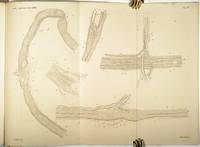
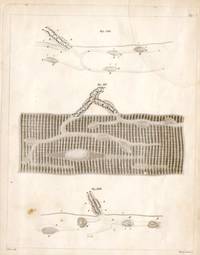
1862370171862. Leipzig Wilhelm Engelmann 1862 4° VIII 38 pp. 1 Blatt Inhalt 5 feine lith. Tafeln Pappband der Zeit; Titel montiert. Selten! Willy Kühne 1837-1900 described the neuromuscular end organ Kühne spindle and introduced the term 'telolemma' for the outer covering of its sheath." Clarke and O'Mailey Human Brian and Spinal Cord pp.75-78.<T>NUC NK 0319696 locates 5 copies. Garrison & Morton No. 1269 unknown
189643069Leipzig, Johann Ambrosius Barth, 1896. 8vo. Contemporary half cloth with gilt title to spine. Band 58 of ""Annalen der Physik und Chemie"". Library stamp to verso of title-page. Light wear to edges and capitals and a damp-stain to the lower part of the last three leaves. Otherwise a clean and well preserved copy. The entire volume offered. Pp. 662-669. [Entire volume: VIII, 776 pp. + 6 folded plates].
189643069Leipzig Johann Ambrosius Barth 1896. 8vo. Contemporary half cloth with gilt title to spine. Band 58 of "Annalen der Physik und Chemie". Library stamp to verso of title-page. Light wear to edges and capitals and a damp-stain to the lower part of the last three leaves. Otherwise a clean and well preserved copy. The entire volume offered. Pp. 662-669. Entire volume: VIII 776 pp. 6 folded plates. <br/><br/><em>First edition of Wilhelm Wien's highly influential paper on the phenomenon of radiation also known as Wien's displacement law. Wien followed Ludwig Boltzmann's approach when incorporating electrodynamics and thermodynamics in investigating radiation and its characteristics. "He argued that if a system reaches the same temperature by the increase of temperature or by the adiabatic compression of the volume containing heat radiation it should yield the same energy distribution. Considering also the Doppler effect of the radiation Wien arrived at an expression for energy distribution that states that the product of temperature and the wave length is a constant". Mathew Chandrankunnel Philosophy of physics 2000 4 p.Wien's empirical observations functioned as a starting point for Max Planck who wanted prove the theoretical foundation for Wien's wishing thus to justify the entropy law. Today Wien's approximation is also known as Wien-Planck law.This phenomenon was coined "Wien's displacement law" because the energy density curve is displaced correspondingly to the temperature; it implies that the hotter an object is the shorter the wavelength at which it will release most of its radiation. Wien's description of radiation awarded him the Nobel Prize in Physics in 1911. Wien's constant is today used in a wide range of different aspects of physics e.g. cosmic microwave background and the determination of how much energy is emitted from a light bulb. Magie "A Source Book in Physics". Pp. 597-600.Other papers of interest contained in the present volume:KOHLRAUSCH F. Ueber Widerstandsmessungen von Electrolyten mit Wechselströmen durch das Dynamometer. Pp. 514-516.BOLTZMANN L. Zur Energetik. Pp. 595-598.RYDBERG J. J. Die Neuen Grundstoffe des Cleveïtgases. Pp. 674-679.WIEN W. Ueber die auf einer schweren Flüssigkeit möglichen Wellen von sehr Höhe. Pp. 729-735.Etc. </em> hardcover
1876328381876. Verh. Naturhist.-Med. Ver. NF 1/3. - Heidelberg Carl Winter's Universitätsbuchhandlung 1876 8° pp.169-228 1 lith. Taf. orig. Broschur; ungeöffnetes Exemplar. Rare Offprint! Introduction of the term "Enzyme" Willy Kühne 1837-1900introduced here for the first time in 1876 the term "enzyme": "Um Missverständnisse vorzubeugen und lästige Umschreibungen zu vermeiden schlägt Vortragender vor die ungeformten oder nicht organisierten Fermente deren Wirkung ohne Anwesenheit von Organismen und ausserhalb derselben erfolgen kann als Enzyme zu bezeichnen." p.190 Garrison & Morton No. 700.1 quotes for the introduction falsely "Erfahrungen und Bemerkungen über Enzyme und Fermente" 1878. Willy Kühne "reports his isolation of trypsin". Garrison & Morton No.1012 unknown
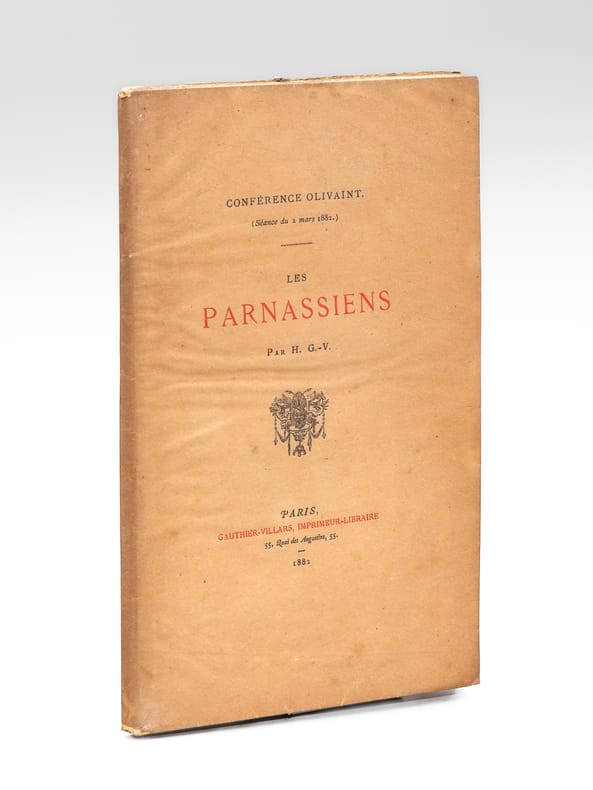
1882665041 brochure in-8, Conférence Olivaint, séance du 2 mars 1882, Gauthier-Villars, Imprimeur-Libraire, 1882, 54 p.
1863392871863. Virch. Arch. path. Anat. 28. - Berlin Verlag von Georg Reimer 1863 8° IV 578 15 Taf. Halbleinenband; St.a.Tit. First Edition! "The best early description of proprioceptive receptors in muscles" was made by Willy Kühne 1837-1900. unknown
1858433951858. Virch. Arch. path. Anat. 14. - Berlin Verlag von Georg Reimer 1858 8 IV 572 pp. 3 Taf. Halbledereinband d.Zt. Erstdruck! W. Kühne "Aus Blutfarbstoff kann Bilirubin entstehen". Rothschuh Nr. 991 unknown
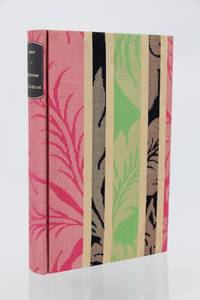
189786967Paris: H. Simonis Empis 1897. Fine. H. Simonis Empis Paris 1897 12.50 x 19.50 cm relié First edition for which no deluxe copies are mentioned one of the first issue copies numbered at the press. Modern Bradel binding in full late 19th century watered silk smooth spine black oasis title label covers and spine with some lacks preserved elegant pastiche binding. Cover illustrated by Guillaume. Rare copy of this novel written almost entirely by Jean de Tinan. H. Simonis Empis unknown
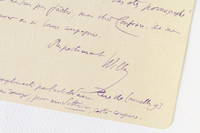
188233005Paris: Gauthier-Villars 1882. Fine. Gauthier-Villars Paris 1882 14 x 22.50 cm broché First edition published anonymously and printed in very small numbers on Holland paper. Deferential autograph inscription signed by Henry Gauthier-Villars known as Willy to Carolus de la Haudardière. We include with our copy the complete 12-page autograph manuscript with deletions and additions that does not appear to be in Henry Gauthier-Villars' hand. Spine faded boards with parchment covers detached and showing lacks handsome interior condition despite occasional foxing printed stamp as bookplate opposite the half-title page. Gauthier-Villars hardcover
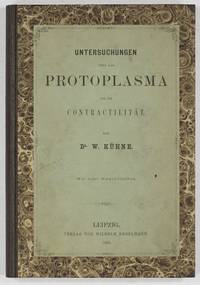
1864307221864. Leipzig Verlag von Wilhelm Engelmann 1864 8° VII 1 158 pp. 1 Holzschnitt im Text und vielen Abbildungen auf 8 z.Tl. getönten lith. Tafeln feiner Halbleinenband. First edition of this important work on protoplasma! Willy Kühne 1837-1900 a pupil of Claude Bernard and Ernst Brücke professor of physiology at Amsterdam and Heidelberg. In above work he brought strong evidence from many sources of the close similarity of plant and animal protoplasm. He observed protplasmic movements and noted effects of reagents of temperature changes and of the passage of an electric current. "Through his research Kühne demonstrated the extraordinary of usefulness of cytophysiological investigations for the solution of problems in general physiolgy." DSB 7/519 Die Frucht von Kühnes Studien zu den in den Elementarorganismen sich abspielenden Lebensvorgängen ist das vorliegende Werk über das Protplasma und die Kontrakttilität. Dort findet sich eine Fülle von Beobachtungsmaterial bezüglich der Kontraktilitäterscheinungen im Tier- und Pflanzenreich und die Bedingungen ihres Auftretens betreffend. Ein Abschnitt des Buches behandelt den chemischen Nachweis des sogenannten Myosins einer spontan gerinnenden Substanz in den Muskeln welche auch die Ursache der Totenstarre abgibt und damit die entsprechenden Hypothese Brückes bestätigt. Rothschuh No.1304 unknown
189786967H. Simonis Empis | Paris 1897 | 12.50 x 19.50 cm | relié
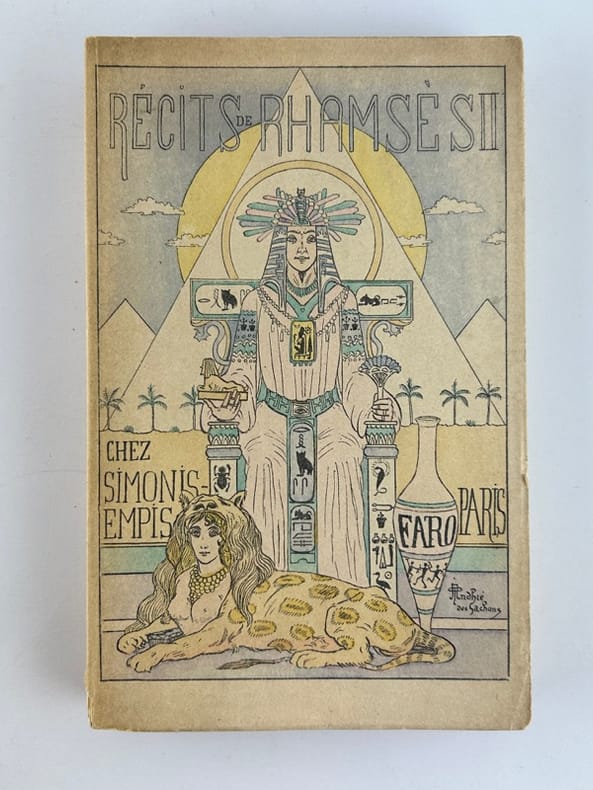
189486577Paris Chez Simonis-Empis 1894, 12 x 18,5 cm, broché, 273p. Rare édition originale. Illustration de couverture par Andhré des Gachons. La plupart des contes de Raphaël Landoy ont paru dans l'hebdomadaire Le Diable au corps (8 janvier 1893-1er avril 1895) avant d'être recueillis dans les Récits de Rhamsès II (en 2 volumes), publiés par les éditeurs parisiens Simonis-Empis et par la Librairie Internationale, respectivement en 1894 et 1900. R. Landoy était le cousin de Colette, née Sidonie Landoy. Brochage fendu en 4 points. Exemplaire A RELIER. Texte de toute fraîcheur. Contient : Préface / Willy. Contes pour M. Jules Verne : Un Problème insoluble - La Puce - Pour un Chiffre. Histoires belges : Le bon Eléphant - Clémentine - Jef et Jan - La Femme trouée - Comment le vidame Spons faillit réaliser l'alliance franco-russe. Légendes : La vraie légende Saint Nicolas à Bruxelles - Pourquoy fusrent ceulx de Dendermonde nommez « Vierpannen » - Légende flamande - Rédemption - Le bon sire de Boitsfort - Le véridique récit de ce qu'il advint aux trois Rois Mages après leur visite sacrée. Contes pour M. Darwin : La Baleine du docteur Champagne - Hérédité - Une bonne Blague : Récits pudibonds - La Citrouille - Le Pélerinage - Histoires de Pochard - Le Record des Records - Le Télescope. Études psychillogiques : Le Truc de M. Pepperbol - Cruelle énigme - Enseignement mutuel - Séance d'Hypnotisme - Le Casino des Affligés - Vibration. Théâtre de l'avenir : La Tache effacée - L'honnête Menuisier - Crime et Châtiment. A la manière d'Edgar Poe : La coupe du vidame. Dicts de Bazoef : Les Aventures de Lollepot au Congo - La Noël du petit anarchiste - Le Chef-d'œuvre - La Dent malade - Le Voyage interrompu - Le Cadavre - Bazoef à la Valkyrie.
189514021895 Paris, Fischbacher, 1895. In-8 relié, demi-chagrin vert, tête or, couvertures et dos conservés, 320 pp. (Evelyne Fortin). Édition originale.
188233005Gauthier-Villars | Paris 1882 | 14 x 22.50 cm | broché
1895048427Paris: Félix Juven 1895. First Edition. Hardcover Half Leather. Very Good Condition. The first year 52 weekly issues of Le Rire bound up in half leather over marbled boards some wear to leather at spine ends but quite sound overall. SLight browning otherwise fine internally. Each issue 12 pages.<br /> <br /> Le Rire ran from 1894 to 1971 covering the issues of the day with mostly modesrtly satirical words and illustrations. Some page centerfolds a large fold out color and black and white illustration and period advertisements throughout. A nice reduction of Belle Epoque Paris. Size: Folio. Quantity Available: 1. Shipped Weight: Under 1 kilo. Category: Humour; Inventory No: 048427. Félix Juven hardcover
189843653Berlin, J.A. Barth, 1898, 1901 Without wrappers. In ""Annalen der Physik und Chemie. Hrsg. von G. Wiedemann."", Neue Folge, Bd. 65, No. 7. (Entire issues offered). Pp. 241-480. . And Vierte Folge, Bd. 5. Pp. 241-488, textillustr. Wien's paper pp. 440-452, textillustrations and pp. 421-435, textillustrations. Clean and fine. The second issue punched in inner margin after cords., no loss of text.
189843653Berlin J.A. Barth 1898 1901 Without wrappers. In "Annalen der Physik und Chemie. Hrsg. von G. Wiedemann." Neue Folge Bd. 65 No. 7. Entire issues offered. Pp. 241-480. . And Vierte Folge Bd. 5. Pp. 241-488 textillustr. Wien's paper pp. 440-452 textillustrations and pp. 421-435 textillustrations. Clean and fine. The second issue punched in inner margin after cords. no loss of text. <br/><br/><em>First appearance of Wien's importent paper in which he shows that the cathode rays are particles that their velocity is about a third to that of light and he establish the ratio between the mass and the charge.In the paper are "described the experiments by which Wien determined the properties of the canal rays. The firstpart of the paper conatins a description of observations on the cathode rays made with a Lenard Tube in which the cathode rays passed through an aluminium window into an extension of the tube where as high a rarefaction as possible was maintained. The magnetic and electrostatic deflexions of a narrow cathode stream were observed and Wien concludes that it is proved by his investigation that the cathode rays which pass through the windoww carry with them strong negative charges."Magie "Souce Book in Physics" p. 597 ff.Wien was awarded the 1911 Nobel Prize for physics for his discoveries regarding laws governing the radiation of heat. </em> unknown
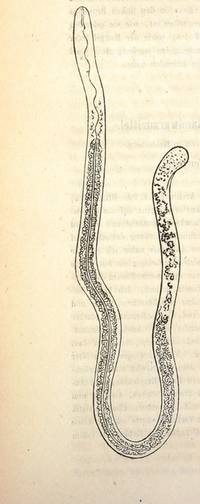
1863531201863. Virch. Arch. path. Anat. 26. - Berlin Verlag von Georg Reimer 1863 8° IV 588 pp. 14 Tafeln Halbledereinband d.Zt. First Edition! Wilhelm Friedrich Kühne "saw a nematode swimming freely within muscle fiber. In its movements the parasite clearly passed through the striated part of the muscle which closed again behind the nematode's tail. He concluded that the fiber was not as solid as most people thought and reasoned that they consisted of a concentrated solution of albumins". James Southworth Steen A Selected Chronological Bibliography of Biology and Medicine No.300 unknown
1878401781878. Unters. phys. Inst. Heidelberg 1/3. - Heidelberg Verlag von Carl Winter's Universitätbuchhandlung 1878 8° 34 pp. Rückenbroschur. Rare Offprint! One of Wilhelm Friedrich Kühne's 1837-1900 main areas of interest was digestive physiology. He discovered the protein-cleaving digestive enzyme trypsin which he named in 1867. He observed the presence of an inactive precursor zymogen of the enzyme characterised it with regard to its activity in an alkaline environment and described separation processes. In 1867 he succeeded in isolating trypsin to a large extent. The term "enzyme" was coined by him and replaced the term "ferment" which had been widespread until then. Garrison & Morton No. 700.1 unknown
1867667751867. Virch. Arch. path. Anat. 39. - Berlin Verlag von Georg Reimer 1867 8° 47 pp. Broschur mit eingebundener orig. Titelbroschur. Seltener Sonderdruck! Ein wesentlicher Interessensschwerpunkt Kühnes war die Verdauungsphysiologie. Er entdeckte das eiweißspaltende Verdauungsenzym Trypsin welches er 1867 benannte. Er beobachtete das Vorliegen einer inaktiven Vorstufe Zymogen des Enzyms charakterisierte es hinsichtlich seiner Aktivität im alkalischen Milieu und beschrieb Trennverfahren. Ihm gelang 1867 die weitgehende Isolierung des Trypsins. Der Begriff "Enzym" wurde durch ihn geprägt und verdrängte den bis dahin verbreiteten Begriff "Ferment". Wilhelm "Willi" Kühne 1837-1900 Sohn eines wohlhabenden Kaufmanns legte 1854 am Johanneum Lüneburg das Abitur ab. Er begann im selben Jahr ein Studium an der Universität Göttingen wo er Chemie bei Friedrich Wöhler Physiologie bei Rudolf Wagner und Anatomie bei Jakob Henle studierte. 1856 wurde er bei Wagner mit einer Arbeit über künstlichen Diabetes bei Fröschen zum Dr. phil. promoviert. Anschließend forschte er an der Universität Jena bei Karl Gotthelf Lehmann zum Zuckerstoffwechsel. 1858 wechselte Kühne erst nach Berlin wo er als Mitarbeiter von Felix Hoppe-Seyler an der Chemischen Abteilung des Pathologischen Instituts tätig war und bei Emil Du Bois-Reymond Studien zur Muskulatur betrieb und anschließend nach Paris zu Claude Bernard. 1860 folgte ein Aufenthalt in Wien bei Ernst Brücke und Carl Ludwig. Ab 1861 leitete Wilhelm Kühne das Chemische Labor im Pathologischen Institut Rudolf Virchows in Berlin wo er sich mit Zellphysiologie auseinandersetzte. Von 1868 bis 1871 hatte er den Lehrstuhl für Physiologie der Universität von Amsterdam inne 1871 ging er an die Universität Heidelberg wo er als Nachfolger Hermann von Helmholtz' bis zu seinem Lebensende das Physiologische Institut leitete. Siehe - Hans Neurath Robert Zwilling: Willy Kühne und die Anfänge der Enzymologie. In: Semper apertus. Sechshundert Jahre Ruprecht-Karls-Universität Heidelberg. 1386-1986. Band 2 Springer Heidelberg 1985; W. Creutzfeld G.A. Martini & G. Strohmeyer Milestones in Gastroenterology and Metabolie Research pp.114 Rothschuh Nr. 970: "Isoliert ein eiweiß-spaltendes Ferment "Trypsin" es löst die meisten natürlichen Eiweißkörper". unknown
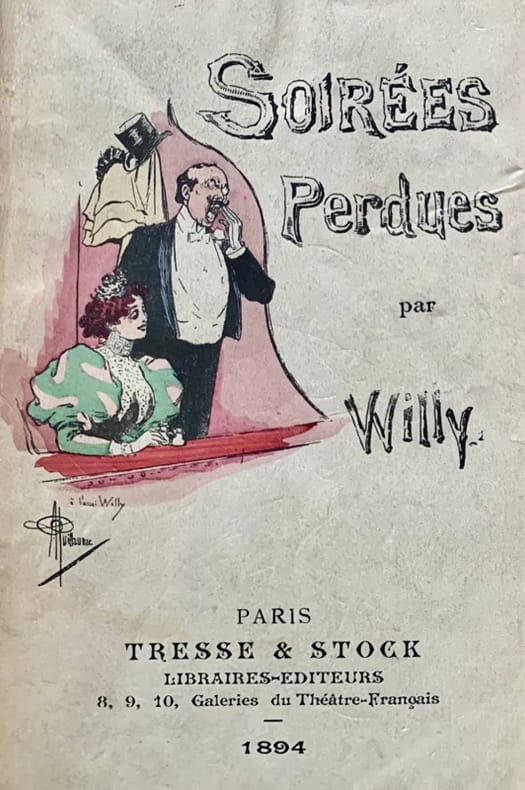
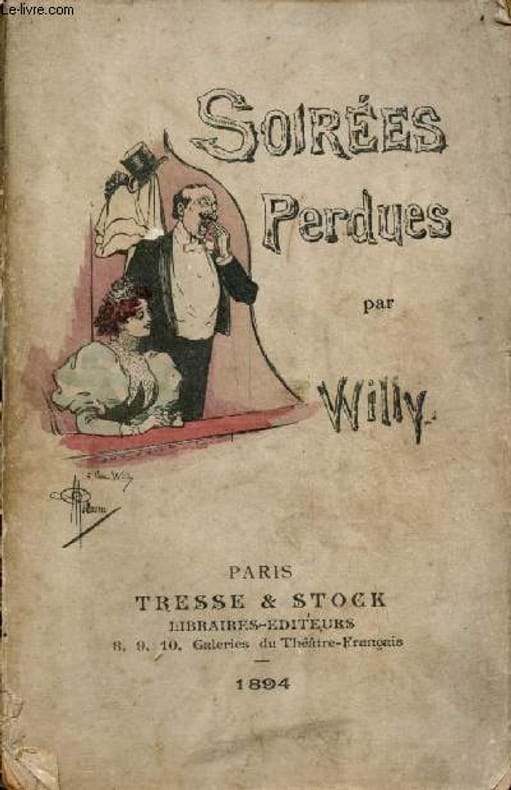
189414011894 Paris, Tresse & Stock, 1894. In-8 br., couverture illustrée, 360 pp. Édition originale. Envoi “au cher ami Boisard, homme du monde, illustré de vertus, son Willy ”. (Ex-libris N. Arnaud)
1900644351900. Fine. s. d. 11.50 x 8 cm une carte Autograph letter signed by Henry Gauthier-Villars known as Willy 6 lines in purple ink sender's address at foot: ""Rue de Courcelles 93"". Amusing letter from Willy central personality of Parisian social life at the turn of the 19th century where all his taste for humor and provocation shows through: ""Ah! Ah! You too are a pornographer! I am not displeased my dear colleague to find myself in such good company"". unknown
1894RO80275309Tresse & Stock. 1894. In-12. Broché. Etat d'usage, Couv. défraîchie, Dos abîmé, Papier jauni. 360 pages - dédicace de l'auteur Willy sur la première page (photo disponible) - plats tâchés - dos fendu, ouvrage désolidarisé - coiffes abîmées.. . . . Classification Dewey : 97.2-Dédicace, envoi
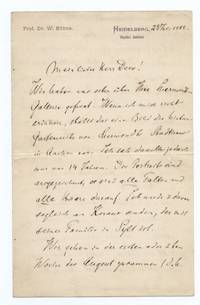
1885367471885. Heidelberg 23.VII.1885 2 2/3 Seiten gr.-8° mit gedrucktem Briefkopf. Wilhelm Friedrich Kühne 1837-1900 Physiologe entdeckte den Sehpurpur erforschte das Protoplasma und führte den Begriff "Enzym" ein. - An Professor A.G. Dew Smith in Cambridge mit dem er in regem freundschaftlichem und wissenschaftlichem Verkehr stand. Dew Smith plante eine Europa-Reise und Kühne schlägt ein Treffen "in Aachen oder in Antwerpen" vor. ". Schreiben Sie nur wenn Sie erst auf dem Continente sind von irgendwo eine Karte an meine hiesige Adresse die mich immer erreichen wird und ein Zusammenkommen wird sich arrangiren lassen. Sie müssten auch Hugo Kronecker mal in Bern wo ich im März war und es sehr angenehm fand besuchen. Haben Sie im Anfang des Jahres die Instrumente die ich Ihnen zum Copiren in Platin-Iridium schickte erhalten Grüssen Sie herzlich die Freunde in Cambridge ." unknown
1859667761859-1860. Arch. Anat. Phys. 1859/3. 1860/3. - Leipzig 1859 8° 41 pp.; 1860 8° 42 pp. 1 Abb. 2 orig. Broschuren. 2 Seltene Sonderdrucke! "Seit dem Erscheinen meiner Untersuchungen aber directe und indirecte Muskelreizung mittelst chemischer Agentien aus denen ich eine Anregung zum Studium der Irritabilitätsfrage entnahm sind über denselben Gegenstand neue Angaben veröffentlicht. welche in dem thatsächlichen Theile den meinigen widersprechen. Hauptsächlich wird der von mir aufgestellte Satz bestritten dass Muskel und Nerv sich zu denselben chemischen Reizen verschieden verhalten. Die Herren Wundt und Schelske Verhandlungen des naturhist.-medicin. 'Vereins zu Heidelberg. Ueber die chemischen Muskelreize. Von Dr. Schelske suchen zu dem Ende nachzuweisen dass erstens meine Behauptung nicht richtig sei dass einzelne Lösungen nur in concentrirtem Zustande erregend auf die Nerven wirken während sie selbst in äusserster Verdünnung vom Muskelquerschnitt noch Zuckungen hervorrufen und dass zweitens kein chemischer Körper existire der nicht entweder gleichzeitig ein Reiz für beide Organe sei oder den Nerven sowohl als den Muskel ganz unerregt lasse. Ich werde mich bemühen diese Widersprüche so viel als möglich zu lösen wo mir dies nicht möglich ist vermag ich nichts Besseres zu thun als die Physiologen welche diesem Gebiete näher stehen einzuladen diese Versuche entweder selbst zu wiederholen oder sie sich bei mir anzusehen indem ich jeder Zeit mit Vergnügen bereit bin Alles ad oculos zu wiederholen." Wilhelm "Willi" Kühne 1837-1900 Sohn eines wohlhabenden Kaufmanns legte 1854 am Johanneum Lüneburg das Abitur ab. Er begann im selben Jahr ein Studium an der Universität Göttingen wo er Chemie bei Friedrich Wöhler Physiologie bei Rudolf Wagner und Anatomie bei Jakob Henle studierte. 1856 wurde er bei Wagner mit einer Arbeit über künstlichen Diabetes bei Fröschen zum Dr. phil. promoviert. Anschließend forschte er an der Universität Jena bei Karl Gotthelf Lehmann zum Zuckerstoffwechsel. 1858 wechselte Kühne erst nach Berlin wo er als Mitarbeiter von Felix Hoppe-Seyler an der Chemischen Abteilung des Pathologischen Instituts tätig war und bei Emil Du Bois-Reymond Studien zur Muskulatur betrieb und anschließend nach Paris zu Claude Bernard. 1860 folgte ein Aufenthalt in Wien bei Ernst Brücke und Carl Ludwig. Ab 1861 leitete Wilhelm Kühne das Chemische Labor im Pathologischen Institut Rudolf Virchows in Berlin wo er sich mit Zellphysiologie auseinandersetzte. Von 1868 bis 1871 hatte er den Lehrstuhl für Physiologie der Universität von Amsterdam inne 1871 ging er an die Universität Heidelberg wo er als Nachfolger Hermann von Helmholtz' bis zu seinem Lebensende das Physiologische Institut leitete." Rothschuh Nr.1344: Beobachtet die Wirkung chemischer Substanzen auf den Muskel und die Gerinnbarkeit von Muskelpreßsaft. unknown