87 résultats
1881265811881. Unters. phys. Inst. Heidelberg. 4/12. - Heidelberg C.Winter's 1881 8° 168 pp. 13 Holzschn. 4 lith. Taf. orig. Broschur; St.a.Tit. Willy Kühne und J.Steiner belgeten 1881 das Belichtungsschwankung in der Retina entsteht. Rothschuh Nr.1881 unknown
187721671877. Cbl. med. Wiss. 15/42. - Berlin August Hirschwald 1877 8° pp.753-784 Rückenbroschur;Papier gebräunt. unknown
1898R240127142H. SIMONIS EMPIS EDITEUR. 1898. In-8. Relié. Etat d'usage, Coins frottés, Dos fané, Papier jauni. 263 pages - auteur et titre doré sur pièce de titre noire sur le dos - Fleuron doré sur le dos - Plats jaspés - EXEMPLAIRE NUMEROTE N°5430. . . . Classification Dewey : 840-Littératures des langues romanes. Littérature française
189835504660Paris, Simonis Empis, 1898 ; in-12, broché, couv. illustrée. 263 pp., 1 p. de table.ÉDITION ORIGINALE. “Willy ont beaucoup de talent” écrivait Jules Renard dans son Journal en 1905, une allusion au fameux “négrier” qui avait publié sous son nom des romans écrits par Colette. Jean de Tinan, P. J. Toulet, F. Carco et d’autres “nègres” moins connus. Ce roman des mœurs parisiennes fin de siècle, du grand monde et surtout du demi-monde, est peut-être boutiqué par Willy tout seul ?
1864307221864. Leipzig Verlag von Wilhelm Engelmann 1864 8° VII 1 158 pp. 1 Holzschnitt im Text und vielen Abbildungen auf 8 z.Tl. getönten lith. Tafeln feiner Halbleinenband. First edition of this important work on protoplasma! Willy Kühne 1837-1900 a pupil of Claude Bernard and Ernst Brücke professor of physiology at Amsterdam and Heidelberg. In above work he brought strong evidence from many sources of the close similarity of plant and animal protoplasm. He observed protplasmic movements and noted effects of reagents of temperature changes and of the passage of an electric current. "Through his research Kühne demonstrated the extraordinary of usefulness of cytophysiological investigations for the solution of problems in general physiolgy." DSB 7/519 Die Frucht von Kühnes Studien zu den in den Elementarorganismen sich abspielenden Lebensvorgängen ist das vorliegende Werk über das Protplasma und die Kontrakttilität. Dort findet sich eine Fülle von Beobachtungsmaterial bezüglich der Kontraktilitäterscheinungen im Tier- und Pflanzenreich und die Bedingungen ihres Auftretens betreffend. Ein Abschnitt des Buches behandelt den chemischen Nachweis des sogenannten Myosins einer spontan gerinnenden Substanz in den Muskeln welche auch die Ursache der Totenstarre abgibt und damit die entsprechenden Hypothese Brückes bestätigt. Rothschuh No.1304 unknown
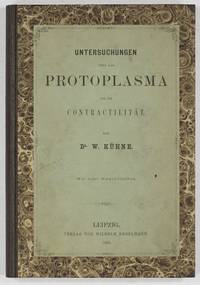
186411974GB1864. Leipzig W. Engelmann 1864. 8°. 8 1 gef. Kupfertafeln VII 158 S. 1 Bl. Halbleinenband der Zeit mit goldgeprägtem Rückentitel leicht beschabt Kapitale leicht bestoßen. Durchgehend leicht wasserwellig bzw. wasserrandig. Sonst in schöner Erhaltung. unknown
185987521859. Arch. Anat. Phys. 1859/56. - Leipzig Veit et Comp. 1859 8° pp.549-853 6 gefalt. lith. Tafl. 2 OBroschBde. Firt Edition! Proof of the coagulability of muscle proteins. Rothschuh Nr.1235: Willy Kühne 1837-1900 beweist die von Nervensystem unabhängige Fähigkeit der Muskelfaser zur Erregungsleitung und Erregbarkeit. Chemische Muskelreizung. Rothschuh Nr.1437: Nachweis der doppelsinnigen Leitung durch Zweizipfelversuch. Garrison & Morton No.620 unknown
189843653Berlin J.A. Barth 1898 1901 Without wrappers. In "Annalen der Physik und Chemie. Hrsg. von G. Wiedemann." Neue Folge Bd. 65 No. 7. Entire issues offered. Pp. 241-480. . And Vierte Folge Bd. 5. Pp. 241-488 textillustr. Wien's paper pp. 440-452 textillustrations and pp. 421-435 textillustrations. Clean and fine. The second issue punched in inner margin after cords. no loss of text. <br/><br/><em>First appearance of Wien's importent paper in which he shows that the cathode rays are particles that their velocity is about a third to that of light and he establish the ratio between the mass and the charge.In the paper are "described the experiments by which Wien determined the properties of the canal rays. The firstpart of the paper conatins a description of observations on the cathode rays made with a Lenard Tube in which the cathode rays passed through an aluminium window into an extension of the tube where as high a rarefaction as possible was maintained. The magnetic and electrostatic deflexions of a narrow cathode stream were observed and Wien concludes that it is proved by his investigation that the cathode rays which pass through the windoww carry with them strong negative charges."Magie "Souce Book in Physics" p. 597 ff.Wien was awarded the 1911 Nobel Prize for physics for his discoveries regarding laws governing the radiation of heat. </em> unknown
189843653Berlin, J.A. Barth, 1898, 1901 Without wrappers. In ""Annalen der Physik und Chemie. Hrsg. von G. Wiedemann."", Neue Folge, Bd. 65, No. 7. (Entire issues offered). Pp. 241-480. . And Vierte Folge, Bd. 5. Pp. 241-488, textillustr. Wien's paper pp. 440-452, textillustrations and pp. 421-435, textillustrations. Clean and fine. The second issue punched in inner margin after cords., no loss of text.
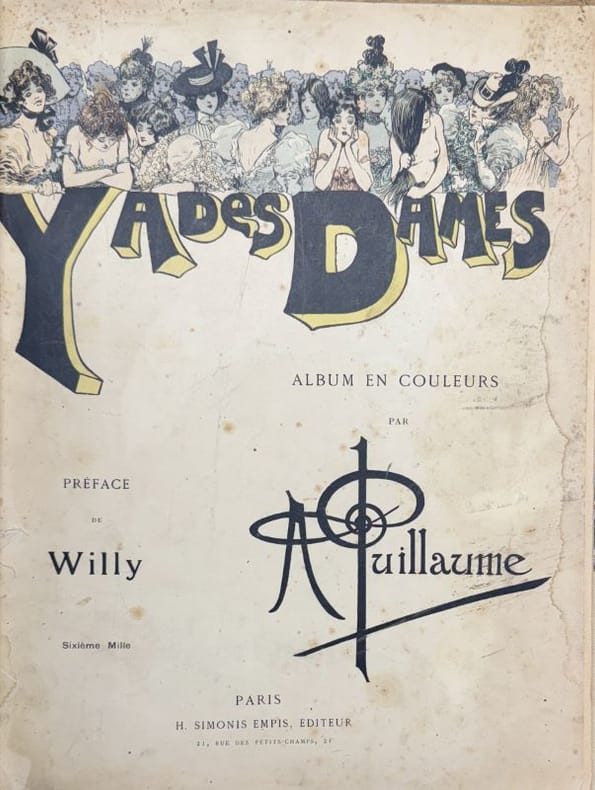
1896119574Paris H. Simonis Empis 1896 1 vol. relié in-folio, demi-toile écrue à coins, pièce de titre, couvertures en couleurs conservées, 20 planches de dessins en couleurs d'Albert Guillaume. Préface de Willy. Mention de 6e mille sur la couverture. Couverture conservée salie, pièce de titre frottée, sinon exemplaire très convenable.
1878667771878. Unters. phys. Inst. Heidelberg 1/3. - Heidelberg Verlag von Carl Winter's Universitätbuchhandlung 1878 8° 4 pp. Seltener Sonderdruck! Wilhelm "Willi" Kühne 1837-1900 Sohn eines wohlhabenden Kaufmanns legte 1854 am Johanneum Lüneburg das Abitur ab. Er begann im selben Jahr ein Studium an der Universität Göttingen wo er Chemie bei Friedrich Wöhler Physiologie bei Rudolf Wagner und Anatomie bei Jakob Henle studierte. 1856 wurde er bei Wagner mit einer Arbeit über künstlichen Diabetes bei Fröschen zum Dr. phil. promoviert. Anschließend forschte er an der Universität Jena bei Karl Gotthelf Lehmann zum Zuckerstoffwechsel. 1858 wechselte Kühne erst nach Berlin wo er als Mitarbeiter von Felix Hoppe-Seyler an der Chemischen Abteilung des Pathologischen Instituts tätig war und bei Emil Du Bois-Reymond Studien zur Muskulatur betrieb und anschließend nach Paris zu Claude Bernard. 1860 folgte ein Aufenthalt in Wien bei Ernst Brücke und Carl Ludwig. Ab 1861 leitete Wilhelm Kühne das Chemische Labor im Pathologischen Institut Rudolf Virchows in Berlin wo er sich mit Zellphysiologie auseinandersetzte. Von 1868 bis 1871 hatte er den Lehrstuhl für Physiologie der Universität von Amsterdam inne 1871 ging er an die Universität Heidelberg wo er als Nachfolger Hermann von Helmholtz' bis zu seinem Lebensende das Physiologische Institut leitete. unknown