VOLTAIREBiblio.com
5 625 résultats
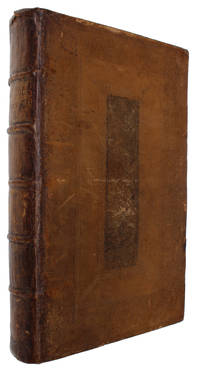
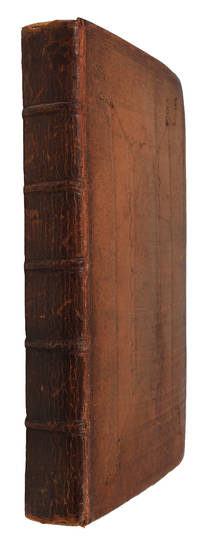
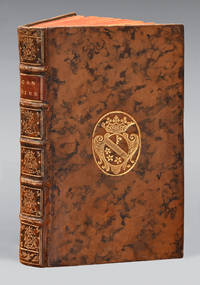
ABAA-75TH-VBF-27<p>N.p. Genève Cramer 1759.</p><p>12mo of 299 pages. Signatures A-N4.</p><p>Full marbled calf coat of arms gilt-stamped in the center of the covers spine decorated with crowned coat of arms repeated five times red edges. <em>Contemporary armorial calf binding.</em></p><p>159 x 93 mm.</p><p><em>"Very rare and much sought after"</em><strong>original edition.</strong></p><p>"<em>There are eight different editions of Candide published in 1759 without the name of the city or the printer all printed in the same format and all having an identical title. Of these eight editions this is the first</em>." Bengesco B.n.F. <em>En Français dans le texte</em>.</p><p>"<em>Raised in a baron's castle a certain young man named Candide leads the most pleasant life in the company of his tutor Dr. Pangloss. And for good reason: he takes from the latter that the world is absolutely good since any cause brings the best end in an inescapable way until the day when the squire disturbs this quietude: having surprised the dear Candide on the breast of his daughter Cunégonde he sends him on the hour to all the devils of a great kick in the butt. Reduced to rolling his hump the young man travels to various countries that will show him that this world does not respond very well to the wonderful teaching of the good man Pangloss. Whether he finds himself in England France or Italy he is forced to note that evil prevails over good in the most savage way.</em>"</p><p>"<strong>It is certain that Voltaire is the master of ironic pessimism</strong>. <em>Eugène Marsan</em> observes in this respect: "<em>Of all his veins it is this one that has suffered the least from time. What he had of caduc in his poetry of dry in his history of short in his philosophy ended up repulsing instead of the pessimism of Candide seducing more and more</em> ".</p><p><strong>This original edition of Candide is rare and very rare in fine condition.</strong></p><p>A copy of mediocre quality in rubbed calf was sold for 100 000 € 90 000 $ at the time by American booksellers exhibiting at the Salon de la Mutualité in May 2001 22 years ago.</p><p>A copy in simple roan with arms was sold for 150 000 € in 2009 14 years ago.</p><p><strong>A precious and beautiful copy - the only one to appear on the market in contemporary marbled calf with arms for half a century - bound with the arms and pieces of arms of the marquis de Caraman 1731-1806.</strong></p><p>Marie-Jean-Louis de Riquet known as the marquis de Caraman fourth son of Victor-Pierre-François comte de Caraman and Louise-Madeleine-Antoinette Portail born on November 26 1731 became a knight of the order of Saint-Louis in 1760 and a brigadier of the king's armies on April 20 1768; he died in 1806; he had married on August 21 1763 Marie-Charlotte-Eugénie de Bernard de Montessus de Rully.</p><p><strong>Voltaire and the marquis de Caraman were frequenting each other at the court of Stanislas.</strong></p><p>In 1738 the treaty of Vienna put an end to the war of Polish Succession. The king Stanislas Leszczynski was exiled. As Louis XV's father-in-law he was given Lorraine and Barrois which were then erected as kingdoms. He was fond of Lunéville where the court led by a "puppet sovereign" attracted brilliant minds with its great freedom. The whole of intellectual Europe met there in particular Voltaire and Madame Du Châtelet. Stanislas took a liking for this couple that he received with all the honors. Voltaire appreciated the relaxed and tolerant atmosphere of Lunéville where he found refuge when he published disturbing works. The two men continued to correspond and remained linked until Stanislas' accidental death in 1766.</p><p>Among the main guests who came successively to charm and entertain the court of Lunéville we must mention the Prince of Conti the Crown Prince of Hesse-Darmstadt Miss Charolais; the Bishop of Toul Mgr Drouas de Boussey; the count and the <strong>marquis de caraman</strong> the count of Stainville the marshal of Bercheny an old friend of Stanislas who lives near Châlons; Mgr de Choiseul-Beaupré the marshal of Maillebois and his son etc. etc.</p><p>His tolerance was the same for all; he welcomed as liberally the philosophers who fled the Bastille as the Jesuits who fled the wrath of the Parliament. At his court everyone had complete freedom of conscience: his first doctors and his treasurer were Protestants.</p><p>For Stanislaus the greatest pleasure of all was to talk with people whose minds were as lively and cultured as his own; he didn't care about their opinions he loved to discuss.</p><p>The men of letters as well as the philosophers were not without appreciating the rare honor which their royal fellow-member made to them so good so familiar so accessible; they pleased themselves infinitely in this peaceful court where they were admired as they deserved to be and where they enjoyed in peace the fruit of their work far from the envy and the cabals. Voltaire did not live happier years than those he spent in Lunéville.</p><p>FR</p><p>S.l. Genève Cramer 1759.</p><p>In-12 de 299 pages. Signatures A-N4.</p><p>Plein veau marbré armoiries frappées or au centre des plats dos à nerfs orné de pièces d'armoiries couronnées répétées cinq fois filet or sur les coupes tranches rouges. <em>Reliure en veau armorié de l'époque.</em></p><p>159 x 93 mm.</p><p><strong>Edition originale</strong> " <em>très rare et très recherchée</em> ".</p><p><em>" Il existe de Candide huit éditions différentes publiées en 1759 sans nom de ville ni d'imprimeur toutes tirées dans le même format et ayant toutes un titre identique. De ces huit éditions celle-ci est la première. "</em> Bengesco B.n.F. <em>En Français dans le texte</em>.</p><p><em>" Élevé dans le château d'un baron certain jeune homme appelé Candide mène la vie la plus agréable en compagnie de son précepteur le Dr Pangloss. Et pour cause : il tient de ce dernier que le monde est absolument bon vu que toute cause amène la meilleure fin d'une manière inéluctable jusqu'au jour où le châtelain trouble cette quiétude : ayant surpris le cher Candide sur le sein de sa fille Cunégonde il l'envoie sur l'heure à tous les diables d'un grand coup de pied au derrière. Réduit à rouler sa bosse le jeune homme parcourt divers pays qui se chargeront de lui montrer que ce monde répond fort peu au mirifique enseignement du bonhomme Pangloss. Qu'il se trouve en Angleterre en France ou en Italie force lui est de constater que le mal prévaut sur le bien de la manière la plus sauvage. "</em></p><p>" <strong>Il est certain que voltaire est le maître du pessimisme ironique</strong><strong>.</strong> <em>Eugène Marsan</em> observe à cet égard : " <em>De toutes ses veines c'est celle-là qui a le moins souffert du temps. Ce qu'il avait de caduc dans sa poésie de sec dans son histoire de court dans sa philosophie a fini par rebuter au lieu que le pessimisme du Candide a de plus en plus séduit</em> ".</p><p><strong>Cette édition originale de Candide est rare et rarissime en bel état.</strong></p><p>Un exemplaire de qualité médiocre en veau frotté fut vendu 100 000 € 90 000 $ de l'époque par des libraires américains exposant au Salon de la Mutualité en mai 2001 il y a 22 ans.</p><p>Un exemplaire en simple basane armoriée fut vendu 150 000 € en 2009 il y a 14 ans.</p><p><strong>Précieux et bel exemplaire - le seul apparu sur le marché en veau marbré armorié de l'époque depuis un demi-siècle - relié aux armes et pièces d'armes du Marquis de Caraman 1731-1806.</strong></p><p>Marie-Jean-Louis de Riquet dit le marquis de Caraman quatrième fils de Victor-Pierre-François comte de Caraman et de Louise-Madeleine-Antoinette Portail né le 26 novembre 1731 devint chevalier de l'ordre de Saint-Louis en 1760 et brigadier des armées du Roi le 20 avril 1768 ; il mourut en 1806 ; il avait épousé le 21 août 1763 Marie-Charlotte-Eugénie de Bernard de Montessus de Rully.</p><p><strong>Voltaire et le marquis de Caraman se fréquentaient à la cour de Stanislas.</strong></p><p>En 1738 le traité de Vienne met fin à la guerre de Succession de Pologne. Le roi Stanislas Leszczynski est exilé. En tant que beau-père de Louis XV il se voit attribuer la Lorraine et le Barrois alors érigés en royaumes. Il affectionne Lunéville dont la cour animée par un " souverain fantoche " séduit de brillants esprits par sa grande liberté. Toute l'Europe intellectuelle s'y retrouve en particulier Voltaire et Mme Du Châtelet. Stanislas se prend d'amitié pour ce couple qu'il reçoit avec tous les honneurs. Voltaire apprécie l'atmosphère détendue et tolérante de Lunéville où il trouve refuge quand il publie des ouvrages qui dérangent. Les deux hommes continueront à correspondre et resteront liés jusqu'à la mort accidentelle de Stanislas en 1766.</p><p>Parmi les principaux hôtes qui viennent successivement charmer et distraire la cour de Lunéville il faut citer le prince de Conti le prince héritier de Hesse-Darmstadt Mlle de Charolais; l'évêque de Toul Mgr Drouas de Boussey; le comte et le marquis de Caraman le comte de Stainville le maréchal de Bercheny un vieil ami de Stanislas qui demeure près de Châlons; Mgr de Choiseul-Beaupré le maréchal de Maillebois et son fils etc. etc.</p><p>Sa tolérance était la même pour tous; il accueillait aussi libéralement les philosophes qui fuyaient la Bastille que les jésuites qui fuyaient les foudres du Parlement. A sa cour chacun avait toute liberté de conscience: ses premiers médecins son trésorier étaient protestants.</p><p>Pour Stanislas le plus grand de tous les plaisirs était de causer avec des personnes dont l'esprit était 168 comme le sien vif et cultivé; peu lui importait leurs opinions il adorait discuter.</p><p>Les hommes de lettres aussi bien que les philosophes n'étaient pas sans apprécier l'honneur rare que leur faisait leur royal confrère si bon si familier si accessible; ils se plaisaient infiniment dans cette cour paisible où ils étaient admirés comme ils méritaient de l'être et où ils jouissaient en paix du fruit de leurs travaux loin de l'envie et des cabales. Voltaire n'a pas vécu d'années plus heureuses que celles qu'il a passées à Lunéville.</p><p>Voltaire est déjà passé par la Lorraine lorsqu'il arrive à Lunéville en février 1748 accompagné d'Emilie du Châtelet sa douce amie depuis quelques années. Stanislas l'accueille avec grand plaisir et lui fait les honneurs de sa cour. Très vite se nouent de bonnes relations entre les deux hommes. Même si Voltaire n'est pas toujours en accord avec les ouvrages que publie Stanislas il apprécie l'atmosphère détendue et tolérante de Lunéville. Il y trouve ce qui lui est le plus cher : " les fêtes et la liberté " comme il en témoigne lui-même dans sa correspondance.</p><p>La cour lorraine offre à Voltaire un refuge où il peut fuir Paris cette capitale française où il est souvent en délicatesse avec la censure et le pouvoir royal. L'émulation artistique et intellectuelle qui règne à Lunéville fait se succéder jeux concerts et représentations théâtrales au cours desquelles les œuvres du " roi Voltaire " sont applaudies. D'autres auteurs importants sont passés par Lunéville comme le fameux Montesquieu le mathématicien Maupertuis ou le président Hénault dramaturge et historien. En 1749 Voltaire et Emilie du Châtelet sont de retour en Lorraine pour une halte estivale au château de Commercy avant de retrouver Lunéville. C'est là que meurt la " divine Emilie " le 10 septembre 1749. Cette disparition brutale affecte tellement Voltaire qu'il doit abandonner la Lorraine après avoir fait ses adieux à Stanislas qui le quitte en pleurant.</p> hardcover
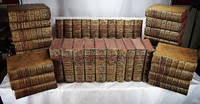
17512605210193Chez Briasson David Le Breton Durand A Paris; Amsterdam 1751 - 1777 1751. First Edition. Hardcover. Very Good. 0x0x0. The Organization of Enlightenment Thought: The Revolution in Ideas. A first edition of this foundational encyclopedia of 18th century knowledge. A massive thirty-five volume set. Large folios volumes 39.5 x 25 cm. Bound in 18th-century French calf. Spines gilt with raised bands. One volume non-uniformly bound in light calf. <br> The set includes: Encyclopedie Paris: 1751-57 & Neuchatel 1765. 17 volumes; Recueil de planches. Paris: 1762-72. 11 volumes 1 2 part I 2 Part II 3 5 6 7 8 9 10 11; Supplement a l'Encyclopedie. Paris & Amsterdam: 1776-77. 5 volumes including the Suite de recueil de planches; Table Analytique. Paris: 1780. <br> Profusely illustrated with engraved plates. <br> Diderot's famous Encyclopedie was initially a modest translation of Chambers's Cyclopaedia. It grew as a project into a massive project which attempted to collect human knowledge from a rationalistic perspective instead of by nature or theology. In organizing knowledge from a position where human reason was paramount the supremacy of the Church was imperiled. As a result the Encyclopedie was widely controversial and placed on the Index Librorum Prohibitorum by the Catholic Church. In discussing fundamental philosophical issues such as on political authority and natural rights articles in the Encyclopedie shifted the basis of governmental authority from the divine right of Kings to radical concepts popular consent was the basis of legitimacy and the ideals of a social contract. The work was banned by the King of France. It spread the foundational ideas of the French Revolution and enlightenment thinkers. "No encyclopaedia perhaps has been of such political importance or has occupied so conspicuous a place in the civil and literary history of its century. It sought not only to give information but to guide opinion." "It was a war machine; as it progressed its attacks on both the church and still more on despotic government as well as Christianity itself became bolder and more undistinguished and it was met with persecution and opposition unparalleled in the the history of encyclopedias." - Encyclopedia Britannica 11th ed p. 1483. "A monument in the history of European thought; the acme of the age of reason; a prime motive force in undermining the ancien regime and in heralding the French Revolution" Printing in the Mind of Man 200. Refs: Grolier/Horblit 25b; Norman 637; PMM 200. <br> Includes: 17 v. : ill. ; 41 cm. supplement 4 volumes plates 11 volumes plates supplement 1 volume. Table Analytique 1 volume. This is an oversized or heavy book which requires additional postage for international delivery outside the US. Chez Briasson, David, Le Breton, Durand, A Paris; Amsterdam (1751 - 1777) hardcover
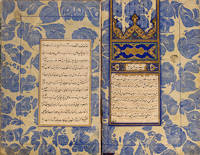
116998Qajar Persia dated 10 Dhu'l Qa'da 1290 AH 30 December 1873. . Single volume illuminated manuscript on paper with fine marbled paper borders in Farsi 141 leaves complete 323 x 215 mm; single column 11 lines to the page written in neat nasta'liq script in black ink occasional headings and significant words in blue inner margins ruled in gold and blue outer borders throughout decorated with fine marbling one fine illuminated opening headpiece later ink inscription to recto of first leaf else very clean and bright condition; contemporary leather over pasteboards covers and extremities a little scuffed and rubbed.<br /> This extraordinary manuscript is most probably the first translation of Voltaire from French into Persian. Little is known about the life of the translator Mirza Reza Tabrizi however he is known to have been working as a civil servant in Khorasan in 1846 and spent the years 1853-58 as an interpreter and instructor in French at the Dar al-Fonun.<br /><br />This manuscript is particularly striking for the remarkable decorated marbled borders of many varying designs and patterns that adorn all the text pages. The use of marbled paper borders in a bound manuscript as here is very unusual. Marbled paper was often used to decorate album pages and calligraphic panels from the sixteenth century onwards and was very much a decorative tool elevating the design and appeal of a single artistic creation i.e. a miniature or calligraphic exercise it's use to adorn the margins of every text leaf is a sign of great luxury and decadence.<br /><br />The only other known textual manuscript to include marbled borders to this degree was copied by the same scribe as the present manuscript and was entitled Tarikh'i Iskander History of Alexander the Great assembled by James Campbell; a reference to this primary text is given in the preface of the other manuscript: 'Ibn Muhammad Khan Safdar 'Ali is to produce this text as well as the History of Peter the Great' thus confirming that the two volumes were undeniably associated at the time of production and assembled in this style at the bequest for the same patron. Although notably the secondary volume was completed a year later and in Kabul Afghanistan indicating that the patron of these works was likely travelling with the scribe and engaging with them as they worked. For more information on the secondary associated manuscript see item 33 in Shapero Rare Books' Catalogue Maghreb to the Far East London 2023.<br /> Qajar Persia, dated 10 Dhu'l Qa'da 1290 AH (30 December 1873). hardcover
2038A Londres Fictitious imprint. BN gives place of publication as Amsterdam. Bengesco gives place of publication as Paris.: Pour la compagnie 1747. Hardcover. Very Good. Octavo. iv 172pp. 2 A8-K8 L6. With the half-title. Title-page in red-and-black. Engraved title vignette. Paper boards. Bengesco 1420; BN CCXIV 2973; Cioranescu 64349. From the library of the Fideicommis Bodenstein with their stamp on the title-page. The first published edition of a work by Voltaire which later appeared under the title Zadig ou La destinée. <br/> <br/> A Londres [Fictitious imprint. BN gives place of publication as Amsterdam. Bengesco gives place of publication as Paris.]: Pour hardcover
1759752Genève Geneva: Cramer 1759. First Edition. 3 vols. in one 12mo 164 x 100mm pp. 2 291 1; 133 1 35 1. First printing of the great 18th century philosophical narrative with all the points correct. Including the 3 usual cancels the right title page ornament repeated pages 193 and 266 the misprints of “que ce ce fut†page 103 line 4 and “précisément†page 125 line 4 the correction removing a paragraph break page 31 the rewritten lines about the Lisbon earthquake page 41 etc. Contemporary full calf red calf label rebacked with the original spine saved and laid down recornered marbled endpapers gilt rubbed inner paper hinges strengthened old ink signatures on the endpaper and front blank tiny signature on the title page one tissue strengthened tear at the bottom of A2 touching the last 3 lines of text without any loss otherwise internally quite nice clean and very good. Bound without N7 a blank and N8 a notice to the binder as is usual agreeing in all respects to what you would have received if you had purchased a copy in sheets on publication day then bought the sequels and then handed them over to the most local Swiss bindery. Ref: PMM 204. There were 18 editions of Candide in 1759. It took 221 years for a clear and convincing bibliography to first sort them out and then got accepted and once accepted our real 1st edition was confirmed as rare. In the last 15 years however that bibliographical data has been more widely circulated and several 1st editions that weren’t on the original 22–copy census have come into market. It is still scarce more so in a contemporary binding.<br /> <br /> Candide bides as the epitomic philosophical fable of the French Enlightenment and the genotype of irony without exaggeration and though it’s laced with more salt than the postwar streets of Carthage it repeatedly tolls a reminder that light hearts live long. Most importantly Candide remains remarkably relevant when examined through contemporary frameworks functioning as an incisive proto-postcolonial text that anticipates modern discourse on global inequality systems of oppression and the limitations of Enlightenment rationality. The novel's scathing portrayal of slavery conquest and religious persecution resonates with intersectional analyses that recognize how power structures interlock across racial gender and economic dimensions. The savage irony throughout the text dismantles not just philosophical optimism but also European exceptionalism exposing the hypocrisy of colonial enterprises and religious institutions alike. The narrative's episodic structure—with its global movements between Europe South America and the Ottoman Empire—invites discussions of transnationalism and diasporic experience while Candide's concluding retreat to cultivate his garden has been reinterpreted by ecocritical scholars as both an acknowledgment of environmental interdependence and a potentially problematic withdrawal from systems-level political engagement.<br /> <br /> “Do you believe†said Candide “that men have always massacred each other as they do to-day that they have always been liars cheats traitors ingrates brigands idiots thieves scoundrels gluttons drunkards misers envious ambitious bloody–minded calumniators debauchees fanatics hypocrites and fools†“Do you believe†said Martin “that hawks have always eaten pigeons when they have found them†<br /> –Voltaire Candide. Cramer unknown
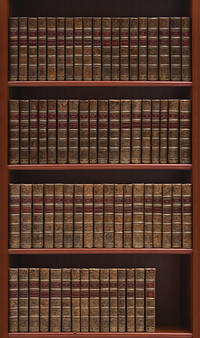
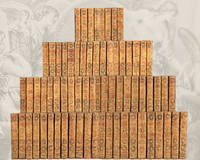
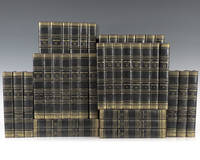
1784191724Kehl: De L'imprimerie de la Société Littéraire-Typographique 1784-89. Canonizing Voltaire an enterprise on the eve of Revolution The first complete collection known as the "Kehl" edition for the small German town in which it was printed to avoid French censorship. After his death the Société Littéraire Typographique was founded there dedicated to the monumental effort of disseminating Voltaire's work through a definitive and typographically magnificent edition. The group of Enlightenment intellectuals ready to champion the author were led by Pierre-Augustin Caron de Beaumarchais who financed the operation and the Marquis de Condorcet who acted as chief editor. For the first time Voltaire's correspondence was published and commentary and a biography by Cordorcet was added. For the type Beaumarchais bought John Baskerville's apparatus from his widow. This coupled with the unprecedented price he paid for the rights the paper mills he purchased and the cost of setting up in Kehl bankrupted Beaumarchais. Nevertheless he concluded "Europe will be satisfied". Octavo 70 vols 213 x 134 mm. Portrait frontispiece engraved plates. Contemporary mottled calf signed by François Gaudreau at foot of spines red morocco labels double gilt fillet to compartments and boards marbled endpapers varicolour bookmarkers. Superficial splits and worming to joints still very firm occasional wear contents largely clean. A very good set. hardcover
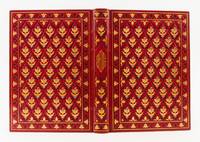
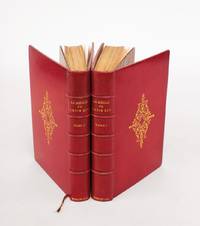
1893ST17884Paris: Imprimé pour Les Amis de Livres par Chamerot et Renouard 1893. No. 55 OF 115 COPIES printed for M. Van der Vrecken de Bormans. 275 x 190 mm. 10 3/4 x 7 1/2". 4 p.l. 159 3. <br/> DAZZLING CONTEMPORARY SCARLET MOROCCO VERY ORNATELY DECORATED IN GILT SILVER AND BLACK AS WELL AS INLAID BY MARIUS MICHEL stamp-signed on front doublure covers elaborately embellished with a floral frame enclosing a large central panel filled with diapered compartments formed by gently curving black leaves each compartment containing a floral sprig tooled in silver and gold flat spine with similarly decorated ogival compartments and gilt titling OLIVE BROWN MOROCCO DOUBLURES filled with rows of inlaid red carnations with dark green pedicels leather hinges jacquard silk endleaves in pink blue and green pattern marbled flyleaves all edges gilt. Original white textured paper wrappers bound in. In a slightly worn brown morocco-trimmed marbled paper slipcase. With eight pleasing color engravings by Rops 4 Robaudi 2 and Garnier 2 depicting scenes from the story accompanied by 29 proofs in red yellow cyan and black & white as called for in the colophon. A Large Paper Copy. Front flyleaf with INK INSCRIPTION SIGNED BY MARIUS MICHEL and dated Mai 1920 noting that he had bound this copy for M. Van der Vrecken de Bormans in 1896 for a very substantial price of 600 francs. Carteret IV 407; Vicaire I 47. Three blank front flyleaves with narrow faint brown horizontal blemish across most of the page apparently a tape shadow; in all other ways A BEAUTIFUL COPY clean fresh and bright internally IN A PRISTINE BINDING.<br/> <br/> This ravishing object is a bibliophile's treasure: an illustrated luxury edition in Large Paper format of Voltaire's philosophical novel offered in a binding from a pre-eminent Parisian atelier. The impressive binding stands out not only because of its remarkable condition but also because of the variety and unerring execution of its decorative elements--from the vigorous use of black gold and silver on the cover and spine to the particularly animated inlaid morocco doublures. Considered the best binder of his generation as well as the founder of modern French bookbinding Henri Marius Michel 1846-1925 began his career in the workshop established by his father Jean in Paris in 1849 where they produced distinguished bindings in the prevailing historical styles for two decades. After the father's death in 1890 the firm came to even greater prominence when Henri began producing bindings in a completely new and original style that did nothing less than change the course of modern bookbinding in France. According to Duncan & De Bartha Henri believed passionately "that bookbinding needed a new vocabulary of ornamentation in order to express the mood and spirit of contemporary authors." The "vocabulary of ornamentation" he developed was based on nature the revolutionary "La Flore Ornamentale" style that he unveiled at the 1878 International Exposition. His favored floral forms dominate the present binding both as inlays and as silver and gold tooling. Our binding was commissioned by Paul Van der Vrecken Baron de Bormans an attaché at the Belgian Embassy in Paris and a bibliophile who belonged to "La société du livre contemporain" as well as the "Cercle Parisien du livre." The 600 francs the binding cost would have bought a very great deal in France at the end of the 19th century. Another copy of this work with the same special features and also bound in inlaid morocco by Marius Michel sold at Sotheby's in 1995 for the hammer price equivalent of $31200. Imprimé pour Les Amis de Livres par Chamerot et Renouard unknown
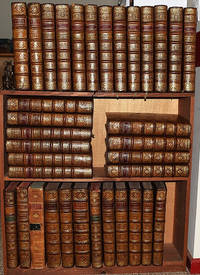
178488246s. l. Kehl: Imprimerie de la Société Littéraire-Typographique 1784. Fine. « Divine Voltaire ora pro nobis ! » Exceptional copy on large paper and contemporary binding Imprimerie de la Société Littéraire-Typographique s. l. Kehl 1784-1789 14 x 21.7 cm 70 vol. reliés The Kehl edition the most renowned edition of Voltaire's works illustrated and published on deluxe paper. It was printed on five different types of paper and only the deluxe editions such as ours on laid paper feature engravings. These are naturally the most sought-after and rarest copies. Binding in full painted sheep decorated with a honeycomb motif smooth spine tooled with gilt fleurons fillets and compartments light beige calf lettering and volume pieces gilt chain-roll border on covers marbled endpapers gilt roll on edges all edges marbled contemporary binding. Two volumes nos. 50 and 70 with slight variations in gilt tools on the spines and with orange morocco lettering pieces edges and covers treated somewhat differently. General condition of the 70 volumes: bindings with light rubbing to corners gilt a little dulled occasional foxing a few wormholes and old restorations not affecting the text. 28 volumes vols. 4 5 8 10 11 13 16 17 19 20 24 27 28 33 34 35 36 37 43 48 61 62 63 65 66 67 68 70 with cracked joints at the ends and 20 volumes vols. 8 11 12 14 16 18 33 34 37 42 46 49 53 56 57 60 65 66 68 70 with damaged caps. Two editions were published at the same time. Our copy belongs to the prestigious in-8 edition on large paper published in 70 volumes the other edition being in-12 format in 92 volumes. It is richly illustrated with 125 etched plates: - There are 17 portraits including 3 of Voltaire: a frontispiece portrait by N. de Largillière engraved by P. Alex. Tardieu; one drawn from Houdon's bust by Moreau le Jeune and engraved by P. Alex. Tardieu; and one allegorical portrait by Louis Croutelle after Moreau le Jeune belonging to the second series of illustrations of Voltaire's works executed by Moreau for the publisher Renouard. The 14 other portraits include an allegorical frontispiece of Frédéric-Guillaume Prince of Prussia depicted in profile in a medallion by Dambrun after Moreau le Jeune; a portrait of Henry IV by Pourbus engraved by Tardieu; one of Charles VII engraved after the original in the King's Cabinet by Mavieri; another of Agnès Sorel drawn by Moreau the Younger after the original in the King's Cabinet and engraved by Mavieri; one of Joan of Arc engraved by Beisson; followed by the Count of Dunois engraved after the original in the King's Cabinet by J. B. Fosseyeux; one of Louis XIV drawn by Moreau Le Jeune after C. Le Brun engraved by J. B. Fosseyeux; one of Charles XII engraved by P. Alex. Tardieu after the original in the King's Cabinet; one of Pierre I engraved by P. G. Langlois after a painting by L. Caravaque; one of Madame du Châtelet after Marie Anne Loir and engraved by P. G. Langlois; one of the Count of Argental after J. Defraine and engraved by J. B. Fosseyeux; one of Frédéric II of Prussia painted from life by Van Loo and engraved by P. G. Langlois; one of Catherine II of Russia engraved by J. B. Fosseyeux; and one of d'Alembert after De La Tour engraved by N. F. Maviez. - 93 engravings by Moreau le Jeune including 44 figures for le Théâtre engraved by Lingée Simonet de Launay Trière Halbou Duclos Romanet Dambrun de Longueil Delignon Le Mire Le Veau 10 for la Henriade engraved by Masquelier Delignon Dambrun Patas Gutemberg Helman Simonet Duclos Romanet 21 for la Pucelle engraved by Simonet Dambrun Halbou Baquoy Trière Delignon de Longueil Croutelle and Duclos 4 for the Contes in verse engraved by Langlois Duclos Delignon and Le Veau and 14 for the Romans engraved by Trière Duclos de Longueil Dambrun Baquoy Delignon Simonet Langlois and Halbou. - 14 scientific plates in volume 31 illustrating the experiments of Newton Descartes and Leibniz. - 1 battle Imprimerie de la Société Littéraire-Typographique unknown
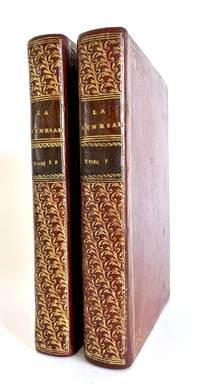
17992091202133206278A Paris De L'imprimerie de Crapelet 1799. Soft Cover. Fine. Number of books: 2 books in total A Paris, De L'imprimerie de Crapelet paperback
STLS0115Kehl De l'Imprimerie de la Societe Litteraire-Typographique 1785 - 1789. 23 x 15 cm. Zus. Ca 35 000 S. Mit insgesamt 145 gest. Tafeln davon 38 Porträts 14 physikal. Tafeln. 108 Tafeln sind von Moreau le jeune gestochen. Zahlr. Abb. im Text. Dekorative Halblederbände d. Zt. mit roten Rückenschildchen Rückengoldpräg. Lederecken. 4 Rückenschildchen fehlen einige Bände restauriert. Unser Exemplar stammt aus der Bibliothek des Wiener Verlegers Paul von Zsolnay. Bengesco 2142; Brunet V1353 ""Edition celebre""; Cohen/R.1042-48; Lewine 564. Die bedeutendste und schönste aller Voltaire-Ausgaben.Von Beaumarchais herausgegeben großteils von von Moreau le jeune mit Kupfern ausgestattet. Die Bände 71 u. 72 Paris Deterville 1801 enthalten ein umfangreiches Inhaltsverzeichnis von C. Chantreau sowie Reihentitelbll. vgl. Brunet V1354. (Kehl), De l'Imprimerie de la Societe Litteraire-Typographique 1785 - 1789. unknown
175165145à Berlin: Chez C. F. Henning 1751. Fine. Chez C. F. Henning à Berlin 1751 8.50 x 14.50 cm 2 volumes reliés First edition displaying all the distinctive features of its publication: it presents no capital letters except at the beginning of paragraphs and it is the very first work to have been printed with Voltaire's spelling. Our copy is complete with its errata leaf which is often missing. Later bindings 19th century in full red morocco Jansenist spines with five raised bands dates and places gilt at foot boards struck at center with large gilt typographical fleurons double gilt fillets on leading edges and headcaps pastedowns lined with blue morocco presenting a wide gilt decorative border monogrammed bookplates mounted on the pastedowns of each volume following endpapers of combed paper all edges gilt bindings signed Chambolle-Duru. Superb copy perfectly established in a binding signed by a master of French bookbinding. Chez C. F. Henning hardcover
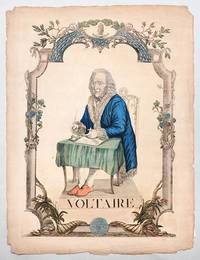
1790138601Paris: Basset c. 1790s. Voltaire as revolutionary icon A full-length portrait of the philosopher towards the end of his life in a fetching electric blue coat. The print is by the Parisian firm of Basset which was a leading source of popular prints during the Revolution. Voltaire was claimed as a foundational influence by many revolutionary leaders and in 1791 they arranged for his remains to be transferred to the Panthéon in Paris. Hand-coloured copperplate engraving. Image size: 70 x 52 cm. Framed size: 85 x 66.5 cm. Presented in a handmade gilt frame with conservation acrylic glazing. Light toning and chipping to extremities not touching impression several small tape repairs to extremities on verso not visible on recto: in very good condition. unknown
177081957à Paris: Chez La veuve DuchesneSaillantDesaint 1770. Fine. Chez La veuve Duchesne Saillant Desaint à Paris 1770 11.80 x 18.50 cm 2 volumes reliés New illustrated edition with first printing by Eisen of a frontispiece an engraved title with the author's portrait in medallion 10 figures and 10 headpieces all engraved by De Longueil. Volume II contains variants and notes: L'essai sur la poésie épique poème sur le désastre de Lisbonne; Poème sur la loi naturelle etc. This edition was partly revised by Voltaire. The publishers' notice announces this edition as the only complete one since there are more than 50 new verses scattered throughout the work. Contemporary full red morocco binding. Smooth spine decorated in grotesque style. Brown morocco title label olive morocco volume label. Triple fillet frame on covers with corner fleurons. Interior fillet. All edges gilt. Traces of rubbing. Some light foxing in margins and verso of certain engravings. Superb copy rare in this condition. Very fine illustration by Eisen. Complete and critical edition with notes from different editions for each canto Marmontel's preface the author's letter of thanks to Eisen. Chez La veuve DuchesneSaillantDesaint unknown
17772308270001Geneva: Pellet 1777-79; Neuchatel: La Societe Typographique 1777. troisieme. Hardcover. Very Good. The Organization of Enlightenment Thought: The Revolution in Ideas 41 of 45 volumes. Quartos 25 x 19.5 cm. Bound in handsome catspaw calf. All edges red. Good bindings and covers. Clean unmarked pages. Includes Vol. 1-36 of the Encyclopedie important note: lacks 3 text volumes 23 30 31; Vol. 37-38: Recueil de planches pour la nouvelle edition du dictionnaire raisonne des sciences des arts et des metiers; lacks the final plate volume v.39 Vol. 40-45 Table Analytique Et Raisonnee Des Matieres. <br> Diderot's famous Encyclopedie was initially a modest translation of Chambers's Cyclopaedia. It grew as a project into a massive project which attempted to collect human knowledge from a rationalistic perspective instead of by nature or theology. In organizing knowledge from a position where human reason was paramount the supremacy of the Church was imperiled. As a result the Encyclopedie was widely controversial and placed on the Index Librorum Prohibitorum by the Catholic Church. In discussing fundamental philosophical issues such as on political authority and natural rights articles in the Encyclopedie shifted the basis of governmental authority from the divine right of Kings to radical concepts popular consent was the basis of legitimacy and the ideals of a social contract. The work was banned by the King of France. It spread the foundational ideas of the French Revolution and enlightenment thinkers. "No encyclopaedia perhaps has been of such political importance or has occupied so conspicuous a place in the civil and literary history of its century. It sought not only to give information but to guide opinion." "It was a war machine; as it progressed its attacks on both the church and still more on despotic government as well as Christianity itself became bolder and more undistinguished and it was met with persecution and opposition unparalleled in the the history of encyclopedias." - Encyclopedia Britannica 11th ed p. 1483. Geneva: Pellet, 1777-79; Neuchatel: La Societe Typographique hardcover
173360085London C. Davis and A. Lyon 1733. 8vo. Lovely contemporary full Cambridge-style binding with five raised bands to spine and blindstamped ornamental borders to boards. . Double gilt line-borders to boards. All edges of boards with gilt borders. Gilt title to spine. Hinges neatly and professionally re-inforced. Internally very nice clean and fresh. A lovely crisp and large copy with good margins printed on heavy fine paper. 16 -including preface contents advertisements 253 1 18 -Index pp. <br/><br/><em>The important actual first edition of this highly celebrated key work of the Enlightenment in which the anecdote of how Newton discovered gravity the story about Newton and the falling apple appeared for the first time together with the description of the difference between the physical world view of the English and the French the "plenum" and the "vacuum". This seminal work in which Voltaire famously depicts British philosophy science society and culture in comparison to French can be viewed as the Enlightenment equivalent to Tocqueville's "Democracy in America". This series of essays which is based on Voltaire's experiences when living in England was actually written by Voltaire mostly in English which he mastered to perfection. It has often been presumed that the first edition of the work was that published in French in 1734 but actually the present English edition constitutes the actual first appearance of the work as well as the version that is closest to Voltaire's intention as the French language version is the re-written one and the English version the original. Curiously almost all modern English versions are translations into English of the French edition instead of the original English version making this edition of the utmost importance.After the original English edition of 1733 two French editions soon followed the first in 1734. Unlike the British the French resented the book and already in 1734 the French Parliament issued an order for the author's arrest and condemned the work causing the impact of it in France to be delayed. The book was burned for being "dangerous to religion and civil order". At the same time the work became a bestseller in Britain and as much as 14 editions of the work were published in the eighteenth century. "Inspired by Voltaire's two-year stay in England 1726-8 this is one of the key works of the Enlightenment. Exactly contemporary with Gulliver's Travels and The Beggar's Opera Voltaire's controversial pronouncements on politics philosophy religion and literature have placed the Letters among the great Augustan satires. Voltaire wrote most of the book in English in which he was fluent and witty and it fast became a bestseller in Britain. He re-wrote it in French as the Lettres philosophiques and current editions in English translate his French." Nicholas Cronk Introduction to the Oxford's Classics edition from 1999.The great French philosopher Voltaire was greatly impressed by the philosophical and scientific achievements of the English especially those of Newton Locke and Bacon. As a disseminator of scientific knowledge Voltaire came to play a great rôle in the popularization of Newtonian science and its discoveries the present work being a prime example. Although the work was condemned by the French authorities it still came to play a great rôle in the spreading of Newtonian ideas in France. The present work generally came to play a dominant rôle in Enlightenment accounts of the history of science and philosophy. The work focuses on British science and thought and uses the accounts of these to emphasize what is lacking in French society and French thought. The work is generally very critical towards the French "ancient régime" and when Voltaire here discusses the emergence of empiricism it is viewed as an English tradition that stands in opposition to the French rationalist tradition with Descartes as the prime example. This view is taken over by the following Enlightenment historians of science and philosophy e.g. d'Alembert see for instance his "Preliminary Discourse" of 1751. Some of the most influential passages of the work are probably those on Bacon who Voltaire sees as the founder of modern experimental science Newton and Descartes. Letters XIV on Descartes and Newton XV on attraction and XVI on Newton's Optics from 1704 are among the most influential essays of the work. In XVI Voltaire reflects upon Newton's "Optics" and the way that he rejected Descartes' theory and set out his own account of the properties of light. In XV he presents the first account of Newton and the falling apple: "As he was walking one Day in his Garden and saw some Fruits fall from a Tree he fell into profound Meditation on that Gravity the Cause of which had so long been sought but in vain by all the Philosophers whilst the Vulgar think there is nothing mysterious in it. He said to himself that from what height soever in our Hemisphere those Bodies might descend their Fall wou'd certainly be in the Progression discover'd by Galileo; and the Spaces they run thro' would be as the Square of the Times. Why may not this Power which causes heavy Bodies to descend and is the fame without any sensible Diminution at the remotest Distance from the Center of the Earth or on the Summits of the highest Mountains; Why said Sir Isaac may not this Power extend as high as the Moon." pp. 127-28.But perhaps the most famous passage in the volume is the opening of Letter XIV: "A Frenchman who arrives in London will find Philosophy like every Thing else very much chang'd there. He had left the World a "plenum" and he now finds it a "vacuum". At Paris the Universe is seen compos'd of Vortices of subtile Matter; but nothing like it is seen in London. In France 'tis the Pressure of the Moon that causes the Tides; but in England 'tis the Sea that gravitates towards the Moon; so that when you think that the Moon should make it Flood with us those Gentlemen fancy it should be Ebb which very unluckily cannot be prov'd." pp. 109-10. </em> hardcover
1761186427London: Printed for J. Newbery R. Baldwin W. Johnston; Printed for S. Crowder T. Longman J. Wilkie; Printed for G. Kearsley; Printed for J. and H. L. Hunt 1761-1824. His oeuvre in English for the first time First collected edition of Voltaire's works in English. This first collection did not include two works but this handsome set makes up the omission. It includes uniformly bound copies of the first English translation of The Age of Louis XV and the second English edition of Voltaire's Philosophical Dictionary. In the early 1750s editions and translations of Voltaire's works multiplied rapidly. Following his earlier surge of fame in the late 1730s driven largely by his plays and his Life of Charles XII publishers eventually produced a full English edition of his writings. This thirty six volume collection was issued between 1762 and 1765 under the direction of Tobias Smollett. Lowndes however notes that Smollett lent his name to the project but took little active part in its translation. A final volume appeared in 1770 although in this set it is represented by a later edition dated 1781. 44 vols duodecimo 170 x 109 mm. Engraved frontispieces with tissue guards to 32 vols. 2 folding plates to vol. 26 folding map to vol. 29. Late 19th-century mottled half calf twin red morocco labels compartments elaborately tooled in gilt marbled sides edges yellow. Bookplates of Sir Walter Runciman 1847-1937 occasional minor contemporary inscriptions. Bindings bright sporadic foxing pale damp-staining to a couple of volumes a few chips and short closed tears to fore edges. A very good set. Lowndes 2791. unknown
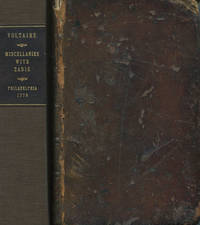
177844246Philadelphia: Printed by Robert Bell 1778. 1778. First U. S. edition. Translated from the French with notes historical and critical by T. Smollett M. D. and T. Francklin A. M. Story contained in MISCELLANIES by Voltaire. The first book on the Haycraft-Queen Cornerstone list and excessively rare—the only copy we have ever seen and it does not seem that any copies have sold at auction for more than twenty five years. Considered to be the "Great Grandfather of the Detective Story." Foxing and staining throughout. A good copy only of this seminal work bound in a full-leather contemporary binding. Housed in a cloth clamshell case with leather label on the spine and titles stamped in gold gilt. Printed by Robert Bell, 1778. hardcover
1767140947325London: Printed for J. Almon 1767. First Edition. Near Fine. First English-language edition of Cesare Bonesana di Beccaria's treatise on criminal justice reform with an added commentary by Voltaire. xii 179 lxxix pp. Bound in full contemporary mottled calf laced in boards. Morocco title label gilt tooling to spine and board edges all edges speckled red. Near Fine with light wear to covers boards slightly splayed joints worn but sound. Light toning and scattered foxing throughout more pronounced in first and last few pages. Discoloration from binder's glue to endpapers author's name penciled to front pastedown math equation penciled to back pastedown. A beautiful copy of the influential Enlightenment classic from the collection of scholar and bibliophile Arnold Meadowcroft Muirhead with his bookplate on the front pastedown. Rare. Printed for J. Almon unknown
173361360London 1733. 8vo. Bound in a lovely contemporary English Cambridge-style full calf binding with a plain spine with five raised bands. Spine a bit cracked vertically and with minor loss to capitals. Corners a bit bumped and adges of boards a bit worn. Binding overall nice and tight. Small damp stain at the lower blank corner of the first few leaves otherwise a very good clean copy on thick crisp paper. 16 -including preface contents advertisements 253 1 18 -Index pp. <br/><br/><em>The important actual first edition of this highly celebrated key work of the Enlightenment in which the anecdote of how Newton discovered gravity the story about Newton and the falling apple appeared for the first time together with the description of the difference between the physical world view of the English and the French the "plenum" and the "vacuum". This seminal work in which Voltaire famously depicts British philosophy science society and culture in comparison to French can be viewed as the Enlightenment equivalent to Tocqueville's "Democracy in America". This series of essays which is based on Voltaire's experiences when living in England was actually written by Voltaire mostly in English which he mastered to perfection. It has often been presumed that the first edition of the work was that published in French in 1734 but actually the present English edition constitutes the actual first appearance of the work as well as the version that is closest to Voltaire's intention as the French language version is the re-written one and the English version the original. Curiously almost all modern English versions are translations into English of the French edition instead of the original English version making this edition of the utmost importance.After the original English edition of 1733 two French editions soon followed the first in 1734. Unlike the British the French resented the book and already in 1734 the French Parliament issued an order for the author's arrest and condemned the work causing the impact of it in France to be delayed. The book was burned for being "dangerous to religion and civil order". At the same time the work became a bestseller in Britain and as much as 14 editions of the work were published in the eighteenth century. "Inspired by Voltaire's two-year stay in England 1726-8 this is one of the key works of the Enlightenment. Exactly contemporary with Gulliver's Travels and The Beggar's Opera Voltaire's controversial pronouncements on politics philosophy religion and literature have placed the Letters among the great Augustan satires. Voltaire wrote most of the book in English in which he was fluent and witty and it fast became a bestseller in Britain. He re-wrote it in French as the Lettres philosophiques and current editions in English translate his French." Nicholas Cronk Introduction to the Oxford's Classics edition from 1999.The great French philosopher Voltaire was greatly impressed by the philosophical and scientific achievements of the English especially those of Newton Locke and Bacon. As a disseminator of scientific knowledge Voltaire came to play a great rôle in the popularization of Newtonian science and its discoveries the present work being a prime example. Although the work was condemned by the French authorities it still came to play a great rôle in the spreading of Newtonian ideas in France. The present work generally came to play a dominant rôle in Enlightenment accounts of the history of science and philosophy. The work focuses on British science and thought and uses the accounts of these to emphasize what is lacking in French society and French thought. The work is generally very critical towards the French "ancient régime" and when Voltaire here discusses the emergence of empiricism it is viewed as an English tradition that stands in opposition to the French rationalist tradition with Descartes as the prime example. This view is taken over by the following Enlightenment historians of science and philosophy e.g. d'Alembert see for instance his "Preliminary Discourse" of 1751. Some of the most influential passages of the work are probably those on Bacon who Voltaire sees as the founder of modern experimental science Newton and Descartes. Letters XIV on Descartes and Newton XV on attraction and XVI on Newton's Optics from 1704 are among the most influential essays of the work. In XVI Voltaire reflects upon Newton's "Optics" and the way that he rejected Descartes' theory and set out his own account of the properties of light. In XV he presents the first account of Newton and the falling apple: "As he was walking one Day in his Garden and saw some Fruits fall from a Tree he fell into profound Meditation on that Gravity the Cause of which had so long been sought but in vain by all the Philosophers whilst the Vulgar think there is nothing mysterious in it. He said to himself that from what height soever in our Hemisphere those Bodies might descend their Fall wou'd certainly be in the Progression discover'd by Galileo; and the Spaces they run thro' would be as the Square of the Times. Why may not this Power which causes heavy Bodies to descend and is the fame without any sensible Diminution at the remotest Distance from the Center of the Earth or on the Summits of the highest Mountains; Why said Sir Isaac may not this Power extend as high as the Moon." pp. 127-28.But perhaps the most famous passage in the volume is the opening of Letter XIV: "A Frenchman who arrives in London will find Philosophy like every Thing else very much chang'd there. He had left the World a "plenum" and he now finds it a "vacuum". At Paris the Universe is seen compos'd of Vortices of subtile Matter; but nothing like it is seen in London. In France 'tis the Pressure of the Moon that causes the Tides; but in England 'tis the Sea that gravitates towards the Moon; so that when you think that the Moon should make it Flood with us those Gentlemen fancy it should be Ebb which very unluckily cannot be prov'd." pp. 109-10. </em> hardcover
182896178Paris: Deslangle Frères 1828-34. Finely bound set of the complete works of Voltaire with historic scientific and literary notes. Octavo 97 volumes bound in three quarters morocco over marbled boards gilt titles and tooling to the spine in five compartments within raised gilt bands marbled endpapers frontispieces with tissues guards and half titles as issued. In very good condition. A complete set covering the broad scope of the versatile and prolific writer. One of the most influential thinkers of the French Enlightenment François-Marie Arouet know by the nom de plum Voltaire was a resourceful and prolific writer. His works touched nearly every literary form including plays poems novels theoretical essays and scientific treatises. A forthright and candid advocate of civil liberties he frequently criticized the institutions of religious dogma and classism prevalent in 18th century France often doing so through satire to avoid censorship and imprisonment. Deslangle Frères hardcover
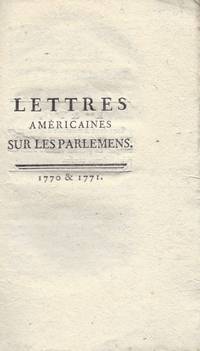
1771729S.l.: S.n. 1771. First edition. Published unbound. Stitched. First page blank but title in ink. First and last pages slightly chipped and stained. Overall in fine condition. First edition. Published unbound. Stitched. 44 4 p. A fictional correspondence between R and T “deux Américaines originaires du Port-au-Prince dans l'Isle de S. Domingue. Le premier réside a Paris depuis quelques années†two Americans from Port-au-Prince on the island of Saint-Domingue. The first lives in Paris for some years. The letters are dated between December 1770 and April 1771. The text is attributed to Voltaire and it is in favour of Maupeou’s jurisdictional reform.<br /> <p><p><br /> René Nicolas Charles Augustin de Maupeou 1714–1792 as the chief minister of the French King made a revolutionary attempt to install the enlightened despotism in France through the suppression of the power of the parliament by destroying its system and the favour of the royal authority. He also made efforts to uniform the judicial system throughout the country. <br /> <p><p><br /> Voltaire praised this revolution applauding the suppression of the old hereditary magistrature and justified the reform in several essays among them this one. <br /> <p><p><br /> Scarce and interesting publication we could trace only two copies in institutional holdings in the US.<br /> <p><p><br /> Not in Sabin.<br /> <p>. [S.n.] unknown
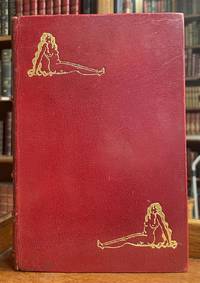
1927315984New York: Bennett Libraries 1927. hardcover. fine. Clara Tice. 8vo 10 colored etchings by Clara Tice with captioned tissue guards rubricated title page publisher's burgundy morocco by Whitman Bennett and designed by Tice with nudes to spine and front cover in gilt inner dentelles marbled endpapers top edge gilt others untrimmed. New York: The Bennett Libraries 1927. A fine copy.<br/> <br/> First Tice edition limited issue. Number 155 of 250 copies on Pannekoek paper this copy additionally signed by Tice though uncalled for in the limitation. This copy is unique as it is from the personal library of Clara Tice with her charming bookplate on the fly-leaf.<br/> <br/> Bennett Libraries unknown
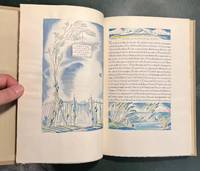
1928311598New York: Random House 1928. Limited. hardcover. fine. Kent Rockwell. Extensively illustrated throughout by Rockwell Kent with each drawing hand-colored. 112 pages. Short slim 4to handsomely rebound in 1/2 brown morocco and beige cloth boards. New York: Random House 1928. A fine copy of the special limited printing with color images printed by Elmer Adler's Pynston Printers.<br/> <br/> From a total of 1470 copies signed by Rockwell Kent this is one of only 95 hand-coloured in the studio of the artist This copy is un-numbered. A splendid production issued to celebrate the inauguration of Bennett Cerf's new company Random House. The logo for Random House used to this day comes from the final illustration in the book -- an idealized country home filled with the ideas of the Enlightenment.<br/> <br/> Random House unknown
19286045New York: Random House 1928. First Edition. Hardcover. near fine. Spectacular hand-colored edition of Candide 1 of 95 issued to celebrate the inauguration of Bennett Cerf's new company Random House. The logo for Random House used to this day comes from the final illustration in the book by Rockwell Kent depicting an idealized country home filled with the ideas of the Enlightenment. No slipcase. A beautiful book. 4to handsomely rebound in 1/2 tan morocco over the original patterned cloth which is very fresh. New York: Random House 1928. A near fine copy with just a couple of minor spots in the margins no bumps or tears. See photos. <br/><br/> Random House hardcover
17511127E001Berlin: C.F. Henning 1751. 1st Edition . Hardback. Printed pages: 12mo. 14 488 1 Errata 2 466 2 Errata. Very Good. 3.75 x 6 inches 9.5 x 15 cm. Complete in two volumes. Full calf leather bindings red leather title labels and gilt decoration to spines. Good solid bindings. Volume one has light rippling to the pages and foxing up to page 3 hole to front free endpaper and three small holes to leading blank Volume II is very clean throughout. Engraved bookplate to front endpapers Charles Grave Hudson - 1st Baronet Hudson of Wanlip Hall Leicestershire. The first edition of one of Voltaire's most important works a landmark in the development of historiography published under the alternative pseudonym M. de Francheville. A very nice example. Overall condition is Very Good. Size: 3.75 x 6 inches 9.5 x 15 cm. C.F. Henning hardcover