LOUVILLE MARQUIS DEMareMagnum

6 188 résultats
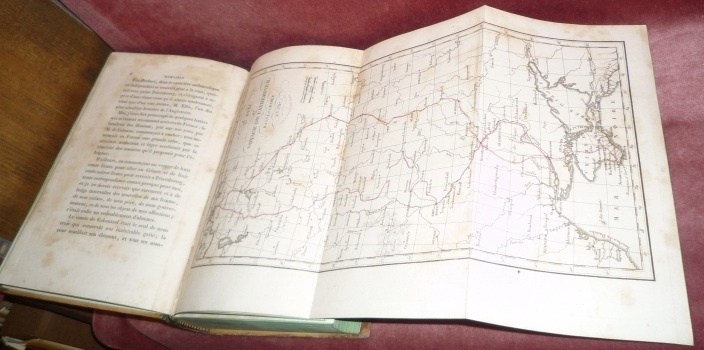
Maradan, Libraire, Paris. 1818. In-8 Carré. Relié plein cuir. Bon état. Couv. légèrement passée. Dos frotté. Intérieur acceptable. 371 pages. Pièces de titre roses sur le dos. Titre, tomaison, étoiles et filets dorés sur le dos. Tranche mouchetée. Etiquette de code sur la couverture. Quelques tampons de bibliothèque. Extraits de la Correspondance du Marquis de Louville, Gentilhomme de la Chambre de Philippe V, et Chef de sa Maison française.
SANSOT E. ET CIE. 1907. In-4 Carré. Broché. Bon état. Couv. convenable. Dos satisfaisant. Intérieur frais. 207 pages augmentées de nombreuses illustrations en noir et blanc dans et hors texte, dont certaines sous serpente et monochromes., dont le frontispice / Jaquette a 3 rabats satisfaisante. PREFACE DE PAUL ADAM / ILLUSTRATIONS DE STEINLEN * 4e EDITION
Charpentier, Libraire-Editeur, Paris. 1869. In-12 Carré. Relié demi-cuir. Bon état. Couv. convenable. Dos satisfaisant. Quelques rousseurs. 417 pages pour le tome I, 466 pages pour le tome II, 484 pages pour le tome III et 482 pages pour le tome IV. Gravures en noir et blanc en frontispices (portraits). Titres, tomaisons, fleurons, roulettes et filets dorés sur les dos. Etiquettes de code sur les couvertures. Quelques tampons de bibliothèque. Nouvelle édition d'après le manuscrit de Conrart, avec une annotation extraite des écrits de Monglat, Omer Talon, de Retz, etc., des Eclaircissements et un Index, par M. F. Riaux, et une Notice par M. Sainte-Beuve.
Librairie Plon. 1946. In-8 Carré. Relié toilé. Etat d'usage. Couv. défraîchie. Dos fané. Intérieur acceptable. 10 volumes d'env. 400-500 pages chacun, illustrés de photos en noir et blanc hors texte. Titre et codes dorés sur les dos. Range fichettes et fichette en collée au dos des 1ers plats. Tampons de bibliothèque en pages de titre. Certains plats tachés. 1. Le lendemain d'Agadir, 1912. 2. Les Balkans en feu, 1912. 3. L'Europe sous les armes, 1913. 4. L'union sacrée, 1914. 5. L'invasion, 1914. 6. Les tranchées, 1915 7. Guerre de siège, 1915. 8. Verdun, 1916. 9. L'année trouble, 1917. 10. Victoire et armistice, 1918.
Librairie Hachette et Cie, Paris. 1903. In-8 Carré. Relié. Bon état. Couv. légèrement passée. Dos satisfaisant. Quelques rousseurs. 576 pages. Gravure en noir et blanc en frontispice (portrait). Illustré de cartes en noir et rouge hors texte. Pièce de tire noire sur le dos, avec auteur, titre et filets dorés. Etiquette de code sur le dos. Tampons et annotation de bibliothèque en page de titre. Pages de garde se détachant légèrement. 2e édition. Algérie, Tunisie, Tonkin, Sahara, Congo, Madagascar, Soudan. Avec un portrait en héliogravure et 11 cartes accompagnant le texte.
Société de l'Histoire du Protestantisme Français, Paris. 1857. In-8 Carré. Relié. Bon état. Couv. convenable. Dos satisfaisant. Quelques rousseurs. 345 pages pour le tome I et 419 + 16 pages pour le tome II. Auteurs, titres, tomaisons et filets dorés sur les dos. Etiquettes de code sur les couvertures. Quelques tampons de bibliothèque. (Rare) Publiés pour la Société de l'Histoire du Protestantisme Français d'après le manuscrit conservé aux Archives de l'Etat à La Haye, par Francis Waddington.
FLAMMARION. 1953. In-8 Carré. Broché. Bon état. Couv. convenable. Dos satisfaisant. Intérieur frais. 650 + 522 + 596 pages- quelques facs-similés et cartes en noir et blanc hors texte
Stavenow-Hidemark, ElisabNot in perfect condition. unknown
Very Good French Modern 1/3 red leather bdg. with five compartments on spine. Demy 8vo. (21 x 14 cm). In French. [xi], 480 p. La Turquie en 1864. Bertrand Camille Collas, born in Bordeaux in 1819 (died 1898), was a sailor for 15 years before devoting himself to politics. His first stay in Turkey dates from 1841-1842 and the second from 1860. Thanks to his good knowledge of the country and its important characters, he was able to follow the progress of political, diplomatic and commercial developments since the accession of Sultan Abdulaziz. This study takes stock this evolution whose aim was to transform the Ottoman Empire into a modern state taking the example of the European model.
2000267085Golden: Golden and District Historical Society 2000. First edition. hardcover. good/no dustjacket. 4to. pp.420 heavy book additional postage will apply; front end page missing Golden and District Historical Society hardcover
Very Good Turkish Modern cloth bdg. 4to. (27 x 20 m). In Turkish. 201 p., 7 military plans in the end-pocket (no missing). Türklerle beraber Süveys Kanalina. Translated by Mazhar Besim Özalpsan. Scarce First Edition. Only one copy located in OCLC: 69392693 (Bogaziçi University Library). Kress von Kressenstein was a German general from Nuremberg. He was a member of the group of German officers who assisted in the direction of the Ottoman Army during World War I. Kress von Kressenstein was part of the military mission of Otto Liman von Sanders to the Ottoman Empire, which arrived shortly before World War I broke out. Kress came from a patrician family in Nuremberg. His father, Georg Kress von Kressenstein (1840-1911), was a high court judge. Kress von Kressenstein joined the Bavarian army as an ensign in the artillery in 1888. In Palestine during the WW 1, Kress joined Djemal Pasha's army in Palestine as a military engineer and was later chief of staff. Djemal Pasha was given the job by the Turkish leader Enver Pasha of capturing or disabling the Suez Canal. This effort is called the First Suez Offensive, and it occurred in January 1915. Kress von Kressenstein was responsible for creating special boats for crossing the canal (pontoons) as well as organizing the crossing of the Sinai desert. While the desert was crossed with little loss of life, the British were aware of their approach and their attack on the Suez came as no surprise to the defenders. The Ottoman forces were repulsed easily and after two days of fighting, they retreated. Kress von Kressenstein's special pontoons were never used. More than a year passed when the Ottomans tried a second attack on the Suez. With Djemal Pasha directing affairs from his base in Damascus, Kress von Kressenstein led a larger Ottoman army across the Sinai desert, again. This attack ran into a strong British defensive fortification at Romani, 40 kilometres (25 mi) east of the canal. The Ottoman army prepared a major set-piece assault on Romani, scheduled for 3 August 1916. The attack was beaten off and again the Ottomans retreated back to their bases in Palestine. The British responded with an attack of their own. They captured some small Ottoman forts in the Sinai, built a railroad and water pipe across the desert and then launched an assault on the Ottoman fort at Gaza. Kress von Kressenstein was in charge of the Ottoman defences along with General Tala Bey. In the First Battle of Gaza (March 1917), the British were defeated, largely due to their own errors. In the Second Battle of Gaza in April 1917, the British were defeated again, the credit for this victory largely going to Kress von Kressenstein. The British removed their unsuccessful generals and replaced them with General Allenby. The Ottomans also replaced their top leadership, bringing in the former Chief of the German General Staff, General von Falkenhayn. Kress von Kressenstein was kept on as commander of the Ottoman 8th Army defending Gaza and he was also awarded Prussia's highest order, the Pour le Mérite. In November 1917, the British under General Allenby breached the Ottoman defensive positions at the Battle of Beersheba and the Third Battle of Gaza. Kress von Kressenstein was able to withdraw his defeated troops in fairly good order to new defensive positions in the north. In the middle of 1918, with the Ottoman-German alliance breaking down, Kress von Kressenstein was sent with a small German force to Georgia (Caucasus), that was protected by Germany after its independence. He helped to frustrate the Red Army's invasion of Georgian region Abkhazia. (Source: Wikipedia). This is the first and only Turkish translation of his memoirs in Palestine during World War 1.
59271Paris, Alexis Eymery 1824 - 1826, 210x125mm, 526 + 438 + 601pages, reliure demi-basane. Titres et tomaison dorés aux dos des ouvrages. Plats marbrés. Ornementation dorée des tome second et troisième qui ne sont pas reliés de même manière que le le tome premier, plus simple dans son aspect. En bon état, excepté quelques rousseurs.
1879AUB-2779Paris, G. Charpentier 1879. Bon exemplaire relié, reliure demi veau, dos orné avec titres dorés, in-12, XXIX + 324 pages avec annexes + articles insérés en tête de volume.
46758Hachette & Cie.1894.Gd.in-8 demi-relié à coins.272 p.Nombreuses planches en couleurs. TBE.Tète dorée.Dos à 5 nerfs ornés.Pièce de titre.
1838218871838 PARIS, BELLOYE,1838.1 volume sur 5,reliure epoque demi basane dos frotté,VIII-368p.,texte a 2 colonnes, 297 gravures et cartes,militaires en noir,bon etat
Very Good Turkish, Ottoman (1500-1928) Original map. Oblong elephant folio. (50 x 60 cm). In Ottoman script. Scale: 1/200.000. [MAP of Ankara city]. Ankara. Gerede, Keskin, Sivrihisar. A rare Ottoman map printed in last period shows Ankara city with detailed place names. This is one the serie of the Bonn projection maps which are the first map series in modern techniques in Turkey and the Ottoman Empire. In order to produce these maps covering Turkish territory, Reconnaissance Branch was incorporated into The Mapping Commission. The maps were produced in the datum based on the latitude and longitude of Ayasofya Mosque in equal area Bonn Projection. The field works for the 123 sheets covering the country were conducted by 76 staff. The production was completed in 18 years starting from east west. Field works continued without stopping except in years 1914 and 1920. This map series called also reconnaissance maps contributed a lot to producing 1:25.000 scale maps.
Very Good Turkish, Ottoman (1500-1928) Original color map. Atlas folio. (55 x 46 cm). In Ottoman script. Scale: 1/400.000. [OTTOMAN MAP of CAUCASIA] Yekaterinodar - Yeysk - Maykob - Anapa. Shows Krasnodar, Maikop, Yeysk, Anapa and shores of Black Sea. At northeast, map shows Kuban river (Kuban nehri) and its basin in Circassia (Republic of Adygea). Maykop is the capital city of the Republic of Adygea in Russia, located on the right bank of the Belaya River (a tributary of the Kuban River). Yekaterinodar (Krasnodar) at north of map, near to Maykop. From northwest to south east, map shows Black Sea shores of the extensive area with interesting details in Ottoman Turkish script. Also shown Belaya, Chokhrak and Dakh Rivers in addition all south land of Krasnodar Krai of the Northwestern Caucasus until southern Georgian borders and Georgia. Almost all toponyms are in Ottoman Turkish.
Very Good Turkish, Ottoman (1500-1928) Original color map. Elephant folio. (60 x 50 cm). In Ottoman script. Scale: 1/300.000. [MAP of KRASNODAR - YEYSK] Yeysk. Bedlapaglia, Yekaterinodar, Anapa. Shows Yeysk, a port and a resort town in Krasnodar Krai, Russia, situated on the shore of the Taganrog Gulf of the Sea of Azov in north, Yekaterinodar (Krasnodar) in south, Anapa (Bigurkal) etc.
Very Good Turkish, Ottoman (1500-1928) Original color map. Elephant folio. (60 x 50 cm). In Ottoman script. Scale: 1/300.000. [MAP of KRASNODAR - YEYSK] Yeysk. Bedlapaglia, Yekaterinodar, Anapa. Shows Yeysk, a port and a resort town in Krasnodar Krai, Russia, situated on the shore of the Taganrog Gulf of the Sea of Azov in north, Yekaterinodar (Krasnodar) in south, Anapa (Bigurkal) etc.
Very Good Russian Original concert advert in Russian with autograph signature and inscription by Turkish female pianist Idil Biret. (21x14 cm). Printed advert in Russian, inscription and signature in Turkish. 4 p. Signed to Turkish diplomat Ismail Berduk Olgaçay, (1925-). [Concert advert of Idil Biret, Moskovskaia Gosudarstvennaia Filarmoniia with autograph signed Biret to Turkish diplomat Ismail Berduk Olgaçay]. Illustrated cover. Rare.
Very Good English In modern half morocco, embossing and with original marbled. [v], 382 p. Cr. 8vo. (20 x 14 cm). In French. Johann Konrad Kern (11. Juni 1808 in Berlingen TG; 14. April 1888 in Zürich; auch: Johannes Conrad Kern) war ein Schweizer Jurist und Nationalrat aus dem Kanton Thurgau. Er diente später als schweizerischer Diplomat in Wien und Paris (dort als 'Minister', entspricht 'Botschafter'). Kern ist als einer der bedeutendsten Staatsmänner des 19. Jahrhunderts in die Schweizer Geschichte eingegangen. Er startete seine politische Laufbahn als Kantonsrat von 1832 bis 1853. Neunmal war er Kantonsratspräsident. Von 1832 bis 1852 war er auch im Erziehungsrat. 1837-50 war er Oberrichter und Präsident der kantonalen Justizkommission. Die Gründung der Thurgauer Kantonsschule im Jahr 1853 war ein Verdienst von ihm. Kern war u.a. Redaktor der Bundesverfassung von 1848, erster Präsident des Bundesgerichtes, Mitglied des Nationalrates (1848-54) und des Ständerates (1855-57), Präsident des Nationalrates 1850/51, Schweizerischer Schulratspräsident, Mitbegründer der ETH Zürich und von 1857 bis 1883 Schweizerischer Gesandter in Paris. Als Diplomat zeichnete er sich mehrfach als Friedensstifter aus. Am 150. Jahrestag der Thurtal-Bahnlinie wurde im Mai 2005 ein ICN-Neigezug der SBB auf den Namen Minister Kern getauft. "Johann Conrad Kern, (born June 11, 1808, Berlingen, Thurgau, Switz.-died April 14, 1888, Zürich), longtime Swiss minister to France and one of the authors of the Swiss federal constitution of 1848. A lawyer and doctor of jurisprudence, Kern was, after 1837, the guiding spirit of Thurgau's cantonal government, especially in the administration of justice. As deputy to the national Diet, he was almost alone in opposing (1838) the extradition of Louis-Napoléon Bonaparte, the nephew of Napoleon, who was trying to overthrow the French government. He combated the clericalist policies of the dissident Sonderbund league of seven Catholic cantons, ultimately proposing its suppression. (Source: Encyclopaedia Britannica).".
New New English Original bdg. Dust wrapper. Folio. (34 x 24 cm). In Turkish. 2 volumes set: ([xvi], 195 p., 31 plates.; 247 p., ills., 33 plates, 3 folding maps). Pamphylia ve Pisidia kentleri. 2 volumes set. Vol. 1: Pamphylia. Vol. 2: Pisidia. Translated by Selma Bulgurlu Gün.
Fine Turkish, Ottoman (1500-1928) Paperback. Pbo. Cr. 8vo. (20 x 14 cm). In Ottoman script. 31 p. Hegira 1334 = Gregorian 1918. Özege 9199. First and Only Edition. Said Halim Pasa was a statesman who served as the Grand Vizier of the Ottoman Empire from 1913 to 1917. Born in Cairo, Egypt, he was the grandson of Muhammad Ali of Egypt, often considered the founder of modern Egypt. He was one of the signers in Ottoman - German Alliance. Yet, he resigned after the incident of the pursuit of Goeben and Breslau, an event which served to cement the Ottoman-German alliance during World War I. It is claimed that Mehmed V wanted a person in whom he trusted as Grand Vizier, and that he asked Said Halim to stay in his post as long as possible. Said Halim's term lasted until 1917, cut short because of continuous clashes between him and the Committee of Union and Progress, which by then controlled the Imperial Government of the Ottoman Empire. During the court martial trials after World War I in the Ottoman Empire, he was accused of treason as he had his signature under Ottoman - German Alliance. He was exiled on 29 May 1919 to a prison on Malta. He was acquitted from the accusations and set free in 1921, and he moved to Sicily. He wanted to return to the Istanbul, the capital of the Ottoman Empire, but this request was rejected. He was assassinated soon after in Rome by Arshavir Shiradjian, an agent of the Armenian Revolutionary Federation, for his alleged role in the Armenian Genocide. Other sources, however, stated that he was unrelated to the Genocide. This intellectual study of him on self-experiences of decline and fall of Islamic world, view and thought. Extremely rare.
Very Good Turkish, Ottoman (1500-1928) Original color map. Atlas folio. (55 x 46 cm). In Ottoman script. Scale: 1/400.000. [OTTOMAN MAP of CAUCASIA] Yekaterinodar - Yeysk - Maykob - Anapa. Shows Krasnodar, Maikop, Yeysk, Anapa and shores of Black Sea. At northeast, map shows Kuban river (Kuban nehri) and its basin in Circassia (Republic of Adygea). Maykop is the capital city of the Republic of Adygea in Russia, located on the right bank of the Belaya River (a tributary of the Kuban River). Yekaterinodar (Krasnodar) at north of map, near to Maykop. From northwest to south east, map shows Black Sea shores of the extensive area with interesting details in Ottoman Turkish script. Also shown Belaya, Chokhrak and Dakh Rivers in addition all south land of Krasnodar Krai of the Northwestern Caucasus until southern Georgian borders and Georgia. Almost all toponyms are in Ottoman Turkish.