12 326 résultats
As New English Original bdg. In publisher's original slip-case. Elephant folio. (66 x 50 cm). In French and English. Color and b/w ills. 144 p., 49 plates., 3 maps. Another superb facsimile edition of a very rare book by Ertug & Kocabiyik. In 1795 the Alsace-born Antoine Ignace Melling, who had come to Constantinople to seek his fortunes, was appointed imperial architect by the Ottoman Sultan Selim III. During his tenure in that position, he also designed and landscaped a seaside palace for Selim's sister, Princess Hatice. While in Constantinople, Melling executed a number of astonishing panoramic views of the city and its environs.Melling returned to Paris in about 1803. In 1809 he set up an engraving studio for the purpose of reproducing these drawings. The completed images were published as a series of fascicles that were sent out to subscribers. The last one appeared in 1819. The Ertug & Kocabiyik facsimile edition of the complete book is produced from the original "elephant folio", an unfolded first edition in the collection of Ahmet Ertug. The technical aspects of the project were done under the supervision of Mr. Ertug in Switzerland by some of the world's leading facsimile specialists. This outstanding facsimile edition is available in two different bindings. One is bound in sturdy Japanese cloth and the other is a very limited edition of only 50 copies bound in leather that is intended for connoisseurs of exceptionally fine books. The binding and decoration of all the leather-bound copies were done by hand. The book measures 50 by 66 cms. The foldout image plates are 65 by 97 cms. There are 48 views of Constantinople in the late 18th century and also three maps. The publishers also offer an edition of the unfolded image plates presented in a leather-bound case. Only 25 copies of this version have been produced. The text for this edition is bound separately and presented in a pocket in the leather case. The descriptions of the views in the facsimile edition are in the original French and an English translation is also provided. The Ertug & Kocabiyik facsimile edition of "Voyage pittoresque" is an outstanding achievement and one that is certain to appeal to collectors of rare books and to those who admire beautiful art objects.
236772Auxerre, Perriquet, 1851-1853 2 parties en 1 vol. in-8, (4)-247 pp et (4)-III-177 pp., 1 planche de musique repliée, 1 tableau replié, 3 pp. de pièces justificatives, 3 pp. de table, maroquin parme, dos à nerfs, tranches dorées, double filet doré sur les coupes, large dentelle intérieure, couverture conservée (Lortic).
156587951565 Si la dimension des reliures (128 x 86 mm) est identique pour les trois volumes, il nen va pas de même pour le bloc de chacun des volumes, même si leurs marges sont à peu près les mêmes: celui du premier volume mesure 126 x 82 mm; celui du second 120 x 74 mm; celui du troisième 120 x 72 mm. Reliures uniformes en plein veau fauve moucheté, filet à froid sur les plats, dos à nerfs ornés, pièces de titre en maroquin rouge, tranches rouges, larges dentelles intérieures dorées, gardes de papier blanc dominoté à points et étoiles dor (reliure du XVIIIe siècle). Titre et collationnement des trois volumes:Recueil des choses mémorables faites et passées pour le faict de la Religion & estat de ce Royaume, depuis la mort du Roy Henry II jusques au commencement des troubles. Premier volume, S. l., s. n. e., 1565. Petit in-8° ou in-16° (126 x 82 mm) de [24] + 883 + [1] pages, avec les signatures en chiffres romains. Histoire de nostre temps contenant le recueil des choses mémorables passées & publiées pour le faict de la Religion & estat de la France. Depuis la publication de lédict de janvier 1561, jusques à la déclaration faicte par le Roy de sa majorité, 1563. Second volume, s. l., s. n. e., 1566. Petit in-8° ou in-16° (120 x 74 mm) de 1047 + [1bl] + [10] pages, avec les signatures en chiffres arabes. Histoire de nostre temps, contenant le recueil des choses mémorables, passées & publiées pour le faict de la Religion & estat de la France, depuis la majorité du Roy, 1563, jusques en lan 1565. Troisième volume. S. l., s. n. e., 1567. Petit in-8° ou in-16° (120 x 72 mm) de 1051 + [4] + [1bl] pages, avec les signatures en chiffres arabes. Ex-libris rectangulaire au nom dAndré Gutzwiller (1922 2014), banquier et bibliophile bâlois.
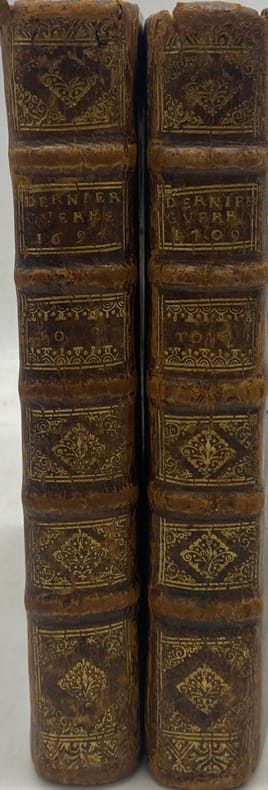
216041S.l., s.d. (1726) 2 vol. in-4, titre, 155 ff., ff. 47-49 reliés par erreur après 51, avec 12 tableaux dépliants hors texte ; titre, 137 ff. (avec de nombreuses erreurs de chiffrage), avec 29 pièces dépliantes hors texte, manuscrites ou imprimées, écriture moyenne et d'une lisibilité variable (environ 30 lignes par page), basane brune granitée, dos à nerfs cloisonnés et fleuronnés, tranches mouchetées de rouge (reliure de l'époque). Dos légèrement frottés.
Very Good English Modern full leather each volumes in traditional Ottoman style. Roy. 8vo. (25 x 17 cm). In Ottoman script. Last 2 volumes are in Modern Turkish. 10 volumes set: ([23], 674, [10] p.; 479, [5] p.; 534, [5] p.; 432, [4] p.; 602, [6] p.; [4], 554, [5] p.; [21], 912 p.; [1], [5], 786, [4] p.; 892 p.; 1112 p)., folding maps, b/w plates. 1896 - 1938. Their contents are: Vol. 1: Description of Contantinople and environs, as of 1631. Vol. 2: Journey to Brousse and Nicomedia, 1640, Pontus, Caucasus and Crimea, 1640-44.i expedition to Crete, 1645; journey to Erzerum and Caucasus, 1648. Vol. 3: Syria, Kurdistan, Armenia, 1650; Roumelia, Bulgaria and Dobrudja, 1655-56. Vol. 4: Persia and Iraq, 1655-56. Vol. 5: Journey to Moldavia and expeditions to Transylvania and Russia, 1658; to Anatolia, then across the Dardanelles to Adrianople, 1659; expeditions to Moldavia and Dalmatia, 1660. Vol. 6: Expedition to Transylvania and journey to Albania, 1661-62; expeditions to Hungary, Montenegro and Croatia, 1663-64. Vol. 7: Austria, Crimea, Daghestan, Caucasus, Astrakhan. Vol. 8: Crimea, Crete, Salonica, Roumelia (Greece). Vol. 9: Pilgrimage to Mecca and Medina. Vol. 10: Egypt. Evliya Çelebi was son of the chief court jeweler, he was educated in a madrasah (Islamic college) and a Qur?an school in Constantinople; and, excelling as a Qur'ân reciter, he was shown favour by the reigning sultan, Murad IV. Entering the Ottoman palace school, he developed skills in Arabic, calligraphy, and music. Under the patronage of the court he began the journeys that took him from Belgrade to Baghdad and from Crimea to Cairo, sometimes as an official representative of the government and sometimes on his own. The result of these travels was his masterwork, the Seyahatname (1898-1939; 'Book of Travels'). This work is also referred to as the Tarih-i seyyah ('Chronicle of a Traveler'). Evliya possessed a vivid imagination, occasionally mixing fact and fantasy; he described places he could not possibly have visited. Noted for his fascinating anecdotes and charming style, he wrote about the ethnography, history, and geography of the Ottoman Empire and neighbouring lands and about the inner workings of the Ottoman government during the 17th century. (Source: Britannica). Currently there is no English translation of the entire Seyahatname, although there are translations of various parts. The longest single English translation was published in 1834 by Joseph von Hammer-Purgstall, an Austrian orientalist: it may be found under the name "Evliya Efendi." Von Hammer-Purgstall's work covers the first two volumes (Istanbul and Anatolia) but its language is antiquated. Other translations include Erich Prokosch's nearly complete translation into German of the tenth volume, the 2004 introductory work entitled The World of Evliya Çelebi: An Ottoman Mentality written by University of Chicago professor Robert Dankoff, and Dankoff and Sooyong Kim's 2010 translation of select excerpts of the ten volumes, An Ottoman Traveller: Selections from the Book of Travels of Evliya Çelebi. Evliya is noted for having collected specimens of the languages in each region he traveled in. There are some 30 Turkic dialects and languages cataloged in the Seyâhatnâme. Çelebi notes the similarities between several words from the German and Persian, though he denies any common Indo-European heritage. The Seyâhatnâme also contains the first transcriptions of many languages of the Caucasus and Tsakonian, and the only extant specimens of written Ubykh outside the linguistic literature. First Printed Set of Evliya Chalabi's book(s) of travels. Voyages and Travels in Greece, the Near East and adjacent regions made previous to the year 1801; being a part of a larger catalogue of work on geography, cartography, voyages and travels, in the Gennadius Library in Athens, compl. by Shirley Howard Weber, Vol. II: 1631.; TBTK 10360.; Özege .; Only 2 copies located in OCLC as set: 80395042. Rare as set.
203733[Compiègne], Imprimerie de Compiègne, 1925 3 vol. in-4, 329 pp., 374 pp. et 360 pp., cartonnage papier imprimé crème (rel. de l'éditeur).
163871Paris, Michel Lévy, 1861-1864 15 vol. in-8, demi-chagrin brun, dos à nerfs, filets dorés (reliure de l'époque).
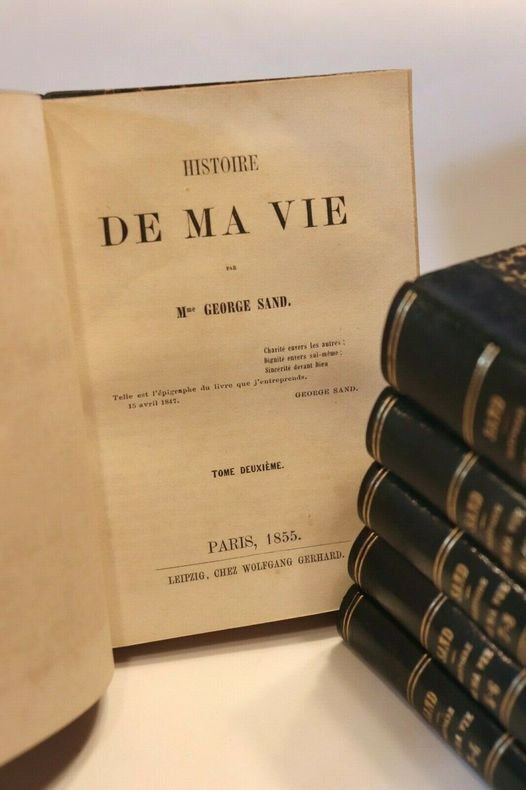
1855AMO-3658Paris, 1855. Leipzig, chez Wolfgang Gerhard [Typographie de L. Schnauss] 13 tomes reliés en 6 volumes petits in-12 (14 x 10 cm) de 162, 166, 147, 171-(1), 164, 160, 160, 160, 164, 160, 160, 160 et 154-(6) pages. Collationné complet. Reliure demi-basane maroquinée bleue nuit, dos lisses ornés de filets dorés en guise de faux-nerfs, auteur, titre et tomaisons dorés, plats de papier marbré. Reliures homogènes, décoratives et solides. Quelques légers frottements, intérieurs frais en dépit de rousseurs et brunissures du papier localisées essentiellement aux premiers et derniers feuillets. Bon papier pour l'ensemble de la série. Très rare édition non autorisée ou préfaçon publiée à Leipzig très peu de temps après le lancement de l'édition française en volumes à Paris par Lecou (1854-1855, 20 volumes in-8). La plupart des bibliophiles peuvent abandonner l'idée de trouver à bon compte et en belle condition d'époque la très rare édition originale publiée entre 1854 et 1855 en 20 volumes in-8 à Paris chez Lecou. L'édition primitive et la seule que l'on rencontre assez souvent, elle celle donnée l'année suivante (1856) en 10 volumes in-18 par Michel Lévy frères. Le texte d'Histoire de ma vie avait été publié en feuilleton dans La Presse entre le 5 octobre 1854 et le 17 août 1855 (138 numéros). L'édition dont nous donnons ici le descriptif est une édition non autorisée (clandestine ou contrefaçon pourrait convenir) dont l'histoire et le détail mérite d'être donné, tant pour sa rareté avérée que pour ses particularités bibliographiques. Voici quelques éléments qui permettent de situer dans le temps ce tirage spécial de Leipzig. On trouve dans notre exemplaire, et ce uniquement à partir du quatrième tome, un timbre encré circulaire portant mention "SAECHS. FRANZOES. VERTRAG. 1856" qui signifie : traité conclu entre la Saxe et la France. Ce cachet signifie que les volumes sur lesquels il est apposé ont été soumis aux stipulations du traité conclu en 1856 entre la Saxe et la France sur la propriété littéraire. Ce traité a été promulgué le 14 juin 1856. En résumé il s'agit d'un traité qui protège l'un et l'autre pays, France et Saxe, contre les contrefaçons (éditions non autorisées) et ce de manière bilatérale. A cette époque, Leipzig, comme d'autres villes d'Europe (Bruxelles notamment), est un véritable centre de la contrefaçon en matière d'édition des auteurs, français notamment. Plutôt que de détruire les éditions lancées sur la marché avant le printemps 1856, il a été décidé de faire un inventaire complet des fonds des libraires de Leipzig et des autres villes de Saxe afin de recenser ces éditions non autorisées. Plutôt que de les détruire (au détriment des libraires et imprimeurs locaux) il a été décidé de faire apposer systématiquement ce cachet encré, stigmatisant ainsi de manière claire et nette tout volume publié sans l'accord de l'auteur. Les exemplaires non revêtus de ce timbre encré étaient passibles de confiscation et de destruction tant chez les imprimeurs et libraires-éditeurs. De ceci découlait une taxation à l'importation sur le sol français (20 francs pour 100 kg pour les livres et brochures). Tout finit toujours par s'acheter ... y compris les droits d'auteurs ... au kilo ! De ce fait, les exemplaires de cette édition (dont nous ne savons pas le chiffre du tirage) ont dû être assez peu répandus sur le sol français. Sans doute même de très nombreux exemplaires, non revêtus du timbre encré, ont-ils été détruits par l'administration française. Tous ces éléments font que cette série, complète en 13 tomes, est devenue fort rare. Il fait maintenant nous arrêter au contenu de ces 13 tomes. Nous avons comparé minutieusement le détail des chapitres entre l'édition définitive de 1876 (la dernière revue par l'auteur), l'édition originale de 1855 en 20 volumes in-8 (Lecou) et notre édition de 1855 (Leipzig). Il s'avère que plusieurs différences notables sont à signaler. Le découpage des parties est différent (pour s'adapter matériellement au format de l'édition de Leipzig, en 13 volumes contre 20 volumes pour l'originale). Par ailleurs, on constate dans l'édition de Leipzig (1855) la suppression du chapitre VI (première partie), chapitre consacré au Maréchal de Saxe (ce n'est sans doute pas un hasard si ce chapitre a été supprimé de cette édition ... de Saxe). Il faut remarquer ensuite, chapitres après chapitres, de nombreuses suppressions de paragraphes (notamment et plus particulièrement aux chapitres VII, VIII, IX, X, XI, XII, et plusieurs autres. Ces suppressions sont-elles dues à une auto-censure de l'éditeur de Leipzig ou bien un allègement du texte (pour gagner du volume ...) concernant des chapitres jugés "non essentiels". L'affaire serait à creuser et mérite toute l'attention des bibliographes à naître. Quoi qu'il en soit, il en résulte que cette édition de Leipzig présente donc un texte allégé de plusieurs chapitres et paragraphes. Difficile d'imaginer que George Sand n'ait pas eu vent de cette édition "pirate" venue de Saxe. Qu'en a-t-elle pensé ? écrit ? dit ? Peut-être sa correspondance en fait-elle mention ? Nous n'avons rien trouvé à ce sujet. Nous avons trouvé trace d'une édition de Berlin (F. Schneider, [ca 1855], 20 tomes - CCfr, B.M. Rennes, cote HP 4604/1-20), et une autre aussi à Leipzig (chez Auguste Schnee) en 11 vol. in-16 donnée comme la pré-façon (pré-originale de l'édition Lecou). Ces trois éditions de Leipzig et Berlin, trois préfaçons, montrent assez l'engouement pour ce texte dès sa publication dans La Presse. Histoire de ma vie n'est pas une biographie linéaire. C'est un choix de morceaux de la vie de George Sand. Les premiers volumes sont tout entiers consacrés à l’ascendance de bonne dame de Nohant. Sa famille, ses relations, ses émotions, sa jeunesse. Il faut d'ailleurs attendre longtemps au fil des pages avant même d'avoir la naissance de l'auteur de la Mare au diable. Les derniers volumes contiennent l'histoire de George Sand écrivain, du milieu littéraire dans lequel elle a évolué. Rédigée à partir de 1847, cette Histoire de ma vie sera reprise et abandonnée cent fois jusqu'à sa publication en 1854-1855. Ses relations avec Balzac, Sainte-Beuve, Delacroix, etc., sont l'occasion de récits vifs, enjoués et naturels. George Sand a placé en exergue de ces volumes les vers suivants : "Charité envers les autres ; Dignité envers soi-même ; Sincérité devant Dieu." On regrettera simplement que sa sincérité devant Dieu ne lui ait pas permis (autorisé) de publier quelques belles pages de ses amours tumultueuses (charité envers les autres ou dignité envers soi-même ?). "Lorsqu’en 1847 George Sand, qui a déjà fait paraître ses plus grands romans, entreprend à quarante-trois ans son Histoire de ma vie, elle définit ainsi son futur livre : « C’est une série de souvenirs, de professions de foi et de méditations dans un cadre dont les détails auront quelque poésie et beaucoup de simplicité. Ce ne sera pourtant pas toute ma vie que je révélerai. » Son modèle n’est pas Rousseau, ni d’ailleurs les Mémoires d’outre-tombe qui vont commencer à être publiés et où elle voit trop de pose et de drapé. Son ambition n’est pas d’inscrire sa vie dans le mouvement de l’Histoire, mais d’offrir le récit d’une existence de femme et d’écrivain qui côtoie rapidement Balzac et Sainte-Beuve, l’abbé de Lamennais et le socialiste Pierre Leroux – et bien sûr Musset et Chopin. [...] si d’autres femmes, avant Sand, ont écrit des mémoires, la singularité de son Histoire de ma vie est qu’on y découvre pour la première fois le récit de formation d’une jeune fille qui a voulu être artiste – mais un récit sans égotisme parce que au miroir de sa propre existence elle désire que se retrouvent tous les autres enfants du siècle : « Ecoutez ; ma vie, c'est la vôtre. »" (Brigitte Diaz, Histoire de ma vie, édition Classiques, Le Livre de Poche, 2004). Sauf erreur de notre part, aucun exemplaire de cette préfaçon (Leipzig, Wolfgang Gerhard, 1855) ne se trouve répertorié au Catalogue Collectif des Bibliothèques de France (CCfr). Ce morceau d'histoire de sa vie est un texte majeur de la littérature intimiste du XIXe siècle. Très rare édition. Bel exemplaire en agréable condition d'époque.
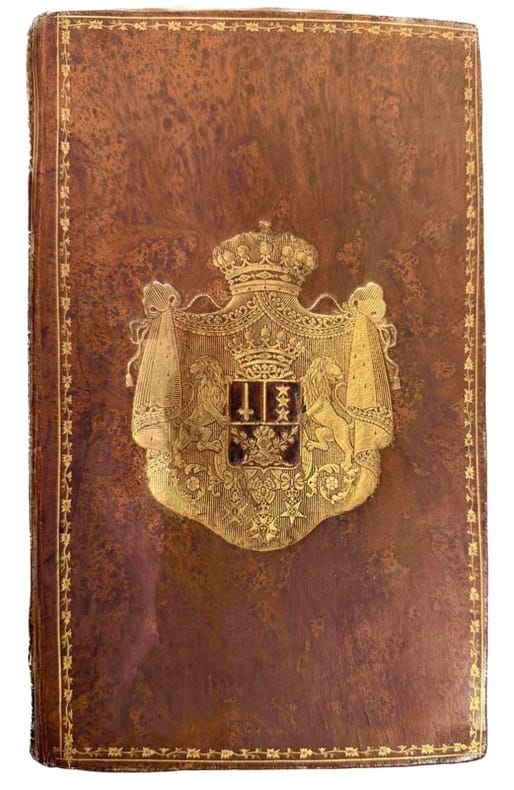
244020Paris, J. G. Dentu, 1815 in-8, XXII-222 pp., errata, veau fauve granité, dos lisse orné, roulette et filet dorés en encadrement sur les plats, armes au centre, tranches marbrées (reliure de l'époque).
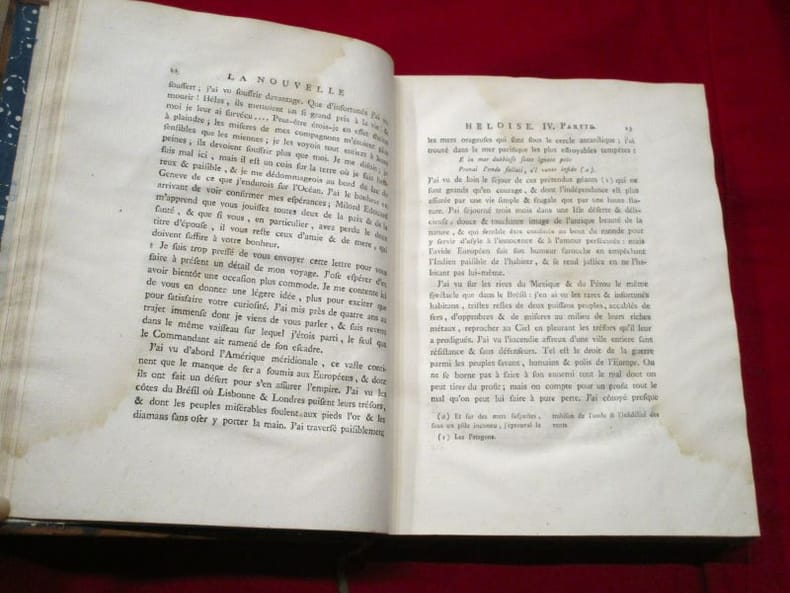
17821170211782 in-4 A Genève, [sans éditeur], 1782, 17 volumes in-4 de 200x255 mm environ, de 460 à 700 pages par volumes, contient un portrait en frontispice d'après La Tour, 35/37 planches (figures de Moreau et Le Barbier) et 24 planches de musique. Plein cuir porphyre, dos à cinq nerfs portant titres et tomaisons dorés sur pièces de cuir vert foncé, caissons à fleurons dorés aux entrenerfs, encadrements à froid sur les plats, filet doré sur les coupes, gardes bleu roi à motifs peints, tranches mouchetées de bleu. Bel état général malgré les défauts indiqués aux reliures (des coiffes et des coins émoussés, discrets et épars trous de ver sur les cuirs et gardes, des frottements, un plat restauré), un tampon d'ex-libris sur chaque page de faux-titre, 2 planches manquantes, une quarantaine de feuillets avec traces importantes de mouillure (Nouvelle Héloïse), auréoles marginales au tome XVI sans atteintes au texte (Confessions), sinon intérieur frais.
Very Good Turkish, Ottoman (1500-1928) Original wrappers. Foolscap 8vo. (18 x 13 cm). In Ottoman script (Old Turkish with Arabic letters). 112 p. On the first page, written 'copies without seals are fake', and this copy is with a seal. Slightly faded and chipped on extremities. Foxing on first pages. Uncut marginal extremities Otherwise a good copy. Exceedingly rare first edition of the first Ottoman voyage to Cape of Good Hope and first-hand travel account of the Ottoman qadi Abubakr Effendi (1814-1880) of South Africa and Mozambique, who was sent in 1862 by Sultan Abdulaziz at the British Queen Victoria's request in order to teach and assist the Muslim community of the Cape Malays. The presence of the Muslim population in South Africa dates back to the 16th century, South Africa and the Cape of Hope have become a colony of Western countries such as Portugal, the Netherlands, and the United Kingdom. The Ottoman Empire was interested in the Far East, Javanese, and South African regions in the 16th century and then tried to establish a relationship. The direct relationship between the Ottoman Empire and South Africa in the 19th century, upon the request of the Muslim people and England, was formed through Abubakr Effendi. The Muslims in conflict with various religious issues have found the remedy by consulting a scholar from the Ottoman Empire through England. After all, Abubakr Effendi reached Cape Town in 1862 and tried to resolve the conflicts among the Muslim people. (Abubakr Effendi: An Ottoman Scholar in South Africa in the Nineteenth Century: Yilmaz, Yusuf). "Abubakr Efendi was sent to Cape Town by Ottoman Sultan Abdulaziz. When chaos reigned in the Islamic society because of the imams who declared themselves as leaders in the region, Muslim leaders in Cape of Good Hope conveyed their letters to the Queen of England in 1862 declaring that they needed a religious leader. Since they had not been educated for years, they had forgotten their Java language and could not read their own books. They sent a letter to the Queen of England, informing them that help could be sought from the Ottoman court, the center of Muslim countries in the period. The issue was refused in the Parliament and the Ottoman Ambassador Musurus Pasha was offered it to the Ottoman Sultan. Abubakr Effendi's mission was to prevent Muslims in Cape of Good Hope to clash with each other and teaching them authentic Islamic knowledge free of superstition. Although Abubakr Efendi had some Arabic translators in his service, he still learned English and African languages in a short time and wrote books in order to benefit the Muslims there. On the fifteenth day he set foot on the continent, he opened a madrasah called the "Ottoman School" and enrolled three hundred students in twenty days. He traveled to Mauritius and Mozambique. He wrote his famous book 'Bayan al-Din' (a sort of catechism) in Afrikaan in Arabic letters. Then he married Rukiye Hanim, but they divorced after a while since they had to communicate by using an English and Arabic dictionary. Then he married James Cook's nephew Tahota Saban Cook. In his memoir, Ömer Lütfi wrote down all the travels of Abubakr Efendi for two years. Abubakr Efendi stayed in South Africa for 22 years and died there." (140 yillik miras: Güney Afrika'da Osmanlilar: Uçar, Ahmet). Abubakr Efendi first traveled to London and then to South Africa by a ship with his assistant Omar Lutfi. He established the first Ottoman School in Cape Town and then wrote his work Bayan Al-Din in Afrikaans with Arabic letters and distributed it to the Muslim population of South Africa. Four printed copies in OCLC: 427674106 (Three copies); 635151131 (One copy). Özege 22397. First Edition. Extremely rare.
Very Good Turkish, Ottoman (1500-1928) Original manuscript book of the registers of the conjurations sessions by the first Turkish spiritualist group. 20x15 cm. In Ottoman script (Turkish with Arabic letters). [154] p., several hand-drawn ills. Group has Bedri Ruhselman, (1898-1960), Albert Braun, (Violinist and Ruhselman's violin teacher of German origin), Hans Ianma (Violin teacher), Hasan Saadeddin Bey, (Turkish spiritualist), and Doctor Zühdü Riza Bey, (Turkish musician, Kemençe teacher, a friend of Sadeddin Arel). Dr. Bedri Ruhselman (1898-1960), the founder of NeoSpiritism and "the Experimental New Spiritism". Ruhselman's point of view and a new perspective to the concepts such as creation, spirit, afterlife, birth incarnation, and rebirth-reincarnation are pioneers in the Early Turkish Republican period. Ruhselman's empirical perspective on "afterlife", one of the most important and primary subjects of theology, has made important contributions to spiritism, out of the classical standpoint. (Source: Ruhselman and his metaphysical vision, Kestel). Albert Braun was Ruhselman's violin teacher and his friend. It's said this early spiritualist group is the pioneer and elitist of Neo-Spiritualism in Turkey. He is considered a Mission Medium, a very rare category within spiritual mediumship. By definition, every medium has a varying degree of ability to tune in to spiritual "frequencies". But not all "reception" (coming from those frequencies) convey a meaningful message (sometimes if any). While mediumship is a gift (meaning that; one either has it or not); very few mediums are actually knowledgeable in spiritual matters. They simply transfer what they capture from their sensitive channels. And once in a while, mainstream media picks on certain mediums, especially when he/she delivers sensational predictions (i.e. Edgar Cayce). Bedri Ruhselman's both interest and gift was manifested since his early childhood. He was conducting spiritual sessions when he was only 12 years old. While continuing his musical education in the Prague Conservatory, in the 1920s, he studied the pioneers of classic spiritualism like Allen Kardec, Gustave Geley, Charles Richet, Leon Denis, William Crooks and become experienced in hypnotism and spiritual sessions. He also completed his medical education and graduated as a medical doctor. In 1950 by establishing Metapsychic Investigations and Scientific Research Society, he gifted an institutional identity to Neo-Spiritualism. His true duty started in 1958 by means of spiritual sessions with a guide being from higher spiritual plans which identified itself as "The Master". Ruhselman and his carefully selected mediums received a vast amount of knowledge via these sessions during a few months. That body of knowledge has been compiled as a book, which Ruhselman never claimed any ownership (stating that it's purely a gift from the higher spiritual plan). The plan has instructed that; the book was only to be released in the future - to be identified by a certain sign. That point alone commends recognition for pure selfless devotion towards undertaken duty. If the ego was in play; one would usually do anything for fame or at least to cash on the subject. But Ruhselman completes his true duty and hands over the book for safekeeping without ever mentioning one word about the content. He passes away a few months after (1960). (Source: Indication23). This manuscript includes their registers of the conjurations sessions with some illustrations which have "table order" of the sessions at a house in Sisli, Istanbul. In the illustrations, given the locations of the goods in the room like piano, wardrobe, chair, etc. Registers including the sessions between the years of 1935-1936. Scripts were written by M. Zühdü Pektas mostly, by various fountain pens with blue and black inks. Some registers are taken by a pencil. An extremely rare stylish manuscript. Unpublished.
Very Good Turkish, Ottoman (1500-1928) Original quarter black leather. Ottoman title-lettered gilt on the spine with decorative elements in compartments. Demy 8vo. (22 x 14 cm). In Ottoman script (Old Turkish with Arabic letters). 459 p., 32 woodcut plates with tissue papers and a folding color map of Khiva calligraphed by Mehmed Vasfi. AH 1292 = Gregorian: 1875. Extremely rare first Turkish edition of this richly illustrated eye-witness travel account of the 1873 Russo-Khivan war and the fall of the Khivan Khanate, by the American war correspondent MacGahan (1844-1878), which was first published in New York in 1874 as "Campaigning on the Oxus and the fall of Khiva", translated by Ahmed Sükrü (?-1876-77) who was the first Postmaster General. After a daring journey through the Kyzil Kum desert, McGahan joined von Kaufmann's army on the banks of the Amu-Darya, shortly before the fall of Khiva. Interesting and lively report with a description of Kazakh- (systematically called "Kirghiz", following the confusing habit of Russian historians) and Yomud Turkmen nomads, as well as of the settled Uzbek, Sart - and enslaved Persians of the Khanate. Probably one of the most complete and objective descriptions of the fall of the Khivan Khanate to three Russian columns which reach it from North and from East, after difficulties due to the climate and the huge distances. The young American makes many friends with Russian officers and gets a lot of information directly from the horse's mouth. There is also a well-documented report about previous Russian attempts to conquer Khiva, which all turned into disasters. The rather civilized behavior of the Russian army with the vanquished Khivans contrasts very much with their cruel and unfair treatment of the brave Yomud nomads, who offer only serious military opposition despite their heavy losses. The Khivan oasis is described as being very fertile and outstandingly well-cultivated. While Mac Gahan is impressed by the beautiful gardens and orchards of the Khanate, he is disappointed by the city of Khiva, the capital, the main residence of its ruler, and the second largest city of the Khanate. Even the Khan's palace (in which he is allowed to spend a few days by the Russian authorities) is disappointing. He visits the treasury room of the palace, in which the fleeing Khan left most of his possessions. He also left his whole harem behind, in his precipitous escape. The text is illustrated with numerous engravings from original designs and paintings by artists (and Russian officers), like Vereschagin and Feodoroff, and enriched with a great number of anecdotes. MacGahan was an American journalist and war correspondent working for the New York Herald and the London Daily News. His articles describing the massacre of Bulgarian civilians by Turkish soldiers and irregular volunteers in 1876 created public outrage in Europe and were a major factor in preventing Britain from supporting Turkey in the Russo-Turkish War of 1877-78, which led to Bulgaria gaining independence from the Ottoman Empire. He learned in 1873 that Russia was planning to invade the khanate of Khiva, in Central Asia. Defying a Russian ban on foreign correspondents, he crossed the Kyzyl-Kum desert on horseback and witnessed the surrender of the city of Khiva to the Russian Army. There he met a Russian Lieutenant Colonel, Mikhail Skobelev, who later became famous as a Russian commander during the Russian-Turkish War of 1877-78. In 1874 he spent ten months in Spain, covering the Third Carlist War. In 1875, he voyaged with British explorer Sir Allan William Young on his steam yacht HMS Pandora on an expedition to try to find the Northwest Passage from the Atlantic to the Pacific. The expedition got as far as Peel Sound in the Canadian Arctic before it met pack ice and was forced to return. OCLC 1014870496.; Özege 7682.; Atabey 744 (Ed. in English).
1835023959Ladvocat (1831), puis Mame-Delaunay (1833-1834), puis Mame (1834-1835), 1831-1835 1835 Dix-huit volumes in-8°, 396, 424, 406, 424, 419, 422, 400, 408, 385, 413, 378, 404, 378, 380, 374, 399, 389, et 415 pp. Reliure en demi-basane d' époque, dos lisses orné du titre, de roulette, de filets et de tomaisons doré.e.s. (dos éclaircis, rousseurs, sont manquants : le faux-titre aux tomes II et VII, le titre au tome II, cerne claire avec atteinte au texte sur les dix derniers feuillets du tome XVIII). Édition originale peu commune. Un fac-similé au tome XI (lettre de DUROC au général JUNOT). Tulard - 5. : " Célèbres mémoires qui doivent beaucoup à Balzac et dont Chateaubriand, Victor Hugo et Alexandre Dumas firent grand cas ". Exemplaire précieux ayant appartenu au docteur KAPPELER qui fut le médecin et l'ami de la duchesse d' Abrantès (voir tome 15, page 216). Cet exemplaire contient un envoi autographe signé, et daté pour les tomes III - VIII - IX - XI, de la duchesse d' Abrantès sur le faux-titre de neuf tomes : I, III, V, VIII, IX, XI, XIV, XV et XVII. Très rare.
209017À Londres, Chez John Adamson, 1777-1789 36 vol. in-12, veau havane, dos lisses ornés, fleurons dorés, triple filet doré d'encadrement sur les plats, pièces de titre et de tomaison, filet doré sur les coupes, dentelle intérieure dorée, tranches dorées, T. XXV à XXX en veau porphyre (rel. de l'époque). Épidermures sur plusieurs plats, petit mque de cuir sur certains, frottements sur d'autres, qqs ff. roussis, discrètes traces de mouillure dans cinq ou six vol. (plus prononcées dans le dernier), petites usures aux coins (parfois plus patentes), trois mors un peu fendus, certaines coiffes un peu frottées, différence de teinte pour les pièces de titre et de tomaison des six derniers vol., parfois qqs différences dans les fleurons, néanmoins ensemble très convenable.
236610Paris, Calmann-Lévy, 1890-1901 8 vol. in-8, demi-chagrin rouge, dos à nerfs orné, couverture conservée (reliure postérieure).
168192034Adrian Moetjens | La Haye 1681 | 8 x 13.2 cm | Relié
242494Paris, Paul Renouard, 1846 in-8, VI-215 pp., demi-maroquin rouge, dos lisse, monogramme CE en pied avec la devise Ou bien ou Rien (rel. moderne). Infime épid. en pied. Rousseurs.
1959015858Copenhague L'Internationale situationniste 1959 In-4 Broché, couverture à rabats
A Amsterdam, & et se trouve A Nancy, Chez Jean-Baptiste Cusson, Imprimeur-Libraire, 1717. 3 volumes in-12, 354-359 et 389 pp. Relure de l'époque en pleine basane, dos à nerfs richement orné, pièces de titre en maroquin rouge, tranches rouges RARE Edition originale. Bons exemplaires.
193591127Gallimard | Paris 1935 | 12 x 19 cm | Broché
Very Good Turkish, Ottoman (1500-1928) Original wrappers. Slightly split on margins. Otherwise a very good copy. Cr. 8vo. (20 x 14,5 cm). In Ottoman script. 212 p. It's written with a legible hand script. Mehmed Tevfik was a 'Hafiz'. Hafiz is a term used by Muslims for someone who has completely memorized the Quran. His name is not figured out in the literature. Manuscript starts with that he describes to started of neighborhood school in Tosya, Kastamonu and his first teacher Ismail Efendi. We learned that his father was professor in Abdurrezzak Madrasa in Tosya which was first and only madrasa in Tosya. After that he mentions his brother Ali, his primary school was in Çankiri. He describes their family journeys from Çankiri to Tosya in a very bright style which was a day and night and eventful journey. They crossed Devrez Baglari by a horse carriage. He gave some examples from Tosya (Kastamonu) local dialect like 'Kadinine' to 'Nine' [i.e. Grandmother]. He cited in very detail that his father's hajj and Hejaz journey with his grandfather. After that he talked about his first special lessons from a hafiz in 1309 [Hegira]. After two years of that, he started to High School in September of 1311 [Hegira]. His daughter's birth (Fatma Hayriye) and he traveled to Istanbul. He describes his military memoirs in Istanbul and when he saw who cursed to Sultan (Abdulhamid II) he was very surprised. After that confusions and difficulties in the last period of the Ottoman Empire, press in the Ottoman Empire, political events, murders and crimes in Istanbul city was told by Tevfik. All kind of events, according to him, a betrayal to the empire and Islamic culture. Based on his memoirs, he was a conservative person. A fine manuscript is not only describing which is an autobiography as well, showing a person who has passion to be an Islamic scholar, but also reflecting thoughts of an anti-revolutionary and the last period of the Ottoman Empire besides events in Istanbul city which was heart of an empire. It's unpublished. Extremely rare.
Very Good Turkish, Ottoman (1500-1928) Original wrappers. Foolscap 8vo. (17 x 12 cm). In Ottoman script (Old Turkish with Arabic letters). 152 p. Roumi: 1324 = Gregorian: 1906. Taken from a volume including multiple books. Spine is restored. A very good copy. First and only edition of this early and extensively rare book including a first-hand account of the topography and descriptions of Hejaz, Mecca, and other parts of Arabian Peninsula such as Taif and Yemen by Sadiq Sherif, who was the first person to take photographs of Mecca, Medina, and the Hajj in 1880 and 1881 as well. Sadiq Sherif was the grandson of Serif Abdulmuttalib, the Emîr of Mecca. This book written by Sherif was dedicated to 'the Progress and Union Society' [i.e. Ittihad ve Terakki Cemiyeti]. The book describes the way of administration and territorial division of Hejaz after giving some information of its geography, borders, tribes and natives, mountains, rivers, crops and products, and animals of this Ottoman 'vilâyat' [i.e. province]. Sherif gives detailed information on how and when the Ottoman Empire ruled Hejaz, the location of Mecca city, its borders, physical and social geography, crops in Mecca and around, its flora, fauna, demographic structure, 'nahiyes', Kâba's construction, and its history, sacred places around, Masjid-i Haram and other masjids, cemeteries, mountains, gifts by Ottoman caliphs to Kaba, 'Taif' area, people who were 'Emîr' of Mecca from the period of Mohammad, Wahhabism and its birth, etc. At the last, Sherif gives place to his personal letter (layihâ) including 49 articles. The letter was about the reforms that Hejaz needs and it was sent to the Ottoman 'sadâret' [i.e. prime ministry]. (Source: History of geographical literature during the Ottoman Empire, Edited by Ihsanoglu). Muhammad Sadiq Sherif Bey was the first person to take photographs of Mecca, Medina, and the Hajj in 1880 and 1881. Sadiq Bey trained as a military engineer after completing his studies in Cairo and at the École Polytechnique in Paris. It is not known when, or from whom, Sadiq Bey learned to take photographs but it was most probably through one of the resident photographers in Egypt. In 1861, prompted by the need to carry out more extensive military land surveys of the area between Wajh and Medina, Sadiq Bey made his first journey to Arabia. He took a camera along with his surveying equipment and took his very first photographs of Medina. In a series of articles published in the Egyptian Military Gazette in 1877, he refers to his early photography at Medina describing the use of a 'photographia'. Sadly, however, none of the photographs from this first journey has survived. In 1880 he was appointed as the treasurer of the Mahmal, the ornate cloth to cover the Ka'ba brought each year on a special litter to Mecca. He accompanied the Mahmal to Medina and Mecca from September 1880 until January 1881. Again equipped with his camera, he succeeded in producing the series of photographs that are now considered some of the earliest known photographs of the region, those of the Ka'ba, taken under great secrecy. Sadiq Bey published various accounts of his travels in Arabia in military journals, through the Emiry Grand Press in Cairo, but the 1880/81 series of photographs appear to have been issued separately for wider distribution through the Société Khédiviale de Géographie. The society's secretary, Dr. Frederic Bonola, advertised sets of photographs for sale. In January and April 1880 Sadiq Bey gave a talk and report to the society on his earlier 1861 expedition, and on 20 May 1881 he presented a report on his recent journey to Mecca; detailed accounts were published in the society's bulletins, numbers 9/10 and 12. (Source: Christie's). Özege 11888.; Karatay, TM II: 695.; MKAHTBK, II: 991.; OCLC 248374684 / 4082352.
Very Good Turkish, Ottoman (1500-1928) Original handsome brown quarter leather binding with Ottoman lettered gilt to spine. Five raised bands to spine, separated from each other with lined gilt. Slight stains on the title page. Else a fine copy. Roy. 8vo. (23 x 16 cm). In Ottoman script (Old Turkish with Arabic letters). 99 p. Hegira: 1313 = Gregorian: 1895. Extremely rare first printed edition of this one of the earliest travel accounts, of an Ottoman admiral's early expeditions to the Indian Ocean, Arabian Sea, Red Sea, and Persian Gulf to counter Portuguese piracy and attacks on Muslim pilgrim ships, which describes the lands he has seen during his voyage from India to Constantinople by Sidi (Seydi) Ali Reis (1498-1563) sent by Sultan Suleiman the Magnificent covering the years 1553-1556. During these naval wars, after two marine battles against the Portuguese fleet and a great storm named The Elephant Typhoon (Tufan-i Fil) by the locals, Reis' remaining six galleys drifted to India. The fleet was unserviceable, resulting in his return home overland with 50 men. Reis then arrived at the royal court of the Mughal Emperor Humayun in Delhi, where he met the future Mughal emperor Akbar, who was twelve years old at the time. He returned to the Ottoman Land over Muslim states in South Asia; Afghanistan, Central Asia, and Iran. But he delayed his return because of the war between the Ottoman and the Safavid Empires in Iran. Finally, following the treaty of Amasya in 1555, he was able to return home and present his book of this narrative journey to the Sultan in 1557. This work offers an extensive insight into the Muslim situation in 16th century South and Central Asia and the Middle East, Islamic navigation, and Turkish - Portuguese relations as well as Persian, Afghan, and Indian geography, naval routes, flora, and fauna. Seydi Ali Reis, formerly also written Sidi Ali Reis and Sidi Ali Ben Hossein, was an Ottoman admiral and navigator. Known also as Katib-i Rumi, Galatali, or Sidi Ali Çelebi, he commanded the left wing of the Ottoman fleet at the naval Battle of Preveza in 1538. He was later promoted to the rank of fleet admiral of the Ottoman fleet in the Indian Ocean, and as such, encountered the Portuguese forces based in the Indian city of Goa on several occasions in 1554. Seydi was able to unite several Muslim countries on the coast of the Arabian Sea (such as the Makran Kingdom, Gujarat Sultanate, and Adal Sultanate) against the Portuguese. He is famous today for his books of travel such as the Mir'ât ül Memâlik [i.e. The Mirror of Countries], and his books of navigation and astronomy, such as the Mir'ât-i Kâinât (Mirror of the Universe) and the Kitâb ül Muhit: El Muhit fî Ilmi'l Eflâk ve'l Buhûr [i.e. Book of the Regional Seas and the Science of Astronomy and Navigation] which contain information on navigation techniques, methods of determining direction, calculating time, using the compass, information on stars, sun and moon calendars, wind and sea currents, as well as portolan information regarding the ports, harbours, coastal settlements and islands in the various regions of the Ottoman Empire. His books are translated into numerous languages including English, French, Italian, German, Greek, Arabic, Persian, Urdu, Russian, and Bengali, and are considered among the finest literary works dating from the Ottoman period. "When Sultan Suleiman had taken up his winter residence in Aleppo, I, the author of these pages, was appointed to the Admiralship of the Egyptian fleet and received instructions to fetch back to Egypt the ships (15 galleys), which some time ago had been sent to Basrah on the Persian Gulf. But, 'Man proposes, God disposes.' I was unable to carry out my mission, and as I realized the impossibility of returning by water, I resolved to go back to Turkey by the overland route, accompanied by a few tried and faithful Egyptian soldiers. I traveled through Gujarat, Hind, Sind, Balkh, Zabulistan, Bedakhshan, Khotlan, Turan, and Iran
19420091# AUTEUR: Sertillanges - Bordeaux - Champion - Duffieux - Gnal Serrigny - Bonnard - Vaudoyer - Chaumeix - Suarez - Valéry. # ILLUSTRATEUR: L-J Soulas # ÉDITEUR: Ecole estienne # ANNÉE ÉDITION: 1942 # ENVOI, BEAUX PAPIERS: Vélin d' Arches # COUVERTURE: En feuillets sous couverture rempliée et sous double emboitage # DÉTAILS: Hommage au maréchal Pétain. in 4° raisin. un des 75 ex sur vélin d 'Arches n°51 d'un tirage total de 200 ex non mis dans le commerce, offert en totalité par la ville de Paris au Maréchal Pétain. Exemplaire de M. Henri Bordeaux. Il y a 10 gravures in texte et 10 gravure hors texte. Les graveurs : A. Jacquemein, G. Degorse, J. Dufour, L-J Soulas, G. Cochet, R. Jeannisson, Vergé-Sarrat, Lemagny, M. Ciry, Cottet. Chapitres : Le Maréchal chez les Dominicains d'Arcueil - à Saint-Cyr - et ses garnisons - à Paris - à l'école supérieur de guerre - aux invalides - à l'académie - à Chantilly - et ”la revue des deux mondes” - ministre et ambassadeur - hommage et souvenirs - paroles du Maréchal Pétain. # PHOTOS visibles sur www.latourinfernal.com