12 326 résultats
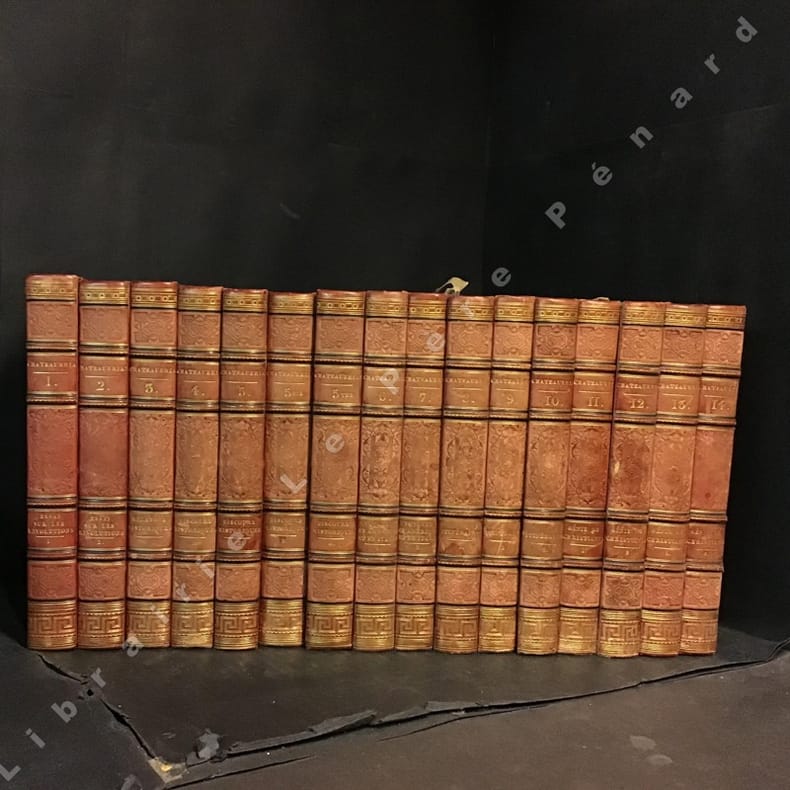
44315Garnier Frères.1911.6 vols.in-4 en demi-maroquin chocolat.Introduction,notes et appendices par Edmond Biré.Frontispice et gravures H-T gravés par Philipoteaux.Tome VI: Table des Matières et Index alphabétique. Belle édition aux dos à 4 nerfs soulignés seguirlandes doréeq et d'un motif estampé à froid.Caractères dorés.
18261247121826 30 Volumes - A Paris, Ladvocat Libraires - 1826-1828 - Demi basane rouge du temps, 4 nerfs sautés, ornementation à froid mais bandeaux dorés sur les coiffes, titre et auteur sur fond rouge uni. 350 à 400 pages par volume - Très bel ex-libris sur chacun des volumes
235911Paris, Arthus Bertrand, 1835 2 vol. in-8, XV-392 pp. et 442-[1] pp., portr. et carte dépl. en front., demi-maroquin noir à grain long à coins, dos lisse orné de filets et roulettes dorées ainsi que de fleurons à froid, tête dorée, couverture conservée (Yseux).
Paris, Plon, 1er octobre 1970-1971. 2 volumes in-8, brochés, 314 et 214 pp plus fac-similés. Non coupés. ÉDITION ORIGINALE contenant 7 fac-similés autographes en fin du volume II. Un des 80 exemplaires numérotés sur Hollande (Exemplaire H. N°16) deuxième papier après 25 Madagascar. Rédigés à Colombey après sa démission, ces Mémoires d'espoir retracent la période présidentielle de Charles de Gaulle. Ils ont été interrompus par la mort brutale de l'auteur, le 9 novembre 1970. BEL EXEMPLAIRE.
45282Imprimerie Impériale.1809.In-folio demi-relié.4 Mémoires reliés ensemble. 47 p.de "Mémoire sur le nilomètre de l'ile d'éléphantine et les mesures égyptiennes."/16 p.du "Mémoire sur les mesures agraires des anciens égyptiens."/ 64 p. "Observation sur la Vallée d'Egypte et sur l'exhaussement séculaire du sol qui la recouvre Planche dépliante et Appendice"./ 224 p.du "Mémoire sur l'Agriculture,l'Industrie,et le Commerce de l'Egypte." Ouvrage dédicacé par l'Auteur.Etat correct avec des rousseurs ou des brunissures.demi-cuir vert à coins.Dos à 5 nerfs avec caractères et fleurons dorés.Initiales en queue.Pierre-Aimé Girard ,Ingénieur des Ponts et Chaussées,participa à l'Expédition d'Egypte en 1789.
243494Paris [puis :] Toulouse, Le Divan [puis :] Edouard Privat, 1941-1964 17 vol. in-8, toile bleue, couv. et dos cons. (reliure moderne). Qqs annotations au crayon.
664587Paris, Roret, 1824-1826 4 vol. in-8, 2 tableaux dépliants, demi-chagrin rouge, dos à nerfs (Lavaux). Rousseurs.
236566Valence, Imprimerie valentinoise, 1912 in-8, 512 pp., avec un portrait-frontispice sous serpente, demi-maroquin rouge à coins, dos à nerfs, tête dorée, couverture conservée (reliure de l'époque).
187570Paris, Dumaine, 1862-1865 4 vol. in-8, bradel toile prune, premier plat de couv. cons. (Montécot).
224212Paris, Dumaine, 1862-1865 4 vol. in-8, demi-chagrin bordeaux, dos à nerfs, couvertures et dos conservés (reliure de l'époque). Mors frottés, début de fente au mors supérieur du tome I. Manque à la coiffe du tome IV. Rousseurs, des feuillets brunis. Manques de papier sur certaines couvertures conservées.
209012Paris, Amyot, 1854 3 vol. in-8, XII-387 pp., 372 pp., 407 pp., demi-chagrin rouge, dos à petits nerfs, filets à froid (rel. de l'époque). Rousseurs, une coiffe inf. abîmée.
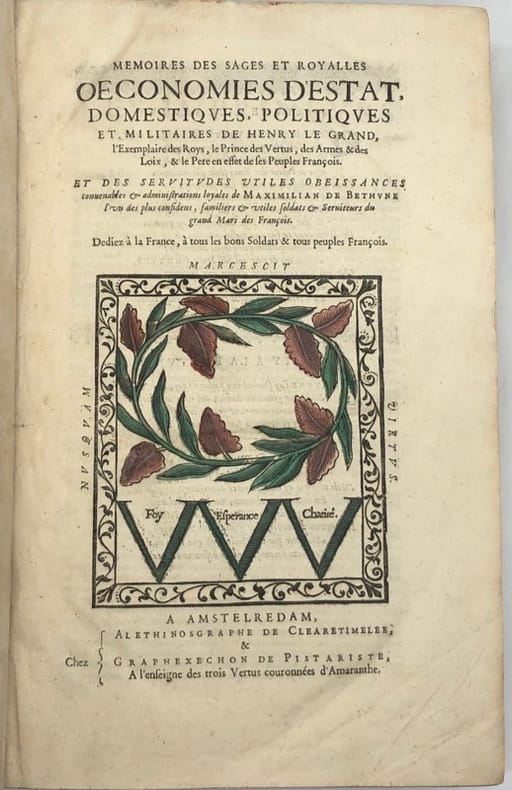
210971Amstelredam, chez Aléthinosgraphe de Cléaretimélée & Graphexechon de Pistariste, s.d. (vers 1640) 2 parties en un vol. in-folio, [4] ff. n. ch. (titre avec la fameuse vignette aux trois V verts, au lecteur), [435] pp. mal chiffrées 535 (il y a saut de chiffrage de 192 à 293) ; [4] ff. n. ch. (titre aux trois V verts, poésies liminaires), [463] pp. mal chiffrées 459, avec deux ff. chiffrés 59-60, basane granitée, dos à nerfs orné de doubles caissons et fleurons dorés, encadrement de double filet doré sur les plats (reliure de l'époque). Restauration maladroite à la charnière supérieure, mors et charnière fendus.
71772aafAmsterdam & La Haye, 1725-1757, in-4to, ex-libris ‘Dr. Edmond Jomini’, reliures en demi-cuir à coins, pièces de titre et de tomaison au dos avec des bandes dorées, plats cartonnés, tranches rouges.
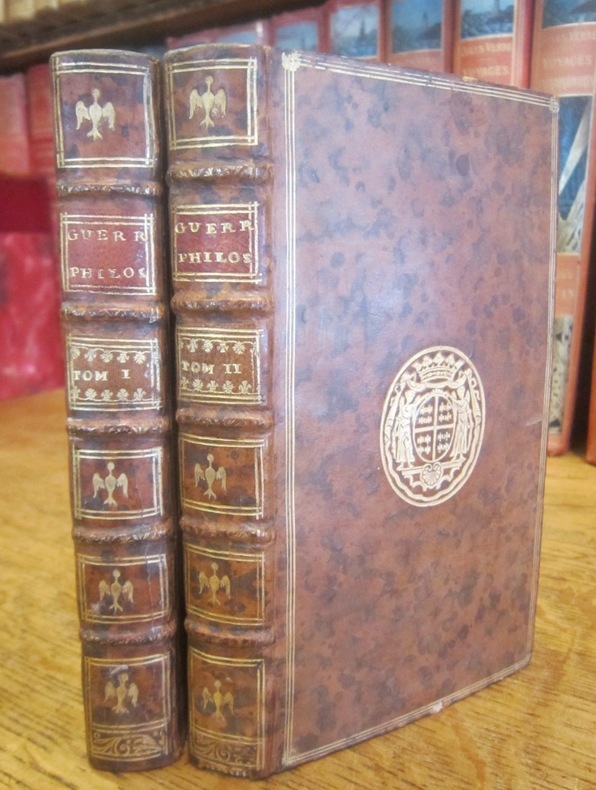
31165Paris Veuve Duchesne 1767 in 12 (17x10) 2 volumes reliures plein veau foncé de l'époque, dos à nerfs orné, pièces de titre et de tomaison de maroquin rouge, tranches teintées bleu, XXXVI et 251 pages, 288 pages, 300 pages, 299 pages [6]. Edition originale. Bon exemplaire ( Photographies sur demande / We can send pictures of this book on simple request )
Very Good French Original map. Oblong Double Elephant Folio. (96x156 cm). In French. Scale: 1/1.500.000. With explanation of geographical terms in Greek, Turkish, Arabic and Persian; With overview sheet: Aperçu general de la division administrative des provinces asiatiques de l'Empire Ottoman. (Jaar: 2011 - Europeana Collections). French edition of Kiepert's huge map of the Imperial Ottoman territories. "Includes list of geographic terms in eastern languages and notes on administrative divisions. Includes notes on materials the cartographer used to put together the map". (See LC copy). Kiepert, (1818-1899), was born in Berlin. He traveled frequently as a youth with his family and documented his travels by drawing. His family was friends with Leopold von Ranke, who inspired Kiepert's creative endeavors. Kiepert was taught by August Meineke in school. Meineke influenced Kiepert's interest in classical antiquity. He attended Humboldt University of Berlin. He studied history, philology, and geography. He published his first geographical work, with Carl Ritter, in 1840, titled Atlas von Hellas und den hellenischen Kolonien. The atlas focused on ancient Greece. In 1848 his Historisch-geographischer Atlas der alten Welt was published. In 1854, his atlas, Atlas antiquus was released. It was translated into five languages. Neuer Handatlas über alle Teile der Erde was first published in 1855. In 1877 his Lehrbuch der alten Geographie was published, and in 1879 Leitfaden der alten Geographie, which was translated into English (A Manual of Ancient Geography, 1881) and into French. In 1894 he created the first part of a larger atlas of the ancient world titled Formae orbis antiqui. He traveled to Asia Minor four times between 1841 and 1848. He created two maps of the region, including Karte des osmanischen Reiches in Asien, in 1844. Kiepert taught geography at the University of Humboldt-Berlin starting in 1854. He taught at the university until his death. Akyol, article 536.; Dagtekin p. 22 (With detailed bibliography on Kiepert's maps). Rare. Preserved in a frame, will be sent without its frame. A wall map.
Very Good Turkish, Ottoman (1500-1928) A modern fine black leather bdg. Small 4to. (26 x 18 cm). In Ottoman script. 3 volumes set: ([13], 448, [11], [6] p.; 386, [12], [6] p.; 203 p). Ibn Battuta was the greatest medieval Muslim traveler and the author of one of the most famous travel books, the Ri?lah (Travels). His great work describes his extensive travels covering some 75,000 miles (120,000 km) in trips to almost all of the Muslim countries and as far as China and Sumatra (now part of Indonesia). Ibn Battuta was from a family that produced a number of Muslim judges (qadis). He received the traditional juristic and literary education in his native town of Tangier. In 1325, at the age of 21, he started his travels by undertaking the pilgrimage (hajj) to Mecca. At first his purpose was to fulfill that religious duty and to broaden his education by studying under famous scholars in Egypt, Syria, and the Hejaz (western Arabia). That he achieved his objectives is corroborated by long enumerations of scholars and Sufi (Islamic mystic) saints whom he met and also by a list of diplomas conferred on him (mainly in Damascus). Those studies qualified him for judicial office, whereas the claim of being a former pupil of the then-outstanding authorities in traditional Islamic sciences greatly enhanced his chances and made him thereafter a respected guest at many courts. That renown was to follow later, however. In Egypt, where he arrived by the land route via Tunis and Tripoli, an irresistible passion for travel was born in his soul, and he decided to visit as many parts of the world as possible, setting as a rule "never to travel any road a second time." His contemporaries traveled for practical reasons (such as trade, pilgrimage, and education), but Ibn Battuta did it for its own sake, for the joy of learning about new countries and new peoples. He made a living of it, benefitting at the beginning from his scholarly status and later from his increasing fame as a traveler. He enjoyed the generosity and benevolence of numerous sultans, rulers, governors, and high dignitaries in the countries he visited, thus securing an income that enabled him to continue his wanderings. From Cairo, Ibn Battuta set out via Upper Egypt to the Red Sea but then returned and visited Syria, there joining a caravan for Mecca. Having finished the pilgrimage in 1326, he crossed the Arabian Desert to Iraq, southern Iran, Azerbaijan, and Baghdad. There he met the last of the Mongol khans of Iran, Abû Sa'îd (ruled 1316-36), and some lesser rulers. Ibn Battuta spent the years between 1327 and 1330 in Mecca and Medina leading the quiet life of a devotee, but such a long stay did not suit his temperament. Embarking on a boat in Jiddah, he sailed with a retinue of followers down both shores of the Red Sea to Yemen, crossed it by land, and set sail again from Aden. This time he navigated along the eastern African coast, visiting the trading city-states as far as Kilwa (Tanzania). His return journey took him to southern Arabia, Oman, Hormuz, southern Persia, and across the Persian Gulf back to Mecca in 1332. There a new, ambitious plan matured in his mind. Hearing of the sultan of Delhi, Mu?ammad ibn Tughluq (ruled 1325-51), and his fabulous generosity to Muslim scholars, he decided to try his luck at his court. Forced by lack of communications to choose a more indirect route, Ibn Battuta turned northward, again passed Egypt and Syria, and boarded ship for Asia Minor (Anatolia) in Latakia. He crisscrossed that "land of the Turks" in many directions at a time when Anatolia was divided into numerous petty sultanates. Thus, his narrative provides a valuable source for the history of that country between the end of the Seljuq power and the rise of the house of Ottoman. Ibn Battuta was received cordially and generously by all the local rulers and heads of religious... Hejra: 1333; 1335; 1336 = Roumi: 1335 ; 1337; 1340 = Gregorian: 1917; 1919; 1921. Ozege: 21289. For fihrist: 5771.
Very Good Turkish, Ottoman (1500-1928) Original cloth bdg. with marbled boards. Cr. 8vo. (20 x 13,5 cm). In Ottoman script (Old Turkish with Arabic letters). 176, [1] p. Lithographed edition. Extremely rare first and only edition of this guide to the distances and meridian calculations of some cities from Batumi located on the shores of Black Sea, Europe until Great Britain, Asia, and Africa shores, prepared for Turkish naval officers, mariners, and vessels, describing the shores of the countries located on these routes. ABOUT THE AUTHOR: Ibrahim Edhem Pasha was an Ottoman statesman, who held the office of Grand Vizier at the beginning of Abdul Hamid II's reign between 5 February 1877 and 11 January 1878. He resigned from that post after the Ottoman chances of winning the Russo-Turkish War (1877-1878) had decreased. He furthermore served in numerous administrative positions in the Ottoman Empire including minister of foreign affairs in 1856, then ambassador to Berlin in 1876, and to Vienna from 1879 to 1882. He also served as a military engineer and as Minister of Interior from 1883 to 1885. In 1876-1877, he represented the Ottoman Government at the Constantinople Conference. He was born in Chios of Greek ancestry, in a Christian Greek Orthodox village on the island of Chios. Strangely, his connection to Chios is not well-documented: his son Osman Hamdi Bey claimed that he was a member of the Scaramanga family, but Edhem Pasha himself tried to efface his Greek connections. As a young boy in 1822, he was orphaned and captured by Ottoman soldiers during the massacre of the Greek population of Chios. He was sold into slavery, brought to Constantinople, and adopted by the (later) grand vizier Hüsrev Pasha. Lacking his own children and family, Hüsrev Pasha raised about ten children who had been orphaned or bought as slaves, many of whom ascended to important positions. The child, now named Ibrahim Edhem, quickly distinguished himself with his intelligence and after having attended schools in the Ottoman Empire, he was dispatched along with a number of his peers, and under the supervision of his father, then grand vizier, and of the sultan Mahmud II himself, to Paris to pursue his studies under state scholarship. There he returned with a Bachelor of Arts and was one of the top pupils at the École des Mines. He was a classmate and a friend of Louis Pasteur. He thus became Turkey's first mining engineer in the modern sense, and he started his career in this field. Edhem Pasha was the father of Osman Hamdi Bey, a well-known archaeologist, and painter, as well as the founder of the Istanbul Archaeology Museum and the Mimar Sinan Fine Arts University. Another son, Halil Edhem Eldem took up the archaeology museum after Osman Hamdi Bey's death and has been a deputy for ten years under the newly founded Turkish Republic. Yet another son, Ismail Galib Bey, is considered the founder of numismatics as a scientific discipline in Turkey. Later generations of the family also produced illustrious names. The architect Sedat Hakki Eldem, a cousin, is one of the pillars of the search for modern architectural styles adopted by the Republic of Turkey (called the Republican style in the Turkish context) in its early years and which marks many important buildings dating from the period of the 1920s and the 1930s. A great-grandson, Burak Eldem, is a writer while another, Edhem Eldem, is a renowned historian. More names include Erol Eldem, Tiana Eldem, Levent Eldem, and Ercan Eldem, an architect. (Source: Wikipedia). Özege 4522.; Only one copy in OCLC: 162837008 (Bayerische Staatsbibliothek).
Very Good Turkish, Ottoman (1500-1928) Modern full morocco in Ottoman traditional style. Roy. 8vo. (25 x 17 cm). In Ottoman script (Old Turkish with Arabic letters). 119 p., 15 unnumbered b/w plates, and 1 color double-paged map of Northwest Africa and the Sahara Desert. First and only edition of this exceedingly rare book of Sahara and other territories of North Africa, written by Sadik El-Müeyyed, including his surviving report and travel account written to be presented to the Ottoman Sultan Abdulhamid II. It's a reference text that specifies the military and the political measures of the Sahara exploration, gives extensive information about the Benghazi region of Tripoli and about Muhammad al-Senusi, the leader of the Senûsî (Senussi) movement there, and his followers. With the impressive and enthusiastic expression of Sadik el-Müeyyed's descriptions, this work reveals not only the affairs of the Ottoman government but also the mysteries of the journeys that have taken months in the Sahara desert, uncovers the living standards of the desert peoples, and sheds light on an unknown aspect of the North African history. Özege 132.; Not in Kursun.
1902008679London: Freemantle and Co. 1902. Stamp signed fine bindings "Bound by Zaehnsdorf for A.C. McClurg & Co." of full polished calf backs ornately gilt marbled end papers tops gilt illustrated. A Near Fine set of six volumes small rubs at spine ends a few small browned spots front end pages. SCARCE in commerce especially so in lovely bindings. A comparable set in fine binding last seen at auction in 1978. . First Edition Thus. Full Polished Calf. Near Fine. 8vo - over 7¾" - 9¾" tall. Freemantle and Co. Hardcover books
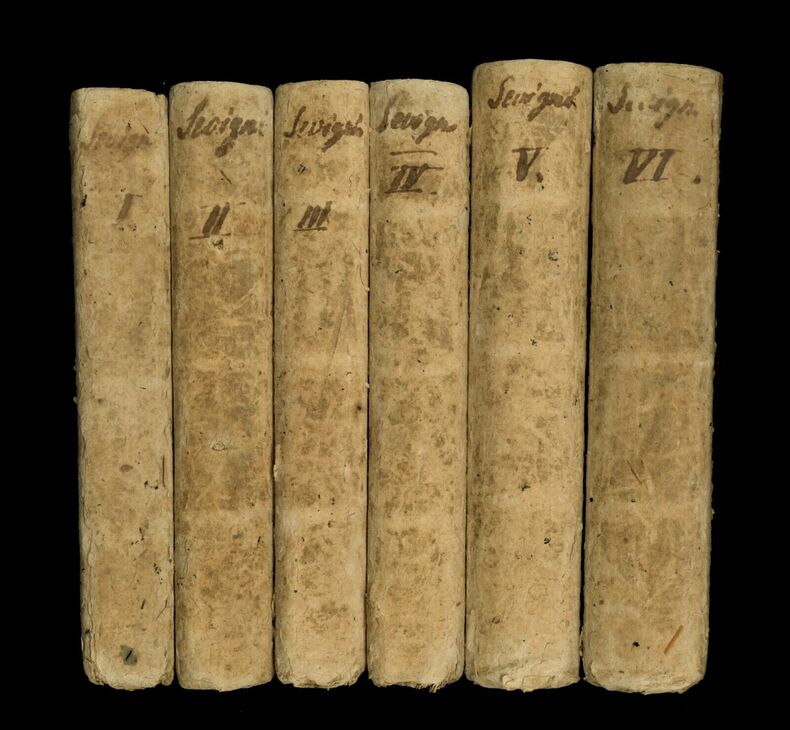
1736AMO-4463A Leide, Chez les Frères Verbeek, 1736-1739 6 volumes in-12 (18 x 11,5 cm pour les 4 premiers volumes et 19 x 11,5 cm pour les 2 derniers volumes) de (2)-XXVIII-348, (2)-369, (2)-368, (2)-344-(40), XIV-482-(6) et (2)-504-(42) pages. Collationné complet. Pages de titres imprimées en rouge et noir. Cartonnage d'attente en papier et carton brut, entièrement non rogné. Usures modérées aux cartonnages (dos, coins et plats) avec quelques salissures et taches. Intérieur en bon état avec quelques rousseurs claires éparses. Reproduction par les Frères Verbeek de l'édition de Paris (Rollin fils, 1734-1737). Cette édition est aussi divisée en 6 volumes comme celle de Paris. Les 4 premiers volumes portent la date de 1736 tandis que les 2 derniers volumes portent la date de 1739 (il existe les deux derniers volumes portant la date de 1738 avec des ornements différents sur le titre). La justification et la typographie des 2 derniers volumes sont différents de celle des 4 premiers volumes. Le premier volume contient la Préface du chevalier Perrin (éditeur des lettres de la marquises) ainsi que la reproduction de l'Approbation datée de Paris, le 30 mars 1734 et signée Gros de Boze. Le cinquième volume s'ouvre sur un Avertissement. Notre édition des Frères Verbeek ne contient pas les deux portraits gravés de la mère et de la fille qui se trouvent dans l'édition de Paris. L'édition des Frères Verbeek reproduit même jusqu'à la mention "De l'imprimerie de Cl. Fr. Simon fils, 1738" en colophon au tome VI (mention évidemment fausse). Les Frères Verbeek étaient réputés pour reproduire sans autorisation, à Leyde, les ouvrages populaires. Ils faisaient imprimer par ailleurs d'autres ouvrages d'importance, avec autorisations ceux-ci. Les frères Johannes et Hermanus Verbeek travaillent en association. Éditeurs de Gravesande, Boerhaave, Van Swieten, Albinus, ils publient parfois avec le libraire d'Amsterdam Balthazar Lakeman (Bnf, Data). On peut considérer cette édition comme une contrefaçon de l'édition de Paris donnée par le Chevalier Perrin chez Rollin fils. Elle est rare. La Bnf ne possède apparemment que les 2 derniers volumes de cette édition. On sait que la première édition des Lettres de la Marquise de Sévigné date de 1725 et a été donnée subrepticement en une mince plaquette de 75 pages regroupant seulement quelques lettres pour la plupart incorrectement retranscrites et fragmentaires (31 fragments). Cette première édition rarissime et quasi mythique n’était connue qu’à 2 ou 3 exemplaires à la fin du XIXè siècle, il ne semble pas qu’on en est répertorié d’autres depuis. Les bibliographes considèrent donc comme véritable seconde édition originale l’édition dite de Rouen publiée en 1726 par les soins du fils de Roger de Bussy-Rabutin (cousin indiscret de la Marquise). On a beaucoup tergiversé pour savoir s’il s’agissait du fils aîné (Amé-Nicolas de comte Bussy-Rabutin) ou bien du cadet, futur évêque de Luçon, abbé de Bussy. Cette édition furtive, désavouée par la petite-fille de Mme de Sévigné, Mme de Simiane, fille de Mme de Grignan, est très rare et les exemplaires en reliure de l’époque en bonne condition se rencontrent difficilement. Les éditions suivantes de 1726, 1728 et 1733 sont également peu communes et reprennent avec des variantes la première édition dite de Rouen en gros caractères citée plus haut. Seule l'édition de La Haye, très rare, apporte de nouvelles lettres (qui se retrouvent dans l'édition de 1728 et 1733 comme nous venons de le voir ci-dessus). Il faudra attendre 1734-1737 avec l'édition pourtant mutilée donnée par les soins du Chevalier Perrin pour avoir à disposition plusieurs centaines de nouvelles lettres (614 lettres contre 134 en 1726). L'édition de 1818, puis l'édition de 1862, données par Monmerqué, puis Charles Capmas (supplément "Lettres inédites" de 1876), donneront un panorama complet du génie épistolaire de la marquise de Sévigné. Provenance : de la bibliothèque de M. Lerber, avec son ex libris armorié dans chaque volume, avec la signature autographe au dessous de chaque ex libris. De la famille de jurisconsultes Lerber de Berne / Bern (Suisse). Provenance contemporaine de l'édition. Référence : Notice bibliographique, Tome XI de l'édition des Grands Ecrivains de la France, Lettres de Mme de Sévigné, p. 442-443, n°10. ; Tchemerzine, X, page 323 ; A. Claudin, Bibliographie des éditions originales d'auteurs français composant la bibliothèque de M. Rochebilière, n°679 : "Edition rare". Bon exemplaire bien complet des 6 volumes conservé dans son fragile cartonnage d'attente de l'époque.
188519897Londres (Paris), s.n. (Marcel Seheur), 1885 (1932) ; 3 tomes, petit in 8 carré, plein chagrin noir, dos à nerfs soulignés d’un pointillé doré et double cadre doré sur les caissons, double pièce rouge de titre et tomaison, double encadrement des plats, tête dorée, contreplats et gardes en suédine rouge, couverture rose illustrée et dos conservés, non rogné, étui de suédine rouge bordé de box noir (reliure de l’époque) ; 138, [6] pp. bl. ; [4] bl., pp. 153-272 ; [4] bl., pp. 281-403, [3], [2] ff. bl. avec bien entendu les faux-titres, titres et frontispices à chaque volume ; 26 lithographies libres hors-texte, aquarellées au pochoir et au pinceau, très nombreux dessins, en-têtes et culs-de-lampes libres tirés en bistre, dessin répété aux trois couvertures tiré en bistre, par le peintre Berthommé-Saint-André.
238212La Haye, et se trouve à Paris, Antoine Boudet, 1760-1764 8 vol. in-12, veau fauve tacheté, dos lisse orné, armes en pied, tranches rouges (reliure de l'époque). Début de fente au mors supérieure du tome 1. qqs soulignures au crayon.
198519Paris, Fournier, 1845 4 vol. in-8, demi-chagrin brun, dos à nerfs, filets dorés (reliure de l'époque).