MAROLLES (Michel de).Livre Rare Book
12 324 résultats
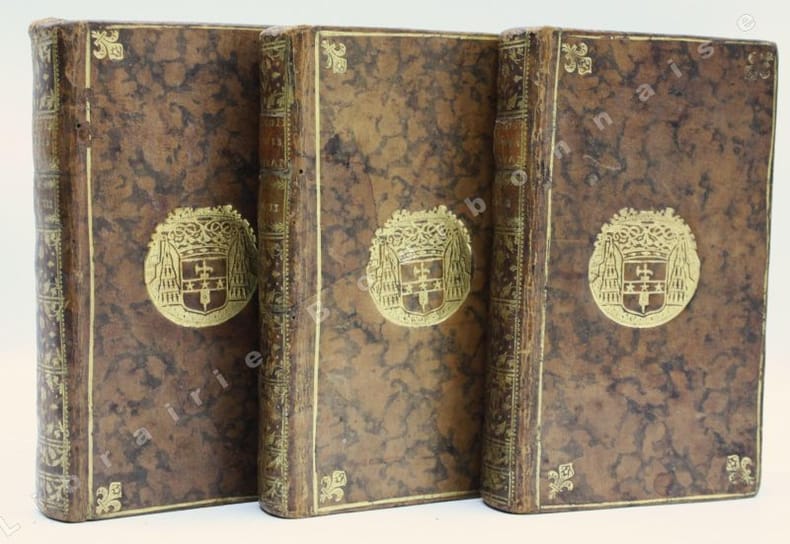
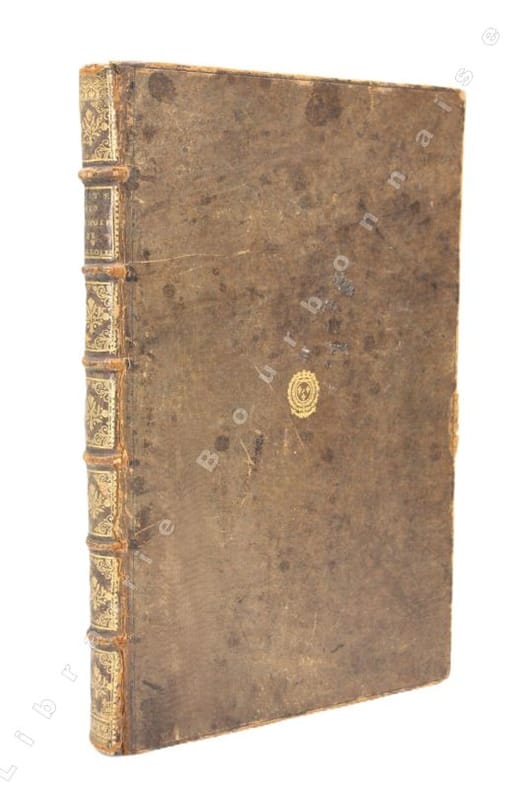
14089Paris, Antoine de Sommaville, 1657 ; in-4 (32 x 21 cm). 272 pp. - 5 ff. dont 1 avec vignette contrecollée aux armes de M. de Marolles. Veau brun, dos à 6 nerfs orné, titre doré. Armes dorées sur les plats. Coiffes arasées, charnière du plat sup. partiellement fendue, frottements sur les chasses et les coins. Bon exemplaire cependant, sans rousseurs et à grandes marges.
AMO-2304s.l.n.d. [1767, Hollande ?] 136 pages y compris le faux-titre (qui sert de titre), l'avertissement essentiel ou inutile (3 pages) et la table à la fin (4 pages). Relié à la suite : [Michielsen ?] Recueil des requêtes, placets et mémoires, les plus intéressants, que l'on présenta à Sa Majesté Impériale Joseph II, durant le Voyage qu'il fit dans ses Pays-Bas en 1781. Sa Majesté Impériale Joseph II à fait insérer dans ce recueil L'Apocalypse du Bien Heureux Jean, Apôtre de la Philosophie : Songe Philosophique Extraordinaire, que les Censeurs Ecclésiastiques, de Pays-Bas, n'avaient pas laissé imprimer. A Vienne en Autriche, de l'imprimerie de la Cour, 1782. [?] (6)-83 pages. 2 ouvrages reliés ensemble en 1 volume demi-maroquin noir à grain long, dos lisse orné, plats de papier marbré bleu, doublures et gardes blanches (reliure anglais du début du XIXe siècle). La dernière page (136) du premier ouvrage est légèrement salie, sinon bel intérieur très frais. Beau papier bien blanc. Reliure en très bon état avec quelques petites usures et frottements (plats), coiffe supérieure légèrement usée (peu visible). Le premier ouvrage, La défense de mon oncle [contre ses infâmes persécuteurs] est ici dans une édition qui reproduit le texte du tout premier tirage avec une fidélité exemplaire, comme le souligne José-Michel Moureaux dans son étude des différentes éditions de ce texte de Voltaire. On y relève à peine une demi douzaine de variantes légères, écrit-il, et pratiquement pas de coquilles. Cette édition faite avec des caractères hollandais n'es pas parisienne. Il est également impossible qu'elle ait été exécutée en province. Moureaux conclut donc à "une édition hollandaise, à la rigueur anglaise". Moureaux précise encore que ce tirage ne figurait pas dans la bibliothèque de Voltaire. Dans cette édition classifiée "C" par Moureaux, l'avertissement est présent et intégré à la pagination, tout comme la table qu'on trouve à la fin. Ce livre a remporté tout de suite un vif succès. Grimm en a entretenu ses lecteurs dès le 15 juillet 1767 (les premiers exemplaires apparaissent à la fin du mois de juin) avec un enthousiasme débordant : " (...) l'on étouffe de rire à chaque page. Il est impossible de rien lire de plus gai, de plus fou, de plus sage, de plus érudit, de plus philosophique, de plus profond, de plus puissant que cette Défense, et il faut convenir qu'un jeune homme de soixante treize ans comme neveu, sujet à ces saillies de jeunesse, est un rare phénomène." (Correspondance littéraire tome VII, p. 367, cité par Moureaux). "Cet ouvrage est une plaisanterie particulièrement dirigée contre un M. Larcher, auteur obscur d'un prétendu Supplément à la Philosophie de l'Histoire [...] M. de Voltaire, dont l'amour-propre s'égratigne facilement, accommode de toutes pièces ce piteux adversaire. Il enveloppe aussi dans cette facétie Fréron et autres personnages, plastrons ordinaires de ses railleries. On ne peut refuser à cet écrit beaucoup de gaîté et même le feu de la jeunesse." (Bachaumont, 24 juillet 1767). On trouve dans cette défense des chapitres aussi curieux que : de la providence - l'apologie des dames de Babilone - de l'alcoran - des romains - de la sodomie - de l'inceste - de la bestialité et du bouc du sabbath - d'Abraham et de Ninon de Lenclos - du temple de Tyr - des Chinois - de l'Inde et du Vedam - que les juifs haïssaient toutes les nations - de Warburton (pamphlet ajouté ici) - des hommes de différentes couleurs, etc. Référence : J.-M. Moureaux, La défense de mon oncle, édition critique, Genève, Slatkine, 1978. Le second ouvrage, Recueil de requêtes etc., serait l'oeuvre (entre autres) d'un certain Michielsen, employé au Comité de la Caisse de Religion, "qui présenta une série de requêtes soit disant présentées à l'empereur Joseph II lors de son voyage aux Pays-Bas. En vérité, il s'agissait de requêtes fictives et satiriques. Dans un style à la fois d'une grande finesse, plein d'allusions et de virulence, l'auteur s'attaqua au clergé, à la noblesse et aux commerçants-escrocs en les ridiculisant. On y trouve tout le patrimoine, ou dois-je dire tout le résidu des Lumières, même une obscénité libertine qui s'en prend à la religion (...)" (extrait des Etudes sur le XVIIIe siècle, volume 6, Roland Mortier, Hervé Hasquin, Université libre de Bruxelles. Groupe d'étude du XVIIIe siècle, Éditions de l'Université de Bruxelles, 1980). On compte en tout, outre un avertissement (4 pages), 13 requêtes dont 2 en latin (qu'il faut traduire pour en tirer toute la verve satirique). A la fin du volume on trouve imprimée sur 3 pages une liste des livres choisis à placer dans différentes bibliothèques publiques aux Pays-Bas (on y trouve la plupart des livres matérialistes et anticléricaux parus à l'époque (Boulanger, Voltaire, Helvétius, Rousseau, le bon sens du curé Meslier, le Compère Mathieu de Du Laurens, l'Arétin moderne, etc. A la suite et sur 11 pages on trouve l'Apocalypse du Bien Heureux Jean apôtre de la philosophie. Ce volume est indiqué en 1836 comme une satire fort peu spirituelle mais rare et recherché (Chronique rimée de Philippe Mouskes, vol. 1). Ouvrage rare. Réunion très intéressante de deux textes satiriques et philosophiques. Bel exemplaire.
1572zt1135A Paris, chez Claude Micard Relié 1572 "In-12 (8,5 x 11,5 cm), reliure plein veau, dos à 4 nerfs orné de caissons dorés et d'une pièce de titre, ex-libris de Bramshill au 2e plat, titre complet : ""Les Memoires de Messire Philippe de Commines, Chevalier, Seigneur d'Argenton : sur les faits et gestes de Loys onziesme, & de Charles huitiesme son fils, Rois de France. De nouveau reveus, & corrigez pour la seconde fois, auquel est adiousté une Epistre de Iean Seleidam, en la recommendation de l'Autheur. Avec la vie de Messire Angelo Catho, Archevesque de Vienne, auquel ce present livre est dedié"", pagination comme suit : titre (1pp.), prologue de l'autheur (4 pp.), 456 pages puis sommaire de la vie de Messire Angelo Cattho (8 pp.) et table des matières (56 pp.) ; manque de cuir à la coiffe supérieure, déchirure au cuir à la coiffe inférieure, mors supérieur fendu en tête, quelques traces en page de titre, par ailleurs intérieur bien conservé, assez bon état général. Livraison a domicile (La Poste) ou en Mondial Relay sur simple demande."
51621Edition originale.Lons-Le-Saunier.1767.2 vols.in-4 en veau raciné d'époque.Dos à 5 nerfs avec pièce de titre et de tomaison.Tranches rouges.1 planche.Au Tome II: quelques notes en marges.Très fine écriture au crayon à l'encre . Belle édition.
Very Good Turkish, Ottoman (1500-1928) A fine half leather bdg. with marbled boards. Two volumes in one. Cr. 8vo. (20 x 14 cm). The text in Ottoman script (Old Turkish with Arabic letters) with bilingual titles in Ottoman Turkish and French on frontispieces and title pages. 2 volumes set: (248 p.; 270, [1] p., the first volume has Columbus' engraved portrait frontispiece, the second has Amerigo Vespucci's portrait). Hegira: 1310 = Gregorian: 1893. First and only edition of this very rare book, which is the first Turkish original work on the history of the discovery of America printed for the Quadricentennial of the Discovery. With this book, Christopher Columbus and Amerigo Vespucci quickly became popular among Ottoman readers (soon after Iranian readers with a translation of the first volume only), and immediately among other Middle Eastern readers, and thus the first comprehensive and original text describing Colombus and the discovery of America appeared in the Middle East and Islamic world. It's been published in Istanbul under the title "The history of the discovery and conquest of America". The first volume is on Christopher Columbus, and the second volume is on Amerigo Vespucci, their lives and travels. Andreas Kopassis Efendy (1856-1912) was one of the few Ottoman Greeks proficient in the Ottoman literary language. Cretan Kopassis is an intriguing figure who made a remarkable career serving the Ottoman state. At the time of the publication, he was a member of the State Council (Sura-yi Devlet). He displayed quite an extraordinary interest in scholarly research and he seems to have been one of the first to have studied Ottoman "tahrir defterleri" [i.e. Ottoman tax registers]. This could be called a translation in a sense. Kopassis makes no reference to preceding translations, nor does he refer to Robertson's history of America. His main source was a more recent equally "classic" work on Christopher Columbus, Washington Irving's "History of the life and voyages of Christopher Columbus" (first published in 1828). Another source referred to by Kopassis is J. H. Campe's "Entdeckung von Amerika" (first published in 1781). His educational background is evident particularly in the introductory chapter where ample references are made to Pliny, Ptolemy, and Plato's Timaios which contain allusions to Atlantis. In his takri (Introduction) to this work, Kemalpasazade Said Bey (1848-1921) praised the author for his elegant prose. Sultan Abdülhamid awarded the order of merit (liyâkât) in gold to the author. In the same year (1315=1895), an aide-de-camp at the Iranian Ministry of War, Muhibb-i 'Âli Khan, translated the first volume into Persian. At the turn of the century, Christopher Columbus had become a very popular figure for Ottoman readers of all ages...". (Source: STRAUS, JOHANN: Nineteenth-century Ottoman Americana.; "Frontiers of the Ottoman Imagination: Studies in Honour of Rhoads Murphey."). Only one copy in OCLC 777274675 (Leiden University Library). Not in American libraries.; Özege 19857.
New German Original bdg. HC. Elephant folio. (67 x 51 cm). -Text book: 30 x 24 cm- In German. 2 volumes set: ([xii], [vii], [Lii], 140 p., 2 plates.; 39 color and b/w plts. (Tafeln)). Limited reprint edition (all copies are numbered) of 1854-1855 Berlin edition of Salzenberg's book exemplifying a growing 19th-century appreciation of Romanesque and 'Byzantine' architecture. For the original edition see Blackmer 1483; Brunet V, 103. "Salzenberg's important work remains the major source of information about the mosaics of St. Sophia". (Blackmer). 1000 copies were printed for individual persons. This copy belonged to 'Ender S. Özer Bagciman. All copies were numbered. (651/1000). The churches Salzenberg describes illustrating the development of a Christian architecture away from the secular long nave basilica or of the classical temple (never intended for congregational use), to a Greek-cross plan with a central dome, allowing greater accessibility to the altar table. Most of the text is devoted to the cathedral of the Holy Wisdom [i.e. Hagia Sophia], built-in Constantinople for Justinian I by Anthemius of Tralles and Isidore of Miletus, who dared to set a large dome over a square with the support of pendentives, achieving, with eastern and western half-domes, an uninterrupted span of over 200 feet. This building provided a model or inspiration to architects of the Middle East and Europe seeking to experiment with central, domed structures. Contents: Titelblatt.; Frontispiz.; Titelblatt.; Inhalt des Textes.; Vorwort.; Einleitung.; Verschiedene Baureste der aelteren Zeit.; Agios Johannes, Klosterkirche des Studios.; Agios Sergios, Kirche des Klosters Hormisdas.; Agia Sophia.; Agia Irene.; Agia Theotokos, Klosterkirche des Lips.; Agios Pantokrator.; Saalbau des Hebdomon.; Cisterne des Philoxenos (Bin-Bir-Direk).; Wasserpfeiler oder Suterasi.; Kirchen aus Klein-Asien.; Anmerkungen.; Anhang: Des Silentiarius Paulus: Beschreibung der Heiligen Sophia und des Ambon.; Vorwort.; I-VI i: Die H. Sophia des Silentarius Paulus.; VII-XIV Der Ambon.; Verzeichniss der Abbildungen.; Blatt I - XXXIX.; Maßstab/Farbkeil.
47971Philadelphie.1788.In-8 relié.204 et 224 p.Portrait en frontispice,réhaussé de couleurs. Bel état.Veau porphyre souligné de 3 filets dorés dont un gras.Dos orné avec pièce de titre.Tranches jaspées.Petit défaut:trou de vers en queue.Tampon représentant une fleur de lys en page de garde.
196712027Arthaud 1967 377 pages in8. 1967. broché. 377 pages. Le roman raconte l'histoire de Pascal et Séraphine qui se rencontrent à huit ans à Marseille lors de l'Exposition coloniale de l'été 1922. Leur amour naissant évolue au fil des années entre séparations et retrouvailles tandis que leur vie reste ancrée dans la rue des Bons-Enfants un refuge au cœur de la cité marseillaise marquée par les conflits
1775YRG-186In-8, plein veau havane glacé, dos lisse avec caisson et fleurons dorés. Pièce de titre en maroquin rouge, absente au tome deux, et tomaison en maroquin vert olive. Plats encadrés d'un triple filet doré et orné de palmettes en écoinçon. Tranches rouges. Frottements d'usage. Sans date, circa 1775, quelques rousseurs, coins émoussés. Édition qui réunit cinq mémoires.
195630425Monaco, Les éditions de l'Imprimerie Nationale de Monaco, Fasquelle et Flammarion, 1956. 25 volumes, in-8, demi-chagrin rouge à coins, dos à quatre nerfs, tomaison et titre dorés au dos, couvertures conservées.
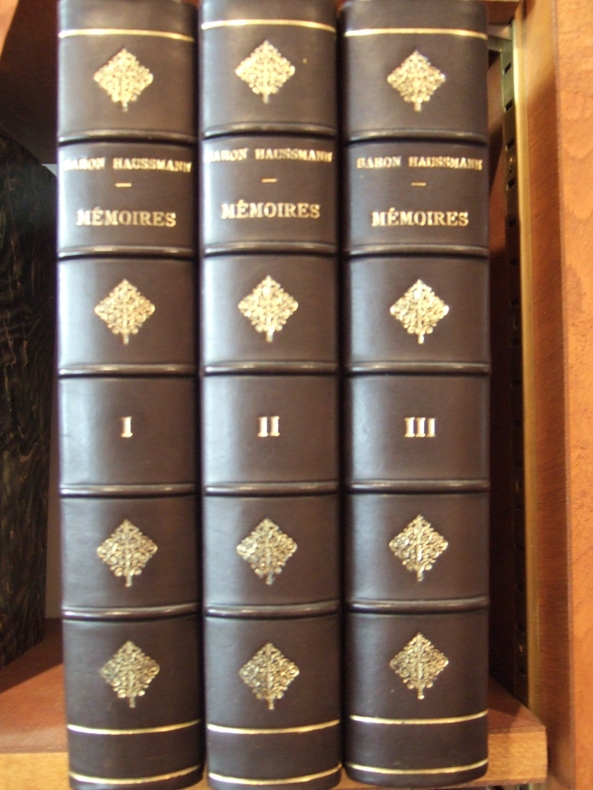
17893Paris, Victor-Havard, 1890-1893. 3 forts vol. in-8°. Demi veau ardoise, dos à nerfs orné de fleurons et filets dorés (rel. moderne).
Paris, Victor-Havard, 1890-1893. 3 forts vol. in-8°. Demi veau ardoise, dos à nerfs orné de fleurons et filets dorés (rel. moderne). Tome I (Edition originale) : Avant l’Hôtel de Ville. La Restauration. Révolution de 1830. Gouvernement de Juillet. République de 1848. Le prince président. Coup d’état du Deux Décembre. L’Empire ; portrait en frontispice, XV-587 pp. Tome II (seconde édition) : Préfecture de la Seine. Exposé de la situation en 1853. Transformation de Paris. Plan et système financier des grands travaux. Résultats généraux en 1870 ; XV-576 pp., un portrait h.t. Tome III (troisième édition) : Grands travaux de Paris. Le plan de Paris. Les services d’ingénieurs. Voie publique. Promenade et plantations. Service des Eaux. Architecture et Beaux-Arts ; portrait en frontispice, XII-573 pp. Bel exemplaire.
Very Good Turkish, Ottoman (1500-1928) Original illustrated wrappers. Cr. 8vo. (20 x 13 cm). In Ottoman script (Old Turkish with Arabic letters). 220, [2] p., 41 unnumbered plates (incl. 68 b/w photos), and 3 maps. Pages are partly untrimmed and uncut. Slight stains on cover and wear at spine. Overall a good copy. Roumi: 1326 = Hegira: 1327 = Gregorian: 1910. First and only edition of this extremely rare book, including a historically significant eyewitness account of Cami Baykurt, who was an Ottoman officer during the Tripoli War (1911-1912), describing the flora, and the fauna in the Sahara desert and around Libya; the Bedouins and their customs with their social life, their culinary culture and their special drinks in his book during his travels to the south of Libya, to the Fezzan region, to participate in the Ottoman military operations at the fortress of Ghat, serving as a commander and governor. This book was prepared to present Tripoli, located in the Libyan lands today, Fezzan in the south, and the desert roads in between to the Ottoman court as well as the intelligentsia. Baykurt was a Turkish politician and soldier who served as deputy of the first period of the Turkish Republican Parliament. He was the first minister of Turkish foreign affairs in the Republican period. He had participated as an officer in the Battle of Tripoli back in the day. The provinces of Tripoli and Fezzan were accepted as destinations of exile in the last period of the Ottoman Empire. The province of Tripoli, the last center of a few Ottoman sanjaks, had been the granary of ancient Rome in the past with its large villages. Özege 21177.; Kursun p. 294.; Not in ATYB I (Askeri Tarih Yayinlari Bibliyografyasi).; OCLC 165148162 (with some misread and misspelled words; Kursun mentioned in his bibliography those misread words, especially 'Kazan mebusu -deputy of Kazan- instead of a deputy of Fizan about his title in some catalogs like OCLC. Kursun has a short but useful biography of Câmî).
Very Good Turkish, Ottoman (1500-1928) Original illustrated wrappers. Chipping on top edge and front cover. Occasional foxing on pages. Overall a good copy. Roy. 8vo. (23 x 15 cm). In Ottoman script (Old Turkish with Arabic letters). 103 p., b/w plates (19 unnumbered b/w plates and 1 map). First edition of this extremely rare first-hand and historically significant eyewitness account of the Syrian and the Suez Canal Operations during the Great War by an Ottoman soldier and statesman. Erden describes in this book his return to Istanbul after his military attaché duty in Paris and his departure to Damascus to join the 4th Army in Syria under the command of Cemal Pasha (1872-1922). He then discusses the Arab Revolt in Hejaz and its possible effects on the Ottoman Empire (The Arab Uprising was initiated by Sharif Hussein bin Ali in June 1916 during the Great War with the aim of creating an independent and united Arab state comprising of Aden in Yemen and Aleppo in Syria against the Imperial Ottoman). After disclosing his views and the actions of the army in the region, he goes on to describe Jerusalem, the Suez Canal, and the wars that took place there. Erden gave new information on the reasons and results of the Canal operation, the condition of the Turkish army along Palestine and Syria fronts, the relations among the Turkish staff, and the nature of the Arab revolt through his views and observations in Egypt, Palestine, and Syria fronts accumulated as he was Cemal Pasha's chief of staff. Erden was a Turkish soldier and war historian. After graduating from the Military Academy in 1903, he worked in the units and headquarters in Yemen, as the staff of the 3rd Corps in the Balkan War and as the Paris Military Attaché. During the Great War, he served as the Chief of Staff of the 4th Army within the entourage of Admiralty Minister Cemal Pasha in Syria. Özege 16174. Kursun p. 51.
Fine Turkish, Ottoman (1500-1928) Original quarter leather bdg. Roy. 8vo. (24 x 16 cm). In Ottoman script (Old Turkish with Arabic letters). 911 p., profusely illustrated with many color and b/w plates, one folded map. Slight marginal foxing and light tears on extremities. Heavy tears on the map, no missing pieces, it needs to be restored. Overall a good copy. Hegira: 1291 = Gregorian: 1874. First and only Turkish edition of this rare and attractively and profusely illustrated book including Schweinfurth's travel account of the African continent, from Central Africa to Egypt, printed in the last Imperial period of the Ottomans. Schweinfurth was a Baltic German botanist and ethnologist who explored East-Central Africa. He was born in Riga, Latvia, then part of the Russian Empire. He was educated at the universities of Heidelberg, Munich, and Berlin (1856-1862), where he particularly devoted himself to botany and paleontology. Commissioned to arrange the collections brought from Sudan by Adalbert von Barnim and Robert Hartmann, his attention was directed to that region, and in 1863 he traveled around the shores of the Red Sea, repeatedly traversed the district between that sea and the Nile, passed on to Khartoum, and returned to Europe in 1866. His researches attracted so much attention that in 1868 the Berlin-based Alexander von Humboldt Foundation entrusted him with an important scientific mission to the interior of East Africa. Starting from Khartoum in January 1869, he went up the White Nile to Bahr-el-Ghazal, and then, with a party of ivory dealers, through the regions inhabited by the Diur (Dyoor), Dinka, Bongo, and Niam-Niam; crossing the Congo-Nile watershed he entered the country of the Mangbetu (Monbuttu) and discovered the river Uele (March 19, 1870), which by its westward flow he knew was independent of the Nile. Schweinfurth formed the conclusion that it belonged to the Chad system, and it was several years before its connection with the Congo was demonstrated. The discovery of the Uele was Schweinfurth's greatest geographical achievement, though he did much to elucidate the hydrography of the Bahr-el-Ghazal system. Of greater importance were the very considerable additions he made to the knowledge of the inhabitants and of the flora and fauna of Central Africa. He described in detail the cannibalistic practices of the Mangbetu, and his discovery of the pygmy Aka people settled conclusively the question as to the existence of dwarf races in tropical Africa. Unfortunately, a December 1870 fire in his camp destroyed nearly all that he had collected. He returned to Khartoum in July 1871 and published an account of the expedition, under the title of Im Herzen von Afrika (Leipzig, 1874; English edition, The Heart of Africa, 1873, new ed. 1878). In 1873-1874 he accompanied Friedrich Gerhard Rohlfs in his expedition into the Libyan Desert. Settling at Cairo in 1875, he founded a geographical society, under the auspices of the Khedive Ismail, and devoted himself almost exclusively to historical and ethnographic African studies. In 1876, he traveled into the Arabian Desert with Paul Güssfeldt, and continued his explorations therein at intervals until 1888, and during the same period made geological and botanical investigations in the Fayum, in the valley of the Nile. In 1889 he returned to Berlin; but he visited the Italian colony of Eritrea in 1891, 1892, and 1894. Schweinfurth died in Berlin. The accounts of all his travels and researches have appeared either in book or pamphlet form or in periodicals, such as Petermanns Mitteilungen, the Zeitschrift für Erdkunde. Among his works may be mentioned Artes Africanae; Illustrations and Descriptions of Productions of the Industrial Arts of Central African Tribes (1875). Özege 19040.
Very Good Turkish, Ottoman (1500-1928) Original wrappers. No bdg. Wear spine, dispersed pages. Roy. 8vo. (24 x 17 cm). In Ottoman script (Old Turkish with Arabic letters). 197, 6 p., 5 panoramic folded huge b/w plates (Including the photographic plts.; 1-) Turkish Convention May, 13, 1923, Detroit, Mich by Photo Craft Byallen -23x39 cm-; 2-) [Among the Young Turks in Detroit, -23x106 cm-; 3-) In the White House with the President, -23x106 cm-; 4-) Islamic Society in the US, -32x40 cm-; 5-) Among the Young Turkish people in Chicago, -23x26 cm-). First and only edition of this exceedingly rare travel account of America by Dr. Mehmed Fuad [Umay], (1885-1963), who was a Turkish doctor and the founder of Himâye-i Etfâl [i.e. Society for the Protection of Orphans], a society that was established in 1921 to provide orphanages to children of the deceased soldiers in the Turkish War of Independence; began visiting many of the Turkish colonies in the US, giving lectures and raising a considerable amount of money for the establishment of these orphanages in Turkey. On 21 March 1923, Fuad Bey was granted permission from the Grand National Assembly of Turkey to go to the US in order to raise funds among the Ottoman immigrants for immediate war relief. Thus, for the first time, humanitarian action became an organized effort by fostering diaspora mobilization. Fuad Bey arrived in Ellis Island on 6 April 1923 on a ship named SS Aquitania and headed to the Ottoman Welfare Association at 35 Rivington Street. In the first meeting held by the Ottoman Welfare Association for the benefit of Turkish Orphan Society, Fuad Bey notes that a total of USD 17,500 was raised in just six hours. To those who donated over USD 1,000, a personally autographed picture of Mustafa Kemal was given by Fuad Bey. He visited the Turkish colonies in Wisconsin, Illinois, Michigan, New York, New Jersey, Massachusetts and Rhode Island. He lectured about the Turkish War of Independence (1919-1922) and the success of the struggle, and many Turkish and Kurdish workers residing in these cities donated their life savings to support the construction of orphanages and the reconstruction of the entire country. Fuad's visit to Peabody, Massachusetts aroused exceptional excitement among the Turkish and Kurdish immigrants. It was the first chance for the Muslim Anatolian immigrants to manifest their national pride and attachment to the homeland. At the same time, their socioeconomic achievement was evidenced with the arrival of Fuad Bey in Peabody in an auto decorated with a large American flag and followed by a dozen autos filled with Turks, the machines decorated with American and Turkish flags.". A day before his arrival, the Turks refrained from work and "went around with badges in honor of his coming. Mehmed Fuad noted that there were around 600 Turks when he visited Peabody in 1923. Despite their small number, they had established Kizilay [i.e. Turkish Red Crescent] society. After being shown some of the tanneries in Peabody and Salem, Fuad gave an address to the Turks and Kurds at the Peabody Institute. The scene was described as: "All the Turks in town were present. They made a spectacle of the doctor's visit, many of them taking a day off. They wore badges in his honor and displayed in front of the Institute the American and Turkish flags. Great enthusiasm was shown. Baskets of roses were carried down the aisles and the flowers were bought at any price, bunches of money being put in the baskets. It was said that USD 8,000 was raised among the Turks of this city for Dr. Fuad Bey to take back with him.". Fuad Bey visited Peabody for a second time on 14 August 1925, as he came for the National Conference of Social Workers held in Denver, Colorado in June, 1925. When he arrived in Massachusetts, he was met by a delegation of Turkish people from [.]". (Source: Ottoman Immigrants and the Formation of Turkish Red Crescent Societies in the United States). No printed copy in OCLC.; Özege 727.; TBTK 11126.
Very Good Arabic Original manuscript without binding. 12mo. (16 x 11 cm). In Arabic. [40] p., drawings, and tables. Marginal texts additionally. A linear wormhole on the bottom from beginning to the end, the thread in the spine is broken hence two separate parts. Otherwise a good copy. Rare manuscript compiled from works related to astronomical instruments written by probably Sibtu'l-Mardînî, copied anonymously in the early 19th century on the paper with 'ahar' with four marginal drawings and tables. The copier of this manuscript is not described. An 'Ebced' notes on the last blank page. The manuscript starts with a calendar in the Islamic system which is prepared with red and black inks and annotated info around the table. The first part includes how to use an almucantar, directions on the sphere, location of the stars in the sky. On the last two pages, the author describes the preparation of an almucantar. The second part is titled "Hadhâ risâle-i cenûb tarafi" [i.e. Tractate on the South direction], and the third and last part titled " Hadhâ risâle-i cenûb taraf, Hadha mukharrar latashich al-shaat fî taraf al-cayb min al-rub'u' mu'âl-ihtizâr", includes some 'sinus mathematics' with two impressive tables on the opposite page. Sibt al-Maridini, the full name Muhammad ibn Muhammad ibn Ahmad ibn Muhammad ibn al-Ghazal (1423-1493), was an Egyptian-born astronomer and mathematician. His father came from Damascus. The word "Sibt al-Maridini" means "the son of Al-Mardini's daughter". His maternal grandfather, Abdullah al-Mardini, was a reputed astronomer of the eighth century AH. He was a disciple of the astronomer Ibn al-Majdi (d. 850/1506). Sibt al-Mardini taught mathematics and astronomy in the Great Mosque of al-Azhar, Cairo. He was also a timekeeper (muwaqqit) of the mosque. He wrote no fewer than fifty treatises in astronomy (sine quadrants, sundials, astronomical tables, and prayer times) and wrote at least twenty-three mathematics textbooks. Al-Sakhawy counted two hundred books that were written by Sibt al-Mardini, on Islamic law, astronomy, and mathematics. Libraries that specialize in ancient manuscripts, all over the world, have transcripts of his works. Sibt al-Mardini's declared that "the opinion of the muezzins (those who call people to prayer) is less correct than that of the legal scholars and it is the latter that should be used as the basis for the determination of prayer time". (Wikipedia). Sib? al-Maridini was a prolific author of astronomical texts, which were still being used and studied into the 19th century. Little is known with certainty about his life. It is thought that he grew up in Damascus, where his maternal grandfather, Abd Allâh ibn Khalîl ibn Yûsuf Jamâl al-Dîn al-Mâridînî (died: 1406), was the muwaqqit (timekeeper) in charge of regulating the daily rituals of the Islamic community) of the Umayyad Mosque. Later he traveled to Cairo, where tradition places him as a student of Ibn al-Majdî. Sib? al-Mâridînî wrote extensively on mathematics and mathematical astronomy. Like his grandfather, he was especially interested in astronomical instruments. The bio-bibliographical sources list some 25 treatises, many of which exist today in multiple copies. According to the historian al-Jabarti (died: 1822), Sib? al-Mâridînî's works on mîqât (ritual timekeeping) and astronomical instruments were still being studied in the curriculum of Cairo's al-Azhar, one of the preeminent educational institutions in the Islamic world, at about the beginning of the 19th century. (Biographical encyclopedia of astronomers, 2007).
14660Paris, Didot, Nyon, Damonneville et Savoye, 1756 ; 4 tomes en 3 vol. in-12. 2 ff.- 389 pp-(3) pp. / 10 ff.- 332 pp. / 4 ff.- 270 pp. - 1 f. bl.-2 ff.- 227 pp. Veau brun marbré, dos lisses ornés, pièces de titre fauves, pièces de tomaison brunes, encadrement de simples filets dorés sur les plats avec fleur de lys aux coins et joli fer armorié sur les plats. Commentaires manuscrits anciens à propos de ces mémoires sur les premières gardes blanches. Bel exemplaire.
114727Série de cinq volumes in-12 de 90 x 150 mm environ comportant 40 textes. Demi-chagrin bleu, dos à quatre nerfs portant titres et tomaisons dorés, gardes marbrées. Intérieur frais et ensemble en bon état malgré les défauts à signaler : un dos insolé, de discrets frottements sur les coins et les coiffes.
7016Paris, Pichon-Béchet, successeur de Béchet aîné, 1827. 25 vol. in-8 cartonnés rouge. Tome I : Mémoires de Sir Philippe Warwick sur le règne de Charles 1er, et ce qui s'est passé depuis la mort de Charles 1er jusqu'à la restauration des Stuart. Tomes II et III : Histoire du Long-Parlement convoqué par Charles 1er en 1640 ; par Thomas May, secrétaire du Parlement. Tome IV : Mémoires de John Price, chapelain de Monk, sur la restauration des Stuart. Tome V : Mémoires de Hollis, Mémoires de Huntington, Mémoires de Fairfax. Tomes VI à VIII : Mémoires de Ludlow. Tome IX : Procès de Charles 1er. Eikon Basilikè, Apologie attribuée à Charles 1er, Mémoires de Charles II, sur sa fuite après la bataille de Worcester. Tomes X et XI : Mémoires de Mistriss Hutchinson. Tomes XII à XV : Mémoires de Lord Clarendon, Grand-Chancelier d'Angleterre sous le règne de Charles II. Tome XVI : Journal de Lord Henri Clarendon, fils du Comte de Clarendon, Grand-Chancelier d'Angleterre, sur les années 1687, 1688, 1689 et 1690. Tomes XVII à XX : Histoire de mon temps, par Burnet, Evêque de Salisbury. Tome XXI : Mémoires de Sir John Reresby, Mémoires du Duc de Buckingham. Tomes XXII à XXV : Mémoires de Jacques II. Bon état général : rousseurs in-t. n'altérant pas la lecture ; couvertures : usure d'usage : coiffes et coins un peu émoussées - 2ème plat du tome XI plus usé sur tranche et bord (1er plat plus légèrement frotté sur tranche) - encoches de coiffe (bas du 1er plat) des tomes I et X abîmées - 2 dos décolorés : tomes 21 et 23, les autres légèrement passés.
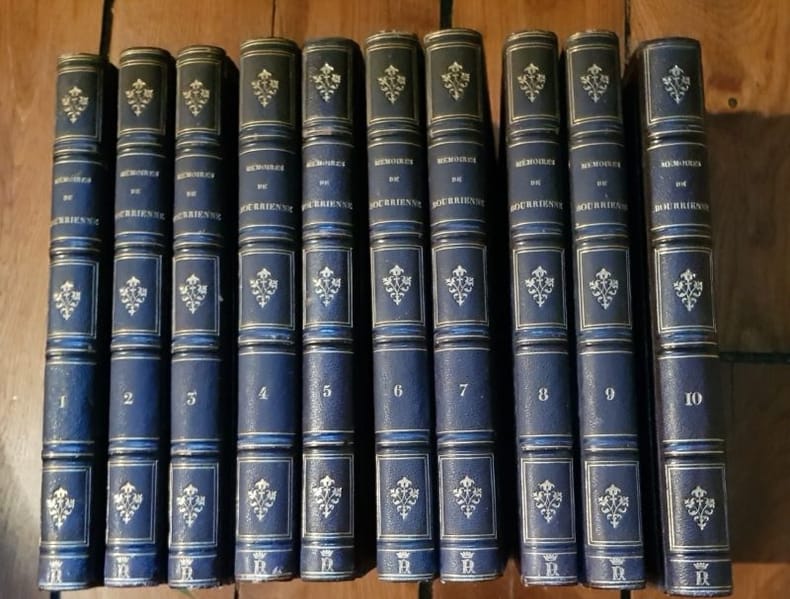
182930753Paris, Ladvocat, 1829. 10 volumes in-8. Demi-chagrin, dos à nerfs, filets et fleurons dorés, couronne royale en queue (?) (reliure de l'époque). Quelques rousseurs éparses sans gravité.
Édition originale de ces mémoires qui firent sensation, par l'un des premiers compagnons de Napoléon, dont il fut le condisciple à Brienne, mais qui se brouilla avec lui par la suite, et devint son ennemi acharné. " Louis-Antoine Fauvelet (1769-1834), dit Bourrienne, et Napoléon Bonaparte n'avaient pas dix ans lorsqu'ils se lièrent d'amitié au collège de Brienne…". " Ces mémoires sont parus pour la première fois en 1829, sous le titre cité. Ont-ils été écrits entièrement de la main même de Bourrienne ? En raison de multiples inexactitudes grossières, le Pr Jean Tulard pense que non et en attribuerait la paternité à Charles de Villemarest qui fut attaché au cabinet de Talleyrand. (Tulard, Bibliographie critique…108, p. 25, Librairie Droz, 1971). Jean Tulard préfère souscrire au jugement d'Arthur Chuquet qui écrit: Peut-on croire aux mémoires de Bourrienne ? Non. Mais il faut les lire et en les lisant avec précaution, on y trouvera quelquefois à prendre et à apprendre. » (La jeunesse de Bonaparte, p. 384). Compromis dans une affaire d'attribution de marché (!), Napoléon Bonaparte l'écarta de son cabinet en 1802. Il n'en poursuivit pas moins ses opérations financières illégales sous le protectorat du prince de Talleyrand. Après une vie faite d'honneurs et de turpitudes, (ministre plénipotentiaire à Hambourg, directeur des Postes, député de l'Yonne), il rendit l'âme le 7 février 1834, à l'asile d'aliénés de Caen, à l'âge de soixante-cinq ans.".
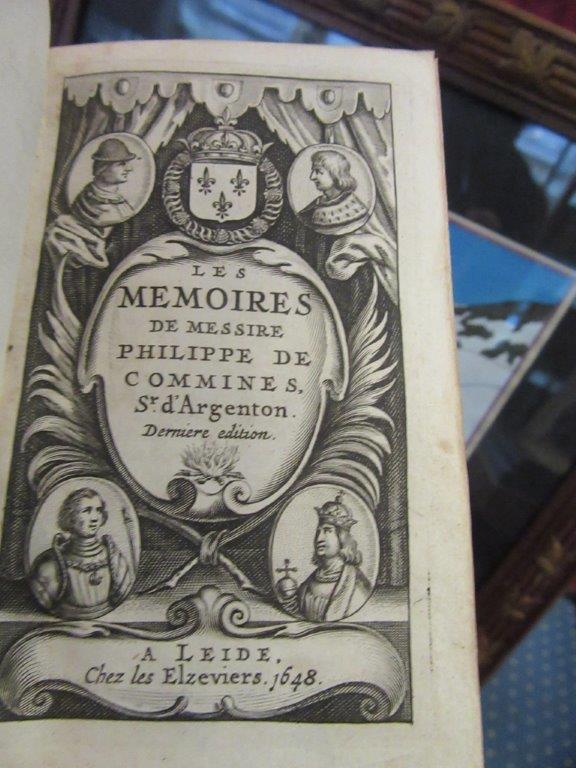
36477A Leide, chez les Elzeviers, 1648. Dernière édition. In-16 en plein cuir de Russie rouge XIXème. 765 pages plus Indice des Chapitres et Table. Seule édition donnée par Bonaventure et Abraham Elzeveir. Frontispice gravé. Reliure aux plats soulignés de 3 filets dorés dont un gras au centre. Dos abondamment décoré de caissons dorés avec motifs et pièce de titre en maroquin vert. Tranches dorées. Très bel exemplaire.
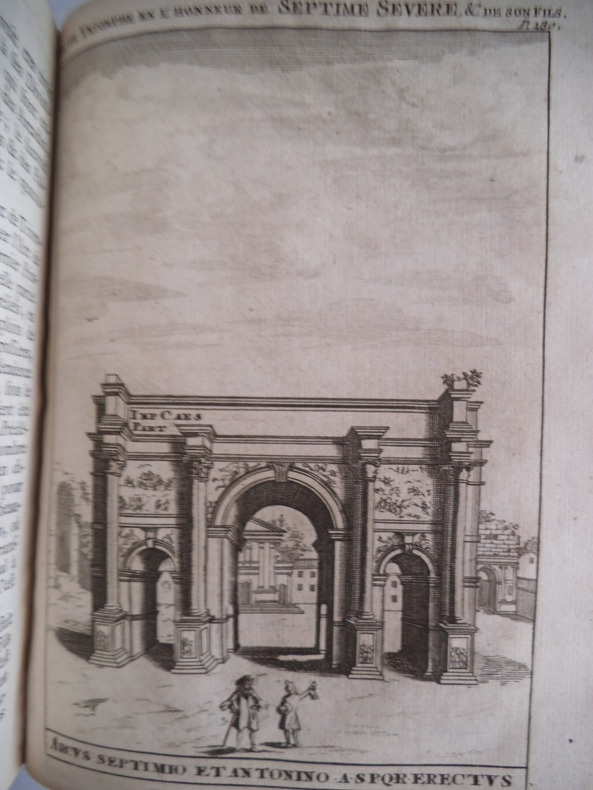
9589expliquées dans les mémoires du Comte de Bxxx contenant ses avantures. Un grand nombre d’histoires & anecdotes du Tems, très curieuses, ses recherches & ses découvertes sur les antiquités de la ville de Rome divisé en trois parties. In 8 demi-cuir marron à coins, pièce de titre cuir noir, roulette, palmette, filets dorés, titre 355 pages 105 gravures en 89 planches, certaines dépliantes, 15vignettes. A La Haye chez Jean Naulme 1750. Plats légèrement frottés, belles gravures
214266Paris, Ladvocat, 1828 2 vol. in-8, 447 pp. et 400 pp., demi-veau blond à coins, dos à nerfs, roulettes dorées (rel. de l'époque). Dos taché, mors et coins légt frottés. Qqs rousseurs.