239 résultats
1829WRCAM7078New York 1829. Vol. 1 Nos. 14-52. Thirty-nine issues in all 8pp. each paginated 105-416 index leaf. Folio. Old three quarter calf and marbled boards leather label. Front board detached old ex-lib. bookplate else clean and unmarked papers in fine condition. A nice run of this French-American newspaper in French with a mixture of domestic and foreign news and literary items. hardcover books
15192Handwritten journal Notebook recording death dates and obituaries for a teenage girl in 1857 upstate New York and others in her community. 96 pages numbered in pencil with 60 pages of content. Originally owned by Anna Arthur a school girl the initial pages record daily life including her daily interests in shopping and fashion. However Anna's contributions to the journal end abruptly in 1857 when she died suddenly "of brain congestion". The remainder of her journal is carried out by a family member likely her mother. Anna's obituary is pasted in. "Died. In this Village of Congestion of the brain after a short illness of but two days Miss Anna Arthur aged 17." Followed with handwritten pencil inscription with date of death Dec. 23 1857. "Among the deaths published in our paper this week is that that of Miss Anna Arthur only daughter of Charles Artur of this village. She was in the enjoyment of usual health until a day or two preceeding sic her death and no alarm was experienced by herself or family at the slight illness which suddenly terminated in Congestion of the brain. Miss Arthur was but seventeen years of age and was a young lady of much promise. -- The mysterious Providence which in the morning of life has removed from earth a darling child falls heavily upon the heads of a fond father and mother and a large circle of youthful friends and acquaintances. Truly we are as the flowers of the valley flourishing to day to-morrow no more! Happy visions rise before us our hearts are joyous no clouds dim the bright future when without a moments warning unseen and unknown the messenger of death lays his blightin touch upon the loved one and our hearts bleed with sorrow and refuse to be comforted."<br/><br/>Also includes a poem "Lines on the Death of Miss Anna Arthur" printed in an Essex County newspaper on Christmas day. "I gazed on a flower that modestly boomed On the breast of a maiden whom Death ahd entombed On her breast was a rose but not spirit was there.The roses that filled with their scented perfume The air which the mortals so softly did breathe: Were naought when compared witht the exquisite bloom Of those flowers that sigh where no spirit can grieve." The poems is signed off from Keeseville a small hamlet in the Adirondacks of New York. Followed by a handwritten poem "A Dirge". "Weep not for her; she died in early youth Ere Hope had lost its rih romantic hues; When human bosoms deemed that home of truth And earth still gleamed with beauty's radiant dews Her summer prime waned not to days that freeze; Her wine of line was run not the the lees; Weep not for her.Weep not for her she is an angel now And treads the sapphire floors of Paradise; All darkness wiped from her refulgent brow; Sin sorrow suffering banished from her eyes Victorious over death to her appear The vista'd joys of Heaven's eternal year; Weep not for her."<br/><br/>Includes obituary notices for members of the local community and others in the family including brother Asahel Arthur who passed in 1914. Includes handwritten poem "Rest Thee Brother." "Rest thee brother rest thee Underneath the snow; Winds shall sing a dirge for thee Murmuring waters flow." Begins with a log of various expenses for items needed in the year 1857 for sewing projects and other fancies that a young lady would enjoy such as "velvet ribbon" "bonnet" black silk kid gloves hair pinsand linen floss among others. Leather cover in poor condition. Wrapped in an attractive marbled folder. unknown books
25583EXPOSITION--LONDON--1851 THE ART JOURNAL. ILLUSTRATED CATALOGUE. THE INDUSTRY OF ALL NATIONS 1851. London: The Art Journal 1851. Folio. Rebacked calf spine and tips with marb boards. xxvi 328 xvi viii xxii viii viii pages. First edition. Containing hundreds of engravings and articles on science by Robert Hunt textiles by Lewis D.B. Gordon the exhibition itself by Ralph Wornum plants agriculture by Edward Forbes and color by Mrs. Merrifield. Rebacked else ve good. unknown books
16721Handwritten diary of a high school girl detailing her experience at the 1876 World's Fair in Philadelphia and over 30 pages of poetry to write in the autograph albums of schoolmates. <br/>8 x 5 in. Original leather boards. 48 handwritten pages. Writing on first 5 pages pasted over partially or completely. "Cora B. Wakelee Huntington Conn. May 22 1876" inscribed on front end page. Includes memories of the World's Fair from the perspective of a young girl in addition to pithy lines on friendship and original mourning poetry.<br/><br/>The 1876 Centennial Exposition in Philadelphia was the first official World's Fair to be held in the US. Wakelee details all of the marvelous things she saw including a model of Niagara Falls that was 160 ft long and 80 ft high. ".Niagara where the water comes pouring over he falls like the real Niagara. There was a house or cottage of each state. The New England House was a log house which as one story and one half high in which everything was 100 years old or over. The Bedstead was 200 years old and the bedding 100. There were two girls quilting a bedquilt. In the Connecticut Cottage there was a New England kitchen with the old fashioned chimney and the wooden nutmegs and wooden ham and gourds. In the Missippi sic state building everything was covered with moss. In Agricultural Hall they made tin pails and cups. All kinds of carpets Rag Three ply Brussels and Ingrain were made. Also cotton cloth bagging and silk handkerchiefs. In Horticultural Hall there was a Fig tree with figs on them also Orange lemon and Pineapple trees. The Egyptian mummies which were human bodies dried. A Swiss watch not so large as a gold dollar. There was Washington's horses and private carriage. There was a picture of Washington and the Declaration of Independence worked with hari. And a picture of Washtington and family worked with worsted. In the lady's pavilion was the head of a lady made of butter called the Butterhead. There was a large collection of animals and birds which were killed by a lady in Kansas. An Eagle made of gold pens was made to look like quills a little way off."<br/><br/>Records information on the High School classes from 1880-1881. Newspapers cutting from 1881 that was also transcribed by hand into the notebook: "We are pleased to note that our side shared in the honors at the close of the Birmingham high school Miss Cora B. Wakelee taking the unabridged dictionary as the first prize for spelling." The previous year she won $3.00 as thesecond place prize for Scholarship. Pages 14-48 are filled with handwritten poems and lines that would be copied into memory books or autograph albums of friends. These had sentimentality as well as humorous tone. "A wish for earth tis often given My wish for thee a home in Heaven." "Though short our acquaintance has been And quickly the hours fave flown Permit me to call you my friend As others I longer have known." "Come what may Come what will Remember the girl that went up hill." "Way over here clear out of sight is the only place she'd let me write." The entries also include original poetry mourning the loss of a close friend: "A sparkle of hope for the Lost In the deepest gloom of winter On a cold and stormy day While the shades of night were falling Mattie Otis passed away./ While the storm was in its fury One could hear the wild winds ror She has gone yes gone forever We shall never see her more." Losses to spine loose hinges. Some toning. Good condition. unknown books
D17552Autograph diary written in pencil signed by Miss Elizabeth Woods of Bowling Green Kentucky. 135 pp. Well educated wealthy American woman's account of seeing Europe; mostly Paris France. Her Southern sensibilities were shocked at seeing a white woman at the same table with a black man. Turns out he was a minister from Haiti and the lady was his wife. Miss Woods saw the Paris Exposition several times; saw Sarah Bernhardt perform; saw President Kruger of South Africa; saw a street where Jews were not allowed to come out after 6pm; describes fancy balls and dinners; shopping for clothes.much of interest. Worn oil cloth binding. Numerous accounts of "charming" or "lovely" people. <br/><br/> hardcover books
4696JAPAN. Diary. January 14 1950 to late 1954. Various places Philadelphia Japan Fort Meade. A lengthy diary of an American officer Lieutenant Louis T. Holtz who was stationed in Japan during the Korean War. It was written on dozens of sheets of loose-leaf notebook pages and it contains many black and white photographs with captions as well as newspaper and magazine cutouts and brochures from places he visited. The diary begins on January 14 1950 in Philadelphia and he discuses seeing shows and such but notes that “All in all this constituted a very enjoyable ten days of leave prior to going overseas. Sometimes I wish I could stay at home and live a normal routine life like everyone else. Other times I find myself eager to go…Almost two years ago who could forecast a war in Korea and the manner in which it would rip everyone’s life to shreds†He writes on January 2 1951 from Kurume Japan: “…perhaps 10 years from now it the diary will be of interest – if any of our civilization remains in 1961…I collapsed 28 June and spent 3 weeks in the hospital with excessive fatigue…I am the Officer-in-charge of the Kurume Office with an area of jurisdiction of approximately 1000 square miles…â€. In April 1951 he mentions “I am very busy in my position as OIC Officer In Charge. It’s a full 7-day-a-week job…The Korean mess has everyone guessing as to eh future of the Far East…being the senior official in an area of jurisdiction of nearly 10000 square miles with dozens of mayors and police chiefs constantly catching my every word as official.â€. The next couple dozen pages contain black and white photographs of protests in Japan and Holtz’s commentary about the images including “When people get hurt propaganda fills the air. The winner: the Kremlin – always!†“Demonstrations take planning and people. You can always be sure the plans were framed in red and the spectators sprinkled liberally with dye-hard communist stooges†“Demonstrations & rallies are usually fantastically well organized. And as often as not they can be unbelievably orderly†and “But orderly or violent you can always be sure there is a professional communist keeping the ‘sheep’ in line or arousing them to maximum fury.†In September 1951 Holtz writes from Sapporro “…life in the Armed Services has been a miserable one because of one bad experience after another…Kurume was one of the most pleasant and enjoyable assignments I ever held. The 45th was without doubt the most bitter and least enjoyable. I gave up so much for so little…â€. Holtz was in California’s Camp Stoneman in November 1951: “…with all the hundreds of officers here not particularly anxious to go overseas and with several actually fighting the assignment I was amazed to find that someone eager to return is sidetracked so abruptly…â€. He was back in Japan by December and then wrote a lengthy entry entitled “The Korean Story†starting with “Combat precautions make it mandatory that no diaries or personal papers be kept where they may fall into enemy hands†and he spends the next seven pages describing his experiences in the Korean War. Holtz wrote in part: “…Things had not gone well at all with Trubota’s unit prior to August 1951. After my arrival working results proved very satisfactory…Three other officers has also joined up in the interim between leaving Sapporo and going to Korea…When oriented in Tokyo they were told that the 45th Detachment would remain in Sapporo and they had already alerted their families to start to prepare to join them overseas…I had to fight Trubota in order to be able to fight the enemy. In one occasion I was reprimanded for going to a forward observation post and not being personally available to answer the telephone at my CP…†and the section finishes with a photograph of the USS Marine Lynx the ship that brought him home. The diary continues with his being stationed at Maryland’s Fort Meade. There are photographs of the mansion he occupied in Kyushu Japanese women at the beach his fellow soldiers after a bowling tournament etc. There are “Samples of United Nations propaganda leaflets dropped on North Korean positions early in the Korean conflict†that show Truman and MacArthur a December 7 1950 letter signed by the mayor of Kurume City Japan. The condition is fine to very fine. unknown books
1930D14181930. Very Good. Cloth-covered boards 12 x 10.5 inches; contains 30 grey heavy cardstock leaves. Nicely preserves silver-gelatin photographs in sepia and b/w average size is 2 x 4 inches passenger lists postcards telegrams newspaper clippings pamphlets a few manuscript entries and more tipped-onto the rectos and versos of every leaf or laid-in at rear. Boards a bit scuffed with a scattering of tiny bleached spots. Binding a bit shaken as expected as the volume is near-to bursting with keepsakes and treasures. <br/><br/>Photographs of landmarks landscapes streetscapes and some wonderful images of the clothing interior design and cars of the period. Postcards mostly b/w with a few colored include but are not limited to Stonehenge Tunbridge Wells Warwick Castle Shakespeares Birthplace Anne Hathaways cottage and lovely garden Raglan Castle Gloucester Cathedral Blarney Castle a portrait of Lenin a portrait of Stalin The Paramount Hotel of New York City. Here and there throughout this travelogue includes quite a few interesting pamphlets. All of them are clean and legible though adhered to the scrapbook by their rear covers and as such not removable without causing damage. They are: A guide to The Duke of Cornwall Hotel Plymouth; The Cathedral and Metropolitical Church of Christ; Canterbury: A Handbook for Pilgrims; Guide to the High Rocks One Mile from Royal Tunbridge Wells; A Short Guide to Battle Abbey; A Catalogue of an Exhibition of Original Paintings and Drawings Made to Illustrate Books Published at the Bodley Head New Burlington Galleries 1930; A guide to Compton Wynyates History of Blarney Castle; A Guide to Glebe Hotel Lakes of Killarney Ireland; Kate by Mary McCartie staple-bound illustrated wraps printed by The Veritas Company Dublin; The University Collection of Antiquities Short Guide-Books I. The Oseberg-Ship and The Oseberg-Room Oslo: A. W. Broggers 1930; Authorised Guide to the Tower of London. The final leaf introduces a new cruise aboard the S. S. George Washington to Hamburg Southampton and Cherbourg and Cobh Queenstown with a passenger list menu and one tiny photograph of the Statue of Liberty. Though no details of this journey are provided one legend is recorded in manuscript: A one-page telling of The Seven Sluggards in the Courtyard of the Paula Becher Modersohn House in Boettcherstrasse in which seven brothers dig a spring because theyre too lazy to fetch water from the well build a dyke around their house because theyre too lazy to fend off flood pave a road because theyd rather not dig their wagon out of the mud in general perform any number of laborious feats so that they can enjoy their laziness in comfort. Some rather brittle newspapers a love letter in which a very particular engagement ring is demanded a few stray postcards and photographs and manuscript see below are laid-in at the rear. Manuscript: 5 folded leaves comprising 17 pages. Hastily records a series of charms spells superstitions and omens undated not offering a location. If you see leaves and dust suddenly rise in a little whorl wind bless yourself and leave there is a passage there i e the fairies are going by hardcover books
197121814Westhampton New York: Moniebogue Press - Torope Conglomerates 1971. 15 issues of this alternative 'people's press' newspaper from Long Island's east end given to a tongue-in-cheek radicalism and wry Crumb-esque wit with illustrations and cartoons to match; articles on the Shoreham nuclear power plant; oil drilling; Sam Melville obituary; Native Americans free health clinics Black and Latin-American eviction fears; battles over wetlands; farm workers' struggles; Vietnam war reportage and political commentary; irregular voting procedures; local politics including a ".Probe of beatings child labor in L.I. Potato Fields."; environmental notes; report sent from a Ku Klux Klan annual meeting in Lakeland Florida; Gardiner's Island; much local advertisement arts and alternative culture; including issues: Vol. I No. 2 3 5 6 7 9 11; Vol. II No. 1-5 inclusive No. 8 12 and Vol. III No. 1; staff included Dean Speir Lorna Salzman Jay Dudley Van Howell and many guest contributors; average issue 12 pages; 11 1/2" x 15" newspaper format; a listing for this periodical shows up on OCLC however it appears to be for microfilm copies; light wear little browning to newsprint; interesting 1970s ephemeral history. . First Edition. Newspaper. Very Good. Moniebogue Press - Torope Conglomerates Paperback books
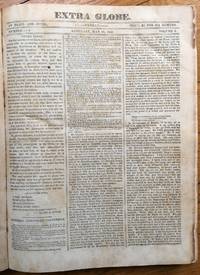
1841166Washington D.C.: Blair & Rives 1841. Good. 423pp. Volume 6 Numbers 1:27 paginated continuously. Folio. Contemporary half sheep and marbled boards. Boards detached with tape repairs. Light dampstaining at upper corner; light tanning and foxing. A complete run of this 1840 Democratic campaign newspaper published weekly as an extra to the District of Columbia periodical the Globe during political campaign seasons. This run of the Extra covers the 1840 presidential election between William Henry Harrison and Martin Van Buren. Content includes speeches and testimonials for Van Buren and against Harrison as well as editorials and other articles and party-related material that address all the principal issues of the campaign. Harrison would go on to sweep the electoral college handily but famously died in office after only four weeks as president to be succeeded by John Tyler. This is the sixth such volume the paper having started the Extra in 1834. It ran to seven volumes ending in 1841. The present volume was published from May 16 1840 to October 26 1840 with the final issue appearing post-election on January 29 1841. The whole was advertised as costing $1 for six months. The editors Francis Blair and John Rives were Jacksonian Democrats initially brought to D.C. by Jackson to be the mouth of the party. Blair & Rives unknown books
5300CARIBBEAN TRAVEL JOURNAL. Diary. 101 pages. The Caribbean. c. 1908-9. The handwritten journal belonging to C. B. Benson of Hudson New York. The diary recounts Benson’s experience on an organized cruise group visit to Caribbean locations such as St. Thomas Puerto Rico Kingston Jamaica Caracas Venezuela Panama City Panama Port of Spain Trinidad and Martinique. Benson records his experiences in each location including his impressions of the town the locals sights he visited and local travel. He visited forts a school churches a mill a sugar plantation and Carnival celebrations. Benson took his tour during the era of colonial rule the attitudes of which infuse both his experiences and observations. Based on his mention of an earthquake in Kingston Jamaica taking place a year or two before he travelled in 1908 or 1909. “…St. Thomas where we arrived about 6 A.M. mid morning Jan 26 is one of the Virgin group and we found her framed and frescoed in the principal churches. Columbus in 1493 gave the group of 100 islands rocks and…which comprise the group. St. Thomas is 13 miles in length and 3 miles in width at its broadest. And I guess we walked the length of it speaking broadly and in the abstract at this distance.The heat of the tropical sun also takes its toll and blurs our ideas of time and distance somewhat. The town of Charlotte Amelia contains 13000 inhabitants – merchants and black babies and they are all dressed in their Sunday best to receive us properly.Thursday morning at 8 we went ashore at Porto sic Rico.Returning thro the village streets we stopped at the market place and noticed the display of fruits in baskets a couple of men seated on low stools with blacks in front of them.a native woman…was entertaining us in the middle of the road with a dance.When passing the island of Haiti.‘Do you know why we do not stop at the Island of Haiti’ ‘No’ There are cannibals there there are so many fat people aboard you would lose your wife’ At St Thomas the American council held open house and received some of us who dared to invade this solitude.An hour’s railroad ride which was made interesting by stops at every little…and station where the bare legged boy with the oil gun in hand squirted oil…bearings sic of the cars and engine. As it was before the 17 miles came to an end the rear axle of the parlor car so called because it had leather covered reclining seats caught fire. But when this happened we were nearly at the end of our journey and we were not delayed much. At the sugar plantation where we detrained we found we had some distance to walk down…to the sugar mill. As there was no path and the sticky wet ground to soil made worse by the heavy rain of the night before.A sugar mill is never a clean place.The process is somewhat intricate but way he likened to the process of brewing.The cane piled up in the yard is boiled in a number of vats then is run off with barrels and in a black and solid state in shipped to the Refineries at New York. The fiber of the cane is then hardened and dried and is fed to the furnaces to boil…cane. After return to the town San Juan we visited the shops. Walked out to the fort at the entrance of the harbor. The town is excellently policed and paved in the principal streets with telegram blocks.As this day was Thursday we concluded that every day was wash day for the native women and girls who for want of other diversions spend most of their time in this form of dissipation. Even the balconies of the main public street filled with traffic of street cars carriages and drays had their fill of wash some of which are found laying in the street having been carried down by the wind. No one had appropriated it as yet; and we did not add it to our collection of souvenirs. At the officers quarters I applied for a permit of the officer of the day to enter the fort ‘San Cristobal’ the fort commanding the entrance to the harbor.The fort was like most forts. The high tower gave a commanding view of the town and harbor. Then we visited the Governor’s Palace. In the Reception Room hanging on opposite sides facing each other are life sized oil paintings of McKinley & Cleveland. In the garden were some large palms tropical ferns a fountain &.Jan 29. early in the morning we were at Kingston in Jamaica. The channel is narrow and tortuous but well… Taking a local pilot we soon…opposite it…of three vessels one of which was the Princess Louise that was caught in the hurricane here three years ago and…the larger of the three vessels was trying to pick up the light from the light house which had been blown down. This destruction of the hurricane.After driving about a mile thru the city the destruction to the buildings & pavements made by the earthquake here a year or two ago half of the city seems to be in ruins and no attempt has been made apparently to rebuild & restore the city. Thousands of lives were lost here at that time which did immense damage to the fruits. Most of the uninhabitable part of the island belongs to the United Fruit Company a Boston Corporation who ships immense quantities of bananas from Port Antonio. Owing to recent destruction by fire of Hotel Litchfield our stop at the port of San Antonio and stay of night at the Hotel was omitted. An excursion across the island by train to Mandeville was arranged in its place.The town of Colon in its principle streets are paved with brick and appear clean. We noticed many buzzards. The air was clear and there was a delightful cool breeze blowing.We stopped at all of the stations going to Panama and noted the wonderful impressions made by the Sanitary Commission. The well ventilated and screened houses. The plan for disposal of garbage the open drainage the cleared lands…But of course the facts are here – bug and drain – all working to the mutual exclusion of some ideas to the American white employers. Therefore after a few months they must have a reaction in the States to…and detach themselves from all absorbing facts. The fighting for life against…fires. Most things are…between the white employers and the black employees. So we find the ‘White Bar’ and the ‘Black Bar’ ‘The White Employees’ ‘The Silver White Employees’ &c as signs on the cars intended to carry workmen back and forth from the works.Caracas the capital of Venezuela is about 3000 ft up but the sun in the middle of the day we found very hot.Plaza Bolivar was decorated with rows of colored electric lights. They are preparing for the Carnival season which ushers in Lent in Catholic countries. The market place had counters for dry goods highly colored handkerchiefs etc. Another section was devoted to fruits vegetables etc. We noticed some very large apricots. Mr. Bolivar apparently has done a great deal for his native town. He has given his name – while the people furnished the funds – for the largest parks a street and the coinage of the plutocrats.The Spaniard the…Hildago -in his easy subjugation of the…pleasure loving tropical savage has replaced the native of simple taste and left in his place the mongrel half-breed with all the vices of the conqueror and none of the virtues of the…Indian savage…â€. The diary is in very good condition. It is mostly written in pencil but is quite legible. hardcover books
1837KC16640Paris: Achille Ricourt 1837. Hardcover. Good. 401pp. 8.5 x 11.25 French text. Starting as a weekly-illustrated journal LArtiste was published in Paris from 18311904 supplying "the richest single source of contemporary commentary on artists exhibitions and trends from the Romantic era to the end of the nineteenth century. Presumably the most important and innovative French fine arts journal encompassing: literature architecture sculpture painting engraving and music. TYPOGRAPHIE LACRAMPE ET COMP. RUE DAMIETTE 2. Full page decorative illustration preceding the Title page and signed in stone Albert Durer. Richly decorated with 50 single-leaf engravings vertical and horizontal most protected by tissue sometimes corresponding to the adjacent text. Good with the leather spine and marble covered boards rubbed with corners and edges bumped. Some pages thumbed with moderate foxing and soiling throughout; wrinkled and lightly worn early and late pages. Rear hinge split. Engravings generally clean and bright when protected by tissue. <br/><br/> Achille Ricourt hardcover books
1728D11085Boston: S. Kneeland & T. Green 1728. Ephemera. Very Good. Single leaf printed on the recto and verso; 195 x 312 mm; mounted to larger album leaf. Some marginal paper repairs one of them eliminating just a few letters of text. A few short tears and small losses. The New England Weekly Journal was started in 1727 a publication similar to Londons The Spectator. Notable here are the slaves ads that close out the information on the verso. One advertisement reads: A very likely Negro girl about 13 or 14 years of Age speaks good English has been in the country some years to be sold inquire of the Printer hereof. A chilling reminder of how commonplace such language once was. <br/><br/> S. Kneeland & T. Green unknown books
18837738Medina Ohio: A.I. Root 1883. Volume I nos. 1-4 12; and volume II nos. 1-4 nine issues in alla complete set would be: Volume 1-2; April 1882 - December 1883 twenty-four issues in all. Slim periodical each issue bound on cord 25.5 x 17 cm. 8-24 pages each issue. Illustrated. A juvenile supplement or "Extra" to Gleanings in Bee Culture the newsletter of the famous apiarist A.I Root. Contents include simple advice on beekeeping entertaining stories moral guidance letters from readers and more. Some soiling and edgewear to front panel of first issue; tiny printed sticker with subscriber's name and address to each. Otherwise very good. Each issue with the same very attractive woodcut masthead. OCLC locates five complete sets indicated. A.I. Root unknown books
16810WWII Daily dairy from an American high school girl in 1942. Handwritten entries about family Scout activities sports and living through WWII. 6 x 3.5 in. Original cloth boards. "Diary 1942" on front cover. Comes with a 1942 postcard addressed to diary's owner requesting she have an eye exam listing her school as Caldwell School and address in Harper IL. Daily entries through mid-May and then entries become more sporadic. She writes about War Savings stamps issued by the US Treasury to help fund WWII. "I got 16 defence sic stamps and got my book almost full. fWe went to see Sergeant York at the tower." The stamps would be collected in a booklet and redeemed for Treasury Certificates or War Bonds. She writes about school activities and playing sports with friends. "After school was Scouts. I brought Lois. I think she is going to be a scout I hope so. I wore my boys shirt and my boyfriend called me a tom-boy. He called me "darling" once." "Today I took out the ball and we played volley ball." ".we made teams and played a good game." ".after school Arvis and I played catch.I played some records and went to bed." They also listened to national coverage of the 1942 Rose Bowl which was played in North Carolina rather than Pasadena due to fears of a Japanese bombing attack. This game was January 1 1942 less than one month after Pearl Harbor. ".Well we are lessening listening to the Rosebowl game and I don't like it. I just had some orange juice." <br/><br/>She writes about her father working night shifts possibly in a war industry; and includes many humorous and charming observations about life through the eyes of a teenage girl. "Today after school I went to a puppet show with my mother.After the show we went backstage. They showed us all the marionettes. When we got home dad was just about to go to work." "My uncle sent a letter.telling her he got married. It was a great shock to her. My mother thought it was grand." "Today mother washed my hair.It hadn't been washed in four weeks did it feel good." "Bill played with the morse code we all had a lot of fun." She writes on social activities with boys. "Today we had our first dancing lesson. I was chosen to take the money in my room.We learned a dance and then the boys came and asked us to dance. I danced with Donald." She also writes about her first menstrual cycle: "Today I became a young lady. Mom had to tell everybody about it too." Some very cryptic messages showing the mischievous nature of the author: "Dear Diary Today I started a thing. Its easy to do and you can make all most anything with it. I got pretty far." The next day she continues: "Today I worked on the thing I started yesterday. Now I got 1 foot done." List of accounts and phone numbers handwritten at the back. Very good condition. unknown books
178147574York: Printed by W. Blanchard and Co. for the Booksellers of York 1781. 1st edition thus. Leather wrapped card stock covers. Later respining with black leather label. Later paper label affixed to front board. General wear & soiling. Ex-lib with stamp to ffep. Faded presentation inscription bookseller note states from Wm F. Hanney Engineer Dept ret York. xiii 3 104 59 1 pp. Last section has such information as "A Concise Account of the City of York" "A List of all the Fairs in the Counties of York." & "An Account of the Horse Races . throughout Great Britain in the Year 1781." 12mo signed in 6s. 6-1/2" x 3-7/8" <br/><br/>ESTC & COPAC record just one institutional holding of this inaugural year: British Library. Research suggests 1795 would be the final year of publication for the year 1796. Printed by W. Blanchard and Co. for the Booksellers of York hardcover books
1946WALTER-FILM000757Vintage original 7 x 5" 17 x 12 cm. black-and-white single weight glossy silver gelatin print still photo USA. Rita Hayworth Glenn Ford George Macready Joseph Calleia dir: Charles Vidor; Columbia. <br /><br />One of the quintessential film noir titles with star Rita Hayworth becoming film history's iconic <i>femme fatale</i>. <br /><br />This image is from a sitting which is amongst the most famous publicity photo shoots of all time utilized fully and in part for scores of publicity campaigns for the film and the star. Hayworth is featured in what is likely her most famous costume a gown designed by Jean Louis. In the film she performs the musical number "Put the Blame on Mame" while wearing this gown. To this day Hayworth's performance is most appealing not only because of her sex appeal but because of her pathos and vulnerability. <br /><br />This still has the original use ink stamp on the verso for Acme Newspaper Inc. Remnant of original paper blurb on verso. Minor interior crease above Hayworth's head to right. Light creases at bottom right corner NEAR FINE Columbia books
1868329Chicago: Root and Cady Publishers 1868. Single issue. 335 x 260 mm. 13 x 10 inches. 8 pp. folded and unopened some light soiling to the paper otherwise very good. Rare musical newspaper published by Ebenezer Toner Root and Chauncy Marvin Cady the leading music publisher's in Chicago before the fire in 1871. The Song Messenger was printed from 1864 to 1871 when the company went bankrupt after the losses caused by the fire. In addition to advertisements for musical instruments lessons and scores this issue contains an "Introductory Course for Congregational Singing" which include instructions for learning Psalm LXVII "Let the People Praise Thee O God Let all the People Praise Thee." Also included is the song Gathering Home music by C. T. Lockwood and lyrics by H. M. Look. Lockwood was prolific song writer producing scores of melodies and marches for Chicago publishers during the 1860 and early 1870's. This issue of The Song Messenger was printed in August 1868 and according to OCLC in known in one copy at the Newberry Library which also holds the April issue of the same year. Knox College in Illinois and the Library of Virginia also hold one issue from the year 1869. Lockwood's Gathering Home was also printed in Western Musical World: A Journal of Music Art and Literature in 1868 by S. Brainard also of Chicago. One copy of this is located at the University of Michigan. 329. Root and Cady, Publishers unknown books
1865018675Clarion PA: Clarion Extra 1865. Book. Very good- condition. Unbound. First Edition. Quarto 4to. Issued the day President Lincoln died as he succumbed to the assassin's bullet. A one-sheet publication no place of publication listed but thought to be Clarion PA issued in haste as it has numerous typographical errors. Folded into fourths moderately foxed with one corner torn off affecting a few letters of text. It reads: CLARION EXTRA. FROM WASHINGTON. Pres. Lincoln Assassinated! Sec. Seward Assassinated! Seward's Son Dangerously Wounded! THE NATION MOURNS. Curiously the final line of text reads: The latest despatch states that Booth the supposed assassin has been captured. - Ed. Measures 5.5 inches width by 12.75 inches height. . Clarion Extra Paperback books
1839WRCAM41144Boston 1839. 289-579pp. plus three plates. Later wrappers. In a folding cloth box leather label by James MacDonald. Volume 2 numbers 3 and 4 of the BOSTON JOURNAL OF NATURAL HISTORY issued in August 1839. A survey of fish in Massachusetts' waters completed as part of a Zoological Survey of Massachusetts. hardcover books
19082921New York & Chicago 1908. Thick quarto. 12 issues of this professional journal for the ice trade. Profusely illustrated with ads for all business connected to the trade. Contents include articles on large scale refrigeration installations various technical matters regional association activities trade conventions etc. Text block very good but three quarter brown morocco binding is split at the hinges and quite rubbed. Scarce in the trade. unknown books
1888224763Vicksburg Miss 1888. FACSIMILE. 1p. printed on verso of floral wallpaper. Folio. Stamped copyright applied for Jan. 1888 on lower margin. Some splitting at old folds. FACSIMILE. 1p. printed on verso of floral wallpaper. Folio. Wall-Paper Newspaper Facsimile. A facsimile of a Confederate wall-paper newspaper printed on the verso of a sheet of wallpaper due to the scarcity of paper. "Compelled to print on one side of the paper only and frequently shorn of advertisements the editor gave to his readers only the military information the local news and occasional quotations from other journals" Brigham.<br/>This issue is famous for the note added July 4th at the bottom of the page by just victorious Union soldiers: "Two days bring about great changes. The banner of the Union floats over Vicksburg . this is the last wall paper edition and is excepting this note from the type as we found them. It will be valuable hereafter as a curiousity". Clarence Brigham "Wall-Paper Newspapers of the Civil War unknown books
12703DAVAR Hebrew historic newspaper 1 July 1948 LABOUR DAILY TEL-AVIV with in headline the proclamation of the Ene of British Mandate in Palestine Eretz-Israel the last British soldiers left yesterday - Israel Jewish Navy entr in the Port of Haifa. This complete newspaper includes 4 large pages size: 17" x 23" twice folded. Very good condition minor cuts in the middle fold. unknown books
14682Very Rare early lithographic printed Qajar Newspaper Urduye Humayun Number 6 issued on 23 Ramazan AH 1300 1882. The newspaper is regarding the Qajar ruler Naser Al-Din Shah's trips in the country. 4 complete pages approximately 13"x 8.6" in size. <br/><br/>The first newspaper ever printed in Tehran was published in 1837 with only three issues printed from May-August 1837. The first lithographic book to be published in Tehran was in 1838. However as one observer to Tehran reported in 1843 the lithographic press in Tehran "remained mainly idle". Berezin p. 248. In the latter part of the 1840s the State Printing House began its work; and was operative until the end of the first decade of the 20th century. As of February 1851 the first Persian regular official newspaper was printed there. Early into the 20th century the lithographic press was being forced out by typeset printings and from 1911-on the official newspapers in Iran was printed typographically. Encycolpaedia Iranica online ed Our Qajar newspaper from 1882 is a rare example of the very early lithographic printing to take place in Iran before the switch to typographical printing. Small paper loss to top right corner of margin does not affect the text. Overall in very good condition. unknown books
143781771 Newspaper with slavery ad. Boston. 15" by 10." The Almanack lists two advertisements relating to slavery "To be sold for want of employment a likely Negro Boy that won't drink rum he is about 14 years old." An interesting slavery related advertisement which chronicles a dark era in American history. Overall foxing some soiling and small tears. Otherwise very good condition. unknown books
1768WRCAM16469Boston: Mein and Fleming 1768. 8pp. newspaper. Somewhat soiled and slightly browned else good. An interesting issue of this Boston newspaper mostly devoted to the actions of Gov. Hutchinson and the Council with regard to a riot against Custom House officers and unrest over shipping in and out of Boston. Mein and Fleming unknown books