34 254 résultats
Edizione originale. Tutto il pubblicato (dal primo numero dell’aprile-maggio 1946 al numero doppio 3-4 dell’agosto- settembre-ottobre-novembre dello stesso anno) della rivista di letteratura e arte «Paesaggio». Esemplari in ottime condizioni, privi di particolari difetti da segnalare. Rivista fondata e diretta da Mino Rosi nel 1946 dedicata a scritti di arte e letteratura. Benché pubblicata per un solo anno - dall’aprile al novembre del 1946 -, «Paesaggio» merita di essere ricordato nella storia dei periodici del secondo dopoguerra grazie ai suoi contributi di alto profilo e alle eleganti immagini e litografie che arricchivano i fascicoli. Tra i collaboratori vanno almeno ricordati Saba, De Pisis, Del Buono, Milena Milani, Sinisgalli, mentre le litografie erano firmate da Tamburi, Gentilini, Gallo, Savelli, Sassu, Pulcinelli, Maccari, Rosi e De Grada. 3 voll.
181931400Sydney: Wireless Press 1918-19. Very Good. lge. octavo. cloth binding 770pp. b/w pls. col. ills. diags. maps index Australasian Monthly Journal for the Navy & Mercantile Marine Aviation Radio-telegraphy & Telephony. Vol. 1 No. 1 to Vol. 1 No. 12. Copiously illustrated inc. photos of decorated Australian Sailors & Flyers. Also many fine photos of Australian Ships & AFC aircraft. Very Scarce Wireless Press hardcover
191223087London: Iliffe & Sons 1912-13. Very Good. Quarto. pictorial wrappers 31 32 34 34 34 32 32 32pp. b/w pls. diags. 8 Copies of this Early & Interesting Aviation Journal several with original heavy covers bound-in. Fine and Valuable archive of Early Aviation Photography & Information Iliffe & Sons unknown
19131266351913. Ireland: June 16-18 1913. <br /> <br /> Small lined notebook 11x17.5 cm 56 pp. orange card covers titled by hand spine reinforced with tape. Approx. 28 pages filled with neat ink manuscript entries illustrated with four small original sepia photos and a hand-drawn folded map tipped to inside of front cover. Covers a little worn contents age-toned but entirely legible.<br /> <br /> § A delightfully detailed record of an amusingly rushed school trip to Ireland made by an English schoolboy in 1913. The boys and several masters departed from Stonehouse in Gloucestershire it seems likely they attended Wycliffe College prep school and travelled by train to Fishguard in Wales and from there by boat to Rosslare Harbour in Country Wexford Ireland. Then by train char-a-banc a governess cart ponies and finally boats they tore across the south of Ireland to Killarney and back in a single day. The dutiful author of the journal prepares for the trip with several lists: "General time-table" "List of required articles" including "change of socks.cup soup-plate. rug if room" "Things to be noticed" Waterford Harbour Mountains Lakes Cattle Grazing. and a very thorough plan for "Meals" cornflakes chocolate bananas squashed fly biscuits. The journal itself is neatly written and full of detail particularly of the various vehicles Irish trains get a thorough review and his glimpses of "real Ireland". Four small mounted photos show a bridge in Kerry viewed from a boat Ross Castle "A Jaunting Bar" a kind of horse-drawn carriage and happily "the Author" who appears to be in his early teens. The star of the journal is a large folding map of the trip carefully hand-drawn and keyed and mounted inside the front cover. unknown
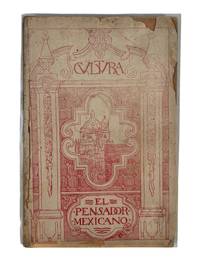
1918216641918. González Obregón Luis. El Pensador Mexicano: Diálogos sobre cosas de su tiempo sacados del olvido. México: Cultura 1918. First edition. T. VI Num. 6. Illustrated cover by Valerio Prieto. 8vo Original printed wrappers with an elaborate red-ink architectural design featuring an illustration of Mexico City's Metropolitan Cathedral. A rare issue of El Pensador Mexicano a publication named after the pseudonym of José Joaquín Fernández de Lizardi the early 19th-century Mexican journalist and novelist known for his social critiques. Luis González Obregón an esteemed historian and chronicler revives the tradition of El Pensador Mexicano in this volume engaging in dialogues that explore historical and contemporary Mexican society. His work is a reflection on national identity political evolution and cultural heritage written during the turbulent post-revolutionary period. Covers show heavy wear with chipping to edges significant loss to upper right and lower margins and creasing along the spine. Interior pages browned but intact with some foxing and minor corner wear. Overall good condition. A scarce piece of Mexican literary and historical discourse capturing the intellectual climate of post-revolutionary Mexico. unknown
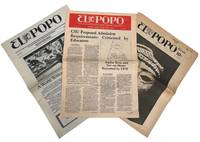
1970230841970. El Popo student newspaper archive 1970-1991 documents the sustained role of Chicano student journalism as an organizing instrument within the Movimiento Estudiantil Chicanx de Aztlán MEChA network and the broader Chicano Movement. Founded in 1970 by students responding to the absence of Chicana and Chicano perspectives in mainstream media El Popo functioned as a political communication system linking campus activism to labor struggles electoral politics and community-based organizing. The publication's name drawn from the volcano Popocatépetl signaled an explicitly militant and mobilizing ethos aligned with movement-era consciousness. Across the archive coverage of United Farm Workers activity anti-Proposition 38 organizing around bilingual ballots urban displacement and police brutality establishes the newspaper as a primary source for grassroots political discourse while the 1991 issue extends this framework into global and late-Cold War contexts through coverage of the Gulf War AIDS crisis awareness and transnational cultural production.<br /> <br /> 1 El Popo. Vol. 1 No. 1. Northridge CA: M.E.Ch.A./California State University Northridge November 1970. Early foundational issue produced at the height of the Chicano Movement situating student activism within labor struggles and community resistance. Coverage includes United Farm Workers organizing boycotts arrests and critiques of institutional racism alongside poetry and personal accounts that articulate emergent Chicano political identity.<br /> <br /> 2 El Popo. Northridge CA: M.E.Ch.A./CSUN March 1985. Mid-period issue reflecting the institutionalization of Chicano Studies and continued student activism. Articles address urban development displacing Latino families police brutality and "tokenism" demonstrating the persistence of structural critiques into the 1980s. The issue maintains bilingual engagement and integrates literary expression with political reporting.<br /> <br /> 3 El Popo. Vol. 25 No. 1. California State University Northridge Spring 1991. Eight-page tabloid-format issue produced through the Chicana and Chicano Studies Department. Lead article "A World Without Fear" documents Judith F. Baca's World Wall project with front-page caption: "Soviet woman worker prepares the Gorky Park site for the World Wall Exhibition 1990." Additional content includes "An Ecological Disaster" on the Persian Gulf War "AIDS CRISIS AWARENESS" and "Sí Se Puede - Young Latina Forum" alongside a "Poesía" section featuring works such as "Brown Hope" "1990: 20 years since the Chicano Moratorium. Away from the spotlight; little access to a dream" and "A Chicano Will Die Today" by Manuel Castro reprinted from Somos Raza. Layout demonstrates the alternative press practice of embedding political meaning through visual and textual juxtaposition.<br /> <br /> Three issues total spanning 1970 to 1991 each measuring approximately 11.5 x 16 inches and printed in tabloid newspaper format with bilingual English and Spanish content. The archive traces the evolution of Chicano student press from movement-era militancy through institutional continuity and into late 20th-century global and public health discourse. Newsprint exhibits age toning expected horizontal folds and minor edge wear consistent with student-produced distribution; all issues remain legible with strong textual clarity. Overall condition very good. The archive provides longitudinal evidence of how Chicano student newspapers functioned as durable infrastructures of political communication sustaining activism across decades of shifting social and geopolitical conditions. unknown
1818189601818. Americana Handwritten 1818 commonplace book. 38 handwritten pages 6" x 4." England. While the writer of this book remains unnamed flipping through the pages offers an intimate look into their thoughts ideas and reading habits. Writings in this book range from the political "The paper money system is a system of murder as well as robbery" to the thoughtful "An artichoke and a pineapple have the same shape but what a difference in flavor!" to the biting "Women have such a tedious manner of telling a story." The latter half of the book is entitled "Memorandum" and appears to be mostly concerned with matters of business. There quotes and verses of poems that the writer found inspiring such as an excerpt from Voltaire: "The art of instructing succeeds better than the art of lampooning because satire dies with those who are its victims but.virtue is immortal." Other excerpts include "The universe appeared as a vault wherein true comfort was entombed; and the sun himself as a lamp to show the gloomy horror of a guilty mind." "One of the Roman emperors sent to buy the pillow of a man that was greatly in debt yet could sleep sweetly." "Of all the tyrannies on humankind the worst is that which persecutes the mind." "Many prose writers dislike wit as eunuchs dislike love." "On Monday evening Mr. Brougham is reported to have made a motion for the diminution of the influence of the crown in a speech which the Times calls the greater parliamentary effort this __. If instead of the greatest the Times had called it the longest that judicious paper would have been for once right.we have heard that the hon. member spoke for three hours & a half." Fascinating journal that offers a detailed view into everyday life two hundred years ago. Delicate pages are intact with expected tanning. Cover is loose from the book with a large stain to blank area. Otherwise very good condition. unknown
193496700Paris, éditions de l’Atlantique 1934 7 numéros. In-4 31 x 23,5 cm. Agrafés, 8 pp. par numéro, première page en bichromie, photographies en noir & blanc, illustrations et cartes hors texte, textes de G. la Roërie, Firmin Roz, Constantin-Weyer, Montpetit, de la Roncière, Maurice Guierre, Valéry Larbaud, etc, illustrations de Chancel, V. Le Champion, ..., publicités. Ensemble en excellent état.
194151777P, Théophile Renaudot 1941 35 fasc. in-folio, ch. 8 pp. Petits effrangements. Bon exemplaire.
190551571PETIT JOURNAL MILITAIRE 1905 108 numéros en 2 volumes In-4, demi-basane cerise, dos lisse orné. Ch. n de près de 14 pp. Texte sur 3 colonnes. Nombreuses illustrations photos, cartes... Table annuelle en fin de chaque volume. Il manque la première page des numéros 2, 22, 29, 48 et 50. Premier volume : dos passé, coiffes frottées. Bon exemplaire du second.
1988223411988. Baim Tracy ed. Outlines: The Voice of the Gay and Lesbian Community archive 1988 to 1992 documents Chicago LGBTQ journalism during the AIDS crisis the expansion of queer community media and the intensification of legal cultural and political struggles over gay and lesbian public life. Tracy Baim co-founded Outlines in 1987 after co-founding Windy City Times in 1985 and contemporary accounts describe Outlines as part of a competitive and consequential Chicago LGBTQ newspaper environment that helped record local and national movement history. These issues show the cultural sphere of LGBTQ community journalism through interviews protest photography AIDS coverage lesbian conference reporting arts criticism legislative updates and international news offering insight into how queer periodicals connected Chicago readers to national politics women's culture legal advocacy and media representation.<br /> <br /> Outlines: The Voice of the Gay and Lesbian Community. Chicago: Lambda Publications 1988 to 1992. Five issues. Archive of five issues from Vol. 2 Nos. 4 and 7; Vol. 4 No. 12; and Vol. 5 Nos. 6 and 8 with visible contents including feature interviews community news protest reporting arts coverage AIDS-related material legal updates and national and international LGBTQ news. 1 Baim Tracy ed. Outlines: The Voice of the Gay and Lesbian Community. Vol. 2 No. 4. Chicago: Lambda Publications 1988. The September 1988 issue carries the headline "Michigan Fest" and centers a report on the Michigan Womyn's Music Festival with additional coverage of an AIDS benefit hosted by Circus Vargas Lily Tomlin and Robin Tyler performances activism against a state AIDS bill protest at the Republican National Convention and a profile of author John Rechy. The issue is especially useful for documenting lesbian cultural space AIDS-era benefit work electoral protest and queer literary visibility within one Chicago-based periodical. 2 Baim Tracy ed. Outlines: The Voice of the Gay and Lesbian Community. Vol. 2 No. 7. Chicago: Lambda Publications 1988. The December 1988 issue features "Torch Song Trilogy-An Interview with Harvey Fierstein" and includes coverage of gay and lesbian choruses queer bookstores LGBTQ representation at Carnegie Hall holiday community programming and World AIDS Day reflections. Its contents place queer performance memorial practice and community institutions within the same field of coverage. 3 Baim Tracy ed. Outlines: The Voice of the Gay and Lesbian Community. Vol. 4 No. 12. Chicago: Lambda Publications 1991. The May 1991 issue headed "3000 at Lesbian Confab" covers a major gathering of lesbian leaders includes an interview with Christie Hefner reports on plans for a Chicago LGBTQ community center and includes global LGBTQ coverage state legislative updates and a section for Asian American Heritage Month. The issue documents lesbian organizing community infrastructure international attention and race-conscious editorial programming. 4 Baim Tracy ed. Outlines: The Voice of the Gay and Lesbian Community. Vol. 5 No. 6. Chicago: Lambda Publications 1991. The November 1991 issue uses the cover title "Victims No More" and documents protests against Cracker Barrel's anti-gay hiring practices and California's veto of gay-rights legislation with a cover image of queer activists confronting authority. Contents include "Dykes Take the Capitol" visuals an interview with Lily Tomlin and legal coverage of Chicago Police Department accountability rulings and internal discipline decisions in a gay case placing street protest lesbian direct action celebrity interview and police accountability in direct relation. 5 Baim Tracy ed. Outlines: The Voice of the Gay and Lesbian Community. Vol. 5 No. 8. Chicago: Lambda Publications 1992. The January 1992 issue headed "World Review: Victories and Setbacks Marked a Momentous 1991" includes coverage of the Thompson/Kowalski guardianship victory international LGBTQ repression including Russia setbacks for LGBTQ political appointments in Chicago Gloria Steinem's Revolution from Within interviews with Dick Sargent and Joe Keenan and legal action against Cracker Barrel. The retrospective format shows how Outlines framed a single year through law family recognition international repression feminism popular culture and workplace discrimination.<br /> <br /> Mild handling wear age toning to newsprint and creasing consistent with circulation and storage very good overall. Concentrated AIDS-era and early 1990s LGBTQ press archive preserving Chicago-based coverage of lesbian organizing queer cultural production legal rights struggles anti-discrimination protest police accountability and national and international movement news. unknown
0204QYR0RFPHardcover. Good. Good on the outside very good inside full leather with consistent scuffing and ghost of gold lettering still visible. Very good inside. Well bound complete. Friends' Miscellany 1837 Hardcover Isaac Comly Joshua Evans John Hunt John Comly hardcover
38193Paris. Charpentier. 1857. 8 volumes in-12. Demi-chagrin vert. Titres et décorations dorés aux dos. Première édition complète. Première série : 1718 - 1726. 468 p. Deuxième série : 1727 - 1734. 540 p. Troisième série : 1735 - 1744. 584 p. Quatrième série : 1745 - 1750. 511 p. Cinquième série : 1751 - 1753. 455 p. Sixième série : 1754 - 1757. 617 p. Septième série : 1758 - 1761. 427 p. Huitième série : 1762 - 1763. 547 p. Bon état malgré de fortes rousseurs in-texte. Couvertures défraichies et frottées.
197327487Paris 1973 In-4 les premiers numéros et 3 des numéros 0 , numéros 00, 003, 004, puis les N°s 1, 2, 3, 4 ( annotations ) , n° 5, N° 6, N° 7, N° 8, N° 9, N° 10, 12, 13, ( pas le 14 ) puis le 15, 16, 17, et les numéros 79, 93, 94, 95, 96, 97, 98, 99, 100, 101, 102, 103, 104, 105, 106, 107, 108, 109, 110, 111, 112, 113, ( pas le 114 ), 115, 116, 117, soit 43 numéros
In-4 gr. (mm. 372x275), legatura edit. in tela verde figurata a colori con titolo oro al piatto (lievi abras.), di pp. 12 cad. fascicolo, molto ben illustrato nel t. da immagini xilografate anche a p. pagina. Offriamo l’annata 1888, completa in 52 numeri, dal 279 al 330. Il volume è introdotto da un bel frontespizio figurato e da 2 pp. di Indice. Esemplare molto ben conservato. .
19385422CBParis, 1938. Folio. 114 S. Mit 8 S. Farblithographien mit indischen Sujets und Lithographien von Chagall (s/w), Miro, Rattner und Klee (farbig); zahlreichen Heliogravuren in Farbe und Gold, Reproduktionen und Fotos in Heliogravure. Orig. steife Broschur mit farbiger Illus. nach Bonnard. + Wichtig: Für unsere Kunden in der EU erfolgt der Versand alle 14 Tage verzollt ab Deutschland / Postbank-Konto in Deutschland vorhanden +, 5422CB|5422CB_2 [2 Warenabbildungen]
19145417CBLeipzig., E.A. Seemann, 1914. 4°. IV, 332 S. Original Leinenbände mit geprägtem Deckel und Rücken in schwarz und gold. + Wichtig: Für unsere Kunden in der EU erfolgt der Versand alle 14 Tage verzollt ab Deutschland / Postbank-Konto in Deutschland vorhanden + Fünfundzwanzgister Jahrgang. Neue Folge. berieben. In gutem Zustand.
19075407CBLeipzig., E.A. Seemann, 1907. 4°. IV, 544 S. Original Leinenbände mit geprägtem Deckel und Rücken in schwarz und gold. + Wichtig: Für unsere Kunden in der EU erfolgt der Versand alle 14 Tage verzollt ab Deutschland / Postbank-Konto in Deutschland vorhanden + Achtzehnter Jahrgang. Neue Folge. berieben. In gutem Zustand.
Diretta da A. Tironi con Angelo Zambelli redattore -responsabile, la Cronaca Turchina, settimanale, appare nel 1868 e si ha notizia di pubblicazione fino ad una data imprecisata del 1870. La Cronaca Turchina si presenta come giornale di libero pensiero e fortemente critico nei confronti dell’Amministrazione Veneziana e del Governo centrale, con feroci attacchi alla Magistratura più volte impegnata a condannare gli articoli pubblicati. Offriamo tutto il pubblicato dell’anno II, 1869, con il supplemento al n 44, con le seguenti lacune: nn 1 3 10 27 40 41 42 43. Molto rara.
Edizione originale. Tutto il pubblicato dal 1954 al 1958. Fascicoli in ottimo stato di conservazione, solo lievemente bruniti alle carte e con qualche raro, occasionale strappo alle brossure (numeri 1 - 2 e 3 - 4 del 1954 con dorso editorialmente non incollato ai fascicoli). Fondato a Napoli nel 1954, «Il Fuidoro. Cronache napoletane» rievocava già nel titolo la figura di Vincenzo D’Onofrio, scrittore partenopeo del XVII secolo che, con lo pseudonimo “Innocenzo Fuidoro” - anagramma del nome -, firmava la proprie opere, a partire da «I giornali di Napoli», raccolta destinata a riportare notizie legate alla città campana non priva di invettive satiriche contro i nobili locali. Similmente, il periodico diretto dal giornalista Massimiliano Vajro si proponeva di raccontare aspetti e personaggi della storia, della cultura, dell’arte e della vita napoletane con contributi di alto livello. Il primo numero (doppio) apparve nel maggio del 1954 per poi proseguire con numeri doppi o tripli fino al 1958, anno in cui furono pubblicati due soli doppi numeri: l’1 - 2 per gennaio-giugno e il 3 - 4 per luglio - dicembre.
5378Aux bureaux, Librairie Stock, Paris, 1898. Un volume in-folio demi cartonnage crème à coins, dos lisse, 1f. de titre, 4 pp. par numéro, du n° 1 (17 février 1898) au n°52 (27 janvier 1899). Cartonnage défraîchi, papier bruni néanmoins bon exemplaire bien complet.
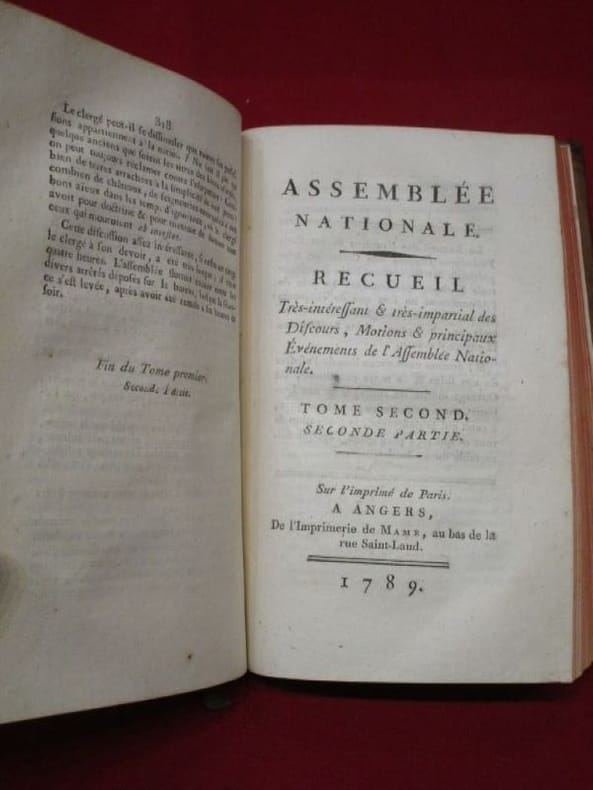
115082[Sl, sd], 1789 - A Angers, Pavie, 1789, 2 volumes in-8 de 125x195 mm, 318,320 pages - 612 pages. Pleines reliures marbrées, dos à cinq nerfs portant titres et tomaisons dorées sur pièces de cuir bordeaux et vert, caissons ornés, filet doré sur les coupes, tranches rouges, gardes de papier marbré à la coquille. Bon état général malgré les défauts de reliure à signaler (une coiffe manquante, début de fente sans gravité sur le mors supérieur du deuxième volume, des griffures et manques de cuir, coins émoussés), ex libris tamponné sur les pages de titre, erreurs de pagination sans manques, 8 feuillets insérés au deuxième volume ( "Projet de bienfaisance", "Avis du sieur Pavie"), intérieur frais.
Buon esemplare, leggermente consunto al mezzo dei fogli causa piegatura, ma senza perdite evidenti. Milano, in “Il Fascio. Organo dei fasci italiani di combattimento“ Anno I - N. 9 (Stab. Tip. Fed. Sacchetti), 1919 (18 ott.). 433x600 mm, un fascicolo di pp. 4 numerate stampate e illustrate in nero. -- Settimanale con gerente D. De Amicis. Bella testata illustrata da Firradini. Numero monografico sull’“Adunata nazionale di Firenze consacra lo sviluppo del movimento fascista. Impressioni e commenti“, tra cui la testimonianza dell’abilità oratoria di Marinetti - in una lunga colonna non firmata a pagina 2, che ’fiancheggia’ il “Discorso di Mussolini”. -- L’articolo condensa i temi toccati dalla conferenza marinettiana nel periodo dell’impegno politico futurista: anti-bolscevismo, “svaticanamento“, sostituzione del Senato con un “consiglio dei giovanissimi“, riforma della scuola in direzione non-professorale, “istituzione di mostre libere e gratuite del genio creatore [per] salvare così il dimenticato proletariato dei geniali che devono governare l’italia di domani“. A confermare quest’ultima asserzione marinettiana segue “La rivelazione di un oratore operaio“, incentrata sulla figura di tal Sommovigo. -- Interessante documento sulle origini del fascismo tra i transfuga del socialismo, gli arditi, gli interventisti e i futuristi. L’articolo precede il testo pubblicato in “Roma Futurista“ II, 45 (2 novembre 1919) e l’opuscolo elettorale a stampa “2 improvvisazioni di Marinetti” per le edizioni dell’ “Ardito” nel novembre ’19. Cammarota, Marinetti, 73.
Foxing in qualche pagina, ma nel complesso ottimo esemplare. L’Italia del popolo fu fondato a Milano da Giuseppe Mazzini. Il primo numero, con in epigrafe Unità Dio e il Popolo, uscì, in formato fo, il 20 maggio 1848. Ebbe vita breve; solo 74 fascicoli vennero pubblicati. Nel 1849 il giornale fu rifondato a Roma e divenne l’organo mazziniano della Repubblica Romana. Anche in questo caso il giornale ebbe vita breve: da Aprile al 3 Giugno. Con lo stesso nome, Mazzini pubblicò periodici a Losanna, (dove si erano rifugiati gli italiani dopo la caduta della Repubblica Romana) dal 1849 al 1850 e a Genova nel 1857. In questo primo volume troviamo scritti di: Mazzini, Pisacane, Saffi, De Boni, ecc.
194920720Paris, Albert Guillot, 1949 ; petit in-4° en feuilles, couverture crème imprimée rouge sous chemise-étui ocre ; 176 pp., 37 compositions de Andres Segovia et lettrines en couleurs gravées sur bois par Roger Boyer.