Periodico mensileMareMagnum

34 248 résultats
leggeri danni
0366912763.Gpaperback. Good. Access codes and supplements are not guaranteed with used items. May be an ex-library book. paperback
026789371X.Ghardcover. Good. Access codes and supplements are not guaranteed with used items. May be an ex-library book. hardcover
1333568568.Gpaperback. Good. Access codes and supplements are not guaranteed with used items. May be an ex-library book. paperback
8vo., First Edition, with a portrait frontispiece, neat inscription on front free endpaper, small red stamp on title; original brown cloth, gilt back, brown endpapers, a very good, bright, clean copy in price-clipped dustwrapper.
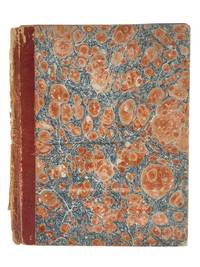
1851218121851. Science Medicine & TechnologyMilitary & WarLabor Environment & Welfare Manuscript industrial journal documenting the British lead shot industry patent culture and metallurgical manufacturing during the height of the Victorian industrial economy. Primarily England and Wales 1851-1853. Approximately 50 pages written in ink in a highly legible hand bound in an octavo-format notebook measuring 8 x 6.5 inches. Quarter red leather over marbled boards. Ownership inscription to front endpaper: "John R. Tracy / Nov 1852."<br /> <br /> An unusually detailed firsthand record of mid-19th-century industrial innovation centered on the manufacture of lead shot at a moment when Britain's expanding military infrastructure mining economy and heavy industry were increasingly dependent on large-scale metallurgical production. Compiled by John R. Tracy the manuscript documents the development and attempted commercialization of what he repeatedly identifies as a "Shot Patent" likely an improvement to the production or grading of lead shot associated with the traditional shot tower process. Rather than functioning merely as a technical notebook the volume captures the broader industrial system surrounding invention in Victorian Britain: factory inspections patent negotiations industrial espionage concerns business networking licensing discussions and the competitive culture of ironmasters and lead manufacturers operating across England and Wales.<br /> <br /> The manuscript opens in October 1852 and proceeds through a sequence of dated entries recording Tracy's travel and meetings with manufacturers engineers and industrial firms. These entries reveal the practical realities of introducing a new industrial process into Britain's established lead trade where manufacturers guarded technical methods closely and approached outside inventors with skepticism. On October 26 Tracy records receiving "letters of introduction to Messrs. A. B. Brown & Green" and to "Platt Bros." illustrating the importance of personal industrial networks and recommendation systems within Victorian manufacturing culture. Another entry dated November 5 describes a meeting arranged through "Mr. Maxwell of Messrs. Norton Theakers" followed by Tracy's note of "Much of 'shot etc.'-a rather funny conversation but on the whole. appointment for tomorrow @ 10 1/2" capturing the uncertain and often informal negotiations surrounding industrial patents.<br /> <br /> Particularly revealing is Tracy's November 6 account of visiting the Flintshire lead smelting firm Newton Keates & Co. where he describes the guarded and competitive atmosphere surrounding lead shot production. Tracy recounts that permission to inspect the works was "at-first-refused in rather a John Bullish manner" before eventually being granted under supervision. He writes perceptively about the mixture of suspicion and curiosity that surrounded industrial patents noting that the proprietor "wished to know the price upon the Patent" but that he deliberately withheld a valuation because "there was no use to let him have the bait to look at before he was hungry enough to bite." The language throughout reveals how industrial innovation in this period depended not simply on invention itself but on strategic secrecy negotiation and control over proprietary manufacturing knowledge.<br /> <br /> One of the manuscript's most important sections is a full-page listing titled "Lead Works in the United Kingdom in 1852" identifying more than two dozen lead works and manufacturers across Britain. Firms including Walker Parker & Co. Newton Keates & Co. and Richmond Anchor Co. are listed alongside annotations describing their production specialties including "sheet" "pipes" "shot" "white lead" and "pig." The page functions as a rare industrial survey of Britain's lead industry during a period of rapid military and industrial expansion documenting the interconnected infrastructure supporting ammunition production construction materials piping paint manufacture and metallurgical processing.<br /> <br /> Later entries contain detailed observations of shot-manufacturing equipment at a Chester lead works including descriptions of shot towers ranging from 76 to 96 feet in height and the use of perforated metal grading systems to regulate molten lead as it fell into spherical form. Tracy records the operation with notable technical specificity: "The shot are dropped through a perforated metal-the holes being smaller at the upper end and increasing in size as you get to the lower cylinder." Accompanying diagrams depict feed bins drop tubes sieves and sorting mechanisms apparently intended to improve efficiency or shot-size consistency beyond earlier tower methods. Tracy critically evaluates the machinery as well remarking that certain sieve boxes "seem inadequate for the work" and comparing the process economically to that employed by "D. De Roy & Co.'s works." The notebook therefore preserves not merely abstract invention but active industrial analysis and comparative manufacturing study.<br /> <br /> The manuscript is documenting metallurgy patent culture and military-industrial production in the decades preceding the major arms expansions of the later nineteenth century. Lead shot remained essential not only for hunting and civilian markets but for military supply systems deeply tied to imperial expansion and industrial warfare. Tracy's notebook reveals the increasingly professionalized yet still highly personal world through which industrial technologies circulated in Victorian Britain where factory visits guarded conversations handwritten technical sketches and negotiated introductions formed the practical infrastructure of innovation. Spine mostly perished with binding delicately held together; boards rubbed and worn. Interior exceptionally clean and highly legible throughout. A substantial and unusually revealing manuscript documenting Victorian industrial manufacturing patent strategy and the lead shot trade during a formative period in British industrial history. unknown
B296087-1London 1999. 24pp. Prof. illus. Lrg. folio. Self-wraps. Edition limited to 200 hand-numbered copies. Slightly soiled on front cover. London, 1999. paperback
18632021757Berlin GE: Verlag von A. Haack 1863. First Edition. Hardcover. Good. Folio 368 pages lacks spine with nos. 2-48 not collated with any faults. <br/><br/>Extensively illustrated with articles stories and more for the home. Verlag von A. Haack hardcover
118 pages including index and black and white illustrations. A remarkable volume of archive photographs, early maps, business documents and correspondence from British Columbia's past. Letter and diary excerpts give extraordinary insights into the personalities and problems facing these key figures. Book clean, bright and unmarked with very light wear. Light wear to illustrated dust jacket. Nice copy. Book
187925065Paris A.Cinqualbre 1879 broché un journal satirique (newpaper), broché in-quarto (29,56 x 20 cm), 4 pages, 1ère de couverture illustrée d'un PORTRAIT-CHARGE DE VICTOR POUPIN colorié au pochoir par André Gill, texte de la notice biographique sur les 3 pages suivantes par Pierre et Paul, sans date(1879) Paris A.Cinqualbre Editeur,
187925079Paris A.Cinqualbre 1879 -in-4 broché un journal satirique (newpaper), broché in-quarto (29,56 x 20 cm), 4 pages, 1ère de couverture illustrée d'un PORTRAIT-CHARGE DE VICTOR CAPOUL colorié au pochoir par André Gill, texte de la notice biographique sur les 3 pages suivantes par Pierre et Paul, sans date(1879) Paris A.Cinqualbre Editeur,
188025108Paris A.Cinqualbre 1880 -in-4 broché un journal satirique (newpaper), broché in-quarto (29,56 x 20 cm), 4 pages, 1ère de couverture illustrée d'un PORTRAIT-CHARGE DE VICTOR MEUNIER colorié au pochoir par André Gill, texte de la notice biographique sur les 3 pages suivantes par Pierre et Paul, sans date (1880) Paris A.Cinqualbre Editeur,
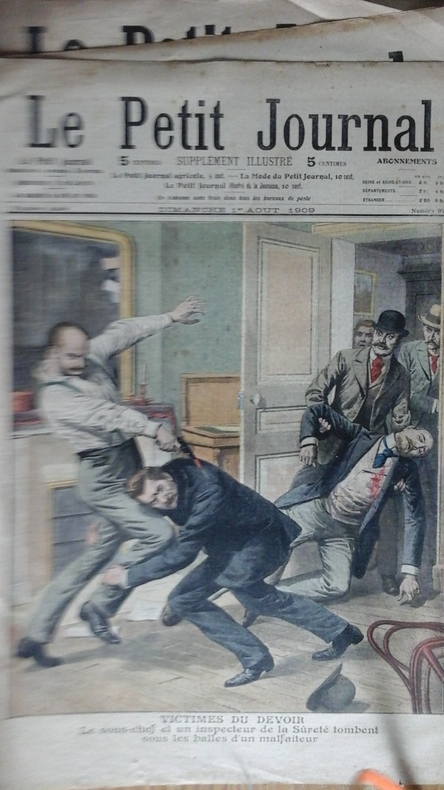
1909LPJ4GARDimanche 01.08.1909
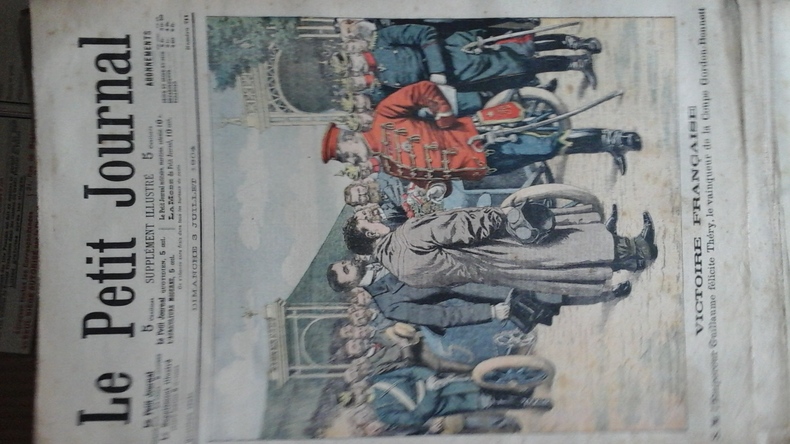
1904LPJ89GARDimanche 3.07.1904
255pp., in the series "Institutum Carmelitanum. Archivium Historicum Carmelitanum" volume 6, 24cm., softcover, good condition (looks unread), [Introduction in Spanish, Diary in Latin], R108213
in 8°, pp. 135, leg. edit. con sovracop. ill. Strenna natalizia, a cura di Adalgisa Lugli, con m. ill. a colori e in b/n. 307/30
Versione dal manoscritto originale di Arturo Loria - Dedica 1 21x15 cm., legatura cartonata, taglio superiore in colore, pp. 70, (18), 120 tavole in bianconero, fuori testo, con ampia descrizioni nel testo e riferimento al margine, 6 illustrazioni nel testo, prima edizione italiana, buone condizioni. Dedica autografa firmata dell'A. ad personam, datata Venezia 4/10/55
Mm 180x245 Due volumi in copertina rigida con sovraccoperta editoriale illustrata: vol. I, 269 pagine con 48 tavole in bianco e nero fuori testo; vol. II, 300 pagine con 48 tavole in bianco e nero sempre fuori testo. Testi di Montaigne, von Anhalt, Luca di Linda, lady Montagu, Montesquieu, De Brosses, Smollett, Goethe, Fonvizin, Stendhal, von Hase, Gogol. Opera in buone-ottime condizioni; sperdizione in 24 ore dalla conferma dell'ordine.
Brossura flessibile in cartoncino ruvido, opera n.302 della collana "Saggi", il volume appare scurito al dorso, pieghe al piatto anteriore e fogli chiari e ben godibili. Numero pagine 111. USATO
Mm 150x210 Collana "La diagonale". Brossura editoriale, 356 pagine, segno di penna a pagina 133 e all'indice. Una parte del testo è in lingua francese e tradotta da Sergio Atzeni. A cura di Sandro Cardinali. Buono stato. Spedizione entro 24 ore dalla conferma dell'ordine.
In-8° pp. 167, bross. edit. alcune sottolin. a matita rossa. Manca la sovracoperta.
In 8, cm. 17 x 24,5, pp. XXVI + 153 + (7) oltre a 76 illustrazioni e una scrittura autografa con dedica di un pregiato esemplare. Brossura editoriale con risvolti informativi, sovraccoperta illustrata con un ritratto in bianco e nero di Edward Lear che presenta ordinari segni d'uso, leggero alone brunito alle pagine. Annotazione a penna alla prima pagina bianca. Traduzione italiana condotta sull'edizione inglese del 1864 da Ilio di Iorio. Lear visito' l'Abruzzo nel 1843 circa e occupo' gran parte dei suoi Appunti del viaggio italiano elogiando la regione (al tempo Abruzzi e Molise) per il suo carattere impervio e delicato e per le tradizioni ancora radicate nella vita cittadina.
Classici italiani, collezione fondata da Ferdinando Neri, diretta da Mario Fubini n.72 - Introduzione - Indicazioni bibliografiche - 17 Viaggiatori, ciascuno corredato di Nota bibliografica: Pietro Metastasio - Lorenzo da Ponte - Francesco Algarotti - Alessandro Verri - Francesco Luini - Pietro Verri - Gian Lodovico Bianconi - Carlo Denina - Carlo Gastone Della Torre di Rezzonico - Luigi Angiolini - Giuseppe Baretti - Lazzaro Spallanzani - Alberto Fortis - Giovanni Battista Casti - Saverio Scrofani - Aurelio De' Giorgi Berttola - Vittorio Alfieri 1 23x14,5 cm., legatura in piena tela verde, sopraccoperta in acetato, fregi e titoli in oro su tasselli al dorso, frontespizio incorniciato-filettato con fregi, titolo in verde, pp. 639, 8 tavole con illustrazioni in bianconero - ritratti, frontespizio, manoscritti autografi...- su carta patinata, fuori testo, edizione ristampa della prima edizione del 1950, in italiano, ottimo stato.
In 8° grande, t.t. edit. ill. con titoli in oro anche al dorso e sovrac. in acetato trasp., pp. 222, [4] con num. ill. in b/n n.t., al frontesp. ritratto di John Ruskin di George Richmond, copia molto buona. (luca008) (spedizione standard SEMPRE tracciata con raccomandata - piego di libri, eventuale FATTURA da richiedere all'ordine)
In 8, bross. ed. con sovracc, pp. 279.Strappetti e abrasioni alla sovracc., lieve brunitrua alle carte, ottime condizioni.Luogo di pubblicazione MilanoEditore BompianiAnno pubblicazione 1942Materia/Argomento Letteratura, Diario di viaggio, Spagna