93 résultats
175254765BBUlm, bey Daniel Bartholomäi und Sohn. 1752. 8°. 6 n.n. Bl., 746 S., 15 n.n. Bl. Register. Halblederband der Zeit goldgeprägtem Rückenschld und wenig Rückenvergoldung.
179019621790. Wraps. Fine. 8vo. No place or publisher given. 8vo. 32p. Pale green wraps. Bookplate of ``Emerici Skublics`` Hungarian. Hungary politics and government. Corners very lightly curled otherwise a fine copy. unknown
17267644GB1726. Tle. 5 und 6 von 12 in 1 Bd. Halle Renger 1726-28. 12 Bl. 375 S. - 6 Bl. 360 S. 34 Bl. Pergamentband der Zeit mit handschriftlichem Rückentitel Deckel stark verzogen. Umlaufend roter Sprenkelschnitt. Beide Deckelinnenseiten mit Exlibris des Joh. Paul Egidius Nitsch. Fliegendes Blatt von alter Hand beschrieben. Stellenweise geringfügig fleckig oder mit schwachem Wasserrand entlang des Kopfschnitts. In Teil 5 große Teilen mit gebräuntem Textblock. Sonst in schöner Erhaltung. Blake 217; Hirsch/H. III 258. - Wegen des langen Erscheinungszeitraums 1721-39 heute meist nur noch in Einzelbänden vorkommendes Sammelwerk mit einer Fülle interessanter Krankengeschichten und deren Behandlung. - Friedrich Hoffmann 1660-1742 einer der große deutschen Ärzte im 18. Jahrhundert wurde 1693 erster Prof. der Medizin an der neugegründeten Universität Halle und las dort über Physik Chemie Anatomie Chirurgie und prakt. Medizin. Zu seinen großen und bleibenden Verdiensten gehören seine Verbesserungen und Bereicherungen der Pharmakologie. unknown
178461403Ohne Ort [Wien], Gedruckt an der schlesischen Gränze [Hartl], 1784. Kl.-8°. 8 Bll., 168 S., Ldr. d. Zt. m. Rückenverg. u. goldgepr. Rückenschild.
171135453MOEWIG ARTHUR 17/11/1998. 1. softcover. Thoregon: 3 Der Sechste Bote 1-Korrago / Shabazza / Tautmo Aagenfelt / Perry Rhodan / Monkey Computer: Enthüllungen! Glossar: Baolin-Nda / Biofar / Cairol / Cairol der Zweite / Chaosmacher / Goedda / Plantagoo / SENECA / SOLHIRN! DIE GRÖßTE WELTRAUMSERIE! MOEWIG, ARTHUR paperback
17861172462Erfurt, G. A. Keyser, 1786. 32, 112 S. Broschur d. Zeit (berieben, Rücken überklebt).
176626619Hamburg 1766. nach den Gründen der Vernunft und des Glaubens. Einbd.etwas ber. ohne Vorsatzbl.wenige Stockfl. ansonsten guter Zustand Von neuem durchgesehen u.verb. J.C.Bohn 8°. Hpgt. Varia unknown
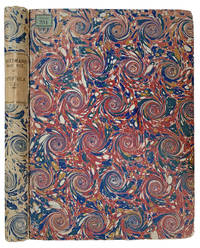
1738M13787Venice:: Apud Sebastianum Coleti 1738. 1738. Sq. 8vo. viii 311 1 pp. 2 small ink ownership stamps on title unreadable. Nineteenth century marbled boards printed title label on spine; extremities showing. Title verso with ink ownership stamp of Th. Renz. Very good. The work contains two parts of ten papers each for a total of twenty papers. Each studies aspects of medicine from the nature of art and efficacy in healing method application of drugs the power and efficiency of medicines applied the ability of the body to understand the remedies of drinking water and the virtues of milk in medicine the power of milk to heal qualities of mineral waters in promoting health. Continuing in the second part: salts as a healer the uses of China bark as applied to fevers uses of ejecting of venom the causes of death by disease the good of medicine the errors that are common in medical practice. "Friedrich Hoffmann also 'Hofmann' was born on 19 February 1660 in Halle where he also died on 12 November 1742. Called 'the second Hippocrates' and the 'Aesculapius Hallensis' he was among the most widely read medical authors of the eighteenth century and is best known for his systematic discussion of the iatromechanical model of medicine — similar to what Hermann Boerhaave 1668-1738 was developing at Leiden — that views the human body as a hydraulic machine wholly governed by mechanical laws. "Hoffmann's father Friedrich Hoffmann the Elder was the respected municipal physician of Halle. The younger Hoffmann enrolled at nearby Jena in 1678 the university at Halle would not open for another fifteen years where he studied medicine for two years under the iatrochemist Georg Wolfgang Wedel 1645-1721 also attending Caspar Cramer's lectures on chemistry in Erfurt in 1680. He received his doctorate in medicine from Jena in 1681 January 31 with a dissertation on suicide de autochiria and began lecturing on chemistry a standard course taught in the medical faculty but soon left perhaps pushed out by senior faculty jealous of his teaching success. After practicing medicine in Minden for two years Hoffmann made an academic tour of Belgium Holland and England during which he met Boerhaave Thomas Sydenham and Robert Boyle returned to Minden in 1684 and assumed various medical offices eventually being appointed the regional physician for Halberstadt. He married an apothecary's daughter Anna Dorothea Herstell on 10 December 1689. "In 1693 he was called to the newly-founded university at Halle as an ally of the Priest August Hermann Francke 1663-1727 with the charge of organizing its medical school and to serve as its first professor of medicine. He also became the godfather to Christian Wolff's first-born son Friedrich. Hoffmann recruited his old college friend from Jena Georg Ernst Stahl 1660-1734 for the second chair of medicine and the two taught side by side for twenty years transforming Halle into the preeminent medical school among German-speaking universities. Along with Boerhaave at Leiden Hoffmann and Stahl were the principal forces behind the medical reforms of the early eighteenth century. "Hoffmann was a member of the German Academy of Natural Scientists Leopoldina 1696 the Berlin Academy of Sciences he was included in Leibniz's founding lists and was inducted on 1 April 1701 the Royal Society of London 1720 and the Russian Academy of Sciences in St. Petersburg 1735. "In all Hoffmann authored about 400 publications mostly brief dissertations and essays but also the six-volume systematics discussed above a twelve-volume collection of case studies Medicina consultatoria 1721-39 and a nine-volume work on how to live a long and healthy life Basic Guide 1715-28 wherein Hoffmann emphasized the restorative effects of proper diet exercise clean air and sleep. He also criticized the diversity and overuse of drugs and was successful in reducing the pharmacopoeia of his day to a few basic remedies. -- The Dictionary of Eighteenth Century German Philosophers 3 vols. edited by Manfred Kuehn and Heiner Klemme. CONTENTS: Part I: 1 De naturae & artis efficacia in medendo. 2 De recta et simplicissima natura medendi method. 3 De medicamentorum prudenti application in tempore. 4 De prudenti medicamentorum continuation. 5 De vera medicamentor in morbis virtute et efficacia rite dignoscenda. 6 De cognoscenda corporis humani natura ex effectu remediorum. 7 De medicina simpilicissima & optima motu inedia aquae potu. 8 De mirabili lactis asinini in medendo usu. 9 De saluberrima seri lactis virtute. 10 De connubio aquarum mineralium cum lacte longe saluberrimo. Part II: 1 De salium mediorum excellente in medendo virtute. 2 De sale medicinali Carolinarum. 3 De manna ejusque praestantissimo in medicina usu. 4 De recto corticis chinae usu in febribus intermittenibus. 5 De purgantibus fortioribus ex praxi medica merito ejiciendis. 6 De medicina emetica et purgante post iram veneno. 7 De imprudenti medicatione multorum morborum et mortis causa. 8 De remediorum benignorum abusu et noxa. 9 De vesicantium et fonticulorum circumspecto in medicina usu. 10 De erroribus vulgaribus circa usum topicorum in praxi. / "Although Enlightenment physicians debated the suitability of milk as a treatment for different individuals and situations Friedrich Hoffmann's Treatise of the Extraordinary Virtues and Effects of Asses Milk 1754 exemplifies the basic understanding of its health benefits in the eighteenth century. Hoffmann who served as the physician to the Prussian King Friedrich I was a friend of Boerhaave and a proponent of the neo-Hippocratic school. He argues that since humans were nourished by a milky substance in the womb and raised on breast milk and since all food upon entering the body was transformed into a milky substance called chyle milk was 'manifestly proved to be the principal of all the kinds of aliment; so it may be deservedly reckoned the chief of all remedies.' Although Hoffmann preferred ass's milk for its resemblance to human breast milk he also recommended the milk of cows sheep and goats for the relief of fevers chronic coughs colic and nervous disorders -- the same aliments that afflicted Pompadour. Why was milk so effective" Hoffman argued that is possessed powerful cleansing properties functioning as a nonviolent purgative that penetrated the body's channels allowing fresh air to enter and perspiration to exit. It also removed obstructions in the chest lungs and bowels and returned the body to its proper system of 'flows.' Hoffmann told readers of how a certain 'gentlewoman' in his care who had been sick for years with fevers aches and pains began a course of milk treatment and 'in three days only everything appeared wonderfully amended.'" -- Meredith Martin Dairy Queens: The Politics of Pastoral Architecture from Catherine de' Medici to Marie-Antoinette Harvard Historical Studies Harvard University Pres 2011 pp. 135-6. REFERENCES: Blake NLM 217; Wellcome II 285. Apud Sebastianum Coleti, 1738. hardcover books
1742270<p>This listing is a rare 18th-century volume titled "Acta Historico-Ecclesiastica" printed in Weimar by Siegmund Heinrich Hoffmann in 1742. It's a scholarly collection documenting Polish and Saxon ecclesiastical history overseen by the Prince of Saxony and published under royal privilege. This copy comes from the library of the Newton Theological Institution.</p><p>The book is worn: the brown cover is scraped corners are bent the spine has scars and there's a crack in the front cover and back. Inside the pages are intact but yellowed with foxing in some areas. This rare archival volume is ideal for collectors of early German ecclesiastical works or institutional archives. See Photos</p> published by Siegmund Heinrich Hoffmann in Weimar, in the year 1742. hardcover
173655712Halae: Renger. Good. 1736. Second Edition. Hardcover. Recent sewn leather binding with gilt title; new eps. No original blanks; begins with title page printed in red and black with vignette. Old PO names foxing/dampstaining/toning throughout. ; Large 8vo 9" - 10" tall; 2834222 pages . Renger hardcover
1701419721701. Halae Litteris Orphanotrophii 1701 Kl.4° 8 pp. orig. Broschur. unknown
1754M13008Genevae:: Apud fratres de Tournes 1754. 1754. Two parts in one. Folio. 24 x 35 cm. viii 871 1 pp. Collation: 4 A6-4D6. Half title title printed in red & black engraved title vignette Latin text printed predominantly in two columns engraved initials engraved head and tail pieces small woodcut fig. p.52; occasional minor stains some folds ownership signature Hermann . . . trimmed on title top edge. Original half calf over boards all edges red; heavily worn with chipped portions spine is mostly missing front joint reinforced with Kozo. Binding "as is" good internally. Bookplate of John G. Curtis Library of Columbia University. Rare. Second edition. "Hoffmann based his treatment on the use of sedatives tonics alternatives and evacuants according to the condition responsible for causing the disease. Apart from this system he was one of the premier practitioners of his day and one of the first to give good descriptions of appendicitis chlorosis rubella and convulsive asthma with dropsy." – Heirs of Hippocrates referring to the entire Opera. More description available on request. REFERENCES: The Dictionary of Eighteenth Century German Philosophers 3 vols. edited by Manfred Kuehn and Heiner Klemme London/New York: Continuum 2010; DSB VI pp. 458-461; Blake NLM lists editions from Geneva in 1740 1748 and 1761; Wellcome Library III p.285 2 vols. in 1. See: Garrison & Morton 72 for the complete 9 volumes published 1740-53; Justin E. H. Smith The Problem of Animal Generation in Early Modern Philosophy 2006; Willius & Dry A History of the Heart and the Circulation pp. 77-78. Apud fratres de Tournes, 1754. hardcover books
1754M13008Genevae:: Apud fratres de Tournes 1754. 1754. Two parts in one. Folio. 24 x 35 cm. viii 871 1 pp. Collation: 4 A6-4D6. Half title title printed in red & black engraved title vignette Latin text printed predominantly in two columns engraved initials engraved head and tail pieces small woodcut fig. p.52; occasional minor stains some folds ownership signature Hermann . . . trimmed on title top edge. Original half calf over boards all edges red; heavily worn with chipped portions spine is mostly missing front joint reinforced with Kozo. Binding "as is" good internally. Bookplate of John G. Curtis Library of Columbia University. Rare. Second edition. "Hoffmann based his treatment on the use of sedatives tonics alternatives and evacuants according to the condition responsible for causing the disease. Apart from this system he was one of the premier practitioners of his day and one of the first to give good descriptions of appendicitis chlorosis rubella and convulsive asthma with dropsy." – Heirs of Hippocrates referring to the entire Opera. More description available on request. REFERENCES: The Dictionary of Eighteenth Century German Philosophers 3 vols. edited by Manfred Kuehn and Heiner Klemme London/New York: Continuum 2010; DSB VI pp. 458-461; Blake NLM lists editions from Geneva in 1740 1748 and 1761; Wellcome Library III p.285 2 vols. in 1. See: Garrison & Morton 72 for the complete 9 volumes published 1740-53; Justin E. H. Smith The Problem of Animal Generation in Early Modern Philosophy 2006; Willius & Dry A History of the Heart and the Circulation pp. 77-78. Apud fratres de Tournes, 1754. hardcover
172854922Hamburg Felginers Wittwe 1728. Contemp. full calf. Gilt compartments on spine. repairs to top of spine and upper compartment. Gilt lineborders with gilt cornerpieces on covers. Engraved titlevignette. 14552869 pp. unknown
172854922Hamburg, Felginers Wittwe, 1728. Contemp. full calf. Gilt compartments on spine. repairs to top of spine and upper compartment. Gilt lineborders with gilt cornerpieces on covers. Engraved titlevignette. (14),552,869 pp.
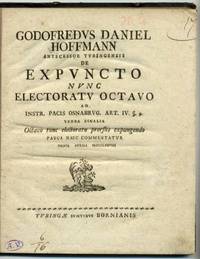
177811223Tübingen: Born in Kommission Osiander 1778. hardcover. Gut. Titelei 60 Seiten. Schmucklose Halbleinwand aus der ersten Hälfte des 20. Jahrhunderts. 21 x 175 cm. etwas bestossen Gelenke gelockert Titelei mit diversen Marginalien von alter Hand sonst innen sauber und nur wenig gebräunt. Seltene Darstellung zu einem Passus des Friedensvertrages zu Osnabrück 1648 besser bekannt als "Westfälischer Friede". Es ging im angegebenen Artikel 4 um die Regelung der die Pfalz betreffenden Angelegenheiten. Paragraph 9 dieses Artikels regelt die Kurwürde für den Fall daß die sog. "Wilhelminische männliche Linie" Maximilian und seine Erben ausstirbt dann erlischt die 8. Kurwürde auf die der Titel der Schrift Bezug nimmt die sog. "rudolfinische männliche Linie" aber weiterbesteht. - Vgl. Kaysers Bücherlexikon III p. 165 dort laufend Georg Daniel Hoffmann genannt und als Verlag Osiander angegeben. Wegen Urlaub kann Ihre Bestellung / Anfrage erst nach dem 21.06.2026 bearbeitet werden. - Because of holidays your order / question can be handled only after 06/21/2026. Born in Kommission [Osiander?] hardcover
17423615998Leipzig, J. C. Langenheim, 1742. 4to. 3 Bl., 40, 200 S., 1 gestochene Schrifttafel. Halbpergamentband der Zeit (ohne das Titelporträt, Titelblatt mit altem Besitzvermerk und Ausschnitt der unteren Ecke).
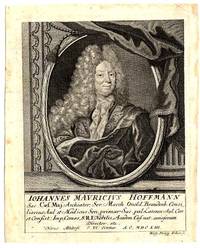
1710342801710. Wolfg. Phillip Kilian Sc. Kupferstich ca. 1710 184 x 14 4 cam auf 205 x 175 cm. Johann Moritz Hofmann 1653-1727 "als Sohn des Anatomen Moritz Hofmann 1622-1698 in Altdorf am 6. October 1653 geboren studirte Philosophie in Hersbruck Mittel-franken Bayern dann Medicin in Altdorf Frankfurt a. 0. und Padua. In letzterer Stadt verweilte er zwei Jahre lang bereiste von hier aus Italien und kehrte 1674 nach seiner Vaterstadt zurück wo er 1675 den Doctortitel annahm und 1677 zum Prof. e. o. der Anatomie ernannt wurde. Später 1681 wurde er ordentlicher Professor dieses Faches und etwa 1686 erhielt er auch den Lehr-stuhl für Chemie und Botanik. 1709 entsagte er der Lehrthätigkeit für Anatomie behielt nur die Professur für Arzneimittellehre die er schliesslich 1713 ebenfalls aufgab um als Leibmedicus in den Dienst des Markgrafen von Ansbach zu treten wo er am 31. October 1727 starb. Hofmann war seit 1684 Mitglied und seit 1727 Präsident der Leopoldinischen Akademie der Naturforscher. Er verfasste eine beträchtliche Zahl von kleineren akademischen Abhandlungen meist Dissertationen die in Altdorf während der Jahre 1680-1703 erschienen so: "De aegro asthmatico" - "De ossium carie" - "De naso faciei promontorio" 1681 - "De dolore" - "De glandulis renalibus" 1682 - "De rnedicamentis martialibus" - "De anorexia" - "Dissertationes anatomico physiologicae ad Joh. van Horne microcosmum annotatae" 1685 - "De odoramentis et suffimentis" 1686 - "De vena portae" 1687 u. A.; ferner eine Sammlung von 20 Dissertationen vereinigt u. d. T.: "Idea machinae humanae anatomico-pysiologica ad observationes recentiores conformata etc." Ebenda 1703; ferner mehrere nicht unbedeutende chemische und botanische Schriften so: "De differentits alimentorum" Ebenda 1677 - "Laboratorium novum chemicum apertum medicinae cultoribus" 1683 - "Acta laboratorii chymici Altorfini" 19 - "Florae Altorfinae deliciae hortenses" 1703 u. A. m" -Pagel Hirsch III p.249 Biogr. méd. V pag. 261. - Dict. hist. III pag. 225. - Poggendorff I pag. 1122." unknown
173425711Frankfurt a. M. / Leipzig 1734. nebst einer Vorrede von Benjamin Neumann Herausgeber Name und Bleistiftnotizen auf Innendeckel. Guter Zustand Michael Blockberger Kl.-8°. Hpgt. Deutsche Literatur unknown
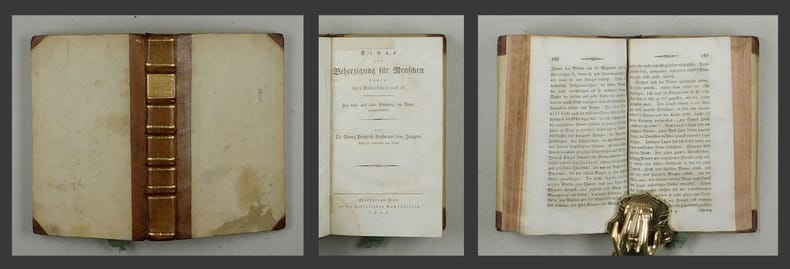
179358886BBFrankfurt am Main. in der Andreäischen Buchhandlung. 1793. 8°. XII S., 371 S. Halblederband der Zeit mit rotem goldgeprägtem Rückenschild und Rückenvergoldung.
179926268AB1799. Neue vermehrte und verbesserte Auflage. 2 Bde. Erlangen J. J. Palm 1799 und 1803. 12°. 2 Frontispize gestochen von D. Chodowiecki 24 kolorierte Kupfertafeln 22 Bl. 273 S. 8 Bl. - 22 Bl. 308 S. 24 S. Hübsche Pappbände der Zeit mit Rückenschildern dezenter Rückenvergoldung und vergoldeten Deckelfileten. Vereinzelt minimal braunfleckig sonst innen sehr sauber und sehr gut erhalten. Pritzel 4132; Nissen BBI 892; Stafleu 516; vgl. Plesch 352. - G. F. Hoffmann 1761-1826 lehrte bis 1804 Botanik an der Universität Göttingen danach wirkte er bis zu seinem Tode in Moskau. - Die schönen filigranen Tafeln stach Johann Nussbiegel 1750-1829 aus Nürnberg. unknown
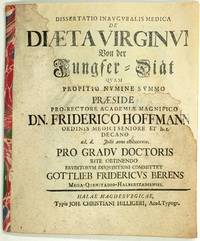
1729455351729. Hala Magdeburgicae 1729 4° 56 pp. Brosch; Titelblatt ergänzt ein Blatt in Faksimilie. unknown
1733705791733. Halle im Magdeburgischen : Zu finden in der Rengerischen Buchhandlung 1733 4° 16 365 55 pp. Pappband im Stil d.Zt. Erste Ausgabe! Wegen des langen Erscheinungszeitraums selten vollständig vorkommendes Sammelwerk ". eine reichhaltige Sammlung von Krankheitsgeschichten darstellend und dadurch sehr werthvoll . hrsg. von einem der Heroen der dt. Medizin im 18. Jhdt" Hirsch-Hübotter. Krankheitsfälle mit Ursache und Verlauf sowie mit den entsprechenden Berichten der Patienten selbst über Erfolg oder Misserfolg. Texte meist in Deutsch einige ganz wenige in Latein. Friedrich Hoffmann 1660-1742 Arzt und Chemiker Professor der Medizin in Halle war Leibarzt des preußischen Königs Friedrich I. "Boerhaave in Leiden Hoffmann und Stahl in Halle wurden die drei großen "Systematiker" der Medizin des beginnenden 18. Jahrhunderts. H.s simplifizierendes System der "mechanischen Arzneigelahrtheit" führte ihm zahlreiche Anhänger zu provozierte aber auch heftige Angriffe der Stahlschen Schule des "Animismus". H. sah den Organismus als eine Art hydraulischer Maschine an. Der Spannungszustand Tonus der Fasern und damit alle das Leben charakterisierenden Bewegungsvorgänge werden gesteuert von einem "Nervenfluidum" das aus dem überall im Kosmos vorhandenen "Äther" hergeleitet und vom Gehirn über die Nerven verteilt wird. Diese Vorstellung knüpft an die alten "Spiritus" ebenso an wie an die solidarpathologischen Lehren der antiken Methodiker. "Spasmus" einerseits "Atonie" andererseits bewirken Krankheit und müssen vom Arzt mit Gegenmitteln behoben werden. Die "Seele" der Stahl eine physiologische Funktion zuweist bleibt streng vom Körper getrennt in der Zuständigkeit der Theologen. In seiner Praxis war H. jedoch kein Doktrinär; er hatte großen Erfolg war ein gesuchter Consiliarius und wurde wegen seiner Liebenswürdigkeit und weltmännischen Sicherheit allgemein bewundert." "Seine chemischen Kenntnisse nutzte H. zu grundlegenden Arbeiten über Mineralquellen unter anderem Karlsbad Lauchstädt. Aber auch präparativ hat er gearbeitet: Die schmerzstillenden "Hoffmannstropfen" bis heute ein beliebtes Hausmittel haben seinen Namen auch im Publikum allgemein bekannt bleiben lassen." Hans-Heinz Eulner NDB 9 1972 pp. 416-418 unknown
170737893MOEWIG ARTHUR 17/07/2001. 1. softcover. Thoregon: 5 Die Solare Residenz Banther Richsen / Tia de Mym / Plato / Kinda Apfer / Kraschyn Kommentar: Hyperkristalle! Glossar: Alpha Karthago / Gruppe Sanfter Rebell / KOBAN-Klasse / Residenzfunk / Spezifikation RT-0066 / Tia de Mym! DIE GRÖßTE WELTRAUMSERIE! MOEWIG, ARTHUR paperback
17088856AB1708. Halle/Magdeburg J. Gruner 1708. 4°. 40 S. Neuer Pp.-Bd. SGC I: IX 601; Waller 4682; Wellcome III 287. - Etwas gebräunt bzw. braunfleckig. unknown