9 773 résultats
182258519(1822) - 1872.
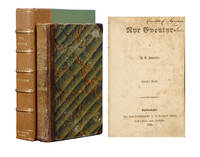
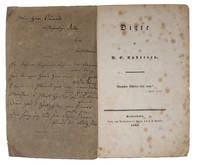
1822585191822 - 1872. <br/><br/><em>With the present Hans Christian Andersen-collection we have aimed not at an exhaustive collection of ALL of his many writings nor at a LARGE collection but at an exquisite chosen collection that tells us the true story of Andersen's life. A collection that enlightens us about both the author and the man Hans Christian Andersen and that sheds light on all aspects of his life and work. A collection that epitomizes quality scope and importance not merely numbers of items nor works that are not particularly important in his life's work. Every one of the 23 items in the present collection has been carefully chosen to represent a certain Aspect of Hans Christian Andersen at a certain time of his life in an attempt to get as close to the great fairy tale author as possible. The items basically span his entire career - from his first book published at the age of 17 and only known in about 10 copies to an original manuscript poem by the ageing author at the age of 67. The 23 carefully chosen and unique items cover his earliest publications that are of extreme scarcity his three seminal fairy tale cycles that catapulted him into fame and created the genre of the fairy tale for which he is now famous world-wide five magnificent presentation-copies among them an absolutely magnificent copy of his very first fairy tale one of the best presentation-copies known that each give us an insight into the poet Andersen and into his circle of friends six splendid original letters that are all different in style and content and written from all over the world among them one of the extremely rare letters known by him written in English in Latin hand an original manuscript which is an extreme scarcity on private hands and something one may never come by again two books from Andersen's own library which is extremely rare to find as only 75 such books are known and almost all of them are in institutional holdings and finally the three main translations that ensured his fame in the rest of the world: the most important translations into German English and French respectively. The collection is divided into the following seven categories and below follows a short preview and introduction to each. Upon request a document with full elaborate descriptions of each item will be provided. 1. Debuts/earliest publications see also 3.1.2. The three fairy tale collections/cycles3. Presentation-copies see also: 2.3.4. Letters5. Manuscript6. Books from Andersen's library7. The three main translations1. Debuts/earliest publications1.1. Ungdoms-Forsøg / Gjenfærdet ved Palnatokes Grav en Original Fortælling; og Alfsol en original Tragoedie. Ungdoms=Forsøg. Kjöbenhavn 1822. The extremely rare first printing of Hans Christian Andersen's first book - with facsimiles of the title-page the contents-leaf and a further four leaves. The book is exceedingly rare. A title-issue appeared in 1827. No more than about ten copies in all of both the first issue and the title-issue are known to exist - only a couple of them are known in private collections and less than a handful of copies are known outside of Denmark. The present publication his first book is of immense importance to Andersen's life and work and is arguably THE most important piece of Anderseniana. 1.2. Ved min Velgører Provst Gutfelds Død. Slagelse 1823.The extremely rare first printing of the 1823-issues of this slightly obscure newspaper which contains Hans Christian Andersen's third publication. This exceedingly rare piece of Anderseniana was published when the master of the fairy tale genre was merely 17 years old namely in February 1823. The present publication constitutes one of the two pieces of publication that are at the epicentre of the coming-to-be of the greatest poet and author to emerge from Danish soil. This little piece is a heartfelt almost perfectly stylized poem that constitutes an obituary of Hans Christian Andersen's early benefactor Gutfeld who was responsible for Collin accepting to be Andersen's benefactor. It was due to Gutfeld and his belief in Andersen that he made it on into the world and was taken seriously enough - at the mere age of 17 - to later be allowed to follow his heart and his life dream - that of writing.1.3. Fodreise fra Holmens Canal til Østpynten af Amager i Aarene 1828 og 1829. Kjöbenhavn 1829. The rare first edition of Hans Christian Andersen's debut novel "Journey on Foot" here in the extremely scarce original printed wrappers. Andersen himself considered this book his debut and refers to it as "my first publication". It came to play a tremendous role in the development of his writing and constitutes one of his most important works. It is the first piece of Andersen that yields any success and the first work for which he gained any recognition. "It is a well-known fact that Hans Christian Andersen made his début as a writer three times during his youth. The first time he published a book was in 1822 when "Youthful Attempts" came out. He was 17 years old penniless and in need for help but the main part of the circulation ended up in the paper mill. The second time he made his début was in 1829 when he published "Journey on Foot from Holmen's Canal to the Eastern Point of Amager" a book which can hardly be classified as a travel book. it seems a subtle and humorous arabesque and a literary satire. This book was published in the year after he had left grammar-school and was qualifying for the entrance examination to academic studies at the university. It can rightly be regarded as a key which enables us to understand the entire development of his later production.2. The three fairy tale-collections2.1. Eventyr fortalte for Børn. 1.-3. Hefte Eventyr fortalte for Børn. Ny Samling 1.-3. Hefte. 2 Bind. Kjöbenhavn 1835-1847. A lovely set of this exceedingly rare collection of Andersen's earliest fairy tales. This legendary fairy tale-collection that created the fairy tale-genre and brought Andersen international fame consists in six parts that together make up two volumes. As with most of the other few existing copies the present set is a mixture of issues and likewise has certain wants concerning title-pages half-titles and tables of contents. "During Andersen's lifetime 162 of his Fairy Tales were published but the scarcest and most difficult to obtain are these six little pamphlets. We do not know exactly how many or how few copies were printed but we do know that no copy with all the title pages and tables of contents has ever been offered for sale."2.2. Nye Eventyr. 2 Bind 5 samlinger. Kjøbenhavn 1844 - 48.First edition of Hans Christian Andersen's seminal second collection of fairy tales - the publication that made him internationally famous - with all five collections in first issue also the first which is of the utmost rarity. It is in this legendary first collection that we find the first printing of "The Ugly Duckling"not as is indicated in PMM in his first. The rarity of the first issue of volume 1 collection 1 is legendary. It was published on November 11th 1843 dated 1844 on the title-page in a very small number probably due to the poor sales of Andersen's first fairy tale collection. Against all belief this first collection sold out within a few days catapulting Andersen into worldwide fame and a second issue was published already on December 21st 1843. Thus only very few copies of the first issue exist and almost all collections of the "New fairy Tales" are bound with the second issue or the third of 1847 meaning that they do not contain the actual first printing of "The Ugly Duckling" "The Nightingale" "The Angel" and "The Sweethearts". 2.3. Nye Eventyr og Historier. 3 Series 10 collections. Kjøbenhavn 1858-1872.A splendid fully complete copy of Andersen's third fairy tale collection WITH ALL 10 ISSUES IN FIRST EDITIONS FIRST ISSUES ALL IN THE ORIGINAL PRINTED WRAPPERS AND ONE OF THEM WITH A SIGNED PRESENTATION-INSCRIPTION BY ANDERSEN - WITH 39 FAIRY TALES IN THEIR FIRST PRINTINGS. It is highly uncommon to find all ten issues of the series together let alone in the original printed wrappers each of which is a scarcity on their own. To our knowledge only one other such set exists in a private collection and that is in far from as fine condition as the present where all but one of the issues which does not have the back wrapper are fully complete with the spines exactly as issued. 3. Presentation-copies3.1. Digte. Kjöbenhavn 1830.THE RARE FIRST EDITION - PRESENTATION-COPY IN THE EXCEEDINGLY SCARCE ORIGINAL PRINTED WRAPPERS - OF ANDERSEN'S THIRD BOOK CONTAINING HIS FIRST FAIRY TALE. The magnificent presentation-inscription - hitherto unknown and unregistered - is arguably one of the most important Andersen-presentations known to exist. It is inscribed to Henriette Collin the then fiancée later wife of his closest and most important friend who was more like a brother to him Edvard Collin. It is one of the very early Andersen-presentations known. This first published collection of Andersen's poetry constitutes Andersen's third published book at the age of 24 and contains at the end the first printing of any of his fairy tales being also his very first fairy tale "The Ghost" or "The Spectre". This is the first time that Andersen uses the term "Eventyr" fairy tale the term which came to denote the genre for which he received world-wide fame as one of the most important writers of all time. 3.2. Nye Eventyr. Tredie Samling. Kjøbenhavn 1845.An excellent presentation-copy of the first edition of the third "collection" of Andersen's second fairy tale-collection containing five of his best fairy tales in the first printing - among them the cherished tales "The Red Shoes" and "The Shepherdess and the Chimney-Sweep ". Inscribed copies of Andersen's fairy tales are very rare and extremely sought-after. But the present presentation-copy is even more interesting as it is inscribed to a fellow author of tales for children - "The poet Kaalund/ in kind remembrance/ of our first meeting/ the 29th of April 1845/ from the NEW FAIRY TALES the printed half title 's author." -in the collection of Andersen's fairy tales that appeared almost simultaneously with Kaalund's renowned "Tales for Children" "Fabler for Børn". 3.3. Historier. Anden Samling. Kjøbenhavn 1853.First edition in splendid condition with the original printed wrappers of the second part of Andersen's "Story"-collection containing first printings of four of his famous fairy-tales. With a lovely poetical presentation-inscription to Frederikke Larcher signed "H.C. Andersen" translated as thus: "I put my bouquet on the board of the stage/ you yourself make the impression of a fresh bouquet". Frederikke Larcher was a stage actress and Andersen might have given the little book as a gift upon her last performance.3.4. Nye Eventyr og Historier. Anden Række første samling. Kjøbenhavn 1861.An excellent copy in the original printed illustrated wrappers of the separately published first part of the second series of "Nye Eventyr og Historier" with a lovely presentation-inscription to the title-page translating thus "The splendid the spirited/ Mrs. Agentinde Renck/ send this bouquet of stories/ from my garden of poetry this spring/ Most heartfelt and respectfully/ H.C. Andersen." This splendid volume contains first printings of one of Andersen's most famous most beloved and most frequently recounted fairy-tales/stories: "What the Old Man does is Always Right". Apart from that masterpiece of moral story-telling the present publication contains five other of Andersen's great stories in first printings.3.5. Da Spanierne var her. Originalt romantisk Lystspil i tre Acter. Kjøbenhavn Copenhagen 1865. An excellent copy of the first edition of Andersen's famed play in the scarce original binding and with a magnificent presentation-inscription to Rudolph Kranold who at the time was director of the Royal Theatre in Copenhagen. His short reign here until 1866 coincides exactly with the work on and premiere of one of the plays that was very closest to Andersen's heart namely "When the Spanish were Here" which premiered at the Royal Theatre on April 6 1865. Reading Andersen's diaries allows us to actually follow the play the entire way through to the stage. It is evident both from his diaries and from the present presentation-inscription that the play meant a lot to Andersen. As the inscription indicates he's anxious that the play not be taken down again and he clearly asks Kranold to take good care of this play that is close to his heart. 4. Letters4.1. Autographed letter signed in full "Hans Christian Andersen" in English for the Scottish author William Hurton. Dated "Copenhagen 2 October 1851".The present letter is of the utmost interest as it is written in English in Andersen's own hand! and also in Latin letters as opposed the gothic handwriting that Andersen usually uses. Letters and inscriptions in Andersen's Latin hand are of the utmost scarcity. Out of the few known letters in Andersen's hand we have even fewer letters by him written in English. He made an exception for William Hurton to whom a few letters have been preserved demonstrating his reverence for this Scottishman so fascinated by Andersen himself. Almost all of these letters are in institutional holdings and the present one on private hands is a true scarcity. 4.2. Autographed letter signed "H. C. Andersen" for Frederik Bøgh. Dated "Basnæs ved Skjelskjør/ den 3 Juli 1862". 4 pages.This very lengthy letter from Andersen to Frederik Bøgh is interesting in several respects. First of all Andersen here mentions several of his works: new songs for the revised version of his opera "The Raven" proofreading and numerous comments for the "new edition of Fairy Tales and Stories" and a brand new fairy tale: "Finally I have written a new fairy tale: "Snowdrop"." Furthermore Andersen talks about his health and problems he has with his eye as well as the weather and his impending travel plans. It is clear from the letter that he is very close to his young student friend Bøgh. 4.3. Autographed letter signed "H. C. Andersen" for Frederik Bøgh. Dated "Tanger I Marokko/ den 8 Nov: 1862.".An absolutely splendid letter with rare observations about Moroccan culture the people how they dress and behave the food the landscape etc. It is clear that Tanger with its "wild romantic nature" its palm trees its wilderness the wild boars and hyenas is very far from the coldness of the North. Andersen's fascination with the "half naked men" and women in horrible dress with the bare headed Moorish Jews in kaftans "the naked brown kids that screamed and roared" and the slaves that carry goods leaps from the pages of the letter and paint a picture of a place that to a Dane in 1862 must seem oddly fascinating and so different. There is no doubt that this rich culture served as direct inspiration for Andersen's story-writing. 4.4. Autographed letter signed "H. C. Andersen" for Frederik Bøgh. Dated "Toledo den 6 December 1862".A splendid letter from Toledo which Andersen paints so clearly as only he can. "Toledo is a dead city but with the life of poetry" he writes after having described in detail to his dear friend back home the ruins and the melancholy that is Toledo. 4.5. Autographed letter signed "H. C. Andersen" for "Kjære William" i.e. William Melchior. Dated " Frijsenborg den 27 August/ 1868. ". A lovely cheerful birthday letter for the young birthday boy William Melchior who was turning 7 years old. The letter is utterly charming and describes the journey of the birthday letter itself flying over land and sea from Jutland to Copenhagen. The letter not only portrays the ease with which Andersen communicates with children it also constitutes a miniature version of beloved Andersen-stories such as "Little Tuk" and "A Piece of Pearl String". 4.6. Autographed letter signed "H. C. Andersen" for Frederik Bøgh. Dated " den 9 Maj 1873".This Beautiful little letter for Nicolai Bøgh bears witness to the heartfelt bond that Andersen felt towards his young friend. This little gem of a letter is very poetical - most of it is almost like a poem describing the sun coming through the clouds and liking the clouds to snow and the heaven to Paradise. Furthermore Andersen mentions his friends' illness liking him to a bird that needs to be free. Bøgh had fallen ill the previous year from an illness that would eventually kill him 9 years later at the mere age of 45. 5. Manuscript5.1. Original handwritten and signed manuscript for a poem entitled "Stormfloden" i.e. The Storm or The Storm Surge. November 22nd 1872. 1 1/2 handwritten pp.Original manuscripts by Andersen are of the utmost scarcity and only very few are known on private hands. The present is the manuscript for a poem that Andersen wrote just a couple of years before he died and which was published as the preface to a "Christmas Present" by Vilhelm Gregersen in December 1872 just a few weeks after Andersen wrote it. The poem is very dramatic and doomsday-like but has an uplifting an upbuilding ending. It is inspired by the dramatic storm or storm surge that hit Copenhagen on November 13th 1872.6. Books from Andersen's Library6.1. F. ANDERSEN C.J. HANSEN J.P.E. HARTMANN P. HEISE and A. WINDING. Ni Fleerstemmige Mandssange. Udgivne af Foreningen "Fremtiden". Kjöbenhavn 1866.Hans Christian Andersen's own copy with his ownership signature to the bottom of the front wrapper of this pamphlet of "Nine Polyphonic Male Songs". The pamphlet contains nine lovely songs written by the greatest Danish authors of the period set to music by the most famous Danish musicians of the period. Andersen's contribution is the song "Hun har mig glemt" She Has me Forgotten which he had printed for the first time in 1854 but in a different version with different wording. Here it is set to music by F. Andersen. 6.2. G.h. GEORG EMIL BETZONICH. En Kjærligheds-Historie. Fortælling. Kjøbenhavn 1862.A truly rare example of a book that has belonged to Andersen with a long presentation-inscription from the author to Hans Christian Andersen to front free end-paper dated on Andersen's 58th birthday. The author of the novel Georg Emil Betzonich 1829 - 1901 is not a famous author today nor was he very famous at the time. It is interesting however that Andersen kept his book in his library. The book passed to Edvard Collin who inherited Andersen's entire estate when Andersen died in 1875 and also Collin kept it. It was sold at the auction of his belongings in 1886.7. The three main Translations7.1. Jugendleben und Träume eines Italienischen Dichters. Nacch H.C. Andersens Dänischen Original: Improvisatoren. Ins Deutsche übertragen von L. Kruse. 2 Theile. Hamburg August Campe 1835.The very rare first edition of the first German translation of Andersen's first novel "Improvisatoren" being the first of Andersen's books to be translated into any foreign language. It is fair to say that no other translation before or after was as important to Andersen as the present. Before the work even appeared Andersen had a list of recipients for the German translation. Among these was Adalbert Chamisso to whom he wrote in April 1835: "Here I send you my Italian son; he speaks the German language so your family can also understand him. I wish that in the great Germany people will be aware of my book and that I may deserve that awareness. That Kruse is introducing me as an author of novels should be somewhat of a recommendation;… For making such an effort of being known outside of little Denmark I think I cannot be blamed." 7.2. Danish Fairy Legends and Tales. Translated by Caroline Peachey. London William Pickering Chiswick 1846.The very rare first edition - ANDERSEN'S CLOSE FRIEND HENRIETTE SCAVENIUS' BORN MOLTKE COPY - of this highly important Andersen-translation which contains the very first appearance in English of some of Andersen's most famous and beloved fairy tales: "The Emperor's New Clothes "The Nightingale" "The Wild Swans" "The Buck-Wheat" and "The Dustman" and for the first time we here find the titles "The Ugly Duckling" previously called "The Ugly Duck" and "The Real Princess" previously called "The Princess and the Peas".7.3. Contes pour les enfants. Traduit du Danois par V. Caralp. Illustrations à deux teintes par Derancourt. Paris Morizot 1848.Extremely scarce first edition of the first translations of any of Hans Christian Andersen's fairy tales to appear in French. This first French Andersen-collection constitutes the introduction of Hans Christian Andersen's works in French literature the introduction of the fairy-tale-genre in France and a cornerstone in the history French children's literature. </em> hardcover
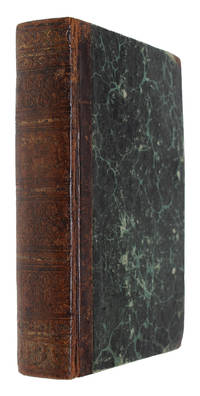
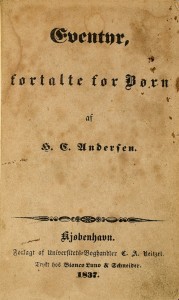
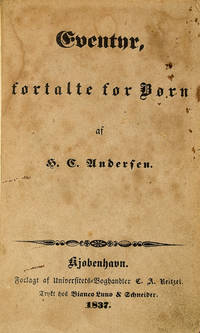
183758457Kjöbenhavn, 1837-1847. Bound in one nice contemporary half calf binding with blindstamped and gilt ornamentation to spine. Gilding vague, also the gilt title. Minor bumping to corners. Internally a bit of scattered brownspotting, but overall unusually nice, clean, and fresh. A truly excellent copy. See collation below.
183758457Kjöbenhavn 1837-1847. Bound in one nice contemporary half calf binding with blindstamped and gilt ornamentation to spine. Gilding vague also the gilt title. Minor bumping to corners. Internally a bit of scattered brownspotting but overall unusually nice clean and fresh. A truly excellent copy. See collation below. <br/><br/><em>A magnificent set - unusually nice and clean and bound together in a contemporary binding which is almost never the case - of the first edition of this exceedingly rare collection of Andersen's earliest fairy tales. This legendary fairy tale-collection that created the fairy tale-genre and brought Andersen international fame consists in six parts that together make up two volumes. As with most of the other few existing copies the present set is a mixture of issues though here merely two of the parts are in second issue. "With the passing of each year Andersen's genious brought forth new "wonder stories" and the fame he had so desperately craved and striven for became a reality. Little did he know in the spring of 1835 when he all but had to beg his publisher to accept these remarkable tales that one day they would make him immortal. And little did the critics nearly all of whom advised him to give up his "experiment" and devote himself to his other writings ever dream that they would live to see him gain world acclaim for these tales. For almost a hundred years now generation after generation has been brought up on Andersen's stories. Take the English-speaking world for instance. Since the first appearance of Andersen's Fairy Tales in London and New York in 1846 over seven hundred different editions including dozens of varied translations illustrated by more than a hundred different artists have been published in the United States alone. Indeed Andersen's stories will live on as classics - as much part of our civilization as the two primary educational factors reading and writing." Jean Hersholt p. 27. Due to the fact that the six little pamphlets together printed in different years all have their own title-pages half-titles contents etc. and that there were then also printed all of this for each volume of three times two together the book binders almost always removed several of these "extra" leaves as they seemed superfluous. It was never the intention of the publisher that the single half-titles title-pages or tables of contents be preserved. However due to the many different laves that were deemed "superfluous" or not all existing sets of these two little volumes have their individual mix-up of half-titles titles and tables of contents. Thus no copies are known to exist with all leaves present. "During Andersen's lifetime 162 of his Fairy Tales were published but the scarcest and most difficult to obtain are these six little pamphlets. We do not know exactly how many or how few copies were printed but we do know that no copy with all the title pages and tables of contents has ever been offered for sale by any dealer or at any auction. To my knowledge only five or six complete copies of the first printings 1835-1842 still exist. Even the second printing of the six pamphlets in their entirety 1842-1847 is exceedingly scarce and difficult to obtain." Jean Hersholt.Here follows a collation including mention of issues and lacunae: Vol. I: VIII pp. joint title-page dated 1837 for the three parts contents-leaf for all three parts and preface "Til de ældre Læsere". The joint half-title merely stating "Eventyr for Børn" has not been bound in.First Part: 61 including the title-page 3 blank verso of p. 61 and the contents-leaf for part one pp. The half-title has not been bound in. Second issue 1842.Second Part: 76 including half-title and title-page 2 contents-leaf for part two pp. 1 f. blank. Second issue 1844.Third Part: 60 including half-title and title-page pp. 2 contents-leaf for part two pp. 1 f. blank. First issue 1837.Vol. II: 3 ff. joint title-page dedication-leaf for Mrs. Heiberg contents-leaf for all three parts. First Part: 58 including title-page 2 contents-leaf for part one pp. The half-title has not been bound in. First issue 1838.Second Part: 53 including title-page 3 verso of p. 53 and contents-leaf for part two pp. The half-title has not been bound in. First issue 1839.Third Part: 49 including title-page 3 verso of p. 49 and contents-leaf for part three pp. The half-title has not been bound in. First issue 1842.This is one of the most complete copies we have ever seen as the only leaves not withbound are some of the half-titles. Usually a lot more leaves have been left out by the binders and it's even rare to find copies that have all title-pages. The separate contents-leaves are very rarely found preserved in copies that have the joint contents-leaves and the blank leaves are almost never withbound. BFN: 266; Hersholt: 23; PMM: 299. </em> unknown
Kjöbenhavn, 1837-1847. Bound in one nice contemporary half calf binding with blindstamped and gilt ornamentation to spine. Gilding vague, also the gilt title. Minor bumping to corners. Internally a bit of scattered brownspotting, but overall unusually nice, clean, and fresh. A truly excellent copy. See collation below.
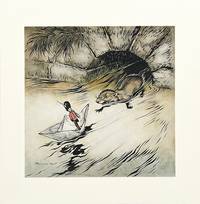
19321549551932. Reworked and embellished original artwork Published within Rackham's illustrated edition of Hans Andersen's Fairy-Tales in 1932 a work described by Hamilton as "ideal - even the classic - late Rackham". This drawing was originally reproduced on page 125 as a black and white drawing for "The Steadfast Tin Soldier". The publishers of the book sent Rackham and his wife to Denmark for a week in November 1931 "to collect Danish atmosphere for the book" as stated by Hamilton. In a letter Rackham wrote that "Copenhagen is a very beautiful city. Lots of water ships fishing boats quays - everywhere. It is rather fatiguing to me. I have to talk so much and behave myself so well all the while taking notes and notes for dear life". Ink and watercolour drawings generally command higher prices than pen and ink drawings. Rackham ever the commercial artist frequently reworked his black and white drawings and as in this example occasionally added detail. The published version shows the steadfast tin soldier in a paper boat. The reworked illustration has indistinct lines of newsprint added to the boat made out of a piece of newspaper. Original drawing 234 x 233 mm on card laid down on artist's board ink and watercolour signed "ARackham" lower left mounted framed and glazed framed size 402 x 397 mm. James Hamilton Arthur Rackham: a life with illustration 1990 pp. 144-5. unknown
(Copenhagen, 1866). Small square 8vo. Original brown full cloth with blindstamped borders to boards and gilt lettering to front board. Spine expertly restored. Very well preserved. Six thick cardboard leaves, each with a mounted photograph (measuring 10x10,4 cm) and two lines of text underneath. All leaves with the original tissue guards. A bit of light brownspotting, but overall very nice.
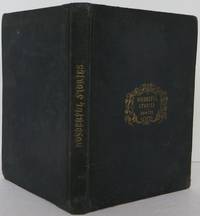
18462405405Chapman and Hall 1846. first. hardcover. near fine. Near fine first edition in English of Andersen's stories in English indicated by first issue title page with last name misspelled as "Anderson." Shelfwear on edges and corners light water spot on cover previous owner's name on FFEP soiling and browning on inside pages. Housed in custom-made foldout case. Chapman and Hall unknown
18351633Kbhvn., 1835-47. Indbundet i et smukt nyere hldrbd.af rødt gedeskind m. rygforgyldn. i gl. stil, i kassette. Med nogle brugsspor og nogle blade fint opforede i bladkanter, indimellem tæt beskåret. Originaludgaven af H.C. Andersens første eventyrsamlinger hvis 6 hefter udgør 2 bind. - Her er de 2 hefter i 1. oplag., mens de 4 er i 2. oplag. De få eksisterende eksemplarer er næsten alle en sammenblanding af disse oplag, ligesom eksemplarerne har visse mangler mht. titelblade, smudstitelblade og indholdsfortegnelser.1. Hefte: Smudstitelblad, titelblad samt 1. blad i faksimile. 61 pp. samt indholdsfortegnelse. 1 oplag. 1835.2. Hefte: Titelblad, 76 pp. samt indholdsfortegnelse. 2. oplag, 1844.3. Hefte: Smudstitelblad, titelblad, 60 pp. samt indholdsfortegnelse. 1. oplag, 1837.Ny Samling - 1. Hefte: Smudstitelblad, titelblad, 58 pp. samt indholdsfortegnelse. 2. oplag, 1846.Ny Samling - 2. Hefte: Smudstitelblad, titelblad i faksimile, 53 pp. (pp.47-48 i faksimile) samt indholdsfortegnelse, 2. oplag, 1847.Ny Samling - 3. Hefte: SMudstitelblad, titelblad, 49 pp. (pp. 48-49 i faksimile). Indholdsfortegnelse på p. 49. 2. oplag, 1847.Printing and the Mind of Man, No. 299. - Birger F. Nielsen, Nr. 266-70, 276-79, 303-05, 325-28, 352-55, 408-11.
18351633Kbhvn. 1835-47. Indbundet i et smukt nyere hldrbd.af rødt gedeskind m. rygforgyldn. i gl. stil i kassette. Med nogle brugsspor og nogle blade fint opforede i bladkanter indimellem tæt beskåret. Originaludgaven af H.C. Andersens første eventyrsamlinger hvis 6 hefter udgør 2 bind. - Her er de 2 hefter i 1. oplag. mens de 4 er i 2. oplag. De få eksisterende eksemplarer er næsten alle en sammenblanding af disse oplag ligesom eksemplarerne har visse mangler mht. titelblade smudstitelblade og indholdsfortegnelser.1. Hefte: Smudstitelblad titelblad samt 1. blad i faksimile. 61 pp. samt indholdsfortegnelse. 1 oplag. 1835.2. Hefte: Titelblad 76 pp. samt indholdsfortegnelse. 2. oplag 1844.3. Hefte: Smudstitelblad titelblad 60 pp. samt indholdsfortegnelse. 1. oplag 1837.Ny Samling - 1. Hefte: Smudstitelblad titelblad 58 pp. samt indholdsfortegnelse. 2. oplag 1846.Ny Samling - 2. Hefte: Smudstitelblad titelblad i faksimile 53 pp. pp.47-48 i faksimile samt indholdsfortegnelse 2. oplag 1847.Ny Samling - 3. Hefte: SMudstitelblad titelblad 49 pp. pp. 48-49 i faksimile. Indholdsfortegnelse på p. 49. 2. oplag 1847.Printing and the Mind of Man No. 299. - Birger F. Nielsen Nr. 266-70 276-79 303-05 325-28 352-55 408-11. <br/><br/><em>Bound in a beautiful recent full leather binding of red goat skin. Back richly gilt in old style in slipcase. Some traces of use and some leaves neatly restored at edges occasionally rather shaved.The first edition of H.C.Andersen's first collections of fairy tales whose six parts make up two bindings. In the present copy two parts are first issues while four are second issues. The few existing copies are nearly all a mixture of these issues and likewise nearly all copies have certain wants concerning title-page half-title and tables of contents.First Part: Half title title page and first leaf in facsimile. 61 pp. and table of contents. First issue 1835.Second Part: Title page 76 pp. and table of contents. Second issue 1844.Third Part: Half title title page 60 pp. and table of contents. First issue 1837.Ny Samling New Collection - First Part: Half title title page 58 pp. and table of contents. Second issue 1846.Ny Samling New Collection - Second Part: Half title title page in facsimile 53pp. pp.47-48 in facsimile and table of contents. Second issue 1847.Ny Samling New Collection - Third Part: Half title title page 49 pp. pp. 48-49 in facsimile. Table of contents on p. 49. Second issue 1847.These publications brought H.C.Andersen international fame. The critical world hailed the "eventyr" as a new genre. </em> hardcover
Kbhvn., 1835-47. Indbundet i et smukt nyere hldrbd.af rødt gedeskind m. rygforgyldn. i gl. stil, i kassette. Med nogle brugsspor og nogle blade fint opforede i bladkanter, indimellem tæt beskåret. Originaludgaven af H.C. Andersens første eventyrsamlinger hvis 6 hefter udgør 2 bind. - Her er de 2 hefter i 1. oplag., mens de 4 er i 2. oplag. De få eksisterende eksemplarer er næsten alle en sammenblanding af disse oplag, ligesom eksemplarerne har visse mangler mht. titelblade, smudstitelblade og indholdsfortegnelser.1. Hefte: Smudstitelblad, titelblad samt 1. blad i faksimile. 61 pp. samt indholdsfortegnelse. 1 oplag. 1835.2. Hefte: Titelblad, 76 pp. samt indholdsfortegnelse. 2. oplag, 1844.3. Hefte: Smudstitelblad, titelblad, 60 pp. samt indholdsfortegnelse. 1. oplag, 1837.Ny Samling - 1. Hefte: Smudstitelblad, titelblad, 58 pp. samt indholdsfortegnelse. 2. oplag, 1846.Ny Samling - 2. Hefte: Smudstitelblad, titelblad i faksimile, 53 pp. (pp.47-48 i faksimile) samt indholdsfortegnelse, 2. oplag, 1847.Ny Samling - 3. Hefte: SMudstitelblad, titelblad, 49 pp. (pp. 48-49 i faksimile). Indholdsfortegnelse på p. 49. 2. oplag, 1847.Printing and the Mind of Man, No. 299. - Birger F. Nielsen, Nr. 266-70, 276-79, 303-05, 325-28, 352-55, 408-11.
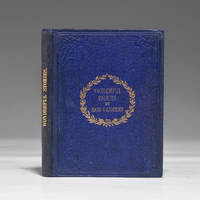
18461247481846. First Edition. ANDERSEN Hans Christian. Wonderful Stories for Children. Translated from the Danish by Mary Howitt. London: Chapman and Hall 1846. Small octavo original blind-stamped blue cloth gilt all edges gilt. Housed in a custom clamshell box. $17000.First edition of the extraordinarily rare first translation into English of Hans Christian Andersen's stories with four hand-colored plates in original cloth.""Wonderful Stories for Children was the first translation into English of the 'modern' fairy tales of Andersen although his stories had been appearing in his native Denmark since 1835 During an early visit to Britain he met Charles Dickens and befriended Mary Howitt the author of a number of natural history books for children Due to her meeting with Andersen she conceived the idea of translating his stories then almost totally unknown in Britain actually learning Danish to enable her to do this"" Quayle 74-6. Because of the popularity of Andersen's tales in England three separate translations were published in 1846: ""Mrs. Howitt's was the best of these and was greeted with a chorus of praise from all the leading literary journals"" Muir 106. ""The earliest collections in Danish of Andersen's tales are of the utmost rarity; and the English translations in 1846 and 1847 are almost as rare"" Muir 52. ""Andersen's work was immediately naturalized into English children's literature and was the second great element after Grimm in the revival of public enthusiasm for fairy tale and fantasy"" Carpenter & Prichard 22. This important work contains ten of Andersen's tales including ""The Naughty Boy"" ""Tommelise"" ""The Rose-Elf"" and ""The Constant Tin Soldier."" First issue with the author's name misspelt on the title page. Contemporary owner gift inscription.Only slightest foxing to preliminaries and a few finger smudges to interior expert restoration to cloth extremities. An extremely good copy. hardcover
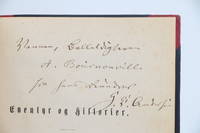
187288798Kiøbenhavn Copenhagen: C. A. Reitzels Forlag 1872. Fine. Twice inscribed to his friend Bournonville the ""poet of ballet"" C. A. Reitzels Forlag Kiøbenhavn Copenhagen 1872 14 x 16.7 cm Relié First edition of the third series of Andersens tales. Two parts in one volume published respectively on 30 March and 23 November 1872 each bearing an inscription by Andersen. He mentions the first in his diary H. C. Andersens dagbøger vol. IX p. 247 and the second is recorded by Henry Tuxen Anderseniana vol. 4 1958-59 p. 155. Red cloth half binding flat spine faded with gilt title and ruled in black black cloth boards. First board with a slight lenghtwise crack spine-ends and corners rubbed small lack of material at the margin of the first board. Rare collection of tales exceptionally inscribed twice by Hans Christian Andersen to his friend the celebrated dancer and choreographer Auguste Bournonville called here Balletdigter poet of ballet in homage to his talent. The inscriptions appear on the half-title page of each part: Vennen Balletdigteren A. Bournonville fra hans Beundrer H.C. Andersen To the friend the poet of ballet A. Bournonville from his admirer H.C. Andersen and Balletdigteren min geniale trofaste Ven Hr. Balletmester Bournonville Hjerteligst H.C. Andersen To the poet of ballet my brilliant and faithful friend the ballet-master Mr. Bournonville / Sincerely H.C. Andersen. The dancer and ballet director of the Royal Danish Theatre remained one of Andersens greatest role-models: Andersen who had aspired to be a dancer in his youth but like many of his fairy-tale protagonists was born in the wrong body relinquishing that career path the now-famous storyteller made use of his writing talents for the stage and collaborated on several occasions with Bournonville. The dancer met the author during Andersens difficult beginnings at the Royal Danish Theatre. After his arrival alone in Copenhagen in 1819 Andersen aspired to build a career on stage which he considered a realm of magic and ecstasy and fought desperately to make his place as a ballet dancer actor or singer. He entered in 1821 as a pupil in the ballet class of Carl Dahlén who had temporarily replaced Antoine Bournonville Augustes father at the head of the theatre. Andersen made a few unremarkable appearances and endured the criticism of his teachers who mocked his gangly figure and awkward posture. The future author of the deeply autobiographical Ugly Duckling abandoned dancing but continued to observe the brilliant career of the young Auguste Bournonville his exact contemporary born the same day as well as the famous dance school he was then founding in Copenhagen. Twenty years later the renowned storyteller had replaced the failed dancer: Andersen returned to the Royal Theatre where the greatest artists of Denmarks golden age gathered and collaborated closely with Bournonville both in the conception of works and in their staging just as he was also a repeated inspiration for the ballet-masters choreographic work with his own fairy-tales and theatrical projects Digterens & balletmesterens p. 15. His storytelling talents translated wonderfully into his opera libretti and theatre texts. Alongside Bournonville who signed the staging and choreography of the dances of elves Andersen had his first stage success with his fairy-comedy entitled Lykkens Blomst The Flower of Happiness and then with a lyrical and dramatic tale Liden Kirsten Little Christine also choreographed by his friend. The two men worked on several stage productions maintained for decades a rich correspondence and exchanged poems expressing their mutual admiration. It was even in August Bournonvilles home years later that Andersen met and fell in love with the Swedish opera singer Jenny Lind the famed Nightingale of the North who rejected him and left the writer in deep distress. In the present collection which contains 17 tales Andersen notably reconnects with his youthf C. A. Reitzels Forlag hardcover
48430Yokohama : Stillfried & Andersen 1876-1885. Pair of nineteenth-century photograph albums in identical large folio format 360 x 470 mm in original matching bindings of gilt-ruled half morocco over brown pebbled cloth the upper boards with gilt-stamped titles 'Northern Japan' and 'Southern Japan' scuffed worn at corners spines in compartments with ornate gilt decoration; all edges gilt; the respective albums containing 47 Northern Japan and 40 Southern Japan albumen print photographs in uniform 220 x 280 mm format mounted recto and verso of thick card leaves all with Stillfried & Andersen's manuscript caption and serial number in the negative; across the two albums the photographs are in excellent condition the prints consistently strong and with good tonal range; both albums with foxing to the endpapers and the outermost mounts and some occasional marginal spotting otherwise remarkably clean throughout. A superb pair of albums with a total of 87 large format topographical views of Japan by the photographic partnership of Baron Raimund von Stillfried and Hermann Andersen. Also known as the Japan Photographic Association the firm was founded in Yokohama in 1876 and operated until 1885. The subjects as spelled in the captions include Fusiyama Tokio Yokohama Ikegami Uyeno Shiba Daibutz Great Buddha of Kamakura Nikko Imaichi Nagasaki Kobe Kinkakuji Yasaka Hirano Karasaki-matz Daishie Ishiyama Tenoji Smiyoshi Homura Sorehashi Umenawa Osaka and Nagoya. hardcover
187288798C. A. Reitzels Forlag | Kiøbenhavn [Copenhague] 1872 | 14 x 16.7 cm | Relié
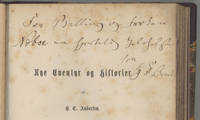
1872352681872. <p>Hans Christian Andersen is best known for such classic fairy tales as The Ugly Duckling The Red Shoes and The Emperor’s New Clothes. In 1872 he published his final major collection in English entitled New Adventures or Nye Eventyr og Historier New Fairy Tales and Stories appearing just three years before his death in 1875; This shows Andersen at his most mature and philosophical containing darker symbolic tales such as The Shadow The Red Shoes The Story of a Mother and The Bell which move far beyond simple children’s fairy tales into moral psychological and existential territory—making an actual 1872 printing.</p><p><strong>Book signed</strong> Nye Eventyr og Historier Tredie Raekke Anden Samling New Adventures and Stories Third Series Second Collection. Copenhagen: C. A. Reitzel 1872. Hardcover bound later in quarter-leather with marbled boards 5.25 x 6.75 73 pages. Signed and inscribed on the half-title page in Danish by Andersen to his friends and benefactors in full translated: <em>""Mrs. Balling and Miss Naeboe.""</em></p><p>Miss Naeboe likely refers to Louise Næboe a young woman with whom Andersen became emotionally infatuated in the 1830s. Like several women in his life including Riborg Voigt and Jenny Lind Miss Næboe appears in his diaries and letters as part of his recurring pattern of intense but usually unreciprocated romantic attachment. These relationships often fed directly into the emotional core of his later more psychologically complex fairy tales.</p><p><img class=""alignnone wp-image-25018 size-post-window"" src=""https://cdn.raabcollection.com/wp-content/uploads/20231204144051/Folder-site-11-1600x1327.jpg"" alt="""" width=""1600"" height=""1327"" /></p> hardcover
LCS-838Véritables créations littéraires, dans un style très personnel, ces contes sont remarquables par leur ironie et l’absence des morales traditionnelles. Copenhague, Bianco & Schneider for C.A. Reitzel, 1842-1844-1837.3 parties en 1 volume in-16 de : VIII pp. avec le titre général, la table générale et la préface (« Til de aeldre Laesere »), (2) ff., 61 pp., (1) f. de table, pp. 3 à 76 (sans le faux titre de cette partie), (1) f., 60 pp. et (1) f. Relié en chagrin rouge, dos lisse. Quelques feuillets roussis.126 x 77 mm.
1837LCS-838<p><strong>A rare compilation that gathers together the first editions of two of Andersen's main tales:</strong></p><p><strong><em>The Little Mermaid</em></strong><strong> and <em>The Emperor's New Clothes</em>.</strong></p><p><strong>P.M.M. n°299.</strong></p><p>3 parts in 1 volume 16mo 126 x 77 mm VIII pp. with the general title the table and the preface " <em>Til de aeldre Laesere</em> " 2 ff. 61 pp. 1 f. of table pp. 3 to 76 without the half-title in this part 1 f. 60 pp. and 1 f. Bound in red shagreen flat spine. Some foxing.</p><p>One of the few copies of the compilation that gathers together for the first time 9 of Andersen's most important tales.</p><p>The first pamphlet contains 4 tales in the second issue: "<em>The Tinder box</em>" "<em>Little Claus and Big Claus</em>" "<em>The</em> <em>Princess on the Pea</em>" and "<em>Little Ida's Flowers</em>". The second part contains the second issue of 3 tales: "<em>Thumbelina</em>" "<em>The Naughty Boy</em>" and "<em>The Travelling Companion</em>". The third part presents the first issue of 2 of the most famous tales by Andersen: "<em>The Little Mermaid</em>" and "<em>The Emperor's New Clothes</em>".</p><p>His first fairy tales were only issued in c. 200 copies and are increasingly rare on the market.</p><p>The collector <em>Jean Hersholt</em> wrote in 1954 that " <em>no copy with all its title-pages and tables of contents has ever been offered for sale by any dealer or at any auction sale</em>".</p><p>" <em>The tales of Hans Christian Andersen are unique. Unlike Perrault's and Grimm's his stories were original inventions The "Eventyr" are fairy tales of supernatural creatures and fantastic happenings. Over and above their intrinsic merit Andersen's stories signalized a new and fundamentally different approach to the writing of books for children. Mawkishness didacticism and moral proselytizing were totally abjured and he was the harbinger of a new era in this genre</em>"</p><p>Printing and the Mind of Man n°299.</p><p><em>Hans Christian Andersen</em> 1805-1875 is a Danish writer who personifies the popular Nordic genius.</p><p>This rare set contains the first printing of two of his most important tales: <em>The Little Mermaid</em> and <em>The Emperor's New Clothes</em>.</p><p>FRANCAIS</p><p><strong>Rare recueil réunissant l'édition originale de deux des principaux contes d'Andersen : </strong></p><p><strong><em>La petite sirène</em></strong><strong> et <em>Les</em> <em>Habits neufs de l'empereur</em>.</strong></p><p><strong>Printing and the Mind of Man n°299.</strong></p><p>3 parties en 1 volume in-16 de : VIII pp. avec le titre général la table générale et la préface " <em>Til de aeldre Laesere</em> " 2 ff. 61 pp. 1 f. de table pp. 3 à 76 sans le faux titre de cette partie 1 f. 60 pp. et 1 f.</p><p>Relié en chagrin rouge dos lisse. Quelques feuillets roussis.</p><p>126 x 77 mm.</p><p>L'un des rares exemplaires du recueil réunissant pour la premiere fois 9 des principaux contes d'Andersen.</p><p>Le premier opuscule regroupe 4 contes en second tirage 1842 : " <em>Fyrtoiet</em> "Le Briquet " <em>Lille Claus og store Claus</em> " Grand Claus et petit Claus " <em>Prindsessen paa Aerten</em> " La Princesse au petit pois et " <em>Den lille Idas Blomster</em> " Les fleurs de la petite Ida.</p><p>La seconde partie présente 3 contes également dans le deuxième tirage 1844 : " <em>Tommelise</em> " La petite Poucette " <em>Den uartige Dreng</em> " Le vilain garçon et " <em>Reisekammeraten</em> " Le compagnon de route.</p><p>Le troisième recueil comporte l'édition originale de deux des contes les plus celebres d'Andersen : " La petite sirène " et " Les habits neufs de l'empereur " <em>" Den lille Havfrue</em> " et " <em>Kejserens nye Klaeder</em> ".</p><p>Les premiers contes d'Andersen furent seulement publiés à 200 exemplaires ce qui explique leur grande rareté sur le marché. Les quelques exemplaires qui sont parvenus jusqu'à nous présentent presque tous une compilation des différents tirages de ces contes ; d'autre part ils sont rarement complets de tous les feuillets de titre de faux titre et de table.</p><p>Le collectionneur <em>Jean Hersholt</em> écrivait d'ailleurs en 1954 que " <em>no copy with all its title-pages and tables of contents has ever been offered for sale by any dealer or at any auction sale</em>".</p><p>" <em>The tales of Hans Christian Andersen are unique. Unlike Perrault's and Grimm's his stories were original inventions The "Eventyr" are fairy tales of supernatural creatures and fantastic happenings. Over and above their intrinsic merit Andersen's stories signalized a new and fundamentally different approach to the writing of books for children. Mawkishness didacticism and moral proselytizing were totally abjured and he was the harbinger of a new era in this genre</em>" Printing and the Mind of Man n°299.</p><p>Hans Christian Andersen 1805-1875 est un écrivain danois qui grâce à ses nouvelles et à ses Contes incarne le génie populaire nordique. C'est à trente ans après le traditionnel voyage en Italie que se doit d'accomplir tout jeune écrivain romantique qu'il publie un court recueil de " <em>Contes pour les enfants " </em><em>Eventyr fortalte for Born</em>. D'autres parties complétant le premier volume apparurent en 1837.</p><p>Après un départ hésitant le succès fut foudroyant et en quelques années le petit vagabond d'Odense allait devenir l'un des écrivains les plus fêtés du monde.</p><p>Véritables créations littéraires dans un style très personnel ces contes sont remarquables par leur ironie et l'absence des morales traditionnelles.</p><p>bon exemplaire de ce recueil rare et recherché qui comporte la première impression de deux des contes les plus importants d'Andersen : " La petite sirène " et " Les habits neufs de l'empereur ".</p><p><strong>One of the few copies of the compilation that gathers together for the first time 9 of Andersen's most important tales.</strong></p><p><strong>The first pamphlet contains 4 tales in the second issue: "<em>The Tinder box</em>" "<em>Little Claus and Big Claus</em>" "<em>The</em> <em>Princess on the Pea</em>" and "<em>Little Ida's Flowers</em>". The second part contains the second issue of 3 tales: "<em>Thumbelina</em>" "<em>The Naughty Boy</em>" and "<em>The Travelling Companion</em>". The third part presents the first issue of 2 of the most famous tales by Andersen: "<em>The Little Mermaid</em>" and "<em>The Emperor's New Clothes</em>".</strong></p><p><strong>" <em>The tales of Hans Christian Andersen are unique. Unlike Perrault's and Grimm's his stories were original inventions The "Eventyr" are fairy tales of supernatural creatures and fantastic happenings. Over and above their intrinsic merit Andersen's stories signalized a new and fundamentally different approach to the writing of books for children. Mawkishness didacticism and moral proselytizing were totally abjured and he was the harbinger of a new era in this genre</em>" </strong></p><p><strong>Printing and the Mind of Man n°299.</strong></p><p><strong>His first fairy tales were only issued in c. 200 copies and are increasingly rare on the market.</strong></p><p><strong>This set contains the first printing of two of his most important tales.</strong></p> Bianco & Schneider for C.A. Reitzel.
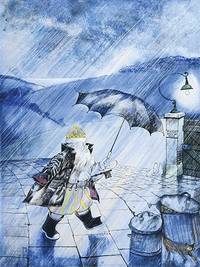
1668401972. Rare original artwork by the artist of Father Christmas and The Snowman Published within Raymond Briggs's The Fairy Tale Treasury Hamish Hamilton 1972 on p. 171. This fine drawing illustrates Andersen's story of "The Real Princess" and is dated only a year before Briggs published Father Christmas which launched his distinctive comic-strip style of illustration. The old king and Father Christmas share remarkable similarities. The Fairy Tale Treasury comprised 32 classic tales which were selected by Virginia Haviland. It was a companion volume to Briggs's The Mother Goose Treasury which won the 1966 Kate Greenaway Medal. After the original hardback appearance in 1972 also issued in the US by Coward McCann and Geoghegan The Fairy Tale Treasury would be published by Puffin in paperback in 1974. On this occasion the Times Literary Supplement described it as a collection "on a. lavish scale". The reviewer stated that "the illustrations are handsome and of great variety". Muriel Rukeyser reviewing the book in the New York Times specifically describes the present illustration: "When the old king whose son you remember wanted a real princess goes out to the palace gate in the rain and the princess is there he is wearing his galoshes as well as his crown. The royal umbrella has one rib bent back the milk-bottles have been put out the cat is hanging around the rain-burnished ashcans because of a past fish and a sign says 'Please Shut the Gate'". Original drawing 298 x 224 mm on paper laid down to production card 398 x 322 mm ink and watercolour with surface scoring unsigned artist's name and address typed on reverse mounted framed and glazed framed size 428 x 342 mm. Fine and unfaded. Times Literary Supplement 6 December 1974 p. 1384; Muriel Rukeyser "The Fairy Tale Treasury" New York Times Book Review 8 October 1972 p. 8. paperback
01243Copenhagen: C.A. Reitzel 1845-1848. The Original Stories That Catapulted Andersen to Fame<br/><br/>ANDERSEN Hans Christian. Nye Eventyr. Kjøbenhavn: C.A. Reitzel 1845-1848. <br/><br/>First edition complete two volumes collections bound together of Anderson's second series of fairy tales the first issue of Collection Two the second issue of Collection One. Small octavo 6 1/4 x 4 in; 157 x 103 mm. Collection One: 47 1 blank; 68; 52 pp. Collection Two: 72; 60 pp. Two leaves comprised of table of contents and dedication page to Collection Two have been misbound out of sequence. Otherwise complete with half titles for each volume both shared title pages both shared contents leaves all dedication leaves all half titles for each fairy tale and all five regular title pages. <br/><br/>Contemporary quarter calf over marbled boards. Marbled edges. Some light scattered foxing and toning and an occasional inkspot. Otherwise a very nice copy. Housed in a quarter morocco clamshell case.<br/><br/>A work of extreme scarcity with OCLC/KVK recording only a handful of copies in libraries worldwide and with possibly only one other example the Klein copy 1980 coming to auction within the last thirty-three years of ABPC records Sotheby Hodgson's catalogue note vague and incomplete. <br/><br/>These stories were originally issued in parts; very few have survived in that state. The publisher Reitzel collected the individual parts in their original printings added tables of contents and published them in anthologies as here.<br/><br/>The importance of these stories here - staggeringly - in their first edition cannot be underestimated. They have become deeply embedded in the Western world's cultural consciousness as timeless as our memories of childhood. More to the point however is that unlike Charles Perrault and the Brothers Grimm who were compilers and talented interpreters of traditional folk stories in their respective cultures in this second series of Andersen tales the stories are wholly original the product of a brilliant imagination featuring characters of great love and yearning who misunderstood and misfits in a cruel world have become transcendent heroes for humanity of all ages. The stories have become the cornerstones of Western children's literature the characters eternal psychological archetypes.<br/><br/>"For his second collection Nye Eventyr New Fairy Tales Andersen wrote some of his most important and famous stories. He moved away from traditional folk material towards creating tales that came from his imagination. The words ‘told for children' were omitted from the new title as Andersen sought to engage adults and children alike. He had found a genre in which he had a unique voice" British Library Online Gallery.<br/><br/>The Stories:<br/><br/>Volume One<br/>1. The Angel<br/>2. The Nightingale<br/>3. The Sweethearts<br/>4. The Ugly Duckling<br/>5. The Fir Tree<br/>6. The Snow Queen<br/>7. Night Ghosts<br/>8. The Red Shoes<br/>9. The Jumpers<br/>10. Shepherdess and the Chimney Sweep<br/>11. Holger Danske<br/><br/>Volume Two<br/>1. The Old Street Lamp<br/>2. The Neighboring Family<br/>3. The Darning Needle<br/>4. Little Tuck<br/>5. The Shadow<br/>6. The Old House<br/>7. The Drop of Water <br/>8. The Little Match Girl<br/>9. The Happy Family<br/>10. The Story of a Mother<br/>11. The Shirt Collar<br/><br/>Nielsen 467 & 529. Copenhagen: C.A. Reitzel, 1845-1848 unknown books
18461803007Chapman and Hall 1846. 1st Edition. Hardcover. Near Fine/No Jacket. Near fine first edition of Andersen's stories in English indicated by first issue title page with last name misspelled as "Anderson." Shelfwear on edges and corners light water spot on cover previous owner's name on FFEP soiling and browning on inside pages. Housed in custom-made slipcase. Chapman and Hall hardcover books
18456201Kjøbenhavn: C.A. Reitzel 1845. First editions. First edition complete two volumes collections bound together of Anderson's second series of fairy tales the first issue of Collection Two the second issue of Collection One. Small octavo 6 1/4 x 4 in; 157 x 103 mm. Collection One: 47 1 blank; 68; 52 pp. Collection Two: 72; 60 pp. Two leaves comprised of table of contents and dedication page to Collection Two have been misbound out of sequence. Otherwise complete with half titles for each volume both shared title pages both shared contents leaves all dedication leaves all half titles for each fairy tale and all five regular title pages. Contemporary quarter calf over marbled boards and marbled edges. Some light scattered foxing and toning and an occasional inkspot. Otherwise a very nice copy. Housed in a quarter morocco clamshell case.<br /> <br /> Nye Eventyr trans. New Fairy Tales Andersen's second collection of stories contains some of his most significant original texts including "The Nightingale" "The Ugly Duckling" "The Snow Queen" "The Red Shoes" and "The Little Match Girl." Unlike Charles Perrault and the Brothers Grimm who were primarily compilers here Andersen "moved away from traditional folk material towards creating tales that came from his imagination. The words 'told for children' were omitted from the new title as Andersen sought to engage adults and children alike. He had found a genre in which he had a unique voice" British Library Online Gallery. These brilliant and imaginative stories have become the cornerstones of Western children's literature and the characters eternal psychological archetypes. Originally issued in parts; very few have survived in that state. The publisher Reitzel collected the individual parts in their original printings added tables of contents and published them in anthologies. <br /> <br /> The Stories:<br /> <br /> Volume One<br /> 1. The Angel<br /> 2. The Nightingale<br /> 3. The Sweethearts<br /> 4. The Ugly Duckling<br /> 5. The Fir Tree<br /> 6. The Snow Queen<br /> 7. Night Ghosts<br /> 8. The Red Shoes<br /> 9. The Jumpers<br /> 10. Shepherdess and the Chimney Sweep<br /> 11. Holger Danske<br /> <br /> Volume Two<br /> 1. The Old Street Lamp<br /> 2. The Neighboring Family<br /> 3. The Darning Needle<br /> 4. Little Tuck<br /> 5. The Shadow<br /> 6. The Old House<br /> 7. The Drop of Water <br /> 8. The Little Match Girl<br /> 9. The Happy Family<br /> 10. The Story of a Mother<br /> 11. The Shirt Collar<br /> <br /> Nielsen 467 & 529. C.A. Reitzel unknown
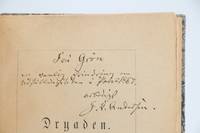
186888799Kjobenhavn Copenhagen 1868. Fine. ""All this has happened and been experienced. We ourselves have seen it at the Paris Exposition in 1867 in our time the great and wonderful time of fairy tales."" translated from the Danish p. 60 Kjobenhavn Copenhagen 1868 12 x 18.7 cm Relié First edition. Bound in full marbled paper with a light brown morocco spine label; original wrappers preserved. Spine ends corners and joints slightly rubbed; minor marginal stain to rear wrapper. Rare first edition of Andersens tale about an ill-fated dryad often compared to The Little Mermaid 1837. Both feature a feminine nature spirit longing to shed her form to enter the human world with fatal consequences. An exceptional copy inscribed by Hans Christian Andersen: Fru Grøn / en venlig Erindring om Udstillingstiden i Paris 1867. / Ærbødigst / H.C. Andersen To Madame Grøn / a kind remembrance of the 1867 Paris Exhibition / With my highest regards / H. C. Andersen. Andersens stay in Paris in 1867 inspired this story set during the Exposition Universelle. It was then that he met the dedicatee Ada Grøn née Courtois along with her daughter and husband the Danish wholesaler L. J. T. Grøn. The inscription is documented by Andersen himself in a diary entry dated 28 April 1870 published by the H. C. Andersen Centre in Odense. From 15 April to 9 May 1867 Hans Christian Andersen visited the Paris Exposition Universelle and was enchanted by it: It would be a simplistic error to imagine Andersen as a pre-ecologist a sentimental ethereal faun moved solely by nature. This deserves an essay in itself. Andersen had a global non-hierarchical vision of the world far removed from nostalgic reveries . The science of his time fascinated him and stirred his curiosity and enthusiasm: the wonder of electricity the microscope of course which reveals what lies beyond appearances photography and all the inventions that announced themselves exalting speed moving images and flight. Indeed that era was the very age of fairy tales and its material was far from depleted. Isabelle Jan Andersen écrivain de toujours La Revue des Livres pour Enfants no 226. The Dryad perfectly illustrates the wealth of inspiration he drew from his Parisian experience. Andersen translates his impressions of modern lifecaught between wonder and skepticismthrough the figure of a dryad a female tree spirit living in an ancient oak in the French countryside dreaming of discovering the human world. One day her wish is granted: an extraordinary event sees her tree uprooted and replanted in the heart of the Paris Exposition Universelle. Freed from her roots the dryad can now closely observe human life. She discovers the city its splendor art pleasures and suffering. But this privilege comes at a cost: severed from her native soil the dryad is doomed to die young. Her brief yet intense earthly life ends in a final vision of the worlds beauty and sorrow. The parallels with Andersens major masterpieces are unmistakable especially the leitmotiv that brought him fame: the powerful yearning of his characters to change their nature. As Ane Grum-Schwensen notes: In Andersens case it is as though a highly conscious recycling of internal intertextual elements takes place creating a wider network linking the works together. This becomes particularly evident when for example in the archives one finds a note outlining the reciprocal connections among the many elements Andersen employed in The Dryad The Little Mermaid The Ice Virgin and The Snow Queen. Ane Grum-Schwensen Images littéraires et recyclage dans les manuscrits dAndersen Genesis 48 2019. A rare inscription by Hans Christian Andersen whose name remains familiar to children past and present. This exceptional copy was presented to one of the few individuals who witnessed the birth of this Parisian Little Mermaid. unknown
19131671231913. ANDERSEN Hendrik Christian. Creation d'un Centre mondial de Communication. Two parts in one volume. 6 xv 128 102 pp. Recto of dedication leaf in heliogravure. 25 heliogravure plates 9 double-page and 5 double-page and folding including the plate 'A World Centre' at the beginning of part I not called for in the list of illustrations 123 heliogravure text-illustrations 9 full-page including that of Athena Apollo and Herakles on p. iii not called for in the list of illustrations 2 lithographic plans with manuscript coloured lines depicting public transport systems and central city heating engraved vignette to pt II p.30 woodcut head- and tailpieces to pt II. Folio 455 x 322 mm bound in publisher's tan morocco. Paris: P. Renouard 1913. Rare first edition of this vision of a utopian world city. Andersen was born in Bergen Norway and emigrated as an infant with his family to Newport Rhode Island. As a young artist he mingled among Newport's wealthy elite and spent some time as Gertrude Vanderbilt Whitney's art teacher. At the age of 21 Andersen travelled to Europe eventually settling in Rome. There he pursued his artistic interest in monumental classically inspired pieces believing that they stimulated in the viewer a desire for self-improvement. He devoted much of his time designing a perfect 'World City' filled with art which would motivate humanity to achieve a near Utopian state. The present work is the culmination of his theories and may be seen as a precursor to later modernist visions such as Le Corbusier's Ville Contemporaine 1922. The book is in two parts. The first deals with the history of the city and monumental architecture and seeks inspiration in classical and contemporary notions of city planning - Paris and Washington DC feature prominently. The second part details Andersen's imaginary urban landscape complete with works of art for the 'World City'. Olympic stadia galleries for the arts and sciences as well as government buildings are all outlined and placed upon a defined grid plan with an emphasis on a grand central avenue acting as the axis of the city. Number LV1 of only 75 copies on Japan paper. There were also 125 copies on Velin. Binding with a little wear and some sun fading overall near fine. unknown books