1 478 résultats
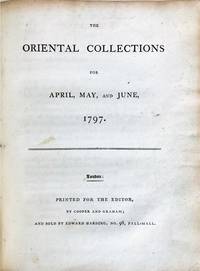
1797MEA1066London:: Printed for the Editor by Cooper and Graham 1797. 1797. Four parts in one vol. 4to. iii-xii 92 viii 93-196 iv 197-300 iv 301-403 1 pp. Lacks the preliminary title for the annual supplied in photocopy facs. Advertisement prospectus contents 18 engraved plates 2 hand-colored 5 figures including 1 hand-colored pp. 16 307 310 338 2 index errata; minor penciling p.95-6 267. At end of first issue: "Subscription for the four numbers . . . for 1797. Modern half navy blue blind- and gilt-stamped calf blue cloth covers raised bands new endleaves. Very early periodical which lasted for about three years bringing Oriental-themed essays dealing with Middle Eastern & Asian literature language music archeology history fauna & flora birds & animals and celebrates as well some of the earliest translations of the great Persian poets such as Hafez and Sa'di. The work contains anecdotes and an especially early rendition into English of the Arabian Nights "A Tale from an original MS. of the Arabian Nights" translated by Jonathan Scott. The two hand-colored plates depict the Musk Deer of Nepal "The Fighting Bulbul of Bengal" an additional plate offers four beasts shown as "Persian zoology" with four figures. / "Many of his academic contributions were published in the Oriental Collections the three volumes of which appeared in London between 1797 and 1800." "William Ouseley as well as his brother Gore continued the pioneering work of William Jones 1746-94; q.v. in the field of Persian studies in Great Britain. Jones and the Ouseley brothers shared the experience of extended stays in India and their careers in turn illustrate how Great Britain's economic interests in India indirectly promoted Persian studies." / Includes translations from a number of Middle Eastern and Asian literatures including: Arabic Persian Turkish Hebrew Sanskrit with illustrative plates including alphabets and some music; original texts included with commentary on various languages./ Selected papers include all of these from the first fascicule: Sketch Biographical and Literary of Abu'l Taieb Al Motanabbi; with his two Poems on the Sickness and Recovery of Saif Uddaula by the Rev. John Haddon Hindley -- Of the Fighting Bulbul of Bengal -- Extraordinary Persian Distich by P.D.V. -- On the different modes of writing the word ---- in European Characters by Philologus -- Extract of a Journal and Memorandums written during a Tour in the Nizam's Country in the Month of November 1791 by an Officer -- Hebrew Running Hand -- Cufick Inscription -- Persian Lines on the Deity quotes in the Historical Work entitled "Tarik Moagem si Athar Moluck al Agem translated by W. Ouseley -- Sonnet b ythe Poet Sadi paraphrased from the Persian by P.D.V. -- On the Christianity of the Mohammedans; with Anecdotes of Murad Beg a Trukish Writer of the sixteenth Century by I.U. -- Remarks on the Collation of Manuscripts; with various Readings in the Gulistan of Sadi by Major Ouseley -- The Lover to his Taper translated from the Arabick of the Sheick Safy Eddin Alhillay by the Rev. J.D. Carlyle . . . -- The Conquest of the Island of Zoos from the Persian by the Rev. R. Gerrans -- Anecdotes of Indian Musick by W. Ouseley -- Account of a Large Tree Communicated by Colonel Ironside -- Account of a Banian Tree in the Province of Bahar. . . -- Persian Sonnet by Khosroo -- Dialogues in the vulgar Arabick of Morocco by Mr. William Price -- Explanation . . . -- Queries and Notes. Three other fascicules contain as much additional material. BIOGRAPHICAL: Major Sir William Ouseley 1767-1842 British Orientalist went to Paris to learn French in 1787 and then became interested in Persian literature which he undertook to learn in Leiden 1794. He was in the year 1800 knighted by "Charles Lord Cornwallis 1738-1805 who from 1786 to 1793 had been Governor-General of India had him knighted in recognition of his promotion of oriental studies." "Ouseley's life as gentleman-scholar is marked by his unsuccessful efforts to obtain government support for a journey to Iran and by his unfulfilled ambition to become a government envoy to a Near-Eastern court. It was the diplomatic career of his brother Gore that allowed William to make the personal acquaintance of the Qajar envoy Abu'l-asan n Ili 1776-1845; q.v. who visited England between 1809 and 1810 and to become his brother's secretary when between 1810 and 1815 Gore traveled as the British ambassador to the Qajar court in Tehran. Ouseley's memoir of Travels in Various Countries of the East is an important source of British-Persian politics during the Napoleonic Wars." -- Encyclopaedia Iranica. His works are notable including the present annual issued from 1979-1800 Persian Miscellanies. An Essay to Facilitate The Reading of Persian Manuscripts; With Engraved Specimens Philological Observations And Notes Critical And Historica Persian Lyrics of scattered poems with the Diwan-I-Hafiz 1795 Epitome of the ancient history of Persia. Extracted and translated from the Jehan Ara a Persian manuscript 1799 The oriental geography of Ebn Haukal an Arabian Traveller of the Tenth Century 1800 Observations On Some Medals And Gems Bearing Inscriptions In The Pahlavi Or Ancient Persick Character 1801 The Bakhtyar nameh or Story of Prince Bakhtyar and the ten viziers : a series of Persian tales 1801 Travels in Various Countries in the East; More Particularly Persia 1819-23 an edition of John Lewis Burckhardt's Travels in Arabia Comprehending an Account of Those Territories in Hedjaz Which the Mohammedans Regard as Sacred 1829 Arabian Proverbs Notes on the Bedouins and Wahbys Catalogue of Several Hundred Manuscript Works in Various Oriental Languages London 1831 A Critical essay on various mss. works Arabic & Persian illustrating the history of Arabia Persia Turcomania India Syria Egypt Mauritania and Spain 1832. REFERENCES: English Short Title Catalog P6556; "William Ouseley" in Encyclopaedia Iranica Printed for the Editor, by Cooper and Graham, 1797. hardcover books
1840YRG-466Édition originale, in-12 demi-cuir à nerfs, 148 pp., coiffe supérieure en partie manquante, rousseurs, mouillure pâle en bas de pages, petite déchirure en bas de la page 12. Librairie Orientale, veuve Dondey-Dupré. Paris.
In 8° (18,8x11,6 cm); due tomi: VIII, 319, (1) pp. e 2 grandi c. di tav. più volte ripiegate, 188 pp. Legature coeve in piena pergamena rigida con titolo e numero del volume al dorso. Tagli spruzzati. Qualche carta con leggere bruniture dovute alla qualità della carta utilizzata. Esemplare completo anche delle due carte spesso assenti ed in buone-ottime condizioni di conservazione. Prima edizione italiana di questa importante studio dedicato all’India ed al commercio con essa, scritta dal noto storico, storiografo, teologo scozzese William Robertson (Borthwick, 19 settembre 1721 – Edinburgo, 11 giugno 1793). Rettore dell’Università di Edimburgo per quasi trent’anni, ha dato contributi notevoli alla storia dell’sud America, della Spagna e della Scozia stessa. Cappellano del Castello di Stiriling, fu anche cappllano del re in Scozia. Fedele presbiteriano e un whig, si offrì volontario per difendere la città contro i giacobiti guidati dal principe Carlo Edoardo Stuart nel 1745. Nel 1754 fu un membro originale della Select Society, indicata anche come la Edinburgh Select Society. Le sue opere “Storia della Scozia fra il 1542 e 1603” (1759) e “Storia d’America” (1777), sono considerati alcune delle opere storiche più importanti del settecento. Figura preminente dell’illuminismo scozzese, fu tra i fondatori della Royal Society di Edimburgo. Nel 1791, il celebre storico scozzese, William Robertson, pubblicò il suo ultimo lavoro, “An Historical Disquisition concerning the Knowledge which the Ancients had of India”, nel quale esplorò i collegamenti commerciali e culturali dell'India e dell'Occidente dai tempi antichi fino alla fine del il XV secolo. Questo studio è considerato fra i primi esempi del movimento "orientalista" britannico e dello studio dell'espansione del dominio britannico in India. Per certi versi il suo lavoro che pur rifletteva i presupposti e gli approcci della scuola orientalista britannica, probabilmente anche in risposta alle critiche mosse a Robertson secondo le quali la sua precedente Storia dell'America era stata troppo sprezzante nei confronti delle culture amerindi, andò oltre rispetto a molti orientalisti nella sua interpretazione positiva della cultura indiana e della loro opposizione a una politica imperiale interventista e repressiva. In effetti, il lavoro era in gran parte diretto a preservare l'antica e sofisticata civiltà indiana dall'imperialismo culturale occidentale. La visione favorevole di Robertson su ciò che percepiva come credenze monoteiste alla base dell'induismo “classico”, rivela molto sui suoi atteggiamenti religiosi come sacerdote e leader del partito “moderato” nella Chiesa di Scozia. La sua storia dell'India verrà sottovalutata in Gran Bretagna (nonostante le sue grandi vendite), in gran parte, non per il valore dell’opera in sé, indubitabile, ma per la situazione politico, religiosa e sociale del Regno Unito dell’epoca. Le sue tesi sull'induismo e la sua critica delle missioni cristiane, non potevano che esser in contrasto con la crescente ondata di risveglio evangelico che stava vivendo in quegli anni il suo paese natale. Tuttavia, la sua opera, grazie anche alle numerose traduzioni, venne lentamente recuperata e valorizzata, con il passare degli anni, arrivando ad avere un ruolo di primaria importanza nel promuovere l'interesse per l'India, nel continente europeo e rappresentò uno dei risultati più significativi del tardo illuminismo scozzese. Prima edizione italiana, completa e non comune. Rif. Bibl.: ICCU IT\ICCU\NAPE\010474.
1798PHO-1473Paris, 1798 – An VII, chez Bleuet jeune, Libraire. 4 volumes in-8 (210x130), pleine basane marbrée époque , dos lisse orné avec pièces de titre et de tomaison XVI-398pp.-3 cartes et une planche dépliantes ; 2ff.-291pp. ; 330pp.; 382pp. , illustré d’un carte et une planche dépliante ,quelques frottements , coins usés, petit manque de matière sur un plat .
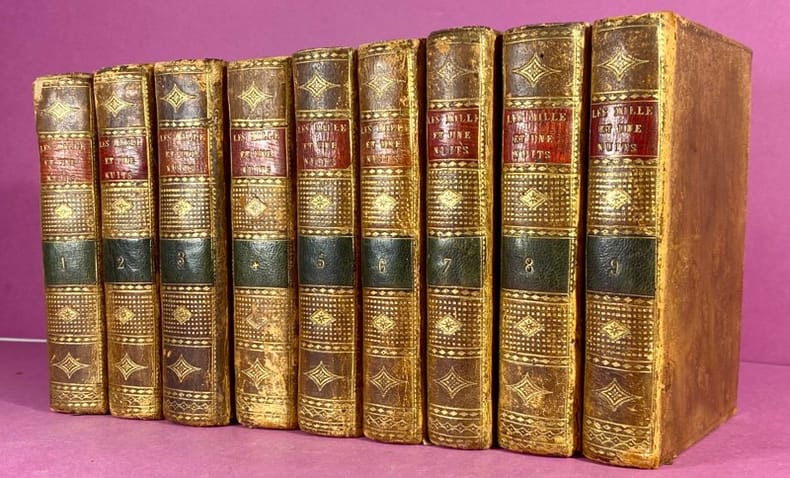
180618911806 Couverture rigide A Paris, Chez le Normant, Imprimeur Libraire, 1806. 9 volumes in-16 (14 x 9 cm), reliure pleine basane racinée de l'époque, dos lisse orné de motifs dorés, pièce de titre en maroquin rouge, pièce de tomaison en maroquin vert, roulette dorée sur les coupes, quelques coiffes supérieures arasées, coins émoussés, petit manque de cuir au tome 1, charnières frottées, charnières du tome 7 légèrement fendillées, quelques épidermures. Tome 1 : xxxij, 479 pages, petit manque au coin supérieur de 3 feuillets (sans atteinte au texte) ; tome 2 : vj, 516 pages, manque au coin inférieur de la page 43 (sans atteinte au texte) ; tome 3 : faux-titre, titre, 548 pages ; tome 4 : vi, 520 pages ; tome 5 : vj 466 (2) pages ; tome 6 : faux-titre, titre, 432 (2) pages ; tome 7 : faux-titre, titre, 397 (3) pages, marques brunes sur les premiers feuillets, déchirure à la page 67 ; tome 8 : xlvj, 460 pages ; tome 9 : faux-titre, titre, 447 (1) pages. Concernant l'ensemble des volumes : intérieur légèrement jauni, quelques rousseurs et marques marginales. Si Antoine Galland fut le premier à révéler les Mille et Une Nuits à l’Europe en 1704, sa traduction était avant tout littéraire : il adaptait les contes au goût de la cour de Versailles, en gommant les passages trop crus ou les répétitions poétiques pour en faire un objet de divertissement galant. Jean-Jacques Caussin de Perceval, professeur de langue arabe au Collège de France, intervient un siècle plus tard avec une ambition différente. Il ne se contente pas de rééditer Galland ; il complète la série. À l'époque, on savait que la version de Galland était incomplète par rapport aux manuscrits originaux. Caussin de Perceval a donc puisé dans les manuscrits de la Bibliothèque impériale pour traduire des contes inédits et donner à l'oeuvre une envergure nouvelle, plus fidèle à la structure foisonnante du recueil oriental. Edition originale de la traduction revue par Caussin de Perceval. "Edition la meilleure et la plus complète", Brunet (2, 361). Bon exemplaire, en assez bon état, dans une reliure typique 1er empire.
16115Paris, Gaultier-Laguionie, 1838. In-8, 58-[3] pp. 1 pl., bradel de toile brune à motifs végétaux noirs, titre et auteur dorés au dos (rousseurs, insolation).
1686PHO-1691Amsterdam et Paris, Daniel Horthemels, 1686. In-12 relié en plein veau d'époque, dos à nerfs, pièce de titre, 3 ff. avec déchirures marginales sans perte, 12 ff., 432 pp., 4 ff., illustré d'un titre frontispice, du portrait de Chardin, de 3 vignettes de chapitres, d'une carte dépl. du Pont-Euxin, et de 15 pll. (dont 13 dépl.). Les plans suivants sont incomplets (Téflis, Festin de Téflis, Kachan, Caravansérail de Kachan, Kom), trace d'adhésif sur une planche, mors fendu, épidermures, coiffe de tête arasée, cachet.
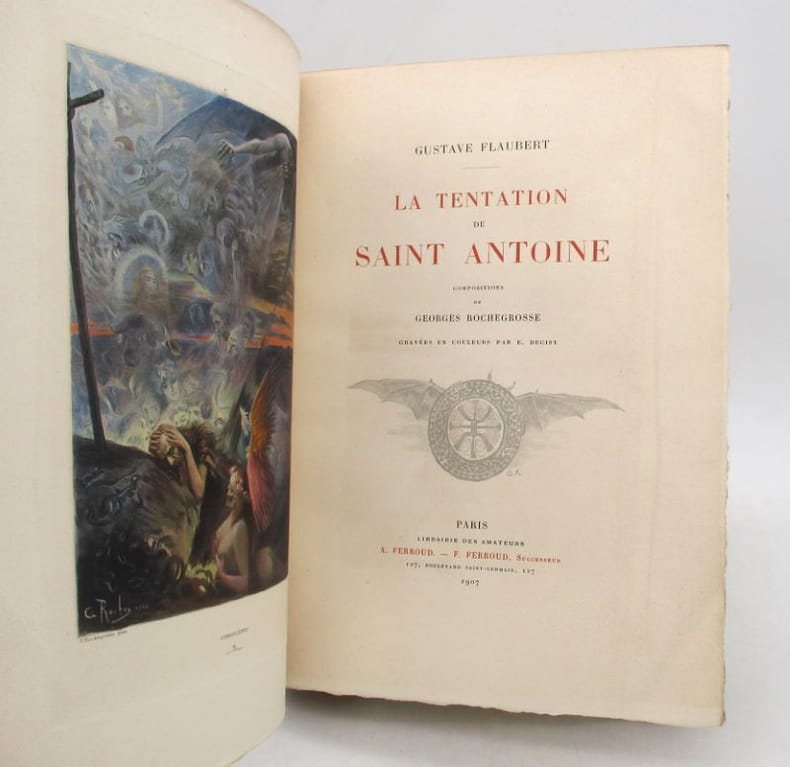
22574Paris, A. Ferroud - F. Ferroud, 1907. In-4, 213 pp., broché, couverture originale illustrée, chemise et étui cartonnés (étui un peu défraîchi, pâle décharge au faux-titre et au feuillet en regard).
20210Paris, L. Carteret, 1925. In-4, 228 pp., en feuilles, couverture originale illustrée, chemise et étui cartonnés de l'éditeur (étui déraîchi, petites taches à la chemise).
Very Good English Original autograph letter signed by Vladimir Fedorovich Minorsky, sent to Turkish professor and historian Osman Turan, (1914-1978), was born in year when World War I started. He had some bad conditions in his childhood. Being in Ankara in years when DTCF established was a great chance for him. He was trained by Fuat Köprülü. His studies in the first period were about pre-Islamic Turkish history. But his studies after he became associate-professor were about Seljukians. There isn't a better studying in this field yet than his studies. (Source: Osman Turan's Life (1914/17 - 1978) and Historiography, Tufantoz). Letter has 12 lines in front, and 4 lines on verso, in English completely. It has a plan of a library, probably in the UK which shows Trinity and Sydney Colleges, etc. Letter says: "Dear Dr. Turan, Very good. We shall be waiting for your on Friday. If you are not engaged come andd have lunch with us at 12.45. If you cannot come at 2.30 and I shall show you the Library. Looking forward to meeting you. Yours sinccerely, V. Minorsky'. "When you come to No 9 push the door in front of you...". Repaired margins. Minorsky was a Russian Orientalist best known for his contributions to the study of Persian and Kurdish history, geography, literature, and culture. Minorsky was born in Korcheva, in the Konakovsky District of the Russian oblast of Tver, northwest of Moscow on the upper Volga River, a town now submerged beneath the Ivankovo Reservoir. There he was a gold medallist of the Fourth Grammar School. In 1896 he entered Moscow University to study law, graduating in 1900, then entered the Lazarev Institute of Oriental Languages where he spent 3 years preparing for a diplomatic career. He made his first trip to Iran in 1902, where he collected material on the Ahl-e Haqq. In 1903 he entered the Russian Ministry of Foreign Affairs, serving 1904-1908 in Persia (now Iran), first in the Tabriz Consulate-General and then the Tehran Legation, and 1908-1912 in Saint Petersburg and Tashkent. In 1911, jointly the Four-Power (British, Russian, Turkish, and Persian) Commission, he carried out a mission in North-Western Persia to delimit the Turko-Persian border, and also published a monograph on the Ahl-i ?aqq religion for which he was awarded the Gold Medal of the Ethnography Section of the Imperial Society of Natural Sciences in Moscow. One of the most important Kurdish manuscripts he obtained during this period was The Forqan ol-Akhbar, by Hajj Nematollah, which he later wrote about in "Etudes sur les Ahl-I Haqq, I.", Revue de L'Histoire des Religions, tome XCVII, No. 1, Janvier 1928, pp. 90-105. His surveys in Iran also provided invaluable material for his 1915 work, Materialï dlya izucheniya vostoka (Materials for the Study of the East), published by the Imperial Russian Ministry of Foreign Affairs, St. Petersburg. From 1915-17 he served as Chargé d'affaires in the Russian Legation at Tehran. As the Bolshevik Revolution of 1917 made problematic his return to Russia, in 1919 he moved to Paris where he worked at the Russian Embassy. There his expertise in Middle Eastern and Caucasian affairs was useful during the Versaille and Trianon peace settlements. In 1923 he began to lecture on Persian literature at the École nationale des langues orientales vivantes, where he subsequently taught Turkish and Islamic history. In 1930 he was named Oriental Secretary to the 1931 International Exhibition of Persian Art at Burlington House, London, and in 1932 was made a lecturer in Persian at London's School of Oriental Studies. In 1933 he became Reader in Persian Literature and History, University of London; Professor of Persian in 1937; and in 1944 retired. During World War II, SOAS had evacuated to Christ's College, University of Cambridge, and there the Minorskys retired apart from a year (1948-49) at Fuad University, Cairo. In 1934 Minorsky was one of the distinguished participants in the Ferdowsi Millenary Celebration in Tehran. Minorsky received n
16244Paris, L. Carteret, 1927. In-8, 101 pp., couverture originale illustrée (rousseurs à la couverture).
189845602Imprimerie Centrale Moussa Roditi Couverture souple Le Caire 1898
Very Good English Modern full dark red leather bound with traditional embossing. Roy. 8vo. (23 x 16 cm). In German. [viii], 351 p. First German Edition. This copy from Zeki Velidi Togan's library. Ármin Vámbéry, also known as Arminius Vámbéry was a Hungarian Turkolog and traveller. Vámbéry was especially attracted by the literature and culture of the Ottoman Empire including Turkey. After spending about a year in Constantinople, he published a German-Turkish dictionary in 1858. Later, he also published various other linguistic works. He also learned some twenty other Turkish languages and dialects. Returning to Budapest in 1861, he received a stipend of a thousand florins from the academy, and in the autumn of the same year, disguised as a Sunni dervish, and under the name of Reshit Efendi, he set out from Constantinople. His route lay from Trebizond on the Black Sea to Tehran in Persia, where he joined a band of pilgrims returning from Mecca, spending several months with them traveling across Central Iran (Tabriz, Zanjan, and Kazvin). He then went to Shiraz, through Ispahan, and in June, 1863, he reached Khiva (Central Asia). Throughout this time, he succeeded in maintaining his disguise as "Reshit Efendi," so that upon his arrival at Khiva he managed to keep up appearances during interviews with the local khan. Together with his band of travelers, he then crossed Bokhara and arrived at Samarkand. Initially, he aroused the suspicions of the local ruler, who kept him in an audience for a full half-hour. Vámbéry managed to maintain his pretences, and left the audience laden with gifts. Upon leaving Samarkand, Vámbéry began making his way back to Constantinople, traveling by way of Herat. There he took leave of the band of dervishes and joined a caravan to Tehran, and from there, via Trebizond and Erzurum, to Constantinople, arriving there in March 1864. This was the first successful journey of its kind undertaken by a European; and since it was necessary to avoid suspicion, Vámbéry could not take even fragmentary notes, except by stealth. After a long and perilous journey he arrived back at Pest in May 1864. He went to London to arrange the English language publication of his book about the travels. "Travels in Central Asia" and its Hungarian counterpart "Közép-ázsiai utazás" were published in 1865. Thanks to his travels Vámbéry became an internationally renowned writer and celebrity. He became acquainted with members of British social elite. The Ambassador of Austria in London gave him a letter of recommendation to the Emperor, who received him in an audience and rewarded Vámbéry's international success by granting him professorship in the Royal University of Pest.
1960ZendAvesta-JamesDar-1Avant-propos de E. BENVENISTE. Professeur au collège de France. Annales du Musée Guimet Tomes XXI, XXII et XXIV 3 volumes. Volume. I :500 pages, 6 planches hors texte. Volume. II : XXXVI-747 pages. Volume. III : CVIII-262 pages. ÉPUISÉ. Année de parution : 1960 Reliure : in-8° relié Pages : 1773. Table des matières 1. La liturgie (Yasna et Vispe red) 2. La loi (Vendidad) L'e pope e (Yashts) Le livre de prière (Khorda Avesta) 3. Origines de la littérature et de la religion Zoroastriennes. Appendice à la traduction de l'Avesta (Fragments des nasks perdus et index).
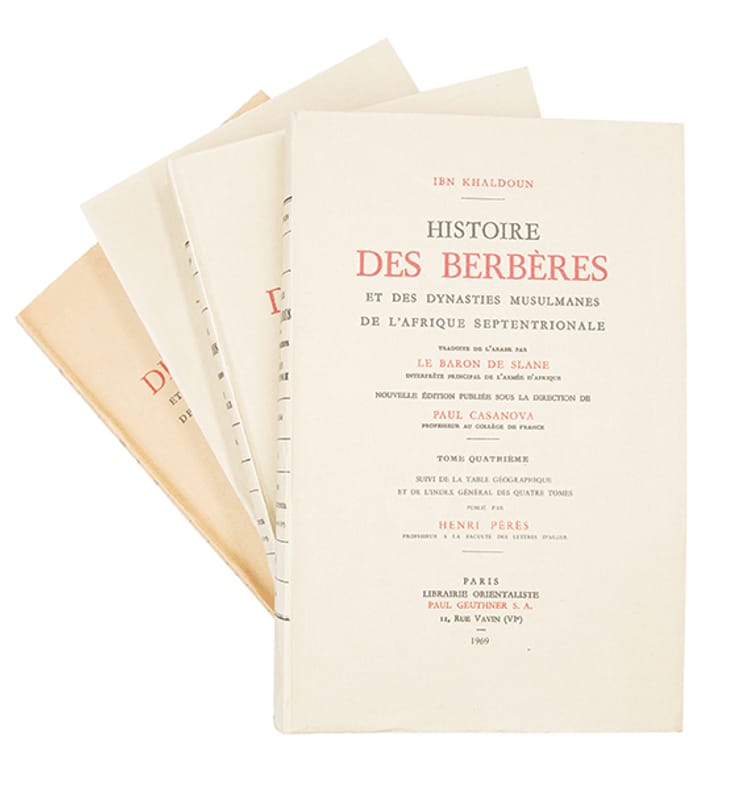
389744 volumes grand in-8 (252 x 163 mm), brochés, couvertures imprimées de l'éditeur. Paris, Librairie Orientale Paul Geuthner, 1968-1969.
16139Grande et belle aquarelle orientaliste, 49 x 32 cm. Restauration à prévoir (déchirures et défauts divers).
52346Paris Editions d'Art H. Piazza (sans date, vers 1960) 0 in 8 (23,5x18,5) 1 volume reliure à la bradel plein velin ivoire mosaïqué, dos lisse, plats ornés d'un décor d'encadrement mosaïqué bleu et rouge, tranches dorées, couverture illustrée conservée, 137 pages, texte encadré d'une guirlande polychrome, étui bordé. Avec 12 illustrations hors-texte en couleurs enluminées par Vincent Louis Noguères. Vincent Louis Noguères, 1898-1989. Frantz Toussaint, 1879-1955, écrivain orientaliste. Tirage à 1500 exemplaires numérotés, celui-ci un des 1350 exemplaires numérotés sur vélin de rives. Superbe exemplaire, reliure parfaite ( Photographies sur demande / We can send pictures of this book on simple request )
173290202Halle, Druckerei d. Waisenhauses, 1741, Frankfurt/Leipzig, Samuel Godofred Zimmermann, 1732. [I. Michaelis:] 4 Bll., 176 S. Mit gestoch. Titelvign. HPgt. d. Zt. mit hs. Rückentitel. - Erste Ausgabe. - [II. Georgi:]: 3 Bll., 360 S., 8 Bll. (Indices).
27952Paris Editions Pierre Lafitte 1938 in 4 (23x19) 1 volume reliure plein cuir vert maroquiné de l'éditeur, dos à 3 nerfs soulignés de filets or et argent, plats ornés d'un décor géométrique à froid encadré de losanges croisés or et argent, tête dorée, couverture illustrée conservée, frontispice, 268 pages [3], avec des illustrations hors-texte en couleurs d'Auguste Leroux coloriées au patron par Daniel Jacomet et Duval-Beaufumé. Bandeaux et culs-de-lampe décoratifs de Sylvain Sauvage, gravés sur bois par Gilbert Poilliot. Tirage limité à 2575 exemplaires numérotés, celui-ci un des 25 exemplaires de tête numérotés sur Japon, avec deux états des illustrations hors-texte, dont un état en noir. Rare sur ce papier. Très bel exemplaire ( Photographies sur demande / We can send pictures of this book on simple request )
27950Paris Editions Pierre Lafitte 1938 in 4 (23x19) 1 volume reliure plein cuir vert maroquiné de l'éditeur, dos à 3 nerfs soulignés de filets or et argent, plats ornés d'un décor géométrique à froid encadré de losanges croisés or et argent, tête dorée, couverture illustrée conservée, frontispice, 312 pages [2], avec des illustrations hors-texte en couleurs de Mariette Lydis coloriées au patron par Daniel Jacomet et Duval-Beaufumé. Bandeaux et culs-de-lampe décoratifs de Sylvain Sauvage, gravés sur bois par Gilbert Poilliot. Tirage limité à 2575 exemplaires numérotés, celui-ci un des 25 exemplaires de tête numérotés sur Japon, avec deux états des illustrations hors-texte, dont un état en noir. Rare sur ce papier. Mariette Lydis, 1890-1970. Très bel exemplaire ( Photographies sur demande / We can send pictures of this book on simple request )
27953Paris Editions Pierre Lafitte 1939 in 4 (23x19) 1 volume reliure plein cuir vert maroquiné de l'éditeur, dos à 3 nerfs soulignés de filets or et argent, plats ornés d'un décor géométrique à froid encadré de losanges croisés or et argent, tête dorée, couverture illustrée conservée, frontispice, 331 pages [2], avec des illustrations hors-texte en couleurs de Sylvain Sauvage coloriées au patron par Daniel Jacomet et Duval-Beaufumé. Bandeaux et culs-de-lampe décoratifs de Sylvain Sauvage, gravés sur bois par Gilbert Poilliot. Tirage limité à 2575 exemplaires numérotés, celui-ci un des 25 exemplaires de tête numérotés sur Japon, avec deux états des illustrations hors-texte, dont un état en noir. Rare sur ce papier. Très bel exemplaire ( Photographies sur demande / We can send pictures of this book on simple request )
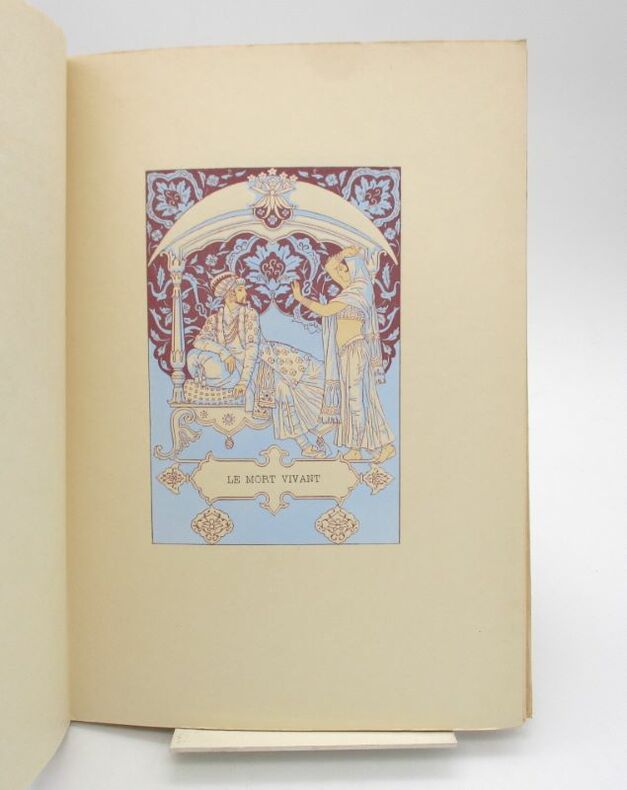
1914107571914 Paris, L'Edition d'Art Piazza, 1914; in - 4°, demi - maroquin orange à coins, dos à nerfs, titre doré doré, date dorée en pied, tête dorée, couverture illustrée conservée; 116pp. Couverture beige illustrée en couleurs et or, chaque page de texte est encadrée d'un ornement oriental tiré en jaune. Illustré de 10 planches hors texte en couleurs, chacune protégée d'une serpente imprimée.
175364436CBLondon, printed by A. Wilde, for S. and E. Ballard, J. Brotherton, W. Meadows, T. Cox, R. Ware, J. Clarke, S. Birt, D. Browne, T. Astley, J. Shuckburgh, J. Hodges, E. Wicksteed, J. Oswald, J. Comyns, C. Bathurst, R. Baldwin, A. Strahan, and A. Wilde, Klein-8°. 17 x 10,5 cm. xxvi (ii), (2) viii, (10) 312 Seiten. [12] Blatt, 276 Seiten. [12] Blatt, 287 Seiten. [11] Blatt, 288 Seiten. [11] Blatt, 276 Seiten. [11] Blatt, 264 Seiten. [7] Blatt, 248 Seiten. [9] Blatt, 280 Seiten. Ganzlederbände der Zeit mit goldgeprägter Rückennummerierung und Fileten. [2 Warenabbildungen]
187712403Barraud 1877 in-8, plein chagrin rouge, dos à nerfs orné de fleurons & filets, filets d’encadrement des plats, fleurons d’angle, tête dorée, couv. cons., IX- 182 pp. 8 planches hors texte et 140 gravures dans le texte. Ex dono manus. au titre. Bon exemplaire.
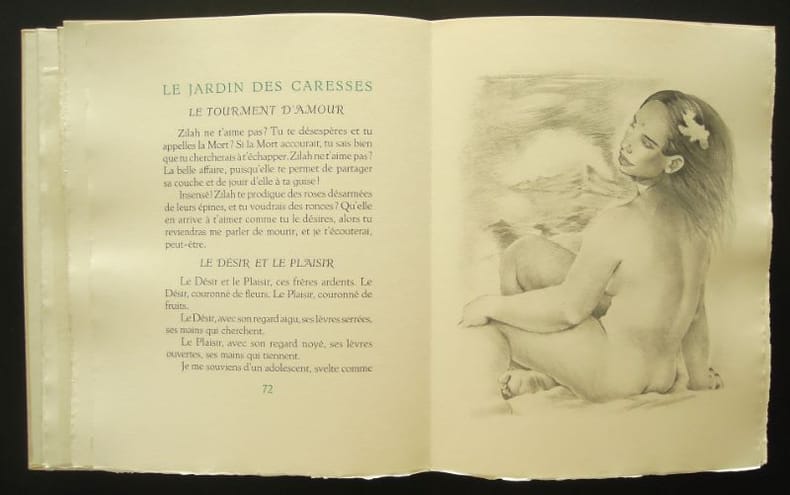
19543591954 Paris, Editions Germaine Raoult, 1954 (achevé d'imprimer au 15 mai 1954), 1 vol. (34,4 x 26,5 x 4,8 cm) de 149 pages suivies de 5 f. de table et d'achevé d'imprimer, en feuilles sous chemise souple et sous étui. Ouvrage en feuilles, illustré en noir et blanc. Impression en lithographie sur Velin de Rives : 18 lithographies sous serpente (17 pleine-page in-texte et un frontispice). Édition limitée à 350 exemplaires, ici le n° 140. Franz Toussaint (1879-1955) : auteur orientaliste français, également scénariste et traducteur de l'arabe, sanskrit, persan, chinois et japonais. Mariette Lydis (1887-1970) : peintre, graveuse, illustratrice autrichienne ; s'installe en France (1927) puis en Argentine (1940).