ÉMILE VERHAEREN.Livre Rare Book
1 479 résultats
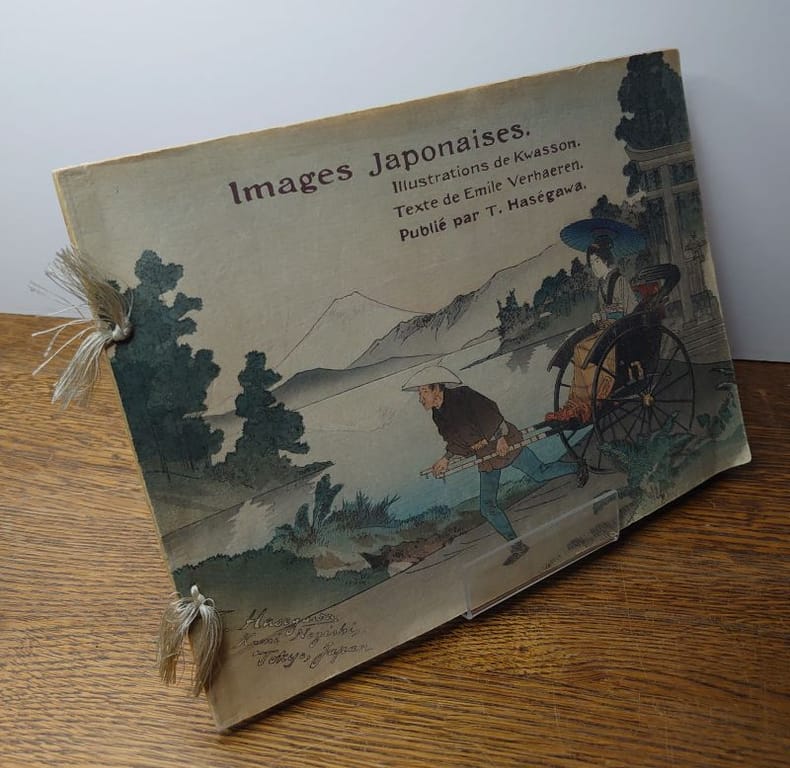
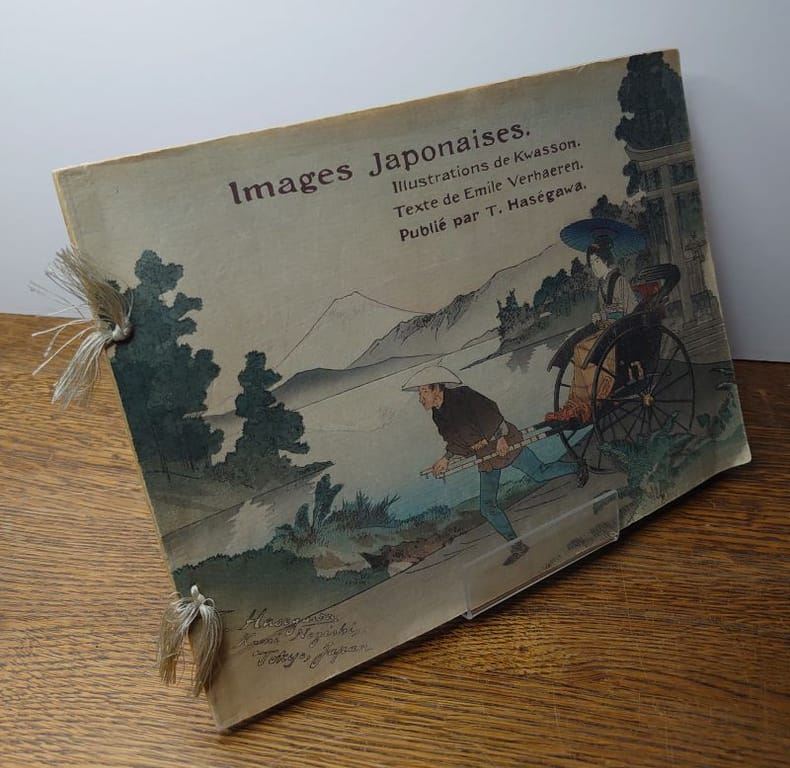
8186Tokyo, Japan, T[akejiro] Haségawa. [l'éditeur Hasegawa a déménagé à l'adresse de Tokyo indiquée sur la couverture (Kami Negishi) vers 1911. Cette impression date donc d'après 1911 (même si le colophon japonais indique la date de 1896 et l'ancienne adresse de Tokyo, 10 Hiyoshicho). Hasegawa a probablement réutilisé les blocs de bois du colophon pour faire des économies.]. Réf : Frédéric A. Sharf, Takejiro Hasegawa Meiji Japan's Preeminent Publisher of Wood-block-illustrated Crepe-paper Books, 1974, voir page 77. 27,5 x 20,5 cm. In-8° oblong. Broché, couture japonaise. Réédition de 6 poèmes de Verhaeren (l'originale est de 1896). Bel ouvrage japonisant dont les poèmes sont imprimés sur fond d'estampes dues à Kwasson, pseudonyme de Munetaro [ou Sôtaro] Suzuki. Au nombre de 14, elles couvrent chacune 2 ff. pliés à la japonaise doublés d'un f. de papier vergé, en plus des deux estampes illustrant les plats de couverture. Les exemplaires présentent de légères variantes de couleurs ou technique (quelques-uns sont parfois partiellement gaufrés comme le notre), résultat du procédé artisanal employé. Petites déchirures à la pliure du premier et dernier feuillet.
8186Tokyo, Japan, T[akejiro] Haségawa. [l'éditeur Hasegawa a déménagé à l'adresse de Tokyo indiquée sur la couverture (Kami Negishi) vers 1911. Cette impression date donc d'après 1911 (même si le colophon japonais indique la date de 1896 et l'ancienne adresse de Tokyo, 10 Hiyoshicho). Hasegawa a probablement réutilisé les blocs de bois du colophon pour faire des économies.]. Réf : Frédéric A. Sharf, Takejiro Hasegawa Meiji Japan's Preeminent Publisher of Wood-block-illustrated Crepe-paper Books, 1974, voir page 77. 27,5 x 20,5 cm. In-8° oblong. Broché, couture japonaise. Réédition de 6 poèmes de Verhaeren (l'originale est de 1896). Bel ouvrage japonisant dont les poèmes sont imprimés sur fond d'estampes dues à Kwasson, pseudonyme de Munetaro [ou Sôtaro] Suzuki. Au nombre de 14, elles couvrent chacune 2 ff. pliés à la japonaise doublés d'un f. de papier vergé, en plus des deux estampes illustrant les plats de couverture. Les exemplaires présentent de légères variantes de couleurs ou technique (quelques-uns sont parfois partiellement gaufrés comme le notre), résultat du procédé artisanal employé. Petites déchirures à la pliure du premier et dernier feuillet.
8590Tokyo, Japan, T[akejiro] Haségawa. [l'éditeur Hasegawa a déménagé à l'adresse de Tokyo indiquée sur la couverture (Kami Negishi) vers 1911. Cette impression date donc d'après 1911 (même si le colophon japonais indique la date de 1896 et l'ancienne adresse de Tokyo, 10 Hiyoshicho). Hasegawa a probablement réutilisé les blocs de bois du colophon pour faire des économies.]. Réf : Frédéric A. Sharf, Takejiro Hasegawa Meiji Japan's Preeminent Publisher of Wood-block-illustrated Crepe-paper Books, 1974, voir page 77. 27,5 x 20,5 cm. In-8° oblong. Broché, couture japonaise. Réédition de 6 poèmes de Verhaeren (l'originale est de 1896). Bel ouvrage japonisant dont les poèmes sont imprimés sur fond d'estampes dues à Kwasson, pseudonyme de Munetaro [ou Sôtaro] Suzuki. Au nombre de 14, elles couvrent chacune 2 ff. pliés à la japonaise doublés d'un f. de papier vergé, en plus des deux estampes illustrant les plats de couverture. Les exemplaires présentent de légères variantes de couleurs ou technique (quelques-uns sont parfois partiellement gaufrés comme le notre), résultat du procédé artisanal employé. Petites déchirures à la pliure du premier et dernier feuillet.
8590Tokyo, Japan, T[akejiro] Haségawa. [l'éditeur Hasegawa a déménagé à l'adresse de Tokyo indiquée sur la couverture (Kami Negishi) vers 1911. Cette impression date donc d'après 1911 (même si le colophon japonais indique la date de 1896 et l'ancienne adresse de Tokyo, 10 Hiyoshicho). Hasegawa a probablement réutilisé les blocs de bois du colophon pour faire des économies.]. Réf : Frédéric A. Sharf, Takejiro Hasegawa Meiji Japan's Preeminent Publisher of Wood-block-illustrated Crepe-paper Books, 1974, voir page 77. 27,5 x 20,5 cm. In-8° oblong. Broché, couture japonaise. Réédition de 6 poèmes de Verhaeren (l'originale est de 1896). Bel ouvrage japonisant dont les poèmes sont imprimés sur fond d'estampes dues à Kwasson, pseudonyme de Munetaro [ou Sôtaro] Suzuki. Au nombre de 14, elles couvrent chacune 2 ff. pliés à la japonaise doublés d'un f. de papier vergé, en plus des deux estampes illustrant les plats de couverture. Les exemplaires présentent de légères variantes de couleurs ou technique (quelques-uns sont parfois partiellement gaufrés comme le notre), résultat du procédé artisanal employé. Petites déchirures à la pliure du premier et dernier feuillet.
ORD-3593Ouvrage orné de 140 gravures. Paris. Garnier. 1928. In-8 (119 x 186mm) broché, couverture illustrée sur le 1°plat d'un grand masque imprimé en rouge, d'un coq sur le 2°, 219 pages, illustrations en noir dans le texte. Dos lgt abîmé sinon bon exemplaire, non coupé, non rogné.
New Turkish Paperback. Large 8vo. (21 x 21 cm). In Turkish. 24 p., b/w and color ills. Macaristan'dan olgular Dogu kâsifi Macarlar.
138160aafFribourg Academic Press / Göttingen, Vandenhoeck & Ruprecht., 2001, gr. in-8vo, XX + 592 p., hellblauer Original-Pappband, / orig. hardcover.
138245aafFribourg : Acad. Press / Göttingen : Vandenhoeck & Ruprecht, 1990, gr. in-8vo, 353 S.illustriert , Original-Leinen + OU / orig. clothbound, jacket (hardcover). Neuwertig.
173290202Halle, Druckerei d. Waisenhauses, 1741, Frankfurt/Leipzig, Samuel Godofred Zimmermann, 1732. [I. Michaelis:] 4 Bll., 176 S. Mit gestoch. Titelvign. HPgt. d. Zt. mit hs. Rückentitel. - Erste Ausgabe. - [II. Georgi:]: 3 Bll., 360 S., 8 Bll. (Indices).
1908104049Paris, Piazza 1908 In-8, maroquin vert ép., dos à nerfs orné de caissons, encadrement de filets sur les plats et en contreplats, tranches dorées sur témoins, couvertures et dos conservés rel. signée Wendling, 217 pp. 50 compositions en couleurs dont 26 à pleine page, 8 planches rehaussées à l’encre dorée, dont la couverture. Texte dans un encadrement ornemental. Dos passé, infimes frottements.
In 8°, brossura con sovraccoperta editoriale, pp. X, 324, (2), con tavole illustrate n.t. b/n; lieve difetto alla testa del dorso per il resto buon esemplare. (ZD5/A) (ZD5/A)
In 8°, brossura editoriale illustrata con alette, pp. 33, (2); ottimo esemplare. (ZD5/A) 2213018952 (ZD5/A)
New English Paperback. Oblong 12mo. (11 x 12 cm). In English. 61 p., color and b/w ills. Pera Museum presents a selection from the Suna and Inan Kirac Foundation Kütahya Tiles and Ceramics Collection focusing on coffee, which was at the center of drinking culture during Ottoman era and continued to be so through the Republic of Turkey. One of the three big collections of Suna and Inan Foundation, Kütahya tiles and ceramics have been an important branch of Ottoman arts and crafts from the 18th to the 20th century. Preserving its cultural importance since its first discovery, coffee pursued its adventure in our daily lives with contribution of ceramics masters from Kütahya. Coffee cups, jugs, ewers and water pipes have become essential companions of both coffee and its rituals.
Very Good English Paperback. 4to. (28 x 20 cm). In English, French, and Turkish. [6], 530, [2] p., color and b/w plates, 1 folded map. Studies on pre-Islamic Turkish art.= Islamiyetten önceki Türk sanati hakkinda arastirmalar. Türk kültürü el kitabi. Vol. II, Ch. I a. Edited by Emel Esin, Halil Inalcik, Oktay Aslanapa. First and Only Edition.
138150aafFribourg Academic Press / Göttingen, Vandenhoeck & Ruprecht., 2013, gr. in-8vo, XIV + 743 S., illustr. on plates, hellblauer Original-Pappband, / orig. hardcover.
138147aafFribourg Academic Press / Göttingen, Vandenhoeck & Ruprecht., 2006, gr. in-8vo, XXI + 254 S., illustr. hellblauer Original-Pappband, / orig. hardcover.
13968962Zeitoun: Zaki, s. d. in-4, portefeuille à rabats comprenant 20 planches en couleurs contrecollées sur papier fort, tache sur le premier plat de la couverture et dos avec manque. Vues d'Egypte aux couleurs impressionnistes.
1983863121983 Paris, Le Courrier du Livre, 1983, grand in 8° broché, 222 pages ; nombreuses illustrations ; couverture illustrée.
Very Good Turkish Original silver gelatin photographic print mounted on cardboard. 53x42 cm (Photo size: 38x30 cm). Signed by Yildiz Moran. Yildiz (Vahid) Moran Arun was born on 24 July 1932, in Istanbul. She is the youngest of three children born to Nemide Moran and Ahmet Vahid Moran. Her father, Ahmet Vahid Moran, was a military officer who served in important positions both at home and abroad. He was the writer of Turkey's very first English-Turkish dictionary printed in Latin script in 1924. In 1950, Yildiz Moran quit her high school education during her final year at Robert College and, following the guidance of her uncle, the art historian Mazhar Sevket Ipsiroglu, went to Great Britain to study photography. After completing her education at Bloomsbury Technical College (1950-52) and Ealing Broadway Technical College, she began to work for John Vickers, the acclaimed photographer of The Old Vic. Moran combined her technical and theoretical knowledge with the practical experience she gained at the studio and stage shoots. She had the opportunity to meet famous artists of the time. The exhibitions and works she saw during her time in Great Britain helped her develop her photographic vision. Following her internship period, she began to make a living taking portrait and lobby photographs. She opened her first exhibition in 1953 in Cambridge. In 1954, she held four more exhibitions in London. All these shows attracted much attention. In her first exhibition, her entire collection was sold. She went traveling in Europe. After making a photo book on Spain and Portugal, she returned to Turkey in 1954. Between 1955 and 1962, she held five solo exhibitions. In 1963, she married Özdemir Asaf (Halit Özdemir Arun) and gave birth to three children in four years. She dedicated the rest of her life to her children. She opened her last exhibition in 1970, in Istanbul. After that, she only took part in retrospective exhibitions. She quit her professional photography career and began to work as a translator and dictionary writer. Between 1981 and 1987, she prepared the complete works of Özdemir Asaf for publication and translated some of his poetry and prose into English. In 1982, the Istanbul State Academy of Fine Arts Photography Institute awarded her with honorary membership on account of her contributions to the art of photography. Lyrically conveying a universal language through her own perspective, Moran became a school in herself with her "timeless" photographs. Turkey's first academically-trained photographer, Yildiz Moran is renowned for the new vision and aesthetic she introduced into photography and considered to be one of the best photographers of all time. Masterfully combining the tradition of the East with the aesthetic of the West, she left behind a legacy of black and white photographs beautifully composed to capture the world of light and shadow reflecting on people and lands. Considering the conditions in the world of photography in the 1950s and 1960s, it is a great achievement that she defined at the age of 20 her passion for photography as the foundation of her life, became the first academically-trained woman photographer in her country, acquired in-depth knowledge of the discipline and combined this knowledge with her talent and hard work. "The camera must be like an extension of your being so that it doesn't create an obstruction between you and your subjects. Anything that has poetry in it is the subject of photography. My only intention has always been to photograph what was universal while staying true to the concept embodied by my subject." Besides her portraits, landscapes, and abstract details, she is also known for her photographs reflecting the lives of the Anatolian people. As a woman photographer traveling in Anatolia, she accessed otherwise inaccessible environments, moments, and perspectives; and, with profound respect, she conveyed the purity of the people she met there and allowed us... (Biography: Merih Akogul).
Very Good Turkish Original silver gelatin photographic print mounted on cardboard. 53x42 cm (Photo size: 38x30 cm). Signed by Yildiz Moran. Yildiz (Vahid) Moran Arun was born on 24 July 1932, in Istanbul. She is the youngest of three children born to Nemide Moran and Ahmet Vahid Moran. Her father, Ahmet Vahid Moran, was a military officer who served in important positions both at home and abroad. He was the writer of Turkey's very first English-Turkish dictionary printed in Latin script in 1924. In 1950, Yildiz Moran quit her high school education during her final year at Robert College and, following the guidance of her uncle, the art historian Mazhar Sevket Ipsiroglu, went to Great Britain to study photography. After completing her education at Bloomsbury Technical College (1950-52) and Ealing Broadway Technical College, she began to work for John Vickers, the acclaimed photographer of The Old Vic. Moran combined her technical and theoretical knowledge with the practical experience she gained at the studio and stage shoots. She had the opportunity to meet famous artists of the time. The exhibitions and works she saw during her time in Great Britain helped her develop her photographic vision. Following her internship period, she began to make a living taking portrait and lobby photographs. She opened her first exhibition in 1953 in Cambridge. In 1954, she held four more exhibitions in London. All these shows attracted much attention. In her first exhibition, her entire collection was sold. She went traveling in Europe. After making a photo book on Spain and Portugal, she returned to Turkey in 1954. Between 1955 and 1962, she held five solo exhibitions. In 1963, she married Özdemir Asaf (Halit Özdemir Arun) and gave birth to three children in four years. She dedicated the rest of her life to her children. She opened her last exhibition in 1970, in Istanbul. After that, she only took part in retrospective exhibitions. She quit her professional photography career and began to work as a translator and dictionary writer. Between 1981 and 1987, she prepared the complete works of Özdemir Asaf for publication and translated some of his poetry and prose into English. In 1982, the Istanbul State Academy of Fine Arts Photography Institute awarded her honorary membership on account of her contributions to the art of photography. Lyrically conveying a universal language through her own perspective, Moran became a school in herself with her "timeless" photographs. Turkey's first academically-trained photographer, Yildiz Moran is renowned for the new vision and aesthetic she introduced into photography and is considered to be one of the best photographers of all time. Masterfully combining the tradition of the East with the aesthetic of the West, she left behind a legacy of black and white photographs beautifully composed to capture the world of light and shadow reflecting on people and lands. Considering the conditions in the world of photography in the 1950s and 1960s, it is a great achievement that she defined the age of 20 her passion for photography as the foundation of her life, became the first academically-trained woman photographer in her country, acquired in-depth knowledge of the discipline and combined this knowledge with her talent and hard work. "The camera must be like an extension of your being so that it doesn't create an obstruction between you and your subjects. Anything that has poetry in it is the subject of photography. My only intention has always been to photograph what was universal while staying true to the concept embodied by my subject." Besides her portraits, landscapes, and abstract details, she is also known for her photographs reflecting the lives of the Anatolian people. As a woman photographer traveling in Anatolia, she accessed otherwise inaccessible environments, moments, and perspectives; and, with profound respect, she conveyed the purity of the people she met there and allowed us... (Biography: Merih Akogul).
Very Good Turkish Original silver gelatin photographic print mounted on cardboard. 53x42 cm (Photo size: 38x30 cm). Signed by Yildiz Moran. Yildiz (Vahid) Moran Arun was born on 24 July 1932, in Istanbul. She is the youngest of three children born to Nemide Moran and Ahmet Vahid Moran. Her father, Ahmet Vahid Moran, was a military officer who served in important positions both at home and abroad. He was the writer of Turkey's very first English-Turkish dictionary printed in Latin script in 1924. In 1950, Yildiz Moran quit her high school education during her final year at Robert College and, following the guidance of her uncle, the art historian Mazhar Sevket Ipsiroglu, went to Great Britain to study photography. After completing her education at Bloomsbury Technical College (1950-52) and Ealing Broadway Technical College, she began to work for John Vickers, the acclaimed photographer of The Old Vic. Moran combined her technical and theoretical knowledge with the practical experience she gained at the studio and stage shoots. She had the opportunity to meet famous artists of the time. The exhibitions and works she saw during her time in Great Britain helped her develop her photographic vision. Following her internship period, she began to make a living taking portrait and lobby photographs. She opened her first exhibition in 1953 in Cambridge. In 1954, she held four more exhibitions in London. All these shows attracted much attention. In her first exhibition, her entire collection was sold. She went traveling in Europe. After making a photo book on Spain and Portugal, she returned to Turkey in 1954. Between 1955 and 1962, she held five solo exhibitions. In 1963, she married Özdemir Asaf (Halit Özdemir Arun) and gave birth to three children in four years. She dedicated the rest of her life to her children. She opened her last exhibition in 1970, in Istanbul. After that, she only took part in retrospective exhibitions. She quit her professional photography career and began to work as a translator and dictionary writer. Between 1981 and 1987, she prepared the complete works of Özdemir Asaf for publication and translated some of his poetry and prose into English. In 1982, the Istanbul State Academy of Fine Arts Photography Institute awarded her honorary membership on account of her contributions to the art of photography. Lyrically conveying a universal language through her own perspective, Moran became a school in herself with her "timeless" photographs. Turkey's first academically-trained photographer, Yildiz Moran is renowned for the new vision and aesthetic she introduced into photography and is considered to be one of the best photographers of all time. Masterfully combining the tradition of the East with the aesthetic of the West, she left behind a legacy of black and white photographs beautifully composed to capture the world of light and shadow reflecting on people and lands. Considering the conditions in the world of photography in the 1950s and 1960s, it is a great achievement that she defined the age of 20 her passion for photography as the foundation of her life, became the first academically-trained woman photographer in her country, acquired in-depth knowledge of the discipline and combined this knowledge with her talent and hard work. "The camera must be like an extension of your being so that it doesn't create an obstruction between you and your subjects. Anything that has poetry in it is the subject of photography. My only intention has always been to photograph what was universal while staying true to the concept embodied by my subject." Besides her portraits, landscapes, and abstract details, she is also known for her photographs reflecting the lives of the Anatolian people. As a woman photographer traveling in Anatolia, she accessed otherwise inaccessible environments, moments, and perspectives; and, with profound respect, she conveyed the purity of the people she met there and allowed us... (Biography: Merih Akogul).
New English Paperback. Pbo. 4to. (29 x 21 cm). In English, German and Turkish. 79 p. Color ills. Amadeo Preziosi, 1842-1882. For the love of Istanbul.= Aus liebe zu Istanbul.= Istanbul askina. [Exhibition catalogue]. A biographical study and selected paintings of the orientalist painter Preziosi, (1816-1882).
138028aafFribourg , University Press / Göttingen, Vandenhoeck & Ruprecht, 2001, in-4to, 304 S. + Karten in Einbandtasche, (S. 137 - 144 mit Falte / falsch gebunden) illustrated publ. binding / ill. hardcover. Copy as new.
138034aafFribourg , University Press / Göttingen, Vandenhoeck & Ruprecht, 2003, in-4to, 250 S. + 33 Tafeln + Arab Text / Pläne, illustrated publ. binding / ill. hardcover. Copy as new.
In 8°, tutta tela con sovraccoperta editoriale illustrata, pp. 285, (3); esemplare molto buono, lievi bruniture ai soli risguardi. (ZB3/A) (La spedizione standard è SEMPRE tracciata con raccomandata - piego di libri, eventuale FATTURA da richiedere all'ordine) (ZB3/A)