AELRED GRAHAM domLivre Rare Book
Masani (RP)Livre Rare Book
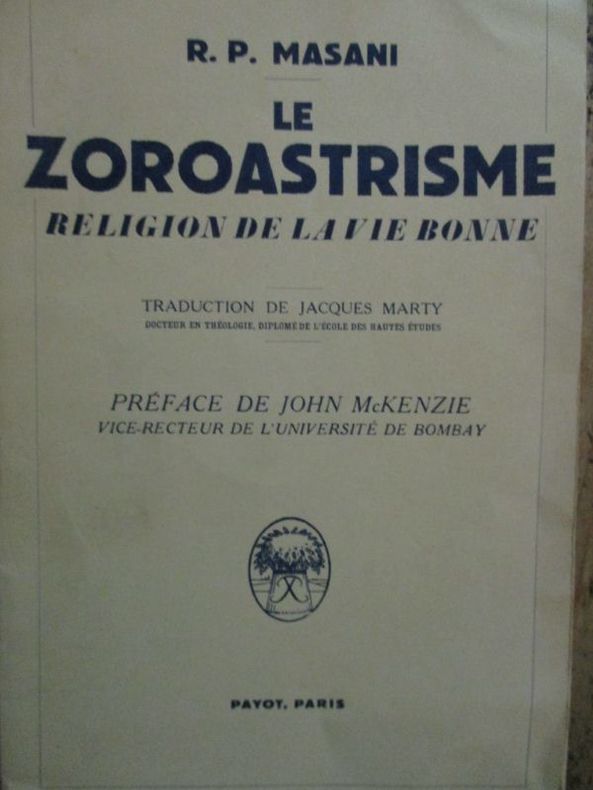
Le Zoroastrisme religion de la vie bonne
193962641939 Paris Payot 1939 In8 broché 191 pages
Le Monde à l'Envers · Montargis, France30,00 €
1 480 résultats
196514741965 broché (paperback) in-octavo carré, dos blanc (white spine) - dos et couverture imprimés (spine and cover printed), sans illustration (no illustration), 240 pages, 1965 à Paris Buchet-Chastel,
1963122301963 broché in-octavo carré (paperback in-octavo), dos et couverture crèmes imprimés très légèrement défraîchis (white spine and cover printed lightly faded) - première de couverture ornée d'une illustration en cul-de-lampe (front cover decorated with a illustration in tailpiece), tranches non rognées (edges no smooth), sans illustration (no illustration), quelques soulignages et annotations manuscrites à l'encre in fine (some underlining and handwritten annotations with ink at rear), 216 pages, 1963 à Paris Librairie Philosophique J. Vrin,
1969107321969 broché (paperback) in-octavo, dos blanc avec une illustration en couleurs se prolongeant sur le recto et le verso de la couverture (spine with a illustration in colour goes on the front and back cover), illustrations : bien documenté (well-documented), 272 pages, 1969 à Verviers Editions Gérard et Compagnie,
1960ZendAvesta-JamesDar-1Avant-propos de E. BENVENISTE. Professeur au collège de France. Annales du Musée Guimet Tomes XXI, XXII et XXIV 3 volumes. Volume. I :500 pages, 6 planches hors texte. Volume. II : XXXVI-747 pages. Volume. III : CVIII-262 pages. ÉPUISÉ. Année de parution : 1960 Reliure : in-8° relié Pages : 1773. Table des matières 1. La liturgie (Yasna et Vispe red) 2. La loi (Vendidad) L'e pope e (Yashts) Le livre de prière (Khorda Avesta) 3. Origines de la littérature et de la religion Zoroastriennes. Appendice à la traduction de l'Avesta (Fragments des nasks perdus et index).
193962641939 Paris Payot 1939 In8 broché 191 pages
New English Paperback. Demy 8vo. (22 x 14 cm). In English. [vii], [1], 107 p., b/w ills. According to the "Great Man Theory", leaders are born with a set of specific skills and traits that makes an individual destined for a leadership position. Also known as a trait perspective to leadership, it suggests that certain individuals have special innate or inborn characteristics or qualities that differentiates them from non-leaders. Specifically, these characteristics were believed to include height, weight, appearance, intelligence, disposition and others. Furthermore, charismatic and inspirational leaders instil faith in a better future for the followers in terms of their self-expression, self-evaluation, and self-consistency. The history of Ottomans is complicated and complex in terms of its emperors from the beginning to the end, in addition to severe relations with Europe and Asia. In this sense, especially the ascension period constitutes great importance; because of the fact that the six emperors of the period turned the Ottoman State into an "Empire" with their individual traits and acts. Therefore, it is worth to consider them as "great men" and evaluate them in this frame in order to construe the claim. It is expected that this book sheds light to the future researches in terms of evaluating both the emperors of Ottoman Empire and the other World emperors in terms of great man theory.
89909aafChampollion, Editions du Rocher / Jean-Paul Bertrand, 1998, gr. in-8vo, 361 p., richement illustré, cachet de l’ancien propriétaire sur p. de garde, brochure originale ill. en couleurs. / Softcover.
New English Paperback. Pbo. 4to. (29 x 21 cm). In English and Turkish. 208 p., color ills. "An Orientalist painter who lived almost half a century in Istanbul up to his death, Leonardo de Mango is described by the art commentator Thalasso as, a painter through whom the East spoke. De Mango was born on 19 February 1843, the eldest child of a large family in the town of Bisceglie near Bari in Italy, where he honed his native talent for drawing up to the age of nineteen. In 1862, under the patronage of an aristocratic family of Bari, he entered the Academy of Fine Arts of Naples and studied there for eight years under Filippo Palizzi and of Domenico Morelli. Morelli was also a painter who treated exotic orientalist themes. During this period de Mango also worked with Saverio Altamura, Bernardo Celentano, Raffaele d'Auria, Federico Maldarelli, Raffaele Postiglione and Giuseppe Mancinelli. In 1883 De Mango settled in Istanbul during the reign of Sultan Abdul Hamid II, where he is known to have set up, and taught for some time at, the oil painting department of the School of Fine Arts. Forced to leave Istanbul briefly in 1911 during the Tripolitanian War, the artist returned to the city following the Treaty of Ouchy on 15 October 1912. De Mango was among the artists who, at the initiative of Alexander Vallaury, a teacher in the architecture department of the School of Fine Arts, and Regis Delbeuf, manager of the Istanbul daily Le Stamboul, organized the first painting and sculpture exhibition at Beyoglu in 1901, dubbed the 'Pera Exhibitions in the Passage Oriental', an arcade owned by the French merchant Bourdon. With 27 works, De Mango was the most well represented artist in the exhibition, as he was again in the 1920 exhibition when he was one of 36 artists, participating with 33 of his own paintings. De Mango also had 16 paintings in the last of the Pera exhibitions, which was held in 1903. He painted in the open air and in his workshop at Beyoglu, reflecting the daily life of the different districts of Istanbul until his death in 1930.". Contents: Erol Makzume "The 75th anniversary of the death of an orientalist painter from Pera, Leonardo de Mango"; Roberta Ferrazza "Leonardo de Mango and the Italian community in Istanbul"; Bianca Consiglio "Portrait Painter Leonardo de Mango"; Piero Consiglio - Giacinto La Notte "Leonardo de Mango stages in a life divided between East and West"; Catalogue.
89512aafFribourg, Musée Bible+Orient, 2003, in-4to, 104 p., rich. illustr. avec des photogr. en couleurs, cartonnage original illustr.
2001109759Bernard Giovanangeli Editeur 2001 In-4 cartonné 27,2 cm sur 19,5. 448 pages. Le cartonnage éditeur est très légèrement passé, avec le coin inférieur du premier plat légèrement émossé, l’intérieur est très propre. Bon état d’occasion.
2677P., Attinger (Collection "Orient" n°9), 1933, 2 volumes in petit 8° broché, 277 et 308 pages.
183412572Paris The Oriental translation committee of Great Britain and Ireland 1834-1835 Un volume in-8 plein chagrin rouge, dos à nerfs, caissons décorés, titre doré, triple filet doré en encadrement sur les plats, tranches dorées, dentelle intérieure, double filet doré sur les coupes, faux-titre, titre, xi pp., 251 pp., titre, [2] ff., 96 pp., texte en hindoustani, [bl.]. Très bel exemplaire.
Very Good French In modern cloth bdg. Large roy. 8vo. (24 x 19 cm). In French. [vii], 244, [2] p. Les castes dans l'Inde. Les faits et le system. First Edition.
1890140220Paris, Société française d'imprimerie et de librairie (ancienne maison Lecène, Oudin et Cie) 1890 In-4 29,5 x 19,5 cm. Cartonnage éditeur percaline rouge signé par Paul Souze,auteur & titre argent sur le dos et le premierplat de couverture, celui-ci orné d’une plaque polychrome encadrée d'un double filet argent et d’un filet en pointillés à l’identique, tranches dorées, 318 pp., illustré de 46 planches par Gil Baer, table des matières, table des gravures. Gouttière irrégulière.
(Storia dell'India - Orientalismo - Libri illustrati dell'Ottocento sull'India) In 4°, bella legatura coeva in mezza pelle bordeaux con punte, dorso a 5 nervi con titoli e ricche impressioni in oro,, carta marmorizzata e filetti dorati ai piatti, guardie in carta marmorizzata, taglio di testa dorato, pp. (2),VII,743,(1), con 7 cromolitografie con veline fuori testo, 2 carte e 350 illustrazioni in b/n nel testo, anche a piena pagina. L'apparato iconografico è tratto da fotografie, acquerelli e documenti dell'Autore. Volume solido e ben conservato.
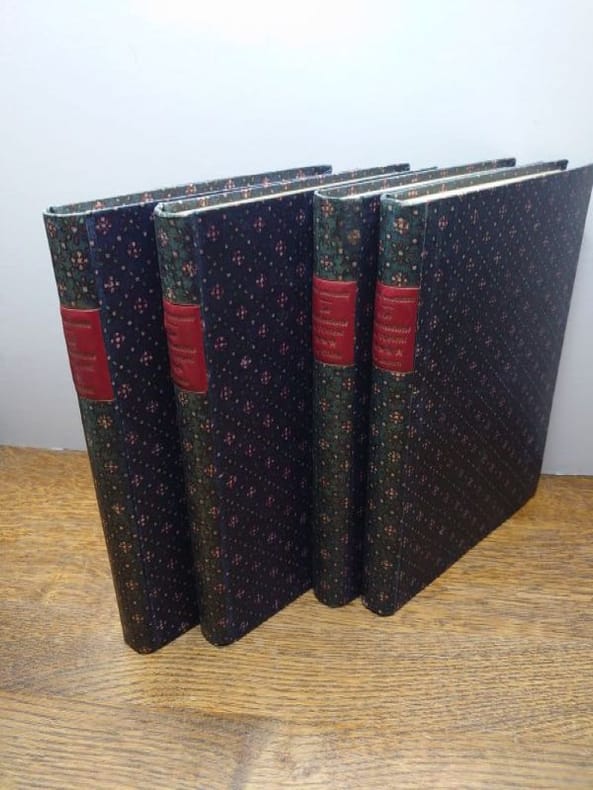
8467Paris, les Éditions Crès & Cie, 1929. 24 x 17 cm, 362, 370, 360 et 319 pp. Quatre volumes reliures bradel plein papier, dos lisses, pièces de titre, couvertures conservées. Bons exemplaires, nombreuses illustrations. Provenance : ex-libris de M. Polain, chargé d'affaires de Belgique à Bangkok, contrecollé sur le contre plat du premier volume.
8467Paris, les Éditions Crès & Cie, 1929. 24 x 17 cm, 362, 370, 360 et 319 pp. Quatre volumes reliures bradel plein papier, dos lisses, pièces de titre, couvertures conservées. Bons exemplaires, nombreuses illustrations. Provenance : ex-libris de M. Polain, chargé d'affaires de Belgique à Bangkok, contrecollé sur le contre plat du premier volume.
1887PHO-2296Paris, Édition Librairie de Firmin-Didot et Cie, 1887. In-4 (29x 20 cm), VII-743 pages, relié demi chagrin et coins, dos à faux nerfs avec auteur et titre, tête dorée, petits frottements, légères rousseurs. Illustré de 350 gravures et héliogravures, 7 chromolithographies et 2 cartes d'après les photographies, aquarelles et documents de l'auteur. Contient les milieux, géographie, les races, histoire de l'Inde, évolution des civilisations de l'Inde, œuvres, Inde moderne, croyances, institution, mœurs et coutumes, administration
In 8°, brossura editoriale, pp. 287, (5); copia molto buona. (ZD5/A) (ZD5/A)
30554P., L'Originel (Collection "Le Corps Conscient"), 1987, in 8° broché, 190pp. ; illustrations ; couvetrure illustrée en couleurs.
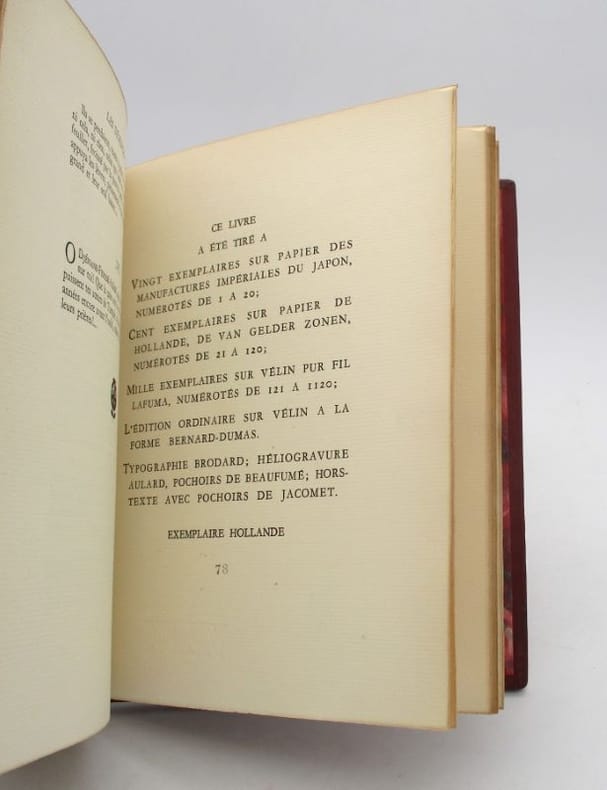
in-8, 347 pages, broche, couverture illustree rempliée.— 1 des 1000 exemplaires s./vélin Allura. Très bel exemplaire, très frais (manque la page de titre). [TX-14] Tres belles illustrations pleine page en couleurs.
35503080, Paris, Ancienne maison Quentin, 1895; in-12° broché, 86 pp. Un des 15 sur chine.
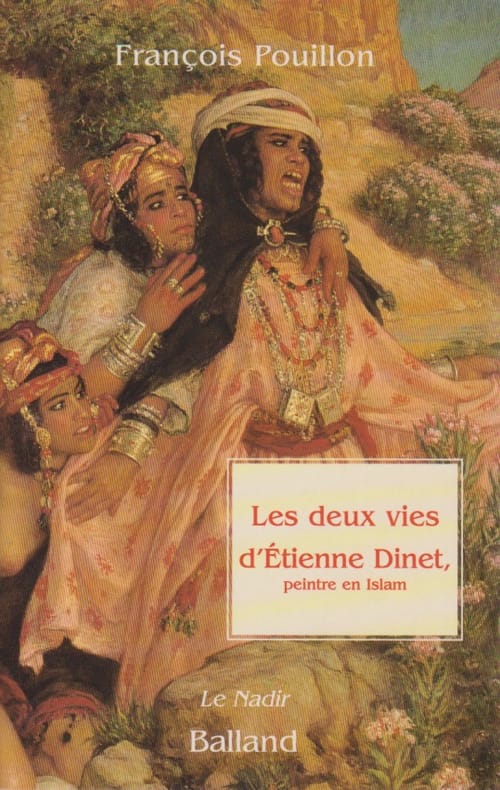
67599Balland, Le Nadir, 1997, 312 pp., broché, très bon état.
18508Paris, Calmann-Lévy, 1937. In-8, 311pp., chagrin rouge, filets dorés sur les plats, dos à nerfs orné de filets dorés, tête dorée, couverture conservée (quelques petites épidermures).
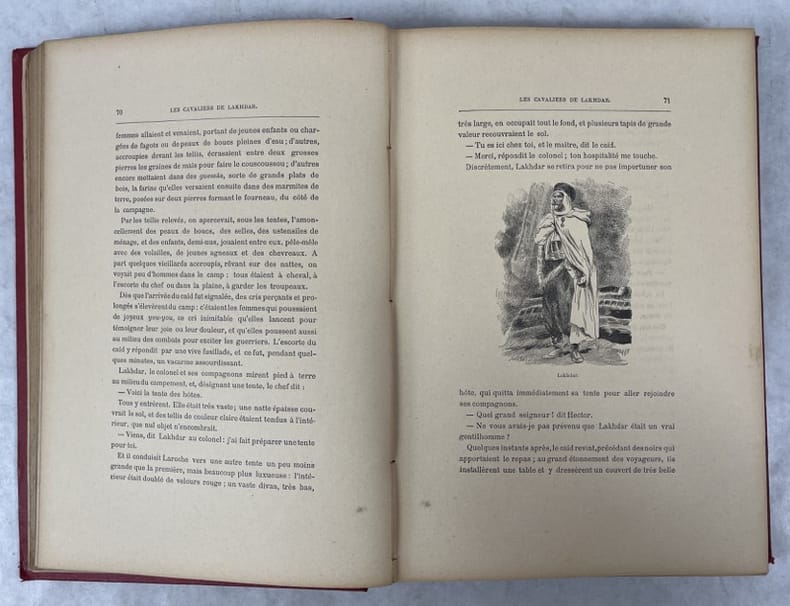
1936ZNF-167llustré par A.Calbet, Calmann-Lévy, 1936. Reliure éditeur cuir rouge à coins, couvertures et dos conservés.