Spenser, EdmundBiblio.com
1 644 résultats
1357991983.Ghardcover. Good. Access codes and supplements are not guaranteed with used items. May be an ex-library book. hardcover
101833971X.Ghardcover. Good. Access codes and supplements are not guaranteed with used items. May be an ex-library book. hardcover
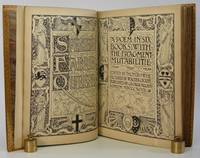
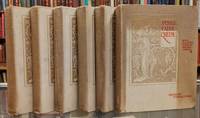
1897206378London: George Allen 1897. Rear cover of the final volume detached hinges tender; some surface scratches; spines faded a shade. A very handsome set. Six volumes. 4tos; lxxxvii 1-248 18 viii 251-527 13 viii 529-805 13 viii 807-1044 12 viii 1045-1274 16 viii 1277-1546 24; full polished tree calf gilt with exquisitely tooled spines with red and tan leather labels marbled endpapers; t.e.g. One of 1000 unnumbered copies on handmade paper printed by Charles Whittingham & Co. at the Chiswick Press this copy has been beautifully bound in the Riviere style by H.S. Nichols. One of the high-water marks of Art & Crafts book design this was Walter Crane's last major commission and one of his most fully executed and highly prized publications featuring 88 full-page illustrations along with head and tailpieces devices and initials throughout. The set was issued in parts between 1894 and 1897 and the original title pages and publisher's devices are bound in at the rear of each volume of this set. n.b. this is a heavy multi-volume set and will require additional shipping charges. George Allen unknown
19722083002115601703Oxford University Press 1972. Soft Cover. Fine. Number of pages: 519p Oxford University Press paperback
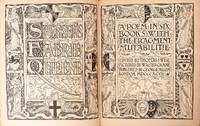
06429London: Published by George Allen 1897. The Most Important Work Illustrated by Walter Crane<br /> One of 1000 Copies Printed on Handmade Paper<br /> <br /> CRANE Walter illustrator. SPENSER Edmund. Spenser's Faerie Queene. A Poem in Six Books with the Fragment Mutabilitie. Edited by Thomas J. Wise. Pictured by Walter Crane. London: Published by George Allen 1897.<br /> <br /> First edition illustrated by Walter Crane. One of 1000 copies printed on handmade paper out of a total edition of 1028 copies. Originally issued in nineteen parts with wrappers also designed by Crane. Six quarto volumes 10 11/16 x 8 5/8 inches; 272 x 220 mm. Double-page general title in Volume I seven title-pages Volume I dated 1894 Volumes II-III dated 1895 and Volumes IV-XI dated 1896 and eighty-eight full-page woodcut illustrations including one double-page. With 132 head- and tail-pieces numerous decorative initials and printer's and publisher's colophons. Printed by the Chiswick Press.<br /> <br /> Bound by Zaehnsdorf stamp-signed in gilt on the front turn-in in full dark green crushed morocco. Covers decoratively tooled in gilt to match the original cover design spines decoratively tooled and lettered in gilt in compartments gilt board edges and turn-ins green watered silk doublures and liners top edge gilt others uncut. Zaehnsdorf exhibition stamp in gilt on rear doublure. Original pink printed wrappers bound in. Spines uniformly faded otherwise a fine set.<br /> <br /> "The most important work in the whole long list of books illustrated by Walter Crane. If Crane's claim to greatness were based entirely on this work he would still retain his position in the front rank of nineteenth-century artists. The wealth of ideas and forms real and fantastic which are embodied in the actual illustrations and even more in the marvellous decorative border designs is almost incredible! Besides the numberless presentments of the human figure in all its manly vigour and womanly grace the whole range of nature's forms of animal and plant life of fabulous mythological inventions of allegorical personifications are worked into decorative designs of exquisite beauty. It would be petty nay foolish to try to find fault with certain very obvious shortcomings as regards anatomical drawing in a work which does not only stand unique as pure decoration but speaks of an amount of knowledge and a wealth of imagination that command unrestricted admiration and respect" Konody p. 71.<br /> <br /> Ashley V p. 196. Engen Crane p. 102. Massé pp. 47-48. London: Published by George Allen, 1897 unknown
1897102598George Allen 1897. Hardcover. Very good/No jacket. Walter Crane. The original 19 parts published between 1894 through 1896 with illustrations by Walter Crane bound into six volumes with the original wraps. Limited to 1000 copies. Bound in white cloth covers are darkened in places with a couple water stained on the spine though no damage seen on the text block. George Allen hardcover
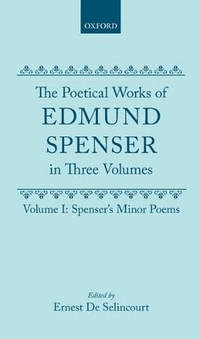
A9780198118237Hardback. New. A scholarly edition of poems by Edmund Spenser. The edition presents an authoritative text together with an introduction commentary notes and scholarly apparatus. hardcover
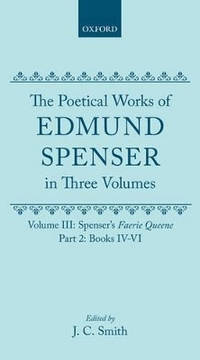
A9780199679706Hardback. New. A scholarly edition of The Faerie Queene by Edmund Spenser. The edition presents an authoritative text together with an introduction commentary notes and scholarly apparatus. hardcover
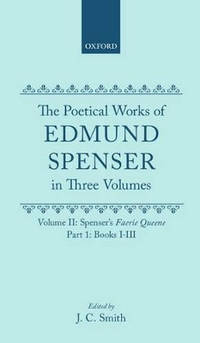
A9780199679690Hardback. New. A scholarly edition of The Faerie Queene by Edmund Spenser. The edition presents an authoritative text together with an introduction commentary notes and scholarly apparatus. hardcover
0267597312.Ghardcover. Good. Access codes and supplements are not guaranteed with used items. May be an ex-library book. hardcover
0282047662.Gpaperback. Good. Access codes and supplements are not guaranteed with used items. May be an ex-library book. paperback
0282575421.Gpaperback. Good. Access codes and supplements are not guaranteed with used items. May be an ex-library book. paperback
0365456454.Ghardcover. Good. Access codes and supplements are not guaranteed with used items. May be an ex-library book. hardcover
0656199156.Ghardcover. Good. Access codes and supplements are not guaranteed with used items. May be an ex-library book. hardcover
0666597936.Ghardcover. Good. Access codes and supplements are not guaranteed with used items. May be an ex-library book. hardcover
1334380678.Gpaperback. Good. Access codes and supplements are not guaranteed with used items. May be an ex-library book. paperback
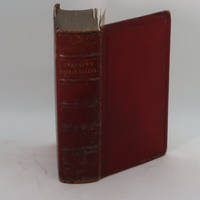
1859FB197 /Str shlf<p>Red leather binding with gilt lettering and raised banding on the spine. All edges gilt.</p><p>This book also has "Epithalamion" added. <strong><em>The Faery Queene</em></strong> is an English epic poem by Edmund Spenser. Books I–III were first published in 1590 then republished in 1596 together with books IV–VI. <em>The Faerie Queene</em> is notable for its form: at over 36000 lines and over 4000 stanzas it is one of the longest poems in the English language; it is also the work in which Spenser invented the verse form known as the Spenserian stanza. On a literal level the poem follows several knights as a means to examine different virtues and though the text is primarily an allegorical work it can be read on several levels of allegory including as praise or later criticism of Queen Elizabeth I. In Spenser's "Letter of the Authors" he states that the entire epic poem is "cloudily enwrapped in Allegorical devices" and that the aim of publishing <em>The Faerie Queene</em> was to "fashion a gentleman or noble person in virtuous and gentle discipline". Spenser presented the first three books of <em>The Faerie Queene</em> to Elizabeth I in 1589 probably sponsored by Sir Walter Raleigh. The poem was a clear effort to gain court favour and as a reward Elizabeth granted Spenser a pension for life amounting to £50 a year though there is no further evidence that Elizabeth I ever read any of the poem. This royal patronage elevated the poem to a level of success that made it Spenser's defining work. <strong>Edmund Spenser</strong> 1552/1553 – 13 January 1599 was an English poet best known for <em>The Faerie Queene</em> an epic poem and fantastical allegory celebrating the Tudor dynasty and Elizabeth I. He is recognized as one of the premier craftsmen of nascent Modern English verse and is often considered one of the greatest poets in the English language. Though Spenser was well-read in classical literature scholars have noted that his poetry does not rehash tradition but rather is distinctly his. This individuality may have resulted to some extent from a lack of comprehension of the classics. Spenser strove to emulate such ancient Roman poets as Virgil and Ovid whom he studied during his schooling but many of his best-known works are notably divergent from those of his predecessors. The language of his poetry is purposely archaic reminiscent of earlier works such as <em>The Canterbury Tales</em> of Geoffrey Chaucer and <em>Il Canzoniere</em> of Francesco Petrarca whom Spenser greatly admired. An Anglican and a devotee of the Protestant Queen Elizabeth Spenser was particularly offended by the anti-Elizabethan propaganda that some Catholics circulated. Like most Protestants near the time of the Reformation Spenser saw a Catholic church full of corruption and he determined that it was not only the wrong religion but the anti-religion. This sentiment is an important backdrop for the battles of <em>The Faerie Queene</em>. Spenser was called "the Poet's Poet" by Charles Lamb and was admired by John Milton William Blake William Wordsworth John Keats Lord Byron Alfred Tennyson and others. Among his contemporaries Walter Raleigh wrote a commendatory poem to <em>The Faerie Queene</em> in 1590 in which he claims to admire and value Spenser's work more so than any other in the English language. John Milton in his <em>Areopagitica</em> mentions "our sage and serious poet Spenser whom I dare be known to think a better teacher than Scotus or Aquinas". In the eighteenth century Alexander Pope compared Spenser to "a mistress whose faults we see but love her with them all."</p> Routedge Warnes. hardcover
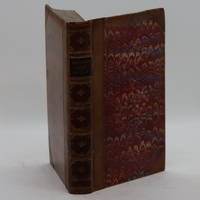
1868FB940 /str shlf<p>Tan calf binding with red and blue marbled boards. Black title plate with gilt lettering banding and decoration on the spine. From the Chandos Classics Library published circa 1868<strong>.</strong></p><p><strong><em>The Faery Queene</em></strong> is an English epic poem by Edmund Spenser. Books I–III were first published in 1590 then republished in 1596 together with books IV–VI. <em>The Faerie Queene</em> is notable for its form: at over 36000 lines and over 4000 stanzas it is one of the longest poems in the English language; it is also the work in which Spenser invented the verse form known as the Spenserian stanza. On a literal level the poem follows several knights as a means to examine different virtues and though the text is primarily an allegorical work it can be read on several levels of allegory including as praise or later criticism of Queen Elizabeth I. In Spenser's "Letter of the Authors" he states that the entire epic poem is "cloudily enwrapped in Allegorical devices" and that the aim of publishing <em>The Faerie Queene</em> was to "fashion a gentleman or noble person in virtuous and gentle discipline". Spenser presented the first three books of <em>The Faerie Queene</em> to Elizabeth I in 1589 probably sponsored by Sir Walter Raleigh. The poem was a clear effort to gain court favour and as a reward Elizabeth granted Spenser a pension for life amounting to £50 a year though there is no further evidence that Elizabeth I ever read any of the poem. This royal patronage elevated the poem to a level of success that made it Spenser's defining work.</p><p><strong>Edmund Spenser</strong> 1552/1553 – 13 January 1599 was an English poet best known for <em>The Faerie Queene</em> an epic poem and fantastical allegory celebrating the Tudor dynasty and Elizabeth I. He is recognized as one of the premier craftsmen of nascent Modern English verse and is often considered one of the greatest poets in the English language. Though Spenser was well-read in classical literature scholars have noted that his poetry does not rehash tradition but rather is distinctly his. This individuality may have resulted to some extent from a lack of comprehension of the classics. Spenser strove to emulate such ancient Roman poets as Virgil and Ovid whom he studied during his schooling but many of his best-known works are notably divergent from those of his predecessors. The language of his poetry is purposely archaic reminiscent of earlier works such as <em>The Canterbury Tales</em> of Geoffrey Chaucer and <em>Il Canzoniere</em> of Francesco Petrarca whom Spenser greatly admired. An Anglican and a devotee of the Protestant Queen Elizabeth Spenser was particularly offended by the anti-Elizabethan propaganda that some Catholics circulated. Like most Protestants near the time of the Reformation Spenser saw a Catholic church full of corruption and he determined that it was not only the wrong religion but the anti-religion. This sentiment is an important backdrop for the battles of <em>The Faerie Queene</em>. Spenser was called "the Poet's Poet" by Charles Lamb and was admired by John Milton William Blake William Wordsworth John Keats Lord Byron Alfred Tennyson and others. Among his contemporaries Walter Raleigh wrote a commendatory poem to <em>The Faerie Queene</em> in 1590 in which he claims to admire and value Spenser's work more so than any other in the English language. John Milton in his <em>Areopagitica</em> mentions "our sage and serious poet Spenser whom I dare be known to think a better teacher than Scotus or Aquinas". In the eighteenth century Alexander Pope compared Spenser to "a mistress whose faults we see but love her with them all."</p> Frederick Warne & Co. hardcover
0365301620.Ghardcover. Good. Access codes and supplements are not guaranteed with used items. May be an ex-library book. hardcover
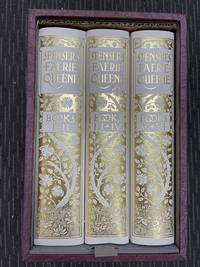
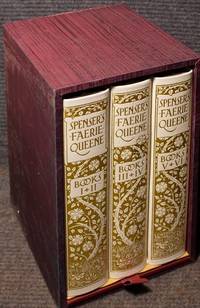
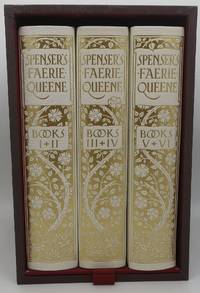
6007gLondon: The Folio Society. As New. Hardcover. 2011. Collectors set - 6 volumes bound in 3 in wooden slipcase with sliding tray. no 884 of 1000 copies.<br><p>Profusely illustrated with 88 large illustrations and 135 illustrative head a nd tailpieces</p> . The Folio Society hardcover
40611London: The Folio Society. Fine with no dust jacket. 2011. First thus. Goatskin. Inventory Box; Drawings; quarto; Folio Society. Poem in six books; with the Fragment Mutabilitie edited by Thomas J. Wise pictured by Walter Crane 3 volumes facsimile edition 2011 reproduced from the 1897 George Allen edition numerous black & white illustrations many full-page top edge gilt original cream morocco goatskin gilt-stamped pictorial designs to front covers and spines contained together in original cloth-covered slipcase 4to. Bslipcase is covered in a sating cloth which chages colors according to the angle of the light. Books rest on a sliding panel with a pull out ribbon at their bottom. Case is as new with cloth crackling by design. Appearance is as new except for minor wear to sllp case back edge. 406/1000 . The Folio Society unknown
003849EGLondon: THE FOLIO SOCIETY 2011. Limited Edition. HARDCOVER. Fine. A FINE THREE VOLUME SET IN A FINE WOOD BOX COVERED IN SILK. LIMITED EDITION NUMBER 651/1000 Copies. Bound in full Nigerian goatskin based on Walter Crane's original edition. Tope edge gold gilt. Set is essentially as new. No flaws. No signatures no bookplates. A very large and heavy volume weighing over twenty pounds. Extra shipping required. No oversea orders. THE FOLIO SOCIETY unknown
19721961436Oxford University Press Clarendon 1972. Hardcover. Used-Very Good. Cloth dj. Two volume set. V.1: books 1-3; V.2: Books 4-7. First published 1909 here reprinted from sheets of the first impression. Prev. owner's bookplates; dust jackets price-clipped; modest sunning to jacket spines. A very sound set with no underlining or other internal flaws. Oxford University Press (Clarendon) hardcover
0266504043.Ghardcover. Good. Access codes and supplements are not guaranteed with used items. May be an ex-library book. hardcover
A9781344738866Hardback. New. hardcover